Scientists don’t think Covid mutations have yet presented us with “immune escape”

Whilst working on tweaks to their vaccines, Pfizer and Oxford scientists don’t think the new Covid mutations have yet presented us with an “immune escape” problem.

Interesting observations from the experience and evidence from Mers and Birdflu vaccines were presented in a Sunday Times article.

Extract from Ben Spencer, Science Editor www.thetimes.co.uk

Towards a second-generation vaccine

Pfizer is working on the prototype of a tweaked vaccine to see off this threat [from covid mutations]. In Oxford, Professor Sarah Gilbert, principal investigator of the group that developed the AstraZeneca vaccine, is also developing a new formulation.

Her team is confident that a modified version will be ready by the autumn — an incredible feat in normal times. For many, however, even that is not fast enough. “We are getting a lot of hate mail from people saying, ‘Why are you going to take so long to make a new vaccine?’” Gilbert said.

Neither Gilbert nor Dormitzer (Philip Dormitzer, the chief scientific officer of Pfizer’s viral vaccines divisioni) is convinced that an adjusted vaccine is necessary. Studies suggest that the South African B.1.351 variant, in particular, reduces the ability of vaccines to ward off mild disease. But there are indications that they still provide enough immunity to prevent hospitalisation and death, the main task of the vaccines.

Pfizer and Oxford are working on prototypes of tweaked vaccines in case these are needed later in the year. The Oxford team has started sequencing the genetic code of several mutated spike proteins, which will be inserted into cells to create a seed stock. “From that master virus seed stock all the batches can be created,” Gilbert said.

Dormitzer is working on a similar process. “I don’t think we are seeing immune escape quite yet — but we may see a strain in the future that does,” he said. “We must be prepared for the worst because the consequences of not doing so are too great. So that is what we are doing. And the best way is to make a small batch and take it to the point of a clinical trial.”

Boosters

Boris Johnson told the Commons last week that people were “going to have to get used to the idea” of vaccinating and revaccinating. Repeated boosters might be needed for two reasons. The first is to provide a top-up, perhaps every year or two, if immunity wanes. The second is to deal with variants. If a virus changes year to year, vaccines need to keep up. That is the case with flu, which mutates far more quickly than any coronavirus.

In fact scientists are confident that boosters will not be needed — for either reason. A third dose may well be required this year to cope with the new strains, and is likely to be given to elderly and vulnerable people in the autumn. But Dormitzer said that a third dose of the same strain could provide enough immunity to get around even a particularly troublesome new strain after that.

Before he joined Pfizer, he led the viral vaccines team at Novartis and spent several years developing immunisations against pandemic influenza. There he learnt that the spacing of doses can help produce lasting immunity.

Vaccines against H5N1 bird flu, which spread throughout the world from 2005, generated an extraordinary immune response if two doses were given a few weeks apart, followed by a third some months later. The result was immunity against five strains of the virus.

“It gave not only very strong immunity but very broad immunity,” Dormitzer said. “You didn’t have to change the strain and the response you got was terrific. Now, that doesn’t mean that would be true for Sars-Cov-2. We have to test that hypothesis.”

Gilbert, too, is confident of the staying power of immunity. She points to a study her team did on Mers, another coronavirus, in which a single vaccine provided stable protection. They found that antibody and T-cell levels dropped for the first six months, then hit a plateau. “And then it just stays at that level,” she said. “They didn’t really change after a year — and that’s just with one vaccination. So I would predict that having given two vaccinations 12 weeks apart, it will look even better. The plateau will be at a higher level.”

A childhood vaccination programme?

The possibility of stable immunity offers a tantalising prospect for Dormitzer. “If we have very long-lasting immunity then the question is, could this become a childhood or infant vaccine?” he said.

It could mean children are vaccinated early and protected for much of their lives. Anyone exposed to the virus as an adult may suffer a mild illness — but that would merely serve to boost immunity. “If they get infected, it won’t be very serious — it will just be a sniffle,” Gilbert said.

As people age, and the consequences of infection become more serious, it might be necessary to vaccinate again, potentially more than once. The prize is lifelong freedom from fear of the virus and the restrictions and sacrifices that it once brought.

Pfizer and Oxford are taking the first steps towards such a programme. Both teams are set to begin trials of their vaccines on children this spring. Oxford is starting with teenagers and working down the age groups, while Pfizer is vaccinating children aged 5 to 11, having already vaccinated the 12-15 age group as part of the original adult trial.

Professor Adam Finn, deputy chairman of the joint committee on vaccination and immunisation, which advises the government, has said the results will come in by the autumn. In his view the Medicines and Healthcare Products Regulatory Agency is unlikely to demand a similar quantity of data to that required for the adult trials.

“We need to know we’re giving the right dose to younger children,” Finn told the BBC’s Today programme. “We need to know they’re safe — and that information needs to come in before we start using them. I think we will see vaccines being used in children later in the year.”

Further developments

Vaccine developers are also due to start trials among pregnant women. None of the existing vaccines is licensed for pregnancy, because mothers-to-be were not included in the initial trials.

Women who are at high risk from Covid-19, such as medical staff and those with certain health conditions, therefore face a difficult choice: take an unlicensed vaccine and risk harm to their baby, or face catching the virus, which could also harm the foetus.

Both Pfizer and Oxford have since their initial trials completed developmental and reproductive toxicity studies, which check whether the vaccines might affect the development of a baby in the womb. This means that the two companies have the all-clear to carry out clinical trials among pregnant women.

Pfizer is also working on trials to make its vaccine easier to distribute. At the moment storage at minus 70C necessitates a cold chain, which poses immense logistical challenges.

The Pfizer team has started work on a freeze-dried version, which could be stored in a normal fridge. If this lyophilisation process is successful, the powder version could be ready for distribution early next year — and many more people would be able to receive the vaccine.

“We’re looking to improve the storage and distribution conditions,” said Dormitzer. “I look forward to the day we don’t have to put our vaccines in dry ice,” he said. “But, for now, it is working.”
Devon’s Best Churchyard Competition 2021

This will be the fourth year that CPRE have held a competition to find Devon’s best Churchyard.

 Last year: All Saints’ Church, East Budleigh and Point in View Chapel, Exmouth were both Highly Commended.

Yesterday’s post on meadows turns out to be timely because churchyards are one of the places to find examples of long established “mini” meadows and meadow flora. 

Could your local churchyard be the best in Devon this year?

Devons Best Churchyard 2021 information

During the pandemic, Devon’s residents have appreciated the green spaces around their churches like never before and now we are inviting churches of all denominations to enter this year’s competition to find the ‘Best Churchyard’ in the whole of the county.

Following a year with little to celebrate, Devon CPRE applauds the volunteers helping to maintain and ‘green up’ Devon’s churchyards. During the challenging months of lockdown, many churchyards have become real sanctuaries for the local community – not just for church-goers. In some places, they’re the only public space to exercise and observe nature.

This is the fourth year we have held our churchyard awards and we’re hoping to receive more entries than ever by the end of March. The judges are not seeking the most pristine or manicured churchyards. They are looking for those which are well-managed to provide a peaceful haven for people and wildlife. Each entry is visited by the judges and assessed on a range of criteria, including the measures put in place to increase biodiversity.

Penny Mills, Director of Devon CPRE, says, “Devon has hundreds of beautiful churchyards and they’ve really come into their own during the challenging circumstances of 2020. Residents the length and breadth of Devon have appreciated their local churchyard like never before, so we want to really celebrate these special places in 2021 and celebrate the people who look after them – because they are all volunteers and they do a fantastic job.”

CPRE Devon trustee and fellow churchyard judge Ivan Buxton has been impressed by the standard of entries year on year: “We are particularly impressed by the careful management of these ancient burial grounds to create sanctuaries for the living. Measures to encourage wildlife and biodiversity have included bug hotels, mini-beast trails, ponds, bird boxes, composting areas, wildflower meadows and even gardens producing fruit, vegetables and herbs for parishioners to enjoy.”

Because of Covid-19 restrictions, last year’s competition had to be run differently to previous years. The judges waited until after Lockdown travel restrictions were lifted in the summer to begin their on-site inspections. There was no official prize-giving ceremony in 2020 but the Winner and Runner-up were presented with their trophies in person, in informal visits observing strict social distancing. This year’s competition will be conducted along similar lines.

Which Devon churchyards will make the shortlist in 2021? As well as the kudos of winning, there’s a top prize of £200 and a beautiful oak plaque, made in Devon from sustainable wood, to display to locals and visitors.

The deadline for entries is March 31st. Download the entry form and more information below.

Devons Best Churchyard 2021 information

churchyard entry form 2021

Honiton Town Council U-turn on grants for local groups

Left hand doesn’t know what right hand is doing in Honiton Town Council – are we surprised? – Owl

Hannah Corfield honiton.nub.news 

No further grants for this year will be awarded to local organisations in Honiton, despite the town council suggesting more money would be made available.

Since the January meeting – in which the grant application deadline was extended with the promise of more funding – council members have gone back on that agreement, stating that ‘unfortunately’ it is not possible to award further grants in 2020/21.

The reason for this change of heart is that the council must first ‘review this year’s reserves’, which won’t be known until the end of the financial year.

The decision was apparently made at the February full council meeting, although no mention of this outcome was recorded.

Honiton Town Council issued the following statement: “It was agreed back in January to grant £40,000 to local organisations for 2020/21, to support local organisations during a particularly challenging year.

“The council has agreed in excess of its £18,0000 budget.

“Grants were agreed on the basis that local organisations have experienced financial difficulties this year arising, not least, from Covid-19.

“At its meeting held on 8 February, the council decided that it unfortunately could not award further grants in 2020/21.

“This is because the council financial outturn 2020/21 will not be known until year end and reserves to be reviewed.”

While no further grants are to be awarded, Honiton Town Council has stated that it wishes to help local groups by other means.

Cllr Philip Carrigan said: “The council would like to continue to financially support local groups.

“There may be other sources of funding that the council (and perhaps others, e.g. East Devon District Council) can direct organisations to.

“The council will explore using other funding including S106 financial contributions, CIL payments and other council revenue budget.

“It is likely that the Council will open its grant bids for 2021/22 from April 2021, which would provide another opportunity for local organisations to secure council grant funding.”

An NHS shakeup could be revolutionary – but only if staffing levels are boosted too

So says Jeremy Hunt, Secretary of State for Health, later Secretary of State for Health and Social Care, from 2012 until 2018. On 3 June 2018, Hunt became the longest-serving Health Secretary in British political history. (The portfolio of social care in England was reinstated in January 2018).

Jeremy Hunt www.theguardian.com

The three biggest challenges facing the NHS are workforce shortages, a struggling social care system and persistent issues with safety and quality, the latter highlighted by the worrying Ockenden review into baby deaths in Shrewsbury and Telford. The shake-up announced by the health secretary, Matt Hancock, does not completely solve any of these issues. Some people are asking, reasonably enough, if it is therefore the right time for such an upheaval, not least with NHS staff exhausted by a pandemic that has lasted far longer than anyone expected.

At the heart of the new reforms is the abolition of clinical commissioning groups (CCGs) – unloved administrative bodies few have heard of, which have the legal responsibility to buy NHS care in every area. They are to be replaced by larger “integrated care systems”, which have an equally jargony name. But curiously this obscure-looking change should help to address all three of those big NHS challenges.

NHS staff feel frustrated they cannot deliver more joined-up care to the growing number of older, vulnerable patients who often have more than one thing wrong with them at the same time. If the new integrated care systems mean better links between hospitals, GPs and community care, staff will feel more motivated, because they can do a better job looking after patients, particularly if they can deliver more preventative care that keeps people out of hospital in the first place.

Social care reform is long overdue, and this bill does not give the social care system a 10-year plan like the NHS has. Nor does it stop families who are living with dementia losing their savings, or provide a penny of extra cash. But the new structures, unlike the CCGs, will sit along local authority boundaries and make it much easier for the NHS and social care systems to merge. Local authorities will have a seat on their boards, so single electronic health and care records will be much easier to set up. This will make a big difference to patients currently having to repeat their story to every new clinical team they see.

But it is on driving forward recent progress on the safety and quality of care that these reforms will really be judged. As health secretary, I introduced Ofsted-style rating of hospitals and other NHS organisations to stop another scandal such as Mid Staffs, and to change the culture of an NHS dominated by targets. By the time I left, 3 million more patients were being treated in good or outstanding hospitals. But how will patients know if their new local NHS system, supposed to be joining up hospitals, GPs and community care, is doing a good job? How will they know, for example, if cancer networks are being set up to speed up diagnosis – essential if we are to improve to French and German cancer survival rates?

With such a lot of taxpayers’ money at stake, it is essential the Care Quality Commission (CQC) is allowed to give the new bodies independent quality ratings, just as it now does for hospitals. Hancock indicated to me in parliament that he plans to do this, but we will need to scrutinise the details. The last thing the NHS needs is unaccountable local monopolies.

Nor should the risks of this new plan be underestimated. NHS restructuring rarely works out as intended, as I know from my own experience. We must avoid the jobs merry-go-round that happened last time, with managers accepting huge redundancy payments only to be re-employed a few months later. The politics, too, are risky, with Labour always tempted to turn any reforms into a secret privatisation conspiracy story. However, I would not expect that from the shadow health secretary, Jonathan Ashworth, given his strong track record of constructive opposition.

The biggest risk of all is that setting up new statutory bodies becomes an enormous distraction. That should be mitigated this time because the new bodies already exist in shadow form. But it will need an iron grip from ministers and NHS leaders over the next year to make sure the focus of all NHS managers remains on improving patient care rather than an administrative shuffling of deckchairs.

An NHS restructuring is a brave thing for Boris Johnson to do. But if we are to turn 2021 into a new “1948 moment” for the NHS, as significant for its future as the year it was founded, it is the right way forward, because you have to start by making the plumbing underneath the world’s fifth largest employer fit for purpose. In that context, it shows boldness and vision. But if it is to be as revolutionary as Hancock hopes, it will need to be accompanied by proper workforce reform to boost staffing levels and a long-term plan for social care.

  • Jeremy Hunt is the Conservative MP for South West Surrey

Seaside towns ‘at risk of losing their high streets for good due to Covid’

SEASIDE towns are at risk of losing their high streets for good due to the Covid pandemic, research reveals.

Natasha Clark www.thesun.co.uk 

They rely on travel, leisure and hospitality — which have all been hit badly by lockdown closures.

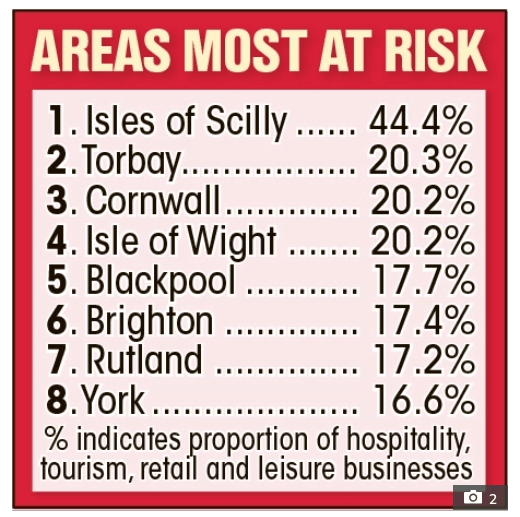
Analysis by the Labour Party highlighted 20 tourist destinations in England where high streets are in danger. Their list includes Blackpool, Brighton, Southend-on-Sea in Essex, Torbay in Devon, Dorset, Cornwall and the Isle of Wight.

The Isles of Scilly are deemed most at risk.

According to the research, 44 per cent of its businesses are linked to hotels and B&Bs, restaurants and pubs, clothing and book shops — which in normal times would prop up its economy.

Labour warned that cash reserves are drying up and debts are building as several government support schemes including furlough and extra grants are set to come to an end within weeks.

It wants the VAT cut to carry on to keep businesses going until firms can get back on their feet in the summer.

Revealed: Cummings’ role in handing Covid contract to firm run by ‘friends’

Dominic Cummings was instrumental in the process of awarding a government contract without tender to a company run by his “friends”, according to court documents that raise questions about whether the Cabinet Office may have misled the public.

David Conn www.theguardian.com

The documents reveal the central role the prime minister’s former chief adviser played in the awarding of the contract to Public First, a research company owned and run by two of his longstanding associates.

Public First was paid £564,393 to research the public’s understanding of the coronavirus and the government’s messaging around the pandemic, and one of its partners was seconded to work in Downing Street.

The company is run by James Frayne and Rachel Wolf, who are both former colleagues of Cummings and the Cabinet Office minister, Michael Gove. In 2019 Wolf co-wrote the Conservative party’s general election manifesto.

When the Guardian and openDemocracy first revealed in July last year that Public First had been awarded a contract without tender, the Cabinet Office said in a statement it was “nonsense” to suggest the owners’ long associations with Cummings and Gove were a factor in the decision to award it a contract.

However, in a witness statement submitted to the high court on Monday as part of a judicial review of the award, Cummings described himself as the “driving decision-maker” behind the government’s decision to conduct more focus groups and hire Public First, and said his faith in the company was based on his extensive experience working with its staff.

Cummings described Frayne and Wolf as his “friends”, but added: “Obviously I did not request Public First be brought in because they were my friends. I would never do such a thing.” He said he “requested” civil servants hire the firm because, in his experience, it was the only company with the expertise to carry out the required focus groups urgently.

“The fact that I knew the key Public First people well was a bonus, not a problem,” he said, “as in such a high pressure environment trust is very important, as well as technical competence.”

Cummings said he knew the quality of the company’s work and “I knew they would give us honest information unlike many companies in this sector”.

“I am a special adviser and as such I am not allowed to direct civil servants,” he added. “However, as a result of my suggestion I expected people to hire Public First. The nature of my role is that sometimes people take what I say as an instruction and that is a reasonable inference as people assume I am often speaking for the prime minister.”

Cummings said he had not met Frayne since 2016 and had no involvement in the contractual arrangements with Public First or the company’s remuneration.

The court documents included an email exchange between civil servants in the Cabinet Office in March, questioning the impartiality of Public First’s work. One said: “I know they’re not going to go away, but I have genuine concerns about the way in which they MIGHT be spinning stuff coming out of focus groups – way, way too close to No10 to be objective.”

Her colleague agreed, saying she was thinking of limiting the company’s work to testing opinion on Johnson’s messages, and having another company, Jigsaw, do focus groups with older and vulnerable audiences.

The head of insight and evaluation at the Cabinet Office and the prime minister’s office described Public First in internal communications as “mates” of Cummings and of Boris Johnson’s then head of communications, Lee Cain, “hence getting all our work with no contract”.

In a witness statement, the official said the email to colleagues was meant as a joke in an effort to ensure overdue invoices were paid to the company, and it “was not true” that Public First was given the work without a contract because of relationships with Cain and Cummings.

Jason Coppel QC, representing the Good Law Project, the not-for-profit campaign group that brought the judicial review, referred to another internal message from the head of insight and evaluation at the Cabinet Office. Sent in January, it related to a previous appointment of Public First for work unrelated to the pandemic. In that message, the official referred to Public First as “Tory party research agency tests Tory party narrative on public money”.

Coppel said that showed senior civil servants had “deep misgivings” about the contract. However, in her witness statement, the official pointed to the rest of her message, which said “but actually, it will be very interesting and very good”. She said her reference was “meant to be frivolous and lighthearted,” and she did not regard Public First as a “Tory party research agency”.

In its legal case, the Good Law Project argues that the Cabinet Office acted with “apparent bias”, given that the contract was directly awarded without competition, and Frayne and Wolf’s work with Gove and Cummings at different times over many years.

The Cabinet Office’s legal case makes a virtue of previous relationships with Public First, saying Cummings wanted Gabriel Milland, a Public First partner, to be seconded to Downing Street because he had worked with him previously “and had a high regard of his abilities, expertise and experience”.

The government argued that Gove’s and Cummings’ relationships with the Public First partners meant they knew the quality of their work, and denied it showed “bias” in appointing the company. “On the contrary, past professional connection simply enabled a better judgment to be reached about whether Public First were indeed the best/only suitable body to perform the services as needed,” its defence states.

The Public First contract was not put out to competitive tender under emergency regulations that waived normal procurement procedures owing to the pandemic.

Frayne has said Public First was “the obvious choice” to run the government focus groups, as it was “one of a tiny number of agencies that could meet this demand”, and was chosen due to its expertise and ability to work at unusually short notice. The company was already doing research for the government in February before it was asked to conduct more than 100 focus groups across the country relating to Covid-19, specialising in researching “hard to reach” communities.

There is no evidence to suggest that Gove was involved in the process to award the contract. The Cabinet Office, represented by Sir James Eadie QC, denied that there was bias or apparent bias in the contract award or on the part of Cummings, and said that other companies were not used because “they could not provide the requisite services”.

The department did not respond directly to a question about whether its statement to the Guardian in July misled the public. Asked at that time whether the fact Frayne and Wolf were “longstanding close associates” of Cummings and Gove had been “a factor” in the decision to award the contact, the Cabinet Office strongly rebuffed the suggestion.

“This is nonsense,” it said in its July statement. “Public First were contracted to undertake this work because of their wealth of experience in the area. We have a number of suppliers for work on government research, of which Public First is just one.”

The judge, Mrs Justice O’Farrell, will determine the judicial review case following the one-day hearing of both sides’ arguments.

Police not amused by Exmouth Mockingbird fans

Bird spotters who breached lockdown restrictions to catch a glimpse of a rare bird have been handed fines.

BBC News www.bbc.co.uk 

Northern mockingbird

The bird watchers travelled to see the rare Northern mockingbird in an Exmouth garden, image copyrightGetty Images

The Northern mockingbird, not often seen in the UK, was first spotted by Chris Biddle in his garden in Exmouth, Devon, on 6 February.

He tweeted about the sighting, prompting excitement among twitchers.

Five were fined for travelling to the town to photograph the bird after Devon and Cornwall Police were contacted on Saturday over the lockdown breaches.

In a statement, the force said: “It was reported that a number of individuals, suspected to have travelled from outside the area, were trying to photograph a rare bird which had been seen in a garden.”

The grey, long-tailed Northern mockingbird is known for its mimicking ability, and is found in southern Canada, across the US, Mexico and the Northern Caribbean.

It is not thought to have been seen in the UK since the 1980s.