Hancock under fire for claiming there was ‘never a PPE shortage’

Matt Hancock has faced outrage after claiming there was ‘never’ a national personal protective equipment (PPE) shortage during the pandemic.

Elisa Menendez metro.co.uk

The health secretary’s remarks were described by Labour as an ‘insult’ to frontline health and care workers who were forced to use ‘inadequate’ PPE, with some fashioning gowns out of bin bags.

His comments came amid questioning over a High Court ruling last week found he had broken the law over Covid-related contracts.

Mr Hancock told Sky News: ‘If I had my time again, absolutely I’d do exactly the same thing again. Exactly the same thing.

‘What I care about is making sure people have the protection they need. I care deeply about the staff of the NHS and the staff who work in social care and I care deeply that they have everything they need.

‘It was really tough but there wasn’t a national shortage at any point. There were difficulties in individual areas but there was never a national shortage.’

Hancock says he’d do ‘exactly the same thing again’ with PPE contracts

In further interviews today, he reiterated that ‘we were very close’ to a national shortage and it was difficult to deliver PPE ‘in the teeth of a national pandemic’.

However, he insisted it never got to that point as his team distributed supplies successfully – despite health and social care workers complaining of desperate shortages across the country which put their lives at risk.

Palliative care doctor, Rachel Clarke, called Mr Hancock’s remarks ‘categorically not true’.

Dr Clarke wrote on Twitter: ‘I say this as someone who *begged* local veterinary practices and schools for masks and visors.

‘Whose hospice nearly closed down through lack of PPE. This was happening up and down the country. It was horrendous.

‘The failures to provide PPE at the time were bad enough – but to lie about it now? Well that’s inexcusable.’

John Peek responded: ‘I’m a dentist and early in the pandemic, I gave visors and goggles to doctors who were working in A&E with totally inadequate PPE.’

Doctor Dominic Pimenta, chairman of charity the Healthcare Workers’ Foundation, said in a thread that the NHS ‘ran out of the correct PPE nearly instantly in many areas’.

He wrote: ‘Covid is airborne. Nearly 1000 U.K. healthcare workers have died as a consequence of inadequate PPE, one of the worst rates in the entire world.’

Rosena Allin-Khan MP, Labour’s shadow minister for mental health, said: ‘It is an insult to claim there was no shortage of PPE.

‘Many frontline workers had to ration protective equipment, putting themselves at risk.

‘Lots of it was inadequate and poorly fitting, and some NHS staff had to make gowns themselves from bin bags.

‘The fact is, it was a smash-and-grab for Tory donors and friends. And protecting workers who were putting themselves in harm’s way to look after people seems to have been an afterthought.’

Meanwhile, around 12 million masks being used in the NHS currently may not meet safety standards and have been withdrawn, reported the BBC.

Shadow Health Secretary Jonathan Ashworth said: ‘This is yet another example of ministers buying duff PPE that is inadequate for protecting our hardworking NHS staff. Ministers should apologise and ensure every penny for every piece of unusable PPE is recovered.’

The health secretary’s comments came amid questioning over last week’s High Court ruling over his department’s failure to publish details of coronavirus-related contracts on time.

He insisted the case, brought forward by the Good Law Project, was not over the ‘substance’ of the contracts but because they were published ‘on average around a couple of weeks late’.

Mr Hancock insisted legal cases about transparency returns were ‘completely second order’ to saving lives and that his officials had been working long hours to procure PPE instead.

As part of the Government’s transparency policy, No 10 is required to publish the procurement of any contracts for public goods or services worth more than £120,000 within 30 days.

The judge said there was ‘no dispute’ that in a ‘substantial number of cases’ Mr Hancock had ‘breached his legal obligation to publish contract award notices within 30 days’.

The billions spent by the UK government on fighting Covid need proper scrutiny

The point of Brexit, according to its champions, was to liberate Britain from intolerable EU rules. One of these was that government contracts should always go out to transparent competitive tender. This was supposed to aid efficiency and avert the endemic corruption of certain European states. One such state now appears to be Britain.

Simon Jenkins www.theguardian.com 

Last November the National Audit Office estimated that since the coronavirus pandemic began, Whitehall had given out £18bn in procurement contracts, largely for PPE supplies and test-and-trace services, including to firms with little or no record of such work. It turned out that the government also secretly set up a fast conduit – a so-called VIP lane – for contracts to people personally known to ministers, peers and MPs.

Unsurprisingly, this became a crony bonanza. Of the £18bn spent, the NAO has traced £10.5bn awarded directly without competition. About one in 10 bids to supply through the fast-track system were awarded contracts, against one in 100 from open tender bidders. Meanwhile, the procurement consultancy Tussell found that of £15bn in health department contracts to buy PPE by October, only £2.68bn of the contracts had been published.

The sums are staggering, as is the potential for waste. In August it was reported that 50m face masks unsuitable for the NHS cost the Treasury £155m: they came from a contract worth £252m with Ayanda Capital, a firm with a senior adviser who was also an adviser to the UK Board of Trade at the Department for International Trade. The NAO found multiple shortcomings with deals signed with Ayanda and Public First.

Last week we saw court documents showing Dominic Cummings’ central role in awarding a contract for Covid focus groups to Public First, “a research company owned and run by two of his longstanding associates”. The contract is the subject of a judicial review, in a case taken by the public interest group the Good Law Project.

On Friday, a high court judge ruled that Matt Hancock, the health secretary, acted unlawfully by not publishing details of multibillion-pound government Covid contracts. The case was also taken by the Good Law Project, which highlighted three PPE contracts: “A £252m contract for the supply of face masks with a finance company, Ayanda Capital; a £108m contract with Clandeboye Agencies, which had previously supplied only confectionery products, and PPE contracts worth £345m with a company trading as Pestfix.” It claims that the government has failed to publish such contracts in a timely manner, hampering scrutiny and transparency.

In his ruling, Mr Justice Chamberlain said: “The secretary of state spent vast quantities of public money on pandemic-related procurements during 2020. The public were entitled to see who this money was going to, what it was being spent on and how the relevant contracts were awarded.” He also criticised the minister for not simply admitting the breaches of the rules instead of spending £207,000 of public money defending them.

A familiar feature of emergencies is that governments feel entitled to take powers that would not be merited in normal times. Hancock certainly deserves sympathy for what has for him been a nightmare year. But we are seeing a web of connections involving others in the Tory establishment in the awarding of contracts: the much discussed “chumocracy”. Hancock’s attempts to excuse his lack of transparency as being “second order to saving lives” ring hollow.

Public sympathy relies on such emergency powers not being abused – as clearly is happening in these cases. At a time when billions in taxpayers’ money is being spent fighting disease and relieving hardship, breaking rules designed to avoid corruption can only diminish public sentiment and sympathy.

The government clearly hopes that its success with the Covid vaccination will wipe out memories of its failures in the early days of the pandemic. Yet it may be the case that its slapdash approach to PPE contracts has contributed to the raw fact that Britain has one of the highest Covid death rates in the world. When this emergency is over, the most searching of all inquiries will be needed: only this will ensure that a government all too happy to avail of emergency powers will actually bring them to an end.

Cost cap granted: “We will keep fighting” – Good Law Project

We are pleased to be able to tell you that the Court has granted a cost-capping order in our judicial review over the award of huge PPE contracts, without advertisement or competition, to Pestfix (a pest control company), Ayanda (an opaque private fund owned through a tax haven), and Clandeboye (a confectionery wholesaler).

goodlawproject.org 

After Government said it would cost an unbelievable £1million pounds to defend the case, we asked the Court to cap our exposure to Government’s legal costs at £100k. We are a small not-for-profit that relies on crowdfunding. After reviewing our fundraising efforts for the case so far and looking at what we have saved for a rainy day, this is the figure we could afford. 

Instead, the Court has granted a cost-capping order of £250k. It means that if we lose the case, we are liable to pay a quarter of a million pounds to Government, as well as needing to cover our own legal costs. Despite huge support from members of the public, generous individuals and organisations, we are still short.  

But we will not be bullied out by costs. This case, which we are bringing alongside EveryDoctor, is simply too important.

In awarding the cost-capping order, the Judge seemed to agree:

“All citizens are likely to have an interest in whether or not the procurement on the part of the government is done using good governance procedures and integrity. And therefore there is a real wider public interest that has been represented by the claimant group, which is a not-for-profit group, in bringing this challenge”

We will fight this case to its conclusion. The case will be heard in Court in May. If you are in a position to donate to the legal challenge, you can do so here:

https://www.crowdjustice.com/case/108million/

Topical Questions (yesterday)

Simon Jupp to Robert Jenrick The Secretary of State for Housing, Communities and Local Government.

If you want to work with EDDC, there’s no time like now to start! – Owl

www.theyworkforyou.com

Photo of Simon Jupp Simon Jupp Conservative, East Devon

Since I was elected, I have been speaking up for Exmouth and East Devon in Parliament, and working hard to secure support for our hospitality industry, Exeter airport and the mighty Exeter Chiefs. Exmouth continues to grow, and I want to work with East Devon District Council to help the town stay a great place to live and work. Could the Secretary of State provide an update on when the next round of funding to improve towns, transport and high streets will be made available?

Photo of Robert Jenrick Robert Jenrick The Secretary of State for Housing, Communities and Local Government

I very much enjoyed visiting East Devon during the general election campaign, and I look forward to seeing Exmouth’s application in due course. As I said then, Exmouth is exactly the sort of town that we want to benefit from the town regeneration funds that we have made available. I am pleased to tell my hon. Friend that we are driving forward our plans to boost town centre regeneration in every corner of the country. The levelling-up fund and the UK shared prosperity fund will build on the work of the future high streets fund and the towns fund, and the prospectuses for those will be published very soon. I hope East Devon District Council will work with him to grasp this opportunity and put in good proposals that we can consider carefully.

Order!….Unlock!

Boris Johnson Is Finally Being Cautious, But Has He Really Changed?

Extracts from Paul Waugh www.huffingtonpost.co.uk

“I won’t be buccaneering with people’s lives,” Boris Johnson said. Well, it’s taken 11 months, three Covid waves and more than 100,000 deaths, but he got there in the end. He won’t bucc it up this time, will he?…..

…..It may be that this famously unreflective PM has finally also looked into his own soul in recent weeks. Perhaps the most startling thing written about him last week was Fraser Nelson’s Telegraph column suggesting he has “started to blame himself” for delaying the first lockdown by a week: a decision that Imperial College London has claimed cost 21,000 lives. Whether he’s feeling guilty about locking down late this January too is an open question.

Yet while it will hearten many that Johnson has finally ditched his chaotic crisis management mode of governing, there lingers an unnerving thought: if even this optimism-biased prime minister has started to be cautious, the scientists’ warnings must be pretty worrying. And indeed, the Sage minutes and documents today confirmed just that.

The sheer precariousness of our current position, even with an amazing vaccine rollout, was laid bare in those Sage papers. Lifting restrictions by the end of April, as some Tory lockdown sceptics had demanded, would spark a huge new fourth wave of infections and risk doubling the death toll, they forecast.

Just as worrying were the minutes of the February 4 meeting that stated: “Relaxation of a significant number of restrictions over three months starting from the beginning of April could lead to hospital occupancy higher than the January peak whereas relaxation over nine months would result in a much smaller peak.” Relaxation over three months from April, doesn’t that sound like, er, the roadmap?

That same meeting also advised “an ‘adaptive management’ approach, responding to data, for example setting levels of infection or hospitalisation that would need to be reached before making changes”. “This makes it more likely that the epidemic can be kept under control,” it said. 

But the PM clearly felt that was a bit too sage of Sage because his roadmap lacks any such figures or numbers to measure progress. Instead, we got a series of tentative dates for each stage of unlockdown. So we didn’t get the data points, but we did get the dates. Which wasn’t really the soundbite promised.

Johnson was honest enough to stress to MPs that lifting lockdown will lead to more deaths, partly because even among those vaccinated there will be a “large minority” who remain insufficiently protected. Add in the uncertainty about the impact of the vaccines on stopping transmission and that looks even more candid.

Despite all the uncertainty, Johnson couldn’t at times hide his own desperation for certainty. In his Commons statement, he said he believed his roadmap was “a one way road to freedom”, that “will guide us cautiously but irreversibly” (he said the i-word three times). Yet when asked by SkyNews’ Sam Coates if he would resign if there was a fourth lockdown, the PM wriggled for some wriggle room, saying it was only his “intention” that this was a one-way roadmap.

He was similarly shifty when asked about financial support, even though his own plans would seem to imply that Rishi Sunak will next week have to announce furlough is extended through May and possibly until June 21, when hospitality firms can fully reopen and make a profit. Despite a small change to isolation support for parents of kids with Covid, there was nothing to match Jeremy Hunt’s call for an isolation salary replacement scheme.

There was even a hint of a throwback to our old friend “Whackamole” from some in government today, as we learned that new outbreaks of new variants could lead to local lockdowns. While there will be no return to tiers over the next few months (amid fears the dominant strain travels just too fast), there will be flexibility to crack down in some places.

In fact, I suspect it will be the lack of regional tiering that most triggers the next Tory rebellion. Notwithstanding recent drops, some regional admissions rates are stubbornly higher than others (the midlands are double the rates of London and the south east). If any of those five-week pauses produces data that suggests different outcomes for different areas, there could be trouble ahead. 

For now at least, the PM has a plan. Let’s see if he really has changed, and sticks to it.

“Jumping Jupp Flash” gets new adviser

Though Owl is always on hand to offer advice, our Simon has chosen a BBC Radio London presenter as his new “Head of Office”.

Let’s hope the advice he offers is to work for East Devon and with the District Council. We all remember that despite being chums with “Dave”, Hugo left no legacy of helping  East Devon.

Duncan Barkes moves on from BBC Radio London

radiotoday.co.uk 

BBC Radio London presenter Duncan Barkes has left radio in London after a ten year stint of broadcasting to the capital to become a political adviser.

Duncan joined Radio London in 2015 to present ‘London’s Late Night Radio Phone-In’ from LBC where he previously presented the late night and overnight shows since 2011.

Previous to this he hosted the overnight show on talkSPORT.

Since July 2020, he has been presenting the weekend early morning shows on Radio London which have also been broadcast on the BBC local radio network and on BBC 5 Live.

His other BBC work has included presenting ‘The Newsroom’ on the BBC World Service and also covering The Nolan Show on 5 Live.

He leaves the BBC to take up the role of head of office and adviser to East Devon MP and Member of the Transport Select Committee, Simon Jupp.

Commenting on his move, Duncan told RadioToday: “Whilst at Radio London I’ve covered two general elections, two terror attacks on the capital, the Grenfell Tower fire and the EU Referendum. I’ve also experienced some of the most challenging broadcasting of my radio career taking hundreds of calls from people affected by Covid-19.

“I am proud to say we took the audience figures of the late night slot to a record high and even broadcast our phone-in live from the back of a black cab.

“Prior to the BBC my LBC years were fantastic and I was chuffed to play a small part in the growth of the station. But it’s time for a change and I have a political itch that needs scratching. Once the pandemic restrictions have lifted, I am looking forward to spending time in the Exmouth constituency office enjoying the delights of East Devon along with some time in Westminster.”

Duncan will still be heard on the radio having recently joined Sussex DAB station V2 Radio to present a Sunday evening show and he also runs an online station called Unforgettable Radio.

Covid vaccines slash risk of infection, illness and death, UK studies find

This appears the most comprehensive report of the encouraging data emerging on the effectiveness of vaccination roll-out in the “real world”. – Owl

Clive Cookson and Anna Gross in London yesterday www.ft.com 

Vaccination against coronavirus provides high levels of protection against Covid-19 infection, illness and death, according to three UK studies released on Monday that provide scientific support for the government’s road map out of lockdown.

The first, carried out in Scotland, found that the Covid-19 vaccination campaign led to a “very substantial” drop in serious illness across all adult age groups. It is the clearest evidence yet that single doses of coronavirus jabs can significantly reduce the risk of hospitalisation, even among the elderly.

Two other studies released by Public Health England echo findings released last week by scientists in Israel where vaccination has been even faster than in the UK. PHE scientists reported that the BioNTech/Pfizer vaccine reduced the risk of infection by more than 70 per cent three weeks after the first jab, rising to 85 per cent after the second dose.

Despite the promising news, the government also released studies by modellers at Imperial College London and Warwick university that indicated that another 30,000 people could die in the UK from Covid-19 before the end of June, based on the current vaccination rate and speed of lockdown easing.

The vaccination research in Scotland, which has not yet been peer-reviewed, is particularly relevant to assessments of the Oxford/AstraZeneca vaccine, which had less clinical trial evidence about efficacy in the elderly than some other vaccines. This had led some European countries to recommend against administering it to those over 65.

Chart showing that Scottish data shows a single dose of Covid-19 vaccines offers very strong protection against hospitalisation, including among the elderly

According to the research, conducted by the universities of Edinburgh and Strathclyde and Public Health Scotland, the chance of hospitalisation from four to six weeks after vaccination was 85 per cent lower after receiving one shot of the BioNTech/Pfizer vaccine and 94 per cent lower after one shot of the Oxford/AstraZeneca vaccine. 

The scientists said their findings were applicable to other countries using the two vaccines but the data were not robust enough to compare the two jabs’ efficacy head to head.

Chart showing that English data shows strong vaccine efficacy among healthcare workers aged under 65, including after a single dose

The second PHE analysis, based on routine testing data in people aged over 80, found that one dose was 57 per cent effective against symptomatic Covid-19 disease from about three to four weeks after the first dose. Early results suggested the second dose in over-80s improved protection against symptomatic disease to more than 85 per cent.

The two PHE studies only had enough reliable data to assess the BioNTech/Pfizer jab, which dominated the early stages of the UK vaccination programme, said Mary Ramsay, PHE head of immunisation. “But the Oxford/AstraZeneca vaccine data are also showing signs of a good effect,” she added.

Chart showing that English data shows BioNTech/Pfizer vaccine offers good protection against infection among over-80s, especially after a second dose

The Scottish study looked at the health records of 5.4m people in Scotland, equivalent to 99 per cent of the population. About 1.14m of those people were vaccinated between December 8 and February 15.

“These are national data strongly demonstrating that the vaccines are providing a very substantial reduction in hospital admissions from day seven onwards,” said Prof Aziz Sheikh, director of the University of Edinburgh’s Usher Institute. “Overall we’re very very confident this is making a difference.”

There is international interest in the impact of the vaccination campaign in the UK, which was the first large country to begin vaccinating its population against Covid-19 with approved inoculations. The UK also unusually opted to extend the interval between doses from four to up to 12 weeks, in order to vaccinate more people with a single dose more quickly.

Sir Mene Pangalos, AstraZeneca’s head of research and development, said he was “extremely encouraged” to see the first evidence of the effectiveness of the vaccine in the “real world”, referring to the Scottish research.

“Comparable vaccine effects were seen across all age groups,” he said. “This data provides further evidence that the vaccine protects against severe Covid-19 outcomes, particularly in older populations who are at the highest risk.”

The PHE study of healthcare workers, called Siren, included 40,000 people who were tested for coronavirus every two weeks, whether or not they had symptoms, between December 7 and February 5. “We are showing a really strong effect in reducing infection,” said Susan Hopkins, PHE’s Covid-19 response director.

Ramsay said: “The BioNTech/Pfizer vaccine is stopping people from getting infected, while also protecting cases against hospitalisation and death. We should be very encouraged by these initial findings.”

Professor Arne Akbar, president of the British Society for Immunology, who was not involved in the research, commented: “Overall these new findings should provide reassurance around the UK’s decision to offer the two doses of the vaccine 12 weeks apart.”

But he added: “It is still the case that the highest and longest lasting protection from getting ill with Covid-19 will only be provided by getting two doses of the vaccine.”

Sir Patrick Vallance, UK chief scientific adviser, welcomed the findings about vaccination but warned that the backdrop to lifting restrictions remained difficult. “We are not starting all this, as of today, from a good position. We’re not now in a ‘let’s release everything’ [situation], we’re in a not-very-good position that is getting better,” he told a media briefing. 

The central message that emerged from all the scientific modelling that fed into government decision-making was to “start from a low baseline to try to get numbers down before you start releasing”, Vallance said. “Go slowly, go in blocks you can measure the effect after four or five weeks,” he added. 

Many epidemiologists expect infections to increase again as restrictions are eased, with R, the average number of people infected by an individual with the virus, rising above 1, and then dropping after more people are vaccinated.

Additional reporting by Sarah Neville

New threat to Judicial Review

Ominous communication from the Good Law Project

Tomorrow [Tuesday 23 Feb], the High Court will hear our application for a cost capping order in our judicial review of Government’s decision to award huge PPE contracts to questionable counterparties.

We have been forced to apply for the order, which would cap the costs of both sides, after Government revealed it planned to spend an eye-watering £1 million defending the case. If we lose, Good Law Project would be liable for these enormous costs. And Ayanda and Pestfix – the fortunate VIP lane recipients of vast contracts to supply PPE much of which we now know to be unusable – are also asking for huge and, we are advised, inflated sums in costs. We are a small not-for-profit, funded by donations from members of the public. We cannot bear this kind of existential risk. 

In an attempt to defend its costs bills, Government has stated that in the last ten years at least 126 judicial reviews have cost over £100k. This may be true. Yet they fail to explain that between 2010-2019, 10,692 judicial reviews were granted permission. In other words, judicial reviews that have cost over £100k represent a tiny fraction of all judicial reviews brought in this period. 

Notably, Government makes no attempt to explain how many judicial reviews have cost £1 million.

Nor do we know why its costs for the three procurement judicial reviews brought by Good Law Project for which we know the costs (two of which were one-day hearings) are for more than £200k, more than £500k, and £1 million.

But you might think it has something to do with the types of points we are making. Last Monday, our case against Michael Gove showed that Dominic Cummings awarded a lucrative public contract to those he admitted were his ‘friends’. Last Friday, the High Court ruled Government had acted unlawfully by failing to publish details of COVID-19 contracts. 

And our judicial review of PPE contracts has already generated an admission from Government that it purchased £155m worth of facemasks that can’t be used by the NHS, fuelled countless newspaper headlines in the UK and around the world, and prompted repeated scrutiny in the House of Commons. And it will get right to the heart of the highly troubling VIP lane largely populated by Ministerial contacts. And all of this before the case even reaches court.

Our litigation is exposing Government’s cronyism and failures to procure in the best interests of the British taxpayer. We want to continue. But we are a tiny organisation pitted against the resources of the state. Unless we are granted a cost capping order tomorrow we will not be able to. We will update you on the hearing and what that means for the PPE case in due course. 

Thank you, 

Jolyon Maugham QC

Director of Good Law Project

Fresh evidence prompts calls for probe into anti-Labour ‘dark money’ groups

The UK’s elections watchdog has been urged to investigate whether ‘non-party’ campaign groups collaborated to flood social media with anti-Labour attack ads.

Peter Geoghegan, 21 February 2021 www.opendemocracy.net

As openDemocracy recently revealed, a series of so-called ‘third-party’ campaign groups spent more than £700,000 attacking Jeremy Corbyn and Labour policies during the 2019 election campaign without declaring any of their donors.

Now new evidence has emerged raising questions about whether campaigners were working together behind the scenes.

Under British electoral law, campaigns are prohibited from joining forces to plan to get around legal spending limits.

A group run by Tory activist Jennifer Powers spent £65,000 on dozens of ads attacking Jeremy Corbyn and Labour on housing policy without declaring any donations.

Powers flatly denied collaborating with anyone else, telling the Daily Mirror she merely had an “amateur interest” in housing, and it was a “kitchen table” operation.

But emails obtained by openDemocracy and shared with the Daily Mirror reveal striking similarities with another campaign run by a former Boris Johnson aide.

The Fair Tax Campaign, founded by Alex Crowley, a former close aide of Boris Johnson, ran around 100 ads worth £63,105 across just two months leading up to the 2019 poll.

Emails sent to the Electoral Commission to formally register the groups were sent just a day apart in October 2019, and used almost identical language.

Both included the phrase: ”Having reviewed [my/our] budget I can confidently say that our campaign will comfortably exceed the spending threshold for registering a third party campaign…”

And added: “Given it would be reasonable and prudent to assume that a General Election is imminent, and therefore any issue campaigning will take place in the context of a live electoral contest….”

Screenshot 2021-02-21 at 15.53.57.png

Letter from Alex Crowley, Fair Tax Campaign, to Electoral Commission

Screenshot 2021-02-21 at 15.53.45.png

‘Near identical’ letter from Jennifer Powers to Electoral Commission

Asked about the similarities, Powers said: “Don’t remember them, never spoke to them.”

She added: “I did follow all the rules that are set out by the electoral commission.

“I just happen to have, I guess, an amateur interest in housing policy.”

Cowley said: “The Fair Tax Campaign complied with the strict rules set by the Electoral Commission, and Facebook’s advertising policies.”

Analysis of both campaigns’ websites revealed their privacy policies were more than 70% identical – but that the text appears on no other site online.

The website for Powers’s campaign has been taken offline but the site is still accessible on internet archives. Both Powers and Crowley’s campaigns stopped buying Facebook adverts immediately after the general election.

A former MP has written to the Electoral Commission calling on the watchdog to launch an inquiry, raising concerns about co-ordination between third-party campaign groups and the potential for US-style ‘Super PACs’ to anonymously fund British political campaigns.

In a letter to Electoral Commission chief Bob Posner, Unlock Democracy director Tom Brake wrote: “More than a dozen third-party campaigns that had spent heavily in the 2019 election reported that they had received no funding above the £7,500 threshold for declaring individual donations, and therefore did not have to supply details of any donor to the Electoral Commission.”

Brake, who lost his seat as a Liberal Democrat in the 2019 general election, added that “as a candidate in eight general elections who has had to fundraise for each of those elections, the sums raised (and then spent) by some of these groups in a very short period of time, without receiving a single donation above £7,500, is astounding.”

British electoral law has tight rules on coordination between political campaigns. Any coordinated campaigning must be declared as ‘joint working’ and campaigns involved have to declare their spending together.

In 2018, Dominic Cummings’s Vote Leave was found to have broken the law by failing to declare joint working during the Brexit referendum.

Mr Brake said the near-identical texts “could be a complete coincidence but I consider it would be in the public’s interest to seek to establish this.

“Particularly as joint-campaigning or coordination in other areas, over messaging for instance, needs to be accurately reported.”

In 2019 it was reported Crowley, who left Number 10 just a month before the election was called, had worked on a fake grassroots campaign pushing for a no-deal Brexit.

The Guardian reported Crowley had overseen the “Mainstream Network” Facebook campaign alongside employees of the lobbying firm run by Lynton Crosby, the Australian political strategist who helped run three Conservative general election campaigns.

In November 2019 one of the Fair Tax Campaign’s ads was banned by Facebook, after the campaign failed to properly declare it as a political message.

Planning applications validated by EDDC week for beginning 8 Feb

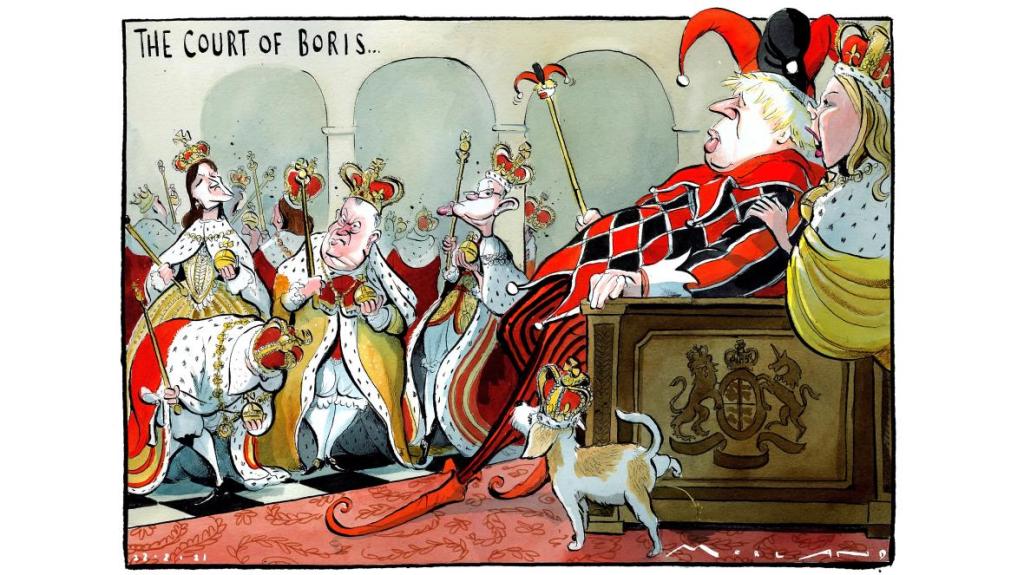
In the court of “King Henry”

The atmosphere in No 10 is becoming increasingly febrile as competing groups vie for Boris Johnson’s attention and patronage. Carrie Symonds’ allies get key roles. www.thetimes.co.uk

Morten Morland’s Times cartoon: February 22, 2021

New breed of local food halls in UK towns offer grub and a hub

Ideas for the post-Covid future – Owl

Food halls were springing up in town and city centres before the pandemic but now smaller community versions, with an extra dimension such as a cinema screen or co-working space, could be arriving on a high street near you.

Zoe Wood www.theguardian.com

There is potential for up to 120 of these community food halls across the UK, a new report has found, as big shifts in consumer spending and attitudes caused by the coronavirus pandemic – including a newfound appreciation of local community – prompt investors to consider piling in.

“These community hubs will give people pride in their town centres again,” said Thomas Rose, a co-founder of the real estate consultancy P-Three, of a new generation of food halls. “This move towards being a loyal supporter of your high street is not going to go away.

“We have spoken to a handful of private equity groups who are looking to invest in this type of concept because they see the consumer wants this,” Rose said. “Local authorities love the concept too.”

There are around 40 food halls in the UK, from flagship venues such as Seven Dials Market in central London to smaller ones in market towns.

Maba street food venue at the The Cutlery Works in Sheffield.

Maba street food venue at the The Cutlery Works in Sheffield. Photograph: Cutlery Works

While P-Three’s analysis also sees scope for a further 50 flagships to open in cities such as Glasgow, Birmingham and Bristol once the pandemic is over, the community model offers something for smaller catchments, hard hit by retail closures but where more money is now being spent.

A former Poundland store in Lewisham, south London, is now Catford Mews, where locals can eat or watch a film or comedy gig. Another example is Cutlery Works in Sheffield where a food hall now fills a former cutlery factory.

When Catford Mews opened in 2019, Preston Benson, the managing director of Really Local Group which is behind the venue, said locals’ jaws were “hitting the floor”.

“They were saying: ‘Oh my God I can’t believe there’s something like this where I live,’” said Benson. “Everyone deserves to have nice, convenient things where they live.”

The Catford Mews entertainment venue

Inside Catford Mews Photograph: Catford Mews

Really Local Group’s other projects include turning the site of a former Blockbuster shop on Sidcup high street in south-east London into Storyhouse, a complex with a cafe, cinema and library. “This is gonna be an all-singing, all-dancing community hub,” said Benson.

Urban regeneration has historically been retail-led, but with high streets battered by a crisis that has led to household names such as Topshop and Debenhams collapsing and online sales rocketing, no one thinks more shopping is the answer any more.

“The danger in real estate is that people are too often just trying to fill space,” said Rose, who says community food halls could provide alternative anchors. “We advise people to put the right tenants in the right buildings, to make sure it is sustainable.

“There will definitely be some stores which can be converted [into food halls] but a 1970s department store isn’t always the best building.”

In Darlington, County Durham, which lost two landmark stores from its main shopping thoroughfare when Marks & Spencer and House of Fraser closed, the historic indoor market is being overhauled to create a food hall, bar, events stage and temperate garden.

Despite the shadow of Covid-19, Dan Warne, a former managing director of Deliveroo, whose first venue Shelter Hall in Brighton opened in the summer, has raised significant new capital as investors recognise “clear trends in the market”.

“We’ve seen a huge increase in people wanting to support local and ensure the businesses they love survive,” said Warne. “Our food halls give an opportunity for small food businesses to expand without the usual risk of finding a premises.”

With more people regularly working from home, community food halls with an average size of around 12,500 square feet are “modest but effective” redevelopments, with the potential to draw sustainable visitor numbers in urban neighbourhoods or towns of more than 50,000 people, P-Three’s report found.

“The regular footfall and spend will act as a catalyst for local regeneration as well as adding value to neighbouring properties making the proposition particularly attractive to both private and public sector landowners and investors,” said Rose.

Sheffield’s Cutlery Works demonstrates the strength of the community model, as it has been a success despite being located in a place that is neither central nor affluent. “If food halls are based on location, location, location, we picked the worst one,” jokes the founder Matt Bigland of the area once inhabited by the city’s cutlery-makers.

The Boozehound craft beer bar at the Cutlery Works in Sheffield, a food hall placed in a former cutlery foundry and works.

The Boozehound craft beer bar at the Cutlery Works in Sheffield, a food hall placed in a former cutlery foundry and works. Photograph: Handout

But Sheffield people “love to champion independents”, says Bigland and instead of office workers and shoppers, Cutlery Works has built a regular clientele that runs the gamut from millennial hot-deskers to grandparents.

He thinks that after the pandemic “food halls are going to come back stronger than ever. I think people have a pent-up energy to get back out and be sociable.”

Coronavirus: Case rates in Devon and Cornwall

Here are the latest rates of cases of Covid-19 in Devon and Cornwall.

BBC News www.bbc.co.uk

The figures are the number of coronavirus cases per 100,000 people in the seven days up to and including 15 February, with the week before shown in brackets for comparison.

The breakdown of the figures by local authority area is:

  • Cornwall – 47 (down from 82.5)
  • Plymouth – 44.6 (down from 64.5)
  • Exeter – 73.8 (up from 37.3)
  • Mid Devon – 60.7 (down from 145.8)
  • East Devon – 63.6 (up from 58.8)
  • Torbay – 88.1 (down from 106.4)
  • Teignbridge – 47.7 (down from 78.3)
  • South Hams – 23 (down from 50.6)
  • West Devon – 19.7 (down from 37.6)
  • North Devon – 22.6 (down from 26.8)
  • Torridge – 14.6 (down from 16.1)

For comparison, the figure for England is 133.2

For a more detailed look at coronavirus where you live, use the BBC’s postcode checker: [see online article]

Better Education for Devon Event Will Listen to Public Views – Wednesday

A Devon education “listening” event will take place on Wednesday 24th February, organised by Cllr Su Aves (St Sidwells and St James) of Devon’s Children’s Scrutiny Committee with Hannah Packham, the National Education Union (NEU)’s Regional Secretary. The discussion will bring together Devon teachers, school staff, parents, students and everyone with an interest in education to focus on priorities and aspirations for the county, both during and after the COVID pandemic.

After brief introductions from the panel, participants will be asked to break out into smaller groups by area of interest to focus on their biggest concerns, and the questions they would like answered from Westminster policymakers. Topics will include primary, secondary, further education and universities, as well as Special Education Needs, and protecting the pre-school sector.

Cllr Su Aves says “We really want as many parents, teachers, governors and other residents to come so we can make sure the whole diversity of Devon educational experiences and ideas form part of our policy understanding. As well hoping to create opportunities for positive changes in Devon, we will be communicating the key findings to Shadow Secretary for Education, Kate Green, at a public event we are putting together for Wednesday 17th March.”

Event panellist Cllr Rob Hannaford (Exwick and St Thomas), who is Chair of the Children’s Scrutiny Committee, added, “COVID has flagged all kinds of issues for Devon, including major inequalities between different families’ home experiences, between schools, social development, and exam results. Teachers, parents and students have dealt heroically with home-schooling, in some cases under unimaginable strain. Our job in Children’s Scrutiny is to build awareness, shine a light on what’s working well and sort out what’s going wrong, and this is an opportunity for us to do more, in more parts of Devon.”

“Equal access to education, the broken assessment and accountability system, cuts and escalating workloads are ongoing priorities for the NEU,” says Hannah Packham, “After COVID-19 we also need reform of our assessment and exams systems to make them fit for the future.”

Devon residents are invited to register at the following link https://www.eventbrite.co.uk/e/138193964869 for the event, which will be hosted by Devon Labour.

Education secretary snubs Devon

Too busy feeding his Tarantula ro respond? – Owl

Daniel Clark, www.radioexe.co.uk 

Education secretary Gavin Williamson has failed to respond to Devon’s calls to him to encourage schools to capture the voice of children and young people and their responses to the Black Lives Matter movement.

Devon County Council in October voted for a motion to write to the secretary of state to encourage him to ensure that schools allow students to see themselves reflected and reflect on how they challenge persisting racist ideas.

But four months later, the council heard that Mr Williamson hadn’t responded to the letter, let alone enacted any of the requests made.

Cllr James McInnes, cabinet member for education, said that it was very disappointing that a response from the secretary of state has not been received, but regardless of this, in Devon they have moved forward the educational aspects that they can influence.

Cllr Claire Wright said: “Does the cabinet member think it is acceptable for ministers to ignore Devon County Council on such an important subject, and given that racist hate crime had increased and the minister has ignored the motion, will you continue to press for the answer on this issue?”

Cllr McInnes replied: “It is disappointing that a response from the secretary of state has not been received but regardless of this in Devon we have moved forward the educational aspects in line with the motion agreed at council. We have already contacted the department for a reply and a reminder, so it is important we do get a reply.

“But we need to look at what we are doing in Devon and we are being proactive and taking it seriously.

“In addition to the work already in place before the council meeting, education teams and schools have been developing their curriculum to challenge historic and persisting racist ideas & celebrate the diversity in Devon, increasing awareness and sensitivity to what racism looks like in Devon and how we can all challenge racism and ensuring that race equality policies are shared (and updated) regularly by schools, parents, children.

“We have also been appealing to school’s pragmatic motives and their principled motives and equipping all young people with an appropriate education, free from racist myths and to provide a safe and affirming educational experience for minority ethnic pupils.

“Additionally, we have eight bi-lingual support workers who have been incredibly active during the lockdown, supporting children and families and providing support in accessing the curriculum and even the school itself.”

In the letter sent to Gavin Williamson secretary of state for education, Cllr McInnes, on behalf of the council, had said: “The point of my letter is to ask you if the Government will also take action nationally and urge schools to capture the voice of children and young people and their responses to the Black Lives Matter movement, ensure that the school environment and curriculum allows all students to see themselves reflected and included and reflect on how they challenge historic and persisting racist ideas and how they celebrate diversity.

“My council believes these actions would certainly help to develop a more understanding and inclusive society that promotes racial equality for everyone.”

Councillor who successfully ended “sexist banter” in EDDC resigns

The article below describes how Cllr Kathy McLauchlan successfully obtained full council backing last October to end “sexist banter” and ditch a freeze on allowances for representatives on maternity leave. 

But various correspondents have drawn Owl’s attention to the EDDC web site which shows Independent Progressive Councillor McLauchlan, a specialist palliative care nurse, listed as a councillor until 17 February (i.e. indicating she must have just resigned). 

If this is the case, then Owl assumes a by-election will be held, possibly in May.

Kathy McLauchlan won the Whimple and Rockbeare ward comfortably in May 2019, taking it from the Conservatives (702 votes to 234). 

In the 2011 election Martin Gammell won the seat for the Lib Dems but it was retaken by the Conservatives in 2015. A by-election followed in 2017 and Martin came within 36 votes of re-taking it.

So not obviously a centre of deep Conservatism. Yet Whimple is the home of staunch Conservative Sarah Randall-Johnson (see this post and many others) who not only is County Councillor for Broadclyst but is also on the Whimple Parish Council.

Call to consign sexism on East Devon District Council to ‘dustbin of history’

Daniel Clark   25th October 2020 eastdevonnews.co.uk 

A call to end ‘sexist banter’ and ditch a freeze on allowances for representatives on maternity leave has been overwhelmingly backed by East Devon councillors. 

Members also backed swapping the term ‘chairman’ for ‘chair’ following a motion tabled by Whimple and Rockbeare representative Kathy McLauchlan.

Councillor McLauchlan, an Independent, wants to ‘end the sexist treatment of woman which was treated as banter’.

She said: “Sexism is commonplace and 38 per cent of councillors have received sexist comments in their own party.

“Sexism is viewed and tolerated as a part of political life, but this has to change and local government should be a safe and secure place for all.

“This is a chance to the right thing for current and prospective members of the council.”

Cllr McLauchlan added that government policy is to write in gender-neutral language and her motion also expressed disappointment that women make up just 30 per cent of members on East Devon District Council (EDDC).

The national average of 35 per cent.

She added: “Woman make up 51 per cent of the population so we have to make working as a councillor easier for them, and the lack of maternity support is a barrier and holds them back as a councillor.”

Exmouth Halsdon representative Cllr Paul Millar seconded the motion.

He added: “Why is it fair that a woman looking after a newborn should be removed from their position?

“As that is what the policy states, and it deserves to be thrown into the dustbin of history never to rear its ugly head again.

“The motion seeks to empower the role of women and younger women in local government, to encourage them to take up senior positions without the fear that starting a family will see them removed from the position, as wanting to start a family should never be a disadvantage.

“This, plus the clause in the code conduct about sexism, will be a safeguard against the minority with dinosaur-like tendencies.”

Cllr Eleanor Rylance said of using the term ‘chair’ instead of ‘chairman’: “It may seem a minor detail to those unaffected by it, but if you are a young girl and don’t see anyone like you or can relate to on a council, you will be put off applying.

“To continue addressing a role as chairman is putting people off applying and a step back before a step forward.

“It’s 2020, not 1970 – you don’t get away with casual sexism anymore.”

EDDC leader Cllr Paul Arnott said that ‘chairman’ alienates people who are sensitive to gender and diversity issues.

Conservative Group leader Cllr Andrew Moulding, who has sat on the authority for 33 years, told the meeting the term ‘chairman’ had long been used it will be difficult for him to change his ways.

“But change my ways I shall do, and I apologise if I forget to call a person by an inanimate object,” he added.

“It will be difficult for me and it will take some getting used to, but I will vote for it, and I am 100 per cent in favour of the matters around maternity, rebuking sexism, and encouraging more female councillors.”

Cllr Helen Parr said: “The most important parts of this are that we bring in proper maternity allowances and that as many women who want to stand are encouraged to and can do.

“It doesn’t matter to me if you call someone chair or chairman, but if people want this in the constitution, I am sure it will be agreed, but it is unimportant compared to the rest of the motion.”

The motion called for members to address the head of any committees, panels, forums or groups as ‘chair’ rather than ‘chairman’.

While EDDC has a policy for maternity pay for representatives without extended roles, its current allowances scheme does not extend to maternity pay for councillors with ‘special responsibilities’.

A report will now be formulated on how to adopt the Fawcett Society’s recommendation of having maternity pay for councillors with extended roles.

New clauses in the council’s code of conduct against sexism will also be introduced, as will a commitment to ensuring gender-neutral language is used.

The motion was supported by 43 votes to zero at a full meeting of EDDC on Wednesday, October 21 – with abstentions from Cllrs Peter Faithfull and Fred Caygill.

Essential reading for a wet weekend: National Model Design Code

The Government is “consulting” on important changes to the NPPF to incorporate ideas in the “Living with Beauty” report (see below) and on its ideas for design codes. If it sounds too good to be true, we all want good design don’t we, it probably is!

This comes from a Civic Voice newsletter which conveniently has links to all the documents. It emphasise to Owl the need for as many as possible to take EDDC’s consultation on the Local Plan – Options and Approaches seriously and respond to it. Closing date 15 March.

National Planning Policy Framework and National Model Design Code: consultation proposals

In response to the Building Better, Building Beautiful Commission report, the government has launched a consultation to seek views on draft revisions to the National Planning Policy Framework. The text has been revised to implement policy changes in response to the Building Better Building Beautiful Commission “Living with Beauty” report.

In response to the Building Better, Building Beautiful Commission report, the Government has announced:

• It will publish a draft national design code setting out clear parameters of good design and a simple process for local communities to define what buildings in their areas should look like
• Create an Office for Place within the next year which will pioneer design and beauty within the planning system
• Provide £4 million for the community-led housing fund, in addition to extra funding for successful areas under the heritage campaign
• Propose changes to the planning framework to place greater emphasis on beauty and placemaking

A number of other changes to the text of the Framework are also set out and explained in this consultation document, but at the time of sending this update, we do not believe that government is proposing a review of the National Planning Policy Framework in its entirety at this stage. A fuller review of the Framework is likely to be required in due course, depending on the implementation of the government’s proposals for wider reform of the planning system.

In addition to the NPPF consultation, the government has published a new National Model Design Code that outlines the design standards new developments are expected to meet. This provides a checklist that will guide local councils to create their own, unique, local design code.  This consultation is also seeking views on the draft National Model Design Code, which provides detailed guidance on the production of design codes, guides and policies to promote successful design.

Key items:

  • The press notice can be found here
  • The consultation can be found here
  • The draft National Model Design Code can be found here

The National Model Design Code guidance notes can be found here

Commenting on a planning application? Here’s some advice

A correspondent, interested in matters involving East Budleigh, sends this note of caution.

If you write a comment on a planning application to EDDC please, in your first sentence, say if your comment is neutral, in support or an objection.

Comments which are obviously objections have not included this and have been classified as “neutral”.

We’re not capable of making the medicines we require any more

But as we get ready to put out the bunting and pat ourselves on the back there is another truth: Britain now has no large-scale facilities manufacturing modern, complex medicines (apart from some producing vaccines).

www.independent.co.uk

We may lead the world in R&D, as the Covid vaccine triumph has proved, but when it comes to actually making medicines our standing is woeful. As a result, thousands of highly-skilled, well-paid manufacturing jobs have simply disappeared, along with factories that have now been given over to retail parks and housing estates.

I’ve been looking into this as the closure of another pharmaceutical plant has been announced, by GSK at Ulverston in Cumbria. There’s been a factory on the site since 1948. Eight years ago, the then prime minister, David Cameron and GSK chief Andrew Witty paid a joint visit and announced a £350m expansion with the creation of 1,000 new jobs. Cue much celebration. Forget the expansion. Now GSK, under a different chief, Dame Emma Walmsley, is scrapping the entire facility and pulling out altogether.

The pandemic has brought home to the government our dire weakness in this area. While Oxford scientists were racing to find a vaccine, Downing Street was being made all too aware of shortages in the supply of other medicines and equipment. They were being made elsewhere and other countries were holding back their stocks.

This prompted Johnson to launch an initiative across Whitehall, in May 2020, called “Project Defend” to shift our national security focus to include resilience in supply lines of essential non-foods. The goal is for the UK, post-pandemic, to be no longer dependant on imports of vital goods. As well as healthcare it’s also taking in other sectors, including the technology industry.

The progress of Project Defend, which is being run out of the Foreign Office, is shrouded in mystery – but put it this way, the campaign has not prevented GSK from shutting another base. Ulverston manufactures antibiotics and they have been sold to Sandoz. That company will transfer the making of those products to their location in Austria. This follows the announcement last year of a joint investment between Sandoz and the Austrian government of more than €150m to boost the long-term competitiveness of its antibiotic manufacturing site and to guarantee the long-term supply of antibiotics.

While Austria improves and strengthens, we’re reducing and growing weaker still. We’re not capable any more of making the medicines we require. The medical world is shifting towards monoclonal antibody therapies. To give some idea about their complexity: aspirin has 21 atoms in a molecule; growth hormone has 3,000 atoms; monoclonal antibody 25,000 atoms. The global biopharma market for these modern treatments is more than $300bn (£214bn) and growing at about 7 per cent a year. Where is the UK in this? Nowhere.

According to industry figures, at the last count in late October 2020, there were 1,700 biopharmaceutical manufacturing facilities in the world. These are the sites capable of producing modern medicines such as the much sought-after monoclonal antibodies. The US has 565, China 220, India 113, Germany 84, Japan 52, France 39, Ireland 23, and the UK nought. That’s right, zero.

This year is the first year when the UK is facing a balance of payments deficit on pharmaceuticals – 10 years ago it was one of the few industries that had a strong surplus. The shortfall is due to the lack of manufacturing – as brilliant and as headline-grabbing as it is, R&D does not help with the balance of payments.

It’s not only the lack of factories. We have now got half the number of people employed in pharmaceuticals than France, and only one-third compared to Germany. We just about compete in numbers employed with Switzerland and Spain. Again, not so long ago we were at the top of the tree and given the lack of investment this picture will only get worse.

Our expertise is being snapped up by foreign companies. A young chemical engineer graduating in the UK today really has no choice but to go overseas for a decent career. The US in particular, is awash with our best talent.

Successive UK governments have stood back and watched this happen. Our industry bodies, too – the record of the CBI in this area is lamentable. It’s a deplorable state of affairs.

Forget HS2 and tunnels across the Irish Sea – we’re talking about vital supplies. Do we really want to be reliant on the US, China, India, Germany and the rest? The pandemic has shown that when crisis hits, countries put the health of their citizens first. Other national and regional governments have made it their business to encourage enormous levels of investment. They are building and preparing; we’re closing and reducing. They will have the products they require; we will be hoping and pleading.