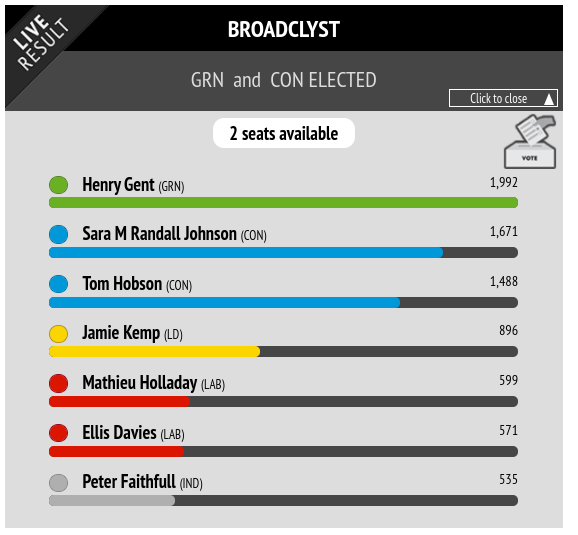
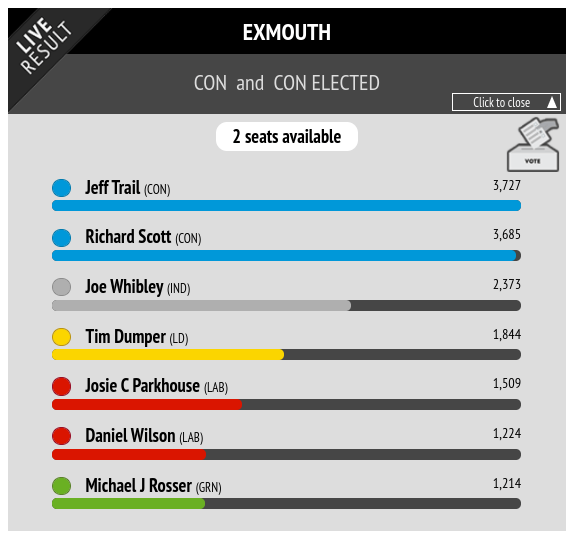
Divided we stand, divided we fail.

This is an interesting insight from Martin Shaw’s blog into the way our local democracy functions under the first past the post system. It shows how blind adherence to “old” national political allegiances and campaigning policies produces unintended, and counterproductive, consequences.

How Labour and the Lib Dems helped the Conservatives prevail in Seaton & Colyton, and across East Devon

seatonmatters.org

After the sorrow comes the anger. In Thursday’s Seaton & Colyton election, I lost by 145 votes. Labour polled 306 and the Lib Dems 160. If either, and certainly if both, had stood down I could well have beaten the Conservative, Marcus Hartnell. I needed only one-third of their combined vote to prevail.

Both parties knew the seat was highly marginal. Both assured me privately they hoped I won. Both had ‘paper’ candidates. They did not campaign. Both knew, however, that with their candidates on the ballot, some voters would back them and inevitably take votes away from me.

However both parties thought that the opportunity to get a miserable share of the vote – by any measure, both 5.9 per cent and 3.1 per cent of the electorate are pathetic performances – was more important than getting a progressive, anti-Conservative councillor elected, someone they knew – based on my track record over the last 4 years – would vote with their parties most of the time.

Elsewhere in East Devon

Exactly the same thing happened in Axminster, where Independent EDA candidate Paul Hayward would also have won if half the Labour vote, or one-third the combined Labour/Lib Dem vote, had gone to him.

In Sidmouth, the Lib Dems were more enlightened, and did not stand against the Independent EDA candidate Louise MacAllister. Yet the Labour vote alone, 209, was still more than Stuart Hughes’ 170 majority. The opportunity to remove a Conservative cabinet member was lost.

It was not only Independent EDA candidates who lost the chance to beat the Conservatives. In the two-seat Exmouth division, where the two Conservatives got 7412 votes between them, the five opposition candidates shared 8164. It does not take much imagination to see that if there had been two, instead of five, there would have been a chance of edging out one or both of the Tories.

In Exmouth, the Independents (EDA did not stand), Lib Dems and Greens did at least recognise the situation by fielding only one candidate each, even if they failed to agree a common two candidates. Labour ploughed on regardless, and was rewarded with its two candidates coming in well behind the Independent and Lib Dem.

Labour’s moronic and arrogant approach

Labour’s approach is the worst of all these parties. Despite never having won either a district or county seat in East Devon, it continues with a ‘strategy’ – if you can call it that – of standing in every seat, regardless of how it benefits the Conservatives.

In this election, this resulted in miserable failure almost everywhere. The local party says that the national party forces them to stand – but if they didn’t submit their nomination papers, these sabotage, no-hope candidates would not exist. Still, local party officers carry on persuading 18-year-olds to put up in order to ‘get experience’, knowing it may hand seats to the Tories.

The exception to this story was Feniton & Honiton. There, because Independents and Greens did not stand, Labour got an unusually good 1491 votes, against the Tories’ 2094. If the Lib Dems hadn’t stood, they might have got closer. Surely there is a lesson here for the party – target one or two seats where you can reasonably hope to do well, and stop playing the Tories’ game everywhere else?

The Greens had a better strategy

In contrast, the Greens came near to such a strategy, deciding not to challenge myself, Paul Hayward and Louise MacAllister since we were poised to win in our finely balanced divisions. They clearly concentrated their resources on Broadclyst, and it seems only right that have been rewarded with their first seat in East Devon, where Henry Gent topped the poll and took a seat from the Tories. Congratulations!

The sorry tale of the Lib Dems – and an inside story of my Seaton & Colyton defeat

I have left the Lib Dems until last. This is in a way the saddest story. Unlike Labour, they acknowledge the need for cooperation. At EDDC, they are working well with the East Devon Alliance, Greens and progressive Independents to provide a historic first non-Conservative administration. In the case of Sidmouth, they did recognise that it was logical to help the Independent EDA challenger to Stuart Hughes, by not standing a candidate.

However in Seaton & Colyton, and Axminster, a different Lib Dem constituency party (Tiverton & Honiton) persevered with no-hope candidates. I can now reveal that this was despite the fact that the original Lib Dem candidate for Seaton contacted me to offer a deal where she would stand down in return for a joint public statement. This was not her private initiative – it followed discussions in the constituency party and she said that John Timperley, their 2019 General Election candidate, would contact me to discuss the detail.

She may have jumped the gun, because I never heard from Timperley, the party in its wisdom decided not to proceed, and a new candidate, Martyn Wilson, ended up on the ballot paper. I met him when he was leafleting. He too said he hoped I would win. I don’t know if his 160 votes, by themselves, would have been enough to tip the balance to me. But a Lib Dem withdrawal and a joint declaration might have had an effect larger than the numbers, benefiting both sides.

This cannot be allowed to happen again

Labour, the Lib Dems, Greens and the East Devon Alliance have a common interest in ensuring that complacent Conservative domination of East Devon, and Devon as a whole, comes to an end. This election was a historic opportunity to make real steps towards this. If Tories had been deprived of Seaton, Axminster, Sidmouth and even one of the Exmouth seats, along with Otter Valley, won by an Independent, and one in Broadclyst, 6 out of 12 East Devon county seats would have been in opposition hands.

Instead, as it was in 2017, it is 10-2 for the Tories. This does not reflect the way people voted. 29564 votes were cast for the combined opposition, compared to only 22265 for the Conservatives. We could have had results which more or less reflected that situation. Instead we are all grossly underrepresented.

Making first-past-the-post work for the opposition

Many of us recognise that the electoral system is flawed. But it is what we have, and we won’t get change until we remove the Tory government using the existing system. In the United States, where they also have the 18th-century system, the progressive forces – from socialists to greens and centrist liberals – unite in a single party. They have got rid of Trump. They have a progressive reforming administration both at federal and many state and local levels.

We’re not looking at a single party. There are strengths in each of the party traditions as well as in the Independent approach. But we MUST, each of us, look at the contribution we can make to a united electoral alternative in Devon.

I am proud that in this election, the EDA only supported Independent candidates in the 3 divisions where we were close last time, and knew we could win. We could have stood paper candidates elsewhere to boost our brand, but resisted the temptation, knowing it would only harm the national parties where they had better chances of winning. Next time round, this must be our common approach. Or Tory rule could continue more or less indefinitely … .

Sounding the alarm on disappearing natural beauty – CPRE

New analysis by CPRE has found that local authorities are increasingly planning major developments in AONBs, largely consisting of executive-style housing – with only 16% classed as affordable. We’ve found government pressure to increase housing numbers is forcing local authorities to prioritise new building over landscape protection.

www.cpre.org.uk 

In calling for special controls over development in areas of ‘special beauty’, CPRE’s founding manifesto of 1926 marked the origins of our campaign for protected landscapes.

By 1949, we’d helped bring about the National Parks Act – which also allowed for the creation of Areas of Outstanding Natural Beauty (AONBs) to safeguard landscapes deemed not wild or large enough for National Park status, but considered equally beautiful. Beginning with the designation of the Quantocks AONB in 1956, 34 AONBs (covering 15% of England) have put natural beauty within 30 minutes of two-thirds of the population.

Worrying trends

Thanks to previous CPRE lobbying, government planning guidance recommends that ‘major development’ on AONB land should only happen under exceptional circumstances, and only when it can be demonstrated that it is in the public interest. But our new research has found that local authorities are increasingly allowing development in AONBs.

Government pressure to increase housing numbers is completely undermining AONBs’ legal purpose to ‘conserve and enhance natural beauty’. Every year since 2017/2018, we’ve seen an average of 1,670 housing units approved in AONBs – representing an annual loss of 119 hectares of supposedly protected landscape.

‘Government pressure to increase housing numbers is forcing local authorities to prioritise new building over landscape protection’

While these housing numbers constitute a 27% increase on the previous five year period (from 2012-17), the amount of countryside they are being built on has more than doubled (up by 129%), indicating an increasingly wasteful use of land. In fact, our research found that greenfield developments in AONBs are using up twice as much land as the national average in providing just 16 dwellings per hectare.

Despite their inherent unsustainability, we found that 80% of planning applications on greenfield AONB land are given permission, flying in the face of planning guidelines. This success rate is encouraging further speculative applications: 967 were submitted in the first five months of 2020/21, putting it on course for the highest annual total since 2017/18.

High housing pressure is also having a major impact on the landscape ‘setting’ of AONBs, with 27,857 housing units approved for building within 500 metres of their boundaries in the past five years – an increase of 135% on 2012-17.

Targeting the south

We identified a particularly intense pressure on these landscapes in the south east and south west of England, which are accommodating 85% of the national total of homes planned for AONBs.

The Dorset and Chilterns AONBs – both recommended for National Park status by the government’s independent Glover Review of landscapes – have both seen 771 housing units on greenfield land approved since 2017. Meanwhile, the Cotswolds AONB (also recommended for National Park status) saw a tripling in new housing.

The Glover Review’s recommendations, published at the end of 2019, endorsed CPRE’s longstanding calls for AONBs to be given a stronger voice in planning decisions, noting the ‘particular development pressure’ on the High Weald and the Kent Downs AONBs. Indeed, our research found that the High Weald has seen 932 homes approved on greenfield sites since 2017, while the Kent Downs has experienced a ten-fold increase in development.

Planning for people and nature

Commenting on the findings, CPRE chief executive Crispin Truman has said that ‘the fact that some of our most highly prized areas of countryside are being lost to build more executive homes says a great deal about our planning system.’ That is why we are calling on the government to use the upcoming Planning Bill to strengthen protections for AONBs and ensure that any development meets the needs of local people.

This should include clear guidance that AONBs’ role in conserving and enhancing natural beauty must take priority over housing targets. Furthermore, planning policy must also ensure that development is not permitted in the setting of an AONB if it would have an adverse impact on the experience and appreciation of the landscape within.

‘We’d like to see policies that encourage the smaller, community-led schemes that are much more likely to provide affordable and social homes for local people.’

But while giving local authorities the power to reject inappropriate developments, we’d also like to see policies that encourage the smaller, community-led schemes that are much more likely to provide affordable and social homes for local people.  And because the people who manage these landscapes are best placed to advise on their future, we want to see AONB partnerships fully consulted on any major developments that affect them, with their advice given the utmost consideration in decision-making.

Empty promises?

Last November, the government’s ‘Ten point plan for a green industrial revolution’ argued that ‘the natural environment is one of the most important and effective solutions’ for capturing and storing carbon – an argument that underpinned their pledge to ‘protect and improve’ AONBs and National Parks ‘for future generations’.

These are noble aims, strongly supported by CPRE, and yet they are currently undermined by the government’s own policies. Our national legacy of natural beauty – created and cared for over centuries – is in grave risk of being left in a diminished and degraded state for our grandchildren.

Protecting and enhancing our Areas of Outstanding Natural Beauty should be a cornerstone of this generations’ efforts to leave the natural environment in a better state than we found it. With meaningful protections and a truly democratic planning system, CPRE believe it should be possible to deliver the homes we need in sustainable locations, while allowing our finest landscapes to continue providing incredible benefits for people, wildlife and the planet.

Find out more about our campaign for better planning and read our full AONB report.

A hilly green coastline with the sea and a tower in the background

Clavell Tower in the Dorset AONB – one of many currently under threat from major housing developments dianajarvisphotography.co.uk / Alamy

Result of the by-election caused by the resignation of Kathy McLauchlan

By Owl’s reckoning the state of power groupings in EDDC is now as follows :

Democratic Alliance (EDA, LibDems, Independent and Greens) 24

Conservatives 21

Independents (various) 6

Independent Progressives (in coalition with DA) 4

Cranbrook Voice 3

Unaligned Indy (Peter Faithful) 1

Over 1m homes in England with planning permission not built

This story keeps surfacing but the Government still sticks to the notion that the bottleneck in building is due to councils failing to grant planning permissions. – Owl

Julia Kollewe www.theguardian.com

More than 1.1m homes that received planning permission in England over the last decade are yet to be built, according to the Local Government Association, which called for new powers to be given to councils to encourage developers to build housing more quickly.

The LGA, which represents 327 of the 333 councils in England, said that 2.78m homes have been granted planning permission by councils since 2010/11, but over the same period only 1.6m have been built. The number of planning consents granted for new homes has more than doubled since 2010, with nine in 10 planning applications being approved by councils.

The LGA said the Queen’s speech should include legislation that enables councils to charge developers full council tax for every unbuilt development when the original planning permission expires.

The government should also make it easier for councils to use compulsory purchase powers to acquire stalled housing sites, or sites where developers do not build to timescales agreed with a local planning authority.

Developers have ramped up homebuilding in recent years since the slump caused by the 2009 financial crisis, with completions reaching 210,600 in 2019-20 – the highest level in the past 10 years. But this falls far short of building the 300,000 homes a year the government has pledged.

The Home Builders Federation denied that builders were sitting on land unnecessarily. Andrew Whitaker, its planning director, said: “Whilst housing supply has doubled in recent years the planning process remains the biggest constraint on further increases.

“Many of the homes included in these numbers will have actually been completed or are on sites where construction work is ongoing. Others will only have an initial consent and be struggling their way through the treacle of the local authority planning departments to get to the point where builders are allowed start work.”

Joshua Carson, head of policy at the consultancy Blackstock, said: “The notion of developers ‘sitting on planning permissions’ has been taken out of context. It takes a considerable length of time to agree the provision of new infrastructure on strategic sites for housing and extensive negotiation with councils to discharge planning conditions before homes can be built.”

The LGA says only by building more council homes can the housing crisis be tackled and the government’s housebuilding target be met. It is calling for councils to be given the powers to kickstart a social housebuilding programme of 100,000 homes a year. Polling by the association has found that 80% of MPs and 88% of peers think councils should have more financial freedoms and powers to build new homes.

Cllr David Renard, the LGA’s housing spokesperson, said: “It is good the number of homes built each year is increasing. But by giving councils the right powers to incentivise developers to get building once planning permission has been granted, we can go further and faster … We need the Queen’s speech to deliver the reform needed to enable councils to tackle the housing crisis.”

Whittaker said: “We would welcome a contribution by local authorities towards housing supply but regardless of who builds the houses, evidence clearly shows that if we are to reach the 300,000 target many more permissions will need to be granted. It is vital that planning departments are sufficiently resourced and that applications are processed efficiently so that work can begin on sites more quickly.”

London cut off from Devon & Cornwall

High-speed rail services cancelled after cracks found in trains

By Alex Therrien https://www.bbc.co.uk/news/uk-57036247

New intercity train

The fleet of Hitachi 800 trains entered service in 2017

Some railway services across the UK have been cancelled after hairline cracks were found in high-speed trains.

The issue was found in the Hitachi 800 series trains, which are used by Great Western Railway, London North Eastern Railways and Hull Trains.

The operators warned there would be cancellations and disruption while the cracks were investigated.

Passengers have been advised to check before travelling and to consider postponing journeys.

All high-speed GWR services between London, Bristol, Cardiff and Penzance have been cancelled and customers are advised not to attempt to travel today.

LNER is currently advising passengers not to travel.

It means limited to no service on the East Coast – between Edinburgh, Newcastle, York and London.

A spokesman for Hull Trains said the problem was being investigated by Hitachi, and once trains had been checked it was hoped they could be released back into service “as soon as possible”.

“This could affect a significant number of our services and passengers should check before they travel,” the spokesman added.

The fleet of Hitachi 800 trains entered service in 2017 and was designed to be electric, but engines were also fitted with diesel power because of delays with railway electrification.

The trains were made at the Hitachi factory in Newton Aycliffe, County Durham.

As Owl feared “Dick Barton” proved a winning strategy.

For the moment the electorate appears to be content to credit the Tories with successfully delivering a vaccination programme and the promise of economic recovery. Despite the mess over Brexit fishing rights. How long will this last?

Today’s Western Morning News summarises the results in the Peninsular as follows:   

…Labour losing control of Plymouth City Council, and Cornwall switching to the Tories in time for the G7 summit; plus, Devon County Council remains under Tory control, albeit with a slightly reduced majority…

Note: two divisions in East Devon – Exmouth and Broadclyst – where two councillors are elected in each, won’t begin counting until this morning, so a final result and composition of Devon County Council  won’t be known until later today.

However, the East Devon Alliance (EDA) suffered a bitter blow as Martin Shaw failed to retain Seaton & Colyton by a wafer thin margin.

EDA candidates also failed to take Axminster and Sidmouth, but again only by small margins:

Axminster: Paul Hayward (EDA) lost to Ian Hall (Con) by 1,439 to 1,672

Seaton & Colyton: Martin Shaw (EDA) lost to Marcus Hartnell (Con) 2,176 to 2,321

Sidmouth: Louise Mac Allister (EDA) lost to Stuart Hughes (Con) 2,431 to 2,601

(Other candidates received few votes – full results here www.devonlive.com)

The positive message to take from this is that, where EDA fields a candidate it is in a very strong position to win.

Jess Bailey (Ind) held Otter Valley, the division vacated by Claire Wright by 3,224 votes to 1,281 for Charlie Hobson (Con)..

Exeter City 

Bucking the trend Labour have retained control of Exeter City Council – and with an increased majority. www.devonlive.com 

Cornwall

The election for Cornwall Council is different this year after boundary changes by the Government cut the number of councillors from 123 to 87. Owl’s skimming over the results show some divisions being decided with candidates winning having only received 700/800 votes. Something wrong with democracy here.

(Owl has yet to digest the overall turnout figures, but some of the divisions are becoming so large as to make it very difficult for those not backed by a national party to contest. This even more apparent in the farcical Police Crime Commissioner elections. A correspondent asked Owl why all PCC candidates came from national parties!).

‘Dorset Local Plan is flawed unless councils work together’

The Dorset Local Plan consultation 2021 is now finished but here is the link to the consultation documents see also this article on the proposal for 30,500 new homes. Including CPRE comments.

New planning rules to be outlined next week. – Owl 

‘Dorset Local Plan is flawed unless councils work together’

Neil Matthews www.dorsetecho.co.uk

I am writing to you as I am becoming increasingly concerned by the size and scale of the proposals contained in the Dorset Local Plan.

It seems that the Plan contains many tired old ideas about solving the housing problems by building on green field sites – often away from existing settlements. DOR 13 is the most extreme of this type of oldfashioned “new-town” planning.

At this time, coming as it is at the end of a pandemic and at a time of great change to how traditional buildings are being used in town centres, surely this is the time to seize the moment to develop a Local Plan that is both innovative and successful.

One that Dorset can be proud of.

At first glance it may seem not relevant to a rural environment such as Dorset: the county not having any cities.

But, of course, that is not the whole story. If we look at the Bournemouth/Christchurch/ Poole conurbation we have a settlement bigger than Southampton, Portsmouth or Exeter.

So, the conurbation is equivalent in size to a major city.

Therefore, the reported move from office and retail space to homes is very relevant. Even in small towns, such as Dorchester and Wimborne, council offices and other buildings are rapidly becoming empty and retail spaces are changing to domestic use. So, immediately we can see that the old approaches to town planning need to change.

New homes do not have to equate with building new houses and destroying the green lungs that towns like Dorchester depend upon.

Secondly, you have put on record that you are preparing to build houses that are not only allocated to the Dorset Council area but also those allocated to BPC Council. Why?

My understanding is that it is the responsibility of the Planning Authority drawing up a Local Plan to think and work strategically.

That means thinking outside the narrow confines of a single authority, but to look at working collaboratively with neighbouring authorities.

In our case that is East Devon, South Somerset, Wiltshire and BPC. Clearly it would be nonsense to plan for development in Sherborne without considering Yeovil (analogous with the dormitory/commuting relationship of Dorchester & Weymouth). Equally weird would be to plan developments in Bridport without considering Crewkerne, Chard and Axminster.

Now when considering Dorset’s eastern reaches, the relationship with BPC cannot be ignored and, given the pressures that you already perceive, means that the councils must inevitably work together. But, of course, Dorset is not the only player here – and not the only one that BPC can call on to help it meet its own target (why can’t it?).

Hampshire shares a border with both Dorset and BPC. Therefore, strategically the three councils should and must work together.

So, to sum up. Without considering the rapidly evolving working environment, The Local Plan is flawed.

Without considering the strategic options of collaborating with our neighbouring councils, the Local Plan is deeply flawed.

Without considering either of these issues, the Local Plan is fatally flawed.

Neil Matthews

Athelstan Road, Dorchester

Sidmouth Folk Festival celebrations announced for summer 2021

Organisers of The Sidmouth Folk Festival aim to put on a week of music, dance and family entertainment this summer.

Becca Gliddon eastdevonnews.co.uk

Billed as A Celebration of Sidmouth Folk Festival, the event from July 30 until August 6, will be an ‘authentic taste’ of the traditional event.

The Sidmouth Folk Festival plans to return in full in 2022, the organisers said.

John Braithwaite, festival director, said: “We are looking forward to this special celebration, as we thank everyone who helped the festival survive last year’s cancellation and to secure its future.

“All this year’s festival activities will be run in line with existing Covid-19 guidance.

“All relevant precautions and health and safety measures will be taken to ensure people’s comfort, and to maximise their enjoyment.”

He added: “Heartfelt thanks again to all who supported the Crowdfunding campaign.

“Some rewards will be redeemable this year, some will need to be deferred to 2022 and that option remains for all pledges.

“Please do join us in our beautiful seaside home in the first week of August to celebrate the ongoing future of The Sidmouth Folk Festival.

“And we look forward to returning in 2022 in grand style.”

The line-up for this year’s celebration event includes live headline performances by festival patrons Show of Hands, the Eliza Carthy Trio and Scottish folk band Talisk. Tickets go on sale later this month.

These outdoor concerts, at Blackmore Gardens, take into account the current preference for open air events, following results from audience surveys conducted by the festival team.

The gardens will also be the venue for a host of free daytime family entertainment, including dance music, street theatre, special events, plus stalls selling food and drink.

Festival activity and entertainment is planned for The Ham lawn.

And there will be live-streamed events and workshops, with details to be announced later this month.

The organsiers said: “Following on from the rip-roaring success of last year’s online festival, there will also be a major web-based presence again in 2021, including live streaming from the town and plenty of workshops, with more details to be announced in late May.”

For more information about the event, see here.

More on: Chris Packham video leads furious protest over river estuary work

Vegetation and tree clearance work at a project that will return a Devon estuary and floodplain to a more natural condition has been postponed after campaigners were left furious over the impact it would have on nesting birds.

Daniel Clark www.devonlive.com 

Wildlife TV presenter Chris Packham led the campaign after highlighting the issue in a video on Twitter that has been viewed over 35,000 times.

The project, that was set to begin on Tuesday, would have seen the removal of vegetation on the River Otter estuary, which would be essential for the success of the project and the restoration of an intertidal landscape which will become home to many new species.

But following the protests, the Environment Agency has said the start of work has been reviewed, and landowners Clinton Devon Estates have confirmed the work will be postponed.

The EU-funded Lower Otter Restoration Project (LORP) will reconnect the River Otter to its historic floodplain and return the lower Otter Valley to a more natural condition; creating more than 50 hecatres of intertidal mudflats, saltmarsh and other valuable estuarine habitats.

The creation of new habitats and restoration of the site will be achieved by breaching the embankment. This will allow a much greater extent of the original floodplain to flood at high tide and drain at low tide producing important intertidal habitat, mudflats and saltmarsh for wading birds. There will also be areas of reedbed and grazing marsh.

Once established, the new site will become a wildlife reserve of international importance within five years, fulfilling the aspirations of all partners involved.

Chris Packham

Chris Packham (Image: BBC)

In a statement, Clinton Devon Estates said: “Following consultation with our partners and other environmental organisations over risks to nesting birds, the start of vegetation clearance work in preparation for the Lower Otter Restoration Project has been postponed.

“Any works in the future will be undertaken on the basis that they will not have a risk of impacting breeding birds.

“The purpose of this vital project has always been to work with nature to achieve a more sustainable way of managing the Otter Estuary and its immediate surroundings, and we are committed to ensuring this continues to be a priority.”

An Environment Agency spokesman added that the delay had been agreed so ‘that timings reflect the balance of ecological risks’.

They added: “Vegetation and tree clearance is one of the first elements in advance of starting earthworks and construction work on the project. The period in which vegetation clearance could be carried out has been dictated by ecological factors, the period in which dormice can be sensitively displaced under licence, and external funding factors. We sought to manage risks associated with nesting birds through the development of clearance procedures directed and controlled by ecologists.

“However, following consultation with our partners and other environmental organisations over risks to nesting birds, the start of vegetation clearance work has been postponed. Any works which are undertaken in the future will be on the basis that they will not impact breeding birds. The purpose of this vital project has always been to work with nature to achieve a more sustainable way of managing the Otter Estuary and its immediate surroundings, and we are committed to ensuring this continues to be a priority.”

In his video post on Twitter, Packham said: “Workers were to turn up and destroy an area of scrub which is home to schedule one species. It is the breeding season as they are likely to have nests and eggs and young and we know that they are protected and you can’t destroy them.

“The EA say they have to do the work now because they cannot do it after June because of dormice on site. The bigger picture is that when the work is completed, it will generate a very rare and valuable piece of coastal habitat so the outcome could be good, but you cannot just start destroying bird’s nests when they are protected, so what sort of signal is this sending out to developer’s elsewhere.

“Come on EA, wake up. You have to do your duty on our behalf and you are meant to look after our environment and the species that live there as next time it may not be a project with a good ecological outcome. Please think again.”

In a statement outlining the project of the LORP website, it had been said that the vegetation and tree clearance was due to start on May 4 and construction phasing and project funding deadlines dictate the timing, which is further constrained by the period allowed under the necessary dormouse licence.

Ecologists were due to accompany each clearance team and where nesting birds or signs of bats are found these places will be protected, and the birds left to rear their chicks, with buffer zones around nests.

All work was due to have been informed by wildlife surveys with ecological impacts assessed by independent ecologists and being completed in accordance with the Environmental Statement, which was an important part of planning, as the work was being undertaken with the full knowledge and support of Natural England.

The statement added: “Although we know the timing of vegetation clearance for May is not ideal for birds this is constrained by the presence of dormice (a European protected species) and the need to carry out the works in the short period allowed by the licence required (as well as construction phasing and project funding deadlines).

“Before vegetation is cleared, experienced ecologists will carefully search for nesting birds and sites used by bats. Where these are found they will be left undisturbed, with a buffer zone to ensure protection. Qualified ecologists have already carried out pre-clearance surveys and will continue to do so before and during works.

“The scheme will create over 55 hectares of rare inter-tidal habitat including mudflat and saltmarsh. However, it will result in the removal of 0.7 ha of broadleaf semi-natural woodland, 34 mature trees and 2.5km of hedgerow. Where woodland, hedgerow and tree habitats are removed these will be replaced in the lower Otter Valley outside of the project area resulting in a habitat gain of just over two hectares of broadleaf woodland and 1.5km of hedgerow. All vegetation clearance methods will follow best recognised practice to ensure that disturbance to wildlife is minimised with all necessary protected species licences in place.”

But the project has now been delayed, with no date yet confirmed for when the vegetation clearance will begin.

When complete, the flood plains project is expected to create 55 hectares (136 acres) of wildlife habitat on the river, estuary and floodplain.

Ministers urged to reveal details of £2bn Covid deals with private health firms

The government has been urged to publish details of up to £2bn in Covid-19 contracts awarded to private healthcare companies, including some that have helped fund the Conservative party.

Rob Davies www.theguardian.com 

Contracts to provide extra capacity during the pandemic have been handed to 17 firms since March 2020.

The NHS has said enlisting independent hospitals helped add 6,500 beds, freeing space to treat Covid-19 patients and allowing elective procedures to continue.

But the Good Law Project, which has repeatedly raised concerns about cronyism and opacity in public procurement, said a lack of transparency about the terms of the contracts was concerning.

The government has not published full details about the contracts, while data on how much the NHS has spent on them is also yet to be released.

The first of two groups of contracts, running from March to December 2020, had 26 firms initially enlisted to provide extra capacity, to a value of £1.6bn.

The government said it did not pay for beds and staff that were not needed, adding that in the end only 17 firms provided services, at cost price.

Accounts for Practice Plus Group, which won £76.3m of work under the contract, raise questions about this assertion. They state that it worked on a “cost plus” basis, using a “cost plus pricing formula”.

The company declined to comment, and referred queries to its trade association, the Independent Healthcare Provider Network.

Accounts for Ramsay Health Care, which won work worth up to £271.1m from March to December 2020, say it worked at cost price plus an extra 8.6% in infrastructure costs. The company said it did not profit from the contract and had made losses during the pandemic.

A second set of contracts for January to March 2021, as peaking case numbers placed huge strain on the NHS, was worth up to £474m. Unlike the first set of contracts, these included minimum payments for making capacity available, as well as for services that were actually used.

Jo Maugham, the director of the Good Law Project, said: “Billions of pounds of public money has been handed to private healthcare firms with hardly any transparency – many of which happen to have links to the Conservative party.

“No one would fault government for doing what was necessary to increase capacity to ensure people could still get the care they needed at the height of the pandemic, so what it is that government has got to lose from publishing these contract details?”

While there is no suggestion of wrongdoing on the part of the companies, Maugham stressed the importance of transparency, particularly given that many of them, or their directors, had either donated money to the Conservatives in the past or worked in the government.

One Healthcare, recipient of work worth up to £17.7m, is owned by the asset manager Octopus Investments, which gave the Tories £12,500 in 2018.

Ramsay Health Care, which operates 34 UK hospitals and treatment centres, won contracts worth up to £380m. Its general counsel previously worked for the Department of Health and Social Care between 2008 and 2013.

Ramsay said he was not involved in negotiating the contracts but did work on their coordination and legal drafting.

Practice Plus Group is owned by the private equity group Bridgepoint, whose advisory board includes the Conservative life peer Stuart Rose and Alan Milburn, the former Labour health secretary.

An NHS spokesperson said: “When NHS hospitals were first under significant pressure from high Covid-19 infection rates, the NHS worked with independent sector hospital providers to secure access to additional hospital capacity, staff and equipment and these providers have delivered almost 3m treatments and services since the start of the pandemic.”

The NHS is understood to be preparing to publish data on how much has been spent on the contracts.

The Independent Healthcare Provider Network said its members provided services at cost and were audited to ensure taxpayers’ value for money.

A spokesperson said: “Over the last year, independent providers helped to keep vital services such as cancer care going throughout the pandemic, delivering over 3.2m procedures for NHS patients under these unprecedented arrangements, including over 160,000 cancer and cardiology treatments.”

The Treasury last year blocked the health secretary, Matt Hancock’s plan to spend £5bn with private hospitals to clear the NHS backlog, on the grounds that it did not offer value for money.

The government has since drawn up a third group of contracts, under a framework agreement, which could lead to suppliers from a list of 90 approved private companies awarded £10bn of work over four years.

The Alternative Boris briefing

If you missed the latest government coronavirus briefing, and even if you didn’t, fear not – Larry and Paul have recorded a much more informative version. Watch and learn. We apologise for any shudders … 

This may not be for Sidmouth, but would Exmouth be up for it?

Something to distract from elections – Owl

Monster zip wire plan to rejuvenate Ilfracombe’s fortunes

Ambitious plans for a zip line could bring thousands of visitors to Ilfracombe.

Lewis Clarke www.devonlive.com

Ilfracombe Town Council has agreed to apply for a zip line that would cross from Hillsborough down to the harbour.

The idea was put forward by Councillor Dan Turton at a meeting on Monday, April 12, and given backing by councillors to proceed at their meeting on Tuesday, May 4.

Cllr Turton said: “We’re looking to put a report forward so we can put something down on paper and get a planning application in. It’s to find if it’s for certain or a pipe dream rather than keep talking about it.

“I would favour putting it on the top of Hillsborough down to the pier. I know Hillsborough is an AONB which could be a sticky point, but I have never been told it would be a 100 per cent no and that it can’t be done. I have only been told it would be difficult.

“I have spoken to AONB, who told me it would go down to community consultation; it wasn’t a no.”

He said that the council would apply the more ambitious scheme but that as a plan B, they would also look at the possibility of a zip line from Capstone Hill.

He added: “It ticks every single box that we’ve been talking about for the last six years.

“It brings money to the town, it gives us an attraction, and it markets the town.

“Ilfracombe is going to be rammed this year and next, so we need to take an opportunity and give people visiting here an attraction tying in with the water sports centre and putting ourselves on the map as a destination where you can do this type of thing.”

He said any surplus income generated could be put back into the community.

He added: “The concept that any money raised on this put back in the community to fund things like toilets is a unique selling point, and we could have hundreds of toilets all dotted around Ilfracombe thanks to this attraction.

“I have had lots of businesses contact me telling me they want to do this and franchise it out. It proves it is a serious business proposition, but I would prefer if the council or One Ilfracombe ran it so we could keep any surplus from the attraction.

“If we are going to do it, do it properly and do it big and go for the biggest venue.

“There’s a derelict shelter on Hillsborough which is covered in beer bottles, graffiti and cannabis, and one of the things was to do something to that shelter.”

Councillor Paul Crabb fully supported the proposal.

He said: “I think it’s a marvellous idea,” he said.

“We have discussed it, and it’s been around the block a couple of times. I think it has come to a point where it needs testing.

“I know that when it comes to Historic England if you suggest as much as dropping a fag packet up at Hillsborough, they’ll go nuts. To suggest putting a wire on it, I think they will go double nuts.”

Despite a feeling it may not get approved, Cllr Crabb said they would gain nothing by not acting.

“To put a planning application in as a parish council would cost a few hundred quid,” he said. “It’s not a lot.

“If the first one gets turned down, you get a chance to put in an amended plan.

“For the sake of that money, where we can be in a position where we get a definite no and the reasons, at least Dan will be happy he’s tried.

“Most importantly, if you look at plan B, which is more than possible but less desirable, it may not be our land, but we can submit an application.

“I’ve been talking to the council surveyor about this, who are quite happy to look at proposals that come forward for areas at the back of the swimming baths and the top of Capstone.

“It would be huge turnover on this thing wherever you put it, so there is a deal to be done.”

However, Councillor Netti Pearson said: “Hillsborough is a scheduled ancient monument. You cannot build on it. It’s not the AONB that is the issue; it’s a scheduled ancient monument.

“The other hindrance would be that we have a working harbour.

“With Hillsborough and the harbour, it’s never going to happen in a million years.”

Councillor Rod Donovan added: “There’s no way you’d get it off Hillsborough. It’s an ancient monument, and you imagine if it’s really popular, the number of people who would be trampling over the ancient monument to get to the starting point.

“It’s a non-starter. It’s an absolute waste of time putting an application in for Hillsborough. Let’s put an application in for Capstone down to the back of the Landmark.”

Speaking again at the meeting on May 4, Cllr Turton added: “This proposal would be for Hillsborough as we are never going to find out if that’s possible unless we put a planning application in.

“Plan B would be Capstone, but we need to find out if Hillsborough is possible as it’s a lot more impressive, bigger, and I think it marketing it, it would go global.

“Ilfracombe has been called on a Which? report the worst seaside town in the country for attractions and visits to the seaside, so this would undoubtedly give them a kick in the teeth, and we certainly wouldn’t be bottom of the list then.

“I think we would be viral all around the world if we were to back it.”

Boris Johnson shifts attention to tackling gang and pet crime as ‘sleaze’ row rumbles on

news.sky.com

Boris Johnson is trying to focus attention on tackling crime and recovering from the coronavirus, despite a number of allegations against him that may damage his party’s election chances.

Is Simon Jupp doing the same?

There are many forms of scamming and this type of crime really angers me

Simon Jupp www.devonlive.com 

It seems not a day goes by without another warning to remain vigilant against those who attempt to scam us or commit some act of fraud. This type of crime really angers me as it is often targeted at the vulnerable or more senior members of our community.

Only yesterday, I received a text claiming to be from my bank asking for authorisation for a large payment to a name I don’t recognise. I deleted it straight away.

Sadly, there are many forms of scamming in existence. A most recent example was when the government’s successful vaccination programme had just launched. I know of some who received a call or a text message asking them to register to receive the vaccine.

As part of this process, they were asked to part with private information such as bank account details. Some messages claimed to have been sent by a local GP surgery or the NHS, but this was simply not the case. Nobody should receive a text message or email asking for bank details when arranging an appointment to be vaccinated. If in any doubt, you should check with your local surgery.

Sadly, there are plenty of other scams doing the rounds. These include messages from HMRC stating you are due a tax refund or an email from a delivery company about a mysterious package that could not be delivered. In these cases, you are asked to provide personal information which is another attempt at possible identity fraud or to gain access to your bank account.

The figures are worrying. UK Finance, the organisation that represents the finance industry, state that their members had managed to stop £1.6billion worth of fraud last year though criminals were still able to steal £1.26billion through their unscrupulous activities. The National Crime Agency says there are roughly 3.4million incidents of fraud a year.

Victims do not only face possible financial ruin, but also suffer trust and self-esteem issues if they have been successfully scammed.

These days we are living in a more online and technologically reliant society which I believe can carry an increased risk of fraud. I have previously made representations on behalf of my constituents when their bank has announced permanent branch closures in my constituency, most recently in Exmouth.

One of the solutions always suggested is that online banking could be a possible alternative for these customers, but I know many who find the thought of this technology daunting and possibly frightening. If someone isn’t technically confident and forced into online banking, they could be more vulnerable when it comes to a sophisticated scam.

Thankfully there is plenty of good guidance available when it comes to battling those who wish to scam or commit an act of fraud against us.

Ofcom, the organisation that regulates the telecoms sector, has some very helpful information about the kind of scams to look out for and the tell-tale signs that a message or call is not genuine. Their website is ofcom.org.uk

Age UK also have a comprehensive website detailing the latest scams. Their site also outlines concerns regarding pension, postal, investment and cold calling scams. More can be found at ageuk.org.uk

If you want to report a scam, then you can contact Action Fraud which is the national fraud and cyber-crime reporting centre. Their number is 0300 123 2040 and their website is actionfraud.police.uk

The key to tackling this growing form of crime is to remain vigilant and to always question the information you are being asked to provide. Also, if you do receive something suspicious, then tell your friends and the organisations that I’ve listed.

By doing this we can all work to together to try and reduce cases of this nasty and pernicious criminal activity.

£3million upgrade to Teignbridge Council HQ

How “Future Proof” is Blackdown House?-Owl

Daniel Clark, local democracy reporter www.radioexe.co.uk

Teignbridge Council HQ, Forde House, Newton Abbot (courtesy: Daniel Clark/LDRS)

It will be more energy-efficient

Multi-million pound plans to decarbonise Teignbridge District Council’s headquarters and revamp the building towards more agile working have been backed.

Councillors have voted in favour of a £3m project at the Forde House HQ in Newton Abbot that will help deliver a net-zero local authority.

They’ll spend £672,000 of grant funding, and borrow £2.3 million on ‘Public Sector Decarbonisation Scheme’ and ‘Agile Working’ projects, although questions were raised about whether the proposals were the best use of the finances given the state of the building.

Projects backed by the council include replacing the gas fired heating system with air source heat pump (£337,600), replacing the extract ventilation system with mechanical ventilation and heat recovery (£61,226), installing draught-proofing on window boxes to reduce heat loss (£25,955), replacing barrel vaulted skylights with an insulated flat roof structure (£112,605) and increasing capacity of incoming electrical supply (£134,708).

The building has had few upgrades since its construction in the mid-1980s and is largely heated by an inefficient gas boiler, which is due for replacement in the next 12 months at a cost of at least £229,900. The grant-funded projects could  cut deliver carbon emissions by 92 per cent.

Teignbridge will also explore making what they call ‘agile working’ resulting from the coronavirus pandemic more permanent.

Proposals include freeing up the ground floor currently occupied by Revenue & Benefits and Housing to enable the potential to rent the space to tenant, as well as optimising the use of the first and second floors by moving desks, developing what they’re calling ‘touch down’ spaces, and creating meeting rooms and staff break-out spaces.

Cllr Jackie Hook, executive member for climate change, said: “When we unanimously declared our aim to be carbon neutral by 2025, we committed to lead the fight to reduce our own carbon emissions within the district. This funding gives us a fantastic opportunity to reduce the carbon emissions by Forde House of over 90 per cent.

“It would be remiss not to look at agile working and home working post covid and it makes absolute sense to consider adaptations to the building to not only ensure lower emissions and energy use but also to ensure more flexible working space and take advantage of the relief of some office space to rent out and produce an income.”

Cllr Richard Daws said that while he was supportive of anything that the council does to reduce the carbon impact and it was a small step in the right direction, he wanted them to think bigger.

He added: “I want the council to commit to looking at the need for in person meetings and unnecessarily travel to meetings. There is a great utility in using technology that could have a massive impact on our carbon footprint as a council, and we can show a lead.  I support this but we need to go further in the future”, before suggesting whether Forde House was still the most appropriate venue.

Cllr Liam Mullone added: “We are looking at recovering the cost of doing this in about 320 years, so why will it take so long to recoup the savings and why is the price tag so large? Given we are in the swing of doing things remotely, has it been considered to knock the whole thing down and start again?

“It is not an attractive building,  not an efficient building, doesn’t have any sympathy to the listed building next to it, so why not start again for this kind of project so have something that is zero carbon and fit for the council and rental possibilities.”

Cllr Alan Connett, leader of the council, said:  “The choice is do we replace the gas boiler and carry on, or take the opportunity to hit some of the climate change targets and agile working possibilities and may attract more people to work for Teignbridge?”

The meeting heard that officers hadn’t considered the option of knocking down the building and to start again, but that due to the remedial and demolition costs, it was unlikely to be a viable proposition.

Will Elliott, the council’s climate change officer, added: “The reason for why the payback is so long is because a number of investments are needed to make it ready for low carbon technology and isn’t geared up for the heating system we want to put in.”

However, Cllr Robert Phipps was left concerned about the scheme viability depending on being able to rent out the office space, while Cllr Linda Petherick added: “We have declared a climate emergency so we have to practice what we preach, but we are saying we have a deficit and then borrowing money to get this work done, so we need to communicate why we are doing it.”

No details yet as to who any tenants for the ground floor space would be, or how exactly the building would be reconfigured to ensure public access to the revenue and benefits team would be maintained.

Councillors voted by 29 votes for three, with four abstentions, in favour of the plans.

Exmouth beach may ban drinking this summer

A booze ban for Exmouth’s beaches may be backed by councillors next week.

Daniel Clark www.devonlive.com

The existing Public Spaces Protection Order (PSPO), which covers a number of central streets in Exmouth, bans consumption of alcohol, urination in public, aggressive requests for money, or intimidatory behaviour, and allows officers to issue fixed penalty notices to those who don’t comply.

But the current order doesn’t cover Exmouth beach, which has sporadically over the last year seen incidents of alcohol fuelled anti-social behaviour, and with the demand of staycation this summer set to rise, East Devon District Council is expecting to see a likely increased level of alcohol fuelled anti-social behaviour linked to the beach area.

As a result, the council’s cabinet, when they meet on Wednesday, May 12, are recommended to carry out public consultation on proposals to vary the existing order to also cover the beach.

At the end of the five week consultation, a further report will come back to the cabinet around whether there is support for and a need for the urgent implementation for the order to be amended to be in place for the summer period 2021 – a period where an increase in related anti-social behaviour problems can be anticipated due to the staycation.

David Whelan, the council’s community safety coordinator, in his report to the meeting, said: “In June 2020 on Exmouth Beach we saw a significant disturbance observed over a weekend exiting from Lockdown, these issues continued sporadically over that summer with a significant increase in anti-social behaviour and littering linked to the alcohol fuelled anti-social behaviour. It was felt at the time this was likely to be an isolated occasion/period of time.

“This however reoccurred over the Easter Bank Holiday weekend when the ability for groups to meet was released. Again alcohol fuelled anti-social behaviour was seen on Exmouth beach with littering, urination and defecation occurring where the use of toilets has been restricted.

“It is considered that during this summer and the demand of the Staycation we are likely to see an increased level of Alcohol fuelled anti-social behaviour linked to the beach area.”

He added: “The PSPO is already in existence in a number of central streets in Exmouth and allows authorised officers to deal with individuals by way of fixed penalty notices. The proposal would be for a variation of the existing order in order to simplify understanding and enforcement of the PSPO.”

The proposed changes to the order would also see it cover the beach area from Sandy Bay via Orcombe Point, to past the coastguard look out station, past the Beach Gardens The Esplanade, The Maer, Queens Drive, and also round past the Sailing Club, Camperdown Yard and the Imperial recreation Ground, all the way to the half-moon field.

Map of proposed variance. Blue is the current PSPO, red is the considered area of the variance for the Exmouth PSPO

Map of proposed variance. Blue is the current PSPO, red is the considered area of the variance for the Exmouth PSPO

Mr Whelan added: “It can be anticipated that we may receive a number of challenges from the consultation if social media and press messaging is sensationalised that Exmouth has an alcohol ban in place for its beach. This will have normal members of the public airing their concerns that they will have police turning up and routinely just seizing their picnic drinks.

“The Police are going to need to be proportionate and sensitive around its enforcement, where it is linked as a precursor to anti-social behaviour. occurring or as a result of anti-social behaviour. occurring and use their discretion when to engage, when to educate, when to encourage and when there is a need to enforce.

“Consideration for inclusion of other coastal area’s for an anti-social behaviour.PSPO was discounted at an early stage, as there has been limited reporting of historic problems and the transport infrastructure does not give the same level of access to the other coastal towns

“A period of consultation would need to be undertaken but this period could be kept to a minimal timeframe of five weeks as other councils have done, early indications from Police and Exmouth Town clerks are they are supportive of the extension of the PSPO.”

The Cabinet are recommended to carry out public consultation on proposals to vary the Exmouth anti-social behaviour. Public Spaces Protection Order 2020 -2023, which could include addition of beach areas in Exmouth, as well as other locations identified as anticipated displacement, before any final decision would be taken later this year.

River Otter flood plain work delayed to protect nesting birds

Plans to go ahead with the restoration of mud flats have been put back after concerns were raised by campaigners about the effect on nesting birds. [Story starts with Tweet]

www.bbc.co.uk 

See: Tweet

Chris Packham@ChrisGPackhamBreaking News . @EnvAgency have sanctioned the destruction of breeding birds tomorrow at the Lower Otter Restoration Project . This is #HS2 part 2 . PLEASE THINK AGAIN @ClintonDevon@kiergroup@NESouthWest Please follow @WiseBirding and RT

Otter estuary

The project involves the removal of vegetation on the River Otter estuary in Devon

The project would have involved the removal of vegetation on the River Otter estuary in Devon, starting on Tuesday.

The Environment Agency (EA) said the start of work was “being reviewed”.

The rescheduling followed involvement from the RSPB and wildlife TV presenter Chris Packham.

The RSPB said it supported the restoration scheme, but it was the wrong time of year.

In a video post on Twitter, Packham said: “You can’t just start destroying birds’ nests when they are protected.

“What sort of signal does that send out to developers.”

Cetti's Warbler

The Cetti’s Warbler is among species that would have been affected say campaigners

An EA spokesperson said the delay had been agreed so “that timings reflect the balance of ecological risks”.

The flood plains project is expected to create 55 hectares (136 acres) of wildlife habitat on the river, estuary and floodplain.

Tony Whitehead from the Royal Society for the Protection of Birds (RSPB) said it had been “very concerned” about work being carried out in May, “in the middle of the nesting season”.

He said species like the rare Cetti’s warbler were at risk and the RSPB had “repeatedly” asked for the work to be moved to another time of year.

“It is good to hear that the works have been paused today and for the remainder of this week,” he said.

“We hope this will give time for the works to be rescheduled for after the bird nesting season, which in our view would be after the end of August.”

.

Boris Johnson wrongly cleared over Covid contracts, say MPs

A cross-party group of MPs has pushed for formal action against Boris Johnson for allegedly misleading the Commons over the transparency of Covid contracts, saying the cabinet secretary, Simon Case, incorrectly cleared the prime minister of wrongdoing.

Peter Walker www.theguardian.com

In a letter to Case the three MPs, who are working with the Good Law Project, said it was “abundantly clear” Johnson had breached the ministerial code by telling parliament on 22 February that details of multibillion-pound Covid-19 government contracts were “on the record for everybody to see”.

Three days earlier a high court judge had ruled that the Department of Health and Social Care acted unlawfully by failing to publish the government contracts within the necessary 30-day period, after a challenge led by the Good Law Project.

In March the Labour MP Debbie Abrahams, Layla Moran of the Liberal Democrats, and the Greens’ Caroline Lucas first wrote to Case, the most senior UK civil servant, to ask him why Johnson had said contracts had been published when at that time they had not.

The final judgment in the contracts high court case, on 5 March, noted that of 708 relevant contracts, only 608 had been published.

In a letter to the three MPs, sent last week, Case said: “The information required to make that judgment was provided to the courts in advance of that final judgment. It is therefore incorrect to assume that the judgment reflects the status on that particular day.”

Case referred the MPs to comments by the junior health minister Edward Argar, who told the Commons on 9 March that when Johnson had spoken the previous month, “the details for all the contracts under scrutiny were published”.

Case added that it was, anyway, not his role to enforce the ministerial code, as ministers were “personally responsible for deciding how to act and conduct themselves in the light of the code, and for justifying their actions and conduct to parliament and the public.”

But in a new letter to Case, sent on Tuesday, Abrahams, Moran and Lucas expressed “serious concern regarding the inaccuracies in your response”.

They wrote: “What the prime minister told parliament was not true. A large number of contracts – and details of those contracts – were neither ‘there for everybody to see’ or ‘on the record’. Unlawfully, their publication had been delayed.”

An example cited in the letter was a £23m contract given by the health department to Bunzl Healthcare, which was not published before 8 March. As such, the letter said, it was “abundantly clear” that Johnson had breached the ministerial code, which sets out that ministers must be accurate when addressing parliament.

In a separate statement, Abrahams said: “It is absolutely clear that not only has the prime minister misled parliament about when PPE contracts were published, breaking the ministerial code in the process, but that he has presided over appalling cronyism in the awarding of these contracts.”

Jo Maugham, the director of Good Law Project, said Case “has no answer because the simple truth is that the prime minister misled parliament. What is surprising is that a senior civil servant should participate in an attempt to disguise that simple truth from the people.”