Your guide to voting safely this Thursday (6 May)

Owl has collated the following information from a couple of sources and believes it to be correct, if unsure please double check.

If you’re voting in person at a polling station, East Devon District Council has asked the public to make sure to do the following:

1. Bring a face mask

You will need a face mask in order to enter, unless you are exempt.

2. Use hand sanitiser

It will be available at the entrance and exit, for use before and after voting.

3. Bring your own pen/pencil

It’s a good idea to bring your own pen or pencil, but there will be clean pencils available if you forget.

4. Keep your distance

Social distancing is key to help stop the spread of the virus. Just follow the signs and be prepared to queue – and factor this into your trip.

Just one more thing…

If you have symptoms of COVID-19, such as a new, continuous cough or fever, you should stay at home and self-isolate.

You can name an emergency proxy to vote for you if you are unable to go to the polling station.

This service will be available until 5pm on the day, and your proxy should be someone you trust.

Click here to access the emergency proxy forms on the Electoral Commission website.

Polling stations will be open from 7am until 10pm.

Polling Stations

Due to social distancing and other safety measures there may be a change in your polling station.

The changes are to ensure everyone can use a polling station in a Covid-secure way. 

Polling cards have been sent out showing your polling station address.  Please call our helpline 01395 571529 if you are unsure. 

List of changed venues below:

Town/ParishStreet namesUsual venueNew venue
Exmouth(Littleham West)Albion Hill – Wragg DriveHoly Ghost ChurchOcean
Exmouth(Town North)Albert Place – Woodville RdAll Saints ChurchExmouth Town FC
Honiton(St Michael’s)Mount Close – Yallop WayCadet CentreHoniton Library
MonktonN/ACourt HallOtter Valley Dairy, Aplins Farm
SeatonAlbion Close – Fore StreetThe GatewayMarshlands Centre
SeatonFortfield – York RoadThe GatewaySeaton Methodist Church
WhimpleN/AVictory HallSt Mary’s Church

Devon Conservatives used procedural means to block discussion of Proportional Representation

A reason to vote on Thursday.

From a recent post by Martin Shaw, EDA county council candidate for Seaton and Colyton. seatonmatters.org 

In the last County Council elections in 2017, the Conservatives gained 44 per cent of the vote in Devon – 56 per cent went to other parties and Independents. Yet because of the first-past-the-post electoral system, they gained 70 per cent of the seats. This has given them an overwhelming majority on the Council and all its committees, which they use ruthlessly – even to ditch Seaton’s hospital beds a couple of years ago.

In Scotland and Northern Ireland, this system has been replaced by the Single Transferable Vote system, which enables voters to rank all candidates (thus voting for the individual as well as the party), and leads to second preferences being distributed so that you get a more balanced representation – with more encouragement for cooperation between councillors of different parties.

It also means that instead of most votes being cast for unsuccessful candidates, and thus wasted, ALL votes count towards the election of councillors. This encourages more people to vote.

This year, the Welsh Assembly has voted to allow local councils to choose this system for their elections, too. Only in England are we forced to stick with first-past-the-post. At yesterday’s Council meeting, I asked the Council to request legislation for England, too, so that Devon could choose its own system.

In response, the Conservative Cabinet produced a meaningless amendment, which simply removed all references to the voting system for Council elections from the motion. They then used their large majority to force this through. We must hope the new Council is more favourable to democracy and reform.

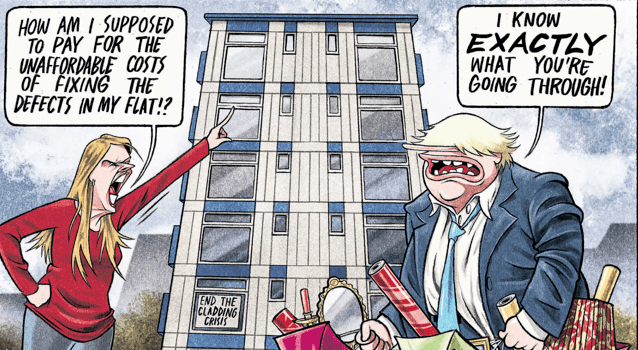
Government to raise taxes on housebuilders to fund cladding removal

The government has now launched a consultation on the tax increase, which it hopes will raise £2 billion over the next decade. The measure, first floated in February, will be joined by a new levy on future tower projects.

By Will Ing www.architectsjournal.co.uk

It comes as MPs voted through the Fire Safety Bill, which clarifies responsibility for reducing risk in multi-occupancy residential buildings in England and Wales, last week. The government was criticised for voting against an amendment which would have protected leaseholders from the crippling costs of making their homes fire-safe.

The consultation has not suggested what the increased rate of tax for residential developers’ profits should be but seeks views on whether the tax should be levied solely on residential development activity, or on all profits of companies that are substantially involved in building homes.

The UK’s largest housebuilders make significantly more than £25 million a year, with Persimmon, Taylor Wimpey and Barratt Homes reporting pre-tax profits of £784 million, £430 million and £264 million respectively for 2020.

Housing Secretary Robert Jenrick said the tax would ‘strike the right balance between developers making a contribution and ensuring fairness for the taxpayer’, while consultation documents note that developers are benefiting from public investment in cladding remediation.

Jenrick added: ‘We’re making the biggest improvements to building safety standards in a generation, investing over £5 billion helping to protect leaseholders from the cost of replacing unsafe cladding on their homes and ensuring industry is held to account for the wrongs of the past.’

However, the government is facing growing calls to fully protect leaseholders from the costs of removing unsafe cladding from their homes – something which it has previously said it supported in principle.

Last week, the cross-party Housing, Communities and Local Government Committee said the government should establish a Comprehensive Building Safety Fund, with finance provided by the government and the building industry.

Clive Betts, the committee’s chair, said: ‘While the extra funding for cladding removal is welcome, it will be swamped by the sheer scale of fire safety issues in multi-occupancy buildings.

‘In the years since the Grenfell tragedy, we have been shocked by the reality of the danger that flammable cladding poses, by how pervasive these materials are in modern buildings and by the frequency with which fundamental fire safety measures, including fire breaks and sprinkler systems, are simply not there.

‘£5 billion in funding is significant, but just cannot match the ongoing legacy of these fire safety failings […] the government’s recent proposals fail to adhere to the fundamental principle that leaseholders should not have to pay to fix these problems.’

Responding to the consultation on increasing taxes on residential developers, Labour’s shadow housing secretary, Thangam Debbonaire, accused the government of ‘dragging their feet at every stage since the Grenfell tragedy’ and noted that ‘hundreds of thousands of people still live in dangerous flats’.

‘Even with this levy, the burden would still overwhelmingly be on blameless leaseholders – while many of those that caused this crisis will get off lightly,’ she said. ‘Labour will keep fighting to protect leaseholders form unfair costs. This fight is not over.’

The government has also pledged to introduce The Gateway 2 Developer Levy, which will charge developers seeking planning permission for new towers. The levy will be brought forward as part of the Building Safety Bill.

Conservative PCC candidate reported for breaking election rules for second time

A Conservative candidate running for North Wales Police and Crime Commissioner has been reported to the returning officer for a second time.

Jez Hemming www.dailypost.co.uk 

Pat Astbury, who is one of five people in the running for the PCC post, was reprimanded by Police Area Returning Officer for North Wales Colin Everett last week for an “inaccurate” statement and for having “privileged access” to Police Minister Kit Malthouse MP.

She had mistakenly called herself “your local Police and Crime Commissioner” rather than PCC candidate in a video discussion with the Minister.

The video was later edited to remove the reference and Mr Everett advised Police Minister Kit Malthouse to “extend the opportunity for an interview to all other candidates” or otherwise ask for it to be withdrawn.

Now it has emerged Mrs Astbury, a former Ruthin town councillor and Mayor, was referred to as a “local councillor” in Conservative communication to electors.

There is no suggestion Mrs Astbury was aware of the error before being contacted by Mr Everett, who is chief executive of Flintshire county council.

She made it clear she had no input into the election material, which had been produced by the Conservative Party.

She said: “It’s the second complaint and the first error (involving Kit Malthouse) was mine. The second one I haven’t seen, as it was in a constituency paper – I don’t even know which one it was.”

The Local Democracy Reporting Service has since discovered the reference was made in a Conservative paper sent to electors in Clwyd West.

In a Facebook post on her campaign page she said: “An error has appeared in print, describing myself as a councillor, when in fact I am a former councillor.

“I apologise if this has been misleading in any way, and hopefully, this explanation will address the matter. There has been no intent to deceive whatsoever, and I trust this explanation will serve to clarify.”

Speaking to the Local Democracy Reporting Service (LDRS), Mrs Astbury added: “Colin Everett said he was drawing a line under the first complaint and he was doing the same under this one too.”

A spokeswoman for the Welsh Conservatives, said: “Pat made a genuine error, for which she has apologised.”

A spokesman for the Police Area Returning Officer for North Wales, Colin Everett, said the matter was now “closed”.

The campaign to find the next PCC is underway in earnest as all the candidates fight for the vacant role left by Arfon Jones, who announced he was stepping down earlier this year.

Who deserves the credit for our vaccination rollout success?

The vaccination rollout is an undoubted triumph for the UK. It stands out in stark contrast to all the lack of preparedness and blundering we were subjected to in the early part of the pandemic.

The Government obviously likes to bask in the glory of this success, especially at election time. But how much of this glory is deserved and how much simply reflected?

The general lack of preparedness for the pandemic from: out of date and insufficient PPE stockpiles, through lack of ICU beds and general NHS cutbacks, to centralisation and disinvestment from locally based communicable disease control; is down to Government. Despite it being a risk that had been identified and “war-gamed” quite recently,

The emergency Government reaction to this lack of preparedness, was to turn to a VIP list of those with connections and the employment, at vast expense, of “consultants” e.g. to procure PPE and to create a “track and trace” system and “Moonshot” programmes. It did not fully mobilise the public resources at its disposal across central government. How long did it take to use the statistical sampling expertise of the ONS to direct our limited testing capabilities? Why were the local authority public health services sidelined?

According to the National Audit Office, the government response to the coronavirus pandemic is on track to cost the public purse £210bn for the first six months of the crisis. Equivalent to almost a quarter of the government’s annual budget for running the public sector.

Frankly, the general consensus is that this has been a costly and not very effective exercise.

Boris Johnson’s dithering and delays in ordering lockdowns is estimated to have cost 21,000 lives in the spring and up to 27,000 lives in the winter of 2020.

In contrast, the vaccine rollout programme has been run by public sector bodies: the NHS, the General Practice Service with the Military responsible for the logistics.

The choice of “well connected” venture capitalist Kate Bingham to lead the vaccine task force to identify the most promising candidate approaches and then spread the bets, was not without controversy. (£670K PR bill and allegations of sharing sensitive documents at a private conference). But she did pull the right expertise together.

The fact that there are any vaccines at all is down to the dedicated scientific teams who did react at an early stage as information emerged that something alarming was happening in China.

Locally this post says it all:

Planning applications validated by EDDC for week beginning 19 April

Local Conservatives have a nerve

Local Conservatives have a nerve boasting about putting ‘meat on the bones’, when their government has both stripped funding and hoisted council tax

From the blog of Martin Shaw County Council Candidate https://seatonmatters.org/

Posted on May 3, 2021

MAJOR SLEAZE

The Conservative candidates for Seaton and Axminster, in a paid advert in the Midweek Herald, say they are working to put ‘meat on the bones’ on the services we need in the area. This is incredible hypocrisy after their government has spent over a decade stripping the same services back to the bone.

Devon County Council’s funding has been reduced by far more than £100 million per year. Highways and Libraries are on standstill funding, i.e. reducing in real terms.

Austerity is still with us

Lest you be fooled by loose talk about austerity being over, let me remind you that golden boy Rishi Sunak has made it very clear that most areas of public services will be on starvation rations for the foreseeable future. Even local NHS managers are expecting funding constraints to return with a vengeance once the Covid emergency is over. These are the Government’s political choices, while they spend lavishly in other areas.

Local cuts

When you vote, just remember that in the last few years, Seaton, Axminster and Honiton hospitals have lost their beds because of Conservative spending cuts. NHS Property Services, which owns the hospitals, spurred on my the government’s incentives for property sales, put the Seaton and Axminster hospital sites forward for housing development.

Colyton Fire Station was almost closed for the same reason. Colyton Health Centre faced possible closure because NHS PS hiked their service charges 5 times. The town’s public services could have been decimated for the sake of land sales.

Only vigorous protests by the local communities, with my support as County Councillor, have held the line in these three cases. On the other hand, Conservative councillors from East Devon voted through the cuts in hospital beds.

‘Cutting Council Tax’ – a pure lie

Local Conservatives’ nerve is almost on a par with that of the well-known liar Boris Johnson, who last week claimed that the Conservatives were ‘cutting council tax’. That will be the same Conservatives who have RAISED Devon’s council tax by 30 per cent in the last 6 years, at the same time as CUTTING services.

Boris Johnson Does Not Need To Resign If He Has Broken Ministerial Code, Minister Says

Boris Johnson does not necessarily have to resign as Prime Minister if he is found to have broken the ministerial code, according to foreign office minister James Cleverly.

Adam Payne www.politicshome.com 

Cleverly, the Conservative MP for Braintree, told Sky News on Monday that if Johnson is deemed to have breached the rules stipulating how ministers are expected to act when in office, it is not as “straightforward” as simply stepping down.

Cleverly said the ministerial code was “there for the guidance of the Prime Minister in appointing ministers” and that it was too “simple” to say Johnson himself should resign if an investigation finds he has breached it.

Douglas Ross MP, leader of the Scottish Conservatives, told the BBC’s Andrew Marr on Sunday that the Prime Minister should resign if is found to have breached the ministerial code.

“Of course, I think people expect the highest standards of those in the highest office of the land,” he told Marr when asked whether Johnson should step aside in those circumstances.

The Prime Minister continues to face pressure to explain who initially paid for the refurbishment of his Downing Street flat.

Johnson insists he has covered the cost of the work, which is believed to have come to £58,000, but has repeatedly dodged questions over who paid for the refurbishment in the first instance, amid claims that it was initially funded by donors to the Conservative party.

There are three investigations into the refurbishment, including an Electoral Commission probe.

However, Johnson as arbitrator of the ministerial code will get the final say on whether he has broken the rules, regardless of what the investigations looking at the refurbishment conclude.

Cleverly was reluctant to discuss what should happen if Johnson is deemed to have broken the code, telling Sky News he did not want to “speculate as to what the outcome of things might be”.

“The Prime Minister has already set out his explanation,” he said.

“He has answered the questions that have been put to him. I don’t know any more detail than what the prime minister has already said.

He added: “Until we know what’s in the report it’s pointless speculating about what actions might be taken. 

Northamptonshire elections bring hope of fresh start after years of turmoil

 “The way that they’ve drawn the boundaries is likely to deliver the best electoral prospects for the Tories, which literally means you’re rewarding failure.”

Jessica Murray www.theguardian.com 

Home to what was once branded the worst-run council in the country, local elections this week mark the start of a new chapter for Northamptonshire.

After years of council turmoil including bankruptcy, a corruption scandal and failing social services, when people head to the polls on Thursday they’ll be voting for the first time to elect two new unitary authorities hoping to start afresh.

It’s the first local elections in the area since 2017, after the vote was delayed first for the restructuring process and then Covid. “It’s been a long time coming, we haven’t had an election for years, so I think everybody is keen to see democracy in Northamptonshire again,” said Robin Burgess, the chief executive of the Hope Centre in Northampton, which works to address poverty in the town.

“I think there is a degree of willingness by politicians to break away from the rather tragic history [of the old councils]. They were very damaged entities and going forward, I think they all want to be seen to be new.”

Poverty has soared in Northampton, with the number of people claiming unemployment benefits in the town more than doubling since the start of the pandemic, one of the sharpest increases in the country. And, with a lack of leadership and funding from local authority sources, charities and social enterprises have had to step up.

“The voluntary sector has been incredibly influential in terms of filling the void of leadership by politicians over the last couple of years because the system has been so broken locally,” said Burgess, whose charity now helps coordinate a network of 40 foodbanks across west Northamptonshire, many of which have sprung up over the past year as demand has increased.

But there is hope the two new unitary authorities, which have replaced the previous county and borough council system, will help improve services and get the area back on track again.

“We have all got a vested interest in making the new West Northants [council] successful because we’re all daily impacted by what has gone wrong,” said candidate Danielle Stone, leader of the West Northants Labour group. “I think it’s important that we renew our mandate, too. We’ve been without a mandate two years, and that’s very uncomfortable.”

But Stone is concerned the new setup means poorer urban areas such as Northampton are likely to be governed by a Conservative-majority council mainly made up of people from wealthier, rural areas. “Our concern is we’re going to be ruled by people who’ve got absolutely no understanding of our communities, and all the kind of inner-city pressures that we have to cope with on a daily basis,” she said.

Sally Keeble, a former Labour MP for Northampton North, said: “The way that they’ve drawn the boundaries is likely to deliver the best electoral prospects for the Tories, which literally means you’re rewarding failure.

“Also quite a number of the people who were responsible for what happened both in Northamptonshire [county council] and in Northampton [borough council] are standing for election again. It really beggars belief that the same people are able to sit and run the same authorities.”

In the town of Corby, which was previously the only Labour-led authority in the county and the only council to vote against the restructuring plans, there are also concerns about being incorporated into what will probably become a Conservative-controlled authority.

“Corby has got its own culture and traditions, it’s got its own needs. I think there are a number of towns scared their voices are going to be lost in this,” said Matt Keane, a Labour candidate and former mayor of Corby. Families in the town have already been hit with a council tax bill increase as reduction schemes across different council areas were brought together.

After an Ofsted report in 2019 which found child protection services in Northamptonshire were failing to keep children safe, these will remain under the control of an independent children’s trust, led since December by Colin Foster.

“It’s been the hardest few months of my professional life, if I’m honest; it’s been really tough. But we’re already making improvements and I feel quite hopeful about the future,” said Foster. “This is the best chance Northamptonshire has had in about eight years to be what communities deserve.”

Northampton Conservatives were contacted for comment.

Johnson aide ‘advised on planning law shake-up’ while employed by property firms

Boris Johnson’s former top aide Eddie Lister was involved in discussions on a massive shake-up of planning laws despite being employed by two major property firms, it is claimed.

Pippa Crerar http://www.mirror.co.uk  (extract)

Industry insiders told the Mirror that the senior aide, who stepped down as No 10 came under pressure over conflicts of interest, had been advising on the proposals.

Whitehall sources also suggested that Lord Udny-Lister had been involved as the Downing Street policy team drew up the plans with Robert Jenrick’s Ministry of Housing last year……

Exeter goes for “car free” development: 51 flats approved, Exmouth Junction

But no parking spaces

“We cannot cram more vehicles onto the roads. Unless we blow up and redevelop the whole city, that won’t change, so the only way to support this is for developments that are car-free. This is the way forward, and these homes are badly needed so I will vote in favour.” – Cllr Rob Hannaford.

Daniel Clark, local democracy reporter www.radioexe.co.uk

All flats, no cars (courtesy: Eutopia Homes/LDRS)

Plans for 51 new apartments on vacant land at the former Exmouth Junction have been approved.

It is the second phase of the major development next to Exeter’s Morrisons supermarket to be approved after Exeter City Council’s planning committee gave the go-ahead for 400 new homes, a care home, and new green spaces in March.

The flats will be built on a brownfield site historically been a railway goods yard, rail sidings and coal concentration yard, before most recently being used for surface storage.

As part of the second phase of the development, Eutopia Homes asked for permission to add an L-shaped apartment block as a ‘gateway building’ into the main site.

The new apartment block will consist of 26 one-bedroom flats, 20 two-bedroom flats, and five three-bedroom flats, with the ground floor featuring a residents’ entrance and communal amenity area, lift to all floors, plant space and internal bike and bin store.

The flats would also have a ‘communal amenity’ on the ground floor, roof terraces, private outside space for some ground floor units, over 100 cycle spaces, and there would be improvements around the entrance to connect to existing cycle paths and widening existing footways for pedestrian access to Prince Charles Road. It will be a ‘car free’ development.

Cllr Richard Branston raised concerns over whether the scheme would be ‘over development’ and whether the car free nature would result in parking pressures in the surrounding areas. Cllr Yolanda Henson said that she didn’t think it was a high quality scheme and while there was a need for more housing, “this too big in an area and crammed in.”

But Cllr Rachel Sutton said that the council cannot get away from the fact there is a desperate need for new homes for people struggling to get on the housing ladder.

She added: “It is difficult as everyone says stop building in the suburban areas and the fringes of the city and when an application comes in for a brownfield site, people say they don’t want that either. If you don’t take brave decisions to put forward car-free development, you’ll never have car-free developments, and there is more to like than not to like.”

Cllr Rob Hannaford added: “We cannot cram more vehicles onto the roads. Unless we blow up and redevelop the whole city, that won’t change, so the only way to support this is for developments that are car-free. This is the way forward, and these homes are badly needed so I will vote in favour.”

And Cllr Ruth Williams added: “This will be ideal for people to rent properties and not to need their own transport. We have to build up rather than out as if we build out then we have to use green spaces. We are desperate to find more social housing for Exeter, and those who need homes would be welcoming this development.”

Recommending approval, the report of planning officers, said: “The proposed development is considered to be acceptable. It will be a car-free development, which is considered acceptable for the site by the Local Highway Authority, and it will therefore support the ambition of the city to be net-zero carbon by 2030. The design and scale of the building are considered to be acceptable.

“It will follow the same architectural approach as the main Exmouth Junction development and act as a ‘gateway building’ to this site. It will make effective and efficient use of the land in accordance with local and national policies. It will deliver housing helping the Council to achieve a 5 year land supply.”

Councillors voted by seven votes to four to approve the scheme.

Scandal upon scandal: the charge sheet that should have felled Johnson years ago 

Yes, it’s a real scandal. Despite the apparent absurdity of a Westminster village obsessing over soft furnishings and the precise class connotations of the John Lewis brand, there is a hard offence underneath all those cushions and throws. By refusing to tell us who first paid for the refurbishment of his Downing Street flat, Boris Johnson is denying us – his boss – the right to know who he owes and what hold they might have on him.

Jonathan Freedland www.theguardian.com

Offence is the right word because, even before the Electoral Commission determines whether the law on political funding was broken, Johnson’s failure to come clean may well be, by itself, a breach of the ministerial code. That bars not only actual conflicts of interest between ministers’ “public duties and their private interests” but even the perception of such conflicts. In refusing to tell us who first paid that bill for overpriced wallpaper, or to give full details of who paid for his December 2019 holiday in Mustique, Johnson has offended the public trust.

So yes, this is a scandal. But do you know what else is a scandal? That while Johnson was racking up an estimated £200,000 on home decor, his government was pushing through a post-Grenfell fire safety bill that threatens ordinary leaseholders with financial ruin, saddling them with the cost of ridding their homes of potentially lethal cladding and other hazards: one woman is facing a bill of £70,000 to make her one-bedroom flat in Bristol safe. That is a scandal.

Or that by breaking his 2019 manifesto pledge and slashing the UK’s aid budget, Johnson has cut our contribution to the UN effort on HIV/Aids and to lifesaving water projects by 80%, and to the UN family planning programme by even more – money that could have prevented maternal and child deaths in the world’s poorest countries. That, too, is a scandal.

A coronavirus death toll of 127,500 that remains the highest in Europe, alongside the deepest economic slump in the G7. The mistake Johnson made three times over in 2020, delaying lockdowns in March, September and the following winter. The seeding of Covid in nursing homes. The decision to keep the borders open even during the height of lockdown, as smart as putting a double bolt and extra chain on the front door while leaving the back door swinging wide open. Johnson’s absence from the first five Cobra meetings on Covid, preferring to flick through swatches at his weekend home at Chequers. They’re all scandals.

The VIP lane for ministers’ pals when the PPE contracts were being doled out, when so many politicians’ chums looked at Covid and saw a commercial opportunity. The £276m contract that went to P14 Medical, run by a Tory donor, or the £160m deal with Meller Designs, also run by a Tory donor, both revealed just this week. The staggering sum of £37bn committed to a test-and-trace programme that never really worked. Johnson’s support for Dominic Cummings, even as he torched the most important public health policy in a century and insulted the country’s intelligence with a tall story about an eye test on wheels. Every one a scandal.

The failure to sack Robert Jenrick, even after he rushed through an “unlawful” planning decision that would save Richard Desmond, yet another Tory donor, £45m in local taxes. The failure to sack Priti Patel, even after she’d been found to have broken the ministerial code. The failure to sack Gavin Williamson, even after he’d presided over an exams fiasco that threatened to damage the life chances of tens of thousands of young people. The appointment of Gavin Williamson, not two months after he’d been fired by Theresa May for leaking sensitive information from the national security council. That, too, is a scandal.

Johnson’s Brexit protocol that put a border down the Irish sea, even after he’d vowed never to put a border down the Irish sea, thereby imperilling a union he swore blind he would protect. His proposal of an internal market bill that proudly declared its intention to break international law, prompting the UK’s top legal civil servant to quit – one of a disturbing number of mandarins driven to resignation on Johnson’s watch.

His illegal suspension of parliament, overturned as a violation of fundamental democratic practice by unanimous verdict of the supreme court. The lies that led to that moment: the £350m on the side of the bus or the scare story that Turkey was poised to join the EU and that Britain would be powerless to stop it. Siding with Vladimir Putin to suggest that the EU had provoked the Russian invasion of Ukraine. Scandals, all.

The blame he bears for wrongly saying, when foreign secretary, that Nazanin Zaghari-Ratcliffe had been training journalists in Iran, further condemning a woman who this week was sentenced to yet another year as a prisoner in that country. His quip about clearing away “dead bodies” in Sirte, Libya, a phrase that makes all too plausible the multiply-sourced claim that he told a Downing Street meeting on Covid he was happy to let the virus rip and “let the bodies pile high” rather than impose another lockdown.

His record as mayor, spaffing Londoners’ money up the wall on failed vanity projects that were either unused or unworkable, yet somehow managing to boost the entrepreneurial efforts of his lover, Jennifer Arcuri, cosy in her very own VIP lane with Johnson as the recipient of £126,000 in public money. That, too, is a scandal.

His racist musings about a “half-Kenyan” Barack Obama, his casting of Muslim women as “bank robbers” and “letterboxes”, and Africans as “piccaninnies” with “watermelon smiles”. His running of a Spectator editorial that falsely accused “drunken fans” of causing the Hillsborough calamity, and suggesting that the people of Liverpool wallow in “vicarious victimhood”. His firings from the Tory frontbench and the Times newspaper, both times for lying.

They’re all scandals. So is a system that makes the prime minister the ultimate arbiter of the very code that he has broken, so that Johnson decides when and whether to investigate himself, making him judge and jury in his own case. Not much better is an opposition party that was walloped by him in 2019 and struggles to lay a glove on him now.

Or maybe the real scandal lies with us, the electorate, still seduced by a tousled-hair rebel shtick and faux bonhomie that should have palled years ago. Americans got rid of their lying, self-serving, scandal-plagued charlatan 100 days ago. They did it at the first possible opportunity. Next week, polls suggest we’re poised to give ours a partial thumbs-up at the ballot box. For allowing this shameless man to keep riding high, some of the shame is on us.

  • Jonathan Freedland is a Guardian columnist

Senior Tory says Boris Johnson should resign if he breached ministerial rules

And pigs might fly!

In Owl’s opinion, based on experience (think Neil Hamilton, Jonathan Aitkin and, locally, Graham Brown) the Tory party doesn’t root out sleaze unless forced to by the electorate, and not always then.

[The charge sheet follows in the next post, to which a few more can now be added.]

Rajeev Syal www.theguardian.com 

One of the UK’s most senior Conservatives has broken ranks and called for Boris Johnson to resign if he breached ministerial rules over the refurbishment of a Downing Street flat, amid new claims that undeclared donations have been sought to fund the prime minister’s lavish lifestyle.

Douglas Ross, the leader of the Scottish Conservatives, said on Sunday that Johnson should “of course” quit if he is found to have breached the code by failing to be honest about cash payments from a Conservative donor sought to redecorate his official residence.

His intervention, which caught No 10 by surprise, came after Johnson was accused of successfully obtaining funds for the flat from a second donor, while a third was alleged to have been asked to pay for his one-year-old son’s care.

It comes as the party attempts to move on from a torrid week and gears up for elections across the UK on Thursday. Labour has narrowed the Tories’ lead since the barrage of sleaze allegations began.

Appearing on BBC One’s The Andrew Marr Show, Ross was asked if Johnson should stand down if found to be in breach of the ministerial code.

“Of course, I think people expect the highest standards of those in the highest office of the land,” he said. “That’s why I think people are looking at the investigations that are currently ongoing and waiting for the answers.”

The new standards adviser, Christopher Geidt, is investigating whether Johnson has breached the ministerial code, which sets out the conduct expected of ministers and how they discharge their duties.

Johnson would be expected to show that his behaviour was consistent with the code, which makes clear there should be “no actual or perceived conflicts of interest”.

His former chief aide Dominic Cummings reignited the row over the flat renovation after claiming the prime minister had sought donors’ cash in an “unethical, foolish, possibly illegal” scheme.

Money from the Tory donor David Brownlow was allegedly used to fund part of a £200,000 renovation in the flat above No 11 Downing Street where Johnson resides with his fiancee, Carrie Symonds, and their son, Wilfred. It is alleged that Symonds had described the flat as “a John Lewis nightmare” when they moved in after Theresa May left.

The Sunday Times reported that there was a second invoice settled by a third party – believed to be another Conservative donor – directly with the contractor. Downing Street refused to comment on this claim.

Yet another Tory donor has claimed that they were asked to foot the bill for a nanny for Wilfred, the Mail on Sunday and the Sunday Times claimed. The donor is alleged to have said: “I don’t mind paying for leaflets but I resent being asked to pay to literally wipe the prime minister’s baby’s bottom.”

Former Downing Street insiders claim that Johnson’s finances are a mess and are a reflection of the way he runs the government. He earns £157,372 a year as prime minister but he is said to have told friends that he requires £300,000 to keep afloat.

Johnson has retained the power to frustrate any inquiry by Geidt into his behaviour. He remains the “ultimate arbitrator” of the code and gets the final say on whether he broke the rules, a situation Labour says allows him to be his own judge and jury.

Geidt’s predecessor, Sir Alex Allan, resigned in November after Johnson overruled his inquiry, which found evidence that the home secretary, Priti Patel, had bullied staff.

Dame Margaret Hodge, the Labour MP and former chair of the public accounts committee, said the prime minister and his government were not maintaining the standards needed to maintain a healthy democracy.

“If you’re taking money in this secretive, private way, how is it influencing how you are approaching the issues of state?

“This is a really dangerous point in which our democracy could be undermined,” she said.

“Is it the tip of an iceberg and are there other ways in which the funding of his rather lavish lifestyle has been dependent on individuals giving him cash and what do they want in return?”

The Electoral Commission this week launched an investigation into whether any donations or loans to pay for the refurbishment of his residence in No 11 were properly declared.

The foreign secretary, Dominic Raab, was asked to defend Johnson on Sunday, but declined to say whether he should resign if he is found to have broken the law.

“I think the right thing for me to do is respect the integrity of those reviews and let them run their course,” he said.

Raab also declined to deny a claim that a second invoice for renovations may have been settled with the supplier by a Tory donor.

Asked about the suggestion that a Tory donor was asked to pay for a nanny, he said: “I have no idea, you don’t have conversations like that with the PM,” he told Sky’s Sophy Ridge on Sunday.

Although earlier polls suggested the sleaze allegations were not significantly denting public support for the Tories, two new surveys indicated they could be having an effect before the local elections in England and votes for the parliaments in Scotland and Wales.

The Conservatives (42%) fell to a five-point lead over Labour (37%), according to the Opinium poll of more than 2,000 adults between Wednesday and Friday.

In separate polling, Focaldata put Labour on 39%, one point behind the Tories, who previously had a healthy lead, according to the Sunday Times.

A No 10 spokesperson said the prime minister “has covered the cost of all childcare”, but did not respond when asked if he paid for the original bill himself or had reimbursed somebody else.

Johnson has denied breaking any laws over the refurbishment of his residence and insisted he has paid “personally” for the works.

Cranbrook has changed drastically while no one else in Devon was looking

[Except Owl]

If you go to what will eventually be Cranbrook’s town centre, you could be forgiven for thinking that nothing has changed.

Daniel Clark www.devonlive.com

The signs adorning the green field outlining that this will eventually be the heart of the new town looks exactly the same as they did back in 2017, with the only difference being the length of the grass.

But across the town, things are changing. The number of new homes being built continues to grow, with parts of the town unrecognisable and new estates springing up compared to this time last year. Work has begun on the next phase of the district heating network rollout.

And even the ‘town centre’ may soon be set to finally look different in the near future after the agreement as to how it will be developed and delivered was reached between East Devon District Council and the East Devon New Community Partners in January this year.

Devon Live takes a look at where Cranbrook is now and what is planned for the future.

Cranbrook currently has around 2,350 homes, equating to approximately 5,500 residents, as well a primary school and a secondary school, a railway station, a parade of local shops, the Younghayes Centre, a country park, a medical centre, and the Cranberry Farm pub, which will eventually be right at the centre of the town.

But plans set out in the East Devon Local Plan and the draft Cranbrook Plan are to grow the town to around 7,740 homes – an additional 4,170 homes from those already consented and/or built – which will give a population of just over 18,000 people.

Planning applications have been submitted for more than 1,000 of these additional houses and associated community facilities, with additional applications for some of the other identified expansion areas anticipated for submission later this year.

The expansion plans will also include two new primary schools, a SEN school, a sports hub, community centre, two new neighbourhood centres and large areas of open space, amongst other items.

The Cranbrook Plan is going through its examination by an Inspector appointed on behalf of the Secretary of State and a ruling is expected to be made before the Autumn of 2021.

WHERE WILL THE EXPANSION AND DEVELOPMENT TAKE PLACE?

Development parcels outlined in the plan are at Bluehayes, to the west of the existing development, Treasbeare, south of the existing development and south of the old A30, Cobdens, to the east of the existing development, and Grange, to the south of Cobden and south of the old A30.

Any business or other use that is permitted within these areas must be of an appropriate scale to the mixed use area and mainly serves the needs of the immediate neighbourhood and must not undermine the vitality and viability of the town centre.

The four expansion areas of Cranbrook

The four expansion areas of Cranbrook

BLUEHAYES

40 hectares of land at the Bluehayes Expansion Area is allocated for a mixed use development, which will include:

  • Around 960 new dwellings
  • Land capable of accommodating a community building and a range of business premises
  • Formal open space recreational land
  • A 420 pupil place primary school (in the event that Bluehayes is delivered before Treasbeare)
  • Formal play space with facilities for children and youth
  • Allotments totalling an area of 0.55 hectare of land

The Bluehayes expansion area will comprise a mix of housing, community and commercial uses that will provide a key route through the town linking the Cranbrook railway station with the Treasbeare expansion area, Skypark, Exeter Airport and existing development at Broadclyst Station.

TREASBEARE

62 hectares of land at the Treasbeare Expansion Area is allocated for a mixed use development, which will include:

  • Around 915 new houses
  • Land capable of accommodating a community building
  • A neighbourhood centre to provide at least 1500 square metres gross of groundfloor floor space, including shops and a range of business spaces
  • A 420 pupil place primary school (in the event that Treasbeare is built before Bluehayes)
  • Formal open space and recreational land
  • Formal play space with facilities for children and youth
  • A sports hub which delivers two senior rugby pitches, two junior rugby pitches, two football pitches, three junior football pitches, an all-weather pitch, four tennis courts, a sports pavilion, changing facilities and a club room
  • Employment land
  • Allotments totalling an area of 0.54 hectare of land.
  • A Suitable Alternative Natural Green Space
  • Land for an extension to the District Heating Energy Centre
  • Five serviced permanent pitches for gypsies and travellers

The Treasbeare expansion area will comprise a mix of housing, education, community, sport, employment and commercial uses (together with safeguarded land for the energy centre) that importantly will provide a key location for activity in the town and act as a hub for education and sporting facilities in this area. The sports hub in Treasbeare will be the main hub in Cranbrook and provide a wider range of facilities than at the Ingrams Sports hub further to the east.

Coloured circles (shape are not accurate) to represent roughly where each of the new neighbourhoods as part of the Cranbrook expansion would be built

Coloured circles (shape are not accurate) to represent roughly where each of the new neighbourhoods as part of the Cranbrook expansion would be built

COBDENS

110 hectares of land at the Cobdens Expansion Area is allocated for a mixed use development, which will include:

  • Around 1,495 new houses
  • A neighbourhood centre to provide at least 1250sq m gross of groundfloor floor space, including shops and a range of business spaces
  • A 630 pupil place primary school, 80 place early years provision and a room for community use
  • A 50 pupil place Special Educational Needs school
  • Formal open space recreational land
  • Formal play space with facilities for children and youth
  • An extension to the existing sports hub at Ingrams, through the provision of 1x youth 9v9 football pitch
  • Allotments totalling an area of 0.88 hectare of land
  • Ten serviced permanent pitches for gypsies and travellers
  • Serviced land suitable to accommodate a place of worship and parsonage
  • Serviced land (of at least 1 hectare in size) for a cemetery
  • Development of the Cobdens expansion area of Cranbrook will require the undergrounding of the 132kv high voltage power line that crosses the site as indicated in the Cranbrook Masterplan.

This Cobdens expansion area will contain around 1,490 new homes and social and community facilities. It will include provision for a neighbourhood centre and associated mixed and meanwhile uses as well as a large area of Suitable Alternative Natural Green Space (SANGS).

GRANGE

30 hectares of land at the Grange Expansion Area is allocated for a mixed use development, which will include:

  • Around 800 new houses
  • A community building
  • A neighbourhood centre to provide at least 1,600sq m gross of groundfloor floor space, including shops and a range of business spaces
  • Formal open space
  • Formal play space with facilities for children and youth
  • Allotments totalling an area of 0.47 hectares of land

The Cranbrook Plan allocates land for comprehensive development for the Grange expansion of Cranbrook. Lying south of part of the Ingrams sports pitches serving the existing town and existing development to its north western edge, the area has a good relationship with the existing town and the Cobdens development proposed to the north.

New play areas, a skate park and a sports pavilion for the Ingram sports pitches are also set to soon come to fruition after a deed of variation to the Section 106 agreement is to be finalised and signed, with Cranbrook Town Council taking on responsibility for delivering these important community assets.

A second area of allotments are also due to be provided in the east of the town, adjacent to Southbrook Lane, to complement the existing Crannaford allotments on Rush Meadow Road.

THE TOWN CENTRE

Plans for the town centre are progressing in line with the Cabinet agreement made in January 2021, with the final details of the Memorandum of Understanding outlined in that report moving toward agreement.

The ‘hard-fought deal’ with developers will bring forward multi-million pound plans which include land that could be used for a leisure centre, a hotel and retail units.

Confirmed uses as part of the proposals include a 2,500 square metres Morrisons supermarket, around 350 town centre homes, a town square, a town hall, and a children’s centre, youth centre and library in a single building.

Cranbrook from the air

Cranbrook from the air (Image: EDDC)

The next stage is for the developers to seek planning permission for the supermarket, the town square, a parade of shops and a childrens’ day nursery. Subject to permission being granted, the developers say that these facilities could be open by late 2022.

As part of the deal, the town square, the town council facility, library and youth facilities will also be delivered much sooner than after the previously required trigger point of 3,450 homes built, with deal also seeing about 350 additional new homes in the town centre area provided.

The cabinet decision means that the council will be investing heavily in Cranbrook’s future to the tune of millions of pounds as it can buy land to build areas of the town centre itself.

Councillors had twice rejected accepting the offer from the East Devon New Community Partners (EDNCp), including once just before Christmas, but after further negotiations over the holiday period, further movement to make the offer for Cranbrook more acceptable had been made, including issues around viability, restrictions on offer food stores within the town being relaxed, and increasing the size of the town square.

An East Devon District Council spokesman added: “We are having regular discussions with Henry Davidson Developments to finalise the plans for the supermarket, high street retail units, town square and children’s nursery, with the expectation being that planning applications for these facilities will be made once the Memorandum of Understanding is signed by all parties.

“We are negotiating a land value for the purchase of additional town centre land for non-residential uses and are exploring delivery options for that land.”

Ed Freeman, service lead for planning strategy and development management, said: “It is fantastic to see Cranbrook really taking shape and becoming a great place to live with such a strong community spirit. A town of this size needs to be a great place to work, socialise and enjoy leisure time, if it is to be the self-contained and sustainable town that we have always envisaged.

“In the last year, we have made great progress on these issues and we continue to work really hard to ensure that the town centre provides the social, community, retail and business spaces that the town needs and the community want. The current situation makes this very challenging and I understand the frustrations the community feel as these facilities are taking longer to deliver than many thought but I really hope that it will be worth the wait.”

And East Devon District Council is looking to continue with the roll-out of a District Heating Network for the expansion of the town and have bid for government funding toward a major project which will take waste heat from a planned Energy from Waste plant at Hill Barton and use it to provide heat and hot water to homes and buildings across the Cranbrook and Monkerton networks.

The district energy network will aim to meet a zero carbon standard, rather than rely on fabric and renewable energy measures on each home, will serve the region, and will ultimately connect 12,000 homes and 2m sqm of commercial space, and underpin the ambition to support the delivery of zero carbon development at Cranbrook.

There is a requirement for all homes to be connected to a district heating network became a key part of the planning strategy for Cranbrook and the neighbouring Skypark commercial development, with all homes tied into a contract with EON.

Together there are now over 100km of heat pipe in the ground, while the first permanent energy centre at Skypark was commissioned in 2013 and a second energy centre, currently under construction at Monkerton, is due to be commissioned later this year.

Tory poll lead slashed as key elections loom across Britain

Labour has slashed the Tories’ poll lead in half as more voters conclude that Boris Johnson is corrupt and dishonest ahead of this week’s bumper set of local and devolved elections.

Toby Helm www.theguardian.com

The latest Opinium poll for the Observer shows the Conservative lead has fallen from 11 points to five points after a week in which the prime minister was at the centre of allegations over the refurbishment of his Downing Street flat, and criticised for reportedly saying he would rather see “bodies pile high” than order another Covid-19 lockdown.

On Thursday, voters go the polls in council elections across the UK, a key parliamentary byelection in Hartlepool, mayoral elections, and elections to the Welsh Senedd and the Scottish parliament, the last of which could mark a crucial step on the road to Scotland’s independence.

The elections are the first since the pandemic began and represent the first electoral test for Keir Starmer since he became Labour leader in April last year on a promise to rebuild the party after its disastrous 2019 general election loss.

On Saturday, Starmer and his deputy leader, Angela Rayner, were campaigning in Hartlepool, with the party battling to hold off a challenge from the Tories in a seat once regarded as one of Labour’s northern strongholds behind the so-called red wall.

Referring to Johnson, Starmer said voters did not want someone who was “unserious” as prime minister, adding that the byelection was on a knife edge. “I’m really conscious of the fact that we have got to earn every vote here, and I mean earn every vote,” he told the Observer.

Rayner said people wanted honesty and seriousness in their politicians. “They don’t want games. They don’t want party politics. They want jobs for their kids, and they want their future secured. That’s what the key message was from them.”

The Opinium poll put Labour up four points compared with a week ago, on 37%, while the Tories had fallen two points to 42%. While Labour will be unhappy to be behind, their gains since last week suggest some voters may be turning against Johnson and the Tories before polling day, after a barrage of stories about Conservative sleaze.

Johnson’s approval ratings have fallen back into negative territory (to -6 from +1 a week ago) while Starmer’s have improved from +1 to +8. Some 42% of those surveyed said they viewed Johnson as “corrupt”, up from 37% a week ago, while less than third (30%) regarded him as “clean”. Only 15% of voters viewed Starmer as corrupt and 44% saw him as “clean”.

Despite Johnson denying last week that he had said he would prefer to see “bodies pile high in their thousands” than order a third Covid lockdown, 52% of respondents disbelieve him and think he did make the remark, while only 28% think he was telling the truth.

The dent in the Tories’ and Johnson’s ratings come despite the government receiving the best approval score since last May for its handling of the pandemic. The poll found 45% approve of its performance, against 36% who disapprove.

Labour is continuing to pile pressure on Johnson over who initially paid for the refurbishment of the No 11 Downing Street flat – an upgrade estimated to have cost around £200,000 – and when. It has been reported that Johnson and his fiancee, Carrie Symonds, described the furnishings left by the prime minister’s predecessor, Theresa May, as a “John Lewis nightmare.” According to the poll, 67% of people describe John Lewis as very or fairly posh, 73% say the same about Selfridges and 43% about Habitat.

Documents relating to the refurbishment suggest permission for the works was granted in January and overseen by architectural practice Feilden + Mawson. The company did not respond on Saturday when asked who paid for their services.

Labour is continuing to ask whether the proper tax has been paid on the refurbishments. It has now raised questions with the Treasury over the payment of VAT. Tax rules mean that government departments can reclaim VAT on “non-business activity” such as repainting and decorating. The opposition is demanding to know whether any VAT refund was paid back by the prime minister if he eventually met the costs of the work.

The government has only said that there is a £30,000 annual grant to refurbish Downing Street, and that the prime minister met all additional costs. However, No 10 has not denied that the prime minister did not pay the original invoice. It is not known whether the work was originally paid for by the state, the Conservative party or directly by a Tory donor.

Labour has also accused the Tories of handing out “crony” contracts worth billions of pounds to friends of the party during the pandemic, leading Starmer to label the prime minister “Major Sleaze”.

Writing in the Northern Echo on Saturday, Starmer said: “Instead of tackling the issues that matter, the Conservative party has become hopelessly distracted by sleaze and scandal. And it’s you and your family who feel the impact.

“At next week’s elections there is a very clear choice: Labour candidates who will be relentlessly focused on jobs, tackling crime and supporting your health. Or the same old Tories: sleaze, waste, one rule for them, and another for everyone else.”

Daft decision to end virtual meetings sees councils facing logistical nightmare

Councils are facing the logistical nightmare of trying to meet physically while abiding by social distancing guidelines after a bid to allow the continuation of online council meetings was rejected by the High Court.

As Cllr Paul Arnott, leader of EDDC said: “The courts are blameless and made the legal decision, and this just sits at the government’s door. I think this is so dangerous. I am extremely vulnerable and not had the second jab yet. Most of the younger members haven’t had a first jab, so the thought of them being forced to gather in one room, however big it is, is ridiculous. On public health grounds we should be waiting until we have had at least one jab, but it seems like we won’t be able to.”

Daniel Clark www.devonlive.com 

The emergency legislation allowing virtual council meetings will not be extended beyond May 7 – and on Wednesday, the High Court dismissed the appeal, with judges saying primary legislation would be needed to extend the use of online meetings and it was not for the courts to set that legislation.

It means that from May 7 onwards, all councils – from Devon County down to the parish councils – will have to resume meetings in person, and also applies to the Dartmoor and Exmoor National Park Authorities, the Devon and Somerset Fire Authority, as well as the Police and Crime Panel.

The decision has left councils across the county will the difficult task of continuing to carry on the business of local government in a Covid secure manner, forcing them to find alternative venues to hold meetings to ensure all members can safely attend.

By law, all councils have to hold their annual meeting in either March, April or May – North Devon, Mid Devon and Torridge have already held theirs – but Devon County Council and Exeter City Council were unable to move their AGMs due to the local elections and they, as well as East Devon, Teignbridge, South Hams, and West Devon councils will have to hold a full council meeting in May in person.

Cllr John Hart, leader of Devon County Council, told Thursday’s full council meeting that the ‘daft decision’ means the council will now need to look at a range of options to maintain the decision-making process in an open and transparent way, and that meetings would continue to be live-streamed, as they were even before the pandemic.

He said: “While no concrete decisions have been made, contingency plans had been made to book a larger venue at Sandy Park to accommodate an ‘in person’ annual meeting following the Elections, which, as Members will know, will be May 27.

There are, however, a number of issues that Officers are currently considering and assessing which include practical matters such as larger venues / rooms, reconfiguration of committee room layouts, overspill rooms, limiting the use of shared microphones, no provision of refreshments and ensuring that agendas only contain items of key business to reduce the amount of time that people need to be physically present.

“Furthermore, consideration will need to be given as to whether a remote / virtual meeting may still be appropriate for some of our non decision-making bodies and other forums. There may need to be other measures taken to reduce the number of people physically in the meeting room, for example, the council could make use of hybrid meeting technology and ask non committee members or the public / press to utilise this, acknowledging the rights of individuals to attend in person if they wished.

“Much of this will depend on the risk assessments of the rooms and what can be done safely, but it is likely a range of options could be implemented moving forwards.

“However, as a Council, I hope we do not reduce the numbers of committee members in the room or cancel large numbers of meetings (meetings would only be cancelled if there was no business to be transacted, as would be normal) or arranging for decisions that would normally be taken by a committee to be made under delegated powers. But as I say, all of this is subject to further discussion and the views of the new Council being considered.”

He added: “Devon will be saying that remote meetings should continue. It is something we have done exceedingly well and it is a daft decision.”

Cllr Rob Hannaford, Leader of the County Council Labour Group, added: “It’s a really unacceptable poor decision. This is a terrible outcome for local councils, and will inevitably have all sorts of unforeseen consequences and additional costs.

“From parish councils up to County Hall, we have all made our views known to the government in the strongest possible terms asking them to change their mind and let common sense prevail.”

“Even though the covid numbers are down at the moment, the pandemic is still ongoing, and it could very well surge back up again sooner than we think, and this just opens things out for the virus to spread.

“We all know that local democracy has moved on since the start of the pandemic, with councillors and staff embracing new technology. The reduction in face to face meetings should also be encouraged from an environmental point of view because it has reduced car journeys and cut carbon emissions.”

“It was totally pathetic that the government said they had not got enough parliamentary time to ensure that local councils can operate safely and properly – it shows yet again the contempt and deep disrespect the government has for us, and the important difficult work that we do for our communities.”

Cllr Alan Connett, Devon County Council Liberal Democrat group leader, added: “Making large groups of people meet indoors for meetings which often last more than two hours, when we’re trying to stop the spread of COVID-19, is unbelievably daft.

“This affects councillors and council staff. Some may have had COVID jabs, some not and some may have clinically vulnerable family at home.

“It should be up to our local councils to decide when it is safe to return – not the Conservative government.

“This is an opportunity missed as it has proved a remarkable benefit. It has moved on local government and this is a retrograde step. That councils have to meet in person before other people are allowed to do so seems to be very short-sighted.”

Cllr Martin Shaw, who had asked for an update on the ruling from Cllr Hart, added: “Shaw – The Government has put councils in an impossible position. The pandemic is not over, precautions will need to be taken to deal with the threat, and there could be a resurgence of Covid and a new wave, and it is essential that councils have the flexibility to organise business in the best possible way.”

Wednesday night’s East Devon District Council full council meeting heard that the council felt that they could accommodate committee meetings at Blackdown House, but would have to hold their full council meetings at an alternative venue, with Westpoint provisionally booked.

Henry Gordon-Lennox, the council’s monitoring officer, told the meeting that the initial expectation was that committee members have to be physically present to vote but they hoped to continue with a zoom meeting for attendance by officers and public and non-committee members.

He added: “From May 7 we are faced with the prospect with return to physical meetings. The government roadmap makes that easier as time goes on and as restrictions ease, it becomes less and less acute, but it is more acute for the next month and a bit.

“The chamber can hold 16 so it covers off all of the committees that can be held at Blackdown House but it would necessitate a very minimal public access, so we can provide three seats in the public gallery to meet the legal requirement for press and public.”

Cllr Paul Arnott, leader of the council, added: “The courts are blameless and made the legal decision, and this just sits at the government’s door. I think this is so dangerous. I am extremely vulnerable and not had the second jab yet. Most of the younger members haven’t had a first jab, so the thought of them being forced to gather in one room, however big it is, is ridiculous. On public health grounds we should be waiting until we have had at least one jab, but it seems like we won’t be able to.”

Tuesday night’s Exeter City Council full council meeting saw them vote to amend the standing orders of the council to enable them to hold meetings at an alternative venue to the Guildhall, with Cllr Peter Holland, Lord Mayor of Exeter, saying that the current plan would be to hold the annual meeting at the Corn Exchange instead.

West Devon Borough Council are working on the basis that all formal Member decision-making meetings will be held in the Council Chamber at Kilworthy Park.

A spokesman said: “In line with social distancing requirements, the capacity will be very restricted. For certain meetings (eg Full Council), it will not be possible for us to accommodate members of the press and public; they will be encouraged to view the meetings via our live stream.”

A spokesman for South Hams District Council said that the position for them is not yet clear. They said: “Due to the lack of ventilation, it will not be possible for us to hold any meetings in the Council Chamber at Follaton House. On the assumption that we will need to meet face to face, we are currently reviewing our options to ensure that we are still able to hold decision-making meetings while complying with social distancing requirements. No decisions have yet been taken over the suitability of potential alternative venues.”

A spokesman for Mid Devon District Council said: “We are making backup plans to resume meetings in person at Phoenix House and are currently reviewing our meeting timetable. In light of the government roadmap, we are also reviewing the necessary arrangements that will need to be in place to hold meetings as safely as possible and in compliance with legislation and guidance. Further details will be published on our website and as part of any published agendas when we have confirmed these plans.”

A spokesman for Dartmoor National Park Authority confirmed that meetings would resume in person at their HQ at Parke and that the press and public would be able to attend.

However, North Devon Council has confirmed that as a result of the decision, they will be resuming meetings in person and that there will be no live-streaming of them.

Senior Corporate and Community Services Officer, Bev Triggs says: “If we are required to return to meetings in person, then committee meetings would be held at Brynsworthy Environmental Centre, the Planning Committee would be held at the Rugby Club and full Council meetings would be held at an external venue with social distancing measures and additional measures in place.

“The public and press will be able to attend, however the numbers will be restricted and will be required to notify in advance to book a place. Only meetings that are required will be held. There would be no streaming of meetings for the time being.”

A Teignbridge District Council spokesman said: “We’re looking at options to hold socially distanced Covid secure committee meetings that will be live streamed so that members of the public can watch. Most of these are likely to be in the council chamber, but we are looking at an alternative for the full council meeting.”

Cllr James Jamieson, Chairman of the Local Government Association said: “It is very disappointing that this last avenue to allow councils to hold online and hybrid meetings whilst COVID-19 restrictions are still in force has not been successful. Councils by law, have to hold annual meetings within 21 days following local elections, so many will now have to use very large external venues to allow all members of the council to meet in person.

“Councils want to continue to have powers to hold online and hybrid meetings even when restrictions have been lifted. A recent LGA survey of its members revealed that 83 per cent of councils said they would be very likely or fairly likely to conduct meetings both online and in a hybrid way once the coronavirus emergency was over if they had the power.

“The current flexibility has been paramount in allowing access for both councillors and the public into council meetings. Many councils have, in fact, seen significantly increased participation by the public in meetings where important decisions are made about planning, housing and the provision of local services. Councils want the flexibility to continue to meet in this way and continue their business, especially in times of emergency such as when flooding occurs or if there is significant traffic disruption due to weather conditions.

“The Government gave clear evidence at the hearing in support of allowing the option of online and hybrid meetings. Unfortunately, the judgement is clear that primary legislation is needed to allow councils to use technology to hold meetings.”

The Judgment is in

A chink of light shines on dark corners! – Owl

action.goodlawproject.org

Good Law Project is now able to reveal the names of four more companies awarded contracts through the VIP lane: Clandeboye Agencies, P14 Medical, Luxe Lifestyle and Meller Designs.

These four are in addition to Ayanda, which enjoyed a £252m deal negotiated by Liz Truss adviser Andrew Mills. And Pestfix which won approximately £350m in contracts despite being described by Government as a company “which specialises in pest control products, that was dormant in 2018” (see page 73). There remain a further 41 firms yet to be revealed.

Good Law Project can also reveal that of the nine contracts the subject of the judicial review – one with Ayanda, two with Clandeboye and six with Pestfix – five or possibly six of them have failed in the sense that some or all of the PPE provided under them has proved unfit for its intended purpose (see page 2). Hundreds and hundreds of millions of pounds – spent with these three suppliers alone – have been wasted. It is inconceivable that this is the only waste. Moreover, the documents disclose that Pestfix and Matt Hancock are “in legal dispute” (see page 176).

In relation to Ayanda, civil servants were afraid of losing the contract with Ayanda because Andrew Mills “has close ties to DIT so wouldn’t be a good outcome” (see page 188), were concerned that Andrew Mills “is using previous relationships and making noise that we are not responsive” (page 190), and “Andrew comes through as highly backed as he sits on the board for DIT – so I don’t want things being escalated” (page 191). 

The High Court said the Government should carry out additional searches for:

  1. texts and WhatsApp messages for some selected civil servants; and
  2. instructions, directions and decisions by Ministers in respect of the establishment, selection and criteria of the VIP lane.

It also said that the Government should supply details of the advice given by Emily Lawson in relation to FFP2 facemasks.

With reference to our other applications, the Government either has now supplied or agreed to supply the information we sought, or our application for that information was rejected by the Court.

The Government was ordered to pay our costs of the application.

Thank you, 

Jo Maugham 

Director of Good Law Project


Good Law Project is able to carry out its work thanks to donations from thousands of people. If you are in a position to do so, you can make a donation here:

Hancock must reveal WhatsApp messages about PPE deals

The smokescreen of Boris Johnson’s ducking and diving around the “nothing to see here” sleaze and cronyism allegations is shown up, in this article, for being just that.

An official is reported as writing: “We are currently drowning in VIP requests and ‘High Priority’ contacts that despite all of our work and best efforts do not either hold the correct certification or do not pass due diligence” 

Conclusion: the sleaze and cronyism actually hindered the Government’s Covid response. It didn’t demonstrate the “fleet of foot”, “cutting through the red tape” response portrayed in much of the Conservative electioneering pamphlets. – Owl

George Grylls, www.thetimes.co.uk

Matt Hancock has been ordered by the High Court to hand over WhatsApp messages about the government’s procurement of PPE.

The health secretary will have to reveal details about a WhatsApp group that was used to fast-track applications from “VIP” suppliers.

The government is being taken to court by the Good Law Project, a campaign group, over its procurement of PPE at the height of the pandemic. At a hearing yesterday it emerged that a WhatsApp group was set up as an “informal way” for the government to communicate with the chief executives of 200 companies.

A government meeting agenda submitted to the court reads: “[Redacted] to connect with [Redacted] and confirm preferred way forward to sharing communications with CEOs and CPOs (Chief product officers).

“Note: There is a WhatsApp group with [circa] 200 CEO and this is informal way to communicate. There is also a separate channel to CPOs.”

Companies that had a recommendation from someone in government were ten times more likely to be awarded a contract to supply PPE, a report by the National Audit Office found last year.

Recent messages released during the Good Law Project’s judicial review have shown that civil servants were unable to secure PPE quickly last year because they were “drowning” in requests from VIP suppliers.

One official handling an offer to supply visors to the NHS in April last year wrote: “This contact has already been allocated a team member — unfortunately if he jumps to the front of the queue, it then has a knock-on effect to the remaining offers of help.

“We are currently drowning in VIP requests and ‘High Priority’ contacts that despite all of our work and best efforts do not either hold the correct certification or do not pass due diligence.”

Transparency International, a campaign group, has said that a fifth of PPE contracts, totalling £3.7 billion, raised a red flag for potential corruption.

At the hearing Jason Coppel QC, for the Good Law Project, argued for the disclosure of the messages, saying that Hancock had shown an “obvious lack of transparency”. Michael Bowsher QC, for Hancock, accused the campaign group of trying to fish for evidence.