Boris Johnson left red-faced after snaps emerge of him posing with rainbow-coloured monkey with a fake…

BORIS Johnson was left red-faced after snaps emerged of him posing with a rainbow-coloured monkey with a fake penis. 

(And a bunch of bananas. Graphic images and video on the sun website. Just how low can Boris Johnson sink? – Owl)

Jonathan Reilly www.thesun.co.uk

The PM stood next to the mischievous ape — which also bares its bum — during a photocall with the arts company that designed the crude outfit.

It caused outrage this week when it was used by a council to promote a children’s reading scheme.

Footage online showed performers running out of the library and the mock appendage being swung at passing vehicles.

Redbridge Council, in East London, has apologised for the “inappropriate” costume and has ordered an investigation.

Its leader, Jas Athwal, said immediate action has been taken.

He reassured residents an investigation has been launched “to ensure something like this can’t happen again”.

Mandinga Arts provide street performers for events based on European, Latin American and African traditions. They said they “apologise for the offence caused” on Twitter.

Mr Johnson was snapped with the crude critter in 2008 while he was Mayor of London.

Firm with ties to Hancock given ‘VIP treatment’, emails suggest

The government gave “VIP treatment” to a firm offering Covid testing facilities which had entered the system “informally” because Matt Hancock was “a good friend” of somebody working with the company, according to internal emails seen by the Guardian.

David Conn www.theguardian.com 

The Animal Health Trust (AHT) had a laboratory based in Newmarket, in the then health secretary’s West Suffolk constituency, and much of its work focused on medical care for horses, including for the horse racing industry with which Hancock has close ties.

The emails between officials within the Department of Health and Social Care appear to contradict denials from that department and the Cabinet Office of the existence of a VIP or “fast track” process for firms with political connections seeking government contracts for Covid testing. Hancock resigned from the cabinet last month after being caught kissing his aide.

In an email on 23 April 2020 to health department officials working on the operation to scale up testing, a civil servant wrote: “AHT came in direct to SofS [secretary of state] office – someone who works with them is a good friend of his and so they entered the system informally that way … They must have fallen through the records gap if we’ve not got trace of them – they’ve definitely been in touch with us and had VIP treatment.”

Apparently addressing the lack of clear records documenting the discussions with AHT, the next morning a senior civil servant wrote: “We definitely need to capture them in the system somehow, so they receive future comms and offers. Owner [sic] is a friend of SofS, lab is in his constituency/area – so he will get direct feedback on our processes!”

A reply was sent to that email by Simon Greaves, a consultant who has described his role for the health department as working “to lead VIP stakeholder engagement” alongside Lord Bethell, the minister brought in by Hancock who oversaw the awarding of Covid contracts.

A government source told the Guardian last month that “VIP” in Greaves’s role description meant leading figures in the testing industry, not people with political connections, as it did in relation to the “VIP/high priority lane” that the government operated when awarding contracts for personal protective equipment (PPE).

Greaves’s newly revealed email asked if AHT could be logged as a VIP “based on the below” – the email from the civil servant who said the AHT “owner” was a friend of Hancock’s. “We have a stakeholder log in which we capture VIP stakeholders relevant to pillar five [building testing capacity],” Greaves wrote. “Can we capture animal health group [sic] based on the below?”

Addressing one NHS England staff member in the group, Greaves added: “We should also speak about how to ensure our Vip [sic] processes are aligned to minimise duplication.”

Despite the VIP treatment, AHT does not appear to have been given a government testing contract. A royal charter company and registered charity with annual funding of approximately £700,000 from horse racing, AHT was already experiencing financial difficulties in March 2020. In July of that year, it went into liquidation.

The health department’s denial last month that it operated a VIP process for testing followed the emergence of an email in a legal challenge brought against the government by the Good Law Project regarding three PPE contracts. Max Cairnduff, a Cabinet Office procurement director, wrote in that email that if offers to supply testing kits came via a minister, officials should “put FASTTRACK at the beginning of the subject line”.

However, a government spokesperson said: “There was no high-priority lane for testing suppliers. All offers of testing went through the same robust assurance checks and there was no separate ‘fast track process’.”

Jolyon Maugham, director of the Good Law Project, said of the latest emails: “It’s just so explicit: civil servants were giving special treatment to friends of the minister. The government flatly denied that there was a VIP process for testing, so what are we supposed to make of all the other denials the government has issued?”

Angela Rayner, the shadow Cabinet Office minister, called for a “fully independent investigation” into whether there was a VIP fast track process for the Covid test-and-trace operation, which had a £37bn budget. “This is yet more evidence that we can’t trust a word that Conservative ministers say,” Rayner said.

The health department, Hancock and Greaves were contacted for comment.

Firms blast ministers over Covid facemask rules ‘mess’

Lots of messaging, guidance, encouragement and expectations, not much in the way of legal backing. 

This is not surprising. None of this is designed to help business. It’s all to do with trying to nuance the various factions in Boris’ flakey 80 majority in the face of exponential growth in infections. – Owl

Henry Zeffman, Chief Political Correspondent | Graeme Paton, Transport Correspondent www.thetimes.co.uk

Facemasks are expected to be worn in shops and at work and table service should remain in bars, the government said yesterday in a move that provoked a backlash.

The guidance issued by ministers was stronger than expected by businesses, which said they were being left in legal limbo. They have five days to decide how to implement the rules, which were described as “mixed messages” and a “real mess”.

Sainsbury’s became the biggest retailer to ask customers to keep wearing masks. Signs and announcements in its branches will reinforce the message. The bookshop chain Waterstones, which has more than 280 shops across Britain, also said it would ask customers to keep wearing masks.

Andy Burnham, the mayor of Greater Manchester, said masks would be required on the area’s tram services. Grant Shapps, the transport secretary, backed a move by Sadiq Khan, the mayor of London, to require masks on the Tube and buses in the capital.

The official advice issued yesterday told shops that “the government expects and recommends that people continue to wear a face covering in crowded, enclosed spaces”. It asked retailers to “consider encouraging, for example through signage, the use of face coverings by workers, particularly in indoor areas where they may come into contact with people they do not normally meet”. Similar advice applies in other workplaces.

Restaurants, pubs and bars are also encouraged to keep many of their Covid adaptations. They are told to consider asking customers to order through an app from their table, to prefer contactless payments, to discourage self-service of food and provide only disposable condiments. Venues should “encourage the use of outside space where practical”, especially for “higher-risk activity, such as exercise or when people are singing”.

Businesses in all settings are told that even though they are no longer legally required to tell customers to “check in” or collect contact details, continuing to do so is among the most important things they can do to curb Covid.

Every sector has been told to ensure adequate ventilation, with ministers recommending that carbon dioxide monitors be used to verify this. Despite the lifting of guidance to work from home, the government says it expects and recommends a gradual return to offices.

Simon Roberts, the chief executive of Sainsbury’s, said the supermarket’s decision to promote mask wearing was because staff and shoppers had said they would “feel more comfortable” if coverings stayed in place.

Roger Barker, policy director at the Institute of Directors, said: “Like everybody else, businesses across the country having been awaiting ‘freedom day’ with bated breath, but instead we have had a series of mixed messages and patchwork requirements from government that have dampened that enthusiasm.”

Usdaw, the retail trade union, called the guidance “a real mess”. Paddy Lillis, the general secretary, said: “Protection for retail workers through wearing face coverings and maintaining social distancing in busy public areas like shops should be backed up by the law.”

Hannah Essex, co-executive director of the British Chambers of Commerce, said the guidance had left companies unclear “whether they will be held liable should they make changes to the way they operate” from next week. She said: “Companies now have just five days to make this judgment call and effectively communicate it to staff and customers.”

Civic leaders are supporting the continued wearing of masks on public transport. Shapps said he backed Khan’s decision to keep the masks rule on the London Tube and buses even though the government was scrapping the legal public transport requirement. “We said people should wear masks in crowded areas,” he told Times Radio.

Devon’s latest Covid hotspots as cases soar

Honiton and Seaton are now hotspots

Colleen Smith www.devonlive.com

Coronavirus cases are rising fast across Devon with new figures showing numbers rising rapidly in the week up to July 9.

The worst trouble spots are now in parts of Newton Abbot, Torquay, Plymouth, Honiton, Seaton and Braunton – all with case rates above 400 per 100,000 people.

In Braunton, the numbers over the seven days up to July 9 shot up by a shocking 500 per cent.

Wednesday’s figures saw 1,046 new coronavirus cases confirmed in Devon and Cornwall with 276 in Plymouth, 111 in Torbay, 96 in Teignbridge, 90 in East Devon, 64 in Exeter, 37 in Mid Devon, 64 in North Devon, , 43 in South Hams, , 27 in Torridge, 13 in West Devon and 225 in Cornwall.

The highest case rate area across Devon and Cornwall is now in Newton Abbot where 44 new cases have been reported.

The Newton Abbot, Broadlands & Wolborough area saw a rise of 193.3%, giving it a case rate of 762.8 per 100,000 people.

Torquay’s Chelston area is the second worst hit with a case rate of 749.2 after another 49 new cases taking the total with covid to 82 (up 148.5 per cent).

Promoted Stories

Torbay as a whole local authority area is now just below 400 cases per 100,000 people – numbers are still lower across Paignton and Brixham.

Torbay had a total of 538 cases in the week up to July 9 (with 242 new cases in the seven days) which is an increase of 81.8 per cent, and a case rate per 100,000 people of 394.8.

These are the other places across the county with case rates of more than 400 in the week up to July 9.

  • Braunton has 42 cases (35 new cases) which is a rise of 500 per cent this week – a case rate per 100,000 people of 445.1.
  • Bradninch, Silverton & Thorverton – 42 (up 31) 281.8% increase and a case rate per 100,000 people of 502.3.
  • Honiton South & West – 23 (up 17) 283.3% increase and a case rate per 100,000 people of 418.1.
  • Seaton – 41 (up 28) 215.4% increase and a case rate per 100,000 people of 544.1.
  • Chelston, Cockington & Livermead has 82 (up 49) increase of 148.5% and a case rate per 100,000 people of 749.2.
  • Ellacombe 39 cases (up 14) 56per cent increase at 668.6 case rate.
  • Torquay Central has 49 cases (up 32) increase of 188.2) and a case rate per 100,000 people of 644.0.
  • Upton & Hele – 37 (up 11) 42.3% increase to 577 case rate.
  • Babbacombe & Plainmoor- 27 cases ( up 19) 237.5%increase to 480.4 case rate.
  • St Marychurch & Maidencombe – 27 cases (up 17) 170 increase to 467.1 rate.
  • Watcombe – 32 cases (up 14) 77.8 per cent increase to 443 rate.
  • Kingsteignton – 60 cases up 51, 566.7 per cent increase to 673.6 case rate.
  • Newton Abbot Highweek – 41 cases up 30, 272.7 per cent increase to 666.7 rate.
  • Kingskerswell – 28 cases (up 16) 133.3 per cent increase to 455.7 case rate.
  • Newton Abbot, Milber & Buckland – 26 cases (up 21) 420 increase to 464 case rate.
  • Ogwell, Mile End & Teigngrace – 43 cases up 24 (126.3 increase) 512.6 case rate.
  • Newton Abbot town centre – 30 cases, up 23 (328.6 per cent increase to 479.6 case rate).
  • In Exeter, St James’s Park & Hoopern had 41 cases, down 14 (-25.5 per cent) and a case rate per 100,000 people of 427.8.
  • Plymouth – 1115 cases, up 657 (143.4 per cent increase and Case rate per 100,000 people pf 425.4.

Dozens of Lords accused of ‘shocking lack of transparency’ over financial interests

More than 40 members of the House of Lords may be in breach of transparency rules, for failing to declare details of private companies that they run. This would make it one of the most wide-scale breaches of transparency rules ever reported in Westminster.

(Demonstrating, once again, that rules only apply to the “little” people – Owl)

Martin Williams www.opendemocracy.net 

The peers include Eric Pickles, the chair of Westminster’s lobbying watchdog, who owns a consultancy business with his wife.

Rules say that, if a lord is a company director, then they should “give a broad indication of the company’s business, where this is not self-evident from its name”. But apart from stating that his business, Oakworth Services Ltd, is a “consultancy”, Pickles has not disclosed what area of work the firm is involved with.

Many other peers have included no description at all of the private companies they run – including Conservative donor Lord Bamford, the entrepreneur Baroness Mone, and Labour peer Lord Carter of Coles.

Carter runs an offshore company called Primary Group Limited, based in the tax haven of Bermuda.

Although he has declared his directorship, he has not said what the company does. Primary Group Limited was named in the Paradise Papers leak, relating to secretive offshore investments, although there is no suggestion of any wrongdoing.

Another peer, Lord Brennan, is chairman of a private business development firm which offers to “develop and maintain our clients’ relations with governments, both in the UK and overseas”, according to its website. But the register of interest gives no details about the nature of the firm’s work.

Lord Polak is said to have run “the most effective lobbying operation at Westminster”, and claimed he has an “encyclopedic knowledge” of Conservative donors. He is the director of a firm called Morpheus III Limited, but does not give any indication of what it does.

Several major political donors, such as Lord Bamford, also face questions about the way they have declared their financial interests.

Bamford owns the digger firm JCB and has given millions to the Conservative Party, personally and through his company. But his register of interests also lists a directorship in a company called Editallied Limited, without providing any further details.

Meanwhile, Margaret Thatcher’s former adviser, Lord Powell of Bayswater, now sits on the board of directors for the Paris-based Financière Agache which owns the luxury fashion house, Christian Dior. He provides no description of the company on the official Register of Interests.

‘Utterly unaccountable’

In total, openDemocracy has identified 54 financial interests from 42 peers that may be in breach of the rules.

They also include the Conservative hereditary peer Viscount Trenchard, who says he is chairman and director of a firm called Stratton Street PCC Limited. He gives no further information, although it appears to be an investment firm based offshore in the tax haven of Guernsey.

But the companies of other peers have very little online presence, and it is impossible to tell what work they do.

For instance, Conservative Baroness Mone lists a directorship at a firm called MMI Global Unlimited. But as well as her register of interests not providing any description, there also seems to be very little information online. According to Companies House, it is based in London and describes its work as “other business support service activities not elsewhere classified”.

Margaret Hodge, the former chair of the Public Accounts Committee, said: “The rules state clearly that if a peer is a director of a company, they are expected to explain what that company does.

“Failure to do so is of course not itself an indicator of wrongdoing, but the sheer scale of the problem shows that there is a problematic lack of transparency in the Lords. It’s especially concerning to see major Tory party donors or close pals of the PM on this list. The whole thing leaves a bad taste in the mouth.”

The Labour MP added: “This important investigation by openDemocracy raises serious questions over the veracity of some entries in the register of interests in the Lords.”

Tommy Sheppard, the SNP’s Constitutional Affairs spokesperson, said peers’ failure to properly declare their financial interests highlights how “undemocratic” and “utterly unaccountable” the House of Lords is.

“These latest findings on the shocking lack of transparency around financial interests adds to the growing list of reasons for why this outdated institution needs to be scrapped,” he said.

Sanctions for peers

A recent ruling by the House of Lords Commissioner for Standards has confirmed that failure to provide details of private companies can be a breach of the rules. An investigation into Lord Stevens of Kirkwhelpington last year said that he “did not indicate the nature of the consultancy or advice given as required” in relation to a consultancy business. The peer did not contest the allegations and issued a “formal and wholehearted apology”.

Sue Hawley, senior director at Spotlight on Corruption, said that parliamentarians should be leading by example with standards and integrity.

“The constant drip-feed of scandals about politicians breaching rules is seriously corroding trust in politics and government,” she said.

“Meeting basic transparency rules in financial interest declarations is a fundamental aspect of a healthy democracy, and there need to be much stronger sanctions for those that consistently fail to do so.”

‘Adequate information’

Responding to openDemocracy’s investigation, Lord Pickles said his company, Oakworth Services Ltd, has not received any income since he started chairing Westminster’s lobbying watchdog, the Advisory Committee on Business Appointments, and that he has given up all paid outside interests.

Lord Powell of Bayswater claimed there was “adequate information” available online about the company he directs. “It is simply an intermediate financial holding company in the control chain between the Arnault family and LVMH (Louis Vuitton Moet-Hennessy) on whose board I also sit, and similarly declare in my interests,” he said.

Lord Polak said: “Morpheus III ltd was formed to look after future possible collaborations in professional, scientific and technical services. It has never traded and is a dormant company.”

A spokesperson for Baroness Mone said she was not aware that details of her company were omitted from the register of Interests. She said her declarations had now been updated as a result of openDemocracy’s inquiry and explained that the company in question is “an app fully funded by Baroness Mone to help start-up entrepreneurs”.

Viscount Trenchard also said he would update his Register of Interests to reflect his company’s investment work.

The other peers named in this article were also approached for comment.

Exmouth’s beautiful new sensory garden now officially open

Exmouth’s new ‘sensory garden’ has officially opened, providing a relaxing and colourful outdoor space for local residents and visitors to enjoy.

Philippa Davies exmouth.nub.news 

It’s been created in the sunken seafront gardens next to the Pavilion, in a project led by Exmouth In Bloom and the Exmouth Art Group.

Two years of work has gone into designing and planting the garden, including the painting of a mural wall featuring pictures of animals and plants.

The finished garden has benches for people to sit on and low-level planters so that people in wheelchairs can appreciate the plants. These have been chosen to offer a range of colours, textures and smells, with herbs including bay trees being included.

It was officially opened on Monday, July 12, by Jeff Trail, chairman of Devon County Council and councillor for Exmouth.

How did the sensory garden come about?

The opening ceremony of the new sensory garden. Picture: Marion Drew

The idea was conceived by Gillie Newcombe, president of Exmouth Art Group, and developed with the expertise of Graham Bell, Horticultural Advisor on the committee of Exmouth in Bloom.

They felt that Exmouth had no suitable outdoor spaces for older people, and those with mental or physical health difficulties, to relax in.

They worked with East Devon District Council and Exmouth Town Council, to find a suitable site to develop. The project was also supported by Exmouth Chamber of Commerce and Exmouth Town Council.

Many local businesses supported the project, with donations of materials, special discounts, or advice. They include the Sun Lodge, Jewsons, Kings Garden Centre, Urban Earth and Friends groups. An army of volunteers gave their time and skills – including carpenter Mike Hole – or helped by donating plants or funding.

‘It comes at a time when so many people will appreciate it’

A view of the sensory garden, looking towards the seafront. Picture: Marion Drew

The garden is now ready for use, but the long-term vision is that it will continue to develop, maturing within the landscape. Its creators hope it will be a place to meet friends, or spend time alone in a tranquil natural environment.

Graham Bell of Exmouth In Bloom said: “This area is accessible to everyone at all times of the day and looks out over the beach and views beyond. It will keep on getting better and better.”

Gillie Newcombe, who has a background in health and social care, has been overwhelmed with the amount of support from across the town.

She said: “There have been donations of all types, from small bedding plants all the way through to mature trees and shrubs which can be over £200 each.”

“After what has been an awful 18 months for everyone, the sensory garden comes at a time when so many people will appreciate it.

Picture by Exmouth Art Group and Exmouth In Bloom

“We are also celebrating Exmouth Art Group’s 75th anniversary and Exmouth in Bloom’s 50th anniversary this year, so we are immensely proud to be able to finally unveil the results of another successful project together.”

Average cost of a Barratt Developments home jumps sharply

Surprise, surprise – Owl

Jane Denton www.thisismoney.co.uk 

The average selling price of Barratt Developments homes going to private buyers has jumped by more than £15,000 in a year.

In a trading update, the biggest housebuilder in the country said its average selling price for private sales was around £325,000, against just over £310,000 last year.

Across all its operations, Barratt saw average selling prices rise from just over £280,000 in 2020 to £289,000 in the last 12 months.

The group, which will publish its full results in September, also upped its profit forecast for the year, claiming it looked set to be slightly better than expected. 

Barratt said it was on track to build around 20,000 new homes over the coming year.

During the pandemic, housebuilders have been able to take advantage of surging buyer demand, driven by the stamp duty holiday and relatively cheap mortgage deals.  

In the last few weeks, the housing market has showed signs it is cooling down, but figures from the Office for National Statistics this morning highlight that average prices have jumped by 10 per cent in the past year. 

Boss David Thomas,: ‘Whilst these are still uncertain times, we enter the new financial year in a strong position and remain focussed on our medium-term targets, including delivering 20,000 homes a year.’ 

Barratt said it was well-placed to perform strongly this year, with total forward sales including joint ventures of £3.47billion at 30 June.

The company said it expected pre-tax profit for the year ended 30 June to be slightly above analysts’ forecast range of £761million to £812million. It made a profit of £491.8million in 2019-2020 and £904.3million in 2018-2019.

The FTSE 100-listed company said it completed 17,243 homes in the year, compared with 12,604 a year earlier and 17,856 the year before that.

Barratt said it had built around 324 homes a week in the second half and had seen ‘build cost inflation’ of around 2 per cent, which it said was in line with its guidance. 

It added: ‘Given the continued strength of the market and constraints in parts of our supply chain, we are currently experiencing build cost inflation of 3% to 4%.’

In the past year, Barratt snapped up 18,067 plots of land for around £877million, up from 9,441 plots the year before. 

The group also said it expected to fork out £81million to fix or replace potentially flammable cladding on some of its high-rise sites. It said the costs set aside for such work may have to be increased in future.

The group said: ‘Whilst the charges in respect of cladding and external wall systems reflect our current best estimate of the extent and future costs of work required, as assessments and work progresses or if Government legislation and regulation further evolves, estimates may have to be updated.’

Shares in Barratt are currently up 0.23 per cent or 1.60p to 698.40p. A year ago the share price was 528.20p, meaning it has risen by around 32 per cent in the past year.

On the dividend front, Barratt said: ‘The Board continues to recognise the importance of dividends to all shareholders with a dividend policy based on a full year dividend cover of 2.5 times.’

William Ryder, an equity analyst at Hargreaves Lansdown, said: ‘Like its peers, Barratt is doing well out of a strong housing market. 

‘House prices are rising and completions have nearly recovered to pre-pandemic levels, which will both be good news to shareholders. 

‘However, Barratt is starting to see build costs rise, which is a common problem in the sector. Cost inflation ran at about 2% for the full year but is currently running at 3-4%. So far, it looks like house price increases are more than swallowing the extra expenses, but if house prices start to cool margins may come under pressure.

‘The burst of build cost inflation may be short lived – the result of pent up demand and pandemic disruption. 

‘If so, it shouldn’t be a problem. But if it’s sustained, or price increases become more widespread, that would be more concerning. The UK’s housing market has surprised us with its stubborn march upwards over the last year or so, but with uncertainty ahead, Barratt isn’t quite out of the woods just yet.’

Value for money? It’s only your money he’s spending

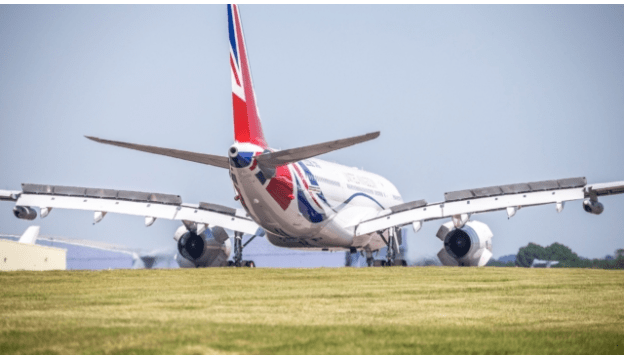
PM’s ‘Brexit jet’ only flown once in promotional role in last five months after £900k paint job

By Dean KirbyNorthern Correspondent inews.co.uk

An RAF plane dubbed Boris Johnson’s “Brexit jet” after being repainted with a £900,000 Union flag has been flown abroad in its promotional role only once in the past five months. 

When the VIP Voyager Vespina aircraft was repainted in “national branding” last summer, officials said it would be used promote the UK around the world while carrying senior royals and ministers on diplomatic and trade missions. 

The RAF Voyager at Brize Norton airbase shortly after it was repainted in 2020

But analysis by i of available flight tracking data suggests the aircraft’s only role in promoting the UK since the end of January has been to take part in a flypast over Athens watched by Prince Charles to mark the bicentenary of Greek independence

When the Trade Secretary Liz Truss landed in Washington earlier this week for trade talks with the US – potentially the Government’s biggest foreign deal since Brexit – she tweeted a picture of herself in front of another RAF aircraft painted in military grey.

The Voyager’s main use has been to refuel RAF fighter planes patrolling the North Sea, where it has been making sorties every few days and could be seen as recently as Wednesday flying at 16,000ft off the coast of Lincolnshire during a five-hour flight. Earlier this month, it joined other RAF planes on a Nato exercise in Europe. 

Andy Netherwood, a former military transport pilot and defence commentator, told i the Voyager has been “rarely used” in its VIP role recently. 

He added: “The £900,000 livery means it wouldn’t be usable on operations requiring an inconspicuous paint scheme. Its usefulness as a troop carrier is also reduced as its economy seats were replaced with fewer business class seats in the front two cabins.” 

The Government says the coronavirus pandemic has meant the plane’s VIP role has been “greatly reduced”. i was unable to verify whether two flights in January, to Athens in Greece and Gander in Canada were RAF operations. 

However, a second jet, a chartered Airbus A321 also emblazoned with a Union flag, leased by the Government earlier this year for an undisclosed sum, has been on frequent visits abroad this year including trips by the Foreign Secretary Dominic Raab to Singapore, Phnom Penh, Hanoi, Brunei, Jakarta and Tel Aviv.

Boris Johnson has been criticised for using that plane to fly from London to Newquay to meet other world leaders at the G7 summit.

The Scottish National Party (SNP) has criticised the cost of the RAF plane’s repainting as a “Tory red, white and blue vanity project” and a “waste of public money”. 

SNP deputy Westminster leader Kirsten Oswald said: “Boris Johnson has been happy to throw taxpayers’ cash at new, unnecessary jets, yachts and Union Jack paint jobs, whilst imposing austerity cuts on the rest of us.” 

The Liberal Democrats‘ deputy leader Daisy Cooper said: “Boris Johnson’s ability to waste taxpayer’s money truly knows no bounds.”

She said: “Wasting money on painting planes while refusing to feed hungry children or properly pay hard-working nurses is just another reminder that this failing PM will always put propaganda over people.”

The RAF Voyager was first repurposed for use by the UK Government in 2015 at a cost of £10m and was used to take David Cameron to the Nato summit in Poland the following year. 

At the time, ministers defending the expenditure, saying it was cheaper than chartering flights and would save around £775,000 a year, with chartered planes costing an average of £6,700 an hour in the air. 

On a trip to South America in 2018, the then Foreign Secretary Mr Johnson said the aircraft was not available to him enough and complained about its dull colour scheme. 

“Why does it have to be grey?” he is reported to have said about its RAF camouflage paint scheme. 

Last year, it was revealed that the repainting of the aircraft was costing the UK taxpayer £900,000 – a move that was condemned at the time as wasteful by opposition parties. 

The Government says the repainting means the plane can “better represent” the UK around the world with national branding similar to many other leaders’ planes. 

A Government spokeswoman said: “The VIP Voyager is used by the Prime Minister, senior ministers and members of the Royal Family for long-haul flights. During the global coronavirus pandemic, the number of such flights has been greatly reduced. 

“Since its livery was updated, the VIP Voyager continues to provide its primary military function of air-to-air refuelling support operations and training.”

East Devon: Mixed views on July 19 lifting of Covid restrictions

If only Boris hadn’t dithered on imposing the first lockdown in March 2020. Remember the Cheltenham Festival…..

If only Boris hadn’t overruled scientific advice for a circuit breaker in September 2020. Remember the “Eat out to help out” August accelerator……

If only Boris hadn’t dithered on imposing the second lockdown until November 2020…..

If only Boris hadn’t let the cork out of the bottle over Christmas 2020. Remember the Alpha variant had started spreading in mid-December…..

If only Boris hadn’t dithered for 17 days before imposing travel ban from those travelling from India in May 2021. The Delta variant became the dominant strain in the UK around mid-May…..

Infection prevalence and incidence would be much lower, and we would be in a better position to open up the economy safely than we are right now.

With a history of being too slow to lockdown; too hasty to open up, why is Simon Jupp so convinced Boris has got it right this time? – Owl

Philippa Davies sidmouth.nub.news

Simon Jupp, East Devon MP; Paul Arnott district council leader; Steve Brown, director of public health, Devon

Simon Jupp, East Devon MP; Paul Arnott district council leader; Steve Brown, director of public health, Devon

East Devon MP Simon Jupp has backed the government’s plans to go ahead with the full easing of Covid restrictions set for July 19, despite rising numbers of cases in the constituency.

But the leader of East Devon District Council, Paul Arnott, has warned that it could be ‘an unwelcome infection accelerator’ that is being introduced too soon.

And Devon’s director of public health, Steve Brown, is urging people to remain cautious, and heed the Government’s guidelines on continuing to wear face coverings in some places.

In the seven days to 7 July, cases in East Devon rose by 64 per cent, climbing from 108 to 277. There are now more than 189 cases per 100,000 of the population.

Mr Simon Jupp said: “Cases here are still lower than the average for the UK. I don’t see any reason not to open up, as long as people follow personal and social responsibility and look after themselves.

“That involves getting the vaccine when it’s their turn, including the second dose and, also, if they choose to, wearing face coverings if applicable.”

“That’s what I’ll be doing. I’ll be taking it on a step-by -step, case-by-case basis to decide whether I want to wear a face mask in a certain scenario.”

“I think moving from mandated state intervention to a more personal responsibility – it’s your choice but you’ve got to be mindful of those around you – is exactly the right way to go.”

“I’m happy for the unlocking to take place next week. I don’t think we can call it “freedom day”, I don’t think that’s helpful as a narrative, but I do think that overall it’s a good thing for our area.”

“At some point, we have to open up. At some point, we have to have some semblance of normality.”

Mr Jupp praised the vaccine rollout locally and nationally and emphasised the importance of opening up fully for the economy.

He said: “We could be cautious forever about new variants that come forward and I don’t think our economy could stand it.”

District council leader urges ‘good sense and consideration’

However, the leader of East Devon District Council Paul Arnott (Democratic Alliance, and leader of the East Devon Alliance) is concerned about full reopening.

He said: “July 19 is destined to be an unwelcome infection accelerator unless people have the good sense and consideration for others to continue to wear masks and maintain social distancing, as at present.

“In my view, with so many local people still at only a single jab [stage], this has come two months too soon and looks like a bid for ‘herd-immunity.’

“I suspect Devonians have more common sense than this and will continue to lead productive lives while continuing to exercise great caution.’

Director of public health: ‘We must continue to stop the spread’

Steve Brown, director of Public Health Devon, has urged people to remain cautious. He said: “There’s no question about us sitting back and doing nothing.”

“We need to take personal responsibility, remain cautious, and continue with the efforts we have made so far in helping to stop the spread.”

“I am pleased to hear clarification from our prime minister that the wearing of face coverings in crowded places – which would include public transport and any indoor space where there are other people – is still recommended, despite it no longer being a legal requirement.”

Petition: Get dark money out of UK politics

www.opendemocracy.net

To: Boris Johnson

  • Stop secrecy over political donations by increasing transparency over dark money donor groups, including so-called ‘unincorporated associations’
  • Keep restrictions to stop millionaire non-doms donating to political parties indefinitely
  • Increase fines for donors who break election laws
  • Accept the recommendations on dark money and transparency set out by the Committee on Standards in Public Life

At openDemocracy we’ve worked for years to expose the malign influence of ‘shadowy’ groups funnelling anonymous money into British politics. And now we’ve revealed that £2.6m has been funnelled to the Tory party via secretive campaign finance groups since Boris Johnson became prime minister.

The British government is proposing new election laws, but they have almost nothing to say about donations like these. So-called ‘unincorporated associations’ can be used to secretly channel money from donors who would never normally be eligible. And millionaires who are based in tax havens (so-called ‘non-doms’) will be able to fund British politics indefinitely.

The UK’s Committee on Standards in Public Life has warned that ‘unincorporated associations’ could be used as “a route for foreign money to influence UK elections”. In a hard-hitting report it’s called for major changes to how politics is funded.

If we’re going to protect our democracy we need to stop dodgy donors from buying political influence. We need to make sure a light is shone on ‘unincorporated associations’. And we need fines to be raised high enough to deter funders from breaking election law.

To do all that we need to show the UK government that the public won’t stand for secretive political donations harming our democracy. Will you take a moment to sign the petition telling the government to clean up UK politics [see link above]?

Neil Parish rebelled against aid cuts

Owl can publish something good about Neil Parish but not, sadly, about Simon Jupp

From Politico newsletter today: 


Those 24 Tory rebels in full: David Amess … Harriet Baldwin … Father of the House Peter Bottomley … Former Northern Ireland Secretary Karen Bradley … Steve Brine … Rehman Chishti … Former Welsh Secretary Stephen Crabb … Former Brexit Secretary David Davis … Defense committee Chairman Tobias Ellwood … Roger Gale … Former Deputy PM Damian Green … NI committee Chairman Simon Hoare … Neil Hudson … Former Foreign Secretary Jeremy Hunt … Pauline Latham … Tim Loughton … Former PM Theresa May … Johnny Mercer … Andrew Mitchell … Women and equalities committee Chairwoman Caroline Nokes … Environment committee Chairman Neil Parish … Mark Pawsey … Bob Seely … Foreign affairs committee Chairman Tom Tugendhat.

This must be a First – Council Leader features in Literary Festival

Windrush – The Soul of a Ship – PAUL ARNOTT –  Budleigh Literary Festival 15 September 

budlitfest.org.uk 

It is rare for one vessel, so lyrically named, to carry the weight of such representation – hope, conflict, imperialism and shame. For three decades the Windrush was the maritime ‘Zelig’ of the twentieth century, playing different roles in the most turbulent years in modern times. Acclaimed filmmaker and Channel 4 producer, and now local politician, Paul Arnott digs into the gripping history of a ship, first designed by a Jewish shipbuilder in Hamburg, who played a role as varied as joy vessel for Nazis and prison ship for Jews, until she famously delivered the first migrants from the Caribbean to an unwelcoming Britain, before sinking off the Algerian coast in 1954. Hear the memories of people inextricably linked to this extraordinary merchant ship at the end of empires.

HOW MANY SHEDS CAN YOU BUY WITH THAT?

David Cameron was paid $1 million a year by Greensill, the FT’s Robert Smith and Jim Pickard reveal. He worked 25 days a year, so that’s the equivalent of £28,000 a day. Or to put it in terms Cameron might understand, he could buy one of his favorite £25,000 garden sheds every day he worked for Greensill, with three grand pocket change per day left over.

(From Politico newsletter)

Devon covid rates rise sharply

East Devon cases rise 64% in a week – Owl

Ollie Heptinstall, local democracy reporter www.radioexe.co.uk 

But hospitalisation and deaths low

Covid infections have risen sharply across much of Devon, with Teignbridge’s rate more than tripling in the past week.

According to data for the week to Wednesday 7 July, Torbay has the region’s highest rate, doubling in a week to 474 cases, a rate of 348 per 100,000 people.

By comparison, the national rate is 312 after another 34,471 cases were recorded across the country.

At district level in Devon, Teignbridge’s rate grew most, with the number of people tessting postive this week more than tripling to 422 (315 per 100,000).

Plymouth’s rate also rose sharply – by more than 150 per cent, with 884 infections recorded in the week, a case rate of 337 per 100,000.

However, the number of infections fell slightly in Exeter and Torridge, the latter of which now has the lowest rate in the south of England at a district level, behind Thanet in Kent and the Isle of Wight.

Elsewhere, West Devon’s rate more than doubled to 117 cases per 100,000, whilst Mid, North and East Devon also recorded significant increases. However, all of these areas remain below the UK average.

Covid in-patients stays low

Despite cases increasing sharply across much of Devon, the number of people in hospital with covid remains very low.

The Royal Devon and Exeter Hospital confirmed  just three  covid patients according to  latest figures (up to Tuesday 6 July), compared to the peak of 128 patients on 24 November 2020.

Plymouth’s Derriford Hospital currently has seven patients, with none in Torbay. However, Torbay did see two patients with covid admitted on Saturday 3 July, the first since 12 April.

North Devon Hospital is currently caring for one patient who is on a mechanical ventilation bed.

It has now been more than two months since anyone died with covid in Devon. The last confirmed case was on Sunday 9 May.

Steve Brown, director of Public Health Devon, says people should remain cautious even though the prime minister has confirmed that the easing of almost all legal restrictions from  Monday 19 July. Face masks are still be advised in crowded spaces.

“There’s no question about us sitting back and doing nothing,” Mr Brown said. “We need to take personal responsibility, remain cautious, and continue with the efforts we have made so far in helping to stop the spread.”

He added: “I am pleased to hear clarification from our prime minister that the wearing of face coverings in crowded places – which would include public transport and any indoor space where there are other people – is still recommended, despite it no longer being a legal requirement.”

Jabs clocking up

The number of adults aged 18 or over who have received at least one dose of a vaccine has increased to almost 86 per cent in the Devon County Council area, 84 per cent  in Torbay and 81.2 per cent in Plymouth.

The proportion of people who are now fully vaccinated with both jabs is now 67 per cent in Devon, 70 per cent in Torbay and 61 per cent in Plymouth.

Planning applicatons validated by EDDC for week beginning 28 June

Message from Sajid Javid, Secretary of State for Health and Social Care, to NHS staff – 2 July

“We’re now on the road to recovery, and just as we start the monumental task of recovering NHS services, I want to give you what you need to recover from this difficult period, and make it as easy as possible for you to do your jobs.”

Sajid Javid – Secretary of State for Health and Social Care, Department of Health and Social Care 2 July healthcareleaders.blog.gov.uk 

To my NHS colleagues,

The NHS is an institution that is close to my heart, and the hearts of so many people across the nation. It was there for the birth of my children, and cared for my father in his final days.

I feel a deep affection for the NHS, and the brilliant people who work there. As the first Secretary of State for Health from an ethnic minority, it’s a great privilege to be representing this diverse institution that represents the very best of modern Britain.

I was determined to get on the frontline and see this for myself. So my first visit as Secretary of State was to St Thomas’ Hospital and vaccination centre, to meet the doctors, nurses, porters, cleaners and volunteers who’ve contributed so much to our fight against this virus, and to our vaccination programme which has given us hope of a brighter future.

We’re now on the road to recovery, and just as we start the monumental task of recovering NHS services, I want to give you what you need to recover from this difficult period, and make it as easy as possible for you to do your jobs.

Just as we recover we must also reform. We are modernising the Mental Health Act to improve services for the most serious mental illnesses. We’ll also keep bolstering the foundations of our NHS. Primary care will continue to be central to our plans to level up the health of the nation, and we’ll continue to build more hospitals and make sure we bring even more people to the front line. Any proposal we bring forward will build on the spirit of integrated working you’ve embraced so enthusiastically, because we know we’re at our best when we work as one.

It’s so important to me that we work together to get this right, and I’m looking forward to meeting as many of you as I possibly can, and to hearing your views.

You’ve all done so much to support this country through this tough 18 months. I will do everything in my power to support the NHS, as we put this pandemic behind us and look ahead to the next chapter.

Sajid Javid, Secretary of State for Health and Social Care

Tories have unhealthy financial reliance on property developers, says report

The Conservatives have an “unhealthy financial reliance” on property developers, with more than a fifth of all donations to the party over the past decade coming from the residential property sector, a report by a leading anti-corruption group has said.

“Build, build, build” – Owl

Peter Walker www.theguardian.com 

While it could not be conclusively proven that government decisions were shaped by this flow of money, such a reliance on housing-based donations created “a real risk of aggregative corruption”, Transparency International said.

The report also highlighted serious concerns about a lack of information on lobbying by housing groups, saying that this, coupled with a rapid turnover of ministers and civil servants, added to the undue influence exerted by the sector.

In contrast, while private renters make up almost a fifth of all households in Britain, there was “a notable absence of tenants at the table” when decisions were made, making it less likely that bold solutions would be made to tackle the housing crisis.

The research, which Labour said illustrated the need for urgent reforms to donation and transparency rules, showed that between 2010 and 2020, the Conservatives received £60.8m in donations from individuals and companies related to substantial property interests. Of property-related donations to all parties, 80% went to the Tories.

Much of this came from a handful of leading donors, the report found. Over the period of 2015 to 2019, 10% of all donations received by the Tories came from just 10 property-linked sources.

The report noted: “While we have seen insufficient evidence to prove beyond reasonable doubt any direct quid pro quo arrangements of donations for decisions, this dependence creates a real risk of aggregative corruption, whereby the actions and judgments of ministers are incentivised by their party’s financial ties to interest groups in this policy area.”

The group also condemned information about lobbying efforts, saying the level of information provided “falls lamentably short of the mark” when measured against expected standards.

In just three years from 2017 to 2020, the research uncovered, ministers held 669 meetings with 894 different interest groups to discuss housing issues, but in more than 40% of cases departmental information described the subjects being discussed only as “housing” or “planning”.

The statutory register of consultant lobbyists gave additional information on only three of these 894 groups attending the meetings.

Another issue of concern highlighted in the report was the lack of “institutional knowledge” within the government given that in the last 20 years there have been 10 community secretaries or equivalent, and 18 housing ministers, with a similarly high turnover of civil service staff.

Duncan Hames, the policy director at Transparency International UK, said the Conservatives’ reliance on property interests was “of serious concern”, while information about lobbying efforts remained “woefully opaque”.

Anneliese Dodds, the Labour party chair, said the research showed “how the rules around transparency for lobbying ministers aren’t fit for purpose”. She added: “We need to know who is lobbying ministers, what they want from government and what is discussed when they meet.”

A Conservative spokesperson said: “Government policy is in no way influenced by the donations the party receives – they are entirely separate.”

Donations were publicly declared and fully legal, and such fundraising was “a legitimate part of the democratic process”, they said, adding: “The Conservative party is delivering on its manifesto commitments to deliver more homes, with new housing supply having risen to its highest levels for 30 years. Working with the housing industry is an essential part of getting new homes built and regenerating brownfield land.”

Ministry of Defence under fire for ‘inventing rules’ to sell wildlife haven

The Middlewick Ranges are an ecological marvel by the standards of 21st-century Britain. The army firing range near Colchester, Essex, has been untouched by a plough for nearly 200 years, allowing skylarks and nightingales to feast on the threatened invertebrates and insects that thrive in the rare acid grassland.

James Tapper www.theguardian.com 

Yet a plan to sell off the ranges to build more than 1,000 homes has prompted accusations from campaigners that the Ministry of Defence (MoD) has rewritten environmental protection rules to suit its case.

Acid grassland – named after the acidic soil that supports fine grasses and lichens – has almost disappeared from England, and is protected under guidelines from the Department for Environment, Food and Rural Affairs (Defra). Planning rules allow developers to build on some types of rare land, including fens, wetland and woodland, so long as they offset the loss by creating replacements. Defra’s Biodiversity Metric allows them to calculate how to do that.

“Under the Defra metric, it says that the score is too high to allow development,” said Richard Martin, from the Save the Middlewick Ranges group. “They couldn’t use it, so they came up with their own one. It’s crazy.”

The MoD’s property arm, the Defence Infrastructure Organisation, agreed the use of a “bespoke metric” with Colchester borough council to push through outline permission to develop the 86 hectare (215-acre) site under the plan. Even worse, according to the campaigners, is how the MoD proposes to replace the acid grassland, by converting farmland nearby.

“They want to put sulphur into the land,” Martin said. “There’s a little brook that runs next to it and all the lands drain into that brook.

“And that flows into Colne Marshes, which is a site of special scientific interest. So you’re going to put sulphur in the rainwater that flows into a SSSI wildlife site.”

The campaigners have been supported by Essex Wildlife Trust, which calls Middlewick Ranges “a major ecological asset” with “precious habitats essential to nature’s recovery”, adding: “We cannot afford to lose them.”

The campaigns resulted in a planning inquiry into how the ranges were added to the local plan, which concluded its hearings earlier this year.

Rosie Pearson, a founder of the Community Planning Alliance, which has advised the campaigners, said: “From a biodiversity perspective, this should be ringing a jumbo alarm bell. The developers couldn’t do what they wanted using the official metric, so they made one up. For the rare species inhabiting the site this could be the death knell – unless the planning inspectorate recognises that what is being attempted is deeply flawed.”

Pearson said developers have been manipulating biodiversity offsetting, adding: “Skylarks are offered ‘offsite plots’ when their meadows are concreted over. Large swathes of ancient woodland have been described as ‘copses’. And arable land is largely dismissed as meaningless for wildlife in the metric.” She said ecological assessments should be done by an independent body, funded by developers, adding: “Local communities should be able to request a second opinion, also funded by the developer, if they have concerns about a report. And government proposals to provide better funding to local authorities for ecology services should be followed through.”

The MoD has defended its plans, saying 63% of the land would be reserved for green open space. It has yet to sell the site to a developer, who would still need planning permission, but if the plan is upheld, opposition would be limited to discussing which parts of the ranges could be built on.

There are more than 460 environmental campaigns across Great Britain according to the Community Planning Alliance, which is concerned that new planning rules – blamed by Tory activists for the Lib Dem victory in the Chesham and Amersham by-election last month – will make it harder for local groups to stop similar developments.

The MoD’s plans rely on a similar project to create acid grassland at the RSPB’s Minsmere reserve in Suffolk.

Adam Rowlands, the RSPB’s Suffolk area manager, who is not involved in Middlewick Ranges dispute, said that creating the acid grassland at Minsmere had taken about 10 years. “It was not an easy task,” he said. “There was quite an intensive period of establishment, scarifying the soils, sowing seed mixes. You can’t just rewild it, otherwise it will turn into scrubland.”

A spokesperson for Colchester borough council said: “Middlewick Ranges is allocated in the Emerging Local Plan for mixed use including housing, open space and community uses.

“The future of the ranges has yet to be finalised, as we continue to await the Local Plan Inspector’s report, but it will be important to ensure residents have an opportunity to comment if the site is included in the Plan.

“Future master planning of the site will need to be undertaken, which will include open space and increased tree-planting, to enhance the biodiversity value of the ranges for future generations of residents to enjoy.

“Whilst we are unable to comment on DIO’s specific plans for the sitethe council remains fully committed to preserving and enhancing all forms of biodiversity in the borough to the greatest extent possible.”

The MoD said: “We continue to work with the council to develop plans for the site, including working with experts to find innovative means to help secure biodiversity. The techniques will be thoroughly tested as part of the examination process.”

July 19: Boris Johnson offers freedom day with health warning – mixed messages?

Boris Johnson will urge people today not to return to life as normal after July 19 unless they want to risk restrictions being reimposed.

Chris Smyth, Whitehall Editor http://www.thetimes.co.uk

As he confirms that all remaining limits on social contact will be lifted in England a week today, the prime minister will emphasise that “caution is absolutely vital” in the face of rising infections.

Wales is to review its restrictions on Thursday and Scotland is due to lift some restrictions on July 19 and most on August 9.

Senior scientific advisers urged people yesterday to continue to work from home over the summer and not to be “overenthusiastic about social contact” because of the risk of thousands of hospital admissions a day.

Susan Hopkins, of Public Health England, said that no one could “ringingly endorse” the decision to lift all restrictions and the country had to be braced for them to return at short notice if hospital admissions rose too much.

Johnson has dropped claims that the end of restrictions is “irreversible” after scientists warned him that the decision to open up fully was a gamble that could go wrong.

The prime minister will strike a wary tone about life after July 19 as he marks the end of lockdown measures with a plea to carry on with many habits formed during the pandemic.

A government source said that “the best way to make sure we never go back is to be cautious”.

Johnson will say that England is “tantalisingly close to the final milestone in our road map out of lockdown, but the plan to restore our freedoms must come with a warning”.

While praising the success of the vaccination programme, which has “weakened” the link between infections and hospital admissions, he will caution that “the global pandemic is not over yet”.

He will say: “Cases will rise as we unlock, so as we confirm our plans today, our message will be clear. Caution is absolutely vital and we must all take responsibility so we don’t undo our progress, ensuring we continue to protect our NHS.”

Hopkins called the decision to end restrictions now a “fine balancing act”, given that a delay could allow more people to get vaccinated, but would risk pushing an exit wave into the autumn or winter and putting even more pressure on the NHS. “I don’t think we know the right answer,” she told Times Radio.

Sajid Javid, the health secretary, has said that cases could reach 100,000 a day and Hopkins said it was “possible” that this could result in 3,000 hospital admissions a day soon afterwards.

“It will depend on the behaviour that we as individuals and the population overall, do,” she said.

There were 31,772 new cases recorded yesterday. The most recent figures for England show 461 hospital admissions on Wednesday.

Hopkins said that January’s peak of 4,000 admissions a day was “three doubling times away from where we are now, and that it was six to eight weeks potentially, unless things change, and unless we keep the transmission rate down”. Vaccination had more than halved the proportion of cases that end up in hospital but there was still a “direct relationship” between the number of cases and pressure on the NHS, she said.

At present 62 per cent of patients in hospital are under 55 as vaccines protect the elderly. Hopkins said that while vaccination had been “highly successful at reducing hospitalisations, it is not 100 per cent effective”. She said now was “not a time to be over-enthusiastic about social contact”, telling people: “We need to be careful, to keep our distance, keep social contacts low, wear masks in enclosed spaces, despite them not being legally required after July 19.”

The government will drop the recommendation to work from home next week, with ministers insisting that it will be up to businesses to decide whether staff come to the office.

Hopkins said: “Over the next four to six weeks that needs to be very cautiously implemented by businesses to keep transmission down.” She advised: “If you are able to do your business effectively from home then . . . we should try our best to do that.”

Sir David Spiegelhalter, professor of the public understanding of risk at Cambridge University, said that the proportion of people infected who ended up in hospital “has dropped a lot. It used to be in the second wave about one in ten. Now it’s about one in 40 because the cases are so much younger”.

But he told the BBC: “That would mean that a hundred thousand cases, if we got there, would be maybe 2,500 admissions a day. That’s very high.”

Spiegelhalter said that with younger people having shorter stays in wards “the actual numbers in hospital would be well below the second wave peak”.

Like it or not, rolling of the dice is under way already

It has always been, we know, a finely balanced decision (Tom Whipple writes). We are about to find out just how finely balanced. No one is pretending that the modelling accompanying England’s reopening, which is expected to be released today, will make for pleasant reading.

Of course, it never has. For six months the Scientific Advisory Group for Emergencies has been predicting that there would be a huge exit wave in the summer. The difference is that where once such predictions were treated with derision — how could we have so many cases when nearly all adults are vaccinated? — they are now treated with fatalism.

When the models are published, the key insight will not so much be in its prediction of the size of the coming wave. Everyone knows it will be big. For those who are immuno-compromised, it is clear this summer will not be one of freedom. Instead, the insight will be in the decision-making process — about how much morbidity and mortality the government is prepared to stomach, and how certain it is that both will stay within “acceptable” limits.

As Boris Johnson prepares to formally announce the lifting of all English restrictions, modellers from Warwick, the London School of Hygiene and Tropical Medicine and Imperial will have already told him how many daily Covid hospital admissions they expect. At the weekend we breached 500. A peak of 1,000 a day seems conservative; 2,000 does not seem inconceivable.

They will also have made it clear we are now rolling the dice. Many scientists vociferously oppose the nation’s acquiescence into mass infection. Others think that, with vaccination falling among the young, with the huge economic costs of social distancing, and with no plans to vaccinate children, it is our only option to reach herd immunity, and delaying opening simply delays deaths. But even that option becomes untenable if the NHS becomes overwhelmed.

In the modellers’ graphs there will be a “confidence interval”, showing the range of likely outcomes. How high will hospital admissions go? Four thousand a day was the figure that nearly toppled the NHS in January. With a backlog of other patients and an exhausted workforce, NHS leaders think even that might be too much.

Last week more than 100 scientists wrote a letter to The Lancet decrying England’s reopening plans as an unethical experiment. They predicted that it would burden the nation with long-Covid-related disability for a generation, create ideal conditions for a vaccine-escape variant, and needlessly cause hundreds, probably thousands, more deaths.

Those points are reasonable, even if some are arguable. But there is a corollary. If mass infection really is an experiment, it is one that has already begun. The relaxation on July 19 might push cases higher but our wave is well under way. If you don’t like 100,000 cases a day, it’s hard to see why 50,000 is acceptable.

If our only goal were to prevent Covid hospital cases, it is clear the best thing would be to reimpose lockdown and start vaccinating teenagers. For reasons of politics, logistics and national exhaustion, that seems highly unlikely.

What have I learned since shooting to fame? We need more compassion in public life | Jackie Weaver

Six months ago the video of a fractious meeting of the Handforth parish council propelled its attenders – myself included – into the spotlight. I’ve been on quite a journey ever since and while I have mostly enjoyed the ride, I can’t pretend it’s been devoid of bumps or bruises. I’ve tried to learn as much as I can from the rough and the smooth, the peaks and the troughs, and I felt like this was an opportune moment to share some of those lessons.

Jackie Weaver www.theguardian.com

First, the good stuff. I have met some amazing people – from the exotic world of showbusiness to the more familiar environment of local government. Making so many new acquaintances in a short period of time has made me a connoisseur of first and lasting impressions and I can say with confidence that it is people’s kindness, generosity and warmth, not their individual skills or achievements, that has stuck with me. These qualities are memorable because they are powerful. We are social creatures and it is through cooperation, collaboration and compassion that we achieve great things.

But while I have learned a great deal from the kindness and love of strangers, I have also become the unwitting target for trolls and bullies. I should stress that overwhelmingly the interactions I have with people online are positive, friendly and constructive but the abuse is, though infrequent, hard to ignore and impossible to forget. Much of it is sexist in nature – men who don’t like the idea that, as a certain parish councillor might have put it, I “have the authority” to speak on particular matters or share my views. I’ve been told on numerous occasions to shut up, pipe down or get lost. People sometimes comment on my appearance (as if it were relevant) or remind me that fame can be fleeting (as if I weren’t aware). One individual, who will have to remain anonymous, has taken to contacting me on a regular basis to tell me that they have seen through my facade to the calculating, toxic and manipulative individual that supposedly lies beneath.

In writing this, I acknowledge that the abuse I have received has neither been as relentless nor intimidating as that experienced by many women in the public eye, especially women of colour. But it has served as a salutary reminder that we must relentlessly defend the basic values of compassion, inclusion and cooperation: though the trolls may be few in number, their voices are loud and uncompromising. We must not allow this to become normal.

Which leads me to my recommendations for revitalising the soul of our body politic.

First, we have to tackle online abuse. The online safety bill that will soon be progressing through parliament couldbecome a landmark piece of legislation – a world first – in addressing this scourge. To be effective, it needs to significantly reduce the number and reach of anonymous social media accounts (the source of most misinformation and hate online) and enforce a new duty of care on social media sites towards their users. These platforms have, for too long, benefited from a laissez-faire system of governance that has allowed misinformation and abuse to spread with impunity. The government needs to catch up.

Second, we should substantially enhance the standards of behaviour expected of local and national politicians. Two quick and effective changes could help to make this happen. It should become the norm – enforced by legal action if necessary – that local councillors either resign or are removed from their post for a fixed period if they are found to have contravened their authority’s code of conduct. No such provision exists and, as I have documented before, this means that councillors found guilty of racism, sexism or homophobia can continue in their role. This unconscionable practice legitimises bad behaviour, low standards and poor governance. If we are to attract a wider demographic to stand in elections, we must redouble our efforts to make the environment they enter as safe as possible.

Further, I would like to see a law introduced to tackle lying in politics at every level. Compassion in Politics, for which I am an ambassador, is campaigning to make it illegal for politicians to wilfully and repeatedly lie to the public. Given the serious nature of their position and the responsibilities they have to the public, the least we can expect is that politicians will be honest, open and transparent.

Last, I think we should be looking to nurture an ethos of compassion, inclusion and kindness in every level of society, in every aspect of our economy, and in every layer of government. These are the values that have helped to save and protect lives through the Covid crisis and brightened the darkest of our days. We should bring compassion training into schools and workplaces and devolve more power, autonomy and resources to local communities. We cannot expect to resolve complicated problems such as pandemics, climate breakdown and inequality if we fight among ourselves. Take it from someone who has met many new people in the past few months – kindness and compassion are more likely to win you friends and influence than their opposites.

  • Jackie Weaver is chief officer of Cheshire Association of Local Councils and an ambassador of Compassion in Politics