Tory MP fears Boris Johnson will delay Covid restrictions needed after summer

Covid restrictions will probably need to be reimposed across England after summer but the government may again delay doing so, a Conservative MP helping lead a Commons inquiry into ministers’ handling of the pandemic has warned.

Aubrey Allegretti www.theguardian.com 

Dr Dan Poulter, who has also been working on the NHS frontline since the outbreak began, said “challenging mutations” of the virus would probably emerge and set back a “return to normality” until at least 2022.

Boris Johnson is expected to announce on Monday that most legal constraints will be scrapped from 19 July, as part of a pivot to telling people they must learn to live with the disease.

Poulter, a vice-chair of the all-party parliamentary group (APPG) on coronavirus, said there was “a sense of worry” about the full unlocking, particularly about the risk that many young people – most of whom are not yet fully vaccinated – could develop long Covid.

With the number of cases rising to levels not seen since January this year, he said a “greater pool of the virus” meant “a higher chance of mutation occurring” and a variant emerging that was much better at evading current vaccines.

Infections could soon reach 100,000 a day, the new health secretary, Sajid Javid, recently said – a substantially higher figure than the 68,053 recorded on 8 January 2021.

Layla Moran, the Lib Dem MP who chairs the APPG, also said she thought ministers had not learned crucial lessons and that her group – set up to scrutinise the government’s decisions and save lives – could be needed for another four years.

After it was set up last July, 73 MPs and peers from eight Westminster political parties came together to hold 25 oral evidence sessions and make more than 50 recommendations to ministers.

Moran said the government was “playing Russian roulette” by gambling on the outcome of the pandemic, and voiced concern that some form of lockdown might be needed in the autumn.

She said people could die unnecessarily if the unlocking turned out to have been “reckless”. “It pays to not assume you’ve got ahead of the virus, because it seems to always get a toehold at the moment that you think you’re on the path to beating it,” Moran said.

Her caution was echoed by Poulter, who said he anticipated a “challenging winter” with the combined pressures of Covid and flu. “The idea that we are fully done with restrictions, I would suggest, is unrealistic,” he said.

“It’s a matter of some concern when people are talking about a return to normality, when we have enough evidence from the last 18 months that we’re going to have to be living with the virus for a lot longer.”

Asked whether he was concerned the government could delay introducing tougher measures – as Johnson did last autumn, against the advice of his scientific advisers – Poulter said it was indeed an anxiety.

“As is inevitably the case with governments … going into reverse gear or changing direction is sometimes quite difficult,” he said. “But I hope that if the data and the evidence suggests that we need to reintroduce restrictions, which I fear it may well, that the government will listen to the chief medical officer and follow the data.”

Tory MPs disable NHS app to ‘protect their holidays’

“Stay home. Protect the holiday. Save your marriage.” was the slogan being banded around the Commons tea room.

By Flash Finance www.thelondoneconomic.com 

Conservative MPs are reportedly deleting the NHS app to circumvent instructions to self-isolate ahead of their holidays, according to The Times.

Concern over the effectiveness of the Track and Trace system was called into question this week as reports emerged that many people were disabling the Covid-19 app as alerts rise by 60 per cent.

Secretary of State for Transport, Grant Shapps, today confirmed the app would undergo changes to make allowances for the end to social distancing restrictions on 19 June.

“As our restrictions change, of course the app needs to change in line,” said Grant Shapps in an interview with the BBC this morning.

“I think the app is very important as one of the tools in our armoury – it is another way to regulate and give people more information about whether they may have been exposed.

“It’s in our interests as a society to carry on doing the things which help protect each other and we will make sure the app is constantly reviewed so it’s appropriate for the period of time that we’re living through, particularly now as we get into the majority of adults having been double-vaccinated thanks so the incredible vaccine roll-out.”

“Taking batteries out of the smoke alarm

But Sir Keir Starmer has raised concerns around decisions to “tune” the sensitivity of the app.

He said: “It’s like taking the batteries out of the smoke alarm: it is so obviously to weaken the defences that we have – and if the consequence of the prime minister’s decision is that people are deleting the NHS app, or the app is being weakened, then that’s a pretty good indicator that the decision of the prime minister is wrong,” he said.

The dropping of all restrictions on 19 July for so-called ‘Freedom Day’ is drawing growing criticism on the world stage.

“The world is at a perilous point in this pandemic. We have just passed the tragic milestone of four million Covid-19 deaths, which likely underestimates the overall toll,” said Dr Tedros Adhanom Ghebreyesus, WHO director-general.

“Some countries with high vaccination coverage are now planning to roll out booster shots in the coming months and are now dropping public health social measures, relaxing as though the pandemic is already over.”

Rapid growth in infections

Despite encouraging data showing lower infection prevalence in people who have had both doses of the vaccine, there is rapid growth in infections, especially among younger people.

According to most recent data from Imperial College London, the highest prevalence was found in 13–17-year-olds, in which the rate of infection has increased from 0.16 per cent to 1.33 per cent since 7 June.

The six key tests that campaigners are using to assess new planning bill – CPRE

We join other leading charities including RSPB and the Wildlife Trusts in releasing six tests that new planning rules must pass to put people and nature first.

 www.cpre.org.uk 6th July 

We’ve worked with other major charities to create six measures that we’ll use to scrutinise the government’s upcoming planning bill.

The six tests provide a scorecard that uses the government’s own wording, from its Planning White Paper, to critically assess whether its vision for planning will become a reality in the Planning Bill.

Passing these tests would mean that the plans laid out in the government’s future planning bill make for the nature-friendly, low-carbon, well-designed, affordable homes and places of the future that nature and people deserve.

A wide-ranging coalition

22 organisations have come together from a range of areas to create the six tests. The coalition includes not only charities such as CPRE, the countryside charity and Friends of the Earth but also voices from the worlds of transport – Cycling UK – and nature – the Woodland Trust, RSPB and the Bat Conservation Trust.

This powerful coalition, which also includes Greenpeace, the Ramblers and The Wildlife Trusts, understands the power of planning to create thriving, sustainable housing that our communities will feel proud to call home.

As our CEO, Crispin Truman, puts it: ‘Planning has enormous potential to reshape society and create healthy, low carbon and thriving communities.’

These tests provide the framework to track government progress towards creating a planning system fit for the future by judging each criteria red, amber or green at key milestones.

Success or failure in six areas

The tests include measures across six key areas:

  • Local democracy. This includes ensuring that future planning rules retain and enhance genuine, accessible community participation and accountability throughout the planning process.
  • Affordable homes. An ongoing challenge, especially in the countryside, the government must deliver an evidenced strategy for building affordable homes and provide local authorities with the power to turn down developments that don’t create affordable housing.
  • The climate emergency. Any plans must see an acceleration of climate action to meet the UK’s net zero targets and make sure that local planning authorities are given powers to deliver climate-friendly developments.
  • Nature: Sites that are important for biodiversity and nature’s recovery must be protected – and new developments must enhance nature.
  • Heritage: Heritage sites and landscapes with special protections must be kept safe and protected from inappropriate development.
  • Health: The importance of human health, wellbeing and equality should be embedded into any new planning system, including prioritising access to natural green space, active travel and reduced air pollution.

The six tests document revisits commitments made by the government and sets out ways to measure success when they release their imminent response to the Planning White Paper.

The contents of this response will give an indication as to whether or not ministers have heeded the much-repeated concerns from this coalition of organisations.

Now: time to change for the better

As they stand, current plans don’t meet these essential criteria for making the planning system better – especially around ensuring local voices are heard.

As Crispin says, ‘what the government is currently proposing would push planning in the opposite direction. Surely, we should be encouraging more people to take part in the planning process, not alienating whole communities which will undoubtedly be the consequences of the government’s changes to planning?’

Crispin warns that significant changes to the government’s current intentions are needed before the planning rules will really work to meet the country’s needs:

‘Unless ministers change direction, they’ll not only fail many of these key tests but will have failed to reach the ambitions espoused in their own Planning White Paper. Communities, Parliamentarians and campaigners are already ‘seeing red’. That’s why we’re calling on the government to urgently change course and put people and nature at the center of the upcoming Planning Bill.’

More outside dining and takeaway pints to continue with ‘levelling up’ agenda

From our Local Enterprise Partnership we’ve had the “Golden Opportunities”, from the Great South West the “Green Jobs Boom”, Simon Jupp thinks “Banging the Drum for Hospitality” is the most important thing to do. Now Boris’ new catchphrase is regenerating the “Great British High Street”. When we will see some actual investment?-Owl

Fionnula Hainey www.manchestereveningnews.co.uk 

More outdoor dining and the continuation of takeaway pints are at the heart of new government plans to ‘level up’ the country, Downing Street has said.

A new strategy to boost local communities will focus on the regeneration of the great British high street, according to the government.

The plans are set to be outlined by prime minister Boris Johnson in a speech next week.

During his 2019 general election campaign, Mr Johnson insisted he would strive to fix regional inequalities in the UK.

Downing Street describing ‘levelling up’ as the “central purpose of his premiership”.

Restaurants, pubs and bars will have more opportunities to serve customers outdoors with the extension of pavement licences, which will then be made permanent, the government said.

Takeaway pints will continue for another 12 months as the temporary permissions for off-sales of alcohol are extended, in what is hoped to be a boost to the hospitality industry.

A government spokesperson said: “The prime minister is determined to level up the UK and deliver a fairer, stronger society – one where whatever your background and wherever you live, everyone can access the opportunities they need to succeed.

”While talent and potential is distributed evenly across this country, opportunity is not.

“That’s why as we emerge from the pandemic, it’s vital that we do not make the mistakes of recovery from the financial crash and seize this moment to ensure a better quality of life for people in every part of the UK.”

No 10 said the prime minister’s upcoming speech will cover creating a more balanced economy with high-quality jobs in every part of the UK, levelling up between generations, increasing access to opportunity no matter where people live, investing in infrastructure and skills, strengthening community and local leadership and restoring pride in place.

Plans also include supporting local sports teams by building new grassroots sports facilities – the equivalent to 50 new artificial pitches, the government said.

Sage underestimated English Covid admissions by a third

Oooops! – Owl

Tom Whipple, Science Editor | Kat Lay, Health Editor www.thetimes.co.uk 

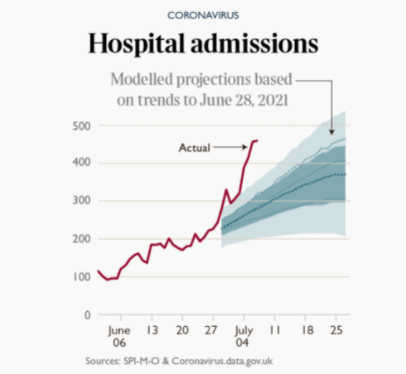
Government modelling from two weeks ago underestimated the level of hospital admissions by more than a third, according to newly released documents.

Projections produced by Spi-M, the Sage modelling committee, on June 28 estimated that there would probably be about 275 daily hospital cases in England by about July 6, with an upper estimate of 350.

In reality on July 7, the latest date for which figures are available, there were 461 people admitted to hospital in England, and admissions were rising at a significantly higher rate than expected.

The discrepancy suggests that crucial decision-making at the time around reopening would have been informed by assumptions that turned out to be overly optimistic.

However, it came after a period when admissions had been significantly below those predicted by earlier models,which led some Sage scientists at the time to suggest that the delay to reopening might have been unnecessary.

Dr Stephen Griffin, from the University of Leeds, said that continued confusion over hospital admissions and their link to cases highlighted the uncertainty in relaxing restrictions.

“While we can’t say for sure that hospitalisations might follow this precise trajectory, it seems likely that they will track the exponential growth in cases we are seeing. Thus, as many are predicting, the dropping of restrictions on July 19 represents an unacceptable and unnecessary risk,” he said.

Neither should hospital cases be viewed as the only relevant metric. “There seems no accounting whatsoever of morbidity in the government plans, and there will be many, including younger people and children, that become seriously unwell,” he said. “Even before the 19th, Delta is out of control, we must not let this run rampant, let alone add more fuel to the fire.”

One of the key concerns about high caseloads over the winter appeared to have been tempered yesterday, with data from Public Health England [PHE] showing that two vaccine doses offered strong protection for most of those who are immunosuppressed.

The study involved a million participants with different conditions that made them clinically vulnerable. It found that overall in this group both the Oxford-AstraZeneca and Pfizer- BioNTech jabs offered 60 per cent protection after one dose. After two doses, the AstraZeneca vaccine offered 80 per cent protection from symptomatic disease. The Pfizer jab offered 89 per cent protection for over-65s, but data was unavailable for younger people.

Among those whose immune systems had been compromised, there was only 4 per cent protection after a first dose, but 73 per cent after a second.

The figures come with some uncertainty due to the smaller numbers involved. Blood Cancer UK said it was also concerned that people with different immune problems were grouped together. Gemma Peters, chief executive of Blood Cancer UK, said: “While there is a lot of uncertainty, there is enough reason to think the vaccines may not work as well for some people with blood cancer to continue to be cautious even after having both doses.”

Dr Mary Ramsay, head of immunisation at PHE, said the findings showed it was vital that anyone with an underlying condition got both doses.

‘Dread and anxiety’ among NHS staff as Covid cases surge again

First an extract from this week’s letter to the “Lancet” criticising Boris Johnson’s “If not now, when?” freedom day strategy.

“Fourth, this strategy will have a significant impact on health services and exhausted health-care staff who have not yet recovered from previous infection waves. The link between cases and hospital admissions has not been broken, and rising case numbers will inevitably lead to increased hospital admissions, applying further pressure at a time when millions of people are waiting for medical procedures and routine care.”

Second in May 2020 Owl wrote:

Owl hears a lot about NHS capacity being measured in terms of the supply of PPE, number of beds and ventilators etc, not much about the limits of human endurance. In a couple of articles Owl has posted recently, Max Hastings has drawn comparisons between this emergency and the way resources are, or have been, mobilised in war. One wartime experience is a recognition of “battle fatigue” and the need  to manage this through “troop rotation” (either as individuals or as units) to maintain full efficiency. (Owl uses the recognised military terms tofacilitate research searches.)

Frontline NHS staff have been working at full stretch in extremely stressful conditions. It is unlikely that this peak work rate could, or should, be sustained indefinitely.

Today, we have:

Dread and anxiety’ among NHS staff as Covid cases surge again

Denis Campbell www.theguardian.com 

“NHS staff have a sense of dread about what’s around the corner. While we understand things need to open up some time, the timing feels like utter madness while we are so close to successfully vaccinating the population, and with a more contagious variant circulating.”

That view, expressed by a frontline respiratory consultant, is widely shared across the NHS. The doctor concerned has already grappled with the first two waves of Covid. She is now steeling herself for the next one which, despite being in its early stages, has already led one major hospital trust, in Leeds, to cancel scheduled surgery, including several cancer operations.

Among an NHS workforce weary after 16 months dealing with the pandemic there is a mixture of apprehension, nervousness, fear, a here-we-go-again resignation at the return of a familiar foe, stoical readiness to do their best again, and also anger that they will have to.

The same doctor adds: “We’ve seen a steady increase in [Covid] numbers over the past few weeks and are back to having a full Covid ward and patients on intensive care. While they are overall a lot younger, sadly deaths are slowly creeping up despite this.

“Healthcare professionals are deeply anxious about the impact of relaxing restrictions further given the current surge in Covid cases. To do away with risk-mitigating measures like social distancing and wearing of masks is incomprehensible to many of us. I feel anxious and frustrated.

“The dread and anxiety are because we’ve been here before, we’ve lived through the first two – or three depending on where you are – waves. We don’t want to be back in that place where we are on ‘escalation’ rotas, routine work is cancelled and we are dealing with deaths that we believe could have been preventable with a better public health strategy.”

Dr Nick Scriven, the immediate past president of the Society for Acute Medicine, who works in a hospital in Yorkshire, says: “Us up north are experiencing a fourth wave in community cases, with an uptick in hospital cases. Although numbers are not massive it’s both frightening and upsetting for staff as ICU cases are rising with unvaccinated people, either as they are young or by choice or both. There is to me a growing feeling that vaccination makes this almost preventable.”

However, doctors and hospital bosses are a bit more relaxed about the coming next surge in cases because they expect it to be different to the intensely demanding first two: smaller, less dramatic and less likely to cripple the NHS. Dr Rupert Pearse, an intensive care consultant in London, tweeted sardonically last weekend to say: “As we did in November 2020 we are projecting a ‘slow burn’ of hospital admissions rather than a third wave. Let’s hope our forecast is more accurate this time.”

Covid admissions to hospitals generally and intensive care units specifically are going up again, reflecting the sharp recent growth in infections. But the numbers involved remain low compared with spring last year and last winter, and the trajectory, while unmistakably upward, is nothing like as vertical as it was then.

Chris Hopson, the chief executive of hospital group NHS Providers, says: “For this set of variants, vaccines have broken the link between infections and previously high hospitalisations/mortality rates. So there’s high confidence among trust leaders that increasing community infection rates, even to the levels we saw in January, will not translate into the levels of hospitalisation and mortality we saw in that peak; a peak that brought extreme pressure to the NHS.”

But Hopson said in a thread of tweets this week on the NHS’s readiness to withstand the next wave that even a smaller surge in Covid cases posed a threat to a health service that is already – and official figures bear this out – the busiest it has ever been.

He pointed to the NHS’s efforts to tackle the huge backlog of people needing hospital treatment and deal with the record number of people turning up at A&E, while trying to give tired, stressed staff some much-needed time off and function with fewer beds than pre-pandemic because social distancing in hospitals means an eight-bed ward now contains just six. He is also increasingly concerned about the burden that the rising number of cases of “long Covid” is now placing on hospitals – a much less prevalent problem during the first and second waves.

Scriven says: “It’s overwhelming busy even without another Covid wave. Moving forwards, the government-projected rise [in infections to 100,000 a day] due to unlocking is a concern. Even if the hospital numbers don’t reach the same levels, the NHS is in a really difficult place. Any rise in Covid will seriously challenge elective [surgery] recovery and urgent and emergency care that is already struggling under the demand.”

Hopson and his counterpart at the NHS Confederation, Matthew Taylor, have warned in recent days that a new influx Covid-positive patients arriving when an overloaded, under-staffed service is facing winter-like demand for care in July would inevitably force hospitals to limit the amount of surgery they can perform. “Any significant Covid surge this summer will place even more strain on a system struggling to cope,” said Taylor.

With ministers putting pressure on the NHS to give the 5.3 million people on the waiting list in England the treatment they need as soon as possible, the service’s inability to do so – and the prospect of a fresh suspension of normal care – could become a key political issue.

Hopson points out that this time around the risk for the NHS is not “the likely absolute level of Covid-19 hospital admissions”, which thanks to the vaccination programme should be much lower than before. It is more about the next wave’s timing and the service’s underlying fragility after a decade of austerity funding and chronic staff shortages.

Delays to surgery can have consequences, he says ominously, suggesting they may prove unavoidable, depending on events outwith the health service’s control, especially what happens in England after “freedom day” on 19 July. “Trust leaders obviously have a mission to avoid any unnecessary harm. So they are instinctively uneasy about potential harm to any patient. But they also recognise wider issues at stake here.”

Pebblebed Heaths car parking “improvements”

Some of you may have noticed a group of planning applications validated for week beginning 21 June for a number of car parks on the Pebblebed Heaths.

They are grouped under this group application. and cover Stowford Woods, Frying Pan, Four Firs and Joneys Cross.

It is a response to the increased “footfall” pressures caused by “build, build, build”. Note the phrases “gathering” and “flexible visitor management” – Owl

Extracts from Pebblebed Heaths Car park strategy 2019 

The primary objective of this car parking strategy is to safeguard the SPA protected bird species (Nightjar and Dartford Warbler) and SAC heathland habitats from the adverse impacts and disturbance caused by people, particularly from dogs that are not on a lead. The principles applied to the car parking strategy seek to achieve this through: –

  • ‘gathering’ visitors towards car parks that are away from sensitive locations and towards those that have less impact on protected habitats and species.
  • retaining and developing the formal car parks that are as close as possible to the points of entry on to the Heaths, adjacent to the principal roads where the car parks are easy to find and easy to sign (e.g. car park name signs) thereby reducing car movements across the heaths and the scattered informal parking that occurs consequentially. 
  • maintaining the current number of car parking spaces across the heaths.  establishing nodes as the starting point for promoted trails, to direct people away from sensitive areas at key times of the year and to create welcoming, attractive locations where visitors can engage with interpretation, messaging and wardens about the nature, value and significance of the Pebblebed Heaths and particularly about responsible dog walking. 
  • the development of cost-effective design and build standards that are appropriate to a countryside location within an AONB and maintenance of surrounding vegetation that gives confidence to car park users that they and their vehicles are secure when using the car parks.
  • the partial, phased or seasonal closure of several car parks to enable a flexible approach to visitor management. 

…..Whilst this report does not recommend charging for parking to manage visitor numbers, as payment for parking at formal car parks is likely to displace visitors across the SPA/SAC undoing the principle of gathering visitors at nodes, the report does discuss charging options being adopted by other countryside managers. 

Labour win seat on East Devon District Council for first time in a generation

So there was no LibDem surge in Feniton where Linda Baker, for Labour, proved Owl’s judgement fallible by coming second, pushing Todd Olive into third place! Worth pointing out that the Conservative win in Feniton would have been be very insecure if the opposition had coalesced around a single candidate.

But Owl was right in describing Jake Bonetta, Labour, in Honiton St Michael’s as an “impressive head on young shoulders” with his decisive win.

Owl believes he is the sort of young blood local government needs more of.

Pity that Feniton chose “Male, pale and stale” and that the turnout was so low.

See also https://seatonmatters.org/2021/07/09/congratulations-to-labours-jake-bonetta-for-honiton-win/

Here is Devon Live on the result:

Joe Ives www.devonlive.com

Labour has won a seat on East Devon District Council for the first time in a generation after claiming a by-election victory in Honiton.

Cllr Jake Bonetta, 19, took the Honiton St Michael’s seat in Thursday’s by-election, becoming both the youngest representative on the council and the first from his party in more than 20 years to sit on the council, in what was a gain from the Liberal Democrats.

In Feniton, the Conservatives gained the seat, with Alasdair Bruce claiming victory in what was a gain from the Independents, with Susie Bond, who previously held the seat, having moved to Berkshire to be closer to family.

Speaking after his win, Cllr Bonetta said: “It’s an astounding victory for the community and I want to thank every single person who got involved in my campaign and entrusted me with their votes.

“I really will work for everyone, no matter how you voted. I think it’s so important that I’m there to represent every single person in Honiton St Michael’s.”

Cllr Jake Bonetta, Labour councillor for Honiton St Michael's

Cllr Jake Bonetta, Labour councillor for Honiton St Michael’s

He added: “I think that my young age is an asset. I think it brings new life to the council. I think it brings a new perspective and on top of that I think it’s so important that young people do get involved in politics.”

Cllr Bonetta, who replaces Liberal Democrat Luke Jeffrey who previously held the seat before resigning to focus on his university studies, is currently the youngest secretary for a constituency Labour Party in the country, and becomes the youngest councillor on East Devon.

Cllr Bruce, who was not present at the count, is a beekeeper, and was previously a Thanet councillor from 2007 to 2015.

Alasdair Bruce, Conservative councillor for Feniton

Alasdair Bruce, Conservative councillor for Feniton

The make-up of the council is now Conservatives (22), East Devon Alliance (13), Independents (15), Liberal Democrats (7), Green Party (2) and Labour (1), with Cllr Bonetta expected to join the governing coalition the Democratic Alliance, currently made up of the East Devon Alliance, Liberal Democrats, Greens and some of the Independents.

Speaking after the election, Cllr Paul Arnott, leader of the council, said: “As leader of East Devon Council it is my absolute determination to work with successful candidates from all party backgrounds and I look forward to working with Alasdair for Feniton and Jake for Honiton. I’m sure they’ll both give eminent service.”

Conservative Jenny Brown, who missed out in Honiton St Michael’s said: “We worked hard. Jake was a worthy opponent and he’s got the town at heart as well – and so have I, and I’m going to be back!”

Labour’s Linda Baden, who lost in Feniton, stayed hopeful: “I think it shows we have a possibility of actually attracting many more votes to the Labour Party, which I think is really positive.”

Lib Dem candidate Todd Olive said: “Obviously my thanks, my gratitude to the 82 voters who put their trust in me to represent them at the district council.”

“Congratulations to Alasdair Bruce, the victor. I hope he serves the residents well, listens to their interests and acts on the urgent issues of our time.”

FENITON

Alasdair Bruce (Conservatives) 239

Linda Baden (Labour) 126

Todd Olive (Liberal Democrats) 82

Turnout 21 per cent

HONITON ST MICHAEL’S

Jake Bonetta (Labour) 807

Jenny Brown (Conservatives) 522

Jules Hoyles (Liberal Democrats) 63

Turnout 25 per cent

Labour wins Honiton St Michael’s

Jake Bonetta (Lab) won yesterday’s by-election with 807 votes to 522 for Jenny Brown (Con). Jules Hoyles for the Lib Dems polled 63. Turnout only 25%. He will now be the first Labour councillor in East Devon for 20 years (and the youngest)

In Feniton, Alasdair Bruce (Con) was elected with 239 votes to 126 for Linda Baden (Lab). Todd Olive for the Lib Dems polled 82. Turnout was only 21%.

Persimmon snaps up 10,000 plots of land in six months

Strong home buyer demand boosts Persimmon as it snaps up 10,000 plots of land in six months and brings dividend payment forward

Jane Denton www.thisismoney.co.uk 

  • Housebuilder Persimmon’s revenue increased to £1.84bn in the first half 
  • The FTSE 100-listed group has snapped up 10,000 plots of land in six months 

Published: 10:30, 8 July 2021 | Updated: 10:36, 8 July 2021

Strong demand from buyers and rising property prices helped housebuilder Persimmon bolster its bottom line in the first six months of this year.

Revenues swelled to £1.84billion in the first half, up from £1.75billion over the same timeframe pre-Covid in 2019.

The group snapped up 10,000 new plots of land at 48 sites over the period and had a forward order book at the end of June totalling £1.82billion.

With sales on the up and mass land buying in full swing, Persimmon revealed it will be doling out cash to shareholders sooner than expected.

The group, which has £1.3billion worth of cash stashed away, is bringing its next scheduled 110p a share dividend payment forward to 13 August. For the full year, shareholders will be receiving 235p a share payouts. 

Persimmon is the latest in a string of housebuilders to post strong figures covering the last few months. On Wednesday, Redrow and Vistry both announced robust sales amid high demand from buyers. 

Steve Clayton, fund manager of the Hargreaves Lansdown Select UK Income Shares fund, which has a holding in Persimmon, said: ‘These are good times for housebuilders. 

‘The customers want to buy and financing is easy, with mortgage availability improving, at rock bottom rates. 

‘The challenge is to keep all the ducks in a row, because cost pressures are bubbling away, staff are hard to find and the government can change the degree of market support provided to homebuyers when it chooses.’

Dean Finch, Persimmon’s chief executive, said: ‘Customer demand for our new homes has been strong right across the UK with healthy sales reservation rates through the period.’

The York-based company delivered 7,406 new homes in the first half, up from 4,900 in 2020, but down slightly from 7,584 over the same period in 2020. 

The group, which is Britain’s second biggest homebuilder, said it expected to operate on around 300 sales outlets on average throughout the year.

The FTSE 100 company said the average selling price of new homes forward sold to owner occupiers was £250,350 in the first half, marking an increase of 3.3 per cent on the year before, when the average price tag was £242,400.  

Shares in Persimmon dropped this morning and are currently down 2.87 per cent or 88p to 2,982.00p. A year ago the share price was 2,433.00p, meaning it has risen by over 23 per cent in the last year.

Steve Clayton adds: ‘Persimmon is performing well and throwing off increasing amounts of cash. 

‘Sales rates per site are running 20 per cent ahead of pre-pandemic levels and prices are rising by almost 5 per cent per annum. 

‘That’s enough to offset the cost pressures unfolding across the construction sector. The group has upped its rate of land buying in the face of strong customer demand for new homes.

‘The cash is building up, with the group now sitting on £1.3billion of funds, with only £100million of land purchase obligations to meet.’

He added: ‘That’s an increase of half a billion pounds over the last year and the group are accelerating their cash returns to shareholders, bringing the next scheduled 110p per share payment forward to August. 

‘With Persimmon now paying a total of 235p per share, that puts the stock on a yield of 7.5 per cent, backed by a business that is performing strongly with cash in the bank.’ 

Richard Hunter, head of markets at Interactive Investor, said: ‘The withdrawal of the stamp duty holiday and other government assistance schemes have yet to fully wash through to the wider economy, and could yet stymie the nascent recovery in terms of unemployment and general consumer confidence. 

‘By the same token, Persimmon is confident of the long term prospects for a housing market which is still undersupplied and where low interest rates and mortgage availability are notable tailwinds.

‘With accompanying comments also upbeat on trading conditions generally, Persimmon is set fair to push further ahead.’

Some links in this article may be affiliate links. If you click on them we may earn a small commission. That helps us fund This Is Money, and keep it free to use. We do not write articles to promote products. We do not allow any commercial relationship to affect our editorial independence.

Housing boom takes Persimmon sales past pre-pandemic levels

Persimmon sales rose above pre-pandemic levels in the first half of 2021, as tax cuts and booming British house prices continued to benefit housebuilders.

So, no need to plead poverty and argue that “affordable” housing targets are too challenging! – Owl

Jasper Jolly www.theguardian.com 

The UK’s largest housebuilder said on Thursday that revenues reached £1.84bn in the first six months of 2021, outstripping the £1.75bn recorded in the same period of 2019. Persimmon’s sales had dropped to £1.2bn during the first half of 2020.

The housing industry had feared financial difficulties in 2020 when home sales were temporarily blocked during the UK’s first national lockdowns. However, the government quickly stepped in to prevent house prices falling, announcing an emergency cut in stamp duty.

The tax cuts prompted a boom in house prices, with demand in some areas also boosted by people looking for more space to work from home. Government data suggest that UK average house prices increased by 8.9% over the year to April 2021, although more recent figures from Halifax, a mortgage lender, suggested that prices may have dipped in June as some of the stamp duty cuts expired.

The average price of houses sold by Persimmon was £258,200, 4.9% higher in the first half of 2021 than in 2020. It completed sales of 7,406 houses during the half, up from 4,900 in 2020 and just short of the 7,584 completed in 2019.

“House price growth is mitigating the effect of the upwards pressure being experienced on the industry’s cost base,” Persimmon said in its statement to the stock market. It also said that it was selling houses 20% faster than in 2019.

The stamp duty cut is due to end completely from 1 October, and some analysts expect prices to fall relatively steeply at the end of the year. Yet with houses in short supply, housebuilders have expressed confidence in continued demand. Smaller housebuilders Redrow and Vistry Group both said on Wednesday they were selling homes quicker than in the previous two years.

Persimmon said: “UK housing market fundamentals remain supportive with low interest rates, improving levels of mortgage availability, ongoing government support and strong customer demand.”

The strong market has allowed Persimmon to brush off difficulties, such as the announcement last month by the UK’s competition regulator that it had found “troubling evidence” that leasehold homeowners and prospective buyers were overcharged and misled by the company, among others. In February it also had to set aside £75m to pay to replace potentially flammable cladding.

The sales have allowed Persimmon to dramatically grow its cash pile. It had net cash of £1.3bn on 30 June, up from £800m at the same point in 2020. That allowed it to accelerate its dividend payment. Persimmon will pay out 110p a share in one go in August, rather than splitting it over two payments in August and December.

Guardian business email sign-up

Dean Finch, Persimmon’s chief executive, said he was pleased that the company was building homes at the rates achieved before the pandemic, in spite of safety restrictions.

“Persimmon performed well during the first half of the year delivering new home sales completions approaching the levels achieved in the first half of 2019,” he said.

“Customer demand for our new homes has been strong right across the UK with healthy sales reservation rates through the period.”

Tories have accepted £2.6m from ‘shadowy’ donors since Boris Johnson became PM

The Conservative Party has accepted £2.6m in donations from ‘shadowy’ groups with anonymous funders since Boris Johnson became prime minister.

Seth Thévoz www.opendemocracy.net 

An analysis by openDemocracy also reveals that more than £800,000 of this was given directly to individual Tory MPs and their local parties, mostly in marginal ‘Red Wall’ seats.

The finding comes after the Committee on Standards in Public Life warned yesterday that “unincorporated associations” could be used as “a route for foreign money to influence UK elections”.

The committee’s report said that “no transparency” is required when these groups donate to individual MPs, and the people funding them “are not required to be permissible donors”.

Speaking on BBC Radio 4, Lord Evans – the committee’s chair – said these groups “can sometimes look slightly shadowy, because you don’t know who has given money to them but they can then contribute funds to campaigns”.

openDemocracy found that British political parties have reported donations worth £12.9m through unincorporated associations in the past five years. £4.1m of this has been declared since Boris Johnson became prime minister in July 2019, with the majority going to his party.

The groups include the Recovery Alliance, which has provided media and consultancy services to anti-lockdown Tory MPs. But the original funders of the group are still unknown.

The Scottish Unionist Association Trust (SUAT) has also faced criticism, after anonymously handing money to Scottish Tory marginal seats in the run-up to the 2016 Holyrood elections. The party repeatedly declined to answer questions from openDemocracy, but has since continued declaring tens of thousands of pounds from the group.

And in 2019, the SUAT took nearly half a million pounds from another unincorporated association, the Irvine Unionist Club, which had previously told openDemocracy that it no longer existed. Since then, the SUAT has been doling out dozens of donations to key Tory seats.

Most unincorporated associations are innocuous groups, such as small local fundraisers or councillors banding together to pay for staff. But these structures have also been used to funnel large sums of ‘dark money’ in British politics.

The Democratic Unionist Party’s record-breaking £435,000 Brexit donation came through an unincorporated association called the Constitutional Research Council. The source of this money has never been revealed.

Opposition parties have called for the committee’s recommendations to be implemented but a new government Elections Bill, introduced on Monday, includes few attempts to bring transparency to political funding.

Cat Smith, Labour’s shadow minister for democracy in the Cabinet Office, told openDemocracy: “Over the last decade the Conservatives have failed to take any action to close the loopholes allowing foreign money to flood into our democracy. This benefits the Conservative Party, allowing wealthy foreign donors who’ve never paid tax in the UK to bankroll their campaigns.

“Instead of closing these loopholes, the government’s Elections Bill announced this week will further weaken our donation laws, allowing rich Conservative expats unlimited access to our democracy and opening the floodgates for foreign money into our politics.”

Elite clubs

Other unincorporated associations include the Carlton Club, an elite £1,700-a-year private members’ club in London’s West End that has supported the Conservative Party for almost 200 years.

Since lockdown last year, the club has made donations of £2,500 each to several Tory MPs in Red Wall constituencies in the north of England and the Midlands. These included donations to MPs and associations in Birmingham Northfield, North East Derbyshire, Stoke-on-Trent, West Bromwich East, and Wolverhampton North East.

As an unincorporated association, there is no way of tracing the original donors of this money.

The United & Cecil Club, a secretive dining society hosted by the Carlton Club, has given £15,000 to the Conservative Party this year – as well as £2,500 to Matthew Robinson’s campaign to be mayor of West Yorkshire.

At the 2019 general election, the United & Cecil Club made similar donations to Tory associations covering dozens of seats, including 11 that were Tory gains at the last election.

Meanwhile, the Midlands-based Leamington Fund has given more than £95,000 to the Conservatives. No public records for the group exist.

“Unincorporated associations make it far too easy to hide the identity of those who make political donations,” said Alex Runswick, senior advocacy manager at Transparency International UK.

“Knowing who is helping fund political campaigns is essential to protect against funds of unknown provenance entering our democracy as well as understanding what these donors may be expecting in return. The law should be changed to provide much greater transparency over contributions from these secretive donor clubs.”

‘Glaring lack of transparency’

Many unincorporated associations are run for legitimate reasons, but they can also provide a loophole in transparency rules.

Normally, individuals who give more than £1,500 to a political campaign need to declare their donation publicly. But donors can avoid this by giving up to £7,500 to an unincorporated association. This group can then pass the money on to a political party without disclosing the original donor’s identity.

Jess Garland, director of policy and research at the Electoral Reform Society, told openDemocracy last month that unincorporated associations are “another giant hole in the sieve that is Britain’s party funding rules”.

“There is a glaring lack of transparency that only fosters distrust and – often justified – fears over who is secretly steering our political debate,” she said.

There is a glaring lack of transparency that fosters distrust over who is steering our political debate

Tory MPs in key marginals like Stoke-on-Trent North, Newcastle-under-Lyme, and Carmarthen West and South Pembrokeshire are among those to have been major beneficiaries of unincorporated associations’ money.

But the biggest beneficiary of all has been the Surrey Heath Conservative Association, whose MP is Michael Gove.

The Conservative Party’s reliance on unincorporated associations has dwarfed that of other parties. But it is not alone in taking money from them.

Recently, the Labour Party accepted £15,000 from the Labour Finance and Business Group, a unincorporated association which is formally affiliated to the party and was designed to act as “the bridge between the Labour Party and the business community”.

The Momentum campaign group has also made political donations as an unincorporated association, giving a single payment of £4,145 to Labour MP Apsana Begum.

“There is almost total lack of transparency about unincorporated associations’ activities and membership meaning donations through this route are clearly open to abuse by just about anyone with the money and will to do so,” said Susan Hawley, executive director of transparency group Spotlight on Corruption.

“The rules clearly need to be updated to prevent these associations from accepting money from overseas donors and requiring them to publish donations to individual candidates.”

There is no suggestion that any of the unincorporated associations named have acted improperly.

Boris Johnson urged to abandon ‘dangerous and unethical’ plan to lift Covid restrictions on 19 July

122 signatories to letter in the Lancet

www.independent.co.uk 

Boris Johnson is facing calls to abandon plans to remove almost all remaining Covid restrictions as a coalition of over 100 scientists and doctors warn it is a “dangerous and unethical experiment”.

After Sajid Javid, the health secretary, admitted daily cases could exceed 100,000 in the summer as measures are lifted on 19 July, the experts stressed there are “grave risks” involved in what they described as an “illogical” policy.

The letter – published today in the medical journal The Lancet – claims ministers’ strategy amid surging cases of the Delta variant “provides fertile ground for the emergence of vaccine-resistant” variants.

The 122 signatories also warn that unmitigated transmission will “disproportionately” affect children and young people who have not been offered a vaccine, with high circulation of the virus leading to “significant educational disruption” — despite the scrapping of school bubbles.

It follows the prime minister’s announcement at a No 10 press conference on Monday that all rules on social distancing, including the requirement to wear masks, will be lifted in just under a fortnight if the 19 July date is rubber-stamped next week.

According to the latest government statistics, the UK recorded 32,548 new infections of the virus on Wednesday — the highest daily figure since January as England endured a third lockdown. Of the adult population, over 86 per cent have now received a first dose of a Covid-19 vaccine while over 64 per cent have had both jabs.

While the link between infection with Covid and death has been weakened, they letter adds, it has “not be broken, and infection can still cause substantial morbidity in both acute and long-term illnesses”.

The signatories include Sir David King, a former chief scientific adviser to government, Dr Chaand Nagpaul, the chair of the British Medical Association (BMA), alongside international experts and members of the Independent Sage group set up to shadow the government’s Scientific Advisory Group for Emergencies.

“In light of these grave risks, and given that vaccination offers the prospect of quickly reaching the same goal of population immunity without incurring them, we consider any strategy that tolerates high level of infection to be both unethical and illogical,” the letter says.

“The UK government must reconsider its current strategy and take urgent steps to protect the public, including children. We believe the government is embarking on a dangerous and unethical experiment, and we call on it to pause plans to abandon mitigations on 19 July, 2021.”

It adds: “As the third wave of the pandemic takes hold across England, the UK government plans to further re-open the nation.

“Implicit in this decision is the acceptance that infections will surge, but that this does matter because ‘vaccines have broken the link between infections and mortality’. On July 19 2021 — branded Freedom Day — almost all restrictions are set to end. We believe this decision is dangerous and premature.”

Editor-in-chief of The Lancet, Dr Richard Horton, stressed there was “no scientific consensus” over the government’s plans to scrap legal Covid restrictions in just under a fortnight.

Instead, he said : “There is deep disagreement. Many scientists are sincerely concerned that with sub-optimal double-vaccination numbers and rapidly rising transmission rates, we are at a very dangerous moment in the pandemic.”

Dr Horton added: “Removing mandates on July 19 will not only accelerate virus transmission, with substantial increased levels of acute illness, hospitalisation, and long COVID, but also create the conditions for the emergence of new variants that could escape vaccine protection.

“The government plan is not, as some have characterised it, a reasonable gamble—it is an entirely unnecessary and self-inflicted hazard that will cause real harm to health.”

Dr Nagpaul said that while the link between hospitalisations and deaths had weekend due to the rollout of the vaccination programme, “it has not been broken”.

“We know that masks are effective in stopping the spread, so it is nonsensical and dangerous for the Government to abandon compulsory mask wearing in indoor public settings, such as public transport, on July 19th,” he said.

“It is vital that we continue with these targeted measures to prevent the spread of this deadly virus until we have enough of the population fully vaccinated with both doses. ”

The warning of a “dangerous experiment” was also echoed by experts involved in the People’s Covid Inquiry, who suggested on Wednesday that the decision to lift remaining restrictions would affect communities across the country unequally, according to The Guardian.

“We’re further widening the health inequalities we’ve seen play out in the last year,” said Dr Tolullah Oni, an epidemiologist at the University of Cambridge.”

A Department of Health and Social Care spokesperson said: “The success of the vaccine rollout is saving lives, having severely weakened the link between cases and hospitalisations.

“We have taken a cautious approach to proceeding with the roadmap, delaying Step 4 to allow for millions more vaccinations so every person most at risk is fully protected.

“Our approach after step 4 balances the need to protect both lives and livelihoods and we will only proceed on 19 July with our four tests having been met.”

‘Living with the virus’ makes no sense. Only half of the UK is fully vaccinated

After receiving my second vaccination in April, I contracted Covid a week ago. I’m now “living with the virus”, a phrase emblematic of the failure of UK public health. Just look at the relative death rates in China (population 1.4 billion), Vietnam (100 million), the United States (340 million) and the UK (68 million). When plotted on the same graph, you cannot see the death curves for those two Asian states because they are so low.

Anthony Costello is professor of global health and sustainable development at University College London www.theguardian.com 

Britain’s leaders and their advisers told us last year that we could not suppress the virus. China and Vietnam did, within six weeks. They told us these countries would inevitably face a huge second wave. They haven’t; just smaller outbreaks, suppressed with good public health practice implemented by people on the ground.

As we know, exploding cases in March 2020 forced the UK into a 13-week full national lockdown, with huge damage to livelihoods, the economy and mental health. None of the east Asian states had national lockdowns, only local ones. In 2020, China’s GDP grew by 2% and Vietnam’s by 2.9%, according to the World Bank, compared with the UK’s 9.9% contraction.

Last summer the UK government set up a privatised, call centre-based test-and-trace system divorced from our underfunded local public health and primary care teams – quite unlike anything done in successful east Asian states. It couldn’t possibly work, and it didn’t. The Treasury refused to give any financial support to poorer people to isolate – in case, as the then health secretary, Matt Hancock, told a Commons select committee, they “gamed the system”. So poor families gamed the test-and-trace system instead, to keep working and feed their families. The virus simply spread, without public health control, and was only suppressed by two more prolonged national lockdowns.

The vaccines arrived with a huge wave of nationalistic fervour. We are world leaders, crowed the prime minister. The first to jab. Yes, our GP network stepped in magnificently to roll out the vaccines, but local authorities and public health remained deprived of any financial support. Meanwhile, test and trace staggered on, a fortune spent on private consultants, test companies and cronies. The £37bn spent was equivalent to a decade’s funding for the whole UK public health programme.

So the third lockdown now ends in a staggered and collapsing roadmap. In February the chief scientific adviser, Patrick Vallance, was alone among advisers saying that find, test, trace and isolate was crucial when case rates fell to low levels. On 19 May, we saw only 1,517 cases a day. Yet no changes were made to our ineffective test-and-trace system – it remained outsourced, with the lowest rate of financial compensation for isolation in any OECD country. So another wave began.

On Monday the prime minister told us we would have 50,000 cases a day by his so-called “freedom day” on 19 July. A day later the health secretary, Sajid Javid, said we could hit 100,000 a day this summer. But it was OK, he told us. We can “live with the virus” because we are all vaccinated.

Well, all except children, and the poorest and most hesitant groups. Actually, only half Britain’s population (34 million) is fully protected with vaccines. Yes, admissions and deaths will go up, but the government can’t say by how much. The possibility of the virus becoming vaccine-resistant was not mentioned. Vaccine protection appears much less effective at stopping infection than it does at preventing serious illness or death. Talk of long Covid is seemingly taboo among ministers, even though the latest government figures show more than 2 million people have lived with symptoms for at least 12 weeks. A new study has found measurable thinning of the brain cortex areas covering taste and smell in these patients.

And the government seems to think it fine for 8.8 million children up to age 16 to become infected – even though the US, Europe and Israel have vaccinated more than 7 million children because the benefits clearly outweigh the risks. Our vaccine committee is still thinking about it. Meanwhile, even in English school classrooms, masks are no longer required.

And what of the global vaccine shortage? At last month’s G7 meeting in Cornwall, President Joe Biden urged fellow leaders to share the patent with all countries so they can manufacture the vaccine themselves. The UK, Germany and Canada said no. Although 95% of funds to develop vaccines came from the public purse, it appears that the shareholders of big pharma companies must be protected. So a million people must die every month to sustain free markets.

New variants will emerge, but those same multinationals can make new vaccines – no doubt with new patents. No new G7 money was committed to the Covax global distribution scheme. And with Indian supplies blocked, Nepal, Bangladesh and the whole of Africa have virtually no vaccines.

Under the new libertarian public health system, “living with the virus” means we must not compromise people’s freedom to do what they like. If you prefer to cough and sneeze in a crowded commuter train, so be it: there’ll be no legal restriction on that. If porters, nurses, doctors, care workers, bus drivers or factory workers become infected, and if some of them die, so be it.

Seemingly no one is accountable. Politicians say they follow the science. Advisers say ministers must make the decisions. An explosion of cases is imminent, the burden on the NHS could be severe, and the threat of new variants that can break through the present vaccine protection is real, as I know. Rather than a merry-go-round of birthday honours and George Crosses, we need a plan to deal with the rampant third wave – one that will keep us safe.

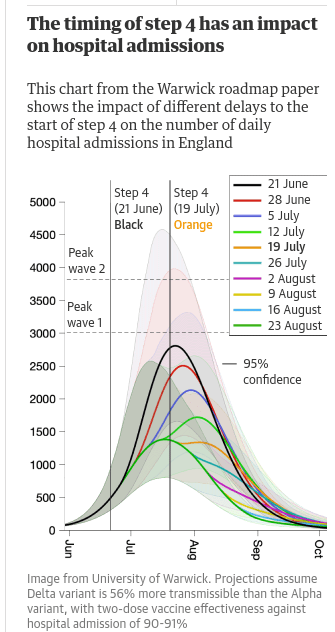
If not now, when? Here’s some alternatives

“We must be honest with ourselves that if we can’t reopen our society in the next few weeks, when we will be helped by the arrival of summer and by the school holidays, then we must ask ourselves: when will we be able to return to normal?” Boris Johnson.

Each week of delay until 23 August would reduce the peak of hospital admissions.

New constituency boundary proposals

As pointed out by a correspondent:

If accepted, the MP for RDE Hospital would go from Ben Bradshaw to Simon Jupp … Oh dear!

From the Boundary Commission:

Consultation is currently open until Monday 2nd August 2021 – please make sure we receive your response by that date at the latest, or it will not be considered. 

NHS in Devon warns it is under ‘severe pressure’

The NHS in Devon is warning Covid-19 admissions are adding to “severe pressure” on services.

Edward Oldfield www.devonlive.com

It says patients with the virus are one of a series of factors meaning all parts of the health system are “extremely busy”.

It is urging people to only go to their local emergency department in immediately life-threatening cases.

A statement said on Wednesday: “The NHS in Devon is under severe pressure at present due to several factors, meaning GP surgeries, hospitals, community health services, mental health services and social care are all extremely busy.

“High numbers of emergency attendances, combined with the need for some health and care staff, or their children, to self-isolate and the impact of Covid-19 admissions are affecting services.”

The warning comes after the Royal Devon & Exeter Hospital revealed on Tuesday it had gone into OPEL 4 status – its highest alert level – due to high demand and staff shortages.

The NHS Foundation Trust said that it was experiencing severe pressure across a range of services and both its acute and community hospitals.

In Plymouth, chief nurse Lenny Byrne urged people to book a vaccination as cases rose and there was “small but slowly rising number” of patients with Covid in Derriford Hospital.

Cases have been rising across the country, with the latest figures for Plymouth on Wednesday showing the highest number since January in the previous week.

During the week June 26 to July 2, there were 454 new cases confirmed in Plymouth, an increase on the previous week total of 218.

That is a rate of 173.2 per 100,000 people, below the current rate for England of 249.6 per 100,000 people.

In Devon, the 1,091 new cases meant a rate of 136 per 100,000, and in Torbay there were 296 new cases with a rate of just over 217.

Although cases are rising, the Government says vaccination has broken the link between cases, hospitalisations and deaths.

The latest figures for Covid-related deaths released on Tuesday showed none in Devon in the past three weeks. In the previous five weeks, there were only two Covid-related deaths in Devon and Cornwall.

Dr Shelagh McCormick of the NHS Devon Clinical Commissioning Group said: “The pandemic is not over yet and we need local people to choose the right service for their needs.

“Where it is not urgent, you can help NHS staff, who are under extreme pressure at the moment, by waiting for the right service.

“You can also continue to support the NHS by continuing to follow the Hands, Face, Space, Fresh Air advice.

“Maintaining high standards of hygiene and continuing with social distancing also helps combat the spread of other infectious illnesses like noroviruses which are circulating in the community.”

The statement said that although the number of people in hospital with Covid was relatively low, hospitals were extremely busy.

It said the reasons include:

  • many staff are having to isolate and not come into work;
  • some staff are having to stay at home to look after children who have been sent home to isolate;
  • as care homes are experiencing the same problems affecting their staff, it can make it harder for hospitals to discharge patients into nursing and care homes;
  • measures to keep people safe – infection prevention and control measures – mean we have reduced capacity in many areas. This means we can’t help as many people as we normally can so waits are longer and we can fit fewer people in our buildings;
  • sustained high numbers of emergency attendances – including record attendances and higher than average ambulance arrivals;
  • caring for Covid patients – although numbers are currently small, teams still have to manage with a reduced number of beds due to infection control measures;
  • Some people are coming to ED when they shouldn’t be – other services are available to help them.

NHS Devon issued the following advice to people seeking help

Here’s what you can do to help – choose the right service for your needs, and if it’s not urgent, please be patient and wait to be seen in the right place.

Before contacting your GP, you can look up your symptoms online using the NHS App, the NHS website or 111 online and there may be steps you can take to help yourself before needing to contact a healthcare professional. Parents can download the Handiapp for information on childhood illnesses

You can also continue to support the NHS by seeking help when you need it from the most appropriate service. There are a range of options to get help in addition to your GP surgery:

Pharmacy: As lockdown eases, don’t forget your local pharmacist can provide health advice and help with minor illnesses like colds, rashes, sunburn, hay fever and diarrhoea. You don’t need an appointment and they can even provide you with the right medicines at the same time.

Mental Health: If you, or someone you know, is struggling with their mental wellbeing, our 24/7 mental health lines are available:

Devon and Torbay – 0808 196 8708

Plymouth – 0800 923 9323

111 First: Our NHS 111 service is available 24/7 to provide advice, treatment and care. Just ring 111 or visit 111.nhs.uk and the service will provide advice and refer you to another service if you need it. If you need to be seen in person, they can book you a time slot.

Minor injury units: Emergency Departments are for life-threatening emergencies. There is a network of minor injury units in Devon who can provide the treatment you need – often they’ll see you quicker, and closer to home.

Today, by-elections in Feniton and Honiton St Michael’s

By-elections for the East Devon District Council wards of Feniton and Honiton St Michael’s are taking place on Thursday July 8. Polling stations will be open from 7am to 10pm.

Candidates for Feniton can be found here

Candidates for Honiton St Michael’s can be found here

Latest health advice

“We must learn to live with the virus” – Boris Johnson

“We are seeing rising hospital admissions and we must reconcile ourselves, sadly, to more deaths from Covid.”

“We have to balance the risks. The risks of the disease which the vaccines have reduced but very far from eliminated and the risks of continuing with legally-enforced restrictions that inevitably take their toll on people’s lives and livelihoods, on people’s health and mental health.”

“We must be honest with ourselves that if we can’t reopen our society in the next few weeks, when we will be helped by the arrival of summer and by the school holidays, then we must ask ourselves: when will we be able to return to normal?”

And who was it that delayed adding India to the Red quarantine list at the end of April, which has left us in a worse condition than otherwise could have been the case (cases doubling every seven days – work it out)? – Owl