No tax break for Freemasons

“Secret handshakes don’t seem to work with the tax man….”

David Byers www.thetimes.co.uk

The Freemasons, the secret society known for its charitable work and strange initiations, has failed to win a multimillion-pound tax break.

The United Grand Lodge of England (UGLE), the governing body for Freemasons in England and Wales, has lost a battle against HMRC to secure a £2.83 million VAT rebate by getting a judge to officially recognise it as solely “a philosophical, philanthropic or civic” organisation.

This comes after a push to publicise its charity work and to attract more members by advertising at universities.

UGLE claimed in court that it should be given the refund, which covered VAT on membership fees between 2010 and 2018, because it had become so outward-looking since the turn of the century that its philanthropy and philosophy was its “main aim and it did not have any other main aims”.

HMRC disputed the claim at the first-tier tax tribunal. Although it agreed that the Freemasons carried out many worthy charitable works, it said that many objectives were still “for the benefit of its members”, and included “making friends, socialising and networking” so it should be taxed as a normal membership organisation. Judge Greg Sinfield ruled that UGLE had stretched its definition of philanthropy too far. “The giving by Freemasons through UGLE and the masonic charities for the benefit of other Freemasons is not philanthropy,” he said.

UGLE said: “We are obviously disappointed with the outcome, but will not be providing further comment during the appeal period.”

Rightwing media hang Boris Johnson out to dry on social care

[Including commentators such as Dominic Lawson – “This is about inheritance, not the quality of care” – Owl”]

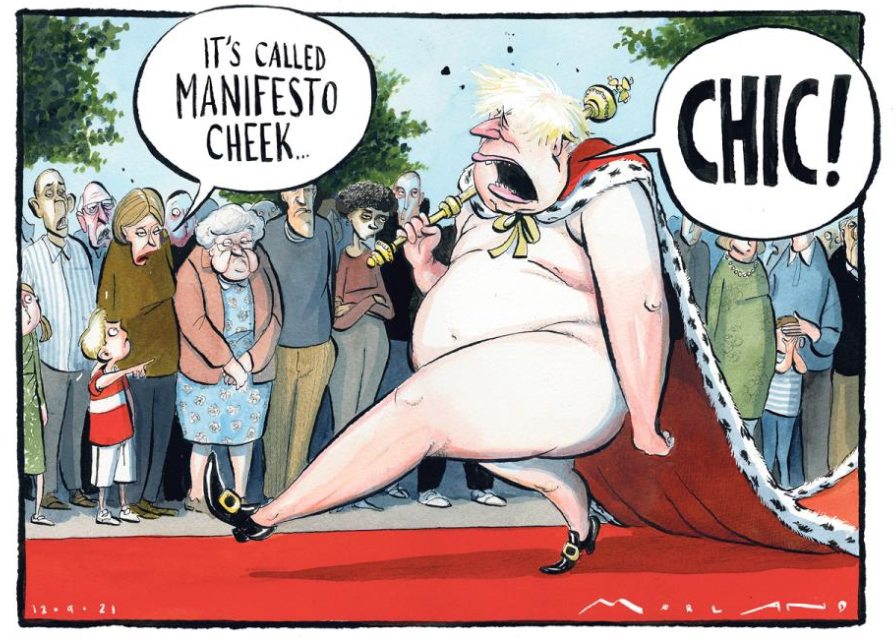
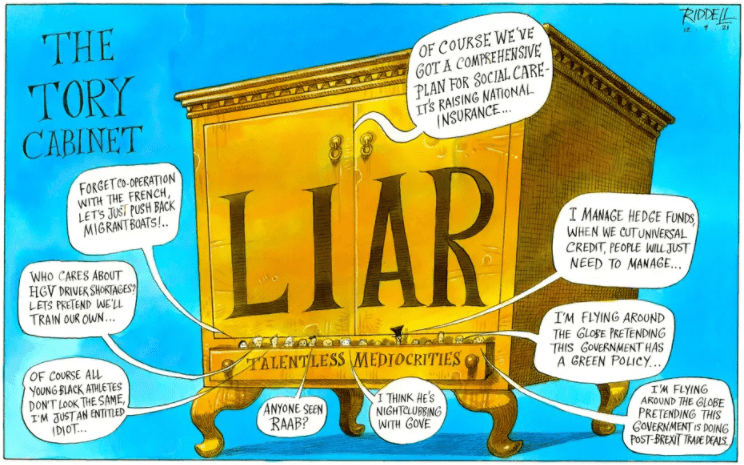
The parliamentary vote on social care passed pretty comfortably for the prime minister, but a nasty war over the funding of his social care reforms rages on in the Tory-leaning press. Accusations of treachery and “disgrace”, of addiction to tax hikes, of being an ideological void – and even of murdering conservativism – are all being laid at Boris Johnson’s door.

Vanessa Thorpe www.theguardian.com 

And this from the closest he has to friends in the media. The leftwing press may have piled on its own allegations that the new tax scheme will hit the struggling employed and yet leave wealthy pensioners and high earners untouched, but much of the harshest criticism is still coming from the right.

Writing in the Daily Telegraph on Thursday, Allister Heath, editor of the Sunday title, attacked the reputation of the PM with a frenzy. “Shame on Boris Johnson, and shame on the Conservative party. They have disgraced themselves, lied to their voters, repudiated their principles and treated millions of their supporters with utter contempt,” Heath argued under the headline “Boris’s shameful Tory betrayal guarantees the total victory of socialism in Britain” and a sub-heading that proclaimed “The Conservatives have trashed their intellectual traditions for the sake of short-term political gain.”

Fraser Nelson, editor of the venerable rightwing journal the Spectator, had no kinder words for Johnson, although he certainly did not declare a covert victory for socialism.

Under the claim that Johnson’s cabinet has presided over the “inversion of the welfare state”, Nelson explained the mechanics by which this trick has been pulled off. “The traditional logic of the welfare state – that those with power and money help those with less of it – would be turned on its head… Some will help families who can in no sense be described as rich. But after the NHS waiting list has begun to ease, the tax becomes a care home insurance scheme, and the refusal to impose any means-testing has big implications.”

On the eve of the vote, the Spectator’s economics editor, Kate Andrews, alleged Johnson had “reneged on manifesto promises left and right” and was now revelling in the growth of the “big state”.

She feared, she added, that the NHS hole will drain all the new cash. “Unless decades of politicalisation and idolisation of the health service are undone overnight, and it becomes politically possible to critique the health service, this seems like a near-impossible situation. The only guarantee, then, is a new, higher tax burden.”

Another pair of missiles launched on the eve of the vote came from the Telegraph. Robert Taylor claimed Johnson is “addicted to big government”, predicting further tax rises, while Camilla Tominey, the paper’s associate editor, said Johnson lacked shame “as he sounded the death knell for conservatism”. She argued: “Mr Johnson’s suggestion that the public feels in their bones the need to spend more on the NHS appeared to miss the point that most would rather it was the government’s money than more of their own hard-earned cash.”

NHS ‘faces breaking point by November’ without masks and social distancing as Covid cases rise

The NHS will be at breaking point within two months if the Government fails to implement basic Covid precautions such as mask wearing and social distancing, a new scientific paper has found. 

By David Parsley inews.co.uk

The paper, which is at the pre-publication stage at the highly regarded medical journal The Lancet, has been authored by a number of leading scientists and was funded by vaccine producer Moderna. 

The report finds that, even with a 100 per cent take up among the over-16s currently being offered a vaccine, there will have been up to one million hospital admissions to Covid wards between “freedom day” on 19 July and the end of the year if the reproduction rate (R-rate) rises above two. 

At an R-rate of 1.7 the paper, seen by i, estimates that the UK will suffer a further 340,000 hospital admissions before the end of the year. 

The current R-rate in England is 0.9 to 1.1, but with the margin of error could be as high a 1.3. In Scotland, three weeks after schools returned, the R-rate stands at around 1.3 to 1.6. 

Without any Covid restrictions in place and with pupils returning to school in England this week, one of the authors of the research believes NHS hospital admissions for Covid across the UK will have reached that same level as at the last peak of 5,671 on 12 January. 

Co-author Dr David Strain, a senior clinical lecturer in the college of medicine and health at the University of Exeter, said: “We found that there is going to be a steady and continued rise in infections and hospitalisations if further interventions are not put in place, whether they be physical distancing, the reintroduction of masks, or different vaccines strategies. 

“If we don’t do anything, hospitalisations will be at the same level as they were at the previous peak by the beginning of November.” 

Since pupils return to school in Scotland three weeks ago there has been a more than fourfold increase in infections north of the border, while hospital admissions are up more than 3.5 times those before the autumn term began.

However, Scotland did open up other hospitality venues and large events around the same time a school pupils returned. 

Dr Strain believes the Government must do something in order to mitigate an “inevitable” rise in cases over the coming weeks in order to ensure the NHS remains operational. 

“We have to do something,” he said. “Whether that something is a firebreak, whether that something is changing the vaccination strategy, or just reintroducing masks and social distancing. But we will definitely have to do something between now and Christmas.” 

The report’s authors also include three researchers from the modelling group Health Economics and Outcomes Research, Marc Evans of Cardiff University, as well as three scientist from Moderna. 

Despite ongoing concerns that the Government may be forced to re-introduce Covid restrictions, ministers have claimed any lockdown in October to ensure the NHS is not pushed beyond capacity was a “last resort”. 

A senior No.10 source suggested to i last night that the only contingency measures under active consideration by ministers in case of unsustainable pressure on the NHS were relatively non-invasive ones such as mask wearing and capacity limits at large events.