Homes above car parks: answer to housing issue? (and update on the Humphreys case)

“A view” from Paul Arnott in this week’s Exmouth Journal (and sister publications)

Before I get going this week, it is appropriate that I record briefly the fact that East Devon District Council has made an initial response to the news that one of its former Conservative councillors, John Humphreys, was sentenced to 21years in prison a few weeks ago for a number of counts of sexual assault.

The council’s first action was to meet to remove his honorific title as an Alderman. It’s a small but significant start to a council response. However, it is important to record through this column that – in my personal view as Leader of EDDC – this is just the first inch in what will need to be a many mile journey looking into this matter. For legal reasons I cannot pass further comment.

However, it is crucial that it is understood by the public, and in particular the victims, that I have heard very clearly the widely reported comment in one of the victim’s impact statements, that he believed there had been many years inertia in the conviction of Humphreys due to his “political influence”.

That statement is one that in my view cannot be left unexplored. It already is being, and I will ensure that every stone which needs to be overturned to get to the truth will be. I suspect that all the people who voted for me and the kind of administration I lead at EDDC would expect nothing less.

As stated, I cannot pass further comment at this stage, so I must apologise for crashing gears with a complete change of subject. So, and with the nights beginning to shorten, we get into the time of the year which, in my view, sets the agenda for what is possible all the way through to the end of next summer.

For that reason, I wanted to share with readers your district council’s absolute number one priority for that period – somehow we must do all we can to increase the level of housing stock available to local people who are unable to afford the prices of most private sector homes. As we all know, there is a “perfect storm” in our area.

House prices are soaring as the broadband-enabled work-from-home revolution was stimulated even further by the pandemic. We happened to have our own home valued both before the pandemic and then a few months ago and it showed an increase in likely price at sale of more than 20% in eighteen months. This accords with data across most of Devon and Cornwall, and it applies in all sectors of the market.

Meanwhile, compounding the post-Brexit loss from the available labour force in Devon, it has become even more unaffordable than before for people on low-to-middle salaries to live here. It’s not just the challenge to raise the deposit and mortgage to get on the property ladder, it is the almost non-existence of the supply in the rental market if you are not over 60.

So, what is needed now is some radical thinking. As a local authority we need to help find brownfield land, perhaps in EDDC’s own ownership, on which to build. I am aware that I am hurling a cat amongst the pigeons here, but I’ll say it anyway. One part of EDDC’s land assets is its car parks, of which there are many. Now, this would not apply to all of them by any means, but perhaps some. How about we retain the car parking capacity at a ground floor level, but build homes at another two or three levels above? This would provide decent starter homes in central locations of some of our most economically challenged towns. What do you think? Please don’t think for a minute this would be about losing car parking capacity, or that this would be rolled out without huge consultation locally. But if not there, where?
Tories’ approach to councillor checks could fuel hysteria

The Journal’s front page last week highlighted the East Devon Conservatives’ urgent calls for all councillors to be subject to DBS checks, immediately following the news that former Tory councillor John Humphreys had been convicted of serious sexual offences against children.

Cllr Paul Millar www.midweekherald.co.uk

The journalist did his homework and spoke to an experienced employment lawyer who questioned the legal validity of what the Tories were proposing. In the Tories’ press release, they claim that their calls for blanket councillor DBS checks have been ‘ignored by other groups within the council’, when the opposite is the case.

Whilst a Cabinet member I called a meeting with the council’s head of legal on the subject. At the time I knew nothing of the Humphreys investigation but I was being lobbied by colleagues who had local casework specifically involving vulnerable adults in relation to housing and wondered why they weren’t subject to a DBS check.

A report followed with reference to current legislation which remains in force, laid by a Conservative-led government in 2012. It stated that an individual in their capacity as a district councillor could not undertake an enhanced DBS check.

Currently no political party can legally vet their candidates before they are selected which could lead to their election to public office. As I’m sure you’re all thinking, this is a completely unacceptable situation when one considers the trust local people place in their elected representatives and access to their lives to help them deal with sometimes very sensitive issues in an advocacy capacity.

But it is also worth emphasising that a DBS check would never have flagged the crimes of Humphreys before he became a councillor, because they only recently came to light. DBS checks are no silver bullet, sadly. In my past role as an MP’s caseworker, I undertook safeguarding training. For the 45 years the Tories were in power at East Devon District Council, they didn’t manage to establish mandatory safeguarding training for councillors in relation to their activities – the current administration is getting that in place now.

With these facts in mind, and with all councillors having sight of legal advice which has been endorsed by the Local Government Association, I resent the way the Tories are campaigning on this most sensitive of issues, which has the effect of whipping up public hysteria. They do themselves no favours in suggesting it is an issue the present ruling groups are responsible for solving, when it is a Westminster issue. And in that respect, they have much better access to government ministers while the Tories remain in power there.

I believe the Tories know full well that the subject of councillors and DBS checks is not a straightforward one, let alone a matter the current administration can click its fingers and change.

Appropriate and necessary reforms need to be made at Westminster. Had Humphreys been legally subject to a DBS check in 2015 before he became a candidate for that local election, it may have flagged that a police investigation on serious offences had begun. Presuming the Tories didn’t know already about the police investigation, the information may have also prevented the Tory group from selecting him as a candidate or indeed later nominating him for the position of Honorary Alderman.

If I could, I would change the law tomorrow to make being a Ddistrict councillor a ‘regulated activity’ which required enhanced DBS checks being carried out on us all. Any new law would need careful safeguards to prevent the public exposure of minor spent convictions from decades ago on matters unrelated to children and vulnerable adults.

But sadly I am not (yet) Exmouth’s elected Member of Parliament with a vote in the House of Commons and the power to propose new legislation. For now, the MP is Simon Jupp, whose silence on this matter and absence of support for his own EDDC Conservative group colleagues speaks volumes.

This week’s PR disaster – Simon Jupp: “Doomed” by his choice

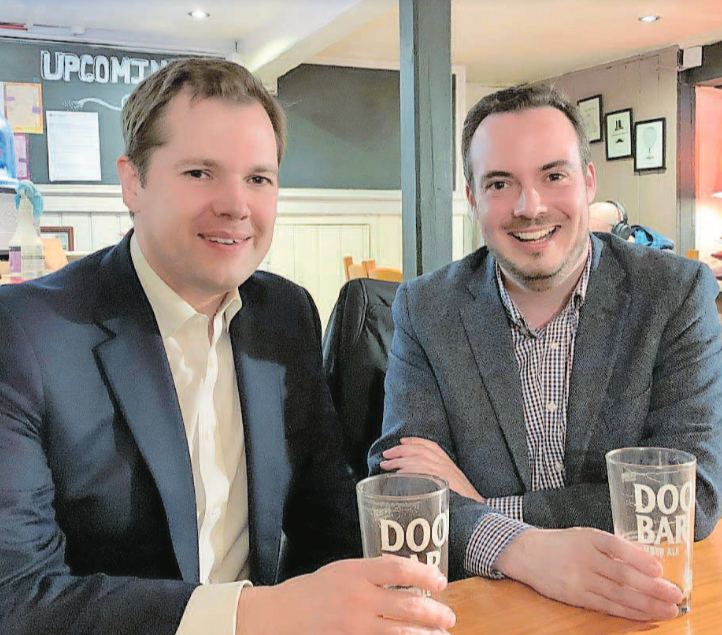
Why, oh why Simon did you decide to be pictured in your media column this week drinking a pint of Doom alongside “Three Homes” Robert Jenrick? Didn’t Boris tell you he was about to sack him and demote your mentor Dominic Raab? And even if he hadn’t, did you really want to associate yourself with his “build, build, build” algorithm and attitude to “lock-down rules”? 

Why, oh why Simon, do you keep banging the drum for the hospitality trade? Have you forgotten “Eat out to help out” and what it did to supercharge last autumn’s infection wave? Don’t you realise that a very high proportion of your constituents feel vulnerable to the delta variant? Don’t you think you would help the hospitality sector more by arguing for the Government to take a more responsible, less “Gung-Ho”, attitude to Covid so that the general population felt more secure to venture out? 

Why, oh why Simon do you chose the hospitality trade in particular? Recent research noted that whilst hospitality, food and tourism are sources of pride for the region and its flourishing tourism sector, it’s inescapable that they are also sources of low pay and low productivity. Are low pay and productivity what you support?

Lastly, why, oh why Simon, if you must go on a pub crawl to support local business, are you drinking a beer brewed in North Cornwall – Doom – and not something brewed locally, in Devon, such as Otter Bitter!!!!

Doom, it’s all in the optics

Tory whips accused of threatening rebels with loss of local funding

Government whips have been accused of threatening to withhold funding from Conservative MPs’ constituencies in a bid to clamp down on rebellions in key votes.

Aubrey Allegretti www.theguardian.com 

Some of Boris Johnson’s backbenchers also claimed that would-be rebels who risk losing their seat in an upcoming parliamentary boundary review were warned they might not automatically be selected elsewhere. In addition, whips were accused of telling some in Tory-held marginals that they could lose “critical defence” funding from party headquarters worth up to £10,000.

The moves were said to have been employed to impose discipline and head off embarrassing Commons defeats before a difficult winter for the government.

While party whips have long been known for employing pressure tactics, the allegation by some Tories that there were threats to withhold town deal funding will raise questions over the fairness of its allocation.

The towns fund, designed to boost struggling areas, was announced in 2019 and 101 town deal offers have been made by the government.

In March the Guardian revealed that of the first £1bn released under the scheme, 39 of the 45 places it went to were represented by Tory MPs. At the time, the chancellor, Rishi Sunak, rejected accusations of “pork barrel politics”, saying the formula was “based on an index of economic need” published by Whitehall and “based on a bunch of objective measures”.

More recently, the chief whip, Mark Spencer, is said to have told some potential rebels in marginals that party funding to retain their seat at the next election could depend on their loyalty to the government. “My pen hovered over your name,” he is alleged to have said.

Nevertheless, the pressure put on MPs appears to have worked: some would-be rebels said in private that the techniques had stopped them voting against the government when they had planned to.

Caroline Slocock, director of the Civil Exchange thinktank, said: “Every government uses tough tactics to curtail rebellions from its own side on key votes. But it is shocking if government whips are promising to hand out public money (or deny it) to their MPs to buy votes.

“Public funds should be allocated following clear criteria based on need, with due process. If these allegations are true, the government risks undermining confidence in government – something more important than winning one vote.”

There have also been more positive attempts to engage with restless backbenchers. Before the summer, some were invited to meetings with No 10 policy chiefs and asked to bring solutions for issues the government should be tackling.

Some insiders defended Spencer. One called him “the best chief whip since the days of Patrick McLoughlin”, who served during the first two years of the coalition government.

One Tory MP noted: “It’s not like the [Theresa] May government where the whips need to go heavy-handed because every vote was on a knife-edge. The government’s majority is such they don’t need to go ballistic with everybody.”

Steve Reed, the shadow communities secretary, said: “This shows again that the Conservatives treat public money like it’s their own. Boris Johnson is bullying his own MPs into breaking the promises they made, but it’s people in our communities who will suffer. The Conservatives aren’t interested in investing in our towns. They are only focused on taking money out of the pockets of working people with tax hikes and a cut to universal credit.”

Conservative campaign headquarters was contacted for comment. A Tory source said Spencer was “always happy to offer support to those colleagues who he finds in the government lobby” and another insisted “engagement with colleagues is totally normal”.

It comes amid speculation of a cabinet reshuffle that some believed would happen last week. Frontbenchers suspected Johnson deliberately did not play down the idea before a vote on the health and social care levy, in an attempt to keep the number of rebels to a minimum. While the threat of a reshuffle has only partially subsided, it is not expected to happen on Wednesday.

The National Trust reaches milestone in its Tamar “restoration project”

A similar project to the Lower Otter Restoration Project, but on a smaller scale at Cotehele Quay.

The National Trust is undoing flood prevention work carried out in the 19th century, and turning back the clock to create wetland habitats. From today’s Western Morning News and National Trust

A milestone has been reached in the creation of a new intertidal habitat in Cornwall.

A 15-metre breach has been made in a 19th century riverside bank on the Tamar estuary ready for the tide to flood in over low-grade farmland.

The farmland was created in 1850 when an embankment was built allowing the land to be drained for agriculture.

The National Trust is now creating the intertidal habitat and allowing the land to return to nature.

The project will also help alleviate flooding during high tides or heavy rains by creating more space for water.

Alastair Cameron, from the National Trust, said: “By creating new wetland habitat similar to that found before the embankment was built, we can make space for nature and water.

“This month we’ve made a relatively small breach in the bank and now we’ll let nature and the tides take their course. It’s really exciting to see the water flowing in now with the spring tides.” 

The new habitat will over the next decade start to attract a wide range of wildlife, including worms and a range of wild birds, such as shelduck, redshank and teal ducks.

“Over the coming years we’ll start to see changes in the habitat which should attract typical Tamar estuary species and in time we’ll see more permanent intertidal vegetation increase like reeds which will attract more and different wildlife,” Mr Cameron said. The project is being jointly funded by the Environment Agency and the National Trust.

Rob Price, from the Environment Agency, added: “We are very much looking forward to see the new intertidal habitat established over the next few years as the project now turns its focus to monitoring the benefits that this enhanced area will provide for local wildlife, habitats and people.

“This valuable work is an important part of an integrated programme of works to build the Tamar catchment’s resilience to a wide range of environmental pressures including those related to climate change.”

Brexit revenge complete: Supreme Court’s powers slashed after Remainers’ sabotage attempts

The Dissolution and Calling of Parliament Bill was voted through its final stage of the Commons by 312 to 55. It repeals the Fixed Term Act introduced by the coalition Government in 2011, returning power to call an election to the Prime Minister.

Dan Falvey, Political Correspondent www.express.co.uk 

Clipping the wings of the Supreme Court, the Bill also seeks to rule out judicial intervention.

The Bill makes it explicitly clear the decision to call an election could not be challenged in the courts.

Cabinet Office minister Chloe Smith told the Commons the legislation “is necessary and proportionate for the avoidance of doubt and to preserve the longstanding position that the prerogative powers to dissolve one parliament and to call another are non-justiciable.”

She added: “Any judgment on their exercise should be left to the electorate in the polling booth.”

Mr Johnson pledged to scrap the Fixed Term Parliaments Act in the 2019 general election.

The decision to write into law there is no legal basis for the courts to intervene in the timing of an election is seen among Westminster as a deliberate attempt by the Prime Minister to get revenge on the Supreme Court.

In September 2019, Mr Johnson planned to prorogue parliament for a number of weeks in a bid to prevent MPs forcing him to extend the date the UK would leave the EU beyond October 31.

However, a legal challenge by a group of Remainers led to the Supreme Court ruling the prorogation illegal.

MPs were sent straight back to Parliament, where they held a vote to force Mr Johnson to beg the EU for another Brexit extension.

Conservative MP Sir Geoffrey Cox, who was attorney general at the time of the prorogation row, spoke out in favour of the Bill in the Commons.

He argued reverting power to dissolve parliament for elections to the Prime Minister was a return to “sanity” and “normality”.

He told MPs: “I see this measure as a welcomed correction that brings back our constitution to the fundamental principles, which have existed for many, many years.”

The Fixed Term Parliaments Act has been blamed as partially responsible for the Brexit impasse in the Commons in 2019.

Under the law, an election could only be called earlier than the five year period if it was supported by two-thirds of MPs.

With the Government struggling to break the Brexit deadlock in Parliament, Mr Johnson twice tried and failed to call an election.

Opposition MPs refused to give their consent to going to the ballot box, claiming they were concerned by the timing of the planned election.

While clearing all the hurdles of the Commons, the Dissolution and Calling of Parliament Bill could still be amended in the House of Lords.

Peers will debate and vote on the legislation later this year.

Inside a £500-a-head Tory donor lunch with Boris Johnson

Where the wine was ‘rubbish’ and he made “incendiary” remarks. [Watch the video, no comment – Owl]

Henry Dyer www.businessinsider.com 

  • Johnson attended a Conservative Party fundraiser on Sept. 10, the largest since the pandemic began.
  • Insider spoke to an attendee who provided an insight into the PM’s behaviour behind closed doors.
  • At one point, he joked about the UK becoming the “Saudi Arabia of penal policy” under Priti Patel.

Boris Johnson was, as usual, running late.

He had just been at Downing Street to speak to the president of Chile, but more important business on the afternoon of September 10 was in the largest conference room at the InterContinental London Park Lane in Mayfair.

Johnson was the guest of honour at the first large Conservative Party fundraiser event since the pandemic began.

With tickets costing up to £500, and three hundred attendees, the lunch was a major opportunity to raise funds for the Cities Of London & Westminster Conservative Association, whose constituency covers Theatreland in the West End, the Houses of Parliament, and the commercial centre of the City of London.

The “substantial sum of money” raised was not just for the association’s work in the constituency, but also for Conservative Campaign Headquarters and other groups, according to the event’s brochure.

Insider spoke to an attendee at the lunch, who shared her experience of what it is like to attend the event, as well as photographs and video, including of incendiary remarks made by Johnson behind closed doors.

Johnson’s “dumb” Northern Ireland-Scotland tunnel is being scrapped as part of the spending review

Boris Johnson’s plan to build “the stupidest tunnel in the world” between Scotland and Northern Ireland – estimated to be at least $ 15 billion is being scrapped as part of the spending review.

newsbeezer.com 

Revealed: Michael Gove’s sexist jibes, racist jokes and homophobic slurs

It’s said Murdoch wants Gove for PM.  Obviously not what everyone wants …..! – Owl

 www.independent.co.uk

Michael Gove made crude sexual comments, joked about paedophilia within top levels of government, and used a racist slur in a series of remarks in his twenties, The Independent can reveal.

The Cabinet Office minister also described Prince Charles as a “dull, wet, drippy adulterer” in speeches at the Cambridge Union while he was a student at Oxford, and after his graduation while working as a journalist.

In apparent attempts at humour, Mr Gove referred to people living in countries colonised by the British as “fuzzy-wuzzies”, accused the late former Tory minister Sir Leon Brittan of being a paedophile, and made a string of sexual jokes at the expense of Conservative minister Lucy Frazer.

The chancellor of the duchy of Lancaster, who has been tipped for the position of either foreign secretary or home secretary in a potential reshuffle, also described Margaret Thatcher’s policies as a “new empire” where “the happy south stamps over the cruel, dirty, toothless face of the northerner”, and said that gay people “thrive primarily upon short-term relations”.

Mr Gove made the comments – which were met at the time by cheers, stunned laughter, and shouts of “shame” – at three evening debates at the Cambridge Union in February 1993, December 1993 and during the winter of 1987, recordings of which came to light this week.

By 1993 Mr Gove had forged a career in television at the BBC, working on the politics programme On the Record, and had performed on Channel 4’s short-lived comedy programme A Stab in the Dark.

In February of that year, Mr Gove made a number of comments about the then European commissioner Sir Leon Brittan, speaking in favour of the motion “This house would rather have a degree from the university of life”.

Imagining an exchange between the two men, Mr Gove said: “[Leon] said: ‘Cambridge taught me an appreciation of music. And in particular an appreciation of the mature male soprano voice.’”

Mr Gove further imagined Sir Leon telling him that there was “no sound sweeter” than a young boy’s voice breaking, apart from the sound of the same boy involved in a sex act.

Sir Leon was a key cabinet minister in Margaret Thatcher’s Conservative government and, before his death in 2015, was targeted by Scotland Yard in a VIP sexual abuse investigation triggered by the testimony of fantasist Carl Beech. The allegations against Sir Leon were found to be false, and Beech was sentenced to 18 years for perverting the course of justice and for fraud.

Mr Gove went on to joke about reporting Sir Leon to “special branch”, saying that he “now satisfies his desires in the Bois de Boulogne and various other Brussels hangouts.”

In December of 1993 he made a speech in support of the motion “This house prefers a woman on top”.

Mr Gove boasted that current justice minister Lucy Frazer, who had invited him to speak at the time, was “actually capable of tempting me into bed with her”, and implied that one college’s entire rugby club had had group sex with her.

He then referred to her “preference for peach-flavoured condoms” and said she had done “remarkably well” to come from “the back streets of the slums of Leeds”.

The Independent understands that Michael Gove and Lucy Frazer were not romantically involved, and that his descriptions were purely fictitious.

In 1987, when Mr Gove was in his final year at Oxford University and serving as president-elect of its debating society, he spoke in favour of the motion “This house believes that the British empire was lost on the playing fields of Eton” as part of an intervarsity debating competition at the Cambridge Union.

In making his case, he used a racial slur, saying: “It may be moral to keep an empire because the fuzzy-wuzzies can’t look after themselves.

“It may be immoral to keep an empire because the people of the third world have an inalienable right to self-determination, but that doesn’t matter whether it’s moral or immoral.”

Referring to the practice of British rule, Gove said that “Eton took the cream of the colonial system, it took fettered foreigners and it turned them into gentlemen.”

“Fettered” is a term that is used to describe people, often slaves, who have been restrained with chains or manacles, typically around the ankles.

He later went on to describe the economist John Maynard Keynes as a “homosexualist”, adding: “Many of us are familiar with the fact that homosexuals thrive primarily on short-term relations.”

The speech also included Mr Gove’s opinions of Margaret Thatcher’s policies, which he described as “rigorously, vigorously, virulently, virilely, heterosexual”.

He continued: “We are at last experiencing a new empire: an empire where the happy south stamps over the cruel, dirty, toothless face of the northerner.

“At last Mrs Thatcher is saying I don’t give a fig for what half of the population say because the richer half will keep me in power. This may be amoral, this may be immoral, but it’s politics and it’s pragmatism.”

Mr Gove, who became an MP in 2005, also said that the Prince of Wales was an example of how university education makes people boring. He referred to him as “a dull, wet, drippy adulterer whose romantic conversation is dominated by lavatorial detail”.

Another jibe was made at the expense of the then president of the union, with Mr Gove saying: “Putting you in charge of the Cambridge Union was rather like putting Slobodan Milosevic in Serbian high command in charge of a rape crisis centre.”

More recently, in 2017, when appearing on the BBC’s Today programme, Mr Gove joked that being interviewed by the presenter John Humphrys was like going into Harvey Weinstein’s bedroom – “You just pray that you emerge with your dignity intact.” Mr Gove later apologised, saying it had been a “clumsy attempt at humour”.

The Liberal Democrats have called for Boris Johnson to consider whether Mr Gove should remain in the cabinet in light of the comments.

Wendy Chamberlain MP, Liberal Democrat chief whip, said: “Michael Gove should be ashamed that he ever thought these things, let alone said them. These inappropriate and racist remarks are not befitting of a government minister, not befitting of a journalist, in fact not befitting of anyone.

“The prime minister should consider whether this is the type of person that deserves to be sat around the cabinet table. However, given Boris Johnson’s own history of disgraceful remarks, I expect this will be another shameful issue he lets go unchallenged.”

Mr Gove and Ms Frazer declined to comment.

BMA to issue damning critique of government over Covid crisis

Chronic neglect of the NHS, poor pandemic preparedness and flawed government policies have contributed to the appalling impact of the Covid-19 crisis in the UK, according to a damning assessment from the British Medical Association.

Ian Sample www.theguardian.com 

More than 130,000 people in the UK have died from coronavirus since the pandemic began, with non-Covid excess deaths up 12,000 last year, making the country one of the hardest hit among comparable nations, the doctors’ body said.

In a speech on Monday, Dr Chaand Nagpaul, the BMA’s chair of council, will warn that the country and NHS staff have never faced such a crisis before and urge ministers to take action to ensure the health service is better prepared to respond to pandemics in the future.

“We will not accept a return to the old pre-pandemic NHS, which was so patently understaffed and under-resourced, where nine in 10 doctors are afraid of medical errors daily,” he is expected to say. “We will not accept an NHS running at unsafe bed occupancy and without spare capacity.”

Before the pandemic, NHS bed occupancy was regularly above the 85% considered a reasonable safe threshold. While the NHS had 7.3 critical care beds per 100,000 people, Germany had nearly 34 per 100,000 as the crisis unfolded.

Further planning failures left the NHS with inadequate stockpiles of personal protective equipment (PPE) for frontline staff, leading to last-minute orders of masks, visors and gowns that in some cases turned out to be unsafe or unusable.

Years of underfunding, inadequate facilities and nearly 90,000 staff vacancies meant the NHS was in crisis before coronavirus emerged, leaving it ill-prepared for the demands of the pandemic, Nagpaul is to argue at the BMA’s annual representative meeting.

He will criticise ministers for dismissing calls for a rapid inquiry into the crisis, before the second wave of infections struck last year, meaning that crucial lessons from the previous six months were not learned. He will add that the ministerial mantra of “living with Covid” belies the reality that thousands of people continue to need hospital care for coronavirus with hundreds dying each week.

Despite warnings from senior doctors at the time, Boris Johnson’s decision to lift coronavirus restrictions this summer contributed to almost 40,000 being admitted to hospital and more than 4,000 deaths since so-called “freedom day” on 19 July, the BMA said.

“We will not accept an NHS in crisis every summer, let alone every winter,” Nagpaul will add. “We will not accept a nation bereft of public health staff, facilities and testing capacity, with ministers then paying billions to private companies who were unable to deliver.”

In the past week, ministers announced substantial extra funding for the NHS, including money specifically targeted at easing backlogs in treatment. While welcoming the funds as an important first step, Nagpaul will urge the government to provide realistic projections as to how far the money will stretch and to acknowledge that the amount will not address the drastic shortage of NHS staff. The BMA estimates that the NHS has 50,000 fewer doctors than the EU average.

More than 4 million people were on the NHS waiting list in England in March 2020, the month the country went into its first Covid lockdown. That number has since risen to 5.61 million. The Nuffield Trust has said waiting lists could top 15 million people in four years without a significant increase in NHS trust capacity.

Last week, GPs in England said they were finding it “increasingly hard to guarantee safe care” for patients, as the shortage of doctors meant they could not keep up with the surge in demand. Prof Martin Marshall, the chair of the Royal College of General Practitioners (RCGP), warned of a crisis in primary care after a 4.5% decrease in the number of GPs across England led to a risk of mistakes being made.

Government failing to stop sewage discharge into English rivers, says charity

One of the first complaints lodged with the post-Brexit environmental watchdog accuses the government and Ofwat of failing to enforce the law to stop water companies from routinely discharging raw sewage into rivers.

Sandra Laville www.theguardian.com 

The office for environmental protection (OEP) is being asked to investigate why water companies have been able to continually fail to meet duties placed on them by law to treat sewage. The secretary of state for the environment, George Eustice, and the financial regulator, Ofwat, had failed to enforce the law, the complaint said.

Lawyers for Salmon and Trout Conservation lodged the complaint with the OEP, whose role is to act as an independent to hold the government and public bodies to their commitments and environmental law.

The complaint says water companies have for 30 years had a legal duty – enforceable by the secretary of state and Ofwat – to “effectually drain sewers” and “effectually deal with sewage”.

But the charity said that despite the legal framework, water companies discharged raw sewage into rivers and coastal waters in England more than 400,000 times in 2020, according to Environment Agency data. The spills via combined sewer overflows lasted for 3.1m hours. Yet the overflows are supposed to be used only in extreme weather to relieve pressure in the sewage system.

“By common understanding, the water companies have failed, and continue to fail to meet the duties placed on them by the 1991 (Water Industry) Act and that duty, patently, remains dramatically unenforced by the secretary of state and Ofwat,” the complaint reads.

The environment bill going through the House of Lords places a duty on government to publish a plan by September 2022 to reduce sewage discharges from storm overflows.

In its complaint, Salmon and Trout Conservation said the government could be using the law to force water companies to cut sewage discharges.

The secretary of state can just tell Ofwat and issue directions to the Environment Agency now to ensure the water companies just comply with existing law,” said Guy Linley-Adams, a solicitor for S&T Conservation.

“In practical effect, the law already says that untreated sewage shouldn’t be discharged into rivers except during very heavy rainfall, and then only to avoid sewers flooding. At all other times, sewage must be fully treated before anything is discharged – and that discharge must not cause pollution.

“The law is clear and has been since 1991. What is missing is the strength of will within government to get this sorted”.

The complaint says the current situation where sewerage infrastructure, by the government’s own admission, has not kept pace with population growth, has been allowed to develop since 1991 because the financial oversight provided by Ofwat has neither sufficiently required, nor sufficiently enabled, the water companies to ensure their infrastructure keeps pace with population growth and meets the requirements of the Water Industry Act.

Data released by the Environment Agency in 2020 shows that sewage and wastewater discharges by water companies into rivers account for damage to 36% of water bodies. Only 14% of English rivers are of good ecological standard, a rating that suggests they are as close to their natural state as possible.

“In the absence of sufficient sewage treatment infrastructure and capacity, rivers have been asked to do that ‘treating’ instead, which has harmed many English rivers,” the complaint said.

Appeal to make South Hams sustainable

A former parish councillor from Staverton in Devon is urging politicians at all levels to take more urgent action to tackle the climate crisis. 

Philip Churm, local democracy reporter www.radioexe.co.uk

Simon Oldridge, who co-founded Sustainable South Hams and Sustainable Staverton, says more than 32 parishes in the South Hams area are already involved in his campaign, but local authorities and central government are failing to act on “compelling” scientific data which proves the threat of climate change. 

In 2019 the government amended the Climate Change Act to commit the UK to achieving net zero carbon by 2050.

But Mr Oldridge claims authorities like South Hams District Council need to be more proactive if they are to achieve those targets.  

“We actually wrote them a letter urging them to do something about the planning laws, locally, that allow house builders to continue to build houses that just aren’t fit for the future net-zero economy that we’re going to live in,” he said.

“They’re still building houses with gas boilers. And those gas boilers are going to have to be taken out before the end of their lives.”

He explained that such changes would be very costly because it would also involve replacing radiators throughout an entire property. 

“That’s really disruptive for people. But that’s being hidden and they’re just bashing these cheap houses out,” he said.

“South Hams should be using the planning laws to stop that. Although I would say it should come from the government, but South Hams I think could probably do better.” 

South Hams declared a climate change and biodiversity emergency in 2019 and has committed to reducing its organisational carbon emissions to net-zero by 2030.

South Hams has also committed to working with partners through the Devon Climate Emergency Response Group to aim to reduce the district’s carbon emissions to net zero by 2050 at the latest.

But it’s not just local authorities who are failing to act on climate change, according to Mr Oldridge. He also points the finger at some politicians, saying some take the issue more seriously than others. 

He said Sir Gary Streeter MP (Conservative, South West Devon) does not appear to have grasped the importance of the issue. “He’s still writing very misleading comments about how the UK is halfway to net zero,” said Mr Oldridge.

“He says the environment bill will solve everything. 

“The environment bill has got nothing to do with climate change at all.  If you do a word search on it, it doesn’t have the words ‘carbon’, ‘CO2’, ‘aviation’, ‘peat’, ‘marsh’ or ‘diet’. On anything to do with climate – it’s not there. 

“It’s an important bill. It’s needed as we leave the EU for tidying up lots of loose ends. But it’s nothing to do with tackling climate change or protecting nature on a wider scale. 

“It mentions ‘forest’ once and that’s in relation to commercial logging.”

Sir Gary gave a short but vehement rejection of Mr Oldridge’s comments “None of those quotes attributed to me are in any way accurate,” he said.  

South Hams plans measures to improve biodiversity and tackle climate change including recently consulting on whether more than 13 hectares of land should be used for ‘rewilding’. 

The council also aims to reduce its own carbon emissions, working with partners, including the Devon Climate Emergency Response Group, Plymouth City Council and West Devon Borough Council, and to increase biodiversity by 10 per cent in its green and wooded public habitats by 2025.

But Mr Oldridge said, although he welcomes many of the measures, he is concerned that politicians often claim they are doing enough.  

“The evidence now is so clear and so compelling that I don’t think that excuse is going to stand for very long for politicians who fail to act,” he said. 

Planning applications validated by EDDC for week beginning 30 August

Compensation for homes affected by South Devon Highway

More residents whose homes have decreased in value because of the proximity of the South Devon Highway will finally receive compensation payments.

Joe Ives, local democracy reporter www.radioexe.co.uk 

Devon County Council’s ruling cabinet approved a £5 million fund this week, which will also go towards outstanding payments from the road’s construction, including surveys and contract commitments.

The £110 million expressway opened in December 2015, linking Torquay with Newton Abbot and bypassing the village of Kingskerswell. It has eased congestion between the towns and ended the misery  – of both residents and drivers – caused by congestion at Kingskerswell.

Data from earlier in the year also found that, since opening, levels of pollution in the village have dropped ‘like a stone’. Previously, it had been so bad that it was designated as an air quality management area requiring statutory monitoring of pollution.

However, many homes near the South Devon highway have dropped in value and are therefore eligible for compensation under the Land Compensation Act 1973. Homeowners were told they would receive their claims within five years of the road opening, but almost six years on some are still waiting.

The pandemic is to blame, at least in part. A reduction in traffic caused by lockdowns and more people working from home meant accurate noise measurements couldn’t be carried out.

Last year, leader of Devon County Council John Hart admitted that while some payments had been made, progress for others had been slower than hoped – partly due to the pandemic which also meant some meetings were postponed.

Councillors had previously been told that more than 800 residents initially submitted claims, but only 270 were eligible for part one – defined as compensation if the value of property “goes down because of pollution or disturbance from the use of a new or altered road.”

Providing an update, a Devon County Council spokesman said: “To date we have agreed 78 part one claims of varying value.

“With new claims continuing to be received and negotiations ongoing, it’s not possible at this stage to confirm the number of valid claims. However we can confirm that we are progressing with further offers and negotiations with agents.”

At the cabinet meeting, Cllr Hart was told that the £5 million fund includes money for land compensation and that payments are now being made to residents.

Experts warn of large hidden costs in UK’s social care shake-up

Many people will still rack up sizeable costs when it comes to paying for social care, experts say, despite government pledges to protect families from “potentially catastrophic” bills.

Rupert Jones www.theguardian.com 

Ministers last week announced a huge shake-up of adult social care and how it is funded – but, as with many financial deals, there is plenty of small print that could catch out the unwary, and detail yet to be published.

One key announcement was that from October 2023 no one in England would pay more than £86,000 for the care they require in their lifetime.

While the government has pointed out that under the new rules, some people could see the amount they have to pay cut by £100,000 or more, it was less keen to clearly spell out that “daily living costs” in a care home – accommodation, food and so on – would not count towards the new lifetime cap.

“Board and lodging” costs would easily be one third of the total bill, says former pensions minister Steve Webb, now a partner at actuaries LCP.

With the average cost of a residential care home for an older person estimated at £35,000-plus a year, that could mean a £12,000-a-year bill for living costs, and a lot more in some cases. For a nursing home, the total average cost is significantly higher – just over £48,000 a year.

Ros Altmann, another former pensions minister, told the Observer that by the time they reached the £86,000 cap, some people would probably have spent £150,000 or more.

It’s also important to note that, with living costs excluded, it would take a typical care home resident a little over three and a half years to hit the cap. Unfortunately, a significant number would not make it to that point because they would die before then.

Webb reckons the new lifetime cap will “benefit very few people for many years to come”. He adds: “No money which people have spent to date, or spend before October 2023, is expected to count. The clock will start at zero in October 2023.”

Webb and Altmann were more positive about another planned change. Currently in England, if someone has assets worth more than £23,250, they are responsible for the full cost of their care in a care home, with no cap on costs. Under the new system, anyone with assets below £20,000 won’t have to make any contribution from their savings or the value of their home. Those with assets from £20,000 to £100,000 will be eligible for some means-tested support. Those with assets above £100,000 must meet all fees until their assets fall below £100,000.

So how might it all work in practice? The government has given the case study example of “Yusuf” in his late 70s, who has lived on his own since his wife died 10 years ago. When she died, he downsized from their family home to a smaller property worth £180,000. As a result, he has £70,000 in savings. Yusuf develops dementia, can no longer cope at home and needs to move into residential care. He ultimately spends eight years living at the home. Yusuf’s care home costs £700 per week, or £36,400 a year.

Officials say that under the current system, over that eight years, Yusuf would spend a total of just over £290,000 on his care from his assets and his income (he has a pension of £210 a week), and as a result would only have £72,000 left in assets.

Under the new regime, the government claims Yusuf would end up spending £123,000 less than under the current system. He would hit the £86,000 cap after three years and four months, and so would no longer need to contribute for his personal care from his assets or his income after that. Beyond this, he would only have to pay towards his daily living costs. He is now left with £173,000, which is 69% of his original £250,000 assets.

In response to this official case study, Webb says that eight years living in residential care “would be at the upper end, I would have thought – I think something closer to three would be more typical”.

He adds: “Although it’s true that with £70,000 in savings, he would currently get zero help, because of the £23,250 capital cut-off, in the new world he still racks up substantial bills until he hits the cap.”

660,000 jobs at risk as UK’s green investment lags

Relative to population, the UK’s green recovery investment is just 24% that of France, 21% that of Canada, and 6% that of the US.

Toby Helm www.theguardian.com

Up to 660,000 jobs will be at serious risk if the UK continues to fall behind other countries in the amount it invests in green infrastructure and jobs, according to an alarming study published on Saturday.

Coming just two months before Boris Johnson’s government hosts the United Nations Climate conference, COP26 in Glasgow, the report by the TUC makes clear that the impact on employment in the UK as a result of jobs moving “offshore” to countries in the vanguard of green investment and technology will be particularly acute in the UK’s industrial heartlands in the north-west, Yorkshire and the Humber.

Separate research by the TUC in June found that the UK is second from bottom in the league table of G7 economies for its record in investment in green investment and jobs – despite Johnson’s claims to be a leading force in the race to save the planet from global warming.

While the UK Treasury is expected to invest only about £180 per person on green recovery and jobs over the next decade, President Joe Biden plans to allocate more than £2,960 per person on a green recovery in the US: jobs and programmes involving public transport, electric vehicles and energy efficiency retrofits.

Relative to population, the UK’s green recovery investment is just 24% that of France, 21% that of Canada, and 6% that of the US.

The study, launched on the first day of its annual Congress, which marks the opening of the political conference season, says jobs in UK sectors such as the steel industry are at grave risk because manufacturing is still dependent on the environmentally damaging process of burning coal at high temperatures. Other countries are blazing a trail in technologies that allow “green” production of high-grade steel without coal and these pioneers will prosper and expand while “dirty” old producers will wither and die.

Last month the Swedish firm Hybrit announced the delivery of its first consignment of “green steel” to the car maker Volvo while another Swedish firm, H2 Green Steel, is planning a hydrogen plant that will begin production in 2024.

The report says that 79,000 jobs are at risk, as other countries race ahead in green development, in the UK rubber and plastic sector, 63,200 in the UK chemicals sector and 26,900 in iron and steel. In total it says that 260,000 manufacturing jobs could be at risk as well as 407,000 in supply chains.

Alan Coombs, a workplace rep for the Community trades union who has worked at Port Talbot steelworks for 40 years, said: “Companies overseas are already setting target dates for green steel. But the UK isn’t even putting our toe in the water.

“We have families here who are the third or fourth generation working at the plant. If we don’t have apprenticeships in green steel technology soon, there won’t be another generation. If we put ourselves at the forefront of green innovation, we can protect the workforce. But it needs government action.”

The TUC is calling on the government to fund an £85bn green recovery package to create 1.24 million green jobs. In addition it is stepping up calls for a scheme to help protect working people through this and other periods of profound industrial change, which would act as a bridge for those in jobs and industries under threat from offshoring during the global transition to net zero.

The union body says that such job protection schemes exist in Germany, Japan and many US states, producing significant savings on redundancies, training and hiring costs, and enabling firms to keep skilled staff on their books.

The TUC general secretary, Frances O’Grady, said: “The world is moving very clearly in one direction – away from carbon and toward net zero. The UK must keep up with the pace of change. There’s still time to protect vital jobs in manufacturing and its supply chains.

“But the clock is ticking. Unless the government urgently scales up investment in green tech and industry, we risk losing hundreds of thousands of jobs to competitor nations. If we move quickly, we can still safeguard Britain’s industrial heartlands.”

A government spokesperson said: “These claims are untrue and we do not recognise this methodology.

“In recent months we’ve secured record investment in wind power, published a world-leading hydrogen strategy, pledged £1bn in funding to support the development of carbon capture and launched a landmark North Sea transition deal – the first G7 nation to do so – that will protect our environment, generate huge investment and create and support thousands of jobs.”

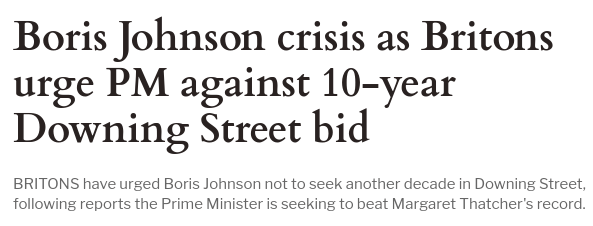
Boris Johnson crisis as Britons urge PM against 10-year Downing Street bid

Yes – you read it in the Express, but in case you didn’t, Owl posts the headlines!

A survey of Express readers found 56 percent don’t want Mr Johnson to try and beat the Iron Lady’s record, versus 42 percent who do. Mrs Thatcher served as Prime Minister for eleven years, from 1979 to 1990.

James Bickerton www.express.co.uk

No tax break for Freemasons

“Secret handshakes don’t seem to work with the tax man….”

David Byers www.thetimes.co.uk

The Freemasons, the secret society known for its charitable work and strange initiations, has failed to win a multimillion-pound tax break.

The United Grand Lodge of England (UGLE), the governing body for Freemasons in England and Wales, has lost a battle against HMRC to secure a £2.83 million VAT rebate by getting a judge to officially recognise it as solely “a philosophical, philanthropic or civic” organisation.

This comes after a push to publicise its charity work and to attract more members by advertising at universities.

UGLE claimed in court that it should be given the refund, which covered VAT on membership fees between 2010 and 2018, because it had become so outward-looking since the turn of the century that its philanthropy and philosophy was its “main aim and it did not have any other main aims”.

HMRC disputed the claim at the first-tier tax tribunal. Although it agreed that the Freemasons carried out many worthy charitable works, it said that many objectives were still “for the benefit of its members”, and included “making friends, socialising and networking” so it should be taxed as a normal membership organisation. Judge Greg Sinfield ruled that UGLE had stretched its definition of philanthropy too far. “The giving by Freemasons through UGLE and the masonic charities for the benefit of other Freemasons is not philanthropy,” he said.

UGLE said: “We are obviously disappointed with the outcome, but will not be providing further comment during the appeal period.”