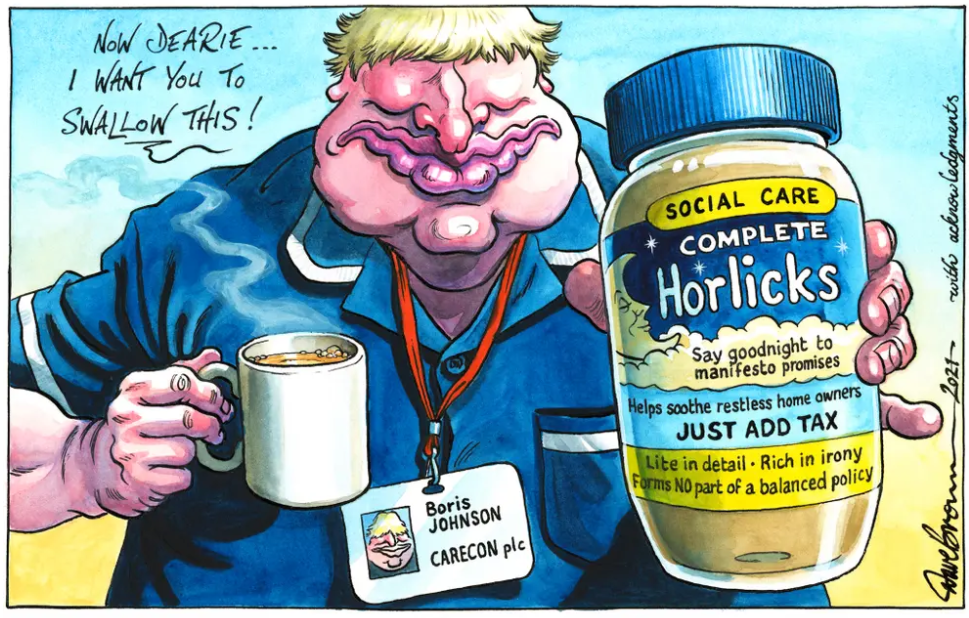
Rightwing media hang Boris Johnson out to dry on social care

[Including commentators such as Dominic Lawson – “This is about inheritance, not the quality of care” – Owl”]

The parliamentary vote on social care passed pretty comfortably for the prime minister, but a nasty war over the funding of his social care reforms rages on in the Tory-leaning press. Accusations of treachery and “disgrace”, of addiction to tax hikes, of being an ideological void – and even of murdering conservativism – are all being laid at Boris Johnson’s door.

Vanessa Thorpe www.theguardian.com 

And this from the closest he has to friends in the media. The leftwing press may have piled on its own allegations that the new tax scheme will hit the struggling employed and yet leave wealthy pensioners and high earners untouched, but much of the harshest criticism is still coming from the right.

Writing in the Daily Telegraph on Thursday, Allister Heath, editor of the Sunday title, attacked the reputation of the PM with a frenzy. “Shame on Boris Johnson, and shame on the Conservative party. They have disgraced themselves, lied to their voters, repudiated their principles and treated millions of their supporters with utter contempt,” Heath argued under the headline “Boris’s shameful Tory betrayal guarantees the total victory of socialism in Britain” and a sub-heading that proclaimed “The Conservatives have trashed their intellectual traditions for the sake of short-term political gain.”

Fraser Nelson, editor of the venerable rightwing journal the Spectator, had no kinder words for Johnson, although he certainly did not declare a covert victory for socialism.

Under the claim that Johnson’s cabinet has presided over the “inversion of the welfare state”, Nelson explained the mechanics by which this trick has been pulled off. “The traditional logic of the welfare state – that those with power and money help those with less of it – would be turned on its head… Some will help families who can in no sense be described as rich. But after the NHS waiting list has begun to ease, the tax becomes a care home insurance scheme, and the refusal to impose any means-testing has big implications.”

On the eve of the vote, the Spectator’s economics editor, Kate Andrews, alleged Johnson had “reneged on manifesto promises left and right” and was now revelling in the growth of the “big state”.

She feared, she added, that the NHS hole will drain all the new cash. “Unless decades of politicalisation and idolisation of the health service are undone overnight, and it becomes politically possible to critique the health service, this seems like a near-impossible situation. The only guarantee, then, is a new, higher tax burden.”

Another pair of missiles launched on the eve of the vote came from the Telegraph. Robert Taylor claimed Johnson is “addicted to big government”, predicting further tax rises, while Camilla Tominey, the paper’s associate editor, said Johnson lacked shame “as he sounded the death knell for conservatism”. She argued: “Mr Johnson’s suggestion that the public feels in their bones the need to spend more on the NHS appeared to miss the point that most would rather it was the government’s money than more of their own hard-earned cash.”

NHS ‘faces breaking point by November’ without masks and social distancing as Covid cases rise

The NHS will be at breaking point within two months if the Government fails to implement basic Covid precautions such as mask wearing and social distancing, a new scientific paper has found. 

By David Parsley inews.co.uk

The paper, which is at the pre-publication stage at the highly regarded medical journal The Lancet, has been authored by a number of leading scientists and was funded by vaccine producer Moderna. 

The report finds that, even with a 100 per cent take up among the over-16s currently being offered a vaccine, there will have been up to one million hospital admissions to Covid wards between “freedom day” on 19 July and the end of the year if the reproduction rate (R-rate) rises above two. 

At an R-rate of 1.7 the paper, seen by i, estimates that the UK will suffer a further 340,000 hospital admissions before the end of the year. 

The current R-rate in England is 0.9 to 1.1, but with the margin of error could be as high a 1.3. In Scotland, three weeks after schools returned, the R-rate stands at around 1.3 to 1.6. 

Without any Covid restrictions in place and with pupils returning to school in England this week, one of the authors of the research believes NHS hospital admissions for Covid across the UK will have reached that same level as at the last peak of 5,671 on 12 January. 

Co-author Dr David Strain, a senior clinical lecturer in the college of medicine and health at the University of Exeter, said: “We found that there is going to be a steady and continued rise in infections and hospitalisations if further interventions are not put in place, whether they be physical distancing, the reintroduction of masks, or different vaccines strategies. 

“If we don’t do anything, hospitalisations will be at the same level as they were at the previous peak by the beginning of November.” 

Since pupils return to school in Scotland three weeks ago there has been a more than fourfold increase in infections north of the border, while hospital admissions are up more than 3.5 times those before the autumn term began.

However, Scotland did open up other hospitality venues and large events around the same time a school pupils returned. 

Dr Strain believes the Government must do something in order to mitigate an “inevitable” rise in cases over the coming weeks in order to ensure the NHS remains operational. 

“We have to do something,” he said. “Whether that something is a firebreak, whether that something is changing the vaccination strategy, or just reintroducing masks and social distancing. But we will definitely have to do something between now and Christmas.” 

The report’s authors also include three researchers from the modelling group Health Economics and Outcomes Research, Marc Evans of Cardiff University, as well as three scientist from Moderna. 

Despite ongoing concerns that the Government may be forced to re-introduce Covid restrictions, ministers have claimed any lockdown in October to ensure the NHS is not pushed beyond capacity was a “last resort”. 

A senior No.10 source suggested to i last night that the only contingency measures under active consideration by ministers in case of unsustainable pressure on the NHS were relatively non-invasive ones such as mask wearing and capacity limits at large events. 

Ministers drop shake-up of planning laws

The biggest shake-up of planning laws for 70 years is set to be abandoned after a backlash from voters and Tory MPs in southern England.

George Grylls, Political Reporter  www.thetimes.co.uk

Reforms designed to help ministers hit a target of 300,000 new homes annually by the middle of the decade will be watered down, The Times understands.

The government had intended to rip up the planning application process and replace it with a zonal system, stripping homeowners of their rights to object to new houses. It said that councils would also be given mandatory housebuilding targets.

Robert Jenrick, the housing secretary, will announce a more limited set of changes. Tory MPs blamed the planning overhaul for their party’s shock defeat by the Liberal Democrats at the Chesham & Amersham by-election in June.

The need for wholesale reform has been questioned after developers set records for housebuilding. Almost 244,000 homes were built in 2019-20, the highest number since the late 1980s, and developers appear to have coped well with the pandemic.

In the first three months of this year construction began on 46,010 dwellings, an increase of a third on the same period last year and the highest number of quarterly starts for 14 years. There are more than 1.1 million homes with planning permission waiting to be built, analysis by the Local Government Association has found.

Ministers are expected to abandon their intention to make housebuilding targets mandatory. The zonal system proposed last year is also likely to be dropped — although councils could be asked to designate “growth sites” where there is a presumption in favour of development and planning applications will be fast-tracked.

Dominic Cummings, the prime minister’s former chief adviser, said in July that the government had already achieved its aims for housing reform by slipping through changes to the planning system this year.

Cummings said that an expansion of Permitted Development Rights (PDRs), which let developers turn high-street businesses into flats and add two storeys to existing buildings without planning permission, had passed unnoticed in Westminster. The changes had been “barely discussed publicly” so that Tory MPs would not get “over-excited”.

A Whitehall source said: “The changes we made this year have been received positively and we’re hearing of examples of them being put to good use and helping our high streets.”

The backbenchers are likely to seek more concessions. Bob Seely, a leading rebel, said: “Communities . . . have a right to demand to be listened to without being shouted down by the Westminster elite as so-called nimbys.”

The Ministry of Housing, Communities and Local Government said: “We will not comment on speculation. Our response to the consultation will be released in due course.”

New Information Commissioner suggests FOI charges; data protection rights to be weakened

It’s been a busy week.

On Thursday, incoming Information Commissioner, John Edwards, was questioned by MPs on the Digital, Culture, Media and Sport Committee. Unprompted, he suggested he thought it was legitimate to charge some Freedom of Information requesters. 

We issued the following statement in response to his comments:

“John Edwards was cautious about taking a firm position on the FOI questions he was asked, understandably wanting to brief himself fully on the issues before commenting.  Unfortunately, that did not deter him from suggesting off his own bat that some requesters should be charged for making FOI requests, a topic no-one on the committee had even raised with him. He seemed unaware that the ICO has always opposed the introduction of charges. For the incoming Commissioner to advocate a reversal of ICO policy on this critical issue before he’s even taken office is not an encouraging sign. We may have the first Information Commissioner who is willing to take the initiative in proposing to restrict FOI rights.”

Our comments have been quoted in this report on the hearing by openDemocracy. 

Mr Edwards is currently the New Zealand Privacy Commissioner. He takes over from Elizabeth Denham, the current UK Information Commissioner, on 31 October 2021. 

Rights to see personal data at risk

As if that wasn’t worrying enough, today the government published its long awaited proposals for reforming data protection law post-Brexit. It didn’t take us long to figure out that they would seriously reduce the rights of individuals to obtain their own personal data by making a  ‘subject access’ request. 

The consultation document proposes several changes based on provisions under the Freedom of Information Act:

  1. allowing subject access requests to be refused if the cost of answering the request exceeds particular limits;
  2. requiring data controllers to advise and assist requesters whose requests are refused on cost grounds; and
  3. permitting burdensome requests to be refused as vexatious.

Under the Freedom of Information Act requesters can challenge such refusals by complaining to the Information Commissioner’s Office (ICO), which must investigate and can overturn refusals. This doesn’t happen under Data Protection legislation. The ICO normally refuses to enforce subject access rights, telling requesters to go to court instead. Few do because of the high costs. 

The consultation would extend the grounds for refusals while strengthening the ICO’s ability to ignore complaints. Any comparison with the FOI regime is misleading: the ICO’s ‘hands off’ approach means individual rights would simply be slashed.

Katherine Gundersen 

Campaign for Freedom of Information go.cfoi.org.uk

A new planning reform could mean the death of England’s high streets 

“…..handing the high streets over to a blundering herd of developers is not democracy.”

Simon Jenkins www.theguardian.com 

The summer of 2021 may be remembered for Covid and the withdrawal from Afghanistan. But another lasting and insidious change took place: the death of the high street. By approving the building of residential homes on ailing shopping streets, planning minister Robert Jenrick effectively allowed any shop, restaurant, cafe or business premise in England to become a house. Since almost everywhere houses make more money, this puts every high street under threat.

Although done in the name of creating “thriving town centres”, Jenrick’s policy will strip away the cohesion that still binds many communities together, urban as well as rural. The diversity of English towns and cities has long been protected by planners enforcing classes of use. Restaurants and shops could not simply become houses without planning permission. But as of last month, if any landlord thinks to profit by turning the use of one building into another, it will require no permission to do so. A building need only to have been vacant for three months (after Covid-19, this already applies to one in seven shops, and could easily be achieved by eviction). Hit by lockdown, online shopping and the end of rental holidays, high street shops are struggling to survive. They need time to recover, not Jenrick kicking them in the teeth and sending their landlords cheering to the bank.

Listed for Jenrick’s chop are high street shops, restaurants, cafes, pharmacies, clinics, creches and gyms. Protests against the change to planning rules have been universal. The Royal Town Planning Institute dismisses the reform as “a golden gift for unscrupulous landlords and developers”. The Town and Country Planning Association (TCPA) calls it “no way to revitalise our high streets or level up”. Even the official developer lobby, the British Property Federation, deplores “the damaging impact uncontrolled conversions to residential could have on the future of our high streets”. The National Trust protests at conservation areas not being given protection, “leaving councils powerless to prevent businesses turning into poor-quality housing”. There is nothing to protect York’s Petergate or London’s Beauchamp Place from becoming flats, top to bottom.

Already, research is showing the likely consequences of this madcap policy. A report from University College London for the TCPA studied Huntingdonshire, Leicester, Barnet and Sussex. The expected loss of high street businesses to housing varies from 89% in Barnet to 75% in Huntingdonshire. Overall, four out of five shops are likely to disappear, mostly small, locally owned businesses.

Perhaps Jenrick’s family lives online, their idea of a high street being a van at the door and a delivery driver. Others romanticise community institutions such as the nursery, the newsagent and the village shop. We tease the French for saving every tabac and boulangerie. England’s high streets may be changing in the direction of the internet cafe, the hairdresser and the delicatessen, but all risk falling to a tidal wave of free-market entrepreneurship and Airbnbs. We should remember that such a market is not fluid. A housing estate that replaces a meadow never reverts to a meadow, nor will it revert to a high street.

We need time to assess the communal impact of the pandemic. I know of villages that have found a new sense of neighbourliness in lockdown. But shops, offices and other businesses have suffered a huge, many hope temporary, economic distortion. To exploit such distortion by freeing the use of buildings from planning control risks tearing the heart out of one community after another.

The point of town planning is to regulate the use of a scarce resource – land – for the public good. People want to see the places where they live sensitively regulated, not left to a free-for-all and to be insulted as nimbys if they complain. Boris Johnson should realise what cost him the Chesham byelection.

Planning has to change with the times and the 1987 use-classes orders were certainly archaic and rigid. But just because a law is out of date does not mean it must be abolished. A sense of community is a delicate thing. Its infrastructure will depend on market forces that are in turn disciplined by local debate and consent. Stripping out that consent – the essence of Jenrick’s planning reforms – and handing the high streets over to a blundering herd of developers is not democracy. The concept of English community is to be a snaking procession of delivery vans, one of Johnson’s most miserable legacies.

East Devon: ‘horrendous’ homelessness problems prompt council to hire extra housing officers

Extra staff are being recruited by East Devon District Council (EDDC) to help deal with ‘horrendous problems’ of homelessness caused by the end of the Government’s eviction ban.

Joe ives, Local Democracy Reporter sidmouth.nub.news 

The moratorium on evictions, which began during the first wave of the pandemic, ended on 31 May. EDDC says this has fuelled homelessness in the area, with current housing staff unable to keep up with cases and some even having to take time off because of stress.

An EDDC report says an ‘unsustainable’ number of people are approaching the council for help. As of Thursday, August 5, there were more than 250 open homelessness cases, and the number is expected to rise as evictions by private landlords soar.

Councillor Megan Armstrong (Independent Progressive Group, Exmouth Halsdon) told cabinet that the end of the eviction ban was causing ‘horrendous problems’ for many people in East Devon.

Councillor Jack Rowland (Democratic Alliance Group, Seaton) said: “It’s sad that we’re in a position that we have to consider this but the staff have been under such pressure and that pressure isn’t going to go away.

“You can only see the situation becoming worse over the remaining months of this year.”

The council’s cabinet, meeting on Wednesday, September 8, agreed to hire two extra housing officers for the next year at a cost of £67,500.

A worrying increase in insecure accommodation

Homelessness was already rising because of the pandemic, as was domestic violence and rent costs. It is claimed that Airbnb and a growth in the number of holiday homes is adding to the problem.

The legal definition of homelessness is that a household has no home in the UK or anywhere else in the world available and reasonable to occupy. Homelessness does not just refer to people who are sleeping rough. It also includes those in temporary shelter without permanent accommodation, those living in inadequate or unfit housing such as campsites, and those living in insecure housing. The last definition can involve people with insecure tenancies, or facing eviction or domestic violence, or those forced to sofa surf.

Councillor Megan Armstrong picked up the general mood of the cabinet when she concluded: “There are no easy fixes to this, but we will keep trying as best we can.”

Overnight emergency health service outsourced

East Devon District Council‘s night-time service to help elderly and vulnerable people with health emergencies will be partially outsourced to a private company for the next four months because of staff shortages – and could save £4,000.

Joe Ives, local democracy reporter www.radioexe.co.uk

The service, known as Home Safeguard, provides users with a pendant with a button for them to press in an emergency. An operator then provides over-the-phone help and, if necessary, calls emergency services. 

Home Safeguard operates between 10:15 p.m. and 7:15 a.m., receiving an average of 21 calls a night. But it has lost three team members recently,  and remaining staff have become overstretched.  Now the council is outsourcing four nights a week to a private company called Night Owl, with the in-house team covering the other three nights. The arrangement will run for four months.

Unlike the council’s in-house service, Night Owl staff are not based in East Devon but at offices in Chichester, Exeter and Ashburton. Nevertheless, council officers say the new people have been familiarised with East Devon’s needs.

Some members of the council have taken against the idea, and are particularly worried by comments made in a report that the change could be made permanent if the service offered by Night Owl proves acceptable and more cost-effective. Officers believe around £4,000 will be saved over the next four months.

Speaking before the cabinet’s decision, Councillor Paul Millar, who recently switched from being an independent to join Jake Bonetta as a Labour Party member, said: “So often this kind of policy can come at the expense of quality, working conditions and democratic accountability and, in the end, costs in the long term if our residents suffer from poor communication between the company and the council.”

He said the current salary offered by the council, under £17,500 per year pro-rata, needed to be increased if it is to address its recruitment problems. 

Cllr Millar added: “The core argument about saving money is not one I subscribe to. The savings are negligible.

“I don’t think it should be about money at all. It should be about quality of service.”

Councillor Jake Bonetta (Labour, Honiton St. Michael’s) added: “I cannot support any move to take our council services out-of-house.

“Investing in our own services with better pay and better conditions is so much more valuable than potentially outsourcing permanently.” 

Council leader Paul Arnott (Democratic Alliance Group) said he sympathised with the criticisms and that he disliked the idea of outsourcing, but in his opinion it was a matter of necessity. He argued that without the emergency measures the service could not be maintained. 

He concluded: “I know the answers don’t please everybody or perhaps entirely anybody, but we will revisit this soon. That’s an absolute commitment.”

In a joint statement issued after the decision was agreed, Councillors Bonetta and Millar said they would work to prevent “any future potential cabinet decision to make any unnecessary and expensive outsourcing of the highly valued Home Safeguard social service permanent.

“Labour councils in other parts of the country have proven that bringing services back in-house and maintaining them there leads to cost savings, greater quality, and a more democratically accountable service to voting residents.”

The issue will be discussed again by the cabinet when the contract ends next February.

Messages on Covid: infection rate may have stabilised but at a high level

More than 8,000 people in the UK were in hospital with Covid on Wednesday – the highest figure for nearly six months – leading to fears of a resurgence in the virus’ ability to cause serious illness and death among the population.

And:

COVID cases no longer climbing as feared

Professor Tim Spector, lead scientist on the ZOE COVID Study app, comments on the latest data:

“It’s great to see the return to schools and summer festivals haven’t yet resulted in a spike in cases as feared. However, the picture is worse in Scotland, where rates are still rising and our figures indicate that Scottish hospitals could soon be overwhelmed. The Scottish situation makes it clear we can’t be complacent about COVID as winter approaches. We are still producing far too many Long Covid cases and hospitalisations unnecessarily. For 521 days, ZOE and King’s College London have demanded cold and flu-like symptoms be recognised as common COVID-19 symptoms and communicated widely as in other countries. With UK rates the highest in Europe, if the government continues with no restrictions, surely we should at least help people to recognise the symptoms early and know when to stay at home.”

Cranbrook plans including Morrisons supermarket submitted

Long-awaited plans for the start of Cranbrook’s town centre which includes a Morrisons supermarket have been submitted.

[Owl is always bowled over by the sense of space given in “artists impressions”]

Daniel Clark www.devonlive.com

It is more than ten years since construction on the new town in East Devon began, and nearly and getting on for nine years since a sign saying ‘coming soon – your new town centre’ was erected.

To date, around 2,500 homes have been built and occupied at Cranbrook, with the new town growing to a population of over 5,500 people, but eventually will expand to around 8,000 new homes with around 20,000 residents.

As well as the new homes, a community building, some retail units, play areas, the country park, two schools, the pub, and the first of two railway stations have been built – but some of the town centre infrastructure needed has yet to get off the ground.

Now though, plans have been submitted for Cranbrook Town Centre, with three separate, but linked, applications for the supermarket with associated car parking and landscaping, the southern side of the High Street comprising retail and residential dwellings above; and a childcare day nursery.

The Cranbrook town centre masterplan

The Cranbrook town centre masterplan

It follows the agreement reached by councillors earlier in 2021 as to how the town centre will be developed and delivered and the demands made for officers to get on with the scheme.

The applications will be located in the parcel of land within Cranbrook Town Centre which lies immediately to the south of the “High Street” section of Tillhouse Road, bounded by Court Royal to the west and Badger Way to the south. A new road is to be built to the east to access the proposed nursery.

A statement with the application, submitted to East Devon District Council, said: “The application seeks permission for a Morrisons supermarket comprising 2,324sqm and the opening and delivery hours of 6.30am – 11pm, Monday to Saturday, and 10am-4pm Sunday. The store has been designed to include 15,000 products and is aimed at providing for a weekly shop.”

It adds: “The store will front onto a 160 space car park which will provide parking for both the store and the wider town centre. Within the store itself, the company’s trademark ‘market street’ concept will be included which has put Morrisons at the forefront of grocery retailing. This minimises the extent to which Morrisons stores compete with traditional town centre comparison goods shops and maximises the complementary role that Morrisons stores play in their relationship with the retail offer in town centres.

“In the store, Morrisons Market Street will have fresh food every day, a bakery, hot and cold ‘food to go’, a fresh meat counter, a barista coffee bar; a ‘free from’ range including vegan, free from dairy, wheat and gluten, and services such as Amazon lockers, Coinstar and a photo booth.

“Customers will also be able to choose to shop online at Morrisons.com and have their groceries delivered to their home or use our Click & Collect service to pick them up from a store. The store will also generate employment opportunities for residents of Cranbrook.”

The application also includes the proposed Cranbrook Town Square, immediately to the south of Tillhouse Road, which has been located in the heart of the town centre and carefully designed to deliver a vibrant and attractive space for social gathering, markets, and outdoor events.

Retail units will front onto the square and deliver a vibrant, active frontage along the southern side of the town’s high street, the northern end of Court Royal and around the town square.

Artist impression of the proposed Cranbrook High Street

Artist impression of the proposed Cranbrook High Street

The statement adds: “The proposed development will deliver eleven retail units on the ground floor of varying sizes and a range of apartments and duplex units on the upper two floors to be built in two phases. The units fronting onto the square will be able to spill out onto the square with outdoor seating areas and canopies to provide shade in the summer months, making them attractive units for restaurants or cafes.

“Marketing has already commenced for these units and a significant amount of interest has already been received from a wide range of occupiers, including a number of local businesses wishing to be represented in the heart of Cranbrook.

“The three storey retail and duplex units have dual frontages: the modern shop fronts face onto the high street from where the retail units are serviced, whilst at the rear the two storey residential duplex apartments have their canopied entrance doors, approached through private garden areas, and linking to private courtyard parking and landscape.”

The application seeks permission for 11 retail units and 26 two bedroom dwellings comprising single storey apartments and two storey duplexes.

The third application is for a vibrant nursery providing childcare for around 100 children, which will be accessed from a new street off Tillhouse Road and include parking provision for staff and parent drop off.

It is hoped that if planning permission is granted before the end of 2021, construction work could begin and be completed in time to allow the foodstore and car park to be open by the last quarter of 2022. The first phase of the high street retail and residential and the nursery would follow and be completed in the first quarter of 2023.

Artist impression of the proposed Cranbrook Morrisons

Artist impression of the proposed Cranbrook Morrisons

The statement concludes: “The High Street south eleven retail units and 26 dwellings, the supermarket and town square, and the childcare day nursery that together comprise the three reserved matters application all therefore formed part of the outline planning application proposals and consents in terms of their use, the quantum of development and their geographical locations.

“Each of the three applications for reserved matters demonstrates the proposals are in conformity with the outline consent and policy requirements and permission should be granted.

“Timely approval of the applications would deliver a national supermarket to the heart of Cranbrook by the end of next year as part of an integrated mixed use scheme for the first phase of the town centre, including the southern side of the High Street.

“The benefits of all three applications are substantial and deliver key aspects of the vision for Cranbrook town centre, including a range of uses that are easily accessible by pedestrian, cycle and bus, and are centred around the market square, an attractive space for social gathering, markets and outdoor events”.

Artist impression of the proposed Cranbrook town square and town centre

Artist impression of the proposed Cranbrook town square and town centre

It comes as last month, East Devon District Council’s cabinet has made an in-principle agreement to borrow up to £40million to help developers build much-needed infrastructure in Cranbrook – with full council needed to rubber stamp the decision.

Council officers admitted that the loan was high risk, but said any dangers are outweighed by potential problems in not creating the infrastructure that East Devon needs to meet its housing obligations.

The money would be used as a ‘revolving’ infrastructure fund – essentially a loan that’s loaned out again. The council would lend the money to developers who might otherwise be put off by high-interest repayments if they sought loans independently.

They would then invest in improving Cranbrook’s infrastructure as the town grows – whilst saving themselves around £8 million.

Council officers believe Cranbrook needs to fund an additional primary school quickly, alongside health and wellbeing provision and, potentially, a new special educational needs school and highway upgrade works on London Road.

Housing crisis sees firms quit Devon

‘There’s a massive effect on tourism and the hospitality sector because there’s just nowhere for staff to live’

Owl draws attention to this paragraph from the conclusions of the Onward report on Levelling-up the South West:

Much of the employment in the South West is reliant on a few low-paying industry groups, namely accommodation and food services and retail. These industries are sources of pride for the region and its flourishing tourism sector, but it’s inescapable that both of them are also sources of lowpay and low productivity. This is paired with a skills shortage amongst young people, especially in Devon and Cornwall.

Lewis Clarke www.devonlive.com 

Businesses are pulling out of North Devon over the housing crisis, the council leader has warned.

At North Devon Council’s strategy and resources committee on Monday, September 6, members agreed to put together an informal panel, inviting relevant organisations and individuals to make representations with a view to preparing a set of actions and recommendations.

The meeting on Monday followed a public meeting organised by North Devon and Torridge Housing Crisis group in Barnstaple held on Thursday, September 2 in which they launched a manifesto with action points for both local and national government.

In his report, the chief executive of North Devon Council, Ken Miles said: “There is little doubt that the housing market in North Devon has changed significantly over the past 12-18 months. House prices have increased substantially and the permanent rental market has significantly reduced, partly as a result of the increase in the short term holiday let market. Many buyers from outside of the area have also been attracted during the pandemic. At the same time, the number of people presenting as homeless has increased significantly.

“Impacts are being felt by individuals, businesses, communities and by public services.

“The issues around the current housing crisis are complex and go beyond the holiday market. Issues such as empty properties, housing standards, energy efficiency, housing supply, affordability, national and local policies are all also relevant and need examination.

“For that reason, it is recommended that councillors and officers engage with the relevant agencies and organisations and those affected by the issues through an informal panel which will draw together a report setting out recommendations on actions that the district council can take and points on which government assistance is required.”

Speaking at the meeting he added: “We need to make it clear what we can do as an authority, what’s within our powers and what we’re going to ask of government. The purpose of the panel meeting is to make that clear.

“That then makes it clear to the public where the control is and where we’ve got to make representations and gives officers a clear steer on where we want to go.

“The panel group can also start setting the agenda; whether we want to look at empty homes, look at building properties, and so forth.”

He said all Devon district authorities had put together a paper which is being sent to Devon MPs raising several issues.

“It’s not just what we are talking about, but also the impact on the local economy as well,” Mr Miles said.

“There are businesses here in North Devon who are not investing in the region due to the lack of housing for their staff. It’s a situation we cannot allow to continue. We’ve got to raise that with government and do whatever we can to resolve it.”

Councillor Malcolm Wilkinson (Mortehoe, Liberal Democrats) said it had a massive effect where he lived in Woolacombe.

“There’s a massive effect on tourism and the hospitality sector because there’s just nowhere for staff to live,” he explained.

“When they pay a minimal wage in Woolacombe and £1.2million is almost the average price for a house, you can forget it when it comes to supporting hospitality.

“If you’ve got a place and you can let it out at £100 a day, it gives those working in the area no chance.”

Jeremy Mann, North Devon Council’s officer for planning, housing and health said the panel was ‘a commendable way forward’,

“The issues are extremely complex,” he said. “The nature of the council’s responsibilities are quite broad and I think the opportunity to look at the whole of it in batches and putting a report together at the end seems a positive way forward.

“It’s important also for our community to understand our care for them.

“A number of the representations that I received after the meeting last week was that as an organisation, we are not telling our story enough. This will be a really good way of showing that we have that care for our community and we are as anxious as anyone to balance the market.”

Councillors then discussed various other implications of the housing crisis and their thoughts.

Councillor Malcolm Prowse (Bratton Flemming, Independent) said: “Every parish council you talk to all agree that we should be allowed to build council houses again. That is the overwhelming feeling of people in North Devon. The old system used to provide the right sort of houses, with the right size and decent gardens in the right communities across North Devon.

“We are now in a situation where we’re relying only on the planning process to deliver housing and it isn’t quite working.”

He added: “I believe this authority should use its corporate powers more to intervene. We should be taking money, buying land, and do all those things people want us to do.

“I’m not saying turn it back to the days of the 1950s when council houses were often built in quite unsustainable positions, but there are plots of land around that we should get involved in.

“I think a lot of developers would be happier about doing a straightforward financial deal rather than getting involved in long complicated S106 agreements. We need that flexibility to do something soon.

“We need to get a move on in the next few weeks and get a policy which can make a difference soon.”

Councillor Netti Pearson (Ilfracombe West, Independent) said that land owned by the authority should be utilised and that they should take every opportunity to build council housing.

“We need to push to make sure it stays as council housing and doesn’t get sold,” she said.

“We need a lobby aspect to whatever decisions we make as there’s not much point in building homes only to see them go.

“As far as affordability is concerned, we should also be looking for a different definition. Affordability in this locale is not affordable to people on the average income.

She added: “I’d quite like us to have some sort of influence on estate agents and what they say in their adverts. They boast about how people can get 30 per cent more than the asking price, which simply fuels the inflation in the area.

“It’s a perfect storm at the moment.”

Councillor John Patrinos (Lynton & Lynmouth, Independent) said a lot of issues were outside of the remit of the authority.

“I know a lot of people don’t understand that and say what the council should do,” he said, “so we need to tell our story effectively.

“We can’t go and build council houses even though we want to, and we can’t provide lots of social rented housing as we just aren’t legally allowed to.

He continued: “At the meeting on Thursday, one of the leading campaigners Emma Hookway said she had spoken to the two local MPs. Unfortunately, she didn’t say what they had said, although I can guess.

“The only people with an opportunity to shape the damage being done in this particular area by current government policy are members of the current government’s party.

“We need to tell the story of what we are doing. Decide what additional things we can do, and then explain why we can’t do everything we’d want and then point the finger appropriately.”

However, Glynn Lane (Landkey Independent) said that it felt like a ‘political movement’.

He said: “I think you’ve got a situation here which is major. I don’t know if this district council can sort it out on itself, but it’s got to come down to government.

“When you talk about housing and all the rest it of it, it was this committee which turned around and tried to restrict housing in North Devon. Now you’re trying to get housing in North Devon. You can’t have it both ways. You either want housing or you don’t.

“You can’t turn around one minute and say you don’t want housing in one location and the next there is a crisis with housing.

“What do you actually physically want? I think personally, you need to take a broad look at yourself and what you really want in North Devon.

“The reality of life is, if you want somebody to have affordable housing in North Devon, you need to build houses people can afford to buy, or even purchase.

“I’ve seen in the last few months decisions made here is not right, and I think you need to look at yourself. It’s all very well trying to blame the government, but you can’t even organise yourself in here.”


Ministers slated for ‘unacceptable’ delivery of Green Homes Grant

“Set up to fail” – Meg Hillier MP, Chair  Public Accounts Committee

By Joey Gardiner www.bdonline.co.uk 

National Audit Office says abandoned £1.5bn domestic retrofit discount scheme will help less than a tenth of the homes originally targeted

Government auditors have slammed the ‘unacceptable’ delivery of the £1.5bn Green Homes Grant scheme designed to help fund 600,000 green domestic retrofits, but which was ultimately closed this spring after paying out just £36m in vouchers.

A National Audit Office (NAO) report released today concluded the scheme was delivered to an over-ambitious timetable and “not executed to an acceptable standard”, with NAO head Gareth Davies describing it as “rushed”.

MP Meg Hiller, chair of the cross-party Public Accounts Committee, said the scheme was “set up to fail”, with its design taking “little account of supplier and homeowners’ needs”.

The NAO report said the scheme, delivered by the department for Business, Energy and Industrial Strategy (BEIS), was currently estimated as likely to fund just 47,500 energy improvement measures, less than 10% of the 600,000 forecast, with a total scheme spend of £256m.

The report blamed the failure on the rushed implementation of the scheme, which was opened just 12 weeks after being announced by chancellor Rishi Sunak as a post-lockdown stimulus measure.

Sunak had said the whole £1.5bn of subsidy should be spent in just six months.

This gave the department just three months in which to design the Scheme, consult with stakeholders and procure a grant administrator. The report found that none of the potential grant administrators approached by the department felt the timetable for setting up a digital voucher system was deliverable, however the one chosen, ICF Consulting Services, said it could have a system up and running in the quickest timeframe. In the event, the system was not fully functioning at the point the scheme was closed in March this year.

The average time the administrator took to issue a voucher under the scheme, following application, was 137 days, with more than half of applicants either failing the application process or withdrawing their application before a decision was taken.

The NAO also revealed that the department’s accounting officer decided to go ahead with the scheme despite the department’s investment committee having rejected it as too risky. This was justified on the basis the scheme was “intended to play a key part in the government’s response to mitigating the pandemic’s economic impacts”, and would deliver value for money in any event, even if not all the cash was spent.

However, ultimately, the scheme incurred administration costs of more than £50m – equating to more than £1,000 per house, a number Hiller described as “astonishing”.

Hillier added: “The government cannot hope to achieve its net zero ambitions if it doesn’t learn the lessons from this botched scheme.”

The report found that despite one of the lessons from previous energy schemes being that schemes should be designed following a proper evaluation of stakeholders’ views, the scheme was announced in July 2020 without any consultation at all, with the department only consulting with installers afterwards.

Given the scheme design and rapid timetable, the NAO found that some installers were reluctant to invest in gaining the appropriate accreditation to take part in the scheme, meaning some homeowners were unable to find installers.

A BEIS spokesperson said the Green Homes Grant was designed as a short-term economic stimulus and delivered during an ongoing pandemic. “Despite this, and challenges with delivery, 99.9% of applications have now been processed, meaning almost 80,000 upgrades to homes,” the spokesperson said.

The department said the UK had a strong track record in improving the energy performance of its homes, with 40% now above Energy Performance (EPC) Band C, up from just 9% in 2008, with the government having committed £9 billion of investment in improving the energy efficiency of buildings.

NHS hiring army of new £270,000 bosses who’ll check how £36bn is being spent

The NHS is hiring 42 new chief executives who will be paid up to £270,000 each, raising fears about how the new health and social care tax will be spent.

Tom Williams metro.co.uk 

Job adverts for CEOs who will lead new integrated care boards across the country were posted at the start of the month.

The NHS has defended the move, saying it is reducing the number of boards from more than 100 and the new recruits will be responsible for the health of hundreds of thousands of people.

But MPs have expressed concerns about the appointments, who will all earn £233,000 on average – more than the Prime Minister – and collectively cost around £9million.

This week all working people were asked to foot the £36bn bill to cover the increased costs of caring for sick and elderly people over the next three years.

A 1.25% hike on national insurance will raise an extra £12bn but broke a Conservative manifesto commitment. It is intended to fix a massive backlog in the NHS caused by Covid.

MPs passed the new legislation in the Commons last night despite widespread discontent among the Tory backbenches.

The new roles will be required to lead the delivery of ‘joined-up’ services across the NHS and social care.

Adverts posted online say successful candidates will need to be ‘politically astute’ and ‘actively champion diversity, inclusion, and equality of opportunity for all’.

Experts have warned there may be little money left for social care as the NHS could ‘swallow up’ much of the extra £12bn being made available.

The Institute for Fiscal Studies said the health service would continue to require most of the new revenue in the coming years, despite plans to divert much of the cash to social care after October 2023.

The health secretary Sajid Javid promised MPs yesterday that he will be ‘watchful for any waste or wokery’ from the NHS, according to the Daily Telegraph.

But criticising the new CEO positions, one Tory MP told the paper: ‘People on low salaries will have difficulty understanding why they are having to pay significantly more tax partly to pay mega salaries for these new posts.’

Care minister Helen Whately has promised the Government will be keeping a ‘really close eye’ on how extra funding will be spent by the NHS.

Asked on Sky News about the new CEO roles, Ms Whately said: ‘People working in the NHS in those kinds of roles are taking on a lot of responsibility, they’re big jobs, and they’re moving from having more senior managers in the NHS to fewer through doing this, the NHS reckons that it needs to have that level of pay to have the right people in those jobs.

‘But I do think the Government keeps a really close eye on making sure that NHS money is spent carefully and appropriately because we want as much of the funding as possible to go to the front line.’

An NHS spokesperson said: ‘Overall, there will be fewer statutory boards – going from over 100 to 42 – and so the people in these roles will have responsibility for the health of thousands more people.’

Massive 820 homes plan for Devon approved

The tyranny of the five-year land supply, land-banking and outline planning permissions  – Owl

Daniel Clark www.devonlive.com 

Plans for 820 new homes to be built on the outskirts of Barnstaple have been given the go-ahead by planners.

North Devon Council’s planning committee on Wednesday morning unanimously backed the outline scheme for Landkey, with planning officer Jean Watkins telling the committee that the potential ramifications of denying planning permission were “catastrophic.”

Officers had recommended that the scheme, which could eventually take 11 years to complete, be given the go-ahead, and councillors at the meeting backed the recommendation despite concerns over how the site would be accessed, and the low level of affordable housing, described as ‘disappointing’.

Access into the site is set to be from a roundabout at the Landkey junction on the A361, but a planned secondary access through neighbouring Westacott Park was stopped by the council last month following an outcry from local residents, and the council voting not to sell the land.

Some nearby residents fear a build up of traffic in the area that will lead to the 820 new home becoming a cul-de-sac, but the council decided to approve the project despite being unsure of what, if any, secondary access road can be delivered.

Artist impression of the completed project and the new roundabout at Landkey. Credit: North Devon Council

Artist impression of the completed project and the new roundabout at Landkey. Credit: North Devon Council

Cllr Malcolm Prowse had described the lack of a link road as a “tragedy.” He said: It ain’t gonna work – we have got to sort out sustainable links for this site to the rest of Barnstaple.”

He argued the public would criticise the council for not insisting on more affordable housing in the plans, a concern shared by several members of the planning committee.

But officers had recommended the plans be approved, and the councillors voting in favour, as without the scheme, the council would not be able to demonstrate a five year land supply, and thus would be at risk of hostile and unwelcome applications on sites not allocated or wanted for development.

The development by East Midlands company Barwood Land will include at least 82 affordable homes, with a potential for up to 25 more. It will include a new primary school and community hub and is believed it could create between 600 to 650 new jobs around Barnstaple.

The report of officers, recommending approval, said: “The scheme will deliver much needed housing including affordable housing in the form of a new community with a school and neighbourhood hub at its heart. There is a new employment zone planned with good access to the A361.

“Cycle and pedestrian links will connect the site back to the Whiddon Valley area and onwards to the links to the town centre and the Community Hub has been planned to contain recreational, social and business facilities and is at the heart of this new development.”

It added: “The key issue is how to deliver the Local Plan’s aspiration of a secondary access back into Whiddon Valley. It is not within this applicant’s control to deliver this link but routes to the site boundary will be provided to allow for onward connection should this link be agreed in time. It is also recognised that it will take between 500-600 units to be constructed before such a link is feasible for safety reasons and to ensure that frontage development is planned.

“The link to Westacott road in whatever form will not be an instant requirement which will allow other options, and if a secondary access is not agreed, then in highway terms the use of a sole point of access from the A361 does not result in safety issues, but in sustainability terms the layout does not connect one community well to another.

“It is not considered to be good place making without such a link, but this application is not considered to fail without a link, particularly as Devon County Council now advise that a bus service can be provided which will support the Park and Change.”

Artist impression of a bird\'s-eye view of the completed project. Credit: North Devon Council

Artist impression of a bird\’s-eye view of the completed project. Credit: North Devon Council

It concluded: “On balance, it is considered that the outline application is acceptable and will provide sustainable development, deliver much needed housing using a well-conceived Masterplan which emphases green infrastructure and a balance of facilities.”

Planning officer Jean Watkins described the potential ramifications of denying planning permission in one word: “catastrophic.”

Councillors voted in favour of the scheme, with a reserved matters application of the detail of the application needed to be submitted and approved before construction can begin.

NEW: A rare and vital win for the future of our planet – Good Law Project

goodlawproject

We’ve won. Government has today announced its new policy for the future of energy production in the UK following our legal challenge last year. We are pleased to say that the proposed new policy is better for our planet, for our children and for our grandchildren. 

Coal and oil-fired generation are out. Gas is being phased out. 

Fewer fossil fuel projects will now be rubber-stamped. 

It’s not perfect yet. And we know more can and must be done. For example, there is scope for Government to be pushed yet further on the timetable for phasing out gas in the public consultation. But in terms of using the law as a tool for social change, this is a win of real substance. 

Thanks to the support of hundreds of you, we’ve proven Government can be made to take the right steps to tackle the impending climate catastrophe and protect our children’s futures. It’s never too late. 

Since forcing Government to review the Energy National Policy Statement we have turned our attention to the out of date and polluting Airports National Policy Statement. Government has announced it won’t review that NPS and we think it needs to do so to meet its NetZero by 2050 obligation in the Climate Change Act. We’ve assembled a strong team to work on the case – and we will deploy the same legal arguments as we did on the Energy NPS. We hope they will achieve the same result. 

As COP26 draws closer, we’re challenging Government to prove to people, both here and around the world, that it means what it says on climate change.

If you are in a position to do so you can support the legal challenge here. Thank you so much for your backing to date. We couldn’t do it without you.

We are grateful too, to our co-claimants Dale Vince and George Monbiot, without whom this challenge would not have been possible. 


It is only with your support that we can continue to hold Government to account. If you would like to make a donation, you can do so here.

Anger over ‘egotism and discrimination’ on Mid Devon’s planning processes

Mid Devon’s planning committee has elements of ‘egotism and discrimination’ a councillor has claimed.

Lewis Clarke www.devonlive.com

At Mid Devon District Council’s full meeting on Wednesday, August 25, Councillor Ashley Wilces (Cullompton North, Unaffiliated) put forward a motion stating: “Any councillor may attend any meeting of a committee of the council and may speak on any agenda item for that meeting.

“However, in relation to the planning committee, the right to speak on a planning application, enforcement item, or other report relating to a particular ward of the council shall be limited to the rights of a ward member to speak as set out in the Protocol of Good Practice for Councillors Dealing in Planning Matters; in addition, the chairman will also permit the following to speak for no more than three minutes, without prior notice being required: adjacent ward members, and any member having previously submitted a comment to that application that permission to speak being limited solely to the raising of material planning considerations relating to directly their ward, or else to any relevant planning policy or plan appertaining to this Council.”

Mr Wilces explained: “What this motion is seeking to do is to put in writing the practices that the chairman of the planning committee uses on occasions and doesn’t use on all occasions as I know myself.

“Members should always be treated in a fair and consistent manner when they speak at any committee, and I wasn’t. It’s wrong that one member can arbitrarily present another from speaking at the planning committee by invoking a non-existent rule without even establishing if there is a good reason for the member to be able to speak at that meeting.

“My motion doesn’t seek to give any rights to members they would not have if they were able to speak as members of the public, which it’s been decided they are not able to do.

“This motion merely seeks to set down in writing a right to speak where there is a good reason to do so. A right that does not rest upon the whim of any contrary individual.

“If discretion was being consistently and fairly applied, there is no reason to bring forward this motion. What I’ve witnessed at a meeting was an exercise in egotism and discrimination.”

His motion was backed by Councillor Graeme Barnell (Newbrooke, Liberal Democrats) who said: “Planning applications cannot be taken in isolation on the ward by ward basis.

“For example, the planning decisions around Crediton involve wards like my own in Newton St Cyres.

“These towns are spreading out and the developments are taking place in other wards. The adjacent ward issue is an essential part of the planning decision making that members from adjacent wards are often key to a voice for local people in understanding the impact of developments.”

As an example, he said that impact of developments in Crediton would affect roads through his ward.

“The way things stand, the chair has the discretion to refuse members in adjacent wards from speaking on issues to the planning committee.

“That is not right and I think we need to be very clear that members should have the right to address issues in neighbouring wards.”

He said it was also an issue across authorities.

“Another issue hit me with East Devon. We’ve had a digestate lagoon bio energy digestate ten yards the wrong side of the road. All the traffic is going to go through a village in my ward.

“East Devon kindly allowed me to speak, but it was an issue of discretion. It can happen the other way round, and I think it’s very important that we get these issues straight.

“Planning decisions and planning applications have much wider implications, particularly as we now have extensive developments taking place under the umbrella of the adopted local plan.

“I think we need to do this on the basis that planning decisions cannot be compartmentalised on a ward-by-ward basis.”

However, members of the council opted to remain the status quo and refuse the motion.

Current chair of the Mid Devon planning committee, Councillor Polly Colthorpe (Way, Conservative) added: “At present chairmen of committees, including the planning committee, have discretion to allow anyone to speak as an adjacent ward member and indeed others if they ask and have a very good reason to do so.

“That gives the chairman some control over the lengths of a meeting.

“I could not accept this motion because it gives an open book to anyone who wishes to claim the right to speak in relation to a planning application.

“Planning has a habit of running for some time. You can see from the four sets of minutes that I have to present to you tonight that one of those meetings went on till gone 7pm.

“If we have to accept anybody the right to speak, the chairman will not be able to control how long the meeting runs. The result of that could be poor decision making from members who’ve been sitting there for a very long time and just want to get it over with.”

Councillor Clive Eginton (Taw Vale, Conservative) agreed. He said: “Those of us that are on the planning committee are fully aware of the length of time that we can be debating any individual application. Some applications are very much quicker than others, and others can drag on indefinitely.

“My concern regarding this is that where you have a situation where it is an application that has a lot of surrounding wards you could conceivably be talking well in excess of half an hour getting on to goodness knows how long for members from those adjacent wards speaking on an application.”

More on Council Blunders

Coincidentally having just posted “Council Blunders”, Owl has also received this correspondence from “Ms. B”:

Owl has written many times on openness and transparency both in central and local government. Without truth and honesty from those who govern us all confidence is lost in our lawmakers. In my own small way I cannot find what has happened to an enforcement number issued by EDDC’s Central Planning Team over a year ago. I have now lost all confidence in EDDC’s planning and monitoring staff and the Local Government Ombudsman who police local authorities as questions remain unanswered.

An enforcement number was issued following an unauthorised demolition in a conservation area. I was told I would be kept informed as to the outcome. I had an e-mail after 8 months from a Chief Planning Officer saying that a retrospective planning application would be forthcoming in a couple of weeks. No application then appeared, no information on the planning portal and no replies to my e-mails.

My only solution was a formal complaint. Stage 1 revealed an explanation from the Service Lead Planning Strategy and Development Manager which said a decision had been made at the time the enforcement number was issued not to proceed with enforcement. This puzzled me, given the e-mail from the Chief Planning Officer referred to above. Also, in my opinion, the reasons given were not in accordance with permitted development. 

Unhappy with these two different stories I proceeded to Stage 2 of the formal complaint. The  Monitoring Officer wrote saying that he dismissed my complaint because he couldn’t “corroborate” the contradiction because the Chief Planning Officer had left the council. Planning is a quasi-legal process; were no records kept? Why didn’t he ask me for copies of e-mails?

I then tried the Ombudsman thinking that, apart from finding out the truth; mistakes and errors can be used constructively to improve services to the public. I was told by many people that the Ombudsman was a “waste of time” but I pressed on.

Every complaint is assessed using an ‘Assessment Code’ with four inter-related tests: All four tests may be considered when deciding to investigate, but the get-out clause is they may just consider one particular test. In my case the officer only assessed the “Injustice Test” and decided I had not suffered “a significant personal injustice” and did not proceed further to investigate any other test.  

For example, the “Fault Test” applies where “the type and scale of the fault amounts to a particularly serious failure to meet normally expected standards of public service.” Inexplicably, this was not applied to my complaint.

So, in conclusion I do not know who or what to believe. EDDC’s dodgy record keeping remains their own secret and an enforcement number has vanished into thin air!  

Council officials’ blunder over ‘proper whack’ planning decisions

Council officials have published planning decisions containing derogatory remarks, which now have to be reviewed by a court.

By Lizzie Massey www.bbc.co.uk

The notice from Swale Borough Council regarding Happy Pants

The notice was published to Swale Borough Council’s website and is legally binding, despite being issued in error

image source: Swale Borough Council 

Owner of The Happy Pants Ranch in Kent, Amey James, has been waiting for a change of use decision for six months.

She was “shocked” when it was rejected on the grounds that: “Your proposal is whack. No mate, proper whack.”

Swale Borough Council said the published decisions are legally binding and must be officially overturned.

Despite being an “administrative error”, the decisions must now go through judicial review.

In a statement the authority said: “This language was used by a junior officer with no knowledge of any of the applications, who believed they were working solely in a test environment and that the comments would never be published.”

It means a delay of about three months before the correct decisions on each of the five applications can be considered.

One application, to partially demolish The Wheatsheaf in East Street, Sittingbourne, to build flats and a micropub, was approved on the grounds of “Incy. Wincy. Spider”.

A third was approved with the text “why am I doing this am I the chosen one”, and the fourth simply listed numbers one to 20.

Ms James said she “nearly had a heart attack” when she read the decision as “the whole future of the charity hangs on that”, and now the development of the ranch faces further delays.

The sanctuary cares for 350 rescued or special needs animals on farmland, and was recently served with noise abatement notices over its loud cockerels.

Ms James said the blunder showed the “constant poor management, security and communication of the council”.

The error by the Mid Kent Planning Support team also affected a sixth application from Maidstone Borough Council.

An application for a farm in Marden to convert an outbuilding into a holiday let was refused with the explanation “Don’t even bother re-applying lol. Not even joking lmao”.

This application from Maidstone council in relation to Marden

This application was also rejected, after being issued in error

image source Swale Borough Council

Leader of Maidstone Borough Council David Burton said the error was “regrettable” and added: “I would like to apologise for any offence caused.”

Swale Borough Council has made no public apology for the error, but did offer an explanation: “Officers for Mid Kent Planning Support team were testing a solution for issues with the software behind the public access site.

“During this testing an error occurred, which published dummy decision notices on five randomly selected Swale applications on the live system.

“Legal advice has subsequently confirmed they are legally binding and must be overturned before the correct decisions are made.”

Swale Borough Council estimates it will cost £8,000 to overturn the five decisions.

New research: Levelling up the South West

The right wing think tank “Onward” publishes new research.

It shows that Devon and Cornall are among the areas within the region that need the greatest support (low wages, part time work, brain drain, poor connectivity).

But, according to the Western Morning News (which backs “The Great South West”), business leaders and politicians insisted yesterday that the challenges can be met providing Government makes the right investments.

So that’s all right then – pass the Catchup Ketchup! – Owl

www.ukonward.com

This morning we publish Levelling up the South West. The new research note, backed by a group of MPs from the South West of England, examines the relative performance of the South West economy against a number of indicators, covering earnings, employment, skills, local industries, and connectivity.

Read the research

On many metrics, the South West performs around average among UK regions, but this hides the notable deprivation in certain parts of the region, especially in pockets of Devon and Cornwall.

Much of the work in the South West is part time, and those below the median are paid poorly compared to their counterparts in the rest of the United Kingdom.

  • Almost a quarter (23.2%) of 25-49 year-olds work part-time, compared to a fifth (19.5%) across the UK. Almost every constituency (90%) has part-time employment above the UK average, the highest of any region.
  • The bottom 60% of part-time workers earn less than their counterparts in any other region. The bottom tenth earn 13% less than the bottom tenth nationally.

This is paired with a skills shortage among young people, a ‘brain drain’ as graduates leave for jobs elsewhere, and a greater reliance on less productive, lower-paying sectors.

  • Devon is particularly short on highly-qualified young people. Just 24% of 20-29 year-olds have a degree, the fourth lowest of any other NUTS2 sub-region.
  • Devon has twice the national share of students as its share of degree-educated young people, indicating a severe ‘brain drain’ as graduates leave the county for opportunities elsewhere.
  • Cornwall and Devon are the top 2 regions for employment in retail and accommodation and food, but the median wage in these sectors is 26% and 31% less than average, respectively.

Unemployment rates have fallen much slower than other regions since the Great Recession.

  • The South West has experienced the slowest decline in unemployment since the post-recession peak in 2011. Unemployment fell from 6.1% in 2011 to 3.2% in 2019.
  • Contrast the South West’s post-recession recovery with Northern Ireland, where unemployment fell from 7.4% to 2.6% over the same period.

Connectivity is poor both in terms of transport and digital infrastructure.

  • In Cornwall and Devon, the number of jobs reachable within 60 minutes by car is two times below the UK median, and five times below the median for jobs available within 90 minutes.
  • The South West has almost twice the proportion of homes below the broadband universal service obligation as the national average (4.2% compared to 2.5%). In West Devon, 12.4% are below the USO, the eighth worst in the country.

Selaine Saxby, Conservative MP for North Devon, said:

“Onward’s findings are a stark insight of the need to level up across the country, not just in the north but here in the south west too, where we may have affluent areas, but we also have significant pockets of deprivation in places like Ilfracombe and Barnstaple in North Devon.

“We live in a beautiful part of the country, a desirable place to live, but it is not sustainable, for example, that our brightest graduates move elsewhere, seeking opportunities in better connected parts of the UK with stronger infrastructure, depriving local businesses of their talent and their ability to make a difference.

“The story of the South West is one of complex inequality that is not easily reflected in traditional interregional figures, particularly around the coast. I hope that the Government will take these findings seriously, as if it is truly to make a difference and level up the country as a whole, the south west cannot be ignored, and indeed deserves a special focus in its own right given the unique situation within which it finds itself.

“I am immensely grateful to Onward for their diligent work, research, and analysis, which goes deep into the intraregional figures and equality, and teases out the true picture, laying bare the reality of the situation on the ground.”

Cherilyn Mackrory, Conservative MP for Truro and Falmouth, said:

“I welcome this report by Onward which clearly shows why it is so important that the South West is not left behind by the Government’s ambitious levelling up agenda. The South West including the beautiful part of Cornwall which I represent faces a unique set of challenges due to a variety of factors, historical, geographical and economical. With our leaving the EU we now have a chance to address these issues and bring about real positive change that the South West needs.”

“This report highlights the challenges, both in jobs and skills as well as digital and physical connectivity that our region faces. It is for the Government to take notice and deliver on the change we need to ensure that not only are we not left behind, but instead prioritised and put at the forefront of this critical levelling up agenda in the future.”

John Penrose, Conservative MP for Weston-super-Mare, said:

“By definition, levelling up will need a different mix of reforms and improvements for each part of the country, because we’re all starting with a different mix of problems. So Onward’s work is essential for putting flesh on the policy bones, to show what it will mean in detail for the South West.”