M5 Motorway ‘should be extended to Plymouth’

Latest in a long line of calls see:

2017 M5 will be extended to Plymouth if these business leaders get their wish

Further calls to upgrade the main road between Devon and Cornwall to a modern standard motorway have been made.

Daniel Clark www.cornwalllive.com 

Plymouth City Council have long been calling for the modernisation of the A38 to ensure the route reflects its status as a major trunk road.

The upgrade of the road could cost around a £1billion scheme, but could lead to some of the tiny communities between Plymouth and Exeter being ‘cut-off’ because ‘farm-track’ style roads connecting them to the dual carriageway would never comply with motorway regulations.

The A38 is an important lifeline for Plymouth, but in its current state, it just cannot cope with forecast demand, councillors this week heard.

One of the commitments that the new Conservative administration Plymouth City Council put in their manifesto ahead of the May Local Elections was to lobby for the M5 motorway to be extended past Exeter to Plymouth. The commitment had previously been a pledge under the previous Labour administration.

And at Tuesday’s cabinet meeting, Cllr Jonathan Drean, cabinet member of transport, announced that he had written to the city’s MPs asking them to lobby for the A38 between Bodmin and Exeter to be included as a priority for investment.

Cllr Drean said: “I am asking them for support for Plymouth’s goal to bring about the modernisation of the A38 to reflect its status as a major trunk road, and this is consistent with the significant growth ambitions that everyone is aware of.”

Improving and modernising the A38 would put safety first by reducing the frequency and severity of accidents, providing better journeys through reduced journey times, increasing reliability; strengthening resilience, and moving towards motorway standard would support economic growth with improvements, generating £885 million of productivity growth and inward investment.

Beyond Plymouth’s boundary, the A38 from Saltash to Bodmin and Deep Lane to Exeter suffers from inconsistent road and junction standards, low quality maintenance and in places there is a poor safety record that needs to be addressed, previous calls for upgrades had said.

Business leaders had previously added that while the A38 will not be transformed overnight, decades of under-investment must begin to be addressed.

“The modernisation of the A38 forms a part of the long term ambitions for the City as set out in the Plymouth Plan. To deliver this plan and support regional growth, the city and the South West region needs a modern A38, built to a motorway standard, accommodating planned growth and supporting the South West region’s economy in the years to come,” a Plymouth City Council statement had previously added.

The meeting also heard that the commitment to continue to raise the city’s profile with Government to level up the investment within the city to provide a resilient and reliable road and rail network to serve Plymouth had also been met, following the recent announcement that Devon County Council had secured more funding to enable exploration work to continue into reopening the Tavistock to Plymouth line.

The former Tavistock North station opened in June 1890, but closed on May 6, 1968, as part of the Beeching Axe.

There has been a long-held ambition for the re-opening the link between Tavistock and Plymouth is to encourage people to use rail services, and the reinstatement of the rail line to Tavistock is identified in the 20-year plan of the Peninsula Rail Task Force.

And now plans have moved a step closer after the project was awarded funding as part of Chancellor Rishi Sunak’s budget last week, getting £50,000 towards the next stage of works for the business case towards the rebuilding the line between Tavistock and Bere Alston in Devon, connecting Tavistock and Plymouth by rail.

Cllr Drean had previously added: “We’re really pleased to have supported and advised our colleagues at Devon County Council on this really exciting scheme.

“Should this project ultimately become successful then it would complement the improvements we are making at St Budeaux Square by increasing the opportunities to transfer between bus and train to access more parts of the city by public transport, while also easing pressure of traffic on the A386 corridor.”

Devon County Council will now produce a Strategic Outline Business Case and update extensive survey work already undertaken on the route.

The hope is to reinstate the disused rail line between Tavistock and Bere Alston, providing hourly rail services through to Plymouth, as well as opening a new single platform railway station at Tavistock next to the 750 dwelling development under construction.

Two-hourly services between Plymouth and Gunnislake would be maintained

“ There are real drawbacks to open registers.”

Quote of the day

 Insider’s Henry Dyer has an absolutely classic Cox quote from his work on the BVI inquiry: “Let me be quite candid. There are real drawbacks to open registers. It becomes a political tool for every — many, many frivolous complaints are made. It is a profound invasion into a legislator’s private life because what happens is, as you can imagine, stories get written, minor infractions are written up to be morally shameful or even impute dishonesty. I accept the need for registers — of course I do; every legislator must — but there are perfectly understandable reticence to invite that kind of onslaught that that can sometimes mean.” Why on earth might such a “distinguished” figure, as he modestly described himself in yesterday’s statement, be so wary of public registers shining a light on legislators’ interests? We can only speculate.

NHS is at breaking point and putting patients at high risk, bosses warn

Patient safety in the NHS in England is being put at “unacceptably high” risk, with severe staff shortages leaving hospitals, GP surgeries and A&E units struggling to cope with soaring demand, health chiefs have warned.

Andrew Gregory www.theguardian.com 

The health service has hit “breaking point”, the leaders say, with record numbers of patients seeking care.

Nine in 10 NHS chief executives, chairs and directors have reported this week that the pressures on their organisation have become unsustainable. The same proportion is sounding “alarm bells” over staffing, with the lack of doctors, nurses and other health workers putting lives of patients at risk.

Sajid Javid, the health secretary, has come under fire for recently claiming, at a No 10 press conference, that he did not believe the pressure on the NHS was unsustainable.

But the survey of 451 NHS leaders finds the health service already at “tipping point”. The results of the poll, conducted by the NHS Confederation, which represents the healthcare system in England, Wales and Northern Ireland, show that 88% of the leaders think the demands on their organisation are unsustainable, and 87% believe a lack of staffing in the NHS as a whole is putting patient safety and care at risk.

The survey of the most senior executives running hospitals, ambulance services, mental health providers, community services, primary care and integrated care systems comes hours before new performance figures for the NHS in England are due to be published.

The number of people waiting for hospital treatment in England has hit a record high of 5.7 million as the NHS struggles to clear the backlog of care that has been worsened by the pandemic. Updated figures are expected on Thursday.

The greatest areas of concern for NHS leaders are primary care, and urgent and emergency care, according to the survey.

Matthew Taylor, the chief executive of the NHS Confederation, said: “Almost every healthcare leader we’ve spoken to is warning that the NHS is under unsustainable pressure, and they are worried the situation will worsen, as we head into deep midwinter, unless action is taken. They are also sounding alarm bells over risks to patient safety if their services become overwhelmed, on top of a severe workforce crisis.

“The health and social care secretary says the NHS is not under unsustainable pressure, but NHS leaders are clear that we have reached a tipping point. Frontline providers across all parts of the NHS are under intolerable pressure.”

A hospital trust chief executive in the south-east said: “Systems are at breaking point and risk is unacceptably high [for] some cohorts of patients, be that in emergency, primary care, cancer or elective care [or elsewhere]. But where is the honesty and openness about this?”

An ambulance leader revealed that pressures were so severe they were hampering the organisation’s “ability to respond to immediate life-threatening calls” and meant “some patients will die”.

Taylor said that while the NHS was approaching winter with more than 90,000 vacancies, the “number one measure” ministers could take now to stop the NHS plunging into crisis would be providing emergency funding for social care, which had even greater numbers of unfilled jobs.

The Guardian revealed last month that the NHS was facing a mounting beds crisis because care homes with unprecedented staff shortages had to stop taking in patients from hospitals.

Health leaders are trying to free up space in the NHS to tackle the backlog of 5.7 million people – equivalent to almost 10% of the population of England – awaiting treatment. But efforts to speed up the discharge of patients into the community are being hampered by care-worker shortages.

The most endorsed recommendation by health leaders in the NHS Confederation poll was for ministers to provide urgent extra support for social care. This should be targeted at ensuring effective discharge arrangements so that people can live more independently in care homes or in their own homes, health leaders said.

The NHS beds crisis is now so serious that as many as one in five beds in some hospitals are occupied by patients who are medically fit to be discharged, the Guardian was told. In most cases that is because there is no care package available to enable them to leave hospital.

Taylor said the required extra support for social care services should include more money to increase care assistants’ wages to help fill staffing vacancies, and to increase the staff’s fuel allowance so more people could be persuaded back into the sector.

He added: “We welcomed the government’s recent extra investment in the NHS, but we cannot immediately buy our way out of this potential crisis due to the 90,000-plus vacancies in the NHS. It would be better to allocate more immediate funding, from the recent funding settlement, to social care services, as boosting the numbers of care staff will have much greater impact on reducing pressures on hospitals and other parts of the NHS.”

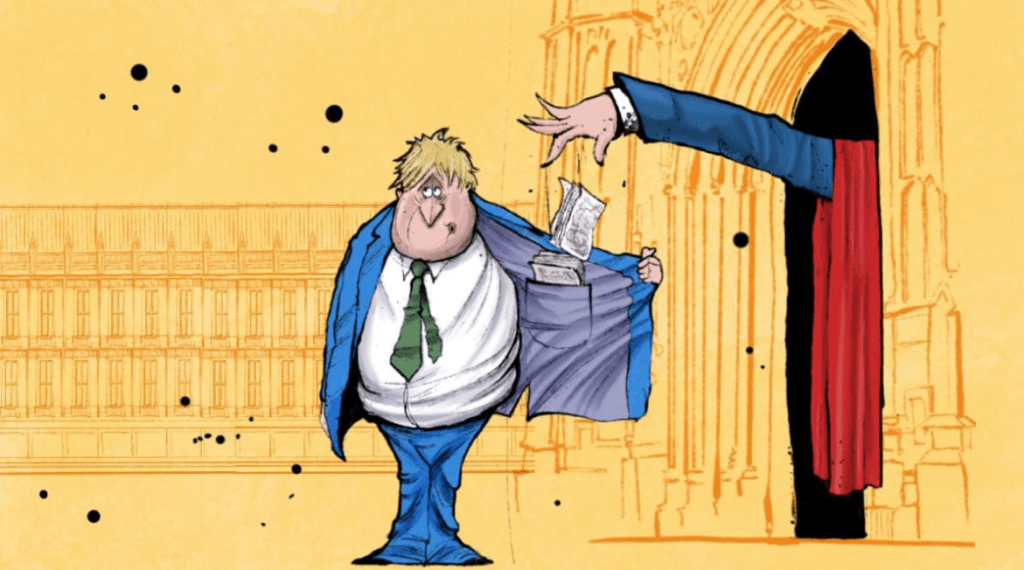
Boris Johnson insists Britain ‘not remotely corrupt country’ amid ongoing sleaze row

He just doesn’t get it (yet) – owl

www.independent.co.uk

Boris Johnson has insisted that Britain is not “remotely a corrupt country” amid continuing fallout over the conduct of some MPs, scrutiny over politicians’ second jobs and concerns over sleaze in politics.

But Labour claimed that the prime minister’s failure to apologise for his role in undermining public trust in politics proved that “he doesn’t care about tackling corruption that has engulfed Downing Street, his government and the Conservative Party”.

And there were signs of growing fears among Tory MPs that the wave of negative publicity could deliver lasting damage to the party’s reputation, with one angry backbencher telling The Independent that the former attorney general Sir Geoffrey Cox had “taken the f***ing p***” by raking in hundreds of thousands of pounds in outside earnings at a time when many voters are facing financial difficulties.

The prime minister’s remarks on Wednesday followed the decision last week to order his MPs to prevent Owen Paterson’s suspension for breaking lobbying rules by creating a Tory-dominated committee – a move that provoked outrage at Westminster.

Despite accusations of “corruption” and the Conservatives dipping in the opinion polls, Mr Johnson twice declined to apologise for his role in the politically toxic row when tackled on the issue at the Cop26 climate summit in Glasgow.

“I genuinely believe that the UK is not remotely a corrupt country, nor do I believe that our institutions are corrupt,” he said.

“We have a very, very tough system of parliamentary democracy and scrutiny, not least by the media. I think what you have got is cases where, sadly, MPs have broken the rules in the past, may be guilty of breaking the rules today. What I want to see is them facing appropriate sanctions.”

Mr Johnson, who said he would not comment on individual cases, stressed that MPs found to have broken standards rules “should be punished”.

He warned them directly: “The rules say the two crucial things: you must put your job as an MP first and you must devote yourself primarily and above all to your constituents and the people who send you to Westminster, to parliament.

“And they also say that you should not use your position as an MP to lobby or otherwise intervene on behalf of any outside commercial interest. It is not only that you have to register those interests – you can’t lobby or make representation while an MP on behalf of those interests.

“Those are the rules and they must be enforced and those who don’t obey them should, of course, face sanctions.”

Despite the prime minister’s attempt to draw a line under the sleaze row, one senior Tory backbencher told The Independent: “I don’t know anybody who thinks the last week has been well handled – and that includes government ministers who were involved in what was done.

“Of course there is reputational damage, some of which is about not looking competent and some of which is a — mostly unjustified — sense that there is some ill-defined idea of sleaze connected to the party. It doesn’t look good and I think we all know that.”

The Conservative MP Bob Neill said: “MPs do feel very let down. This is a reminder that the prime ministers and his advisers in Downing Street must not take the parliamentary party for granted.”

Earlier, Labour demanded an investigation into Sir Geoffrey after it emerged that he appeared to conduct lucrative work advising the government of the British Overseas Territory on a corruption case from his Commons office in September.

In a statement issued earlier, Sir Geoffrey said he “does not believe” he breached MPs’ rules, and also revealed that the Tory chief whip had advised him it was “appropriate” to vote via a proxy on a separate occasion in April while advising the British Virgin Islands from the Caribbean.

Several media reports claimed on Wednesday evening that Sir Geoffrey has made at least £5.5 million from a second job while he has been an MP.

While Mr Johnson declined to comment on the case, one Conservative MP highlighted the unease in the parliamentary ranks, telling The Independent: “A lot of people are p****d off and, ultimately, the buck stops with Boris, so this is not doing him any good.”

A second backbencher also deployed an expletive when summing up the current situation, saying they were furious Sir Geoffrey had “taken the f*****g p**s”, provoking public fury about all MPs.

“When Covid started, I was volunteering to support the NHS and vulnerable people and there he was taking off for the British Virgin Islands for a month and bringing us all into disrepute,” the MP added.

Geoffrey Cox faces more fury as report claims he rents out his London home while claiming £1,900

Extract from www.dailymail.co.uk 

Sir Geoffrey Cox rents out his London home while claiming £1,900 a month for a second property, it was reported last night.

The former attorney general even claimed £3,800 in taxpayer cash for his second London property for two months while he was working abroad in the Caribbean.

While not against Commons rules, an ex-standards chief said MPs earning cash overseas while claiming from taxpayers is ‘totally wrong’.

Sir Geoffrey rakes in around £1,000 a week for the home he rents out in Battersea, south London, The Daily Mirror reported.

He and his wife bought the property as a second home for £535,000 in 2004 and claimed £82,298 in mortgage interest payments over four years……..

Pollution in the river ends in the sea – anyone for a swim?

More on sewage discharges from Nicola Daniel:

I am deeply disappointed that the government has passed such a weak compromise amendment to the Environment Bill on raw sewage discharge into our waters. There is no time scale or an increase in penalties. No one, including SWW seems in a hurry to rectify the situation. If SWW are “totally committed to supporting beaver habitats”, I would like to see their plan of action.

The lower saltmarsh area of the Otter is designated a SSSI and part of this area is a Marine Conservation Zone as well.

The River Otter cannot wait. The beavers and the otters cannot wait.

The river Otter is 44 km. long and the Tale, its main tributary, is 14 km., a total of only 58km (36miles).There is agricultural run-off in these rivers and also permitted sewage discharge from us humans.

There were: 7,229 hours of permitted sewage outfall in 2020 from 891 episodes! This is from just one small river and its tributary in East Devon.

(I have taken these figures from the Rivers Trust sewage network discharges map. https://experience.arcgis.com/experience/e834e261b53740eba2fe6736e37bbc7b/

I hate to think what the pollution level has been in the sea off Budleigh Salterton with the flooding we have experienced in the last weeks. What goes in the river ends in the sea plus whatever is discharged by those living in seaside communities.

In the case of Budleigh residents added a further 623 hours from 83 episodes and also, with a good westerly breeze and tidal flow, more is added to the bay from Straight Point where the Maer Lane Sewage works discharged, 850 hours, from 59 episodes.

A total of 8,702 hours from 1033 episodes (20 per week on average).

The Prediction board is not functioning on the Parade.

If it seems that there is no immediate or even future solution to pollution in our seas and rivers what can we do? We cant wait. Do we follow the example of Cornwall County Council who are working with Natural England, the Environment Agency and South West Water due to the high phosphate levels in the river Camel. The river Camel is part of a Special Area of Conservation. This has resulted in all planning and development proposals in the area being put on hold.

It is clear that in East Devon sewage treatment capacity is failing to keep up with development.

Anyone for a swim?

Iain Duncan Smith accused of ‘brazen conflict of interest’ over £25,000 job

Another Tory joins the list of sleaze “suspects.” Brazen becomes an overused word. – Owl

Ben Quinn www.theguardian.com 

Iain Duncan Smith is facing questions over his £25,000-a-year second job advising a multimillion-pound hand sanitiser company after he chaired a government taskforce that recommended new rules benefiting the firm.

The MP and former Conservative party leader chaired the Task Force on Innovation, Growth, and Regulatory Reform, which reported back in May after he and two other MPs were asked by Boris Johnson to recommend ways of cutting supposed EU red-tape.

However, the fresh spotlight on moonlighting by MPs has now prompted questions about the taskforce’s recommendations that alcohol-free hand sanitisers should be formally recognised as suitable for use in the UK.

The taskforce said in its report: “Current guidelines in the UK on non-alcohol based hand sanitisers are unclear. As a result, there is confusion in industry and among consumers as to what products are safe and effective to use, and we may be unnecessarily limiting the range of sanitising products available.” It called on the government to review guidance “to place alcohol- and non-alcohol-based on a level playing field”.

Duncan Smith was a director of Byotrol between June 2009 and May 2010 and has previously declared share options. Both have been approached for comment.

Byotrol, which is based in Cheshire, said in August that its revenue almost doubled and its pre-tax profits rocketed by more than 600% following “exceptional demand” for its sanitising technologies due to the pandemic. It reported a revenue of £11.2m for the 12 months to 31 March, up from £6m the previous year.

Angela Rayner, Labour’s deputy leader, said: “The prime minister needs to explain why he think it is justified for one of his MPs to be paid by a company that stands to benefit from a recommendation of a taskforce chaired by that same MP. This is exactly the kind of brazen conflict of interest that proves that the Conservatives think it is one rule for them and another for the rest of us.

“Did this MP declare an interest when these matters were discussed and reported on by the taskforce? Why is the prime minister failing to act over these glaring conflicts of interest?”

Steve Goodrich, head of research and investigations at Transparency International UK, said: “The informality of a government taskforce might seem like an agile way to develop new policy but without basic governance arrangements it provides an open door to vested interests. If those proposing a major reform [could] benefit from it financially, this should at least be a matter of public record and probably should be subject to independent review.”

The health sector featured prominently in the recommendations of the taskforce, which called for the ripping up of EU data protection laws and the system for clinical trials for drugs. Brexit afforded the UK a “one-off opportunity” to set out a bold new UK regulatory framework, it said.

Duncan Smith, MP for Chingford and Woodford Green, is one of a number of Conservatives who have been moonlighting in the health sector. As well as being retained by Byotrol, Duncan Smith is a member of the international advisory board of Tunstall Health Group, earning £20,000 a year for up to 30 hours of work on top of his basic annual MP’s salary of £81,932.

Others Tory MPs working in the healthcare sector – in some cases for companies that have benefited from lucrative Covid-19 contracts – include Steve Brine, a former junior health minister.

Brine works with Remedium Partners, a recruitment agency for the NHS, and also for Sigma Pharmaceuticals. NHS test and trace announced in May that Sigma would provide lateral flow device test kits to community pharmacies. Brine’s declaration in the register of members’ interests states that he is a “strategic adviser” to Sigma and receives £1,666 a month. “I am a strategic adviser to both, not a lobbyist,” he said.

Richard Fuller, the MP for North East Bedfordshire, earned £65,000 from a second job at venture capital firm Investcorp Securities Ltd, which included £30,000 for “consultancy work on the impact of Covid on portfolio companies”. Those companies included Cambio, a private health firm which secured a £63,000 NHS contract without competition from other providers.

Alun Cairns, the former Welsh secretary, took a job advising a science company, BBI Group, involved in Covid testing in July during a period when the government was under pressure to increase testing.

Honorable member for Torridge and West Devon?

More allegations of sleaze.

From www.dailymail.co.uk :

‘Brazen’ Tory Grandee Sir Geoffrey Cox faces sleaze watchdog probe for using his taxpayer-funded Commons office to take private legal work… defending Caribbean government in fraud probe launched by the UK Foreign Office

Is this the smoking gun?

From www.thetimes.co.uk

On September 14, the day of the hearing in question [in the British Virgin Islands], MPs were debating the government’s plans for a new levy to fund health and social care. Cox did not contribute to the debate.

There were six votes on the issue over the course of the day, all of which Cox took part in in person. About two hours into the BVI hearing he left his desk for 20 minutes, later telling the hearing’s chairman: “Forgive my absence during some of the morning, I’m afraid the bell went off.” This was an apparent reference to the division bell that indicates when votes in the House of Commons are taking place.

The Foreign Office inquiry aims to establish whether there is evidence of “corruption, abuse of office or other serious dishonesty that has taken place in public office” in the BVI.

The hearing came the day after Cox’s sole contribution to a Commons debate in the almost two years since Johnson sacked him as attorney-general in February last year.

Boris Johnson Has Travelled More Than 26,000 Miles To Escape Difficult Questions In The Last Decade

Boris has a habit of “bolting” hasn’t he? – Owl

Kate Nicholson www.huffingtonpost.co.uk 

Boris Johnson has travelled further than the circumference of the Earth to escape tough questions just in the last decade, according to Labour’s new findings.

The opposition party crunched the numbers behind the prime minister’s absences during key political moments since 2011 and came up with the staggering conclusion he had travelled a total of 26,529 miles to dodge awkward questions.

The world’s circumference is approximately 24,901 miles.

The prime minister is already under fire for refusing to face the Commons on Monday when MPs were debating the Conservatives’ attempts to overhaul the independent MPs’ watchdog.

Johnson claimed he had a prior commitment visiting a hospital in the north-east of England and that his train would not pull into London in time for the 4.30pm debate. 

His critics have been quick to point out how, only last week, he used a private jet to travel from Glasgow to London just to attend a private dinner with his friend. 

Still, this hospital visit on Monday amounts to 568 miles, to Newcastle and back.

When the UK was gripped by supply chain issues causing by the HGV driver shortage, the prime minister went on holiday to Costa del Sol – a 2,103 return trip.

The camping holiday he embarked upon during last year’s A-level drama – as the pandemic meant the regular university admission process went awry – saw the prime minister travel to Aberdeen and back for a 1,098 mile trip.

During the Iranian crisis last year when tensions rose between the US and the Middle Eastern country, Johnson decided to travel from London to St Vincent and Grenadines and back, a total of 8,550 miles.

When he was foreign secretary, he even avoided Heathrow’s third runway vote by jetting off to Kabul in 2018 – this was a 7,102 mile trip.

For the London riots in 2011, when Johnson was mayor of the capital city, he escaped to Toronto in Canada – another 7,108 mile return journey.

This is just the latest batch of criticism over the prime minister’s leadership skills this week – even rightwing newspapers such as the Daily Express and the Daily Mail have turned their front pages against him.

Johnson’s approval ratings have now slumped to a record low, according to a new Opinium poll for the Observer.

The government’s storm sewage amendment feels like ‘an attempt to pacify critics’ – Cllr. Jess Bailey

“Duty on sewerage undertakers to take all reasonable steps to ensure untreated sewage is not discharged from storm overflows.” No timetable, no list of penalties, no new teeth for the Environment Agency, it’s all “tbd”.

As reported in Monday’s Daily Express (double page spread under headline: “UK rivers ‘little better than open sewers’”) last year, sewage pumped or spilled into English rivers 403,171 times, up 38%  on 2019.

Dear Simon and Neil, under Boris Johnson’s government do you realise river pollution is getting worse? 

If you are committed to “improving water quality” (see Simon Jupp at reference) what are you actually going to do?

Or is it just: “Blah, Blah, Blah”? – Owl

Will Goddard sidmouth.nub.news

An Otter Valley councillor for Devon County Council has said that the government’s amendment to the Environment Bill feels more like ‘an attempt to pacify critics, rather than a meaningful attempt to clean up the rivers and sea’.

Her comments come after MPs passed a compromise last night (Monday 8 November) to disagree with a House of Lords plan to put a ‘duty on sewerage undertakers’ to make sure raw sewage is not dumped in rivers and coastal waters, and instead propose ‘a reduction of adverse impact of storm overflows’ and make it enforceable under a different Act.

East Devon MP Simon Jupp voted with the government, saying he was ‘committed to improving water quality in East Devon’.

DCC Cllr Jess Bailey (Ind., Otter Valley) said: “The extent of sewage discharged into rivers and the sea is horrifying. Sewage is discharged into the River Otter from many sites including sites at Honiton, Newton Poppleford and Fluxton for thousands of hours each year.

“This is putting our wildlife at risk and threatening the existence of the beavers. That is why I have written to the CEO of South West Water calling for action on their sewage discharges.

“The Government’s amendment … goes nowhere near far enough. It feels like more of an attempt to pacify critics, rather than a meaningful attempt to clean up the rivers and sea.

“I would want to see targets for clear up, time scales, penalties for offences and a duty on the Environment Agency to ensure compliance, none of which have been included. More needs to be done, urgently.”

You can read the section about storm overflows (pages 5-9) in the latest version of the Environment Bill here.

SEE ALSO: Sidmouth: ‘I am committed to improving water quality in East Devon’ – Simon Jupp MP

Tropical Storm: Sir Geoffrey, MP for West Devon or the Virgin Islands?

Conservative MPs face intense scrutiny of their personal financial affairs this morning as the party’s ongoing sleaze scandal dominates British politics for a second week in a row. Boris Johnson bottled yesterday’s emergency Commons debate on MPs’ standards, went on a chicken run to Northumberland and refused to apologize for the Owen Paterson debacle, allowing Labour leader Keir Starmer to accuse him of “running scared” and “cowering away” in one of his punchiest parliamentary performances to date. Today’s newspapers are the most brutal No. 10 has faced since, er, last week, with the story once again making every front page. The danger Downing Street faces this morning as it limps through to recess is that the next few days leave a vacuum filled by journalists dissecting Conservative MPs’ entries in the register of interests — as Caribbean-based part-time MP Geoffrey Cox is finding out as he becomes the next top Tory fighting for his occasional political career. (Politico)

See also www.dailymail.co.uk 

Sir Geoffrey yesterday revealed he has earned more than £1million from outside legal work over the past year on top of his £82,000 salary as a backbencher.

A Whitehall insider said: ‘While he should have been in the UK working for his constituents he’s been over in the British Virgin Islands doing his second job working as a barrister and advising those accused of trousering cash for their mates.’

PM accused of ‘running scared’ of Commons sleaze debate

Prime minister Boris Johnson has been accused of “running scared” of scrutiny over his botched attempt to neuter parliament’s independent standards system, after he dodged a House of Commons debate on sleaze.

www.independent.co.uk

Mr Johnson’s blamed a long-standing appointment to visit a hospital in the north-east for him missing a three-hour emergency debate, sparked by his effort to create a Tory-dominated committee to rewrite sleaze rules after an ally was found guilty of paid lobbying.

Former minister Owen Paterson quit as an MP last week after the PM U-turned on his plan, which would have got him off the hook for a 30-day suspension recommended by a standards watchdog and given him the chance to appeal.

In a TV interview during his visit to Hexham General Hospital in Northumberland, the PM three times refused to offer an apology for his actions, as demanded by Labour.

And he also refused to comment on new research suggesting that peerages are being granted to all wealthy Conservative donors who take on a temporary role as the party treasurer and increase their donations beyond £3 million.

Mr Johnson said that his timetable for returning to London by train meant he was unable to attend the debate, where the government will instead be represented by chancellor of Duchy of Lancaster Stephen Barclay.

But Sir Keir Starmer – who will lead the debate for Labour – said: “Boris Johnson does not have the decency either to defend or apologise for his actions.

“Rather than repairing the damage he has done, the prime minister is running scared.

“When required to lead, he has chosen to hide. His concern, as always, is self-preservation not the national interest.”

And Labour deputy leader Angela Rayner pointed out that Mr Johnson flew from Glasgow to London last week for dinner in a private club at which he is believed to have discussed the Paterson affair with former Daily Telegraph editor Charles Moore.

“When his friend got found guilty of corruption, Boris Johnson flew back from a climate change conference on a private jet for a crisis meeting at an all-male members’ club,” said Ms Rayner.

“Today he is running scared from an emergency debate in Parliament on corruption and standards in politics.”

Commons Speaker Sir Lindsay Hoyle played down reports that he would be announcing his own review of the House’s standards procedures, telling Sky News that he first wanted to hear MPs’ comments in today’s debate and consider an upcoming report from the standards committee.

Labour are demanding that the prime minister apologise for attempting last week to neuter the Commons standards system to help his friend Mr Paterson avoid punishment after he was found guilty of lobbying for companies paying him more than £100,000 a year.

The Speaker described the events around the Paterson case as a “very dark week for politics” and said it was important to “get this House to a much better place than where we left it last week.”

He said he would consult with standards committee chair Chris Bryant, saying: “We’ve got to move this House forward to where the public have trust and faith in the politicians. This House has to be, quite rightly, not tarnished.”

Mr Johnson said that “frankly, I don’t think there’s much more to be said” about the Paterson case, which led to the Commons standards committee recommending a 30-day suspension for an “egregious case of paid advocacy”.

The PM ordered Tory MPs under a three-line whip to support a plan last week to help Paterson avoid the punishment, but was forced into a humiliating climbdown after opposition parties boycotted his proposed Conservative-dominated committee to rewrite sleaze rules.

Downing Street has indicated there are “no plans” for the former MP – who quit the Commons last week after Mr Johnson’s U-turn – to be given a peerage.

But asked if he could rule out sending Mr Paterson to the House of Lords, the PM would say only: “There’s been absolutely no discussion about that.”

Mr Johnson’s official spokesperson said that the prime minister’s trip to Northumberland has been in his diary since before today’s sleaze debate was announced last Thursday.

The PM travelled to the north-east by train and will return this afternoon by the same mode of transport, making it impossible for him to reach Westminster for the start of the debate at 4.30pm.

But he faced accusations of trying to dodge scrutiny – particularly after he used a private jet to return from Glasgow to London last week to attend a dinner in a male-only club.

No 10 insisted that Mr Barclay was “the right person” to lead for the government in the three-hour debate because of his cross-Whitehall responsibilities.

Asked whether the PM agreed with environment secretary George Eustice that the standards row was a “storm in a teacup”, Mr Johnson’s spokesman said: “We fully recognise the strong feeling on all sides of the House on this.

“We supported the principle of a right to appeal to make the system fairer and the importance of that to be done on a cross-party basis, and we recognised that wasn’t possible.”

Commons Speaker Sir Lindsay Hoyle confirmed he will make a statement ahead of the emergency debate on standards on Monday.

Sir Lindsay said: “Last week did not show our democracy in the best light.

“I hope today’s debate will give members the chance to express their views and help us move forward.

“I also hope MPs will consider their language to get the right message across.”

The PM’s official spokesman was asked why Mr Johnson could not fly back to London as he did from the Cop26 summit last week.

The spokesman said: “I gave you the reason for that flight before.”

He added: “We think the Chancellor of the Duchy of Lancaster, whose department is the lead on this area, is the right person to lead (the debate).”

North Devon MP against Torridge’s climate action

After voting down the Lords amendment on limiting sewage discharges: how “green” are Devon MP?

North Devon’s MP has spoken out against a climate bill recently endorsed by Torridge District Council (TDC) in claims that have been described as “pathetic” by one activist.

Joe Ives, local democracy reporter www.radioexe.co.uk 

A motion at a full council meeting at TDC calling on the local authority to express support for the Climate and Ecological Emergency (CEE) Bill was passed by 17 votes to 16 after having failed at an attempt in February.

Green MP Caroline Lucas’s private member’s bill in parliament seeks to make it legally binding for the UK to reduce its greenhouse gas emissions, protect and restore habitats and set up an independent citizens’ assembly to make recommendations on the climate crisis to parliament. It now has the backing of North Devon and Torridge district councils as well as several other local authorities in Devon, including Devon County Council.

More than 100 MPs have backed the bill, but the Conservative member for North Devon Selaine Saxby is not one of them.

She said she is in favour of a number of environmental measures but argued many of them are already going to become law in the government’s own Environment Bill, due to be passed next week.

Ms Saxby is also critical of the idea in Caroline Lucas’s bill for a Citizens’ Assembly that would make policy recommendations on climate. She said: “What the CEE bill does is it fundamentally changes the democratic system under which we operate at Westminster and that is why I cannot support it.

“I’m not in favour of changing our democratic process. If our local councils feel that the democratic process needs changing then I hope that they will put themselves forward for parliament and then try and battle with the legislation.”

That argument has been echoed by councillor Simon Newton (Conservatives, Winkleigh) the leader of the Conservatives at TDC. Speaking at the full council meeting, Cllr Newton claimed the intent of the citizens’ assembly was “to try to take control” of climate policy out of the hands of democratically elected MPs. He said he was against such an idea in all circumstances: “It doesn’t matter what colour the government is, it is the principle.”

However, activists have dismissed these claims. Peter Scott, a member of Zero Hour, a campaign group trying to get the CEE bill passed into law, said the argument that the citizens’ assembley was undemocratic was“pathetic.” He explained that the assembly would only make recommendations and not dictate policy decisions to parliament.

He dismissed claims that the Environment Bill will do enough to protect the environment and address the climate crisis, arguing: “The Environment Bill is a post-Brexit catch-up bill which is designed to preserve environmental standards following the UK’s exit from Europe. It has nothing whatsoever to do with dealing with the climate crisis. In fact, climate change is hardly mentioned in the bill at all.

“It contains purely domestic measures for enhancing nature. It doesn’t deal with the destruction of nature that the UK causes around the world.”

It’s not the first time Mr Scott and the North Devon MP have disagreed. Mr Scott complained to the Independent Press Standards Organisation in June claiming an article by Ms Saxby was inaccurate. The regulator disagreed, but Mr Scott is appealing that decision.

Many scientists support the CEE bill. Sir David King, former chief scientific advisor describes it as “very, very important way to take us towards a safer future.”

A recent report by Intergovernmental Panel on Climate Change (IPPC), a United Nations body, found that climate change could not be ruled out as a cause of events like ice sheet collapse, abrupt ocean circulation changes, and unpredictably extreme heat rises could not be ruled out due to climate change.

It said: “It is unequivocal that human influence has warmed the atmosphere, ocean and land,” and that global warming is set to exceed the “safe” zone of 1.5 degrees if emissions continue to rise at current rates.

Covid, cold or flu? Why it is getting tricky to tell them apart

In 1918 a deadly influenza pandemic swept the world, and doctors had a tough time diagnosing it. The symptoms were so unusual that many doctors, without the benefits of modern medicine, thought their patients had cholera, dengue fever or even typhoid.

Tom Calver www.thetimes.co.uk 

The descendants of that H1N1 virus are circulating today as seasonal flu, yet mercifully the worst of the symptoms are consigned to the history books. Flu will put you in bed with a temperature and give you a cough, but it will not make your eyes bleed.

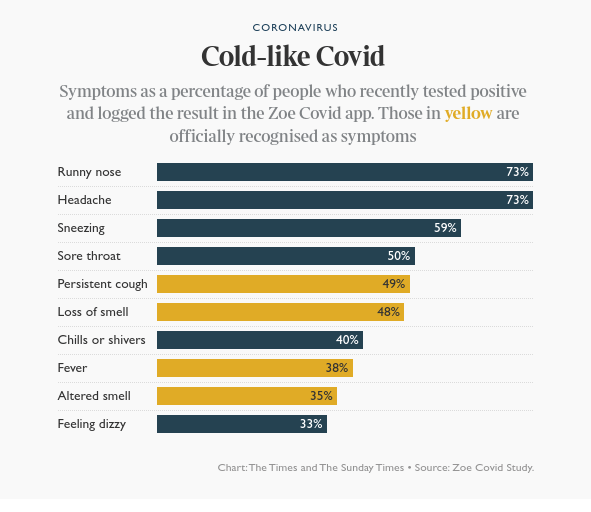
Neither will Covid, but some of its early symptoms were unusual: alongside a persistent cough, patients reported muscle aches and a lost sense of taste and smell. As other viruses make a comeback, from the “super-cold” to seasonal flu, it is becoming increasingly hard to tell what it is that we have.

Covid

Professor Tim Spector of King’s College London has been tracking the symptoms of millions of users of his Zoe Covid app since the start of the pandemic. “We’re not getting the classic symptoms nearly as much,” he says. “It’s much harder to tell between a cold and Covid now.”

That is a worry for GPs such as Simon Hodes, in Watford. “Monday was one of the busiest days I can remember in my career,” he says. “It was literally: cough, cough, cold, runny nose, temperature, fever. I don’t know what we’re dealing with when they come in.”

It would be a mistake to assume that the coronavirus is no longer causing serious illness: more than 1,100 people in Britain are dying of it every week.

The Delta variant, with which about one in 50 people are now infected, is about twice as infectious as a cold and three times as infectious as seasonal flu: research from Imperial College London suggests your chance of catching it from contact with an infectious person is one in ten. The virus is spreading quickly among households with children.

But for the majority of its carriers the cases are mild. Most who catch it are young: under-20s make up half of the caseload, and children’s immune systems are better at fighting it. And most of the adults who catch it are vaccinated, so their cases are generally less severe too.

Common cold symptoms are caused when the body’s immune system reacts to one of a number of viruses, says Dr Julian Tang, a virologist at Leicester University. Symptoms such as coughing, sneezing and a runny nose are caused by cytokines, released by the body’s virus-fighting B-cells (which make antibodies) and T-cells (which attack infected cells).

But in years to come, as newer variants emerge, experts such as Tang believe that Covid symptoms could get even milder. “We will see fewer of the unusual neurological features like altered smell and taste, tinnitus and psychological issues — though, as with flu, the muscle aches, fatigue, fever, coughs and headaches may persist.”

What remains odd about Covid is the variety of symptoms. John McCauley, director of the Worldwide Influenza Centre at the Francis Crick Institute in London, is one of the world’s leading flu experts. “The consistency between patients is not as simple as with something like measles, which has well-defined symptoms. The loss of taste and smell in some Covid patents is unusual, but many do not have this: it seems to be a whole spectrum.”

This inconsistency is not unheard of: when McCauley caught swine flu in 2009, his only symptom was muscle ache.

Colds

While 38,000 people are testing positive for Covid a day (and many more unaware of it), Spector says the number of people catching colds could be four to five times higher. Colds, which are caused by a number of viruses including rhinoviruses, seasonal coronaviruses and RSV, have been circulating for a long time in humans. “Newborn babies and children are exposed to all of these viruses from a young age,” Tang says. “But because these viruses have adapted to humans to some extent, the illnesses have been generally milder than with Covid, which is a new virus.”

Since “freedom day” on July 19, we have become reacquainted with old foes that are taking advantage of our immune systems being out of practice. Since September social media users have spoken of a “super-cold”, which is simply a made-up name for all the illnesses that we have not had for two years. Data from the UK Health Security Agency shows that calls to the NHS 111 service about cold and flu symptoms are much higher than expected for this time of year, particularly among patients aged 15 to 44.

Flu

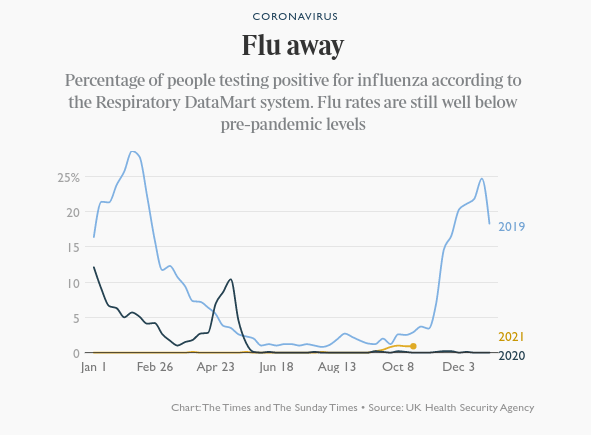
One piece of fortune has been flu rates, which are below average for this time of year. But if levels surge, it may be confused with Covid: a high temperature, a cough and muscle aches are symptoms of both. This matters: if a flu patient is admitted, quick diagnosis is key if they are to benefit from anti-flu drugs such as oseltamivir.

McCauley has spent the past months developing a flu jab for the months ahead. The uptake is expected to be high, with about 63 per cent of over-65s having had it. With so little flu in the world, it has been hard to know what to base the flu jab on. “It’s really too early to tell [how effective] it will be this year. What we can say is that we have the viruses well covered, or pretty well covered.”

How bad a flu outbreak is in a given year mainly depends on which strain circulates. “H3N2 viruses are probably the worst overall, with the elderly being particularly vulnerable,” McCauley says. These viruses emerged from the 1968 Hong Kong flu outbreak, which killed an estimated million people worldwide.

Flu or no flu, a cocktail of respiratory viruses looks likely to dominate this winter — and to tell them apart, many countries are acknowledging the wide range of symptoms that Covid is causing. The WHO lists 13.

Britain has not followed suit, opting instead to list just the big three: temperature, cough, and loss of taste or smell. Spector has been campaigning for the NHS to expand its official symptom list for 18 months. “They’re refusing to add flu and cold-like symptoms,” he says. “Perhaps they’re worried about testing capacity or think it’ll create confusion.”

With such an overlap in symptoms, the only way to be confident that your illness is not Covid is to take a test. The coronavirus is like a cold for most, but for about 170 people a day it is a death sentence.

Boris Johnson trying to ‘take down’ standards watchdog, Keir Starmer says

Keir Starmer has accused Boris Johnson of trying to “take down” the standards watchdog for his personal interests as Downing Street made a new bid to stop the regulator investigating the controversy around his flat refurbishment.

Rowena Mason www.theguardian.com 

The Labour leader said Johnson was leading the Conservative party “through the sewers and the stench lingers,” highlighting a pattern of behaviour where the government “goes after” those charged with enforcing the rules.

Days after Johnson was forced by a public and party backlash to abandon attempts to overhaul the standards watchdog, No 10 argued on Monday that the prime minister did not need to declare how much he was loaned by a Tory donor to make over his Downing Street flat.

The commissioner, Kathryn Stone, is set to rule within weeks on a potential investigation into whether Johnson properly declared the funding as an MP. She will decide after the Electoral Commission finishes its inquiry the Conservatives’ role in helping to fund the £50,000-plus refurb.

But on Monday Johnson’s spokesman said the matter was declared in the list of ministerial interests and said there was no need for the prime minister to have registered it on the list of MPs’ interests as well – putting it outside the remit of the commissioner.

Asked if the prime minister believed Stone should be able to investigate the flat refurbishment, the spokesman said: “Obviously it’s a matter for her on that. The interest, as you know, has been transparently declared by the prime minister following advice from Lord [Christopher] Geidt, the independent adviser.

“And the Commons rulebook is very clear that such ministerial code declarations do not need to be double-declared. And the flat was clearly a ministerial matter, as the PM only occupies it by virtue of his office.”

A Downing Street source dismissed Starmer’s accusation that the prime minister had tried to “take down” Stone, claiming it was “not true”.

Labour has repeatedly called on Stone to investigate whether Johnson should have declared a loan from a Tory donor, David Brownlow, to fund his flat redecoration. The cost has never been formally confirmed, although party accounts showed it covered a £52,802 “bridging loan”, which was later paid by Lord Brownlow and subsequently repaid by Johnson.

An inquiry by Geidt, the prime minister’s independent adviser on ministerial interests, found Johnson had acted “unwisely” by not taking enough interest in the funding of the renovations, but not broken any rules.

“It is not for the prime minister or cabinet ministers to decide what the independent anti-corruption commissioner investigates,” said Angela Rayner, Labour’s deputy leader. Stone has previously investigated Johnson three times, including an inquiry into the funding of his holiday in Mustique by a Tory donor and the late registration of financial interests.

Johnson was absent from parliament as MPs debated the Westminster sleaze scandal on Monday, where several Tory MPs were among those criticising the government for its efforts last week to overturn a 30-day suspension for Owen Paterson, a Conservative backbencher who broke the lobbying ban.

In the process, the government also tried to announce reform of the wider standards system for MPs, proposing that John Whittingdale, a cabinet minister and former boss of Johnson’s wife, Carrie, should be put in charge of the shake-up. But the move was abandoned after a backlash among the public, media and MPs.

Starmer said: “It wasn’t a tactical mistake, an innocent misjudgment swiftly corrected by a U-turn. It was the prime minister’s way of doing business. A pattern of behaviour.

“When the prime minister’s adviser on the ministerial code found against the home secretary, the prime minister kept the home secretary and forced out the adviser. When the Electoral Commission investigated the Conservative party, the prime minister threatened to shut it down. And when the commissioner for standards looked into the prime minister’s donations, the prime minister tried to take her down.”

With the prime minister taking the train back from a hospital visit in Northumberland, it was left to Stephen Barclay, the Cabinet Office minister, to expressed “regret” in the House of Commons for the government’s misjudged attempts to change the rules.

Johnson refused to apologise for the furore over standards in an interview earlier in the day. But several Tory backbenchers were unimpressed with his refusal to attend. Mark Harper, a former chief whip, said: “Politics is a team game. It’s essential to work with your colleagues to deliver anything. But if the team captain is to expect loyalty from the backbenchers and for minsters to listen to the direction of the team captain, they deserve that decisions are well thought through and soundly based.

“As on this occasion … if the team captain gets it wrong, then I think he should come and apologise to the public and to this house. That’s the right thing to do in terms of demonstrating leadership.”

4 Questions Boris Johnson Needs To Answer Right Now

Boris Johnson has been heavily scrutinised in the past few weeks for his handling of sleaze within his own party, rising Covid cases, and his own rather lax approach to major environmental issues in the UK.

Kate Nicholson www.huffingtonpost.co.uk 

The prime minister has repeatedly refused to answer direct questions on these pressing problems for weeks, to the growing frustration of the public.

Here are just four questions Johnson needs to answer right now.

1. Why won’t you apologise to the public over the Owen Paterson debacle?

All Tory MPs were whipped to vote against suspending fellow Conservative MP Owen Paterson last week.

The independent watchdog advised Parliament to suspend Paterson for 30 days after he was found guilty of lobbying on behalf of two companies which both paid him to be a consultant outside of Westminster.

While Paterson was initially let off, furious public backlash triggered a surprising U-turn from the government just the day after the Parliamentary vote.

Paterson then resigned but questions remain over how the government chose to back a former Tory cabinet minister rather than the traditional disciplinary process for MPs.

His critics have asked if the prime minister has any integrity at all after the ‘sleazy’ events on last week.

But when pressed over the case on Monday, Johnson said: “I don’t think there’s much more to be said about [the Owen Paterson] case, I really don’t.”

He refused to apologise on three occasions during a TV interview with the BBC.

Labour’s Sir Keir Starmer said: “Boris Johnson does not have the decency either to defend or apologise for his actions.”

2. Why did you not appear in the Commons to debate changing the MPs’ watchdog?

Johnson did not field questions from the despatch box in the Commons on Monday when MPs were voicing their concerns over changing the Parliamentary Standards Committee, an amendment championed by Tories just as Paterson was found guilty last week.

He claimed he could not attend the emergency three-hour debate because he had a prior one-hour engagement in a north-east hospital.

On Monday, Johnson said he was returned to London by train and so would not be able to attend the debate as he would not be in Westminster for its start at 4.30pm.

It did not escape many people that Johnson had actually used the least environmentally friendly method of transport when leaving the climate summit COP26 in Glasgow and travelled by private jet last week, just so he could go for dinner with a friend.

The prime minister’s spokesperson said the hospital engagement had been in his diary since before the Tory sleaze debate erupted last week.

Asked by a reporter if he regretted “the huge error of judgement” to “rewrite the Parliamentary rules” – as a way to prevent Paterson’s suspension – Johnson dodged the question and said: “I’m here to look at what we’re doing to encourage people to get their booster jabs.” 

3. How will you address accusations of more Tory sleaze linked to the House of Lords?

Johnson has so far refused to comment on the joint investigation between The Sunday Times and Open Democracy which found Tory donors who gave £3 million or more to the Conservative Party would become peers in the House of Lords.

Johnson did dismiss claims that he had already decided to make Paterson a peer after throwing him under the bus in his U-turn last week, and said: “There’s been absolutely no discussion about that.”

4. Why will you not wear a mask in crowded areas, despite advising the public that they should do so?

The government has repeatedly called for people to wear masks in crowded, indoor environments but has stopped short of making it mandatory.

Even so, the prime minister appears to have gone against his own advice repeatedly.

Cabinet ministers have previously claimed that it’s fine for them not to wear masks when together because they all know each other well.

Even though this argument does not stand up when it comes to curbing Covid transmission, the prime minister has also been seen not wearing a mask when surrounded by people he doesn’t know, such as at COP26 when sat next to 95-year-old national treasure Sir David Attenborough.

Even during his hospital visit on Monday when he was surrounded by medical staff in masks – and vulnerable patients – Johnson was photographed without a face covering.

Planning applications validated by EDDC for week beginning 25 October

New Tory sleaze row as donors who pay £3m get seats in House of Lords

The Conservative Party has been accused of abusing the honours system by systematically offering seats in the House of Lords to a select group of multimillionaire donors who pay more than £3 million to the party.

Jonathan Calvert, George Arbuthnott, Tom Calver www.thetimes.co.uk 

An investigation by The Sunday Times and Open Democracy reveals that wealthy benefactors appear to be guaranteed a peerage if they take on the temporary role as the party treasurer and increase their own donations beyond £3 million. In the past two decades, all 16 of the party’s main treasurers — apart from the most recent, who stood down two months ago having donated £3.8 million — have been offered a seat in the Lords.

Among them was Peter Cruddas, a billionaire whose peerage was pushed through by Boris Johnson against the recommendation of the Lords appointments commission. One of the commission’s members has broken the panel’s silence over the process, saying the prime minister’s decision to “override what we did … left a bad taste in my mouth”.

The role of Conservative treasurer has become the most ennobled job in Britain — ahead of holders of the great offices of state, leaders of the country’s institutions and charitable organisations and even former prime ministers.

As well as Cruddas they include the City millionaires Lord Spencer, Lord Fraser, Lord Lupton and Lord Farmer, who were ennobled in the past seven years. The mining mogul Sir Mick Davis turned down the offer of a peerage.

Farmer said it had become “a tradition” for Conservative prime ministers to hand out a peerage to the holder of the party’s top fundraising role. The former vice-chairman of the party Lord Brownlow was also given a peerage in 2019 shortly after his donations to the party topped the £3 million mark.

The alleged use of seats in the Lords as an arm of party fundraising is particularly controversial because — unlike other honours, such as knighthoods — peers fulfil an important role in the legislative process as a check and balance for new laws.

There is widespread concern in the Conservative Party about the way successive prime ministers have abused their control over appointments to the Lords by rewarding benefactors. Six former Tory ministers expressed deep unease about the practice.

One said it was a “scandal in plain sight” — widely known and accepted in the party. A former party chairman said: “The truth is the entire political establishment knows this happens and they do nothing about it … The most telling line is, once you pay your £3 million, you get your peerage.”

The party never publicly acknowledges the practice. One former minister said there was “a law of omerta” forbidding any discussion of the link between donations and seats.

A Conservative spokesman said: “We do not believe that successful businesspeople and philanthropists who contribute to political causes and parties should be disqualified from sitting in the legislature.”

Lord Fowler, a Conservative former cabinet minister and later Lord Speaker, said: “Most big contributors want something: it may be influence over the direction the party is taking; it may be a particular policy; it may be an honour. All have clear dangers for a political party.”

Many other Conservative donors have also been ennobled alongside the party’s treasurers: 22 of the party’s main financial backers have been given peerages since 2010. This includes nine donor treasurers. Together they have given £54 million to the party.

Only two Labour Party donors and five Liberal Democrat financial backers have been ennobled over the same period. The parliamentary watchdog has blocked six further peerage nominations for Conservative donors on the grounds of impropriety over those 11 years.

A Tory insider said his party was dangling peerages before donors like “carrots” and everyone in the party was aware of the “cynical operation”. He cited the case of one donor he knew who had been enticed into giving £1 million to the party because he had been persuaded by a treasurer that the donation could lead to an ennoblement.

There is no suggestion any of the donors named in this investigation requested or were promised a peerage or were directed or offered to pay any particular sum to secure an honour. However, numerous Conservative sources have been highly critical of the way the party appears to be using peerages to reward large donors. They say it is morally corrupt and wrong.

Many of the ennobled donors have made minimal spoken contributions to the House, despite the party justifying their peerages on the basis of their business or financial experience. The donors often stop or severely curtail their handouts once they are accepted into the House.

Lord Jay, a former chairman of the House of Lords appointments commission, said donations were increasingly becoming a factor in prime ministers’ selection of new peers.

“It would be better if people were appointed on the basis of the contribution they will make as lords, rather than on other factors such as how much money they’re giving to the party,” he said.

Clamour is growing in Westminster to reduce the size of the House of Lords. Successive Conservative prime ministers have used peerages to reward their friends and cronies, and there are now more than 800 peers, which makes the Lords the world’s second-biggest political chamber behind the annual Chinese Congress.

Since Johnson became prime minister 96 peers have been created.

Cruddas and Brownlow did not respond to requests for comment. Lupton declined to comment. Lawyers for Spencer denied he had taken the role as party treasurer and made donations to secure a peerage. Farmer said he donated to the party because he wanted a Conservative government.

Anneliese Dodds, the Labour Party chairwoman, said last night: “The stench of sleaze emanating from Boris Johnson’s government grows by the day, with even a former Conservative prime minister calling his administration ‘politically corrupt’.

“Labour would stamp out sleaze, with a tougher system to restore the public’s faith in our democracy and politics.”

Residents’ fears grow over risks from district heating networks

Many DHNs [district heating networks] have successfully cut emissions and prices for households. However, those that are poorly designed and inadequately maintained have left some customers enduring freezing homes and enormous bills.

Cranbrook? – Owl

Anna Tims www.theguardian.com 

It was during a night in June that two radiators exploded in Luca’s house, jetting scalding water across the bedroom of his six-year-old son and bringing down the ceilings of the ground-floor rooms. By a fluke the family was away.

“If my son had been in his bed he would have been severely burned,” says Luca. “The disaster was inevitable. In the 10 years since I bought the house, not once have the pipes and radiators been serviced, and similar things have recently happened in neighbouring properties.”

The London housing estate where Luca lives is supplied with heating and hot water by a district heating network (DHN) operated by Southwark council.

DHNs generate heating from a central source to a whole community via a network of insulated hot water pipes, eliminating the need for individual household boilers.

There are about 14,000 in the UK run by councils, housing associations and private companies, supplying nearly 500,000 homes. They’re considered to be a cheaper, greener alternative to traditional systems, and the Climate Change Committee has estimated they need to account for 18% of the UK’s energy supply if the country is to meet its 2050 net zero target.

Many DHNs have successfully cut emissions and prices for households. However, those that are poorly designed and inadequately maintained have left some customers enduring freezing homes and enormous bills.

They are unable to switch supplier because they are locked into contracts of 25 years or longer, as soon as they buy a property supplied by a DHN. And they cannot get redress for poor service via the energy ombudsman because the sector is largely unregulated.

Campaigners have warned that thousands more people risk being trapped with unaccountable providers, as more networks are rolled out without statutory regulations.

Currently there are no controls on consumer tariffs and no technical standards to which new networks must adhere.

Developers who are required to install DHNs as a planning condition are free to choose the cheapest option, which may not be suiable, and some councils, which run their own networks, lack resources and expertise.

“There are good, well-run networks, but we cannot be confident this will become the norm, even when legislation is belatedly brought in to cover this growing sector,” says Ruth London of the campaign group Fuel Poverty Action.

The damage to Luca’s home was so extensive because DHNs operate at higher pressure and temperatures than ordinary systems, and already leaking pipes were overwhelmed.

Since the flood, the family has been living in temporary accommodation funded by their insurer. He says that he heard nothing from the council for the first three months, until the Observer intervened.

Southwark has now offered to replace the radiators, but until the malfunctioning network is overhauled, the family fears they could burst again.

Luca asked to be disconnected from the scheme so he could switch to a private supplier, but was told that, as a freeholder, he would have to pay a £39,500 fee. With this type of scheme, leaseholders and social housing tenants are not allowed to switch because their share of the costs would have to be passed to other residents.

Councillor Stephanie Cryan, Southwark’s cabinet member for council homes and homelessness, told the Observer: “I am very sorry this issue has taken some time to resolve for this family.

“While we identified a leak back in January, and we can replace all of the radiators, the wider issue is much more complex and, to date, we have been unable to come to a solution in terms of disconnection from the district heating system.”

Seventeen other Southwark residents who approached the Observer reported spending weeks in unheated homes during winter, and five-figure bills to maintain the system that let them down.

Giancarlo Niccoli was asked to pay £13,700 towards repairs of the network on his estate, after his one-bedroom flat was left without fully functioning heating for six months.

He was still billed the annual tariff of £1,000, plus a 10% administration charge, while paying for electric heaters to see him through the winter.

“The council sends multiple engineers to do the same job poorly, and then it needs repair again, at our expense, months later,” he says.

“I once had to move out while my flooring was pulled up because a botched repair caused leaks.”

Southwark insists the costs are allowable within the terms of his lease, irrespective of service standards, a fact supported by a tribunal to which Niccoli took his complaint.

In April, the council launched a compensation scheme which awards residents £3 for each day the system isn’t working, a sum residents claim is inadequate to cover electric heaters.

Jack Lewis, from the Southwark Group of Tenants Organisation, says any added heating costs are particularly concerning given the recent cut in universal credit and rising energy prices. “We will continue to lobby the council to implement immediate payments to compensate for the cost of additional heating measures,” he says.

Southwark council, which supplies a number of council estates via DHNs, admits its systems are not of a good enough standard. It is estimated that it would cost £350m to modernise its networks, some of which date back to the 1960s.

The council told the Observer that the money was not available, partly because of government policy. Increased discounts to encourage council tenants’ right to buy their homes, and the abolition of “rent convergence” – which allowed councils to increase social housing rent – have dented its budget.

The borough has the largest concentration of social housing in the capital. “We have always played catch-up on maintenance across a huge housing stock,” it says.

“The government could cap the bills for leaseholders and pay the difference to councils – then the investment for works can continue, because the money has to come from somewhere.”

DHN customers in other local authority areas have reported similar problems. The government recently pledged £300m for new low-carbon heat networks, and £4.175m of grants to overhaul existing infrastructure. It’s also developing an additional funding scheme to improve the efficiency of networks.

Three years after the Competition and Markets Authority called for regulation of the sector to protect customers, the Department for Business, Energy and Industrial Strategy (BEIS) told the Observer that it was a work in progress.

“The government is committed to legislating to implement heat networks regulation within this parliament,” it says. “This will include consumer protection rules which ensure all heat network consumers receive a fair price, a reliable supply of heating, and transparency of information.”

According to Ruth London, government funding is welcome but insufficient to remedy the problems with existing networks.

For Luca, the promises are too late, and he is fearful of moving back into his house when repairs are complete.

“My trust in the heating network has gone,” he says. “I really feel I’m being held hostage by a system that doesn’t deliver on what it should, and literally endangered my son’s life.”