
It was news to us as well!

[And would he have reasons other than Omicron to grab the headlines right now? – Owl]
Yesterday he announced the “Omicron Emergency Booster National Mission” to encourage everyone who is eligible to “get boosted now”.

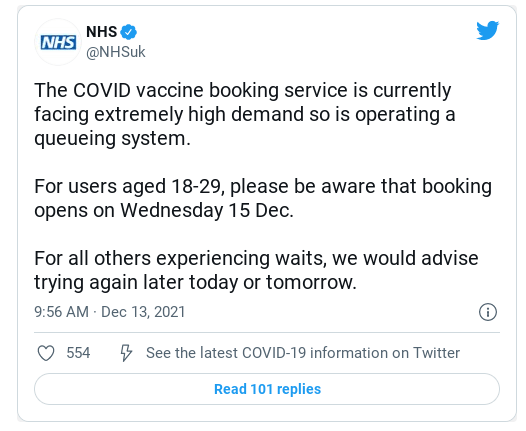

Possible Plans D and E are being discussed by the government should current measures fail to bring the Omicron variant under control, Whitehall insiders have said.
Meanwhile it’s the vote on Plan B tomorrow, Plan C possibly on December 21. – Owl
Clare Busch www.devonlive.com
The Mirror reports the tougher Covid-19 plans being discussed include another lockdown.
MPs have already been told they may have to return to Parliament for a vote on tougher restrictions should Omicron infections hit the expected million mark.
A vote on Tuesday, December 21 could move the current Plan B rules to Plan C, which would require masks in all indoor establishments and the use of Covid app for pubs and restaurants. Vaccine passports could be required for smaller venues.
Plan C would also include a return to table service only and a required self-isolation after contact with someone infectious.
The possible Plan D could mean all pubs and restaurants stopping indoors service with only outdoor service allowed.
A Plan E would see a return to lockdown with all pubs, cafes, restaurants and non-essential retail closed.
Individuals would only be able to leave their home for essential reasons such as work, medical appointments and to buy food.
Schools would be the last to close.
Plan B includes masks for public transport and most indoor settings, vaccine passports for large events and advice to work from home. The plan came into effect today (Monday, December 13) just as Boris Johnson confirmed the first death associated with Omicron in the UK.
The Prime Minister said at a vaccination clinic in west London: “Sadly yes Omicron is producing hospitalisations and sadly at least one patient has been confirmed to have died with Omicron.
“So I think the idea that this is somehow a milder version of the virus, I think that’s something we need to set on one side and just recognise the sheer pace at which it accelerates through the population. So the best thing we can do is all get our boosters.”
Boris Johnson said that Omicron now represents about 40% of coronavirus cases in London. He added: “tomorrow it’ll be the majority of the cases” there.
Plan B will stay in force for at least six weeks, with a review on January 5.
A Health Department source told the Mirror: “If you follow the science, we should really be doing Plan C now. The PM is gambling with the NHS to save his leadership.
“But we all know the PM can’t let anything hit Christmas. That really did him damage last time round. To do it again would be killer.”
 24 Garratt Close Exmouth EX8 5PJRef. No: 21/3171/FUL | Validated: Fri 03 Dec 2021 | Status: Awaiting decision24 Durley Road Seaton EX12 2HWRef. No: 21/3168/FUL | Validated: Fri 03 Dec 2021 | Status: Awaiting decisionLawdeshayne Farm Colyton Devon EX24 6DURef. No: 21/3170/FUL | Validated: Fri 03 Dec 2021 | Status: Awaiting decisionThorncombe Highcliffe Crescent Seaton EX12 2PSRef. No: 21/3172/FUL | Validated: Fri 03 Dec 2021 | Status: Awaiting decisionGoodman House Offwell Honiton EX14 9RRRef. No: 21/3161/FUL | Validated: Thu 02 Dec 2021 | Status: Awaiting decision2 Sid Vale Close Sidford Sidmouth EX10 9PHRef. No: 21/3154/FUL | Validated: Thu 02 Dec 2021 | Status: Awaiting decision34 Station Road Budleigh Salterton EX9 6RTRef. No: 21/3155/FUL | Validated: Thu 02 Dec 2021 | Status: Awaiting decision3 Sidleigh Sid Road Sidmouth EX10 9DERef. No: 21/3151/FUL | Validated: Thu 02 Dec 2021 | Status: Awaiting decisionWell Cottage Gorseway Convent Road Sidmouth EX10 8RJRef. No: 21/3160/FUL | Validated: Thu 02 Dec 2021 | Status: Awaiting decisionJasmine Cottles Lane Woodbury Exeter EX5 1EERef. No: 21/3139/FUL | Validated: Fri 03 Dec 2021 | Status: Awaiting decisionWaysmeet Hawkchurch Axminster EX13 5UARef. No: 21/3141/FUL | Validated: Wed 01 Dec 2021 | Status: Awaiting decisionAdjacent 39 Winslade Park Avenue Clyst St Mary Exeter EX5 1DARef. No: 21/3143/TRE | Validated: Wed 01 Dec 2021 | Status: Awaiting decisionTillworth Bungalow Hawkchurch Axminster EX13 5UBRef. No: 21/3146/FUL | Validated: Wed 01 Dec 2021 | Status: Awaiting decision48 Tyrrell Mead Sidmouth EX10 9TRRef. No: 21/3127/FUL | Validated: Tue 30 Nov 2021 | Status: Awaiting decision12 Salterton Road Exmouth EX8 2BWRef. No: 21/3130/FUL | Validated: Tue 30 Nov 2021 | Status: Awaiting decision10 Stoneborough Lane Budleigh Salterton EX9 6HLRef. No: 21/3124/FUL | Validated: Tue 30 Nov 2021 | Status: Awaiting decision9 Chard Road Axminster EX13 5HNRef. No: 21/3134/FUL | Validated: Tue 30 Nov 2021 | Status: Awaiting decisionCharnwood Cooks Lane Axminster EX13 5SQRef. No: 21/3116/FUL | Validated: Mon 29 Nov 2021 | Status: Awaiting decisionThe Old Vicarage Chardstock Axminster EX13 7BYRef. No: 21/3113/TCA | Validated: Mon 29 Nov 2021 | Status: Awaiting decision1 Heath Cottages Broadclyst Exeter EX5 3GZRef. No: 21/3112/FUL | Validated: Mon 29 Nov 2021 | Status: Awaiting decision5 Coly Road Honiton EX14 2EHRef. No: 21/3119/FUL | Validated: Mon 29 Nov 2021 | Status: Awaiting decisionKhadine Slade Road Ottery St Mary EX11 1JERef. No: 21/3118/VAR | Validated: Mon 29 Nov 2021 | Status: Awaiting decisionSellerswood Farm Musbury Axminster EX13 8SRRef. No: 21/3117/FUL | Validated: Mon 29 Nov 2021 | Status: Awaiting decisionElm Way Cottage Elm Way Sidford Sidmouth EX10 9SYRef. No: 21/3115/FUL | Validated: Mon 29 Nov 2021 | Status: Awaiting decisionIford Southbrook Lane Whimple Exeter EX5 2PGRef. No: 21/3105/FUL | Validated: Sat 04 Dec 2021 | Status: Awaiting decisionLarkshayne Colyton EX24 6SHRef. No: 21/3104/FUL | Validated: Mon 29 Nov 2021 | Status: Awaiting decision9 Walls Close Exmouth EX8 4LYRef. No: 21/3110/TRE | Validated: Mon 29 Nov 2021 | Status: Awaiting decision189 Manstone Avenue Sidmouth EX10 9TLRef. No: 21/3108/FUL | Validated: Thu 02 Dec 2021 | Status: Awaiting decision8 Ottery Street Otterton Budleigh Salterton EX9 7HWRef. No: 21/3109/TCA | Validated: Mon 29 Nov 2021 | Status: Awaiting decision45 Grove Road Whimple Exeter EX5 2TPRef. No: 21/3099/FUL | Validated: Tue 30 Nov 2021 | Status: Awaiting decisionPassaford Farm House Northmostown Sidmouth EX10 0NLRef. No: 21/3100/FUL | Validated: Tue 30 Nov 2021 | Status: Awaiting decisionGreendale Farm Shop Sidmouth Road Farringdon Exeter EX5 2JURef. No: 21/3078/FUL | Validated: Tue 30 Nov 2021 | Status: Awaiting decision11 Oak View Honiton EX14 2UDRef. No: 21/3088/FUL | Validated: Tue 30 Nov 2021 | Status: Awaiting decision7 Masey Road Exmouth EX8 4ASRef. No: 21/3082/FUL | Validated: Fri 03 Dec 2021 | Status: Awaiting decisionGrow Out Building 3 4 Babbage Way Science Park Clyst Honiton Exeter EX5 2FNRef. No: 21/3086/ADV | Validated: Thu 02 Dec 2021 | Status: Awaiting decisionHigher Stables Meeting Lane Lympstone Exmouth EX8 5JJRef. No: 21/3077/FUL | Validated: Thu 02 Dec 2021 | Status: Awaiting decisionCrealy Adventure Park Sidmouth Road Clyst St Mary Exeter EX5 1DRRef. No: 21/3059/FUL | Validated: Wed 01 Dec 2021 | Status: Awaiting decisionPhase 4 Town Square Land To The South Of Yonder Acre Way CranbrookRef. No: 21/3069/MRES | Validated: Tue 30 Nov 2021 | Status: Awaiting decisionLand South Battishorne Way HonitonRef. No: 21/3055/VAR | Validated: Wed 01 Dec 2021 | Status: Awaiting decision7 Woodlands Drive Exmouth EX8 4QPRef. No: 21/3034/FUL | Validated: Mon 29 Nov 2021 | Status: Awaiting decisionSaxons Cotleigh Honiton EX14 9JDRef. No: 21/3036/FUL | Validated: Tue 30 Nov 2021 | Status: Awaiting decisionEast View Old Taunton Road Dalwood Axminster Devon EX13 7QDRef. No: 21/3024/FUL | Validated: Mon 29 Nov 2021 | Status: Awaiting decisionVirtues Vineyard Southleigh Colyton EX24 6JARef. No: 21/3015/VAR | Validated: Tue 30 Nov 2021 | Status: Awaiting decisionSector Hall Sector Lane Axminster EX13 5RZRef. No: 21/2985/LBC | Validated: Mon 29 Nov 2021 | Status: Awaiting decisionCourt Barton Feniton Honiton EX14 3BDRef. No: 21/2949/LBC | Validated: Mon 29 Nov 2021 | Status: Awaiting decisionThe Garage Adjoining Strand House The Strand Lympstone Exmouth EX8 5EYRef. No: 21/2952/CPE | Validated: Mon 29 Nov 2021 | Status: Awaiting decisionWoodland Lodge Bystock Exmouth EX8 5EDRef. No: 21/2925/FUL | Validated: Wed 01 Dec 2021 | Status: Awaiting decisionAxe Valley Academy Chard Street Axminster EX13 5EARef. No: 21/2927/FUL | Validated: Fri 03 Dec 2021 | Status: Awaiting decision48 Lipscomb Avenue Exmouth Devon EX8 2FLRef. No: 21/2929/FUL | Validated: Mon 29 Nov 2021 | Status: Awaiting decision
Good Law Project has today written to the Metropolitan Police asking it to justify its failure to investigate reports of an unlawful party being held at No 10 Downing Street on 18th December 2020 – and threatening legal proceedings if it fails to do so.
There have been multiple reports from people who say they were in attendance on the night that a party of 40 – 50 people took place in the prime minister’s own home. This would have been a clear breach of the “tier 3” restrictions in place at the time.
Yet – unbelievably – the Met claims there isn’t enough evidence to open a criminal investigation.
Apparently, this wasn’t even the only unlawful gathering held at Boris Johnson’s home during this period.
Further reports have now emerged alleging there were gatherings at the prime minister’s flat on 13th November 2020, a leaving party at No. 10 held on 27th November 2020 for former aide Cleo Watson, and a party at the Department for Education on 10th December 2020.
Good Law Project’s lawyers have today sent a pre-action protocol letter to the Met asking it to open an investigation, or to set out the full and detailed reasons behind its refusal to do so.
The pre-action protocol letter also asks the Met to provide details of its policy ‘not to investigate retrospective breaches of the covid regulations’, referred to in its statement of 8 December 2021.
If the Met refuses, Good Law Project will consider suing.
The Met is due to respond by 31st December 2021.
Jo Maugham, Director of Good Law Project said: “Now we know what Boris Johnson and his advisors think about the awful sacrifices people up and down the country have made. They think sacrifices are for the ‘small’ people – but not for ‘Great’ people like them.
“But the law says we are all equal. Great and small alike, subject to the same laws. That’s what the law says – and the Metropolitan Police need to apply it.”
Agenda for Strategic Planning Committee on Tuesday, 14th December, 2021, 9.30 am
Online meeting to discuss:
Infrastructure Funding Statement PDF 336 KB
And:
Working draft of the proposed East Devon Local Plan 2020 – 2040 PDF 441 KB
Details here.
The number of patients stuck in hospital in England despite being medically fit to leave nearly doubled between February and November this year. The rise is worrying health experts, who say it is more evidence that the crisis in the adult care system is creating backlogs in the NHS.
Chaminda Jayanetti www.theguardian.com
NHS England data shows that the number of times hospital trusts were unable to discharge a patient who no longer met the criteria to stay in hospital increased from 223,593 in February to 402,211 in November – a rise of almost 80%.
The data shows the extent of “stranded patients” – people who are clinically fit to leave hospital but cannot be discharged, often because of a lack of adult care or NHS community health provision. As a result, patients find themselves stuck in an environment where they pick up infections, while hospitals are unable to free up bed space for new admissions.
The Observer has also obtained data on “delayed transfers of care” (DTOC), which measures the number of days individual patients stayed in hospital after they were ready to be discharged.
NHS England stopped collecting DTOC statistics at the start of the pandemic, but a freedom of information request found 26 hospital trusts that are still recording these figures – with DTOC numbers rising by nearly 75% between February and October.
Miriam Deakin, director of policy and strategy at NHS Providers, the membership body for NHS trusts, said: “Trusts do all they can to reduce delayed transfers of care, given its impact on patients. However, with the latest performance figures showing more than one in 10 beds are occupied by patients who are medically fit to leave hospital, there is a pressing need to invest in social care and care in the community.
“In addition, urgent investment is needed in the social care sector including in home-care services – which is why we have called for retention payments to support people to remain within the care workforce over these critical winter months.”
University Hospitals Dorset NHS Foundation Trust saw acute care DTOC numbers increase from 2,701 on 1 April to 4,452 on 1 October. DTOC cases caused by problems securing care packages at home doubled in that time, while those arising from difficulties in finding beds in community hospitals more than doubled.
Dr Tristan Richardson, clinical director for medicine at University Hospitals Dorset NHS Foundation Trust, said: “If we have a patient who can’t leave hospital because a package of care is not available to support them at home, or there is not a place in a care home, for example, that means a patient can’t move from our emergency department on to a ward.”
He added that this “fills up our emergency department, which in turn means other patients are waiting to enter the emergency department in ambulances, and consequently those ambulances can’t then be attending an emergency in the community. The knock-on effect presents a clear compromise to all patients.”
A report from Dorset council in November described the link between the crisis in adult care and delayed discharges from hospitals: “The shortage of home care and therapy support is… having an adverse impact on the local hospitals; people are waiting for packages of care… to be available before they are discharged. Therefore increasing length of stay and decreasing hospital capacity.”
The report identified “significant gaps in workforce capacity such as the lack of home care and therapy workers”, and noted that the workload of hospital social work teams had tripled but that the “workforce has not increased to match the demand”.
David Fothergill, of the Local Government Association, said: “Councils and care providers are doing all they can to ensure people are able to safely return from hospital to their homes and communities as quickly as possible, despite multiple and ongoing pressures.
“These include, but is not limited to, significant shortages in the social care workforces, with more than 100,000 vacancies available on any given day, and extremely high turnover rates.
“Recent extra government funding for care workforce retention and recruitment will help, but this falls well short of enabling an immediate significant uplift in pay, which is the single biggest factor behind staffing shortages.”
NHS England did not respond to a request for comment.
Torbay health boss advises caution
Joe Ives, local democracy reporter www.radioexe.co.uk
Torbay’s health boss wants residents to take an “adult,” risk-based approach to social activities as covid cases rise across the Bay.
Latest complete figures (the week to Sunday 5 December) show covid infection rates across Devon have risen for the fourth week in a row with all parts of the county having an infection rate higher than the UK average.
Torbay recorded 934 new cases, up 57 on the previous week. The seven per cent rise takes the infection rate in the Bay to 686 per 100,000 of the population – almost 30 per cent higher than the national average of 496.
With the rising cases and concerns over the new Omicron variant, Torbay’s director of public health Lincoln Sargeant advises residents to take precautions when meeting other people.
He said: “I think rather than saying ‘don’t’ I think it’s a matter of people working through what kind of activity is it? How many people are involved? Are there any vulnerable people that are there? And based on those kind of questions, decide whether you should go ahead or not and if you’re going ahead [think about] how you’re going to make it as safe as possible – is there an option to meet outdoors for example?
“As a standard, any meetings that we’re going to with people who are not in our household or general social circles that we’re already interacting with we should lateral flow tests done as a minimum, so I would say it’s more of people thinking about the measures they can take and how they can mitigate risk rather than saying ‘this’ or ‘that’ activity shouldn’t go ahead.
“Let’s be responsible and adult, and look at our activities, do the relevant risk assessments and act accordingly.”
Dr Sargeant will change his advice if infections start rising in the over sixties. He said that although this age group tends to be more prudent than younger ages, he will be keeping a careful eye on hospital admissions, especially as family groups of different generations meet up over Christmas.
He said: “The kinds of triggers to change the advice would be if we suddenly saw a spike in [hospital] admissions and if we began to see the over sixties’ rate of infection beginning to ratchet up. Then it might be a situation of saying we might want to tighten up on our advice and restrictions.”
Leader of Torbay council Steve Darling (Liberal Democrats, Barton with Watcombe) added: “The buck does stop with the government. It’s they who give the national guidance.”
More than five cases of the Omicron variant have been identified in Devon. This more transmissible form of the disease is expected to overtake Delta to become the dominant form of covid.
Health officials are encouraging eligible members of the public to take up ‘’booster’ shots when offered. Vaccination drives are expected in the Bay in the new year.
In Torbay, 85 per cent of residents aged 12 or over have received one dose of a covid vaccine, while 79 per cent have had both jabs. Forty-six per cent have had their third vaccine.
Across Devon, 1,372 people have now died within 28 days of a positive covid test. A total of 206 of these deaths were in Torbay.
People aged 30 and over can now book their booster jab two months after their second dose, a month before becoming eligible to receive the third injection.
Full list: the vaccine passport rebels
Coffee House www.spectator.co.uk
On Tuesday next week [tomorrow], a vote will be held on Boris Johnson’s new Covid restrictions to tackle the Omicron variant. They will include vaccine passports for large gatherings, compulsory face masks in more places, and people being asked to work from home when they can (but told they can still go to parties).
When the health secretary Sajid Javid introduced the measures in the Commons this week, he was greeted with jeers and calls for him to ‘resign’ from his own party members. There is now a growing backbench rebellion against the government’s proposals, with several MPs publicly denouncing the winter restrictions, which they feel are a step too far in a society protected by what Boris Johnson once called the ‘huge wall of immunity’ from vaccines.
Below is the full list of Tory MPs who have so far promised or indicated they will vote against the measures next week. The list will be updated ahead of the vote. At present, it looks as if Johnson will need Labour’s support to pass his measures.
1. Steve Baker
2. Ben Bradley
4. Graham Brady
6. Richard Drax
7. Simon Jupp
9. John Redwood
10. Greg Smith
11. Dehenna Davison
12. Marcus Fysh
13. Gary Sambrook
14. Pauline Latham
15. William Wragg
19. Craig Tracey
20. Robert Syms
21. Anthony Mangnall
22. Greg Clark
23. Esther McVey
24. Liam Fox
25. David Davis
26. Mark Jenkinson
27. Alicia Kearns
28. Mark Harper
29. Darren Henry
30. Steve Brine
31. Craig Mackinlay
32. Simon Fell
33. Andrew Bowie
34. David Warburton
35. Siobhan Baillie
36. David Jones
37. Tom Randall
38. Ben Spencer
39. Andrew Rosindell
40. Charles Walker
41. Douglas Ross
42, Karl McCartney
44. Johnny Mercer
45. Tom Tugendhat
46. Richard Fuller
47. Giles Watling
48. Desmond Swayne
49. Andrew Bridgen
50. Andrew Lewer
52. Adam Afriyie
53. Julian Sturdy
54. Peter Bone
55. Chris Grayling
56. Chris Green
57. Tim Loughton
58. Tracey Crouch
59. Miriam Cates
61. Lee Anderson
62. Jonathan Djanogly
63. Mark Francois
64. Jill Mortimer
65. Tobias Ellwood
66. Scott Benton
67. Henry Smith
68. Matt Vickers
 East Devon Watch