Historic London landmarks sold off ‘ridiculously cheap’ to developers

Cash-strapped councils in London have sold off historic public assets worth over £70 million in the last five years, Metro.co.uk can now reveal.

Remind anyone of the Knowle? – Owl

Gergana Krasteva metro.co.uk 

Some historic buildings in London will be turned into boutique hotels after they were sold off by councils (Pictures: Credit Getty; Rex; Geograph; Wikimedia Commons)

Some historic buildings in London will be turned into boutique hotels after they were sold off by councils 

In a big blow to communities, instead of refurbishing Grade I and Grade II-listed landmarks to use as youth centres or much-needed housing, some councils gave them away for ‘very, very low’ sums.

This is the case of Fulham Town Hall – built in 1890 with Georgian architecture – which was bought by developer Ziser London for £10 million to be turned into a boutique hotel, spa and a restaurant.

But leader of Hammersmith and Fulham Council Stephen Cowan pointed out that the Grade II-listed landmark opposite Fulham Broadway Station was sold ‘rather incompetently’ under the former Tory council.

The councillor argued that in Fulham, it is hard to buy a house for ‘anything less than £2 million’, so its selling price was ‘absolutely ridiculous’.

He told Metro.co.uk: ‘Our predecessors sold it in 2014 alongside a lot of other properties very, very cheaply.

‘We are not necessarily against selling it, just against selling it for so cheap.

‘When the Conservatives were in office, they decided to sell off community centres, youth clubs and two big council estates – all of which for very low, knocked-down prices – including Fulham Town Hall.

‘We viewed this decision as unbusiness-like and bad value for money. We tried to stop it when we came into office but they had exchanged contracts already with the people they sold the town hall to.

‘So, we did our best to review it but we were legally obliged to honour it. The building was actually sold in 2013 but the process was not complete until 2017.

‘And we thought it was a very bad thing as it was too low and it was sold for ridiculous purposes.

‘If you sell it, sell it for proper value and make sure it is of community use.’

According to dozens of Freedom of Information requests to all London borough authorities, Hammersmith and Fulham Council is not alone in disposing of historic public assets.

After years on the market, Greenwich Council finally cashed in on the dilapidated former East Greenwich library.

The Grade II-listed property, which shut in 2015, was bought by the Redeemed Christian Church Of God – an expansionary religious movement from Nigeria – in 2019 for £1.8 million.

A spokesperson for the council, however, insisted that the sale was not driven by a need to generate money.

In another controversial move, the City of London also sold Snow Hill and the 1960s Wood Street police stations in 2020 for £14.9 million and £40 million respectively.

Magnificent Hotels bought the Grade II-listed building on a 151-year lease to convert the Wood Street property into a five-star boutique hotel after City of London Police declared the station was surplus to operational requirements.

Located a 10-minute stroll from Wood Street, Snow Hill police station is also being transformed into a 219-room hotel by Premier Inn.

A City of London Corporation spokesperson said: ‘Both properties were sold to hotel developers and, once redeveloped, will represent a boost to overnight accommodation in the Square Mile.

‘The capital released by these sales will be reinvested into the new state-of-the-art headquarters for the City of London Police which will form part of the Salisbury Square Development on Fleet Street.’

Another historic property viewed as ‘surplus’ is the former Drill Hall Theatre in Chenies Street, Bloomsbury.

The 19th-century building was snapped up by RADA for £3.4 million in December 2017.

They continue to beaver away in Otterton

The National Trust has  just published their list of Wildlife’s winners and losers in the face of the extreme weather events of 2021. 

One of the winners is beavers which gives Owl an excuse to publish the following photo sent in before Christmas by a correspondent. It shows evidence of “beaver activity”  just below Otterton Mill. 

Owl assumes that the rain in the past few days will have caused more sewage releases across East Devon, including into the Otter.

Going, going……..

[Results from the Scottish beaver trials show beavers fell larger than average trees, with a very strong preference for trees that re-sprout such as willow These provide an immediate and longer term source of food, and the upper branches can be used for dam building material. Beavers dam small streams to provide ponds of deeper water for a  safe underwater entrance to their lodges, rather than larger rivers. So this activity around Otterton looks to be related to feeding. (Readers may be better informed – Owl)]

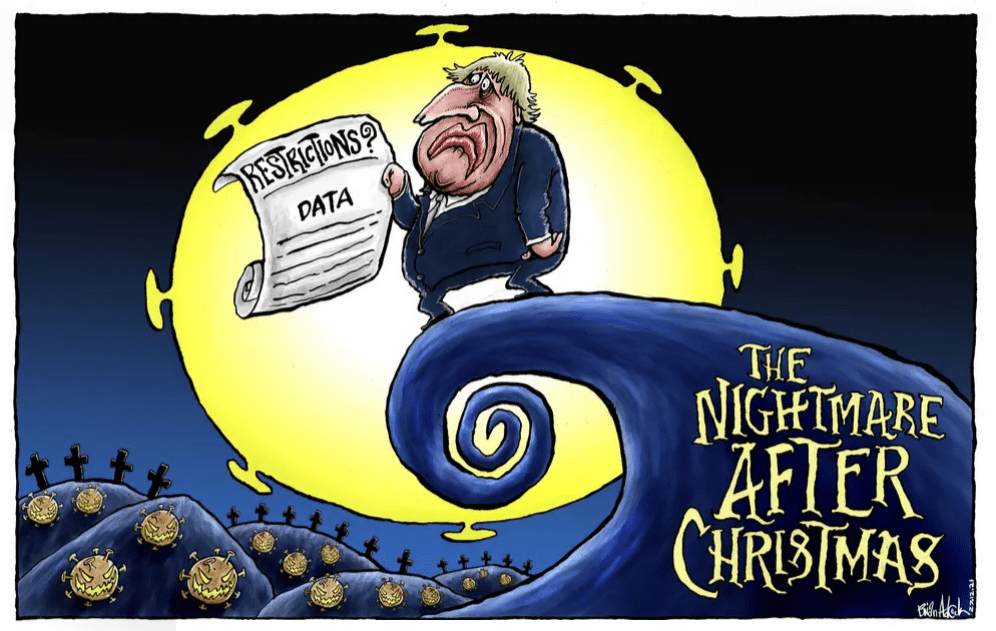
Once again the PM failed to act, serving his own interests

“Boris Johnson cannot act because his party will not let him.”

Editorial: www.independent.co.uk 

It hardly needs to be stated that no government of almost any kind, let alone a free, democratic one, likes to impose restrictions on its people’s most basic liberties. At various points over the Christmas period, new, legally binding restrictions have been or will be imposed in Wales, in Northern Ireland and in Scotland.

These include limits on the numbers of people who can meet indoors and outdoors, in different kinds of venues. In Scotland, pubs have been restricted to table service only, and only three households may mix together. In Wales and Northern Ireland, nightclubs are shut, alongside various other limits on social interaction of the kind we are all too familiar.

Political leaders take these measures with unimaginably extreme reluctance, and they do so because their scientific advisers have warned them of the consequences coming down the line if they do not act.

And yet the overall prime minister of these three semi-autonomous countries, Boris Johnson, has not acted. He has received, by and large, the same advice as Mark Drakeford, as Nicola Sturgeon and as Paul Givan and Michelle O’Neill. But the part of the country over which he does have authority, namely England, has the most severe Covid crisis on its hands by a huge margin, and yet no new legal measures have been introduced, and given the time that it would take to do so, nor will they before the end of this calendar year.

The reasons for this are clear. They are political. Boris Johnson cannot act because his party will not let him. Last time he tried to bring in new restrictions, he was dependent on the Labour Party to do so, and a hundred of his own MPs rebelled. That is a massive rebellion, quite possibly the second largest in parliamentary history. (Only Theresa May’s first meaningful Brexit vote, when 118 of her own MPs voted against her, was more damning.)

It means, in no uncertain terms, that the prime minister does not have the authority within his own party, which is the governing party, to act on the advice of his own scientific advisers, to take the very basic steps that other parts of his own country consider to be necessary to maintain public health.

The politicians and the large part of the media that continue to support him will continue repeating the same old debatable and uncertain narratives (we deliberately stop short of the word facts); that the Omicron variant causes less severe illness, that the data is not sufficient, as if they somehow understand more than the scientific advisers, when they palpably do not. The data is sufficient for leaders with political authority to act. They have already acted. Because they can, and because they know it’s the right thing to do.

All that is happening is the same old dreary ideological battle, except it’s not dreary, it’s deeply unsettling, not least because it’s happened so many times already in the last almost two full years, with the same consequences, and the same lack of action.

There are many reasons to believe that we, which is to say the rich countries, are reaching the end of our epidemic (the pandemic is not nearly over, and nor will it be until the rich countries get real about vaccinating the entire world). New therapeutic and retroviral treatments that will make Covid-19 a manageable disease are about to hit the mainstream. But they do not mean that the need to act, for one last final push, now, has gone away. It’s obvious. It’s just that the only people who refuse to see it are calling the shots, with entirely predictable results.

Planning applications validated by EDDC for week beginning 13 December

Ex-TSB boss is preferred candidate for NHS England chairman role

A banker is set to become the new chairman of NHS England in a bid to make it more “accountable” for its funding.

www.newschainonline.com 

The Department of Health and Social Care confirmed former TSB chairman Richard Meddings is the Government’s preferred candidate for the role on Thursday.

The Telegraph reported that ministers wanted Mr Meddings to provide an “outside eye” to make the NHS accountable for its additional funding, and said the Government was anxious to identify a “heavyweight” from the private sector with experience in digital and data, in order to help the NHS make better use of technologies.

The NHS still relies on paper records at some of its hospitals.

Health and Social Care Secretary Sajid Javid has invited the Health and Social Care Committee to hold a pre-appointment scrutiny hearing with Mr Meddings.

The role of chairman with NHS England will become available when Lord Prior of Brampton steps down early next year.

The Telegraph also reported that Cabinet ministers stressed their expectation that the NHS must achieve value for money after an additional £5.5 billion was channelled towards it for the second half of 2021 and a national insurance increase is set to fund an extra £12 billion for it next year.

As chairman of TSB, Mr Meddings oversaw what he described as “its most challenging year” in 2018 when it accrued losses of £104.5 million.

The migration of its IT system cost the bank £330.2 million, with higher charges related to customer compensation, additional resources and fraud.

Around 80,000 customers switched their bank account away from TSB the same year.

Mr Meddings is also a non-executive director at HM Treasury and Credit Suisse and is the former group finance director for Standard Chartered bank.

The Department of Health and Social Care said he was selected as preferred chair after an open public appointment process.

Following the select committee hearing, it will then set out its views on his suitability for the role of chair and the Secretary of State will then consider the committee’s report before making a final decision.

Attempts to undermine scientists in a pandemic are shameful

E.g,: ‘Dodgy data’ used in push for tighter Covid restrictions

Health chief accused of disseminating misleading statistics on hospitalisations that overstated the risk from omicron – Telegraph 25 December

Editorial www.independent.co.uk 

Professor Chris Whitty and other high-profile public health officials are tipped for new year honours, and rightly so. Sir Chris, as we may soon learn to call him, and his fellow scientists have been voices of calm, consideration and, above all, truth throughout the pandemic. They have told the public the facts as they emerged, framed them against scientific understanding – so far as it went – and counselled caution.

They were not always right, such as in their early dismissal of face-coverings, but their successes have greatly outweighed their failures. On the big calls, such as radically reducing social interaction, they have been proved right. Where there have been problems it has been because scientific guidance hasn’t been sufficiently heeded.

The rapid development of vaccines – in which Britain played a pioneering role, though it was the result of intensive international collaboration – is one of the great medical achievements of this or any age. Many lives have been saved by the dedication of scientists and clinicians, and by the public’s trust in them.

And yet, even as they are honoured by many, these public servants are also increasingly the subject of derision and abuse, and from people who should know better. Not only is this unkind and ungrateful, but the tendency to undermine public trust in science and medicine actively undermines the effort to control the spread of the virus, relieve pressure on the NHS and save lives.

Sometimes it is said, lazily, that the world has to “move on” and “learn to live with Covid” because of the damage public health measures can do to the economy. An uncontrolled spike in infections, however, will invariably do much more harm to jobs and businesses, even if the value of the lives of those killed – avoidably – by the virus can somehow be discounted to zero.

Worst of all, the political and media tide of criticism of the likes of Professor Whitty – or, most recently, Dr Jenny Harries – feeds the conspiracy theories and the cranks in the anti-vaxxers’ topsy-turvy world. If people want to believe that Omicron, for example, is “mild” and no worse than the common cold or a case of the sniffles, then of course they will be unwilling even to wear a face-covering or avoid crowded spaces. If it is supposed that independent scientists are responsible for “dodgy” data, and that they have some secret agenda to control peoples’ lives for the sake of it, then of course people will cease to take reasonable precautions to protect themselves and others. Careless talk costs lives.

It is shameful, then, that such language is being used against public servants whose only agenda is to protect public health. For issuing warnings about the ominous Omicron variant, officials are derided as “scaremongers”, “doomsday scientists” and “Dr Doom”. The modelling they have to use to assess policy options is supposedly always wrong, even though it is never a prediction of anything more than a range of possible outcomes if no action is taken and public behaviour remains unchanged. It is grotesque that someone such as Jacob Rees-Mogg tries to challenge Sir Patrick Vallance on epidemiology.

When, as now, it becomes clearer that a case of Omicron is less likely to lead to hospitalisation and is thus, on this definition, “milder” than the Delta variant, some media channels and politicians twist this into saying it is “mild”, meaning almost benign. It is not the common cold, however. In truth, it can still kill, and it will certainly add to the pressures on the NHS, which is struggling to catch up with the considerable backlog of non-Covid illnesses.

Spectrums of likelihood are turned into binary facts. So vaccines are said to be no help in preventing transmission, even though they may reduce transmission in some settings. Similarly, because people with vaccines do still succumb to Covid, it is claimed that the vaccines don’t work. It is sometimes said that natural immunity is superior to vaccines (and that vaccines are therefore useless). It is ludicrous, but such crude nonsense is stated with depressing frequency. Sad to say, it carries a good deal of political motivation.

Comparatively modest measures, such as Covid-status certificates or social distancing, are characterised as “lockdown”, when they are not. The cycle of new variants of concern and countermeasures is presented as never ending, yet Professor Whitty has explained, in his patient, honest way, that in around 18 months’ time, new and powerful polyvalent vaccines, as well as a range of improved treatments and techniques, will indeed mean that people can learn to live with the virus – but safely. With widespread polyvalent vaccination, variants will be less likely to be vaccine-evasive, and less likely to circulate freely if basic precautions are taken.

At the moment, it is not possible to learn to live with the coronavirus, because it is still too widespread and too deadly. Therefore, periodic intrusions on liberty to protect lives and to protect the economy will continue to be necessary, as will vaccinations and boosters, and not just in the rich world but globally. Beating Covid will need political leadership, perseverance and money, as well as clear, balanced messaging and honest debate through the media.

There is no need to shoot the messengers: all the scientists can do is point the way.

Boris Johnson to examine hospital data before decision on Covid rules

The Prime Minister says he will not hesitate to take further action on Omicron – despite a revolt in his party when he last imposed restrictions. – various press reports

[Data reporting is often delayed over weekend and holidays.]

Owl not holding their breath.

Jessica Elgot www.theguardian.com 

Boris Johnson is expected to examine crucial hospital data on Monday before making any new announcement on Covid measures, but has no plans to recall his cabinet, with ministers still deeply sceptical of further legal curbs.

Sources said the prime minister would “take stock” after being encouraged by improving data on Friday, a sign that No 10 is leaning away from stricter curbs in England, but Downing Street sources said he would act quickly if there were new causes for concern.

Instead, Johnson will receive only his regular data briefing over the bank holiday with England’s chief medical officer, Prof Chris Whitty – expected to be knighted in the new year honours – and the chief scientific adviser, Sir Patrick Vallance.

Key evidence that the government will examine on Monday includes data on the length of stay in hospitals, the transition rates to ICU and new death figures. There is concern among some government figures about undeclared positive cases – including those asymptomatic but also those isolating after a lateral flow test whose results are not recorded by the NHS because they do not take a PCR.

However, cabinet ministers are still highly sceptical of further legal restrictions, a week after a tense three-hour cabinet meeting in which the majority pushed back against any new curbs.

One cabinet minister said the positive data on Omicron’s severity – a Health Security Agency analysis found those catching Omicron are 50% to 70% less likely to need hospital care compared with previous variants – proved they had been right to hold out.

“The data so far is still struggling to be persuasive of legal changes to be required,” one cabinet minister said. Another said it was “right that we didn’t rush last time given positive, early data”.

But a hospital doctors’ trade union urged ministers to implement further measures without delay to help the NHS, including limits on household mixing and table service only in hospitality venues.

Dr Paul Donaldson, the general secretary of the Hospital Consultants and Specialists Association, warned Johnson that “it would be ludicrous” not to respond more decisively to Omicron, and that Christmas mingling would inevitably have spread Covid.

“There is a high probability we are moving too late,” said Donaldson, a consultant microbiologist.

“We will soon start to see the impact of Christmas. We are holding out hope that hospitalisations are at the lower end of projections. But given the uncertainty we face it would be ludicrous not to take additional precautions,” he added.

The HCSA also wants to see social distancing measures applied in retail and hospitality settings, such as mask-wearing, table spacing, limits on capacity and queueing systems, as well as social distancing and bubbles in all schools and continued working from home.

The NHS Confederation, which represents health service trusts in England, said any further steps would help the NHS, given the rising number of hospitalisations and staff off sick due to the virus. There were 1,171 people admitted to hospital across the UK in the previous 24 hours, the government disclosed on Friday.

“Any new restrictions which are brought in to help ease the pressure on the NHS need to be clearly explained to the public. Confusion and complacency can make any new restrictions ineffective,” said Matthew Taylor, its chief executive.

The prime minister has pledged to his restive backbenchers, a significant number of whom rebelled over the last set of restrictions, that he will recall parliament before implementing new restrictions but it is possible any vote could be retrospective, should the decision be taken later in the week.

Johnson faced significant opposition from his cabinet before Christmas during a three-hour meeting where the decision was taken to delay any new curbs until after the festive weekend.

The transport secretary, Grant Shapps, the foreign secretary, Liz Truss, and the business secretary, Kwasi Kwarteng, were said to be the most sceptical of restrictions, while the levelling up secretary, Michael Gove, and culture secretary, Nadine Dorries, have urged the most caution.

On Friday, papers released from government scientific advisers showed modelling for the impact of implementing “step 2” restrictions from Tuesday – a date now unlikely to be practicable. That would mean an end to indoor gatherings and introducing the rule of six outdoors, with bars and restaurants only able to serve outdoors.

The modelling suggested that restrictions could reduce deaths by 18% if kept in place until mid-January or 39% if retained until the end of March.

Cabinet resistance to further restrictions is also likely be deepened by the collapse in Johnson’s own poll ratings over the scandal of No 10 Christmas parties and deep rifts with his own party over plan B restrictions to enforce home working, mask-wearing and new Covid passes for large venues.

Speaking to the Observer on Sunday, Conservative MPs suggested that those who wished to eventually replace Johnson should resist further Covid restrictions.

Johnson and the education secretary, Nadhim Zahawi, are said to be determined that schools reopen on time in January. Step 2 restrictions would allow schools to remain open, as well as non-essential shops, subject to social distancing rules.

New coronavirus restrictions come into force from Monday in Wales, Scotland and Northern Ireland. From Boxing Day, a maximum of six people will be allowed to meet in pubs, cinemas and restaurants in Wales, as well as other restrictions on numbers for larger events.

In Scotland, up to three households can meet, with 1-metre distancing between groups at indoor and outdoor venues such as bars, restaurants, theatres, cinemas and gyms. Table service is also required at places where alcohol is served.

Northern Ireland is also recommending restricting socialising to three households, while up to six people can meet in pubs, bars and restaurants.

However, there are serious concerns in the NHS that the large number of frontline personnel falling sick as infections spiral because of Omicron is hampering the service’s ability to provide care.

Staff absences in England due to Covid have been soaring during December, the latest official figures showed last Thursday. The number of days lost to illness caused by Covid went up by 38% to 124,855 in the week to 19 December, while the number of staff off sick rose by 54% from 12,240 to 18,829, both compared with the previous week.

At some hospitals in London, which has been hit first and worst by the new variant, the number of staff off ill with Covid has trebled since the start of the month, NHS England’s figures showed.

Taylor said that the service was facing a “double emergency” of sharply rising staff absences because of illness at the same time as the demand for hospital care was rising.

Chris Hopson, the chief executive of NHS Providers, has said that the loss of frontline staff to sickness is “a big worry” for hospital bosses who are facing growing demand from patients, especially as the NHS in England has almost 100,000 vacancies anyway.

Home-seekers despair as affordable property vanishes from UK hotspots

With a focus on the problems in Exeter – Owl

Robert Booth www.theguardian.com 

Jonathan Taylor was pleased by his first peek at a sparkling new studio apartment that could one day become his home. The 24-year-old from Exeter has been living in YMCA accommodation since he was 19 but, as he viewed freshly painted white walls, the reality of a more settled home dawned.

“If I lived in this place I’d feel more important,” he said. “I’d feel I’ve landed on my feet.”

Taylor, who juggles cleaning jobs at a builders’ merchant and a pub, is a victim of what many fear is a deepening housing crisis in the Devon cathedral city fuelled by surging house prices, the spread of short-term Airbnb lets and rising social waiting lists.

It means the chance to rent a decent, affordable home like the one Taylor is viewing is vanishingly rare. The fact Taylor may soon be given a chance to move in is down to YMCA Exeter, which is converting a former Poundstretcher warehouse into 26 homes for priced-out young people for a £140-a-week rent – well below the market rate.

The small attempt at a solution comes as Exeter and many other parts of the UK are facing a new challenge to further complicate the housing crisis: the arrival of metropolitan homebuyers seeking more space and less stress. Pandemic exiles are selling up high-value homes in places such as London and snapping up bigger properties for a fraction of the price.

Latest figures show that Londoners bought more than 112,000 homes outside the capital this year, an increase of 62% compared with 2020, according to the estate agent Hamptons.

They spent £54.9bn, the highest annual spend on record, reflecting soaring property prices, which have been lifted by the government’s temporary cut to stamp duty. The average UK house price has risen from £450,460 in 2020 to £486,890 in 2021.

“It is getting tense,” said Rob Hannaford, leader of the Labour group of Devon county council. “People coming down with big budgets is causing anger and resentment.”

Exeter is among several UK areas that have become honeypots for city people who decided during the lockdowns that another life must be possible. House prices are surging too in Richmondshire in North Yorkshire, Pembrokeshire in west Wales, and the Scottish borders. Cities such as Exeter are seeing already threadbare supplies of affordable housing pushed to breaking point.

“Local people can’t get anywhere in the system,” said Hannaford. “People from London are coming in and putting in a ridiculous offer over the asking price and getting what they want. These might not be houses that local people could afford, but it does trickle down.”

Exeter’s social waiting list grew 47% from 2017 to 2020 to reach about 2,600 households. House prices went up 8.5% in the last year. Meanwhile the population grows, more properties become second homes and private landlords increasingly switch long-term rentals to short-stay Airbnbs.

The pressure is such that Hannaford said the council was even concerned about how to find homes for 67 Afghan refugees currently in a hotel after this summer’s evacuation from Kabul. Attracting social workers, teachers and care workers is becoming harder. There is a plan to build 500 council homes but it is playing catch-up.

Blaming the arrival of outsiders may not be entirely fair given the affordable housing crisis in Exeter has been brewing for years. Landlords have bought up swathes of stock to rent to students and, in a nationally recurrent theme, there is public opposition to construction on the surrounding green fields.

Newcomers resist any suggestion they are causing a problem and some stressed they wanted to become part of the community and contribute with their different skills and experience.

“The pandemic and lockdown gave us some unexpectedly clarity,” said Sabrina Russo, who moved from London to Exeter with her family in December 2020. “We realised that a bigger home, time outdoors and a slower pace had become real priorities … Exeter is friendly and welcoming and we’ve started to meet people and make friends. We bought a house that we love.”

But, said Laura Wright, the Exeter city councillor in charge of council housing and deputy leader, there was “growing alarm at the prices that some people are willing and able to pay to move here from London”.

“As a nation, we have been locked into a way of thinking and acting over the last 20 years which values making the biggest profit possible above collective responsibility for social cohesion and welfare.”

The sharpest house price rises in the year to August have been in desirable, more spacious locations outside the major cities where there have also been substantial increases in people waiting for social housing. The list includes Wychavon, Stratford-upon-Avon, County Durham, Cheshire West and Newark and Sherwood in Nottinghamshire. In these places, average house prices rose between 13% and 20% in a year while waiting lists have lengthened over the last three years.

“My age group is being pushed out of the city,” said Natalie Overson, a 23-year-old who aspires to be a midwife and has been on Exeter’s social housing waiting list for five years. “A lot of it is people buying second homes, or buying to rent out. It is the middle and upper classes that are making it harder for us to live in the cities we grew up in.”

Becky Merriman, 34, a youth worker, has been unable find a rental home in Exeter, which means she has to commute 40 minutes each way and continue to live with her parents.

“I’ve been trying since May and it has been quite traumatic,” she said. “We would ring agents as soon as a property went up [online] and they would say the viewings were all gone in 10 minutes. It’s mentally exhausting.”

In West Devon, which includes half of Dartmoor, house prices have risen 20% in the last year and 800 households are waiting for social housing.

“We as a local authority have got to be building houses,” said Neil Jory, West Devon’s Conservative leader, who added that people moving from London and Bristol was “causing us a great deal of concern”. “There are cases in Devon where teachers have come to the county to work and three months later they have gone back to where they came from because they can’t afford anywhere to live.”

Flood warning issued for Devon as people told ‘take action now’

A flood warning has been issued for parts of Devon on Boxing Day following heavy rainfall across the South West.

Maxine Denton www.devonlive.com

The county was battered with rain yesterday (December 25), causing some significant delays to traffic and travel, following severe flooding on roads across the region.

The Environment Agency has now issued a flood warning for the River Clyst from Broadclyst to Clyst St. Mary for Boxing Day evening, after heavy rainfall in the River Clyst area on Christmas Day.

The warning alerts residents to “act now” as several areas can expect flooding to properties and farms before levels begin to fall today (December 26).

The Government website states: “Flooding is expected on Saturday evening. Heavy rain has been falling in the River Clyst area throughout Saturday. This has caused the River Clyst to rise and the river will remain high overnight before levels begin to fall on Sunday.

“There is likely to be road flooding at Broadclyst Bridge, Clyston Mill, Dymond’s Farm and Sowton Barton areas and flooding to properties and farms between Clyst St. Mary and Topsham including Newcourt Barton and Cotts Farm.”

It continued: “Flood waters may be deep and fast flowing in these areas. Residents are strongly urged to take action now. Remain safe and be aware of your local surroundings. We will be closely monitoring the situation throughout the night and this message will be updated as the situation changes.”

Now Tory MPs warn: don’t toughen Covid new year rules

Is the colour of the “post-Johnson” government beginning to show itself? -Scary, Owl

Cabinet ministers vying to succeed Boris Johnson have been warned by Tory colleagues that they will damage their chances unless they stridently oppose further Covid measures in England, as MPs called for New Year’s Eve restrictions to be ruled out.

Michael Savage www.theguardian.com

With ministers expected to meet as soon as Monday to discuss whether additional measures are needed to protect hospital capacity, several Conservatives said that they would be watching those emerging as leading contenders to replace Johnson should he step aside before the next election.

The news comes after it emerged government scientific advisers had modelled the impact of implementing so-called “step 2” restrictions from Tuesday. Such measures would see an end to indoor gatherings, limited outdoor gatherings, and bars and restaurants only able to serve outdoors. The modelling suggested that restrictions could reduce deaths by 18% if kept in place until mid-January or 39% if retained until the end of March.

[The modelling report, published on Christmas Eve, can be found here. What it doesn’t seem to cover is the impact of rising infection rates, through sickness and self-isolation, on staffing levels in hospitals under the various scenarios. – Owl]

Delaying the measures until New Year’s Day would reduce their impact, though the scientists said their models did not have “sufficient precision” to detect differences in a small delay. “When an epidemic is rapidly growing, the earlier interventions take place, the larger their effect,” they said.

New coronavirus restrictions are being introduced by the devolved governments of Wales, Scotland and Northern Ireland, including new physical distancing rules, the closure of nightc lubs and limits on indoor gatherings.

The UK recorded 122,186 new Covid cases on Friday, the highest yet, while the Office for National Statistics estimated that 1.7 million Britons had the virus in the week ending 19 December, also a record.

However, Tory MPs are hardening their attitudes against further restrictions and now want cabinet ministers to be vocal in their opposition. “If No 10 proposes tighter restrictions straight after Christmas, those cabinet ministers with freedom-loving instincts – who gave us all so much hope last week – must speak out,” said one member of the Covid Recovery Group of Tory MPs. “In any future leadership contest, we will all remember how they acted this week. We need real, gutsy, freedom-loving Conservatives to rescue us from this madness.”

Other Tory MPs also said they would consider a candidate’s position on restrictions in any leadership race.

It shows the extent to which speculation over Johnson’s position risks affecting the government’s Covid policies. It also reveals a weakening of the prime minister’s authority after a series of scandals and setbacks that have seen Labour take a poll lead.

Liz Truss, the foreign secretary, and Rishi Sunak, the chancellor, are seen as the frontrunners if the Tory leadership becomes available. Both are said to have expressed opposition to the tightening of restrictions recently. Allies of the prime minister have already accused them of jostling for position.

Several MPs said that data suggesting Omicron was less severe than the Delta variant that it has displaced meant that new restrictions should not be needed. “Evidence is showing there is no need for further restrictions,” said Tory MP Richard Drax. “Time to trust people to get on with their own lives and for the state to back right off.” Former minister Desmond Swayne said: “We have earned the right to be treated like adults: to make our own assessment of the risks we are prepared to take and the sensible precautions that we apply. People are fed up with being ordered what not to do.”

Graham Brady, chair of the powerful 1922 Committee of Tory MPs, said: “As we look forward to the new year, it is time to move on from the lazy assumption that government has the right to control our lives; we should take responsibility for our own lives once again.” Charles Walker, a former vice-chair of the committee, said: “I think the PM has done extremely well to weigh up the information, hold his nerve and get us to this point. Like everyone, I hope that the emerging data supports the current course of action being maintained.”

However, scientists have continued to stress the need for extreme caution over the next few weeks and to consider further restrictions. “The wiser course is clearly to do everything we can to minimise transmission while the size and nature of the impact of Omicron clarifies itself and while everyone who is willing gets a booster and gets time to mount an immune response to it,” said Professor Adam Finn of Bristol University. “Better to take the flak for overreacting than for failing to act when there was still time.”

This point was backed by Stephen Griffin of Leeds University. “We have to follow the precautionary principle and act ahead of the curve. And that’s the problem at the moment, we’re not doing that. So we will experience harm. We will experience further Long Covid and we will allow the virus to continue to evolve, I’m afraid.”

Decision on stricter Covid rules for England may come on Monday

Ministers could meet as soon as Monday to determine whether new restrictions are needed in England over the new year amid growing concerns that soaring Covid cases could hit public services.

Jessica Elgot www.theguardian.com 

They will be expected to assess new modelling from the University of Warwick, given to the Scientific Advisory Group for Emergencies (Sage) in documents published on Thursday.

Scientists have looked at the effects of a potential return to step 2 restrictions from 28 December or 1 January, lasting either two weeks, four weeks or three months until 28 March. No 10 said the data had not yet been considered by ministers.

Step 2 – part of last year’s roadmap – includes a ban on indoor social mixing, a return of the rule of six, and bars and restaurants only able to serve outdoors.

It comes as new ONS figures showed one in 35 people in England had Covid last week, with 1.7 million people testing positive across the UK. No 10 said officials would continue reviewing the latest hospital data over Christmas but that ministers would not meet again until Monday at the earliest.

“We are worried about workplace resilience,” one government source said. “That’s a key reason to reduce the isolation days [from 10 to seven] but a decision will have to be taken in the round, taking in hospitalisations and severe illness, which should be clearer over the weekend.”

A Whitehall source said any restrictions based on workplace concerns would probably be targeted at sectors rather than being broadbrush but ministers had not ruled out legal guidance coming in next week.

The government’s Covid-O committee, which has been focused on the functioning of services and workplace absences, is expected to review the situation again after the Christmas weekend.

Pat Cullen, head of the Royal College of Nursing, told the BBC there was a “very, very depleted workforce” due to the number of staff forced into isolation.

Dr Jenny Harries, the head of UK Health Security Agency, said there were a number of factors as well as the variant’s severity, that would be taken into account when ministers convene after the Christmas weekend to discuss further restrictions for England.

Despite the soaring cases, hopes have been raised that new restrictions could be avoided after analysis showing the risk of hospitalisation is up to 70% less for people with Omicron compared with those infected with Delta, according to the first UK government study of its kind.

Harries said ministers would need to take a holistic approach about how widespread the impact of case rates was on essential services – as well as numbers being hospitalised.

“Ministers will look at all of the data that we have available – and that isn’t simply what the epidemiology is saying, it’s how it’s impacting society,” she told the BBC.

“So, for example, we have very high rates of individuals off sick – we know that particularly in London, around one in 35 have currently got Omicron. Now that’s having an impact on the workforce. So these are not simply about hospitalisation rates.”

She added that ministers are being kept updated daily and that will continue throughout the Christmas period. “I don’t think we do know yet that this is going to be a significantly less serious disease for the population – the older population – that we are normally most concerned about in relation to serious disease and death.”

The Sage documents found “an apparent slowing of growth rates” which could be linked to self-policing of behaviour. But the papers said there were still “doubling times in most of the country … in the region of two to three days and, importantly, test positivity rates are still rising.”

And the 2021 Award for The Most Pointless Covid Headline goes to:

Neil Parish MP I do not want to see restrictions on our lives any longer than is necessary.”

(Accompanied by a photo of him on the steps of No 10 Downing Street. Surely he can’t be throwing his hat in the ring? One has to spot the clues these days.)

www.devonlive.com 

Water firms accused of dumping sewage to avoid vital investment

Water companies have collectively cut investment in wastewater and sewage networks by almost a fifth in the 30 years since they were privatised. They have collectively paid out more than £15 billion in dividends to shareholders since 2010 and their bosses have been paid more than £65 million in the past five years.

Ben Webster www.thetimes.co.uk 

Water companies have collectively cut investment in wastewater and sewage networks by almost a fifth in the 30 years since they were privatised, according to analysis of official data.

Campaigners for cleaner rivers said the data showed some companies had chosen to dump raw sewage in waterways instead of investing adequately in treatment systems.

Average capital expenditure on wastewater and sewage networks fell from £2.98 billion a year in the 1990s to £2.4 billion in the past six years, according to data from Ofwat, the industry regulator, for the ten largest water companies in England and Wales.

The data was obtained via freedom of information requests by the Windrush Against Sewage Pollution campaign group and was first reported by the Financial Times. Ashley Smith, the group’s founder, said: “The data shows that some companies have become heavily reliant on being able to get away with illegal sewage dumping to prop up underinvestment in infrastructure.”

Raw sewage entered water courses more than 400,000 times last year and this was a reason why 84 per cent of rivers and lakes in England failed to meet the government’s target of good ecological status.

Last month the Environment Agency and Ofwat launched an investigation into more than 2,000 sewage treatment works after companies admitted they might have illegally released untreated sewage.

The government strengthened the environment bill, enacted last month, after facing a backbench rebellion over concerns that it was failing to be tough on water companies over sewage pollution. The new Environment Act requires the government to ensure that they progressively reduce the impacts of discharges from storm overflows.

Water companies have collectively paid out more than £15 billion in dividends to shareholders since 2010 and their bosses have been paid more than £65 million in the past five years.

Ofwat said overall investment had been broadly similar once other factors were taken into account, such as changes to accounting policies and spending on “nature-based solutions”.

A spokesman for the regulator said: “We continue to see huge investment going into the sector. The amount financed by investors has more than quadrupled since privatisation, while returns to investors have fallen over time, so more of the customer bill is going towards performance.”

A spokesman for Water UK, which represents water companies, said: “Private investment has brought more than £160 billion into an industry that was previously starved of cash. Meanwhile, bills have, in real terms, remained around the same level for over a decade and have fallen in both the last two years. The water industry is one of the most heavily regulated in the country with tight controls on company activity, including on the amount companies are permitted to invest each year.

“There is a widespread recognition that this is a critical decade if we are to tackle the many challenges we face. This is why we are pushing the government to encourage the economic regulator, Ofwat, to authorise schemes that meet government’s environment targets, including ending all ecological harm from overflows, ensuring resilient water supplies, and meeting our ambitious 2030 net-zero target while ensuring value for money, and great service, for customers.”

They do but you don’t! – Owl

Devon and Cornwall PCC asks if police force delivers value for money

www.bbc.co.uk

The force is set to grow by 188 officers in 2022/23

A police and crime commissioner (PCC) is asking residents if they think the force in their area delivers value for money ahead of a budget meeting.

Alison Hernandez can increase the Devon and Cornwall Police portion of council tax by up to £10 a year for a Band D Property for the next three years.

Currently those in band D households in Devon and Cornwall pay £236.56 a year in their policing precept.

A decision will be taken at a budget meeting in January.

“I really want to know if the public have confidence in policing and whether they think they have value for money for what they pay in their council tax,” said Ms Hernandez.

“And that will inform about how I set the council tax precept for the budget meeting.”

The force has added 498 officers since 2016/17 to 3,422 officers this financial year, Ms Hernandez added.

A further 188 officers will be added in 2022/23.

“This increase is helping to keep Devon and Cornwall as counties with some of the lowest recorded crime rates in the country, but there are still significant challenges ahead,” she said.

“Inflation means the force is facing significant additional costs, crime types, like domestic abuse, are now being reported and recorded more effectively.

“This is an extremely welcome development but it means our force is dealing with more calls for help than ever before.”

People have until midnight on 9 January to complete the survey on the PCC’s website.

Results will be published in a report to the 11 February meeting of the Devon and Cornwall Police and Crime Panel.

Taylor Wimpey drops costly leasehold terms after investigation

Thousands of people who bought leasehold homes from the housebuilder Taylor Wimpey will be liberated from terms where their ground rent charges doubled every 10 years, after a long-running investigation by the UK competition watchdog.

Joanna Partridge www.theguardian.com 

The Competition and Markets Authority (CMA) has been looking into the contractual cost increases imposed by Taylor Wimpey and other property developers, which have left some owners struggling to sell or mortgage their homes, while their rights to their property can also be at risk if they fall behind on the payments.

Taylor Wimpey has voluntarily given formal commitments to the CMA that it will remove terms from leasehold contracts that cause ground rents to double in price– a move welcomed by leasehold campaigners.

The company has also agreed to remove terms from contracts that had previously been converted, so that the ground rent increased in line with the higher retail prices index (RPI) measure of inflation.

As a result, affected leaseholders’ ground rents will remain at the amount charged when they first bought their home and will not increase over time.

Taylor Wimpey has also confirmed to the CMA that it has stopped selling leasehold properties with doubling ground rent clauses.

Andrea Coscelli, the CMA chief executive, called the announcement “a huge step forward for leaseholders with Taylor Wimpey”.

He said: “These are totally unwarranted obligations that lead to people being trapped in their homes, struggling to sell or obtain a mortgage.”

The CMA launched enforcement action against four housing developers in September 2020 – Countryside, Taylor Wimpey, Barratt Developments and Persimmon Homes – which it believes may have broken consumer protection law in relation to leasehold homes.

In March, the CMA ordered Taylor Wimpey and developer Countryside Properties to remove the terms in their contracts, and wrote to them giving them the opportunity to sign formal commitments, known as undertakings.

Countryside Properties said in September it was voluntarily removing the terms from its contracts.

The housebuilder Persimmon also agreed at the time to offer leasehold homeowners the opportunity to buy the freehold of their property at a discounted price, and to make repayments to some homeowners who bought their freeholds.

In addition, the insurance group Aviva, which bought freeholds from developers, agreed in June to remove ground rent terms that were considered unfair and repay homeowners whose rents doubled after the CMA’s investigation.

Of the four housebuilders against whom the CMA launched enforcement action in September 2020, only the investigation into Barratt Developments is ongoing.

Coscelli said the CMA was prepared to take further action against companies.

“Other developers and freehold investors should now do the right thing for homeowners and remove these problematic clauses from their contracts. If they refuse, we stand ready to step in and take further action – through the courts if necessary,” he said.

There are more than 4m residential leasehold properties in England and Wales. The National Leasehold Campaign (NLC), a not-for-profit organisation created in 2018 to highlight the problems faced by leaseholders, celebrated the Taylor Wimpey announcement.

The NLC co-founder Cath Williams, a university lecturer from Liverpool who bought a leasehold home from the housebuilder, called the move “a real step forward”.

She said: “It will significantly reduce the cost to buy the freehold or extend the lease and ensures that any leaseholders that have converted to RPI from doubling are treated equitably. It validates what we at the NLC have been saying for years – converting doubling ground rents to RPI is not the answer.”

Taylor Wimpey’s chief executive, Pete Redfern, said: “Taylor Wimpey has always sought to do the right thing by its customers, shareholders and other stakeholders, and we are pleased that today’s voluntary undertakings will draw this issue to a full close, within our original financial provision.”

The company said it was making a financial offer, agreed with the CMA, to third-party freeholders of leases that Taylor Wimpey no longer owns, to enable their leaseholders to revert to a fixed ground rent.

As part of its review into the leasehold sector, the CMA is continuing its investigation into two investment groups, Brigante Properties, and Abacus Land and Adriatic Land.

We must protect the people and businesses hit hardest by Omicron

One of the more obvious and offensive evasions the government is presently engaged in is to engineer a sort of informal policy of reducing social interactions, but without ever authorising any specific regulations that would trigger a legal or moral obligation to provide further financial support for business.

Editorial www.independent.co.uk 

Aside from a modest package aimed at the leisure, hospitality and entertainment sectors announced by the chancellor, there is, so far, no sign of a repeat of the comprehensive furlough scheme to protect jobs. Nor has the Treasury indicated any willingness to boost sick pay for those self-isolating, doing the right thing, and not infecting others while asymptomatic. 

This line won’t hold if the Omicron virus epidemic starts to accelerate in the sort of ways the experts said was possible when it was first detected. The self-denying ordinances of millions of people has slowed the spread of the virus, but that has all too often meant cancelled works parties and nights in the pub or at the theatre. It looks very much, then, like those who have been trying to make a living from this line of work, rarely easy even in normal times, will be placed under further pressure. It is simply random and unfair. The approach taken in the earlier part of the pandemic was the right one – slow the spread of the virus and flatten the peaks of infection to protect the NHS, and support the parts of the economy and the families hardest hit through social insurance. It worked, and it can work again.

The least anyone, but especially those struggling to plan ahead in the service sector, should have a right to expect is for the government to level with them about prospects for the end of the year, new year and Hogmanay celebrations, and the possibility of recovery in January. The confusion is exacerbated by the mixed messages and hypocrisy emanating from Downing Street, and the impression of a prime minister not so much guided by science or even his own instincts, but those of the increasingly anti-scientific cabinet and bloc of MPs. They are driven, in turn, by an ever-more hysterical section of press delegitimising the likes of Professor Chris Whitty and Sir Patrick Vallance as “Domesday scientists” and “lockdown fanatics”. They ask for the “incontrovertible evidence” that Omicron is a threat, but by then it could be too late, and a hard lockdown may be inevitable. 

The public is also right to ask why administrations in Wales, Northern Ireland and Scotland are pursuing different paths, and those in Ireland and parts of continental Europe are imposing lockdown-style measures. In England, Mr Johnson simply repeats the mantra that the data is under constant review. This helps no one – keeping data under hour-by-hour monitoring (if this is indeed what happens) is the least they can do during a public health emergency. People want to know more, and to understand the uncertainties. They want to know how they should behave at Christmas and new year, and business people need to understand what chance there is of them doing any business. They must be grateful to Prof Whitty at a personal level for his guidance on prioritising contacts, but it would be better, and clearer, if some fresh guidelines were issued that added some detail to such broad principles.

Encouragingly, from a purely public health standpoint, though not for businesses, many people have made their own decisions and erred on the side of caution. The booster vaccines, masks and even Covid status certificates impose little or no personal inconvenience, and actually help businesses retain consumer confidence that it is safe to enter their premises. Stronger measures, such as social distancing, the “rule of six” and so on will more seriously impact employers. It is a moment for decisions and for openness, neither conspicuous features of the disintegrating Johnson government.

For those following the data hour by hour. The message is stark.

COVID cases explode

covid.joinzoe.com  23 December

According to ZOE COVID Study incidence figures, in total there are currently 144,284 new daily symptomatic cases of COVID in the UK on average, based on PCR and LFT test data from up to three days ago [*]. An increase of 66% from 87,131 reported last week. A difference of 57,153 in a week is the largest jump in cases since March 2020, when the ZOE COVID Study launched (Graph 1).

In the vaccinated population (at least two doses) there are currently 56,346 new daily symptomatic cases in the UK. An increase of 52% from 27,000 new daily cases reported last week (Graph 2). This is the steepest rise in cases in vaccinated individuals since the ZOE COVID Study began tracking cases in vaccinated individuals on the 8th December 2020. 

The ZOE COVID Study now estimates its UK incidence figures with a two day lag, making the data even closer to real time and helping ZOE track the Omicron outbreak in the UK. 

The UK R value is estimated to be around 1.2 and regional R values are; England, 1.2, Wales, 1.0, Scotland, 1.1 (Table 1). The R value in London is 1.5. 

In terms of prevalence, on average 1 in 45 people in the UK currently have symptomatic COVID. In the regions, England, 1 in 43. Wales, 1 in 47. Scotland, 1 in 67. (Table 1).

Cases are now rising in all the regions of the UK, most rapidly in London. Cases are also rising fast in the South East, East of England, and the North West. (Graph 4).

Cases have exploded in the 18-54 year olds. These groups have now overtaken the 0-17 year olds who had had the highest rates since July. Cases in 55-74 have seen an uptick in cases too, but cases remain low in the over 75s. (Graph 3).

According to new analysis, ZOE estimates that half of all people experiencing new cold-like symptoms are likely to have symptomatic COVID-19 and not just a harmless ‘cold’. This has been calculated by comparing the number of new cases of a cold-like illness to the number of new cases of confirmed COVID (Graph 5).

ZOE’s predicted Long COVID incidence rate currently estimates, at current case rates, 2,394 people a day will go on to experience symptoms for longer than 12 weeks, based on previous variants (Graph 6). It’s not yet clear if the rate of Long COVID incidence remains constant with the Omicron variant.

The ZOE COVID Study incidence figures (new symptomatic cases) are based on reports from around 840,000 weekly contributors and the proportion of newly symptomatic users who have received positive swab tests. The latest survey figures were based on data from 64,119 recent swab tests done in the two weeks up to 20th December 2021. 

Professor Tim Spector, lead scientist on the ZOE COVID Study app, comments on the latest data:

“The number of new symptomatic cases has exploded over the last week, making it the biggest jump in cases I’ve seen since we started the ZOE COVID Study. Whilst the figures paint a worrying picture, the good news is that our preliminary data, based on around 2,500 probable cases reported on the ZOE app suggests that Omicron is more mild that Delta. However, this highly transmissible variant will infect many more people before the year is out. To help us slow the spread, my advice continues to be; avoid gathering indoors, and, if you are meeting up with people, check everyone is free of cold symptoms, test yourself just before and get fully vaccinated.

Over the past few days, we saw self-isolation rules already causing havoc for our frontline workers, so I’m pleased to see that the Government has reduced the isolation period down to seven days. However, what continues to shock me is the misinformation in their latest stay at home guidance about the symptoms of COVID. ZOE data clearly shows that the most important symptoms are no longer, a new continuous cough, a high temperature or loss of taste or smell. For most people, an Omicron positive case will feel much more like the common cold, starting with a sore throat, runny nose and a headache. You only need to ask a friend who has recently tested positive to find this out. We need to change public messaging urgently to save lives as half of people with cold-like symptoms now have COVID.”

To ZOE COVID Study app can be downloaded here: https://api.covidradar.org/launch/ 

The Government’s latest stay at home guidance can be viewed: https://www.gov.uk/government/publications/covid-19-stay-at-home-guidance/stay-at-home-guidance-for-households-with-possible-coronavirus-covid-19-infection#symptoms 

Graph 1. The ZOE COVID Study UK incidence figures total number of daily new cases over time.

Graph 2. The ZOE COVID Study UK incidence figures results over time; total number of new cases and new cases in fully vaccinated

Graph 3. Incidence by age group 

Graph 4. Prevalence rate by region

Graph 5. Comparison of new onset of cold-like illness and new onset of COVID with respiratory symptoms

Graph 6. Predicted Long COVID incidence over time

Please refer to the publication by Thompson at al. (2021) for details on how long covid rates in the population are modelled

Table 1. Incidence (daily new symptomatic cases)[*], R values and prevalence regional breakdown table 

Map of UK prevalence figures