Council seeks your opinion on East Devon culture scene

Surprisingly, Owl understands that the “New Guard” found that EDDC had neither a strategy for Tourism nor Culture, where various grants might be available.

Paul Arnott www.midweekherald.co.uk 

I don’t think I’ve ever asked readers before to be kind enough to take part in an online survey from EDDC, so this is a first. Curiously, a driver for this is that the administration I am lucky to be leader of wants to do all we can to help grow the local economy.

Now that may not seem consistent with a request to fill in our Public Survey to help us all develop a 10 Year Culture Strategy. But it is. I have been lucky enough to have worked in arts or entertainment, journalism and television or film production and publishing for nearly 40 years, and here is the single most valuable lesson I ever learned:

If you want to feel good about yourself, or be able to lord it over your peer group that your work is the bee’s knees, then get a review in The Guardian or The Independent. However, if you wish to carry on with your project on a sound financial footing, what you also need are good reviews in The Daily Telegraph and the Daily Mail, because to be brutally frank the older readers of both are the ones with the disposable income and the available time to attend.

In other words, don’t ghettoise what you create, always think about how you can do the thing you believe in whilst making sure that the box office is still taking ticket money, or sponsors are happy to donate. This does not mean you have to only produce unchallenging work. Quite the opposite. It means you have a duty to the public to take great care to explain what you are doing, even if it is potentially controversial.

At the Edinburgh Fringe Festival, for every young person in the audience for even the most provocative of work, there is always another who looks at first glance like they most enjoyed a gentle amble around a National Trust house. Don’t judge a sausage by its skin – often this latter group may be comfortably set-up in their middle to later years, but that does not mean they do not have excellent critical faculties.

Which brings me back to the survey. The English language does not really help – even the term “Culture” strategy risks seeming a little elitist. But then that is what we all live in, a culture. It could as well be called an Entertainment strategy, or Arts strategy – all these things mean more or less the same thing.

So what might be considered Culture in East Devon? That’s for you to say. Perhaps a book group, taking part in am-dram or an art class. Private activity such as reading, crafting or knitting. Bouncing around an outdoor festival, or quietly watching a play. Watching or taking part in dance.

Classical or jazz concerts, going to an art gallery or looking at some outdoor art. Nipping to the Picturehouse or the Radway for a sub-titled film or the new Batman, or closer to home supporting film in a screening in your village hall. Folk music. As well of course as visiting our many historic houses, or scheduled monuments.

All of this is “Culture”, which also is “art” and also “entertains”. Crucially, it has the ability to create and sustain many worthwhile and skilled jobs, as well as benefitting our sense of well-being. In some aspects, the creation of something amazing, or just witnessing that, is a life-affirming, even spiritual experience.

Of course, we all get an awful lot from the superb output on British TV, but we are very passive in that context. What we would like to find out through the survey instead, please, is what the residents of East Devon are up to, what they particularly like and what they would love to see more of. The survey is open till March 27th. Please do give it a go. https://eastdevon.gov.uk/community-engagement/culture-strategy-consultation/

Government ignored warnings about Putin’s ‘march to war’ for 10 years

Government ignored warnings about Putin’s ‘march to war’ for 10 years, says ex-UK defence official.

In scathing remarks, Mr Scott said the warnings were “subjugated” to the City of London – and making sure financial capital remained a “safe haven for corrupt wealth”.

Is our defence safe in Tory hands? – Owl

Adam Forrest www.independent.co.uk

The UK government consistently ignored warnings that Vladimir Putin could wage war in favour of welcoming Russian money into London, Britain’s former defence attache to Moscow has claimed.

Retired air commodore Carl Scott said he and others warned of the “inevitability of conflict in detail, regularly” during his period in Russia between 2011 to 2016.

The former defence official said Putin’s “long, dark march to war was obvious”, having pointed out many pronouncements from the Kremlin about conflict ahead.

In scathing remarks, Mr Scott said the warnings were “subjugated” to the City of London – and making sure financial capital remained a “safe haven for corrupt wealth”.

In a letter to the Financial Times, he said the Russian president’s aims were “never concealed”, having instigated “colossal” militarisation, control over the media and clampdowns on dissent.

The former attache stated: “The list is remorseless, the consequences could not be ignored. But they were … We reported the inevitability of conflict in detail, regularly and with the despair of Cassandra.”

Mr Scott also said Brexit “emboldened” Putin’s regime. “It was not until I returned to the UK on the eve of our withdrawal from the EU, a manoeuvre which greatly emboldened those in Moscow, that I understood how our society had changed in the years I was serving overseas.”

The retired defence official added: “All was subjugated to the City, all served the interests of our lucrative status as a safe haven for corrupt, and corrupting, wealth. The values we were demanding of other nations had long since faded from our own actions.

“I despair at the decisions Putin has taken, but even more at the prospect of finding credible leadership at home in the UK among those who have compromised so long with his regime and the wealth it offered.”

Boris Johnson’s government has joined allies in imposing punishing economic sanctions on Russian banks and other crucial parts of the economy. But MPs have urged ministers to go further on individual sanctions aimed at targeting Putin’s cronies.

Doubts have been raised about the effectiveness of sanctions after a billionaire hit by an asset freeze earlier this month said he had already handed ownership of UK mansions over to trusts.

A spokesperson for Alisher Usmanov told the BBC and The Guardian that most of the businessman’s British properties and his yacht were “transferred into irrevocable trusts”.

Rachel Davies, Transparency International’s head of advocacy, recently told The Independent that oligarchs were using shell companies registered in Britain’s crown dependencies and overseas territories to hide their wealth in London.

MPs and campaigners are worried that the Economic Crime Bill rushed through parliament last week could still allow some wealthy property owners using overseas companies to hide behind trusts.

It comes as MPs warned that sanctions against Russia will come at a cost to the UK and the poorest households will be hit hardest.

A report by the Treasury select committee revealed the UK is not protected against the economic impact of unprecedented sanctions on Russian oil and gas and that soaring prices will intensify the cost-of-living crisis.

The cross-party group of MPs said the impact on the UK is a “cost worth bearing” to help Ukraine in fighting for its freedom and to damage Russia’s ability to fund the war.

Alienation fears as Devon village set to grow

Plans for a big increase in the size of a Devon village which one local claimed would cause “division and alienation” have been approved. Developer Baker Estates has won its appeal to build 60 homes on farmland in Chudleigh Knighton.

The scale of local development used to be set by local councils (remember the “old guard” EDDC “jobs on high growth scenario”), now it’s dictated by the government’s 300,000 houses a year. – Owl

Edward Oldfield www.devonlive.com

Hennock Parish Council objected to the original outline planning application, arguing that the scheme was too big and would increase the size of village by 12 per cent. The developer appealed after Teignbridge District Council failed to make a decision by a deadline set out in planning law. And the inspector has decided after a hearing that the development can go ahead.

The developer has offered 30 per cent of the homes to be classed as “affordable”, including homes for rent and shared ownership, and self-build plots. An agreement sets out financial contributions to public services, and the site will include public open spaces and a play area. Neighbouring farmland will be set aside for biodiversity, and there will be a series of measures to protect rare greater horseshoe bats and improve their habitat.

The outline application submitted in September 2020 is for 10 acres of two fields at Tollgate Farm, alongside the B3344 Plymouth Road at the north-eastern edge of the village. It includes the access onto the main road, a drainage pond and open space.

The planning application illustrates the tensions involved in finding acceptable sites for new housing, including affordable homes, to help solve the housing crisis. Thousands of families in Devon are on the waiting list for social housing as a shortage of accommodation drives up private rents, and the stock is further squeezed by second home buyers and owners switching to short-term holiday lets. Yet many people are concerned about the impact of greenfield housing developments on the landscape and wildlife, and the increased pressure on already stretched local services like health and education.

According to the 2017 census, the village of Chudleigh Knighton had a population of 1,155. Objectors said the site was outside the settlement and not zoned for housing in the Local Plan, and they raised concerns about the impact of the extra residents on village services. One local said: “I worry that this development will drive current residents out of our village if the school can’t cope with the extra influx.”

One Teign Valley resident said: “It is utterly ridiculous to countenance that number of houses in one small village. You’d be doubling the size of somewhere like Hennock and experience shows such actions cause division and alienation within a community as the incoming population take time to assimilate.”

Another local resident commented: “We need to nurture and protect our countryside. Too many of these soulless community devoid developments are being built in Devon, especially around Newton Abbot and Exeter.” Action on Climate in Teignbridge’s Ecology Group objected to the potential impact on greater horseshoe bats, which have special protection.

Responding to the comments, planning inspector Hollie Nicholls said she considered that conditions on the development would allow it to go ahead without harming the South Hams Special Area of Conservation, which gives protection to the greater horseshoe bats in the area.

Illustrative masterplan for around 60 homes on land at Tollgate Farm, Chudleigh Knighton

Illustrative masterplan for around 60 homes on land at Tollgate Farm, Chudleigh Knighton (Image: Focus on Design/Baker Estates)

On the size of the scheme, she said she did not consider around 60 homes “should be considered out of scale or excessive.” On school places, she said she noted the comments from Devon County Council education department that the local schools had enough capacity to cope with the expected extra pupils.

The inspector said the benefits of the development included affordable housing in an area of housing need and an increase in demand for goods and services in the village. The benefits were not outweighed by significant harm, even though the scheme was outside the development plan. Given a shortfall of identified housing sites in the district, there was a titled balance in favour of development, so she allowed the appeal.

The next stage will be a “reserved matters” planning application to Teignbridge Council, including detailed designs of the homes and covering the layout and landscaping of the development.

Mum left homeless blames second home owners

Full time working mum Trudy Lincoln can’t afford the soaring rental prices which have been pushed up by holiday homes

Becky Dickinson www.devonlive.com 

A single mum and her four children have been left homeless after being evicted from their home in Hartland, North Devon, this week. Trudy Lincoln and her family are now ‘sofa surfing’ and Trudy says second home owners and Airbnbs are to blame.

The family, who had lived in the same property for eight years, were forced to leave after the landlord decided to sell. Trudy says she asked her landlord if they could remain in the house until it was sold, to give them more time to find somewhere else, but he refused.

She told DevonLive: “He says he wants to sell it but it wouldn’t surprise me if he wanted to Airbnb it. People are advertising Airbnb for over a £1,000 per week in North Devon.”

Despite working full-time in middle management, Trudy says she can’t afford the high rental prices in the area, which have been pushed up by second homes and Airbnbs. And she says many estate agents wouldn’t even let her have a viewing because she has four children and three dogs (who have been in the family for years.)

Trudy said: “I have applied for 45 houses since October and I’ve not been able to get one viewing. I’m now in a position where I don’t know what else I can do.”

The family are currently staying with a friend, but need to move out after tomorrow. All their possessions are being put into storage. On top of that, Trudy is trying to cope with juggling work and school runs.

“I’m having to manage it all as well as working full time and trying not to not disrupt the children’s schooling. I’m also having to sort out school transport as their school route changes, I am waiting to hear back from these as to what happens,” she said.

Unsurprisingly, she said the situation is taking its toll on family life. “We are all really struggling and tension is high between us all. Two of the children have been really upset all weekend,” she said.

Trudy said the council offered the family a room in a hostel with a shared bathroom, but she didn’t feel this would be a suitable option. “As I work full time, the children would be home alone for a while till I got home and I really wouldn’t feel safe knowing that they would be in a place with other people they don’t know.” On top of this, the family would have been forced to give up their beloved dogs.

Trudy added: “To all Airbnb and second home owners I would like to say thank you, thank you for making a housing crisis worse than it already is and thank you for putting pressure on families who are struggling to put a roof over their heads through no fault of their own.”

Despite working full time, Trudy said she felt like she was letting her children down by not being able to provide a roof over their heads. For now, the family are relying on the goodwill of friends and will continue ‘sofa surfing’ while they carry on the desperate search for a place of their own.

Yvette Cooper criticises “deeply shameful” Tory MP votes on borders bill 

Our loyal members, Neil and Simon, had a busy day on Tuesday knocking down all those irritating Lords amendments to the borders bill. – Owl

Katie Neame labourlist.org

Yvette Cooper has criticised the “deeply shameful” votes of Tory MPs who have rejected House of Lords amendments to the nationality and borders bill after a parliamentary debate today.

Conservative MPs have scrapped all changes made to the legislation by peers, including an amendment that would have blocked government plans to criminalise asylum seekers arriving in the UK without permission.

Reacting to the votes, the Shadow Home Secretary said: “Tory MPs voted to make it a criminal offence for Ukrainian families to arrive in the UK without the right papers with a penalty of up to four years in prison. At a time when the British people have made clear that we need to help Ukrainian refugees, this is deeply shameful.

“The Conservatives also voted against the international Refugee Convention which Britain helped to draft in the wake of the Second World War, calling on all countries to do their bit to help those fleeing the horrors of war. This should be a source of pride, and for the British government to reject it when war is raging in Europe once more is inexcusable.

“More than three million people have left Ukraine since the Russian invasion, many of them children and elderly people. They need support and solidarity from all countries. The Home Office has already been far too slow to help. Today’s votes make that much worse. Britain is better than this.”


Results of House of Commons votes on House of Lords amendments today:

  • Motion to reject amendment four, which proposed to remove a clause that would allow the UK to strip dual nationals of their British citizenship without notice, passed by 318 to 223
  • Motion to reject amendment five, which sought to ensure the bill remained compatible with the 1951 Refugee Convention and the 1967 Protocol Relating to the Status of Refugees, passed by 313 to 231
  • Motion to reject amendment six, which tried to force the government to drop its plans to treat asylum seekers differently depending on how they arrive in the UK, passed by 318 to 220
  • Motion to reject amendment seven, which proposed to reduce the period asylum seekers are unable to work after arriving in the UK from 12 months to six, passed by 291 to 232
  • Motion to reject amendment ten, which sought to make it easier for those already in Europe to be reunited with family members lawfully residing in the UK, passed by 305 to 230
  • Motion to reject amendment 11, which would have required the government to commit to resettling at least 10,000 refugees each year, passed by 313 to 227
  • Motion to reject amendment 13, which would have removed from the bill a new offence of knowingly arriving in UK without valid entry clearance, passed by 317 to 220

In a speech during the debate today, Labour frontbencher Stephen Kinnock said the bill “doesn’t only fail to meet any of the challenges our migration system faces” but “actively makes the system worse”.

He described the proposal to criminalise people seeking asylum in the UK without clearance as “a particularly disturbing aspect”, saying “we should not be seeking to criminalise refugees desperately looking for a new home”.

The shadow immigration minister also highlighted the proposal to allow asylum seekers to be offshored to overseas processing centres, calling it “perhaps the most unhinged element” of the legislation.

“It’s operationally illiterate because it’s so utterly impractical, and it’s economical illiterate because it costs an eye-watering amount of taxpayers’ money,” Kinnock told MPs today, calling Britain’s asylum system “utterly inflexible”.

The shadow minister said the bill represents “a catalogue of failure on immigration policy” and “a combination of incompetence and indifference from a government that is presiding over a system which is neither fair, compassionate nor orderly”.

Tory rebel Damian Green told the House of Commons that safe routes to the UK are unavailable for “far too many people”, including 87% of those arriving in small boats, as they come from Iran, Iraq, Syria and Yemen.

Fellow Conservative rebel David Davis slammed asylum offshoring as a “moral, economic and practical failure”, saying: “What we cannot do is basically put aside our ethical standards to drive people away from our shores”.

Tory backbencher Robert Buckland argued in the debate that asylum seekers “have a contribution to make to our society” through alleviating labour shortages and bringing revenue to the Treasury.

Andrew Mitchell, a former International Development Secretary, criticised the offshoring asylum seekers idea by noting that “it would be much cheaper to put each one in the Ritz and send all the under-18s to Eton”.

The controversial nationality and borders bill returned to the House of Commons today after the government suffered 19 defeats on the legislation in the House of Lords, where peers made a number of amendments.

Proposed changes to the bill from the Lords included scrapping plans to allow asylum seekers to be offshored to overseas processing centres, as put forward by former Tory immigration minister Lord Kirkhope.

Peers had also voted to reduce the amount of time asylum seekers have to wait before they can work in the UK from 12 months to six months, and to create a statutory resettlement scheme with a target of 10,000 refugees per year.

The House of Lords tried to force the government to drop plans to treat asylum seekers differently depending on how they arrive in the UK, as ministers intend to make arriving in the UK without permission a criminal offence.

Labour’s Lord Dubs – who fled Nazi Germany as a child – described the government move as “a complete nonsense” and “not workable”, highlighting that people often struggle to get to the UK via official routes.

Peers had also voted against plans to allow the UK to strip dual nationals of their British citizenship without notice. Tory peer Baroness Warsi said the proposal would make her and her children “second-class citizens”.

The bill was passed by MPs in December, with 298 for and 231 against, giving the government a majority of 67 votes. Ministers say the legislation will establish a “firm but fair” system and enable the UK to “take full control of its borders”.

Human rights organisation Amnesty International says the legislation would “create significant obstacles and harms to people seeking asylum in the UK’s asylum system”.

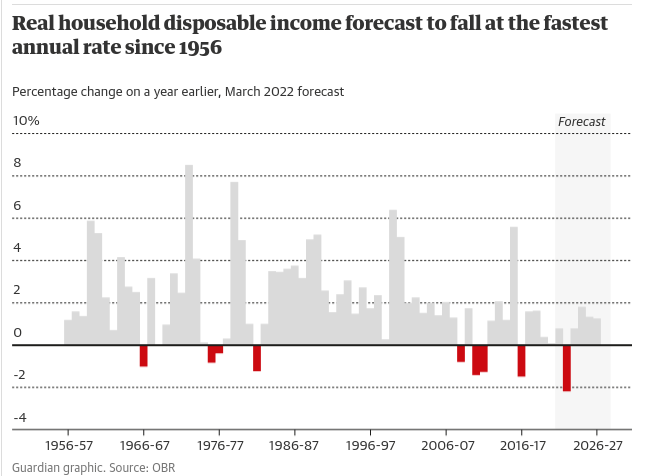
Rishi Sunak takes us back to the 50’s 

Saves his “War Chest” for a pre-election bonanza.

Do you remember the 50’s or will this be a new experience for you? – Owl (who is as old as the hills)

Real household disposable income forecast to fall at the fastest annual rate since 1956 – graphic