Michael Gove ‘tells Lords they should sit outside London during refurbishment’

Southwest loses out again. – Owl

www.lancashiretelegraph.co.uk 

The House of Lords should relocate outside of London rather than moving to a building nearby during refurbishment works, Michael Gove has reportedly told the Lord Speaker.

The Levelling Up Secretary is said to have written to Lord McFall of Alcluith suggesting locations including Stoke-on-Trent, Burnley and Sunderland.

In the letter, reported in the Sunday Times, Mr Gove said he knows “cities and towns across the United Kingdom would be pleased to extend their hospitality to peers”.

He is quoted as saying that having “carefully reviewed the proposed arrangements”, he “will not support the use of the QEII Centre as an alternative location”.

The Queen Elizabeth II Centre conference and exhibition space is just a few minutes’ walk from the Palace of Westminster in London.

In the letter, which the Sunday Times said was also sent to Prime Minister Boris Johnson and Cabinet Secretary Simon Case, Mr Gove suggested a move elsewhere in England, Scotland or Wales.

He is reported to have written: “As the minister responsible for levelling up, it is clear to me that the House of Lords moving elsewhere, even for a temporary period, would be widely welcomed.

“I have carefully reviewed the proposed arrangements and… I will not support the use of the QEII Centre as an alternative location.

“I propose to establish dedicated liaison points for you in my department to support you in identifying a suitable location for the House of Lords in the North, Midlands, South West, Scotland or Wales. I would, of course, be happy to meet you to discuss this.”

A spokesperson for the Department for Levelling Up, Housing and Communities declined to comment.

Earlier this year, a report showed that restoring the Palace of Westminster without finding a new home for MPs could take up to 76 years, with a repairs bill reaching £22 billion.

The project’s sponsor body and delivery authority said the cheapest option would involve a “full decant” of the palace for between 12 and 20 years, with the work costing in the region of £7 billion to £13 billion.

In this scenario, with MPs elsewhere for much of the time, the report estimated the restoration would take between 19 and 28 years.

A House of Lords spokesperson said: “The Lord Speaker has just received this letter from the Secretary of State. We will respond to it in due course.

“In March the House of Lords and House of Commons Commissions reaffirmed their united commitment to preserve the Palace of Westminster for future generations.

“Both Commissions will meet in June to consider future arrangements for the restoration and renewal programme and proposals will then be put to both Houses of Parliament. This process will set the way ahead.

“Any decision about whether and where to relocate the House of Lords, whether on a permanent or temporary basis, is ultimately a matter for the House itself.”

Pressure grows on Labour and Lib Dems to agree joint anti-Tory strategy

The Lib Dem leader, Ed Davey, told the Observer on Saturday that his party would concentrate on the Devon seat of Tiverton and Honiton because it believes it can pull off a sensational win against the incumbent Conservatives in the south-west, where it has traditionally been strong.

Toby Helm www.theguardian.com 

The Liberal Democrats will put all their campaign efforts into only one of two crucial byelections this summer – leaving Labour to fight the Tories in the other – as pressure intensifies on leftwing parties to work more closely together to oust the Conservatives from power.

The Lib Dem leader, Ed Davey, told the Observer on Saturday that his party would concentrate on the Devon seat of Tiverton and Honiton because it believes it can pull off a sensational win against the incumbent Conservatives in the south-west, where it has traditionally been strong.

But with resources and money limited, the Lib Dems know they can maximise their chances there only if they limit help for their candidate in the other contest, in Wakefield, where Labour is the traditional incumbent but was pushed into second by the Tories at the 2019 general election.

The two byelections – caused by the resignations of Tory MPs Neil Parish and Imran Ahmad Khan over sex-related sleaze scandals – are likely to be held on the same day on a byelection “super Thursday” in late June or early July. The double election is seen as a potentially critical moment for Boris Johnson’s administration.

If the prime minister were to lose both it would be another blow to his chances of surviving in office, showcasing his vulnerability to twin Lib Dem and Labour recoveries in their respective heartlands, following the Partygate scandal and with a cost of living crisis raging.

Without mentioning the Wakefield contest, Davey said: “Political parties always put resources where they can win, so we will be working incredibly hard to take the fight to the Tories in Tiverton and Honiton.”

With Labour certain to do the reverse, prioritising Wakefield while backing off in Tiverton and Honiton, there is now a growing focus on how far the parties on the centre-left should go in terms of cooperating – whether it be informal “one-off” arrangements, or more organised pacts, in order to dislodge the Tories.

A special constituency-level MRP survey of 10,000 voters, commissioned and published on Sunday by the pressure group Best for Britain, has found that if Labour, the Lib Dems and Greens came to formal agreements not to fight each other in 119 English seats at the next general election, they would be able to form a coalition government without relying on MPs from the Scottish National party.

However, if such pacts only happened between parties on the right and no such arrangements were made on the left, then Labour would fall short of that majority and could govern only by relying on the SNP.

Ukip stood down in seats where it risked splitting the rightwing vote when Theresa May was prime minister in 2017, and the Brexit party stood down for Johnson in 2019.

If past behaviour is any indication, Reform UK, the successor to the Brexit party, is likely to stand down to help the Conservatives if a Labour-led government looks likely at the next election.

The Best for Britain polling found that if the 2017 and 2019 situation were to be repeated with no similar arrangement on the left, then Labour would win 307 seats, the Tories 261, SNP 52, the Lib Dems 7, Plaid Cymru 4 and the Greens 1. This would not be enough for Labour to govern without the SNP.

However, if Labour, the Lib Dems and the Greens were to play the rightwing parties at their own game, and agree to stand down candidates in order to maximise their chances of winning against the Tories, then Labour would win 323, the Tories 239, SNP 52, the Lib Dems 13, Plaid Cymru 4 and the Greens 1. Under this scenario Labour would be able to govern with the Lib Dems but without the SNP.

Naomi Smith, the CEO of Best for Britain, said: “To win, Labour needs to do what the Conservatives most fear them doing, and that’s working with the Lib Dems and the Greens at election time.

“The parties on the right stand down for each other to secure majority governments on a minority of the votes, and our data shows that the safest way for opposition parties to defeat this corrupt and failing government is to stand aside for one another in the seats they can’t win.

“We saw last week in the local elections that voters up and down the country are already collaborating to get rid of this government. Their party leaders need to catch up.”

Layla Moran, the Lib Dem MP for Oxford West and Abingdon, added: “In an election where the opposition vote is split, many voters will want to back the candidate who is most likely to win and deliver change. To this end we must be honest with each other about the situation in each constituency and ensure that the voters have the information they need to lock the Tories out of power.”

Caroline Lucas, the Green party MP for Brighton Pavilion, said: “This polling shows that in many constituencies, the Green party holds the key to beating the Conservatives, a point underlined by our strong performance in the recent local elections.”

Torbay Council Conservative leader ‘breached code of conduct’

The leader of the Conservatives at Torbay Council has been found to have brought the council into disrepute.

Does the Conservative sense of entitlement lie at the heart of these breaches of conduct? – Owl

www.bbc.co.uk 

David Thomas was also found by the council’s standards committee to have used his position as a councillor to improperly gain an advantage.

It comes after a procedural row during a meeting in September last year descended into disarray, with one clerk too upset to continue their duties.

Mr Thomas was told he must write an “unequivocal” apology to the clerk.

The incident happened during the opening meeting of the council’s housing crisis review panel, according to the Local Democracy Reporting Service.

An administrative error led to the panel being top heavy with Conservatives, not reflecting the political make-up of the council which is run by a coalition of Liberal Democrats and independents.

Fellow Tory councillor Hazel Foster, who was also found to have breached standards by bullying an officer, refused to accept a change that would have led to a more balanced panel.

An hour-long debate ensued and one clerk became visibly distressed and left the meeting.

On Friday, the standards committee found Mr Thomas had exacerbated problems and contributed to disorder at the meeting.

The standards committee deemed this was a breach of the council’s code of conduct as it brought the authority into disrepute.

Commenting on the accusation, Mr Thomas said: “I believe this meeting didn’t show [Torbay] council in the best of lights. It is certainly not the council’s finest hour.”

He said he honestly believed that when he spoke at the meeting he only did so to keep the meeting on track.

“I believe and I still believe there are lessons to be learned across the whole of that meeting,” Mr Thomas said.

In its conclusions, the standards committee recommended that training was provided to all councillors and relevant officers to prevent administrative confusion.

Watch: Reactions as PM dodges question on Russian money donated to Tory party

There has been another scandal involving Russian money allegedly flowing into the Tory party.

By AMERICAN EXPRESS www.thelondoneconomic.com 

In February 2018, a donation of $630,225 was made in the name of wealthy London art dealer Ehud Sheleg, who was most recently the treasurer of the UK Tory party.

However, an alert that was filed by Barclays bank last year with the National Crime agency – which has been seen by the New York Times – say that the money originated from the bank account of Sheleg’s father-in-law, Sergei Kopytov.

Kopytov is a former high-ranking pro-Kremlin Ukrainian politician who now owns hotels and real estate in Crimea and Russia.

Via a statement issued by Sheleg’s lawyer, Kopytov said he was a Ukrainian citizen and had not made any such donation.

He said: “I have no interest in British politics whatsoever.

“Any donations made by my son-in-law to a British political party have nothing to do with me or with the money I gifted to my daughter.”

Interview

Sky’s Sam Coates asked the PM about the breaking scandal.

He said: “What’s your response to allegations in the New York Times that the Conservative Party took donations from a donor with links to Russia & money linked to a Russian bank account?”

The PM gave a non-reply and eventually said: “You’ve got to be from the UK to give donations.”

Reactions

Go to www.thelondoneconomic.com to read more

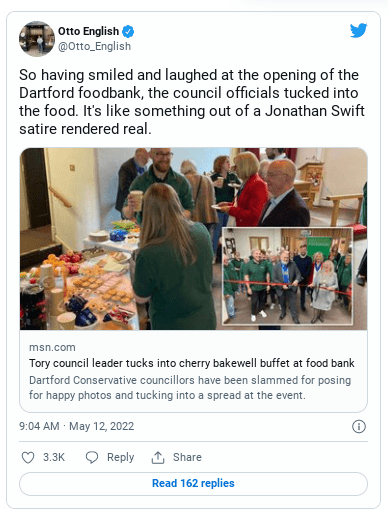
Literally read the room! Fury as Tory council leader tucks into buffet at food bank opening

The image of Dartford’s Tory council leader grinning as he cut the ribbon to open a food bank has rightly sent people into orbit, as the pics emerged.

www.thelondoneconomic.com 

But now more details have been discovered about the buffet they had afterwards, more of this later.

As you can see from the tweet below the initial unveiling didn’t go down very well…

James O’Brien also tweeted: “WTF are they all so happy about?”

It comes a Conservative MP has been slammed for suggesting people in the UK use food banks because they “cannot cook properly” and “cannot budget”.

Ashfield MP, Lee Anderson, invited “everybody” on the opposition benches in the House of Commons to visit a food bank in Ashfield, Notts, where, when people come for a food parcel, they now need to register for a “budgeting course” and a “cooking course”.

He claimed food bank users in his constituency are shown how to cook meals for “about 30 pence a day”.

Buffet

Now another image has revealed the party went on to enjoy a buffet after the opening event – in the same church building where desperate families will queue for handouts.

The leader of the local Tory council, Jeremy Kite, was among those tucking into the food.

Pictures of the event were hastily deleted from his Facebook page once they were spotted.

Nicholas Hair, a Labour council candidate in Bexley, said: ‘Having worked with colleagues in Dartford, and seeing the destitution of up to two million people across this country right now, this was disgusting to see.

‘Food banks are not “heart warming”, they are evidence of a failure of government and of a society to seek social justice.’

Reactions

See them all on www.thelondoneconomic.com 

Sewage dumps into English rivers widespread, criminal inquiry suspects

A criminal investigation into water companies in England has uncovered suspected widespread illegal sewage discharges from treatment plants, the Environment Agency has revealed.

Remember “The tories just voted against an amendment to stop water companies dumping raw sewage into rivers” (Including Simon Jupp and Neil Parish) – Owl

www.theguardian.com 

The investigation into more than 2,200 water treatment plants run by all 10 water companies is examining whether the firms breached legal regulations about when and how frequently they are allowed to release raw sewage into waterways.

The EA said an initial examination of hundreds of documents from the water firms “confirmed that there may have been widespread and serious non-compliance with the relevant regulations”.

Breaching the legal regulations amounts to illegal dumping of raw sewage, and criminal penalties apply. Last year, Southern Water was fined a record £90m for illegally discharging billions of litres of raw sewage into coastal waters off Hampshire and Kent. The company argued in court that the discharges had not been deliberate, and said it was committed to transformation, transparency and cultural change.

The revelations came as members of the public, NGOs and charities rejected as too little and too late government plans to cut the scale of raw sewage discharges into rivers and seas.

Targets drawn up by government and put out to consultation include a requirement for water companies to reduce the frequency of discharges to bathing waters by 70% by 2035, or significantly reduce harmful pathogens they contain, for example by using ultraviolet radiation.

By 2040, 160,000 discharges of raw sewage through storm overflows into all waters should be eliminated, and by 2050 ministers are promising to eliminate approximately 320,000 discharges, about 80% of the total, into all waters.

The latest Environment Agency figures recorded the scale of raw sewage discharges from the 15,000 storm overflows in England in 2021 as 372,533 discharges for a combined total of more than 2.7m hours. In 2020, there were more than 400,000 sewage discharges, totalling more than 3m hours.

The majority, 55.2%, of the 18,268 people who responded to the consultation via 38 Degrees, a campaign group that regularly helps the public respond to government consultations, disagreed with the timescale and scope of the government’s targets. Questioned further, 83.9% said the timeframes being proposed by the government were much too long.

Matt Richards, campaign manager at 38 Degrees said: “The conclusion we can draw from this is that, regardless of people’s stated views of the proposed targets, the overwhelming majority want the government to move much quicker than they are currently proposing.”

Christine Colvin, of the Rivers Trust, said: “We think this plan gives us too little, too late. We need to see a broader scope that includes clear milestones for government as well as water companies, and much more urgency and ambition. We want to have healthy rivers fit for people and wildlife within the decade, not by 2050.”

Any release of raw sewage into rivers and coastal waters through storm overflows is supposed to take place only after exceptional weather and according to conditions in the permits issued by the EA.

Fish Legal, in its response to the consultation, also rejected the timeline and ministers’ proposed approach. It said the ambition to cut discharges into bathing waters was “extremely limited”.

The legal group also condemned the entire approach of the reduction plan. It said: “There appears to be an assumption running though this consultation that most storm overflows only happen due to excessive rainfall … The Environment Agency, as a regulator, also appear to have been working on that assumption … Our members and the public therefore do not share the Environment Agency’s confidence.

“The Environment Agency has previously taken a passive approach to regulating these discharges, relying on the water companies to collect and even analyse the relevant data. If nothing else, the current major investigation into water companies’ permit compliance is a tacit admission that operator self-monitoring and self-reporting – a situation whereby the water companies oversee their own works and report their own permit compliance – has not worked.”

A report by the environmental audit committee in January found that rivers were being subjected to a chemical cocktail of sewage, agricultural waste and plastic pollution.

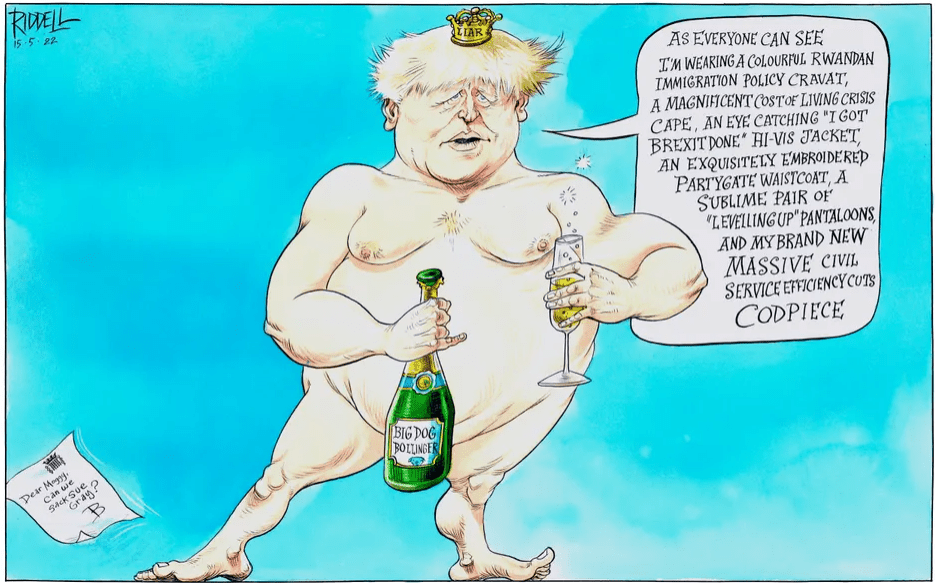
Champagne bottle signed by Boris Johnson auctioned at charity event ‘as souvenir of Partygate’

A champagne bottle signed by Boris Johnson was auctioned off at a charity event “as a souvenir of partygate”.

Tories really are in a class of their own! – Owl

Chiara Giordano www.independent.co.uk

Food critic Jay Rayner tweeted an image showing a description of the bottle from what appeared to be the page of an auction catalogue.

Beneath the title “Bottle of champagne signed by Prime Minister Boris Johnson”, the description read: “A bottle of champagne signed by Boris. Hugely valuable as a souvenir of partygate and the exemplary behaviour and morality of our dear leader! Donated by: Oliver Dowden”.

Sharing the image on Twitter on Friday morning, Mr Rayner wrote: “Perhaps you thought the Conservative party took partygate seriously.

“Last night a champagne bottle signed by @BorisJohnson was donated to a charity event in Hertfordshire by local MP and Tory party chairman @OliverDowden. Read the description.”

Mr Dowden, who has been the MP for Hertsmere since 2015 and co-chairman of the Conservative Party since 2021, confirmed he donated the item – but had no knowledge of the description.

The MP’s spokesperson said: “This item was donated in good faith several months ago for a local charity auction.

“Oliver Dowden had no prior knowledge of the description and this is obviously not his view.”

The Metropolitan Police on Thursday announced the number of fines handed out to government staff for law-breaking parties held during the Covid-19 pandemic had doubled to more than 100.

Scotland Yard said last month that 50 referrals had been made to the criminal records office for fixed penalty notice (FPN) fines over parties in Downing Street and Whitehall when the country was under strict social-distancing rules.

In an update, the Met said its Operation Hillman team had now recommended 100 fines. The force said its investigation, into 12 separate events, remained ongoing.

Number 10 said Boris Johnson had not been issued with another fine, after he was punished last month over his rule-breaking birthday party in June 2020.

Slashing Civil Service jobs – the incoherence of slogan politics

Cutting civil service jobs is an old chestnut that plays well with the right wing.

Owl looks at three consequences of this proposed solution to the cost of living crisis that has emerged in place of an emergency budget from the Stoke-on-Trent awayday.

Depriving 91,000 (one in five) civil servants of their jobs, as we teeter on the brink of recession, seems a perverse way of dealing with the short term impact of the  cost of living crisis. It surely can only make matters worse.

The civil service has been increased to deal with Brexit. Reducing it  size will  inevitably reduce the services the government can deliver.  With 38 new bills announced in the Queen’s speech, what is the government now going to stop doing? Boris Johnson’s administration consistently falls short on delivery eg issuing visas to Ukrainian refugees. Its record on the value for money of contracting work out cronies isn’t too good either.

Civil service jobs are (or were until the cabinet went on its awayday brainstorming session) considered by the government to be so prestigious that a key part of the Levelling Up programme envisages moving 22,000 of them out of London. The recent Bloomberg analysis points this up as one of the consistent failings of Boris Johnson to meet his own levelling up targets. Only a couple of days ago Michael Gove gave us his views that arithmetical targets were not a thing of beauty.

Tiverton & Honiton: Voters in porn MP by-election desert Johnson’s Tories

Swing voters in Tiverton & Honiton have said that they will not vote for the Conservatives until the “lying buffoon” Boris Johnson has quit, boosting the Liberal Democrats’ hopes in an impending by-election.

[Neil’s comeback story continues across the press under various headlines eg. “Tractor pull the other one! Porn MP is eyeing up a comeback” www.thelondoneconomic.com]

Chris Smyth www.thetimes.co.uk 

A focus group for Times Radio found that voters in the Devon constituency who supported the Tories in the last election were swinging towards the Lib Dems as they lost faith in the prime minister.

Some said that they would never vote for the party until it had a different leader despite a lukewarm reception for Labour’s Sir Keir Starmer, who was described as bland.

The findings will boost Lib Dem hopes of overturning a 24,239 Tory majority in a by-election prompted by the resignation of Neil Parish, the MP who was caught watching pornography in the Commons.

While the voters were not enthused by Sir Ed Davey — with one describing him as the “British version of Biden, been around forever but known for not doing anything” — their hesitation about voting for his party has largely evaporated.

One voter, Andrew, who is retired, said that he had “begun to really not respect Boris. He’ll say anything and does very little to deliver”. Lucinda, a charity worker, said: “A lot of people have lost trust in Boris and the Conservatives — it’s just a bit of a mockery.”

James Johnson, Theresa May’s former pollster who ran the focus group for Kekst CNC, likened the issue of Downing Street parties to the Iraq war for Tony Blair, or Nick Clegg’s broken pledge on university tuition fees, in causing a permanent loss of trust.

The voters described the prime minister variously as a “lying buffoon”, “just an idiot”, a “selfish greedy man”, and a “self-promoting arsehole” and told him: “Do the right thing, resign, we don’t want to be led by a clown.”

They dismissed Johnson’s argument that he had got the “big calls right” as “smoke and mirrors”, describing him as an opportunist.

Four of the six voters opted for Starmer over Johnson, despite a lack of enthusiasm for the Labour leader. Starmer was described as “weak”, “boring” and “a bit like Theresa May”, although some voters contrasted his lack of charisma positively with “bombastic, buffoonish Boris”.

Almost all the voters described the cost-of-living crisis as the main issue in the forthcoming by-election, with some also mentioning GP appointments and local issues such as pot holes and new development. James Johnson argued that this meant “the issue agenda is stacked heavily in the Lib Dems’ favour”, adding: “the Lib Dems are seen as a ‘credible’ party, ‘the lesser of evils’ and a ‘happy medium’ to vote for. There was no mention of tuition fees.”

Read the full conversation by clicking on this tweet:


Breaking News: “Independent” candidate may enter Tiverton and Honiton by-election race!

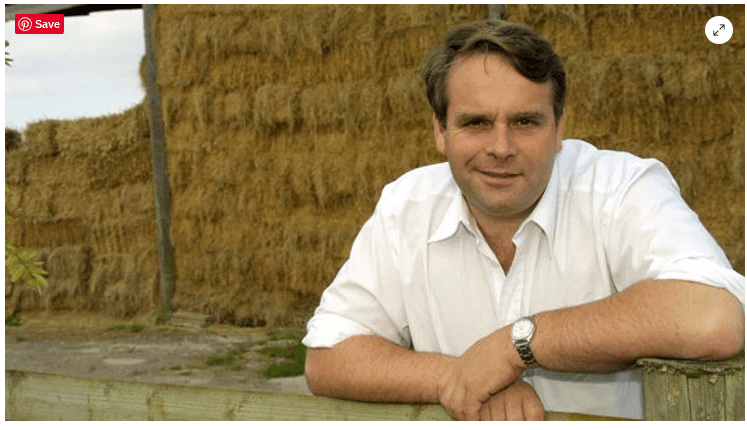
‘Porn MP’ Neil Parish threatens to stand for re-election against Tory candidate

“I’ve got some sort of quite powerful backers within the farming community… If I stood, it wouldn’t be a problem in raising the money. The farming community realised how I fought their corner.”

Noon update according to Politico Newsletter: He’ll decide whether to stand on the eve of nominations closing! (Just to upset Tory High Command – Owl)

Will Taylor www.lbc.co.uk

“Porn MP” Neil Parish is weighing up standing for re-election and running against the Conservative Party candidate.

The politician resigned after he was caught watching porn twice in the House of Commons.

The ex-Tory MP became the focus of both outrage and ridicule when it emerged he had brazenly watched it in the chamber, causing female colleagues to complain.

Mr Parish later said he had accidentally viewed it in the first instance, while searching for tractors on his phone, before later accessing it deliberately.

He resigned his seat in Tiverton and Honiton in South West England after initially looking like he would try to fight on, and admitted he was a “f***ing idiot”.

But he is now considering running as an independent in the upcoming by-election triggered by his own resignation, pitting himself against any Tory candidate who stands.

“It is an option for me and one that I could consider,” he told the Telegraph.

“The only thing that may well stop me is the fact that my local party, my local activists, my local councillors, are friends. I don’t know if I want to do that to them.

“Some of the hierarchy of my own party, I suppose I wouldn’t have the same problem with doing it. At the moment, I’m taking soundings.”

He went on: “I’ve got some sort of quite powerful backers within the farming community… If I stood, it wouldn’t be a problem in raising the money. The farming community realised how I fought their corner.”

Mr Parish resigned after admitting his “moment of madness”, saying he was “not proud of what I was doing”.

He was reported as telling his wife he was sorry she “married a f***ing idiot”.

Mr Parish denied watching the porn in a way that he hoped others would see it, and added: “I make a full apology. A total full apology. It was not my intention to intimidate.”

The former chair of the Commons environment committee, who is passionate about rural issues, has said he will decide before nominations for the by-election close.

First elected in 2010, he won the Tiverton and Honiton seat in the 2019 general election with 35,893 votes, a 60% share and 24,239 votes ahead of his closest rival in the constituency, a Labour nominee.

Street votes on England planning rules ‘will not increase affordable housing’

Mini-referendums that allow homeowners in England to loosen planning rules and build bigger and taller extensions may do nothing to increase the supply of affordable housing, campaigners have said.

Better to take more notice of the Neighbourhood Plan process – Owl

Robert Booth www.theguardian.com 

“Street votes” have been included in the levelling up and regeneration bill as part of what the housing secretary, Michael Gove, has described as a way to boost democratic involvement in homebuilding.

But the countryside charity CPRE said the policy would allow homeowners to simply have more space and increase the value of their properties, making it harder still for first-time buyers to get on the property ladder.

“We don’t think it will provide any more affordable homes, [it] will make existing homes in urban areas less affordable, and there are no guarantees it will lead to more homes overall,” said Paul Miners, the group’s policy director.

The local votes are part of a new package of planning reforms unveiled after ministers scrapped an earlier attempt to allow property developers to build new estates without having to repeatedly apply for planning consent.

Officials said the votes would grant residents the right to allow the development or replacement of properties on their street within design rules and national policies. Development would only go ahead if the proposal is endorsed by a “supermajority” of residents at referendum.

“It has the scope to be very divisive in terms of neighbours,” said Peter Rainier, principal director of planning at law firm DMH Stallard.

The bill also includes a new requirement for community votes if a council wants to change a street name. Last year, Swanage town council in Dorset tried to change a street name from Darkie Lane but a public consultation found most residents wanted to keep it.

Successive governments have struggled to boost housebuilding to tackle the affordability crisis in the face of vociferous local opposition to greenfield development and rural sprawl.

The 2020 attempt to free up construction led to a backlash in the Conservative heartlands, and backbench MPs including Theresa May called the approach “ill-conceived”. The government is playing down the likelihood that it will hit a manifesto target of building 300,000 new homes a year by the mid-2020s.

Gove said on Wednesday: “Arithmetic is important but so is beauty, so is belonging, so is democracy, and so is making sure that we are building communities.

“People, when it comes to housing development, should be partners. We are going to do everything we can in order to ensure that more of the right homes are built in the right way in the right places. I think it is critically important that even as we seek to improve housing supply you also seek to build communities that people love and are proud of.”

Social housing landlords said any reforms should boost the delivery of affordable homes. Kate Henderson, the chief executive of the National Housing Federation, said planning changes should “deliver the number and type of affordable homes the country desperately needs”, citing 4.2 million people in need of social housing in England.

Gove’s predecessor as housing secretary, Robert Jenrick, said on Tuesday that the government would miss its manifesto target “by a country mile” and it could be years before the output hits even 250,000 a year again. He said: “We have to get those homes built because we are letting down hundreds of thousands of our fellow citizens. People are homeless today because we are failing to build those houses.”

On “street votes”, May warned parliament of “unintended consequences”. She said: “I can well imagine a situation in which somebody persuades their neighbours in a street to agree to the sort of development that might enhance the value of their houses but which actually has a negative impact on the wider community and wider neighbourhood.”

Street votes were proposed last year by the Policy Exchange thinktank, with the backing of several architects and planners associated with Prince Charles who have advocated for the “densification” of urban areas, in part to reduce pressure to build on open fields.

Sign up to First Edition, our free daily newsletter – every weekday at 7am BST

The thinktank said: “Residents of a street should be able to agree by a high majority on new strict rules for designs to make better use of their plots. A street of suburban bungalows, for example, could agree on the right to create Georgian-style terraces. In many cases, an adopted ‘street plan’ would greatly increase the value of residents’ homes, giving them strong reasons to agree on it.”

It suggested redevelopment of listed and pre-1918 properties should be prohibited.

Another day, another 50 fixed penalty notices

Downing Street is the most fined address in the country for Covid breaches, according to the Telegraph headlines.

Seven occasions when Boris Johnson denied No 10 broke Covid rules

 Here are the moments Johnson denied rules were broken.

1 December – House of Commons

After the Mirror’s first story broke about Christmas parties in Downing Street:

“What I can tell the right hon and learned gentleman is that all guidance was followed completely in No 10.”

2 December – Sky News

Asked why he would not explain his account of the allegations, Johnson said:

“Because I have told you and what I want to repeat … that the guidance is there and I am very, very keen that people understand this.”

7 December – BBC News

When asked about Downing Street Parties in December, the prime minister said:

“All the guidelines were observed.”

8 December – House of Commons

After the Allegra Stratton video is released by ITV News:

“I apologise for the impression that has been given that staff in Downing Street take this less than seriously. I am sickened myself and furious about that, but I repeat what I have said to him: I have been repeatedly assured that the rules were not broken. I repeat that I have been repeatedly assured since these allegations emerged that there was no party and that no Covid rules were broken.”

8 December – Downing Street press conference

Asked why he had not extended the No10 inquiry:

“ … all the evidence I can see, people in this building have stayed within the rules … if that turns out not to be the case … and people wish to bring allegations to my attention or to the police … then of course there will be proper sanctions …”

Johnson giving a Downing Street press conference

13 December – Sky News

Asked again about Downing Street parties:

“I can tell you once again that I certainly broke no rules … all that is being looked into.”

20 December – BBC News

After the Guardian reveals pictures of people, including the prime minister, at No 10 drinks in the garden on 15 May 2020

“Those were people at work, talking about work. I have said what I have to say about that.”

Michael Gove Appears To Ditch Government Pledge To Build 300,000 Homes A Year

“We’ll do everything we can but it’s no kind of success simply to hit a target if the homes that are built are shoddy, in the wrong place, don’t have the infrastructure required and are not contributing to beautiful communities.

“Ultimately, when you’re building a new dwelling, you’re not simply trying to hit a statistical target. I’m certainly not.” – Michael Gove

When is a target not a target? – Owl

Kevin Schofield www.huffingtonpost.co.uk 

Downing Street has said the government remains committed to building 300,000 new homes a year, despite Michael Gove suggesting the target had been ditched.

The pledge was contained in the Tory manifesto in the run-up to the 2019 general election.

It said: “Since 2010 there has been a considerable increase in homebuilding. We have delivered a million homes in the last five years in England: last year, we delivered the highest number of homes for almost 30 years.

“But it still isn’t enough. That is why we will continue our progress towards our target of 300,000 homes a year by the mid-2020s.”

Appearing on Radio 4′s Today programme this morning, the levelling up secretary was asked if the government would hit its target.

He said: “We’ll do everything we can but it’s no kind of success simply to hit a target if the homes that are built are shoddy, in the wrong place, don’t have the infrastructure required and are not contributing to beautiful communities.

“Ultimately, when you’re building a new dwelling, you’re not simply trying to hit a statistical target. I’m certainly not.”

Pressed on whether the government was still committed to its manifesto pledge, Gove said: “We are not bound – I am not bound – by one criterion alone when it comes to development. Arithmetic is important, but so is beauty, so is belonging, so is democracy.”

But Downing Street later said the government remained committed to its target.

“Our target to deliver 300,000-a-year is central to our levelling up mission,” the prime minister’s spokesperson said.

“We’re certainly making progress towards that target. We are at 244,000-a-year currently.

“Some of the measures in this bill are designed to remove some of the barriers that can gum up planning applications and cause more resistance amongst local communities.”

Boris Johnson’s Flagship Plan to Fix Britain Is in Trouble

The prime minister promised to supercharge Britain by reducing regional inequalities. Two years on, an exclusive analysis by Bloomberg News shows things are going backwards.

Joe Mayes, Andre Tartar, Demetrios Pogkas www.bloomberg.com (Extract)

In 2019, Boris Johnson led the Conservative Party to a resounding general election win, pledging to revive large parts of the UK left behind during the era of globalization that made London one of the world’s richest cities.

Johnson’s rise was driven by his successful campaign to pull Britain out of the European Union. The so-called “levelling up” agenda was designed to turn that into tangible benefits by 2030, especially for the working class Brexit voters who abandoned the opposition Labour party to hand Johnson his party’s biggest majority since the 1980s.

More than two years on, in a period dominated by the coronavirus pandemic, most of the places that lagged behind London and the South East of England when Johnson came to power have seen little sign of better times. In fact, as a new Bloomberg News analysis shows, they’re more likely to be falling further behind.

To understand how levelling up is progressing, we analyzed 12 key socioeconomic metrics across every one of the UK’s 650 parliamentary constituencies to measure whether the gap has changed—one way or another—since 2019.

The data we used are based on priorities outlined in the government’s official levelling up policy paper and were compiled in consultation with Bloomberg Economics. Where data at the constituency level was unavailable, we used data for higher-level geographies and matched them to the relevant parliamentary seats.

Our analysis shows that the salary gap is widening in nine out of 10 constituencies, that home affordability is getting worse nearly everywhere, and that public spending per head has fallen behind the capital in every region of England.

Only on a few metrics has the gap narrowed for much of the UK—including life expectancy and the share of people receiving Universal Credit benefits—and in both those cases it’s because the situation in London and the South East has worsened. As a result of Covid-19 the death rate is up and more people are claiming welfare benefits. This is not the kind of levelling up Boris Johnson was looking for…..

(This graphic summary says it all. But note that the “hot spots” in the southwest are not in the peninsula but to the east: in places like Bristol, Bath, Gloucester & Swindon. Each hexagon represents a constituency.)

….The UK Treasury has been reluctant to dedicate large new pots of money to the levelling-up cause, citing the need to repair the public finances post-Covid. The roughly 12 billion pounds of funding announced so far amounts to about 3% of total government departmental spending in the 2019 fiscal year. Haldane argues this shouldn’t be a particularly limiting factor because tilting more of existing government budgets away from London and the South East will spur levelling up alone.

And the public money that has been dedicated to levelling up hasn’t always gone to the areas that need it most. Of the 100 most deprived areas in England, only 38% of councils won at least some of the Levelling Up Fund money they requested, 34% didn’t participate at all and 28% had all their bids rejected, BBC Panorama reported this week…..

There is a lot more to read in the full article, all illustrated by more graphics and an interactive table where you can search results for your own constituency. – Owl

Cranbrook’s epic £5.5M town centre approved

“Getting Cranbrook done!” The New Guard deals with a legacy issue.

(Just think Simon how this money could have been spent instead on reducing car park charges. Maybe you could winge about it in the next Tory leaflet.) – Owl

Anita Merritt www.devonlive.com

A major milestone has been reached in the continued development of Cranbrook after the go-ahead was given for funding of up to £5.5m for a town centre. Planning permission has also been granted for a supermarket, high street shops with apartments above, a town square and a children’s day nursery

East Devon District Council has announced it has approved the funding for the acquisition of town centre land in Cranbrook. It sits alongside current plans to provide space for shops and community facilities including a children’s centre, youth centre, library, town council offices, health and wellbeing hub, a leisure centre and a skatepark.

Work on the supermarket and nursery is due to be completed by summer next year, followed soon after by the high street shops, apartments, town square and children’s day nursery. The investment is funded by the Exeter and East Devon Enterprise Zone from borrowing against future ring-fenced business rate income.

By securing the land, the council says it can make sure that the new town centre will be able to grow and develop over time, including providing workspace to meet the needs of a growing population.

The Council has also agreed the process for delivering the £40m Cranbrook Local Infrastructure Fund. The fund will ensure that critical infrastructure, such as schools and transport improvements, can be delivered in step with new homes as the town expands to a population of around 20,000 people.

Cranbrook town centre supermarket

Cranbrook town centre supermarket (Image: EDDC)

Cllr Dan Ledger, East Devon District Council’s portfolio holder for strategic development and chair of Cranbrook Strategic Delivery Board, said: “This is a monumental moment for the town where the ‘coming soon’ notion actually becomes a reality over the next few months. Through partnership working across all levels of local authority and with the consortium of developers, Cranbrook will now finally have its much-needed centre.

“I couldn’t be happier for the residents.”

Cranbrook town centre plans

Cranbrook town centre plans (Image: EDDC)

Agreement on the details underpinning the facilities for the town has been coordinated by the Cranbrook Strategic Delivery Board. The Board is a partnership of Councillors from Cranbrook Town Council, East Devon District Council and Devon County Council who all played an important role agreeing the way forward with the developer consortium (Cranbrook New Community partners in conjunction with Henry Davidson Developments).

Cllr Les Bayliss, chairman of Cranbrook Town Council, said: “This long awaited news will undoubtedly bring significant benefits to the community. For example, being able to shop locally I believe will have a positive impact on the people that live in and around Cranbrook. Not to mention the benefits locally to the environment, economy and the potential of local employment opportunities”.

Pinewood Studios in talks with Neil Parish over new ‘Carry On…’ script

Pinewood Studios say they are in talks with former Tory MP Neil Parish over his script for a new Carry On film.

Gerontius www.newsbiscuit.com

Rank Organisation say they have already signed a deal with Parish and filming for the comic caper should get underway later this year at the Buckinghamshire studios.

The film – titled Carry On Ploughing – is set in the farming community of mid Devon and centres around a young hapless farming lad played by Jim Dale trying to woo the barmaid from the local village pub. Dale tries to impress the barmaid (played by Barbara Windsor) with his ploughing skills and his massive seed planter. But the barmaid’s mother has misgivings about Dale and what he intends doing with his enormous dibber, and has barred the farming lad from the local pub.

Carry On regulars Sid James, Kenneth Williams and Charles Hawtrey are all said to be on board with the new film and say it is one of the most laughable and implausible scripts they have encountered in Carry On history.

James said he had appeared in nearly 20 Carry On films but the plot for this script was the most ridiculous yet.

Former Tory MP Ann Widdicombe was initially pencilled in to be Windsor’s battle-axe mother, but having met her during rehearsals Rank say she would be better suited to the new Hammer House of Horrors movie set for next year.

Parish said he had been working on the Carry On script while serving as a sitting MP and had even researched farming practices on his mobile phone while still at work. The former Tiverton and Honiton MP added that he had been so keen to get the Rank script ready for filming, he had even visited websites while sitting on the front bench in the House of Commons.

A publicist for Rank welcomed having Parish on board and looked forward to working with him on this and future projects. ‘Neil is Rank through and through,’ he said. ’We think he will fit in nicely with his new stablemates.’

[Central Casting is looking for a replacement for Neil in the long running Whitehall farce, due to end no later than January 2025. Conformity is essential. Lib Dems have other ideas. – Owl]

Tory MP claims no ‘massive use’ for food banks, saying people unable to cook and budget ‘properly’

A Conservative MP is under fire after claiming there is no “massive use” for food banks in Britain, and suggesting people use them because they are unable to cook or budget “properly”.

Ashley Cowburn http://www.independent.co.uk 

The MP for Ashfield Lee Anderson made the remarks – labelled “condescending” by unions – as ministers face intense criticism over support available to the most vulnerable amid a cost of living crisis, with soaring energy bills and levels of inflation at a 30-year high.

Earlier, cabinet minister Michael Gove provoked anger as he defended the government’s approach, ruled out demands for an emergency budget, and suggested people “calm down” over the lack of extra financial support before the autumn Budget.

During a Commons debate on the Queen’s Speech, Mr Anderson invited MPs to visit a food bank in his constituency to witness a “brilliant scheme” whereby those in receipt of food parcels have to “register for a budgeting and cooking course”.

“We show them how to cook cheap and nutritious meals on a budget – we can make a meal for about 30p a day – and this is cooking from scratch,” he added.

But when pressed by a Labour MP whether it should be necessary to have food banks in 21st century Britain, Mr Anderson replied: “I’ll invite you personally to come to Ashfield, look at our food bank, how it works.

“I think you’ll see first-hand there’s not this massive use for food banks in this country. We’ve got generation after generation who cannot cook properly, they can’t cook a meal from scratch, they cannot budget.”

Addressing MPs, he added: “The challenge is there – come. You’re sat there with glazed expressions on your faces, looking at me like I’ve landed from a different planet. Come to a real food bank that’s making a real difference to people’s lives.”

According to the Trussell Trust – the largest network of food bank providers in the UK — the main drivers of food bank use are problems with the benefits system, challenging life experiences, ill-health, or lack of informal or formal support.

Between April 2021 and March 2022, food banks in the organisation’s network distributed more than 2.1 million emergency food parcels – a 14 per cent increase compared to same period in 2019-20.

Sumi Rabindrakumar, head of policy at the Trussell Trust, told The Independent: “Research from the Trussell Trust and other independent organisations is clear – that food bank need in the UK is about lack of income, not food.

“Cooking from scratch won’t help families keep the lights on or put food on the table, if they don’t have enough money in their pockets.”

They added: “Our research shows that people at food banks had on average just £57 a week to live on after housing costs, and no amount of budget management or cooking classes will make this stretch to cover council tax, energy bills, food and all the other essentials we all need to get by.

“That’s why we’re urgently calling on the government to bring benefits in line with the true cost of living and – in the longer term – to introduce a commitment in the benefits system to ensure everyone can afford the essentials we all need to survive.”

Following Mr Anderson’s comments, the SNP’s Joanna Cherry hit back in the Commons, saying: “All of us have food banks in our constituencies, we don’t really need to visit his because we’re perfectly well aware of the requirement for them.

“The requirement for them is not that people don’t know how to cook, but because we have poverty in this country at a scale in this country that should shame his government”.

Wendy Chamberlain, the Liberal Democrats’ welfare spokesperson, said Mr Anderson should apologise for the “shameful” remarks, which were an “insult to millions of hard-working people”.

Karen Buck MP, Labour’s shadow work and pensions minister, said: “In the world where people actually live we now hear daily stories of families going without food and others unable to turn their ovens on in fear of rising energy bills.

“The idea that the problem is cooking skills and not 12 years of government decisions that are pushing people into extreme poverty is beyond belief. Out of touch doesn’t even cover it.”

The row follows confusion over Boris Johnson’s promise on Tuesday that more help would be revealed in “the days to come”, before the Treasury ruled out further short-term financial measures, including an emergency budget.

Mr Gove told BBC Breakfast: “The prime minister was making the point we are constantly looking at ideas to relieve the pressure on people facing incredibly tough times – but that doesn’t amount to an emergency budget.”

The minister added: “It’s example of some commentators trying to take a statement that is commonsensical, turning it into – capital letters – a big news story, when the Treasury quite rightly say, ‘calm down’.”

The levelling up minister also claimed Labour and Lib Dems have no “whizz bang ideas” to address the cost of living crisis – despite rejecting their call for a windfall tax on oil and gas company profits.

One Torbay Tory found to have bullied council clerk, another faces behaviour allegation hearing

A prominent Torbay councillor bullied a council officer and ran “roughshod” over council rules in a Zoom meeting, in scenes reminscient of the notorious ‘Jackie Weaver’ incident at another council.

Joe Ives, local democracy reporter www.radioexe.co.uk 

An investigation into how Hazel Foster (Conservatives, St Marychurch) chaired a new housing review panel meeting has concluded she brought the council into disrepute.

It also found she used her position to bring about an advantage for herself and other Conservatives.

But Cllr Foster believes that council procedures are at fault.

The judgments against her were made at a marathon four-hour standards hearing of Torbay Council on Tuesday [10 May], which considered an independent report into Cllr Foster’s actions at the council’s first meeting of a new housing crisis review panel last September. 

Following an administrative mix-up, the make-up of the housing panel was top heavy with Conservatives, which didn’t reflect the political situation at the council overall. Torbay is run by a coalition of Lib Dems and independents.

Instead the panel mistakenly was listed as comprising three Liberal Democrats, two independents and seven Conservative councillors. 

Committee chair Cllr Foster, who is married to the area’s MP Kevin Foster, refused to accept a change that would have seen it balanced more in line with the overall council.

But some Tory councillors, including Mrs Foster, felt that changing the membership with the Zoom meeting underway was an unfair attempt to move the goalposts after the selection process had finished, and limit Conservative involvement. 

That led to a fierce hour-long debate over panel membership that became so aggravated a council clerk became visibly distressed and left the meeting. Ignoring please from fellow councillors and senior officers, Mrs Foster repeatedly attempted to pass a vote on the membership of the council that had been printed on the original meeting report.

The council’s chief executive Anne-Marie Bond, a lawyer by training, was eventually drafted into the online meeting to advise. 

The meeting eventually went ahead without the panel’s membership being agreed.

However by this stage, the discussion of the Bay’s housing crisis proved a footnote to the bitter argument preceeding it. 

Following the meeting, six councillors – five Liberal Democrats and one Independent – complained, along with the council’s director of place Kevin Mowat, sparking an investigation.

Unlike other public Torbay Council meetings held over Zoom at the time, and despite requests by the Local Democracy Reporting Service, the video has yet to be published.  

Councillors on the standards committee agreed with the independent investigation’s findings that Cllr Foster bullied the officer and that she had ploughed on despite clear signs that her actions had caused upset. 

The officer in question told the investigator she felt bullied and pressured to take on actions that were beyond her remit.

Cllr Foster said: “I’m really really saddened by the clerks’ comments,” and that she holds the officer “in the highest regard.”

She said that initially she had not known the clerk was upset and that, later, when she did realise this, she did not know the reasons why.

Mrs Foster said she felt it was her duty as chair of the panel to continue with the meeting and get the vote on its membership “out the way” regardless.  

After becoming upset, the clerk had turned off her Zoom camera. Cllr Foster told the hearing that this did not indicate to her that something was wrong.

She explained: “As you know during these Zoom meetings there can be many occasions when a screen would go blank. Had somebody come to the door? Had she left the kettle on? There can be many reasons why.”

Councillor Judith Mills (Churston with Galmpton, Independent) pointed out that by this stage several councillors had commented on the clerk’s distress.

Cllr Foster believed the clerk’s behaviour could be because of personal reasons unrelated to the meeting. 

Th at was rejected by the independent investigator, hwo said: “The clerk clearly stated that she was distressed and in difficulty.

“I don’t see how anybody would have not been aware of that.”

Councillor Jermaine Atiya-Alla (Lib Dems, Ellacombe) criticised Cllr Foster, saying: “You did not show any emotional empathy at that time.” 

Cllr Foster countered that she was wronged too. “No empathy was shown to me,” she said.

The scrutiny committee agreed that Cllr Foster had not acted respectfully to other councillors and officers.

The independent investigator said he had watched the “invaluable” Zoom recording of the meeting “many times” and concluded that there were many instances where Cllr Foster had shown disrespect.

He said: “It appeared to me that Cllr Foster didn’t want to hear what anybody had to say.

“Her line was always ‘let’s move to the vote’…there didn’t appear to be any respect for what anybody said, whether it be fellow members or experienced officers in the room.”

Cllr Atiya-Alla argued that Mrs Foster had shown “ a complete lack of respect” to the clerk and other members.  “To me, it seems like you just didn’t care about what anyone else had to say…and you were running roughshod on the rules.”

Foster admitted she was rushing the vote at points but this was because she felt it was very important to move the meeting along.

As reported by the local democracy reporting service in September last year, the meeting had echoes of the infamous ‘Jackie Weaver’ incident at Handforth Parish Council.

Both Torbay council’s scrutiny committee and the independent report found that the episode and its subsequent media coverage brought the council into disrepute. 

Cllr Foster said that the excerpt from an article presented in the report did not represent the full write-up.

The independent investigator disagreed, saying:“ I don’t think it is at all misleading. It is a very poignant point that the article highlights.” He also pointed to the fact that a link to the full article was included in his report.

Cllr Foster said her actions did not harm the reputation of the council. “I believe that when residents here in Torbay – or anywhere – go to the vote they do expect their councillor to stand up to what they feel is correct and the right thing to do”, she argued.

“On this occasion, I was following the agenda and felt that was the right thing to do.”

Cllr Foster denied seeking advantage by forcing through a Conservative majority on the housing review panel and that she had not known proportionality was required.

“I strongly reject this assumption”, she continued. “I find that it is a completely a matter of opinion. [There] is no factual evidence.”

She said the claims were “a slur” on her character and that as no formal decisions were made by the panel, there was no advantage to be gained by a  Tory majority.

The independent investigator rejected that, noting the panel would have had influence and so it would have been advantageous to Cllr Foster for the panel to be disproportionately made up of Conservatives.

The complainants had initially suggested that Cllr Foster had attempted to compromise the impartiality of those who work for, or on behalf of the council and that she had wasted the resources of the council.

In the end, the scrutiny committee and the independent investigator agreed she had not.

Nevertheless, the scrutiny committee did find that Cllr Foster’s breaches of the code of conduct elsewhere required significant sanctions. 

Cllr Foster was told that she must carry out ‘acceptable behaviour training,’ and that she write an apology letter to the clerk affected by her behaviour, the head of governance and the council’s director of place.

She must also make an unequivocal apology for her conduct at a meeting of the full council on Thursday 21 July.

The committee said the leader of the council, Steve Darling (Lib Dems, Barton with Watcombe) should be “recommended to consider” suspending Cllr Foster from her post as the council’s domestic abuse and sexual violence champion until her acceptable behaviour training is completed.

It was also decided that the committee would recommend to the leader of the Conservative group, David Thomas (Preston), that Cllr Foster should be suspended from the committees she serves on, and from outside bodies at which she represents the council. 

However Cllr Foster will be allowed to carry on as a councillor representing St Marychurch.

Speaking after the meeting, Cllr Foster accepted she had made mistakes although wasn’t entirely in agreement with the hearing’s findings.

 “I’m disappointed it’s come to this”, she said.

“I see it was all about a procedure that had failed prior to the meeting that put me in that unfortunate position that I was asked to tell five councillors [the extra Tory members] that they couldn’t be on that committee.

“I felt that was unfortunate that the procedure had left me in that position.”

She said she hoped the council would make changes to the way meetings are conducted so no one else would be placed in a similar position to her in the future.

She disagreed with the standards committee’s finding that she had used her position as committee chair for her own advantage.

Regarding the clerk who was upset, she said: “I completely apologise. I have a lot of respect for her. She’s an excellent officer and I will completely apologise for my actions or anything I said that made her feel that she was upset and had to leave the meeting.”

Cllr Foster said she will abide by the sanctions decided upon by the scrutiny committee. 

Separately, Conservative group leader councillor David Thomas faces a hearing into allegations regarding his own behaviour at the same meeting.

An independent report has concluded that he broke the council’s code of conduct twice, in attempting to use his position improperly to secure an advantage or disadvantage and bringing his office or the council into disrepute.

Cllr Thomas’ hearing will be held this Friday.