‘Precarious’ state of environment must be national priority, Government warned

“Our rivers are in a poor state, bird and other species numbers are in serious decline, poor air quality threatens the health of many, and our seas and sea floor are not managed sustainably.”

www.impartialreporter.com 

Toxic air that harms health, and water pollution from sewage and farming must be tackled as urgent priorities, the new environmental watchdog has warned.

Overfishing and damage to sea floors from trawling, loss of natural habitats, and degraded soils must also be urgently dealt with by the Government, the Office for Environmental Protection (OEP) urges in its first report.

OEP chairwoman Dame Glenys Stacey said that, despite ambition by the Government, the environment is in a “precarious” state and suffering worrying and persistent declines in air and water quality, species and habitats.

The report calls for the Government to make a comprehensive “stocktake” of the state of the natural world, set out ambitious legal targets and coherent action, and to make the environment a priority across all departments.

Addressing the crisis in England’s air, water, landscapes and seas should have the same level of cross-government support and urgency as climate efforts to cut greenhouse gas emissions to net zero, it urges.

The OEP is also calling on the Government to reverse the decline in funding for monitoring the state of the environment over the last decade – but does not call for more resources overall to tackling the environmental crisis.

The watchdog was set up as part of the post-Brexit regime for managing England’s environment, with a role for monitoring progress on reversing harm to the natural world and acting as a regulator on green laws.

Its first monitoring report on the Government’s 25 Year Environment Plan, announced in 2018, warns that, while the plans for the natural world are ambitious, progress on delivering them has been too slow.

It warns of “tipping points” where slow, persistent declines in nature become catastrophic – such as setting fishing limits above scientific advice, which can lead to fish stock crashes, and the continued damage to the seabed, which destroys the marine ecosystem.

Failing to prioritise these issues and address them before the tipping points are reached will make it much harder to reverse the declines, Dame Glenys said.

And she said: “The 25 Year Environment Plan was an ambitious attempt to confront the challenges facing the environment, yet we continue to see worrying and persistent trends of environmental decline.

“Our rivers are in a poor state, bird and other species numbers are in serious decline, poor air quality threatens the health of many, and our seas and sea floor are not managed sustainably.”

Turning the situation around will not be easy, she acknowledged, but urged the Government to set a clear and ambitious vision for the environment which is prioritised across all departments.

“All of us have an inarguable dependency on the environment, and its precarious state should be a matter of concern for all of Government and a national priority,” she warned.

A decade ago the Conservative Government said it wanted to leave the natural world in England in a better state for future generations than it found it, and in 2018 produced the 25 Year Environment Plan with dozens of measures across 10 areas from clean air and water to waste, wildlife and landscapes.

Last year it also passed the Environment Act, which will allow for setting new targets in areas including curbing air pollution, and is set to produce a new Environmental Improvement Plan (EIP) under the Act next year.

The OEP report highlights a series of areas which it thinks the Government should prioritise and take immediate action on, including cutting air pollutants that cause tens of thousands of early deaths a year.

Tackling water pollution in rivers, lakes and streams from treated sewage and agricultural run-off from livestock and arable farms should also be a priority.

England’s seas need urgent action to halt overfishing, which affects around a third of stocks in UK waters, and to prevent the damage caused by fishing gear trawled over the seabed which removes the plant and animal life living there.

On land, loss of habitat caused by intensification of agriculture and urbanisation must be tackled, as well as erosion and degraded soils, which causes flooding, releases carbon and puts costs on farming.

The report calls on the Government to understand the drivers of environmental decline, create a vision to tackle the crisis, set ambitious targets, implement coherent strategy and policy, ensure good governance and monitoring, assessment and reporting on progress.

Environment minister Rebecca Pow said: “We welcome this report, which acknowledges that our Environment Act gives us new tools to make a real difference to our environment, putting it at the heart of government and transitioning us to a sustainable future with nature on the road to recovery during this decade.

“Six months on from the Act gaining royal assent, we are currently consulting on legally binding environmental targets which include a world-leading target to halt species decline by 2030.

“We have launched a consultation to deliver the largest programme in history to tackle storm sewage discharges and we have taken action to transform the way that we deal with waste.”

Why “Levelling up” under the Tories can never be more than a slogan

“There will also be a new duty on the government to set “levelling up missions” and report on whether they have been accomplished. The law to make everything better for everyone will work by placing a statutory obligation on the government to explain how things are getting better.

Johnson is reduced to these inanities because the most powerful faction among his MPs will not, as a point of ideological principle, countenance anything that seriously interferes with the accrual of wealth and privilege to those who already have them. Levelling up has hit the same obstacle that derailed David Cameron’s “big society” agenda. That too was conceived as a way to rehabilitate unhappy parts of the country without recourse to any of the explicit financial redistribution that Thatcherite Tories despise as socialism.”

From: Inane and Orwellian: a Queen’s speech to improve the life of Boris Johnson 

Rafael Behr www.theguardian.com 

£18m Levelling Up funding for Dinan Way?

Dinan Way link plans could be set for £18m Levelling Up boost.

How many times have we been here before?

How much effort is expended on making these “bids”? – Owl

Dan Wilkins www.exmouthjournal.co.uk

Plans to extend a major Exmouth link road to connect with the A376 could be set for an £18million ‘levelling up’ boost. 

Devon County Council and East Devon District Council could bid for nearly £75million of government funding, among which is £18million earmarked to be spent on the completion of the Dinan Way link extension. 

Currently traffic from Dinan Way has to use unsuitable residential roads to access the A376. The bid includes improved pedestrian and cycle connections to the Exe Estuary multi-use trail and has the potential to improve bus journey times to Exeter. The wider bid includes other walking and cycling improvements focusing on the regeneration of the town centre. 

The county council’s cabinet is being recommended to approve a package of five schemes to be put forward for cash from the government’s Levelling-Up Fund and to make a contribution of more than £6 million towards the work. 

If successful, £20million would be invested in the completion of Dinan Way, with both Devon County Council and East Devon District Council committing to provide £1million each. 

Also benefitting from the £75million would be plans for a second railway at Okehampton, a new slip road at Lee Mill and an enhanced cycle route between Newton Abbot and Torbay. 

Devon’s Cabinet Member for climate change, environment and transport, Andrea Davis, said: “Throughout the pandemic, the county council has been working in close partnership with the district councils to support the most vulnerable people in our community. 

“This new bid demonstrates the Team Devon partnership now working to support economic recovery and growth in close collaboration with our MPs. These schemes will also reduce carbon emissions, improve air quality, cut congestion and improve the safety, security and overall experience of transport users. 

“This is the second round of bidding for Levelling-Up cash. We didn’t do as well as we wanted in the first round and I hope the Government will look more favourably on these ambitious proposals. 

“Just last month the University of Exeter published a report calling for the Government to prioritise the South West in its levelling-up efforts.  

“Devon is a beautiful place but it’s not just seaside holidays and cream teas. Four of our eight districts are among the UK’s worst 25 low wage ‘hotspots’ and too many of our youngsters don’t go on to university or vocational training which will enable them to get the better-paid jobs. 

“We’ve got an ambitious Team Devon proposal for devolution which would enable us to tackle some of these structural problems in the longer term but these five bids would be a real start in helping us to boost our economic growth and fight climate change by providing real alternatives to our reliance on our cars.” 

The cabinet meeting will take place at County Hall, Exeter, on Wednesday, May 11, at 10.30am

Queen’s Speech: Boris Johnson accused of abandoning families to poverty

Boris Johnson has been accused of abandoning British families to a life of poverty, after his legislative programme for the coming year contained no new measures to deal with the cost of living crisis.

Andrew Woodcock www.independent.co.uk

One think tank described the package set out in the Queen’s Speech as “cosmetic surgery for an economy facing a heart attack”.

Labour leader Sir Keir Starmer also denounced it as “a thin address, bereft of ideas or purpose” delivered by a government “whose time has passed”.

Mr Johnson told MPs that measures including a Levelling Up and Regeneration Bill to enable councils to boost renewal of run-down towns and a Brexit Freedoms Bill empowering ministers to scrap remaining EU rules would help get Britain “back on track” after the Covid pandemic.

But he continued to reject demands for an emergency budget to help households who are being forced to choose between heating and eating.

He also gave a strong signal that he has lined up with chancellor Rishi Sunak in resisting further financial support before the autumn budget, telling MPs: “However great our compassion and ingenuity, we cannot simply spend our way out of this problem.”

Any help for households beyond the £22bn already announced would have to be balanced against the need to keep public finances “on a sustainable footing”, he warned.

Meanwhile, the Treasury was quick to scotch any suggestion of an imminent extension of support, saying that further fiscal measures would have to wait until after the next review of the energy price cap in September.

Senior ministers, including the PM and Mr Sunak, were on Tuesday evening assessing proposals from cabinet colleagues for money-saving measures that can be achieved without cost to the government, such as doubling the gap between MOT tests or increasing the ratio of children to carers in pre-school nurseries. Mr Johnson said the outcome would be announced in the coming days.

But the Child Poverty Action Group said government support was “a far cry” from the help needed by families facing inflation forecast to top 10 per cent this year and energy bills expected to leap by a further £1,000 in the autumn.

CPAG chief executive Alison Garnham said Mr Johnson’s package of 38 bills offered “no short-term comfort for parents struggling to feed their kids in the face of rocketing prices, and no long-term vision for ending child poverty”.

She warned: “Promises on levelling up and education will go unmet while families don’t have enough money to live on – and abandoning 4 million children to a life in poverty won’t be much of a legacy either.”

Responding to a Queen’s Speech, delivered for the first time by the Prince of Wales, Sir Keir said that the contents of the government’s agenda failed to respond to the pressing challenges of the current moment.

With the economy stalling and prices soaring upwards, the Labour leader said the UK was “staring down the barrel of something we haven’t seen in decades – a stagflation crisis”.

And he denounced ministers’ “inertia” in the face of Labour demands for an emergency budget and a windfall tax on the excess profits of energy companies.

“We need a government of the moment with ideas that meet the aspirations of the British public,” Mr Starmer told MPs. But he said that the Johnson administration was “too out of touch to meet the challenges of the moment, too tired to grasp the opportunities of the future … Their time has passed.”

The Queen’s Speech package included controversial plans to scrap the Human Rights Act, to ban gay conversion therapy while allowing the practice to continue for transgender people and to allow the use of gene-editing to “precision breed” animals and plants.

It set out measures to protect army veterans from prosecution for alleged crimes committed during the Northern Irish Troubles.

But there was no place for the Employment Bill to enhance rights at work, which was promised as long ago as the Queen’s Speech of 2019, or for promised animal welfare legislation to ban the import of fur and foie gras.

TUC general secretary Frances O’Grady said that mooted protections from pregnancy discrimination and rights to flexible working and fair tipping risked being “ditched for good”.

“Bad bosses up and down the country will be celebrating,” she said.

Anti-poverty charity Oxfam branded the failure to prioritise the rights of workers in precarious and low-paid jobs “a dereliction of duty”.

Liberal Democrat leader Sir Ed Davey said that the absence of an Employment Bill meant that family carers would once again miss out on the week’s unpaid leave first promised to them in 2019.

Mr Johnson’s repeated failure to deliver on the pledge was “insulting and woefully shortsighted”, said Sir Ed.

Care England chief executive Martin Green said that the failure to set out plans for much-needed reform of adult social care left a “bitter taste” for the sector.

Dr George Dibb, head of the IPPR think tank’s Centre for Economic Justice, said it “beggared belief” that the government’s programme contained such limited action in response to Bank of England warnings of a shrinking economy over the coming 18 months.

Describing the package as “cosmetic surgery for an economy facing a heart attack”, he said: “This crisis calls for a major restructuring of the UK economy to drive higher wages, productivity, innovation, investment, and faster decarbonisation.

“But the main brake on the economy in the short-term is shrinking household budgets as a consequence of the failure to tackle the cost-of-living crisis. Today’s Queen’s Speech contains almost nothing for families who are struggling to make ends meet.”

Levelling up, hospital delays: Calls for inquiry in the south west

There are calls for an inquiry into why problems with the hospital system in the south west are “so much worse” than the rest of the country.

BBC News www.bbc.co.uk

Last week a Gloucestershire NHS Trust chief executive revealed she was driven to hospital by her husband, fearing an ambulance would take too long.

Patients in ambulances are waiting up to 14 hours to be handed over to hospital staff.

Local agencies say they are determined to overcome the challenges together.

Many put the delays down to hospitals being unable to discharge patients quickly enough.

South Western Ambulance Service currently has the longest wait times in England, with category-two calls, which include strokes and chest pains, taking nearly two hours on average to reach patients last month.

The target is 18 minutes.

And last week there was an average of 20 ambulances waiting outside the Gloucestershire Royal Hospital at any one time.

Carole Jarman said her friend was on the floor for 15 hours and waited a total of 27 hours before an ambulance arrived

Carole Jarman, 61, from Stroud, told BBC Radio Gloucestershire that her 89-year-old friend waited 27 hours for an ambulance last month after she had a fall.

Ms Jarman said it was “an awful experience”.

Cathie Cooper said she waited 10 minutes to even get through to a call handler when requesting an ambulance while she was having an asthma attack.

Unison’s South Western Ambulance lead for Gloucestershire, Shane Clark, said he now wants a central government inquiry.

“It would be really interesting to have a public inquiry to understand why the south west seems to be worse, why are we having this grassroots social care issue that doesn’t seem to be happening elsewhere,” he said.

Unison’s Shane Clark said while ambulances still queue in other areas of the country, the wait times are not as long as in the south west

Mr Clark, who is from Gloucester, has worked for the ambulance service for more than 15 years.

He said while crews are providing the best standard of care they can for their patients, beds need to be available when they arrive at hospital.

He added that he was concerned about the capacity of community hospitals in Gloucestershire.

Deborah Lee, chief executive of Gloucestershire Hospitals NHS Trust, has been praised by many on Twitter for her honesty

Posting on Twitter last week, Ms Lee said her husband had “bundled her into his car”, after she had showed the signs of a stroke because he had heard her “lamenting ambulance delays”.

She was clear to point out that the issues with ambulance waits were not at the “front door of hospitals” but at the back.

According to the NHS trust that runs them, Gloucestershire’s two main hospitals regularly have more than 200 patients medically fit to be discharged, but they are unable to move them out and hospital bosses have admitted they are struggling with the high numbers of patients.

Some of the issues contributing to the delay in discharging people include a reduction in the numbers of beds in community hospitals, difficulties in getting GP appointments, meaning more people are turning up at A&E, and how long it takes to organise adult social care in the community.

The BBC is not responsible for the content of external sites.View original tweet on Twitter

Adult social care is overseen by the county council so that people who are well enough can going back to their own homes, but with short-term support.

For those who need a longer term plan, the council works with other health partners, which might mean moving patients into care homes.

Executive director of Adult Social Care and Public Health at Gloucestershire County Council, Sarah Scott, said it is a “complex situation”.

“We are working really really hard on this [problem] and if it was simple, we would have solved it by now,” she said.

Executive director of Adult Social Care and Public Health at Gloucestershire County Council, Sarah Scott, said there are no easy answers to the problems faced

“It is easy to think well there are 200 people in the hospital, lets put them all in a care bed, but actually not all of them need a care bed.

“We know only half of them need some adult social care support, so an even smaller proportion of that 100 will actually need a care home bed.”

She added that one of the issues is a shortage of staff in the sector.

Charity Crossroads said hospitals have to be careful as they can be responsible for a “dereliction of duty” for discharging patients too early.

Jamie Webb, a registered manager at Crossroads Care – which helps people return home after being in hospital – said the sector is struggling.

“The community-based care is vastly under staffed, that’s having a knock-on effect for the hospitals in order for them to be able to discharge because there just isn’t the staffing levels to be able to increase those packages of care,” he said.

Local agencies say they are determined to overcome the challenges together with the aim of keeping communities safe

Mr Webb said that results in many people coming to him that have not fully recovered, with them ultimately ending up back into hospital.

The acting chief executive of Gloucestershire Hospitals, Professor Mark Pietroni, said: “We are committed to getting the safe discharge process right for everyone involved and work closely with health and social care colleagues, patients and their families to ensure that people can be discharged safely to the right environment for their onward care.”

Gloucestershire Health and Care Trust, for community hospitals, added in statement that it is “working tirelessly” with the NHS and local authority partners to improve flow between services in hospitals, community clinics and within people’s own homes.

Sir Keir Starmer has turned the tables on the PM with his promise to resign

Sir Keir Starmer doesn’t seem to be one of life’s gamblers, but he has now put his political career on the line. If Durham Police decide that he did break the rules sufficiently to warrant a fixed penalty notice, then he will quit as leader. He wants to prove, he says, that not all politicians are the same.

Editorial www.independent.co.uk 

While Boris Johnson refused to say if he would resign if issued with a fine for breaking Covid rules, because he could be fairly sure that he did attend social gatherings, Sir Keir is confident that he did not break the rules, and that he won’t have to stand down.

However, he knows that Durham Police are in a difficult position (one possibly made more invidious by Sir Keir’s move), and they still might quite conceivably issue him with an FPN. The new Starmer motto should be: who dares wins.

Then again, given the realities of this bizarre situation, it may not be such a wager as it seems. The Labour leader knows better than most that he would be quite unable to continue to do his job properly or command the respect of the public if he was found to have broken the law, and indeed to have committed the serious political crime of hypocrisy. On the other hand, if he is exonerated, his already strong reputation as a man of honour and integrity (in stark contrast to You Know Who) will be further gilded. Win-win, sort of.

Rather cleverly, then, Sir Keir has turned the tables on his tormentors, and converted a moment of jeopardy into one of opportunity. Even if it doesn’t pay off for him personally, it will redound to the credit of the Labour Party, and gift his successor with a party firmly in command of the moral high ground.

The press conference, albeit restricted to the broadcasters, also showed a willingness to face up to his problems. He did cancel a previously arranged speech, but he did not hide in a fridge, so to speak. It follows his increasingly powerful command of the Commons, and the encouraging gains Labour made in the council elections.

As he himself would be the first to remind anyone, there is much more to do before Labour can dream about a return to government, but the progress made by the Labour leader and his team speaks for itself – a nine percentage point swing compared to the December 2019 general election, a five percentage point lead on the Conservatives, the biggest gap for a decade, and significant gains in control of councils. Those are the measures of his achievements.

Still, he is mortal, and he may find it difficult to know which way to jump if the Durham Police come up with some criticism of a “minor breach” that is not serious enough to warrant a fine. The obvious precedent there is the famous case of Dominic Cummings (who later stated to a parliamentary committee that he had not given a full account of his actions in lockdown at the time).

Politics is very often the art of making the best of a bad job, and of persevering even under the most unrelenting, even unhinged, media campaign against you – one quality that the prime minister certainly possesses in abundance.

Sir Keir hasn’t buckled under the strain, even though he has looked uncomfortable in recent days. He has instead charted a route through the storm, and may well ride it out. He might even emerge from it stronger. If he does so, it will be because he hasn’t done anything wrong, rather than the case with his counterpart who clings to office even when the evidence of his wrongdoing is all around him and a fixed penalty notice has been issued. Not all politicians are the same.

Levelling up in the south-west – Dentist shortage leaves patients doing DIY treatments

Many patients in south-west England are being left in dental pain because they are unable to register for NHS care, with some so desperate that they are even resorting to DIY treatment, it has emerged.

Gove speaks on “Levelling up” today. Will he produce the “Magic Sauce” the “Catchup Ketchup”? – Owl

Steven Morris www.theguardian.com 

The charity Healthwatch in Somerset has reported that it is almost impossible for a new patient to register for an NHS dentist in the county, which is leading to adults and children living in agony, self-treating, or travelling out of the area for help.

Cases on its books include a woman who got her husband to pierce an abscess because she was in excruciating pain and could not find NHS treatment. “I was in tears with the pain and got my husband to burst the abscess with a needle and I then had a mouthwash with warm water and salt,” she said.

A man from Bridgwater, who asked not to be named, said he recently had a large filling fall out. He was not registered with an NHS dentist and could not find one. “I went to the chemist and they gave me a product called Dentemp. The clue’s in the name, but I’ve been using it for six weeks now and will keep going with it until the pain just gets too bad.”

Alan Hardcastle: ‘If I have to go private, it has a massive impact on our household income, but I may have to bite the bullet.’

Alan Hardcastle, 51, from Glastonbury, was upset when he was told he and his 11-year-old son had been removed from his NHS dentist’s register because they had not had an appointment since before the pandemic.

The college lecturer has toothache and is struggling to find another dentist. “I’ve rung round 14 so far in Glastonbury, Street and Bridgwater. One says they can take my son on, but none will take me. I can only eat on one side of my mouth. If I have to go private, it has a massive impact on our household income, but I may have to bite the bullet.”

One NHS worker has been suffering with toothache for three days. “I spent a whole day trying to find a dentist and am still in agony,” they said. “I can’t believe no dentist will see me. My NHS dentist took me off their register after 20 years of being a loyal patient. I was told there are not enough dentists in the practice now. I work for £10.18 an hour and I can’t afford private rates.”

A mature student said she was experiencing pain after root canal work. She tried to register with 10 NHS surgeries in and around Taunton and was told none were accepting patients. One practice told her to check in Devon.

One person who said their family had been removed from their dentist’s register during the Covid lockdown said they had rung “countless” surgeries because their daughter had an abscess. They were worried that their daughter could suffer sepsis and the blood tests she needed were being delayed.

Experts in dental care said they were not surprised by the situation in Somerset.

Dr Nigel Carter, CEO of the Oral Health Foundation, said the impact of factors such as Brexit and coronavirus on top of dentists’ dissatisfaction with NHS contracts and too few new dentists being trained had led to a shortage of places in NHS practices. “We’ve had a perfect storm,” he said.

He said he was aware of people carrying out their own dentistry, including using temporary fillings and even extracting wobbly teeth. “We need more dentists,” he said. Carter criticised NHS England for not accepting that there was a problem in Somerset. “They are burying their heads in the sand,” he said.

Eddie Crouch, the chair of the British Dental Association, said even before the pandemic people were doing round trips of 50 miles in Somerset to find an NHS dentist and more practitioners were leaving for private practice or only doing NHS work part time.

NHS England insisted there were dental appointments to be found in Somerset – but did not provide figures on how many surgeries were accepting new NHS patients, saying the decision was up to individual practices.

A spokesperson for NHS England and NHS Improvement South West said: “More than 550 additional urgent care appointments are available every month across Somerset to ensure those with urgent clinical need can access treatment, and community and special care services continue to treat patients. We are in the process of securing extra high street dental services across the south-west.”

A Department of Health and Social Care spokesperson said: “We’ve given the NHS £50m to fund up to 350,000 extra dental appointments and we are growing the workforce so people can get the oral care they need.”

Struggling parents skip meals to feed their kids

6.8 million Brits skip meals or eat less as they can’t afford or access food, see www.mirror.co.uk.

Here is a local example.

Where is the plan to deal with the cost of living crisis? – Owl

Anita Merritt www.devonlive.com

Despite working as many hours as they can and only spending money on essentials, a Bideford family-of-five has revealed the extreme lengths they have to go to so that they can financially survive. It includes skipping meals so that their children can eat, only heating the rooms where their children sleep and having to walk around the supermarket with a calculator to stick to their tight budget.

Kate Worby, 29, has three jobs as a children’s entertainer for her own business Magical Guests. She also works as a carer and a cleaner. Her partner, Charles Skudder, 29, is a full-time university student who also runs a valet business and has worked nights as a carer at a local care home until it recently shut down.

He also helps out with Kate’s children’s entertainer business which covers Devon and Cornwall and mostly has bookings at weekends. Together they help look after their three children aged eight, four and almost one.

Kate told DevonLive: “We are always on the go and hardly ever at home. On the rare days we do find ourselves both at home together we are busy getting on with things that need to be done.

“We are forever trying to keep our heads above water like I’m sure it is for a lot of families. Everything is going up but wages are not matching it so we are having to make our money stretch even further. Physically we can’t do any more hours than we are already working. We have not had a day off in goodness knows how long.

“It’s a constant battle in your head as you think, can I justify not taking an extra shift? Often we just do it because we have to. We are both just so stressed.” One of the biggest battles the couple face is the rising cost of food. Often it means she and Charles don’t eat.

Kate said: “The children will always come first. They get free school dinners but if they come home from school really hungry I will cook them a meal, even if it was for me and Charles, or I try to make the food stretch by bulking it out such as with frozen vegetables.

“When Charles and I are not eating enough it takes its toll. I am so tired as I have not eaten really in three days. We either don’t eat or between us have one meal a day, even if it’s just cheese on toast. It’s not enough, but it’s at least something. It’s a very real thing for a lot of families.

“I’m quite a savvy spender anyway so I will save where I can. I’m always looking for the best bargain for everything but it does mean we can’t do things like buying biscuits, for example, for the children to have as a snack.

“That’s not within the budget. Literally, we buy the basic everything such as potatoes and pasta. I have learnt to make my own things like sauces.

“It just means when you are going out shopping you can’t think that looks nice and just pick it up. I go with a list and get what’s on it. I walk around with a calculator on my phone so I know when we have reached our maximum budget. If it means I haven’t got a meal for say two nights I have to reevaluate what I have actually got and how you can stretch what you have in the basket.”

Kate admits it can be embarrassing when her calculations aren’t quite right and she has to leave some food behind at the checkout. She said: “Supermarkets are really good about that kind of thing. Having to put things back is always embarrassing but they are generally very compassionate.

“I have heard the phrase heat or eat said a lot but for us it’s not actually the case. It’s heat less, eat less. We can’t make a choice between the two because we have a young baby so we have to heat his bedroom and the other children’s bedrooms but not anywhere else.

“We limit it to heating just the rooms that are essential to be heated. Luckily we are coming into summer again but in the winter it will be a massive problem. There will be extra coats and jumpers being put on.” the couple rent a three-bedroom house after having to use the deposit they had saved to buy a house on other things.

Kate said: “We have never been overly flush with money and have always lived within our means. Our rent has gone up which has impacted us a lot. At the same time, everything else has gone up like council tax and energy bills. All the rises build up so we have to watch every single penny we spend.

“We don’t drink or smoke or go out, and we have no hobbies. All we literally do is go to work and look after the kids. I don’t know what we are doing wrong in the grand scheme of things to be working so, so hard and being stuck in this loop.

“We just have to keep going and hope that one day things will get better. Once Charles finishes university he will hopefully start bringing in a good wage, but until then we just have to take it week by week.

“I also hope that by talking about how we are struggling it can raise awareness and the big wigs might think, ‘hang oo, this is not fair’. We work, we are on Universal Credit and we are still struggling. Something has gone wrong somewhere for that to happen.”

Exmouth Journal prints “no comment” photos

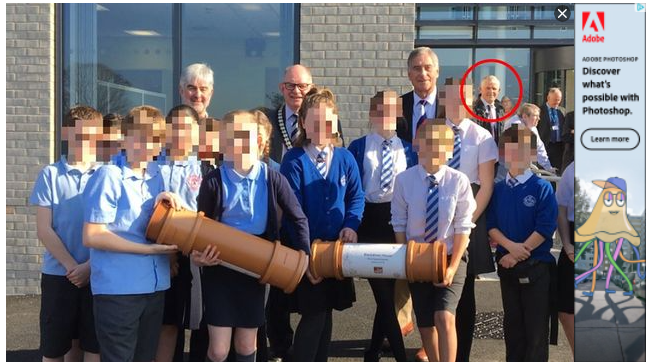
Photo shows John Humphreys with children while being investigated for sex offences www.exmouthjournal.co.uk (Extract)

John Humphreys can be seen in the background of this photo showing children at the opening of Blackdown House, EDDC’s new premises – East Devon District Council

One photograph, taken at the selection meeting for the East Devon Conservative candidate for the 2019 election, is on the East Devon Conservative website. It shows John Humphreys as one of the main placard holders. The meeting took place at Exmouth Community College on a day the school was closed. 

At an East Devon District Council cabinet meeting on Wednesday, May 4, leader Cllr Paul Arnott said: “Surely a condition of his bail was that he must not be allowed to enter a school premises, amongst other restrictions regarding access to places connected with young people.”   

He asked the chair of the Conservative group in East Devon, Cllr Bruce De Saram (Exmouth Littleham) to explain the image. 

Cllr De Saram said he had no comments on the matter.

Simon Jupp and Conservative councillors categorically deny any knowledge of Mr Humphreys’ crimes whilst he was in office or when he was given his honorary title of alderman by the council in December that year. The title was removed by the council in 2021. 

Separately, in March 2019, whilst under investigation, John Humphreys was pictured with children from Littletown Academy at the opening of East Devon council’s new offices (see above). 

Asked why Humphreys was allowed to attend these events while being investigated on suspicion of sexually assaulting teenage boys, a spokesperson for Devon and Cornwall Police said: “A long and thorough police investigation resulted in John Humphreys being convicted and jailed for a total of 21 years at Exeter Crown Court in August 2021.  

“The circumstances of this case and Humphreys’ offences were heard in public by the court during the trial which was widely reported at the time.   

“No further suspects were identified within the police investigation.  

“The conviction was only possible thanks to the tenacity, patience and strength of the victims who put their trust in our officers investigating these matters. 

“In 2019, the case was progressing with the police and CPS to bring the case to court. It would not be appropriate to comment on further speculation.” 

Power of protest is a winner

John Curtice writes this analysis in the Times:

In 2015, David Cameron nearly strangled his Liberal Democrat coalition partners to death, capturing no less than 27 of their seats (John Curtice writes). It was a calamity from which the Liberal Democrats have struggled to recover. But now, it seems, they may pose a threat to the Conservatives once more.

The Liberal Democrat performance on Thursday was not quite unprecedented. The party’s vote was at least as high in 2019. However, that ballot took place in particularly propitious circumstances. Theresa May was struggling to get her party to back her Brexit deal, and some voters who opposed Brexit were attracted by the Liberal Democrats’ promise of a second referendum.

However, apart from that occasion, this was the party’s best local election performance since it made the fateful decision in 2010 to enter government with the Tories.

This advance has had no discernible connection with Brexit. It was just as strong in heavily pro-Leave wards as it was in the most pro-Remain. This suggests that the Liberal Democrats are recovering their mantle as the principal party of protest, a development that means it can win in pro-Leave parts of Britain once more — as illustrated by its success in winning control of Somerset.

There was a pattern to the party’s performance, however, and it is one that will especially concern Tory MPs.

First, the Liberal Democrat vote rose most in the more rural parts of the south and Midlands of England outside London — that is, in prime Tory territory. Second, Liberal Democrat support rose particularly strongly (by as much as nine points) in those wards where the party started off in second place to the Conservatives. Although anti-Tory tactical voting by former Labour voters was partly responsible for this pattern, these were also the kinds of places where the Conservative vote fell most heavily. It looks as though the Liberal Democrats feasted especially well on the apparent discontent of many a traditional Conservative voter.

There are 69 parliamentary seats in the south and the Midlands outside London where the Liberal Democrats were second to the Conservatives in 2019. Although in many of these the local Conservative MP has a large majority, they have been served notice that their seat may not be so safe at all.

In 2019, Boris Johnson could win by focusing his fire on Jeremy Corbyn’s Labour party. Next time his party may well need a strategy to deal with the Liberal Democrats too.

John Curtice is professor of politics Strathclyde University, and senior research fellow, NatCen Social Research and The UK in a Changing Europe

Correspondent adds a postscript to “Open letter to my MP”

Dear Simon,

It has been drawn to my attention that there are many items that the residents of East Devon would like to add to my list of 5 May 2022 in order for you to act.

The alternative route to the M5 into the peninsula is the A303. The same old bottlenecks have existed for years and years. Can you not pressure urgently, please, for this to be a functioning road fit for 2022?

Mr. Gove has been reported as being disturbed by Natural England’s advice that in many rivers new developments should be “nutrient neutral”. Effectively putting the brakes on any new properties in the area. One of the rivers affected is the River Axe in the Tiverton and Honiton constituency. Will the Clyst and Otter be next? Waiving the nutrient neutral objective would be a cop out.

I hope that you regret your vote to reject the Lord’s amendment that would have placed legal duties on the water companies to reduce sewage discharges in our rivers.

Have you followed up on the EDDC scrutiny committee earlier in the year when they called South West Water to explain? At the meeting it was revealed there were 42,000 raw discharges into Devon’s rivers and coastal areas in 2020. South West Water pleaded poverty and told East Devon residents to “do their bit” to prevent sewage overflows into rivers and seas, despite making huge profits.

In 2020 the river Otter had 90 discharges from Newton Poppleford and 137 from Honiton, on average two to three times a week. This into a river which has seen the return of otters and beavers and empties into a popular bathing bay. All the other rivers in your constituency suffer from the same problems.

Let’s not forget Exmouth’s sewage overflow. At Straight Point the Maer Lane Sewage works discharged, in 2020, 850 hours from 59 episodes. To this now must be added 303 houses at Goodmores Farm. Should Exmouth, like Axminster, be adding any more development? 

As Mr. Parish has resigned it is now your task to fight for the missing £1.6 million the government promised they would help the council with two years ago if LED was kept running through the pandemic. This is council taxpayer’s money we cannot afford to lose.

Finally, I wonder if the fact that Topsham has voted a LABOUR councillor to represent the ward on the Exeter City Council seems a trifling upsetting. I wonder why this has happened. Surely not all “partygate” ? Perhaps it is your government’s punitive target for house building which has resulted in ribbon development effectively joining Topsham with Exeter? Food for thought.

Planning applications validated by EDDC for week beginning 25 April

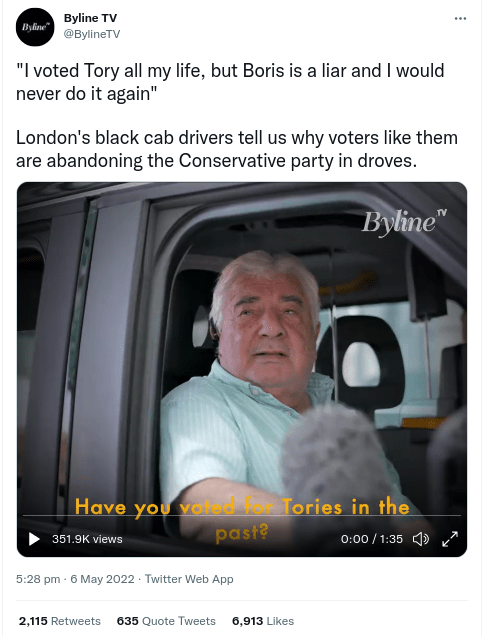
Verdict of the Black Cab Drivers

London’s black cab drivers tell us why voters like them are abandoning the Conservative party in droves. One gives a brutally honest three word description of Boris Johnson (FUW)

Listen here.

Boris Johnson sighed in relief – then the message from UK local elections took hold

…..The Lib Dems have already started campaigning in Tiverton and Honiton, where a byelection will be held next month after the resignation of Tory MP Neil Parish, who admitted looking at porn in parliament.

www.theguardian.com (Extract)

The constituency includes the prosperous Devon town of Cullompton, normally safe Conservative territory. There, lifelong Conservative voter Tim Cox said he was considering voting for a different party for the first time. “It’s just the general behaviour of the Conservative party. It’s pretty shocking – it’s appalling,” he said, pausing on the high street. “Johnson lied. It’s the bare-faced lies he’s told. It’s all about personal character to me, whether you are believable or credible as a leader of the country. There are a few of them in the cabinet, including Johnson, who just aren’t.”

There seems to be some desire for change in the constituency, which has been staunchly Conservative since its creation in 1997. Ryan Lacey-Mills, 34, who works in car sales, voted for Johnson in 2019 but now felt the PM was a spent force. He is also weighing up the offer from other parties. “[Johnson] has had his time. He did Brexit,” he said. “Whether it is his fault or not, something needs a shakeup. It’s time for a change.”

Even those still planning to vote Conservative struggle to summon up much enthusiasm. Steven Morris, 69, believes Johnson will have to go eventually. He can’t forgive the parties that took place in No 10 when the country was in lockdown. “I’ve got asthma. I was actually locked up for two months when it all kicked off – and to think they were having parties really upsets me,” he says, cradling a wrapped portion of fish and chips. “I always thought the Conservatives had got standards, but Boris hasn’t got any.”

As they eye Tiverton and Honiton, the Lib Dems have their blood up. Johnson may be able to soldier on after Thursday’s local elections but whether he could survive a byelection defeat in a safe seat in a few weeks time is another matter entirely.

Levelling up just got tougher, says Michael Gove

Looks to Owl as if it is/was nothing more than a slogan.

Rising prices are making the government’s plans to reduce regional inequalities more difficult and more important, says Michael Gove, the cabinet minister for levelling up.

BBC Panorama www.bbc.co.uk

The goal of levelling up is to provide equal opportunities across the UK.

A BBC Panorama investigation raises questions about whether the money is reaching the most deprived areas in England.

Mr Gove said his department was helping councils to ensure bids are effective.

Levelling up was a key part of the Conservatives’ 2019 election campaign.

The government recently set out its 12 “missions” for the policy – ranging from improving education to faster broadband capability to local transport – with a deadline for delivery in 2030.

“Unless we stick to those missions, then the cost of living issues that we face at the moment will deepen inequality,” said Mr Gove.

Labour’s Lisa Nandy, the Shadow Levelling Up Secretary, said the government should begin by getting inflation under control. “By their own admission, their mismanagement of the economy is going to make levelling up harder,” she told the BBC.

For the first round of the so-called Levelling Up Fund, £1.7bn has been allocated to towns and cities across the UK.

When Panorama sent freedom-of-information requests to councils in the 100 most deprived areas in England, it found that 28 councils had all their bids rejected. This included 18 areas that were on the government’s top priority list, including Knowsley and Blackpool.

Meanwhile, 38 councils won all, or some, of the money they requested, and 34 councils did not submit a bid in this round.

Map showing outcome of Levelling up fund bids in 100 most deprived local authorities

A second round for the fund will open for applications at the end of May.

Former government economist Nicola Headlam said asking councils to bid against each other was not the right approach. “A beauty contest around who gets the money, that’s not really how I would do it,” she said. She also said that affluent places could have more resources to write better proposals.

Mr Gove said his department was deploying levelling up directors, who live in the relevant areas, to assist with bids.

Data methodology: Data gathered under Freedom of Information requests to lower tier local authorities. We have excluded any bids made at a county council or combined authority level as these had more limited eligibility criteria for the Levelling Up Fund. We used the Index of Multiple Deprivation 2019 ‘rank of average ran’ summary measure. Corby has been excluded due to boundary changes, so we included the 101st-ranked local authority Nuneaton and Bedworth.

Second home owners face doubling of council tax

The Government will be giving local authorities the power to double council tax on second homes in plans due to be announced in next week’s Queen’s Speech. The new council tax rules for second and empty homes will be introduced as part of the UK Government’s commitment to invest in local communities and drive levelling up across the country.

Maxine Denton www.devonlive.com

In Devon alone, figures presented to Devon County Council’s cabinet earlier this month showed that there were more than 11,000 homes classed as second homes. It also revealed that in October, there were 640 homes in Devon that were being charged the Empty Homes Premium as they had been empty for more than two years – 46 of them in the South Hams and 33 in West Devon.

Under the new rules, English local authorities will gain ‘discretionary powers’ to levy a premium of up to 100 per cent on council tax bills for second homes that are furnished but not occupied as a sole or main residence. As well as supporting and improving services, this extra funding could be used to help ensure council tax is kept low for local residents.

Other homes simply left empty could also see the standard council tax rate doubled after 12 months – as opposed to two years at present. It is thought that the move will discourage owners from leaving properties vacant for a long time, while injecting money back into local areas.

In addition to having the power to apply greater premiums at a level of their choice, Local Authorities will have flexibility on how to spend the funds raised and can decide to prioritise keeping council tax bills low for local households. This will help with plans to deliver affordable housing, social care and children’s services.

Both West Devon and South Hams councils have declared housing a crisis. Due to a number of factors, including the lack of rented accommodation which is available for longer than six months, an excessive rise in house prices due to second home-owners, the conversion of properties to Airbnb’s and people moving into the District since the pandemic. South Hams District Council last Autumn said it has no choice but to declare a Housing Crisis.

West Devon councillors in February heard that house prices in the borough are the least affordable in Devon with average housing costs at over 12 times the average salary. An almost complete lack of long term rented accommodation was highlighted as one of the leading problems contributing to the crisis alongside the increasing trend for people to move to the area from urban locations.

Two donors who gave Tories £1m between them handed public health jobs

Two businessmen who together donated more than £1m to the Conservative party have been handed prominent public health jobs, igniting a new “cronyism” row.

Aubrey Allegretti www.theguardian.com 

After the government came under criticism for its awarding of Covid contracts, including a “VIP lane” for suppliers, Labour raised fresh questions about recent appointments to NHS England and the UK Health Security Agency (UKHSA).

One of those given a senior public health advisory role was chair of a firm that reportedly sued the NHS for hundreds of millions of pounds over a failed IT project.

There is no suggestion that improper recruitment processes were followed. But the health secretary, Sajid Javid, was urged to ensure there would be no conflicts of interest.

In March, Oluwole Kolade was made a non-executive director and deputy chair of NHS England for three years. In just over a decade, Kolade has donated £859,342 to Conservative party headquarters; the party’s London mayoral candidate in 2021, Shaun Bailey; and the party’s branch in Hitchin and Harpenden. About a third of the donations – £300,000 – have been made since Boris Johnson became prime minister.

The government’s public appointments website said the appointing department was Javid’s and added: “Kolade has made a donation to the Conservative party.”

Kolade is a managing partner of Livingbridge, a private equity firm with extensive investments in private healthcare. On its website the company said it “has made a private equity investment in the healthcare and education sector in almost every single year for the past two decades”. Livingbridge’s portfolio includes multiple NHS suppliers, and private dental companies, care providers and fertility firms.

Andrew Gwynne, the shadow health minister, said the appointment looked like “naked Conservative cronyism” and urged against the NHS being “placed in the hands of the highest bidder”. He called on Javid to “come clean about what guarantees he secured that this position won’t be used to benefit private interests over public health”.

Another prolific donor, Simon Blagden, was made a member of the UKHSA advisory board in April. Since 2005, Blagden and companies he is associated with have donated £376,000 to the Conservatives. These include Pietas Ltd, a firm he was director of from 2000 to 2020, and Avre Partnership Limited, which he has been director of since 2014.

He was also a chairman of Fujitsu UK, which sued the NHS over a failed IT project. A parliamentary committee’s inquiry into the debacle in 2013 cited reports that a sum of £700m was sought from the Department of Health.

Blagden already holds a role in government – as chair of its telecoms supply chain diversification advisory council at the Department for Digital, Culture, Media and Sport – and in 2016 was awarded a CBE for services to the economy.

Labour said that “yet again, the Tories have appointed one of their own to a crucial public role”.

A spokesperson for the Department of Health and Social Care said: “Political activity is not a bar to holding a public appointment. In line with the requirements of the code of governance for public appointments, if someone has been politically active and has made donations, the government declares this when the appointment is announced.

“Wol Kolade was appointed by ministers in 2018 as a non-executive director on the board of NHS Improvement – he declared he had made donations to the Conservative party and the department declared this when he was first appointed and again when he was reappointed this year.”

A UKHSA spokesperson said: “All members of our advisory board have been appointed in line with government protocols and will provide vital impartial oversight and advice to help UKHSA deliver its strategic objectives.”

Kolade and his company Livingbridge were contacted for comment. Blagden was contacted for comment through Larkspur International, where he is a director.