Whitby turns tide on second-home owners

The people of Whitby have voted overwhelmingly to limit the sale of second homes in the Yorkshire seaside town, making it the latest tourist hotspot to turn the tide on holidaymakers pricing out local people.

Tom Ball www.thetimes.co.uk 

A parish poll held on Monday night asked locals if they wanted new [homes] to be reserved for locals, to which 93 per cent voted in favour.

Of the 2,228 ballots cast, 157 voted against and 18 ballots were rejected.

One in five properties in the town where Bram Stoker’s Dracula is set, are second homes or holiday lets, according to Scarborough borough council.

That proportion has more than doubled in the past two decades.

People say that the rise in second-home ownership has meant that locals cannot afford to buy in their home town.

Last year house prices rose by 17 per cent and the average asking price is £254,218, according to Rightmove.

This is the second highest price increase of any coastal town, beaten only by Padstow in Cornwall where they jumped 20 per cent.

Anthony George, 25, said that the vote was an expression of “pent-up frustration” against a situation that had led to many young people having to leave Whitby.

“If you want to buy a house these days in Whitby, on a Whitby salary, good luck to you,” said George, an apprentice chef. The average salary in the town is £18,900.

“As it stands, I’m going to have to rent for the rest of my life if I want to stay, or move 20 miles inland.”

Whitby attracts more than 150,000 visitors each year, many of whom come to visit the ruins of the Benedictine abbey above the town.

The poll is the latest sign of unrest in tourist hotspots as local families struggle to match the prices paid by those wanting second homes by the sea.

Residents of St Ives, Fowey and Mevagissey – all in Cornwall – have previously voted to limit sales of new builds to permanent residents.

Last week Tim Farron, MP for South Lakes, urged the government to consider giving local authorities the power to limit second home ownership.

During a debate in parliament on the Levelling Up Bill, Farron said that excessive second home ownership had led to the prospect of buying or even renting a house becoming a “pipe dream” for people in rural areas such as his constituency in Cumbria.

The Whitby poll, which had a turnout of 24 per cent, is not legally binding but organisers hope it will influence planning decisions.

Linda Wild, the mayor of Whitby, called on the borough council and the government to amend planning regulations to make it possible to protect local housing for primary residence.

“We need a ‘use class’ which applies to holiday lets,” she said. “Then the planners can manage that change of use. We also need to tax second homes and holiday homes more effectively through council tax and business rates to reflect the impact they have on local people.

“Whitby is not unique in this predicament and local people want their voice heard by government alongside people from Cornwall, North Norfolk, Northumberland and the Lakes. We absolutely need government to give local people the power to keep holiday resort communities sustainable.”

A spokesman for Scarborough borough council said: “The outcome of the poll is no more and no less than an expression of the views of the electorate of the parish who have voted in the poll and is not binding on any organisation.”

Lib Dems say they trail only narrowly in Tiverton and Honiton race

The Liberal Democrats plan to flood Tiverton and Honiton with activists after internal polling suggested the party was only marginally trailing the Conservatives before next week’s byelection in the Devon constituency.

Peter Walker www.theguardian.com 

A sample carried out by the party, based on tens of thousands of voter contacts, suggested that of people intending to vote on the day of the byelection, the Conservatives had 46% support and the Lib Dems 44%.

The party said it had a four-point deficit at the same point before December’s byelection in North Shropshire, which it won.

Victory for the Lib Dems in Tiverton and Honiton requires overturning a Conservative majority of 24,239, which the party says would be the biggest such margin ever overcome in a byelection, although other races have seen bigger swings in percentage terms.

If the polling figures are accurate they suggest that an unspoken accord between the Lib Dems and Labour to focus resources on one each of the two byelections taking place next Thursday could result in a double defeat for Boris Johnson.

Labour has concentrated efforts in Wakefield, where it appears to be well ahead. The Lib Dem figures suggest support for Labour in Tiverton and Honiton, where it has tried less hard, has shrunk to 6%.

Labour finished ahead of the Lib Dems in Tiverton and Honiton in 2019, and activists vigorously dispute the idea they are badly lagging there this time, saying recent council seat gains indicate they will again outperform the Lib Dems.

While the Lib Dems have triumphed in two previously strongly Tory seats in the last year, starting with a byelection win in Chesham and Amersham, party officials put their chances in the Devon seat at no better than 50-50.

The Conservatives have campaigned hard in Tiverton and Honiton, with Johnson among a series of senior figures to visit. Lib Dem canvassers report worries that some former Tory voters, while disaffected over issues such as Downing Street parties and complaints that the government has neglected the area, could simply stay at home rather than transfer their support.

The Lib Dems have issued a call for MPs, peers and activists to head to the constituency immediately to help with canvassing, with officials saying travel plans need to be made because of next week’s national rail strikes.

A party source said: “The momentum is definitely with the Liberal Democrats in Tiverton and Honiton, but it is not by any means over the line. If we get an army of activists knocking on doors this weekend, we can do it. Whatever happens it’s going to be a very close-run thing.”

The byelection was prompted by the resignation of Neil Parish, the Tory MP since 2010, after he admitted watching pornography on his phone in the Commons.

The vote in Wakefield is taking place after Imran Ahmad Khan, who took the previously Labour seat for the Conservatives in 2019, resigned after being found guilty of sexually assaulting a 15-year-old boy.

Thousands of East Devon homes could be abandoned by 2050s: Report

Professor Jim Hall, Professor of Climate and Environmental Risks and former Director of the Environmental Change Institute at the University of Oxford, said: “We need to have honest conversations with coastal communities that it will simply not be possible to protect every house and business from sea level rise.

Paul Jones www.sidmouthherald.co.uk 

Nearly 200,000 homes are at risk of being abandoned by the 2050s – and East Devon is on the list of affected areas, according to new research.

The district – which includes Sidmouth, Exmouth, Lyme Regis and Seaton – features in the top 20 places which would be hardest hit should water levels rise by around 35cm in the next 28 years, as forecasts warn.

According to new research published in the peer-reviewed journal Oceans and Coastal Management, sea level rises caused by climate change are putting nearly 200,000 English properties at risk of being abandoned by the 2050s.

The study was led by Paul Sayers, an expert on flood and coastal risks who works with the Tyndall Centre at University of East Anglia and advises the Climate Change Committee (CCC).

It concluded mean sea levels around England will be around 35cm higher by 2050 than their historical level and will continue to rise as increasing global temperatures, due to greenhouse gas emissions, melts glaciers and ice caps and causes ocean waters to expand as they warm.

In addition, foreshores are at risk of being eroded, which can further deepen the water at the coast leading to larger waves reaching the shore. 

The combination of sea-level rise and larger waves will greatly increase the number of properties at risk of flooding.

Investment in improved sea walls and other defences will protect many of the properties at risk, but this will not be affordable or possible everywhere. 

For the first time, the new study calculates how many English properties will be threatened with coastal flooding but where the costs of improving defences may be too high or technically impossible for the government to continue to protect communities, given current funding regimes.

The researchers found that, by the 2050s, 120,000-160,000 properties along the English coast are at risk of relocation due to sea level rise, in addition to 30-35,000 properties that had already been identified as at risk from sea level rise. 

This means the number of properties at risk is five times higher than suggested within current shoreline planning documents, and many communities that face an uncertain future haven’t yet been identified. 

In 2018, the CCC identified 100,000 properties that would be at risk from sliding into the sea due to coastal erosion – meaning around 300,000 properties are at risk from sea level rise and coastal erosion. 

This analysis found that around 30% of local authority assessments, known as Shoreline Management Plans, which recommend ‘Hold-the-Line’ in the longer term – implying that sea defences will be built and maintained along the shoreline – may be unrealistic as sea levels rise due to cost or feasibility constraints, covering 1,700km of the English coast. 

When will homes start to be lost?

In March 2020, 41% of mortgages had terms longer than 25 years and the median first-time buyer mortgage now lasts for 30 years. 

Many people may be buying houses or paying off mortgages on properties which will not be habitable or will be within a few years of being abandoned by the end of the mortgage term. 

Most people who are likely to be in this situation will be unaware of it and there is currently no government scheme to help them. 

Which local authorities have the most properties at risk? 

A total of 20 local authorities have 2,000 or more (some with tens of thousands) at risk of being lost to sea level rise including (ranked in order from most numbers of properties to fewest): 

1. North Somerset

2. Sedgemoor

3. Eastbourne

4. Wyre

5. North East Lincolnshire

6. Warrington

7. Swale

8. Dover

9. Portsmouth

10. Tendring

11. Ipswich

12. Gloucester

13. Bristol City

14. Maldon

15. Adur

16. Cornwall

17. East Devon

18. East Lindsey

19. East Suffolk

20. West Lancashire

Decisions on precisely which, and how many, of these properties and communities will have to move will depend on government policy, the research concluded.

Since sea level rise responds relatively slowly to changes in global temperatures these risks in the 2050s are now almost inevitable, even if emissions are now cut rapidly, it said.

But faster emission cuts will greatly reduce the amount of sea level rise later this century and beyond.

Lead author Mr Sayers said: “Significant sea level rise is now inevitable. For many of our larger cities at the coast protection will continue to be provided, but for some coastal communities this may not be possible.  

“We need a serious national debate about the scale of the threat to these communities and what represents a fair and sustainable response, including how to help people to relocate.”

How can we transition to stop this?

The study argues that England faces “a transformational challenge” but that there is a “lack of clarity as to how this transition will be made, particularly when it would impact communities”. 

A new round of updates to local authority plans, which is happening now, is an opportunity to promote a more open discourse including where it is necessary to discuss relocation, according to the study. 

It warns that postponing hard choices has consequences including “further (inappropriate) development [on flood plains]” or unfairly propagating “the belief that protection will continue in the long term”. 

The study assessed a number of factors to determine the likely pressure for relocation including the type of settlement and landscape, the existing local authority plan, the economic case for continuing to protect properties, and shoreline vulnerability. 

Large towns and cities are assumed to warrant Hold-the-Line protection while small communities are more vulnerable. 

The economic case was assessed on a cost-benefit analysis using a lower cost-benefit ratio than is usually used to calculate whether projects should attract central government support, meaning the study potentially underestimates the number of properties at risk. 

The combination of sea level rise and seabed erosion means that it will not be technically feasible to defend some areas, regardless of the question of cost, the report adds. 

The types of areas most at risk from sea level rise

They include: 

Single communities: For example, Fairbourne in Wales, which is already due to be abandoned to sea level rise.

These communities contain a large number of properties (Fairbourne has a population of 700 people) but the complexity of the shoreline and floodplain means that the cost of maintaining defences is so large that it can’t be justified. 

Communities containing dispersed clusters of properties on a long floodplain: For example, the Somerset Levels, East coast and North West.

A narrow floodplain, with properties on, constrained between the shoreline and raising ground, e.g. Dawlish (Dawlish is being protected but other places like this may not be so lucky) – often roads and railways run along these areas 

Small quay and coastal harbours communities: For example, quays across Cornwall – low lying properties squeezed between a rising ground and harbour quay walls 

Professor Jim Hall, Professor of Climate and Environmental Risks and former Director of the Environmental Change Institute at the University of Oxford, said: “We need to have honest conversations with coastal communities that it will simply not be possible to protect every house and business from sea level rise.

“These changes are coming sooner than we might think and we need to plan now for how we can adjust, including a nationwide strategic approach to deciding how to manage the coast sustainably in the future.”

Meanwhile latest news from the Beauty Salon

The Conservative Party candidate in the Tiverton and Honiton by-election has been accused of “trying to erase” Boris Johnson from her campaign because he is seen as “toxic” to her hopes of retaining the traditionally safe Tory seat.

Tory candidate in Tiverton by-election accused of ‘trying to erase’ meeting with Boris Johnson

By David Parsley inews.co.uk 

Mr Johnson visited the constituency last Friday to support his candidate Helen Hurford just hours after Chancellor Rishi Sunak had been in Devon to back her.

However, while the former headteacher turned beauty salon owner published a video of herself with Mr Sunak, she has not publicised the visit of the Prime Minister on any of her campaign social media sites or flyers.

Residents and rivals claim she sees Mr Johnson as a vote loser following Partygate and the parliamentary investigation into whether he lied over the lockdown-breaking activities of Downing Street during the Covid-19 crisis.

Following last week’s victory for the Prime Minister in the confidence vote by MPs, Ms Hurford, who is defending a Tory majority of more than 24,000, told i she would have supported Mr Johnson had she already been an MP.

She said: “If I was an MP at that time, I would have voted in favour of Boris because we need a leader that makes the big calls. He’s made the right decisions on those big calls.”

Last Saturday, Ms Hurford added that she considered Mr Johnson as “an asset” to her campaign, and that she would post a picture with him on her campaign sites in the coming days.

She said: “Yeah, it will go on. Perhaps Rishi may have felt that he would have been overshadowed.”

However, four days on since Ms Hurford told i that she would promote the Prime Minister’s support for her, she has failed to do so.

Instead, Ms Hurford has posted pictures of a visit by Levelling Up Secretary Michael Gove on Saturday, and one from employment minister Mims Davies on Monday.

As well as Mr Sunak, she has also posted pictures and videos of herself with the Tory party’s co-chairman Oliver Dowden, Deputy Prime Minister Dominic Raab, and tourism minister Nigel Huddleston.

She is yet to promote last week’s visit of the Prime Minister in her campaign literature.

The official Twitter account for Tiverton and Honiton Conservative Party features pictures of Mr Gove, Mr Dowden and Mr Raab, but has avoided making any reference to the Prime Minister’s visit to the constituency so far. Ms Hurford does not have a Twitter account.

Ms Hurford’s main opponent claimed her campaign was avoiding any mention of Mr Johnson as he was a “vote loser on the doorsteps”.

Liberal Democrat candidate Richard Foord said: “There’s clearly been some hand-wringing in the local Conservative campaign about how to deploy Boris Johnson. Their conclusion was not at all, but they had no choice to but to accept the invitation that the Prime Minister made to himself to visit her in the constituency.

“I think he rather forced himself upon them. This is how I would read it. They’re trying to erase him from their campaign.”

Mark Field, a lifelong Conservative voter in Axminster, said he would not be voting for the Tories again until Mr Johnson was replaced as leader of the party.

“I didn’t even know he’d been in the constituency,” he said. “They snuck him in and out under our noses, didn’t they. And no wonder, he’d only get booed if he walked through Axminster. Even by many of us who voted for us last time. No wonder she’s hiding the fact that she met him. He’s toxic to her campaign.”

Ahead of Mr Johnson photo opportunity with Ms Hurford, he received a mixture of cheers and boos during a surprise visit to the Royal Cornwall Show.

Ms Hurford has been approached for comment.

The by-election was triggered by the resignation of Tory MP Neil Parish after he admitted watching porn in the House of Commons on his mobile phone.

Demand for new UK homes still outstrips supply, say building firms

“Overall, build cost inflation has been offset by house price gains and we expect this trend to continue.”

The average selling price of a Bellway home is expected to exceed £305,000 this year.

What a surprise – Owl

Julia Kollewe www.theguardian.com 

Bellway and Crest Nicholson, two of Britain’s biggest housebuilders, have said demand for new houses continues to outstrip supply, pushing up prices and offsetting the rising cost of building materials and energy.

Bellway posted strong sales for the four months from 1 February to 5 June, when house reservations averaged 253 a week, compared with 239 in the same period last year.

The company expects to complete more than 11,110 homes in the year to the end of July, a 10% rise from last year. Material shortages are starting to ease, although bottlenecks remain at regional level, affecting bricks, blocks and roof tiles in particular.

Jason Honeyman, the Bellway chief executive, said: “Demand is strong, reservations are ahead of last year and our order book remains substantial.

“Overall, build cost inflation has been offset by house price gains and we expect this trend to continue.”

The average selling price of a Bellway home is expected to exceed £305,000 this year.

There are some signs that the housing market is starting to cool amid the worsening cost of living crisis. Halifax, one of the UK’s biggest mortgage lenders, last week reported that annual house price growth had slowed but remained in double digits.

Crest Nicholson said it built 1,096 homes in the six months to 30 April, up nearly 8% from the same period last year. It made an adjusted profit before tax of £52.5m, up from £36.1m, and raised its full-year forecast to between £135m and £140m.

Peter Truscott, the Crest chief executive, said: “No one in the construction sector is immune from the current impacts of input cost inflation. However, we are managing to successfully offset this with sales price inflation in a market with strong demand and relatively poor levels of supply. Finally, the tapering off of Help to Buy, which is due to end in April 2023, has had no measurable impact on our sales rate to date.”

He said Crest’s developments were often in areas that are benefiting from the rise in home working since the Covid-19 pandemic. “We continue to see this rationale being cited by customers in their reasons for moving home,” he added. The firm is opening three new divisions, the first two in Yorkshire and East Anglia.

Bellway said the government’s help-to-buy scheme was used by customers in 16% of house purchases, compared with 22% last year and 39% in 2020. It is mostly being used for apartments in and around London, but Bellway has been building fewer apartment blocks in recent years. At the same time, it said the availability of higher loan-to-value mortgage loans was “gradually improving”, allowing people to buy with smaller deposits.

More than 35 homebuilders agreed in April to pay £2bn towards fixing unsafe cladding on high-rise buildings in England after the 2017 Grenfell Tower fire, but a further £3bn is needed. Michael Gove, the housing secretary, said the further £3bn would be raised by an extension to the building safety levy, forcing industry to pay for the remedial work on buildings where the developer cannot be traced or forced to pay up.

Bellway said it had set aside £187m since 2017 to cover cladding work to apartment buildings more than 11 metres in height, and in April it pledged to cover buildings constructed since April 1992, which will cost a further £300m. It has appointed a managing director to lead its new building safety division to oversee the work.

Crest took a £48m charge related to cladding work on buildings taller than 18 metres last October, and said it recognised the “significant distress caused to residents”. When it signed the pledge in April to carry out work on all buildings more than 11m tall, it took a further £105m charge. With regards to fixing “orphaned” tower blocks, Crest said it would not pay towards any buildings it had not constructed.

When will the bottom of the barrel be scraped no further? Only the Tory party can decide

On the news round:

” … Johnson was dialling in from a farm just over the Devon border, where he was campaigning and simultaneously hiding over the weekend in the run-up to a by-election in one of the safest Tory seats in the country, which he looks set to lose after one of his MPs was caught watching porn in the House of Commons chamber. 

If he loses that, it could be the end of him, but it’s not up to us. Only the Tory party gets to decide when the bottom of the barrel can be scraped no further, and you wouldn’t like to bet how far down the U-bend they’re prepared to follow their leader. …”

www.independent.co.uk  (extract)

As by-election gets closer, expectation management grows

A couple of contrasting articles published in the past few days caught Owl’s eye:

Tory gloom deepens as Lib Dem poll rating spikes before crucial Tiverton and Honiton by-election

www.dailymail.co.uk (extract)

….Tory gloom around losing the upcoming Tiverton and Honiton by-election next week will have deepened after a new poll showed support for the Liberal Democrats spiking.

With nine days to go until voters head to the polls in the Devon constituency, there is a growing expectation that the Conservatives will lose a seat they have held ever since it was created in 1997.

The Lib Dems are eyeing a hat-trick of by-election victories after their recent successes in Amersham and Chesham, and North Shropshire.

Their hopes will have been boosted by a Redfield and Wilton Strategies survey, which revealed the Lib Dems have climbed to 15 per cent support in a poll of national voting intention.

This is two percentage points higher than last week’s poll.

A downbeat Conservative source told MailOnline that punters shouldn’t be betting against bookies, who have installed the Lib Dems as favourites in Tiverton and Honiton.

Meanwhile, a separate poll revealed that more than two in five (43 per cent) of rural Conservative voters – such as those found in the Devon constituency – thought the party took rural communities for granted…

….Lib Dem leader Sir Ed Davey said: ‘This Conservative Government simply doesn’t care about rural parts of the country.

‘Conservative MPs and candidates ignore these communities at their peril.

‘There is a growing revolt at a Conservative Party which allows rural health services to be cut to the bone and fails to save people from the cost of living crisis.

‘Rural areas are being hardest hit by this financial crisis as petrol prices spiral and no help is given for those relying on heating oil.’

Are the Lib Dems in danger of being over-hyped (again)? – UK in a changing Europe

Chris Butler ukandeu.ac.uk Lecturer in Politics at the University of Manchester and a former Campaigns Staffer for the Liberal Democrats between 2007 and 2015. (extract)

The Liberal Democrats’ short betting odds in Tiverton and Honiton seem to be based on two heuristics. Firstly, that the Liberal Democrats are traditionally strong in South West England. Second, that the Lib Dems are proving to be electorally successful in rural areas as evidenced by their sensational by-election victory in North Shropshire last year.

Let’s deal with these two points in turn. Whilst the South West of England was indeed a strong area for the Liberal Democrats between 1997 and 2010, since nailing their flag to the mast over Brexit the basis of Liberal Democrat support has migrated to affluent well-educated areas in the Home Counties.

In Cornwall, where the Liberal Democrats won all six Parliamentary seats in 2005, the party now holds just 13 of 87 seats on the unitary authority and only came second in two of the parliamentary seats in 2019.

Of course, last autumn’s sensational victory in North Shropshire showed that the party did have the potential to win in leave-voting Leave areas and it is this that has primarily led to the expectation of Liberal Democrat victory in Tiverton and Honiton.

The potential for Conservative defeat is aided by the tacit electoral alliance of Labour and the Liberal Democrats acting as a pincer movement on the governing party with the former focusing on Wakefield and the latter on the Devon seat. Issues over payments to farmers and ambulance waiting times provide fruitful issues for the Liberal Democrats to campaign on.

But the party’s success in North Shropshire was also helped by the Conservatives’ complacency. They clearly under-estimated the Liberal Democrats’ potential to win in rural leave-voting areas and lazily selected a ‘lawyer from Birmingham’; a mistake they haven’t repeated this time around….

……..To win in Tiverton and Honiton the Liberal Democrats would require a 22.8% swing, smaller than what they achieved in last year’s by-elections in Chesham and Amersham and North Shropshire but still a tall order. There is a possibility that if the Liberal Democrats pull off an enormous swing, but one not quite enough to win, this will change the narrative for Boris Johnson, given how much Conservative defeat in Tiverton & Honiton is assumed by commentators……

…..The perennial problem for the Liberal Democrats in trying to gain multiple parliamentary seats at an election is simply one of capacity. Unlike the larger parties, Liberal Democrat parliamentary success relies disproportionately on a strong local ground campaign to overcome problems of credibility.

To encourage tactical and switch voting Liberal Democrats need to convince voters that they can win in their area and they achieve this through a strong poster campaign, personal contact with voters and an emphasis on the local context. This requires boots on the ground and is much more difficult to scale up than the Conservatives’ usual tactic of national direct mail and social media advertising.

Focusing on the local context also means that the party’s most effective messages are covered by the more restrictive constituency spending limits. Whereas parties such as the Conservatives who wish to focus on a national message are able to take advantage of the far more generous national campaign spending limit……

“Bust up at top” – Paul Arnott responds

Owl reported the original story, East Devon Council bust up at top, and two comments: a correspondent on bust up at top and bust up at top the context speaks volumes

Now Paul Arnott responds, within the limits imposed by the need, under “Part B” confidentiality, to protect a former employee.

This raises the questions again about who broke confidentiality and leaked the original story, and why? – Owl

East Devon leader responds to critical report

Radio Exe News www.radioexe.co.uk 

East Devon District Council’s leader has responded to criticisms in a Radio Exe article, based on an independent report commissioned by the council about the circumstances relating to the redundancy of a member of staff.

Cllr Paul Arnott, who leads the council as part of the Democratic Alliance, last week joined the Liberal Democrats nationally in order to throw his support behind its candidate for the Tiverton & Honiton by-election Richard Foord.

The report was highly critical of issues which arose after the current administration took over from the Conservatives. As part of its conclusions, it said” It cannot be stated strongly enough the damage that has been done to the council, its reputation, its officers and members and its ability to reach its potential.”

Mr Arnott has politely asked to respond to the content of Radio Exe’s article, and we are publishing his comments in full here.

He writes: “Because this leaked report was made to a Part B meeting [the confidential part of a council meeting] – in order to protect the former employee – there is a limit to what I am able to state. However, I am able to correct with thanks to the editor that which was stated in the article which I have already reported at Council in Part B.

“First, this is framed as a dispute between me as the leader and the CEO. This is simply wrong.

“At every meeting discussing the matter I had four other senior councillors with me, the majority of whom did not consider this was a redundancy matter after a number of meetings. Unfortunately, the report claims to have interviewed one of the three councillors who were also statutory consultees and simply the authors did not do so.

“I have no doubt that if they had they would have not written the report as they have.

“Second, it is said that when the new administration came in back in May 2020 we declined Local Government Association (LGA) advice. The opposite is the case. With other senior councillors I had many meetings with the most senior possible LGA officers both before this matter, during it, and after it.

“Third, the report offers a view, paradoxically, that my involving the UK’s most senior LGA employment officer in attempting to settle this matter was “inappropriate”. This is a subjective view which I do not accept.

“Fourthly, as to any costs to the council, I am not personally responsible for a penny of that. I did not choose or commission legal advice taken by officers, and any costs of the report were agreed by full council cross-party.

“Finally, some concerns are raised about the working relationship of me as the leader and the CEO. It is very common when such a seismic political change as the Conservatives losing power at EDDC for the first time in 45 years for this relationship to require careful nurturing.

“This work has been fully done, ironically with the good offices of the LGA, and the people and members of East Devon can be assured that the council is firing on all cylinders.”

BoJo spotted in Seaton in bullish mood

According to reports in today’s Western Morning News:

The Prime Minister says he is “confident” in the Conservative candidate contesting the forthcoming by-election in Tiverton & Honiton.

Speaking on a visit to Cornwall yesterday to launch the Government’s new food strategy, Boris Johnson said he had been in the Devon constituency over recent days and “attracted a good deal of support” while visiting Seaton on the coast.

A by-election is being held on June 23, following the resignation of Conservative MP Neil Parish, who admitted watching pornography in the House of Commons.

The constituency has been Tory since it was created in 1997 and in the 2019 general election Mr Parish won the seat by 24,000 votes over second placed Labour, with the Liberal Democrats nearly 3,000 votes further back.

However, the Lib Dems have billed themselves as the “real challengers” in the by-election, while polls suggest Labour could take back the Wakefield seat in Yorkshire from the Conservatives in another by-election being held on the same day.

Asked by the WMN whether he was anxious about the possible outcome of the Tiverton & Honiton by-election, Mr Johnson said: “It takes an awful lot to make me anxious about anything.

“We are very confident that we have a fantastic local candidate in Helen Hurford, and she would be a wonderful MP for Tiverton & Honiton. I was there all weekend and it struck me there was a very positive mood.”

.

Planning applications validated by EDDC for week beginning 30 May

Lib Dems face ‘challenge’ to topple Tories in Devon despite anger at the PM, Ed Davey warns

As Sir Ed speaks, Ms Hurford was sitting down for tea and cake at a nearby farm with the Prime Minister, who had snuck in and snuck out of the constituency on his way back from the Cornwall Show. Again, no chatting to the voters, and no media presence.

[Why is Helen Hurford usually described as a “former headteacher” seldom as “beauty salon owner”? – Owl]

By David Parsley inews.co.uk 

The Elsie May’s café in Tiverton loves a blast of pop classics from the 1980s and, so it transpires, does Liberal Democrat leader Sir Ed Davey.

Following a day on the by-election campaign trail with his Tiverton and Honiton candidate Richard Foord, Sir Ed is re-energising ahead of an evening rally with a hot chocolate, accompanied by the likes of Aha, Eurythmics, Toto and the soundtrack to Flashdance.

“Oh, I like this one,” says Sir Ed to his advisor. “I went to a Tears for Fears concert when I was a teenager.”

Perhaps Sir Ed has more in common with his nemesis in No 10 after all. While a young Boris Johnson pronounced he wanted to be “king of the world”, one of Sir Ed’s favourite ditties turns out to be the beat combo’s “Everybody Want To Rule The World”.

“Oh, you heard that, did you?”, he says. “They were great, weren’t they?”

Sir Ed’s focus, though, is not so much on world domination. Among Liberal Democrats, everybody wants to rule this piece of Devon after the by-election on 23 June.

Sir Ed has already been to this “winnable” Tory stronghold three times the past few weeks, and he’s going to be around the constituency all weekend.

Despite a Tory majority of 24,239, the bookies have the Lib Dems as big odds-on favourites to take this seat for the first time since its creation in 1997. So, Sir Ed must be brimming with confidence. Not really.

“Well, I don’t believe the bookies,” he says. “We’re not the favourites. We’re the underdogs. It’s a huge challenge. It’s even bigger than the challenge we faced in North Shropshire.”

Of course, the Lib Dems do not want to be seen as the favourites here in farming country. It would look somewhat cocky to assume victory in such a seat, but Sir Ed is a by-election specialist.

Yet, he knows his party is still recovering from the 2010 coalition with David Cameron’s Conservatives. As a Cabinet member in that government, he is all too aware of the damage that collusion with the enemy did to his party.

At the 2010 General Election, Sir Nick Clegg’s Liberal Democrats won 57 seats in the House of Commons. After a period in power that saw the party ditch its policy on university tuition fees and vote through Tory austerity measures, supporters deserted the party, leaving it with a mere eight MPs at the next election in 2015.

It didn’t get much better in the December 2019 election, when then-leader Jo Swinson launched the party’s campaign claiming she could be the next Prime Minister. She ended up winning just 11 seats and losing her own seat to the SNP.

But after years in the political wilderness, an onslaught of damaging headlines for the Conservatives have helped spark something of a Liberal Democrat resurgence.

By-election victories last year in Chesham and Amersham and North Shropshire have, according to Sir Ed, given his party a renewed momentum.

Now, thanks to the resignation of Neil Parish, the Tory MP who watched pornography on his phone in Parliament, the Lib Dems have another unexpected opportunity to capitalise on that momentum.

“What was good here is that while we were third in Tiverton and Honiton in 2019, we were considered the main challengers from day one,” he says.

“My overall sense is that we are catching up. The challenge is persuading enough Tories who are pretty upset with Johnson, and the Conservatives more broadly, that they can switch to us. We’re having some success in that. The question is, can we keep the momentum going to polling day?”

Referring to odds that place the Lib Dems as firm favourites, he cautions: “I just think it’s still quite an ask. Don’t get me wrong. I think we were really competitive. I just think the bookies’ odds are, well, not a reflection of the challenge we have here.”

One issue for the Lib Dems is that the Conservatives are actually taking this by-election seriously.

Last June, neither the bookies nor the Tories considered them a threat in Chesham and Amerhsam, but they overturned a 12,000-vote Tory majority to claim the seat with an 8,000-strong majority of their own.

Still, back in the Westminster village, Conservative Campaign Headquarters (CCHQ) seemed equally unphased when the rural constituency of North Shropshire went up for grabs.

After all, there was a comfortable 22,949 majority to defend this time and, thought Mr Johnson, not even the by-election bandits could turn that around.

But turn it around the Lib Dems did, and now sit on a reasonably comfortable near-6,000 majority of their own. That result finally grabbed the attention of CCHQ and, despite an even larger majority here in Tiverton and Honiton, the Conservatives are throwing everything at it.

While the Tory candidate has, so far, declined to talk to the national media and tends to film her campaign videos in safe and easily controlled locations away from voters, her campaign is bombarding the doormats of the 75,000 residents in his part of Devon. In particular, one leaflet has caught the eye.

It is yellow and asks constituents: “Thinking of voting Liberal Democrat?”. It goes on to accuse the Lib Dems of having, among other things, a policy to re-join the EU, voting against border controls, and being committed to putting up energy and road taxes.

Conservative party candidate Helen Hurford has been accused of negative campaigning after sending a flyer in Lib Dem colours to the voters of Tiverton and Honiton (Photo: Supplied)

Conservative party candidate Helen Hurford has been accused of negative campaigning after sending a flyer in Lib Dem colours to the voters of Tiverton and Honiton (Photo: Supplied)

At the very bottom of the page, and in the smallest print permitted by the Electoral Commission, there’s the legal bit that concedes this has been produced on behalf of Conservative candidate Helen Hurford. The Tories are going negative, and Sir Ed admits it will work on some voters, despite denying every point bar one on the not-so-cunningly disguised flyer.

“It is not our policy to re-join the EU,” he says. “We’ve said that the issue in front of us today is the awful trade deal that they’ve done, which is damaging farmers. It’s damaging to businesses and that’s the trade deal we voted against in the House of Commons.”

On the point of the Home Secretary’s border bill, Sir Ed claims it has “a huge number of flaws in it”.

“Let me give you one example,” he adds. “The borders bill means that a Ukrainian refugee who comes here is considered a criminal. I don’t think women and children trying to escape Putin’s bombs should be seen as a criminal. I don’t think Priti Patel should pass a law to make them a criminal.”

As for slapping more taxes on households during the cost of living crisis, Sir Ed says that’s “just a nonsense”.

“I proposed a cut to VAT on fuel, and that would reduce energy bills, not increase them. They can try and make out stuff, but I’ll tell you what our policy is. I’m the leader of the party.”

He then points to a quote on the flyer that Ms Hurford believes will gain her votes. It’s from the Lib Dems’ deputy leader Daisy Cooper.

“We would want to play a role in ousting this Conservative government, that’s our number one priority,” it says.

Sir Ed believes Ms Hurford is doing his candidate’s work for him.

“I tell you what, I want to get Boris Johnson out of 10 Downing Street, and I think the fact that the Tory candidate supports Boris Johnson so much will be an issue for her on polling day.”

As Sir Ed speaks, Ms Hurford was sitting down for tea and cake at a nearby farm with the Prime Minister, who had snuck in and snuck out of the constituency on his way back from the Cornwall Show. Again, no chatting to the voters, and no media presence.

There’s also yet to be any sign of the photo of Ms Hurford and Mr Johnson together on either her website or social media. Perhaps, she agrees with the theory among many local Tories that her boss is more of a liability than an asset in these parts.

After all, she has not hesitated to post pictures and videos with other Tory heavyweights such as Rishi Sunak, Dominic Raab and Oliver Dowden.

“It’s up to voters to decide what they think of that leaflet,” says Sir Ed. “I’m more worried about the fact that the Conservatives are taking this constituency for granted.

“Whether it’s promising forever to reopen train stations and never doing it, or promising investment into Tiverton High School and never doing it, or promising a relief road around Cullompton and never doing it.

“They have made all these promises, and what people are saying, is that they’ve promised these things over the years, but they’ve never made good on them.”

Sir Ed believes “many traditional Tory voters are moving against Johnson” and claims the people of Tiverton and Honiton know they are being “taken for fools” when they “are ignored when it comes to the Government’s levelling up policy”.

“It’s not just because the way Boris Johnson has lied that has led to voters here turning against him,” he says. “It’s also because the Conservatives are not speaking up for the people of Tiverton and Honiton.”

Despite a confidence that the Tories are turning towards his party, Sir Ed claims he is not convinced enough of them will turn in time for when the polling stations open in 12 days’ time.

“If this was a two-month campaign, we’d win without a shadow of a doubt,” he says. “But it’s not. It’s in less than two weeks’ time, and we still have to convince a lot of people here in that short period of time.

“The transition with voters in a by-election campaign goes from ‘oh is there an election?’. That’s the first week or two. Then it goes ‘we’re not very happy with the Tories, Johnson has behaved appallingly and taken us for granted’.

“Then there’s a realisation that, ‘oh, the Liberal Democrats could win here, and I may vote for you’. That’s the journey we’re on, and some people will join that journey really fast, but for a lot of people it’ll take four or five weeks.

“The question is, can we take them on the journey fast enough? The evidence from North Shropshire is we have proved we can do it, but every constituency is different.”

While even the thought of the Lib Dems turning around a 24,239 majority in a true blue rural constituency would have been a ludicrous one a year or so ago, no one here is ruling it out in this crazy political climate.

After all, as Sir Ed knows, Tears for Fears once told us it’s a Mad World.

National park authority defends wild camping rights on Dartmoor

Alexander Darwall, a City fund manager, and his wife, Diana, own 2,784 acres in south Dartmoor. They have filed a case questioning the legal basis of the authority’s bylaws, which allow for responsible backpack camping, where campers leave no trace in permitted areas of the national park.

Tom Wall www.theguardian.com 

Dartmoor National Park Authority (DNPA) has vowed to defend wild camping on the moor, following a case brought by a wealthy landowner.

The huge moorland in Devon is one of the few places in England which legally allows wild camping in certain areas. DNPA fears the case, which seeks, according to the complainants, to clarify the law governing wild camping in the park, could throw into doubt popular overnight events such as Ten Tors and the Duke of Edinburgh’s award.

Alexander Darwall, a City fund manager, and his wife, Diana, own 2,784 acres in south Dartmoor. They have filed a case questioning the legal basis of the authority’s bylaws, which allow for responsible backpack camping, where campers leave no trace in permitted areas of the national park.

Papers lodged by the Darwalls’ lawyers in the high court claim there is no legal right to camp on Dartmoor, as the Dartmoor Commons Act, which gives the park authority the power to make bylaws, does not allow for camping without a landowner’s consent.

According to the documents, the couple argue: “There is an additional requirement that the camping regulated by the defendant [the park authority] must only take place in areas where the landowners consent and subject to whatever additional conditions and requirements the landowners may stipulate in return for their consent.”

The park’s chief executive, Kevin Bishop, said the authority would not give in to pressure from the Darwalls. “We will defend the right to responsibly wild camp on the moor because national parks exist to both conserve the environment and to create opportunities for public enjoyment and understanding of nature,” he said. “The Darwalls’ claims lack substance. Done properly wild camping is not, as suggested in this claim, a threat to the environment nor a significant risk of wildfires.”

Bishop told the Guardian that section 10 of the Dartmoor Commons Act does give the public right to access the moor for the purposes of outdoor recreation. “We believe this includes wild camping, provided it is done properly,” he said. “This means you carry all you need in a rucksack, stay for no more than one or two nights, and leave no trace.” He said the authority was already working with landowners and the police to clamp down on “fly-camping”, where campers light fires and leave a mess.

A spokesperson for the Darwalls said they were not challenging the park’s existing bylaws but “just asking the Dartmoor National Park Authority to cooperate with those who are responsible for looking after the land and the environment”. The spokesperson added their action would not put events at risk: “I am sure that in all circumstances wild camping could continue on Dartmoor, though it depends in part on the DNPA.”

A Cambridge graduate and former Goldman Sachs analyst, Alexander Darwall is the chief investment officer of Devon Equity Management. After purchasing Blachford Estate on Dartmoor in 2011, the couple soon came into conflict with ramblers by terminating a permissive agreement allowing people to park near the New Waste area of the moor. A petition against the move, which was signed by more than 500 people, claimed the car park had given families, school groups, walking clubs, horse riders and locals access to a “truly beautiful part of Dartmoor”, with a rich prehistoric and industrial history.

Mark Horton, who helps run the 3,800-strong Dartmoor wild camping Facebook group and the Dartmoor access group, said thousands of people, including increasing numbers of women and families, camped responsibly on Dartmoor every year. He accused landowners of looking for any excuse to prevent wild camping. “It’s people with money restricting other people’s pastimes because they want it all to themselves,” he said. “The majority of wild campers should not lose out because of the action of a tiny minority who pitch up next to roads and leave a mess. The fact is cattle and quad bikes used by farmers and landowners cause more damage on the moor than wild campers.”

On the page, there are posts this month from parents taking their sons and daughters out for their first wild camping experiences. All members must leave a photo showing how they left no trace of their visit. Horton, a local builder, who started wild camping on geography field trips in the 1980s, added: “I’m out there camping on Dartmoor all the time. People of all walks of life do it to get away and switch off for a night or two. On the jubilee weekend, I met an electrician, an air-con guy and a doctor out camping.”

Bishop fears that if the Darwalls are successful, the decision could put an end to young people camping on the moor as part of the gruelling Ten Tors challenge, where 2,400 young people from across the south-west aim to reach 10 checkpoints over two days. “If we lose this case there is a risk that campers would need permission from landowners and/or wild camping will be banned from certain areas,” said Bishop. “It could put events like the Ten Tors at risk, which give so many young people a taste of adventure for the first time and opens their eyes and minds to national parks.”

“Backpack camping is an important part of how some people experience Dartmoor every year. It enables people to enjoy the more remote parts of the park and enjoy the moors’ special qualities, dark night skies [and] the sun setting and dawning over the Tors,” he added.

The spokesperson for the Darwalls said it “was not true” they were trying to restrict other people’s pastimes, adding that the Darwells “are simply trying to clarify (not challenge, as you put it) the meaning and extent of s.10(1) Dartmoor Commons Act 1985, given their responsibilities as land managers”. They added that the action would not put the Ten Tors and Duke of Edinburgh’s award at risk: “I don’t believe that there is any risk in any realistic circumstances and I don’t believe anything Mr and Mrs Darwall are doing puts these at risk.”

The spokesperson added the Darwalls closed a permissive car park on farmland due to the presence of cattle and important biodiversity: “There is no access restriction to New Waste and there is no access restriction to Stall Moor.”

NHS: “Safe in their hands”?

Paramedics ‘quitting in droves’ as ambulance wait time soar to record highs

By CIMA www.thelondoneconomic.com 

The number of calls for an ambulance in England have nearly doubled since the Tories came to power, amid warnings that record pressures on the NHS are causing paramedics to quit in their droves.

Ambulance calls have risen by ten times more than the number of ambulance workers since 2010, according to analysis of NHS data.

An increase in people seeking emergency treatment, GPs unable to cope with the demand and cuts to preventive care have all been blamed for the shocking figures.

The analysis, undertaken by the GMB union, found that there were 7.9 million calls in 2010-11. By 2021-22, the number had risen to 14 million – an increase of 77 per cent.

Pressure on services

In the same period, the number of ambulance workers has risen by just seven per cent, indicating the extreme pressure on staff.

Ambulance workers are staging a demonstration on Sunday outside the GMB’s annual congress in Harrogate, North Yorkshire, to highlight the pressures they are facing.

The average response time for serious ambulance calls was 51 minutes in April 2022, compared with 20 minutes a year before.

And GMB said more than 1,000 ambulance workers have left their jobs since 2018 to seek a better work-life balance, more pay, or to take early retirement.

Paul, a paramedic and GMB deputy branch secretary, told the Observer he had recently seen a crew waiting ten hours between arriving at hospital and transferring a patient to care.

“They arrived at the hospital at 20.31. They then cleared from the hospital at 05.48 in the morning. The impact of the lack of resources is affecting the ambulance service.

“We are also seeing people become aggressive to the ambulance crew, because they’ve waited hours upon hours in an ambulance.

“We used to have crew we called ‘lifers’ – you join and you’re there for the rest of your life until you retire. But now we are seeing people do two or three years and then going to better jobs – maybe a GP practice or become a university lecturer. There are no nights, no weekends; you’re in a nice, clean environment.”

‘Unbelievable stress’

GMB national officer Rachel Harrison, said: “Ambulance workers have faced more than a decade of cuts while demand has almost doubled.

“It’s no wonder they are leaving in droves while the service itself is teetering on the brink of collapse.

“The explosion in demand is due to savage cuts to essential services since 2010. GMB members tell us the pressures they face are the worst they have ever experienced.

“Our members face unbelievable stress and even abuse while they do their best to administer care and save lives.

“We need urgent investment across the health and care services, otherwise we risk an unprecedented crisis.”

Michael Gove’s planning reforms will ‘erode’ public’s ability to object to developments, legal advice warns

Campaigners accused levelling up secretary Mr Gove of a “power grab” and warned poor quality developments would be built against the will of those forced to live beside them.

Kate Devlin www.independent.co.uk 

Michael Gove is facing calls to tear up his flagship planning reforms after a former adviser to Boris Johnson warned homeowners will not be able to object to nearby developments under the proposals.

Ministers announced the legislation in a flurry of publicity over new “street votes” on loft conversions and conservatories last month.

But a new legal opinion, which has been seen by The Independent and will be published by the Commons levelling-up committee next week, warns that the bill will actually “substantially erode” the rights of local people.

Campaigners accused levelling up secretary Mr Gove of a “power grab” and warned poor quality developments would be built against the will of those forced to live beside them.

The Town and Country Planning Association said that, in the wake of the legal advice, the government should amend the bill.

Paul Brown QC, who advised the prime minister on planning when Mr Johnson was the mayor of London, wrote: “The bill introduces a new mechanism to allow the secretary of state to grant planning permission for controversial developments, bypassing the planning system entirely. There is no right for the public to be consulted as part of this process.”

He adds: “Overall… the bill radically centralises planning decision-making and substantially erodes public participation in the planning system.”

Naomi Luhde-Thompson, director of climate change organisation Rights Community Action, which commissioned the legal advice, said: “This advice is devastating about the impact these proposed laws have on people’s voice in the decisions that matter to their communities. It’s cutting people out of decisions, when we need all hands on deck to deal with crises we face.  Involving people and communities in the development and change of places is a foundation for building places for everyone.”

Fiona Howie, chief executive of the Town and Country Planning Association, said the plans go against the government’s levelling-up agenda “which has emphasised the importance of empowering local leaders and communities”. She added: “We hope, therefore, that the government will take the legal opinion on board and seek to amend the bill as it passes through parliament.”

Under the government’s “street votes” plan, people could be given the right to vote on proposed property extensions as well as new homes.

But Crispin Truman, chief executive of countryside charity the CPRE, said that far from strengthening local democracy, the levelling-up bill “is a cleverly disguised power grab by the government”. He added: “As written currently, ministers would have unprecedented power to overrule local plans and, based on the government’s track record, it could mean more poor quality and inappropriate developments being imposed on people against their will.”  

He also warned the bill would leave local councils less able to “deliver affordable homes on small sites, new nature reserves or on renewable energy generation in new housing developments”.  

Rebecca Murray, from Friends of the Earth, said the government’s levelling-up agenda “was meant to give communities the power to regenerate their local areas and ensure that planning decisions are made democratically – yet this bill is set to do the exact opposite”.

Dr Richard Benwell, CEO of Wildlife and Countryside Link, said public participation in planning was important as it gave people a voice in protecting nature and responding to climate change. “If ministers are allowed to drown out these voices then significant environmental concerns could go unheard,” he said.

A Department for Levelling Up, Housing and Communities spokesperson said: “The levelling-up bill will put power back in the hands of communities and local leaders, simplify the planning system and end outdated, bureaucratic practices that slow down regeneration.

“Under our reforms, local people will be in charge of planning, not big developers or national diktats, and communities will have greater say in local plans, giving them more opportunity to shape what happens in their area and stronger grounds to resist unwanted development.”

Exeter brownfield site could provide new ‘waterside community’ for 14,000

The housing potential for this brownfield site is greater than the grade 1 agricultural land “sacrificed” by farmers to build Cranbrook. Makes Owl wonder whether the GESP provided too soft an option for too long.

Anita Merritt www.devonlive.com

Plans are to be unveiled to turn a once thriving Exeter industrial centre into a ‘vibrant new waterside community’ that has the potential to house around 14,000 people. The proposals could see brownfield land at Water Lane, between Marsh Barton and the Exeter canal, turned into new homes alongside shops, offices, restaurants and many other facilities.

Historically, it was once the home of a thriving industrial centre and Exeter gasworks, but for decades the site has been described as ‘underused’ and has been identified for many years by the city council as suitable for a major redevelopment in its Liveable Exeter vision. That vision states a desire to create an enterprising, self-sustaining community and a place to work as well as to live where day to day needs can be met without the use of a car.

Over the last years, many of the plots, including a former meat rendering plant, have been acquired by the Water Lane Development Management Company (DMC). Now the project team are preparing to invite feedback on proposals for a mixed-use community.

Exact details of the proposals won’t be revealed until Friday, June 24, when a drop-in exhibition will be held at Haven Banks Outdoor Education Centre from 10am to 7pm. The exhibition will also be on view the following day, Saturday, June 25, from 10am to 4pm, and will also be available online. Exeter residents are being invited to shared ideas to help before finalised are submitted to Exeter City Council’s planning department.

Richard Clarke, of Water Lane DMC, said: “Although the proposals are at an early stage, we would like to start a conversation with neighbours, and people living and working right across the city of Exeter, to help refine our vision of a low-car, low-carbon community, well connected to the city, but also a place where people will be able to live, work and spend their leisure time.

“Exeter is a fantastic city with a great environment, surrounded by some amazing countryside. If it’s to continue to thrive and grow in a way that protects that environment, we must make the best use of underutilised land within the city’s boundaries.”

Water Lane is one of nine sites identified in the city council’s Liveable Exeter programme which promotes a vision for sustainable mixed communities, close to the heart of the city. Richard added: “We want Water Lane to be a low-car, low-carbon community, which will help meet the challenges of climate change. It’s already a well-connected site. Parts of it are only a 15-minute walk from Exeter High Street, and less than five minutes from Marsh Barton, and yet the beauty of the canal and the Riverside Valley Park are also on the doorstep.

“The new Marsh Barton railway station which is opening soon will also help connect Water Lane with the rest of the city, and we have been discussing with Stagecoach how we can make the best use of electric buses to serve the new residents – as well as existing ones nearby.”

Water Lane DMC is working closely with Co-Cars, which are already prominent and popular in the city, to develop electric car, van and bike-sharing hubs that are embedded within the design concept of the development, to provide genuine alternatives to private car ownership.

Richard said: “If we’re to meet net-zero carbon targets in the fight against climate change, we will all need to change the way we live. We can make this as simple as possible by designing a community that’s fit for the future, with all the necessary infrastructure.

“In addition to promoting sustainable travel, we’re designing an energy centre to make the best use of solar electricity generated on site, with the aim of being reliant solely on sustainable energy.”

Richard added: “We’re some way off submitting any planning application but it’s important that the local community, and people in Exeter, have an opportunity to be involved in the design of this new and highly sustainable community. We’ll be asking what sort of facilities might be needed, what kind of homes and how best to turn a brownfield site into a green community, with a focus on improving the natural and cultural environment.

“It’s a large area, and like any brownfield site it has its challenges. We look forward to inviting the people of Exeter to help shape the proposals.” The exhibition material will be available online at www.waterlaneexeter.co.uk from Friday, June 24.

Washfield Village Jubilee Scarecrow competition (near Tiverton). Winner of people’s choice announced.

On a grass verge down a long, winding country lane, where the hilltop views stretch across much of mid-Devon, there is evidence of rural disquiet in the peaceful village of Washfield.

www.theguardian.com (Extract)

A slumped figure with blond straw hair, his tie askew and suit dishevelled, sits on the roadside next to a table with wine and cheese, and a sign saying “Time’s up Boris”.

“He won the people’s choice vote in the village scarecrow competition,” says David Elston, who lives opposite and is proud to have constructed the winning entry with his wife, Marion.

“The competition was part of our platinum jubilee celebrations,” adds Elston, a retired engineer who comes from a long-established local farming family.

While he sees the funny side, as he poses next to the winning scarecrow, Elston is clear that it also carries a message. He thoroughly disapproves of the real Boris Johnson both for the damage he believes the prime minister and Brexit have done to the rural economy and for his habit of partying in Downing Street during the pandemic.

David, who says he has voted Tory in the past, and Marion will decide which party to put their crosses by in the much bigger “people’s vote” – the Tiverton and Honiton byelection on 23 June – when they attend a hustings this coming Thursday. But it doesn’t seem likely to be the Conservatives.

“His big Brexit deal is a mess, really,” says David. “A lot of price rises have been caused by the increased bureaucracy. The cost of fertilisers and feed have shot up.”

Boris Johnson says everyone wants to live and have second homes in Cornwall

Are any of Boris Johnson’s children working and looking for housing in Cornwall?

There are approximately 3.7 million households in the South East. There are approximately 277,000 households in Cornwall. If just 7.5% of households in the South East exercised their “right to a second home” they would create a demand equal to the current housing capacity of Cornwall.

Can Cornwall really build, build, build its way out of this on “brownfield sites” as BoJo seems to think?

[Cranbrook is built on Grade 1 agricultural land] – Owl

Evie Townend www.cornwalllive.com

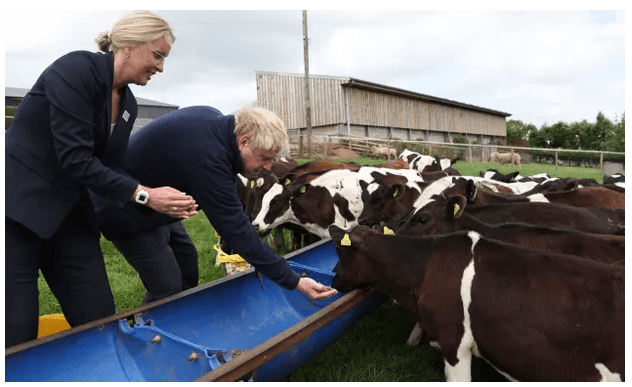
Boris Johnson has said that Cornwall’s “trouble” is its growing popularity as more people chose to live and holiday in the county. The Prime Minister was interviewed about the housing crisis when he joined Prince Charles and Camilla with a surprise visit to the Royal Cornwall Show on its second day today (June 10).

Speaking to the BBC, Mr Johnson spoke about the “imaginative” measures that Cornwall Council are implementing to address the inadequate and insecure housing situations faced by many. However, he was interrupted by the interviewer when he said the “trouble” is that more and more people are wanting to reside and visit the county.

He said: “Of course the trouble is everyone wants to live in Cornwall, everyone wants their second homes in Cornwall.”

This was met with the interviewer commenting that people who live in Cornwall already were struggling to live in the county. She said: “Yes, but the people who live in Cornwall want to be able to live in Cornwall.”

In the interview, Mr Johnson spoke about the need for local people to be supported buying and owning properties by ensuring the tax system differentiates and supports them. He said: “Yes that’s exactly right. I’m sorry to say we’ve got to look at ways of differentiating and making sure that we use the tax system to support people growing up in Cornwall so that they have a right to buy and own here as well.”

He also spoke of the housing development schemes that are already under way in Cornwall, speaking of the council’s “balanced” approach in ensuring that brownfield sites are developed, rather than using further greenfield sites.

Boris said: “Cornwall Council has got some very imaginative schemes to help local people get the housing they need by supporting them – Conservative run-Cornwall Council. But what we’re also trying to do is make sure there’s a balance in the way we approach it.

“I’ve seen some fantastic developments here in Cornwall, on disused brownfield sites, real opportunities for developments without destroying green field sites. But what we have to do is make sure local that people have the chance to own that and to buy.”

Moving on to the topic of farming, he said that it was important for the farming community to be supported “in everyway possible” as the UK gets to grips with live outside the EU.

“What I want to see, in this time of uncertainty, is us producing more of the food that we eat certainly in our own country and eating more of the food we produce.”