Royal Cornwall Hospital declares ‘critical incident’ again

As the Daily Mail highlights that the NHS needs FORTY THOUSAND more hospital beds in England alone to return to pre-pandemic standards of hospital care

  • Health Foundation estimates it will cost the taxpayer up to £30billion to scale up
  • People’s illnesses are to get more complex by 2030 as the population gets older
  • England has fewer beds per person than Lithuania, Poland and Hungary

Royal Cornwall Hospital has once again declared a ‘critical incident’ following delays in discharging patients due to bed blocking. A spokesperson for Cornwall’s largest hospital told CornwallLive about the escalation today (Tuesday, July 12) after reports that ambulances were queueing up outside with emergency patients waiting to be seen.

Edward Church www.cornwalllive.com

The hospital, at Treliske, Truro, has escalated its alert level this high several times in the last few years. Most notoriously, it did so at the outset of the Covid pandemic and in October last year when its emergency department became swamped with patients.

Royal Cornwall Hospital Trust (RCHT) chief executive Steve Williamson said: “As a result of the acute pressure on our hospitals we are stepping up our escalation level to an internal critical incident. The number of people ready to leave our acute and community hospitals but waiting for care home places or care at home has risen by well over 20 percent since April.

“Without these delays, ambulances would not be held, and we would have enough hospital beds to admit people needing emergency and planned care. Although our Covid positive inpatient numbers have doubled in the last week, these patients are mostly in hospital for other reasons and effective infection prevention and control measures mean they are not impacting hugely on the availability of beds.

“Declaring an internal critical incident galvanises system partners to take additional and immediate steps to create capacity to aid the movement of patients through our hospitals and consequently releasing ambulances and their crews. Our population can help too by making sure they make the right choice if they need urgent care, either by contacting their own GP, even if here on holiday, seeing a pharmacist or calling 111 for advice on the most appropriate place for their needs.

“If families have a relative in hospital who they could help to get home sooner by supporting them in their home whilst they get back on their feet, it will release beds for others who need our care. We urge them to talk to the ward team about how we can work together to make that happen.”

The alert means the hospital admits it is overwhelmed. Last weekend, a hospital spokesperson made a public plea for people stay away unless they could not avoid it.

Problems are so bad that it’s being reported that paramedics are spending their whole 12-hour shifts in ambulances in queues at A&E.
Dragons’ Den-style project hands control of £2.25m to Brent council residents

As local councils in England continue to feel the sting of over a decade of budget-slashing austerity policies, Brent council has launched an initiative to give residents the power to decide how they spend £2.25m of funding for local projects.

Aina J Khan www.theguardian.com 

The participatory budgeting process was first pioneered in Porto Alegre in Brazil. It has been trialled in Tower Hamlets, but is a first for Brent council which trialled a much smaller version of the initiative in January, with a funding pot of £500,000.

At Brent civic centre on Tuesday evening, the grand hall was abuzz as almost 200 residents streamed in to attend a Dragons’ Den-style event, where each group or individual had three minutes to make a pitch for up to £50,000 of funding.

The initiative, called You Decide, will allocate a £400,000 budget for five localities across the borough, which includes Harlesden, Kilburn, Kingsbury and Kenton, Wembley and Willesden.

“Giving people the opportunity to decide where the money is actually spent on things they want to see in their communities, it’s really empowering,” said Muhammed Butt, the council’s leader.

The funding is split into two pots: one targeted towards social and physical improvements; and a second which aims to support health and wellbeing in the area.

In a series of public consultations, local residents are given the deciding power to vote for projects that will be awarded funding through a voting system that ranks the projects on a scale of one to five, a process overseen by an independent company.

More than 200 grant applications were submitted for the scheme. Tuesday’s selection round resulted in only 12 being awarded funding.

Among them was a consultant dietician, Salma Mehar, 42, who plans to improve health inequalities in the borough with a nutrition education project that aims to provide free nutritional resources for children with biodegradable plates, and eco-toothbrushes made from bamboo and corn starch, both engraved with educational messages around nutrition and oral hygiene.

“Children from lower socio-economic communities generally tend to have poorer health outcomes,” Mehar, a mother-of-two, said. With almost two-thirds of Brent’s population from Bame groups, much of her work has centred around these communities. “They’re the ones who need more education,” she added.

Brent is London’s most diverse borough, but 33% of its population are living in poverty, a rate significantly higher compared to the overall rate of poverty in London. The north-west London borough also has some of the highest childhood obesity rates in London.

During the first wave of coronavirus in June 2020, Brent had the highest age-standardised coronavirus death rate in England and Wales. Excess deaths in the borough were three times the national average.

“Now people have become all of a sudden really interested in health inequalities in certain communities, but I’ve been seeing this for the last 20 years,” said Mehar, who has been promoting health and wellbeing in Bame communities in north-west London for two decades.

“There’s an issue of paying for healthier food, healthier meals, healthier resources. Our aim is to promote and produce resources that are going to be free of charge for these children and their families, but supported by a local council and the government.”

James Jordan, 32, and Jermaine Bishop, 37, were also successful in securing funding for Set Them Up, a foundation that will teach financial literacy on topics including mortgage, rentals and pensions, to students aged 15 to 18.

“We made some silly mistakes when we were younger, when we came out of school, so we’re really trying to highlight safe usage around money and credit,” said Jordan.

Since April 2010, Brent council has been forced to curb its budget by £196m , as government funding it received has been cut by 78%. The borough has metamorphosed over the years as regeneration efforts have transformed its urban spaces.

The funding from the initial scheme in January was taken from the carbon offset fund, which is formed by a charge paid by housing developers who have not met the London mayor’s carbon emissions target on their development. That fund was used for carbon reduction projects in Brent.

The money from Tuesday’s participatory budget event is from the neighbourhood community infrastructure levy, a charge that local councils apply to housing and residential developers, which is reallocated back into local communities.

Whether this new participatory budgeting project will have any tangible impact remains to be seen. But at least for now, the power to change the area is temporarily in the hands of its residents, not just its council.

“It’s democracy in the heart of the community,” Butt said.

Official Covid death toll reaches 200,000

To put this number in perspective there were 70,000 civilian deaths and 384,000 soldiers killed in combat during the six year course of WWII.

“We got the big calls right” or did we? – Owl

Tom Whipple www.thetimes.co.uk

Over 200,000 people in Britain have now had Covid recorded on their death certificate, according to the latest figures from the Office for National Statistics.

The milestone comes more than a year after the country reached 150,000 Covid-related deaths towards the end of last winter.

With hospital admissions continuing to rise amid a wave fuelled by a subvariant of Omicron, public health officials expect the toll to increase over the next few weeks.

Simon Clarke, from the University of Reading, said that the latest wave, in which infections are close to record levels, showed the importance of staying on top of the vaccination programme.

“At the moment we have transitioned to a situation where population-wide immunity, delivered largely by vaccination, means that Covid-19’s worst effects are likely to be a mass sickness which keeps people off work, and while this could disrupt public services, it doesn’t fill intensive care units with people struggling to breathe,” he said.

“But we are seeing the virus change and try to squeeze through the gaps in that immunity, so the vaccine producers need to ensure that future boosters take into account those changes to the virus and the government needs to ensure that boosting is comprehensive enough.”

At present the government plans to offer a booster to over-65s in the autumn, as well as those in younger age groups at increased risk. The JCVI, the committee advising the government on vaccinations, does not yet know whether that booster will, for the first time, be tweaked to match the variants. Both Pfizer and Moderna have vaccines in development that are specifically targeted to Omicron.

Sajid Javid, as health secretary, recently indicated that he was looking at extending this booster programme to include those aged over 50. Clarke said that doing so could be money well spent, adding: “A half-baked booster rollout done on the cheap risks not covering enough people and could end up costing the economy more in the long run.”

The 200,000 figure, announced today by the ONS, represents deaths up to June 25. The delay is because the statisticians have to wait for the official death certificates, where doctors mention Covid only if they deem it contributed to someone’s death.

These numbers are separate from the more rapid but less accurate “28-day” measure, in which those dying within 28 days of a positive test are all recorded as Covid deaths — in England this figure is 157,000 and in Wales 7,500. This measure is no longer used in Scotland and Northern Ireland.

The latest wave has not translated so far into steeply rising deaths. ONS data shows that total mortality is only slightly higher than expected at this time of the year, although because of the lag from infection to hospitalisation, more deaths are expected.

While scientists do not expect to see peaks anywhere near those encountered pre-vaccination, when there were more than 1,000 Covid deaths a day during the worst periods, some groups remain at risk.

A survey by Blood Cancer UK has found that a quarter of those with the cancer are still only leaving home for essential trips. Treatment for the condition can wipe out the immune system, and more than four fifths of those surveyed by the charity said they were still anxious about Covid.

An estimated half a million Britons are immuno-compromised, meaning they typically have a less strong response to the vaccines.

The organisation called for those who have not gained vaccine protection to be offered Evusheld, an antibody prophylactic.

“The number of people with blood cancer who have died of Covid is shockingly high,” said Gemma Peters, the chief executive of Blood Cancer UK.

“We also know that the effort to avoid coming into contact with the virus has had a huge mental health impact. While it is completely understandable that the country is now getting back to normal life after a horrible two years, this return to normality needs to be accompanied by much more support for those who are still vulnerable to Covid.”


‘Next PM should be a non-Conservative’

It isn’t often that the people of East Devon make a real difference to national politics. 

Martin Shaw, Chair, East Devon Alliance www.midweekherald.co.uk

But I think we can safely say that when voters in Honiton, Seaton and Axminster helped return our first non-Conservative MP last month, we played a major role in forcing Boris Johnson’s grudging commitment to leave Downing Street later this summer.

While everyone knew that Johnson was badly discredited – for his Seaton photo opportunity he lurked at the yacht club end of the beach to avoid bumping into residents – it was only after 22,500 of us voted in the Liberal Democrat, Richard Foord, that enough Tory MPs got the message that sticking with Johnson could cost them their seats.

So our great Devon victory was a vital first step towards getting the country out of its mess.

But the problem is much bigger than Johnson. Most other Conservatives (including virtually all the new contenders to lead the party) excused his behaviour even after we called time on it. And that behaviour itself was just the tip of the iceberg.

When the East Devon Alliance was formed nine years ago to tackle corruption in our district council – after a Conservative councillor was exposed offering planning permission for £25,000 – people did not often use the word ‘corruption’ to describe British politics. We thought East Devon was an exceptionally bad case, the result of a long period of one-party rule.

But now it is routine to describe the national government in this way. During the pandemic, millions of pounds were handed without proper scrutiny to firms linked to ministers’ cronies and Tory donors – while many of the latter, including the oligarch son of the former KGB agent that Johnson met in a Tuscan villa, were awarded peerages. (I wonder if Johnson’s strong support for Ukraine is partly an attempt to compensate for the Tories’ Russian links?)

This self-interested clique at the centre of the Conservative party has scant concern for the real problems of the country and the difficulties facing ordinary people. Their claim that they have ‘got the big calls right’ doesn’t stand up to examination.

The early response to Covid was a shambles and the policy towards care homes was ruled unlawful after EDA’s Cathy Gardner took them to the high court. Indeed the government washed their hands of the pandemic after the third vaccine was rolled out.

Until last week, Sajid Javid presided over an NHS which has never been in a worse state, with six millions waiting for treatment, the ambulance service in crisis, and staff shortages worse than ever.

Similarly, Rishi Sunak delayed and delayed supporting people with their energy prices, and then the help was too little, especially for the people whose benefits he slashed only last year. He has continued the decade of austerity which has made it impossible for local councils to maintain, let alone really improve, public services – even Devon County Council could be at risk of bankruptcy.

Instead of solid work to improve our economy and society, for 12 wasted years the Conservative Party has given us an endless soap opera of rivalries between wealthy, overentitled men (and a few women). 

They serenade us with pretend policies like ‘levelling up’, which no one really knows the meaning of, and which have brought precious little benefit even to the north, let alone to Devon, which has again been taken for granted.

Half of these years have been taken up with the fantasy of Brexit, which has had virtually no practical benefits but has wrecked much of our trade, damaged the fishing industry it was meant to help and divided Europe just when it faces the threat of Putin.

As the soap opera resumes, Tories are telling each other that the next prime minister has to be a Brexiteer. In my view, the next prime minister, like our new MP, should be a non-Conservative.

Average UK household £8,800 a year worse off than those in France or Germany

The UK’s failure to get serious about inequality and weak growth over the past 15 years has left the average British household £8,800 poorer than its equivalent in five comparable countries, research has found.

Owl thought our Local Enterprise Partnership had cracked the problem of productivity growth and, along with its local business partners, were assuring us of sunny uplands.

Are there any grownups running our economy?

Larry Elliott www.theguardian.com 

A “toxic combination” of poor productivity and a failure to narrow the divide between rich and poor had resulted in a widening prosperity gap with France, Germany, Australia, Canada and the Netherlands, the report from the Resolution Foundation said.

The thinktank said that if the UK matched the average income and inequality levels of those countries, typical household incomes in Britain would be a third higher and those of the poorest households two-fifths greater.

Its chief executive, Torsten Bell, said: “Britain is a rich country, with huge economic and cultural strengths. But those strengths are not being built on with the recent record of low growth leaving Britain trailing behind its peers.

“This forms a toxic combination with the UK’s high inequality, leaving low- and middle-income households far poorer than their counterparts in similar countries.

“We must turn this around, but we are not on track to do so. We underestimate the scale of our relative decline and are far from serious about the nature of our economy or the scale of change required to make a difference. This has to change.”

The foundation’s report – Stagnation Nation – coincided with calls from the Confederation of British Industry (CBI) and the Treasury select committee for the government to produce a coherent growth strategy.

In an open letter to ministers, the CBI director general, Tony Danker, took a sideswipe at the tax-cut bidding war being conducted by the Tory party contenders to replace Boris Johnson, urging the candidates to show how growth policy was “about more than this”.

The overriding objective of tax policy currently should be to boost business investment, the business lobby group added. “Growth that relies on only government or household consumption is doomed to fail, especially at a time of rising inflation and high debt.”

Danker said the economy could be boosted by £700bn over the coming decade provided the government developed “serious, credible and bold” policies for growth.

“There are prizes on offer through decarbonisation, innovation, trade, thriving regions, labour and health. And those prizes can be realised if government pulls on four key growth levers: smart taxation to unlock investment; building a workforce for the future; delivering catalytic public investment; and making markets to outcompete the world.”

Meanwhile, the cross-party Treasury committee expressed concern at the “chop and change” in the government’s economic approach, warning of a risk of fragmentation and a lack of long-term thinking after the abolition of its industrial strategy and replacement with the plan for growth. It was not clear how the plan for growth was an improvement on its predecessor, the report said.

Mel Stride, the committee’s chair, said: “We have a new chancellor and shortly will have a new prime minister. Getting a grip on productivity will be key to kickstarting economic growth and stimulating greater business investment in the UK. The evidence that we received suggests there needs to be greater stability and long-term certainty in government policymaking.”

The Resolution Foundation said the UK had closed the productivity gap with France and Germany in the 1990s and the first half of the 2000s, but since then the gap had widened from 6% to 16% – the equivalent of £3,700 per person.

While the top 10% of households in Britain were richer than those in many other European countries, middle-income British households were 9% poorer than their counterparts in France, while the poorest fifth of households in Britain were more than 20% poorer than their French and German equivalents.

Meanwhile, the latest monthly barometer of confidence from YouGov and the Centre for Economic and Business Research shows that weak growth and rising inflation in recent months have led to a seventh successive decline in consumer confidence.

Have the dirty tricks, skulduggery and in-fighting commenced?

Background: A survey of the Tory party membership from the Conservative Home website has shown that Sunak would comfortably win in a run-off against Hunt, but would struggle against many of the other candidates including Truss, Kemi Badenoch and Penny Mordaunt.

‘It’s a stitch up!’ Nadine Dorries rages at Rishi ‘dark arts’ to secure PM win

Rishi Sunak faces two major opponents in battle to PM

Cally Brooks www.express.co.uk 

Writing on Twitter, the Secretary of State for DCMS wrote: “This is dirty tricks/a stitch up/dark arts. Take your pick. Team Rishi want the candidate they know they can definitely beat in the final two and that is @Jeremy_Hunt. It was in response to a Tweet by Commentator Dan Hodges who revealed he was told Gavin Williamson, who is on Rishi Sunak’s team, organised a “syphoning off of some votes” to help Jeremy Hunt get to the election.

He wrote: “One rival camp tells me Gavin Willamson (who is on Team Rishi) has organised syphoning off of some votes to let Jeremy Hunt get over the threshold.”

Nadine Dorries is a member of the Conservative Party and has served as Secretary of State for Digital, Culture, Media and Sport since 2021.

It comes as the first eight leadership candidates to get through to the first round of voting have been revealed.

Kemi Badenoch, Suella Braverman, Jeremy Hunt, Penny Mordaunt, Rishi Sunak, Liz Truss, Tom Tugendhat and Nadhikm Zahawi have made it through.

Sajid Javid and Rehman Christi withdrew from the content minutes before the deadline.

But some have denied the accusations, with Sky News’ Political Editor Beth Rigby claiming sources have told her it is “complete nonsense”.

She wrote on Twitter: “Update on the Williamson/Hunt story doing rounds. Source close to Sunak campaign tells me its ‘complete nonsense.

“Mel Stride running the whipping op & that behaviour isn’t happening. It’s a dirty story being spread by anti-Rishi people’.”

It comes after Rigby challenged Rishi Sunak over his suitability to lead the country as she pointed out he shares several flaws with Boris Johnson.

The Sky News chief editor questioned Rishi Sunak about his record as she noted the former Chancellor had been building his campaign to succeed Boris Johnson on the need for change within the party.

Beth Rigby noted Mr Sunak had also been handed a fine after he was found to have breached lockdown rules by attending a gathering at a time when groups could not meet. She also noted he is currently seen as a “corrosive” figure because of his fiscal policies, questioning his chances of securing the leadership of both the party and the country.

Ms Rigby said: “You’ve just stood here and said Boris Johnson is a remarkable person, you don’t want history to demonise him.

“But the fact is, the party just ousted him on the basis of conduct, probity, and causing division. And here you are, and I have to put it to you that you have a police fine over Partygate.”

Rigby added: “And there have been questions too over your very wealthy family avoiding paying millions of pounds in tax due to your wife being a non-dom taxpayer.

“I know that has changed very recently. And I have to say you’re an utterly corrosive figure in the parliamentary party for a big chunk of it. There are many in the party who do not want you to be Prime Minister.”

The former Chancellor said: “I think it’s important, whoever wins this election does restore trust because trust has been broken. We need to rebuild all that with the country. It’s something I’m keen to do as leader.

“I think I can do that, and I think it’s about the conduct of Government, which is important. And you can expect that’s the kind of leadership I will provide.”


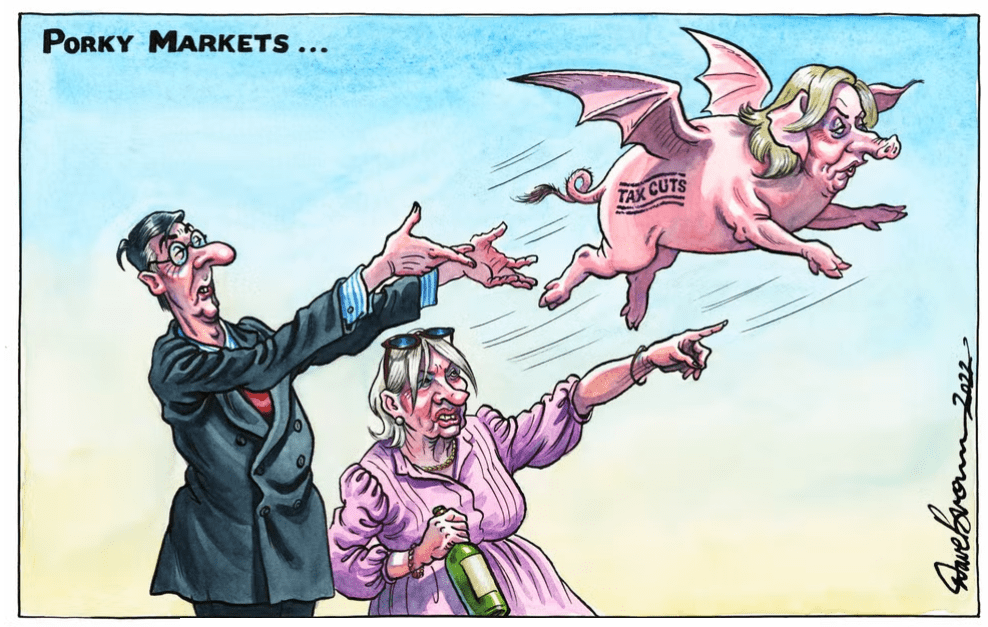
Porky Markets

This leadership campaign reveals the ideological narrowness of the Conservative Party

Editorial www.independent.co.uk 

A leadership election campaign ought to be a good chance for potential prime ministers to set out how they would deliver the kind of government that the people want. Instead, we have had a parade of leading lights offering fantasy tax cuts, and one candidate who seems to be running on a ticket to abolish unisex toilets.

What is the No 1 priority of the British people? It is the cost of living. And what do the candidates have to offer them? Unfunded tax cuts, mainly. Cuts to national insurance contributions, income tax, fuel duty, and even corporation tax. And none of them spelling out credible spending cuts to pay for these things, implying higher borrowing at a time when interest rates are rising, meaning it would pile on costs to be paid by future generations.

To his credit, Rishi Sunak, the recent chancellor, set the terms of the election by pre-emptively attacking “fairytales” about the economy. This does seem to have forced at least one candidate, Penny Mordaunt, to rein in the impossible promises and to agree that lower taxes are only prudent when the public finances are sustainable.

But the tone has been set by Jacob Rees-Mogg, who is now backing Liz Truss, in condemning Mr Sunak as a “socialist” chancellor for belatedly doing the right thing and using the benefits system to protect vulnerable households from the rise in energy bills.

The overall impression is of a party that would prioritise tax cuts, which by definition help the better off (those who pay taxes), over broad-based help for people on low incomes.

What else do the British people care about? The National Health Service. The coronavirus backlogs and the dangerous delays in ambulance call-outs. And what do the Tory candidates have to say about that? The only candidate who seems to have taken the NHS issue seriously is the recent chancellor. His allies criticised Boris Johnson in the weekend press for failing to set up regular meetings, led by the prime minister, to oversee the backlog programme. This kind of Blairite public-service-reform focus is the only way to ensure that the full weight of the government machine is devoted to identifying the bottlenecks and clearing them.

The people’s priorities include the housing crisis. Only one candidate has mentioned it – Sajid Javid, though he has since stood down from the race. People are worried about crime. That has been the subject of familiar sloganising, but no new thinking. And people are also concerned about the arrival of small boats across the Channel, while being uneasy about the Rwanda scheme proposed by Priti Patel, the home secretary, as her main response to that problem. So far, all the candidates have backed the scheme – while the scheme itself has been suspended until the new prime minister takes office at the beginning of September.

The other huge issue with which the British people expect their leaders to engage is the climate emergency – coincidentally underlined by the current unusual heatwave. On this, the centre of gravity of the Conservative Party seems to be moving away from the people. Kemi Badenoch, the biggest surprise candidate of this race, described the target of net zero carbon as “economic disarmament”. While other candidates have not gone that far, the tone of the debate is all about “realism”, which is code for backsliding.

There is time for some of the candidates to prove us wrong, but the early stage of this contest has exposed the gulf between the Conservative Party’s deepest instincts and the people’s priorities. A leadership election ought to be a chance for a party to showcase its best talents. So far, it has shone an unforgiving light on the party’s true nature.

Conservatives abstain as council declares cost of living emergency

A second Somerset council has called on the government to urgently address the cost of living crisis – though Conservative councillors abstained from the final vote.

Daniel Mumby www.somersetlive.co.uk 

Somerset West and Taunton Council became the second local authority in Somerset to pass a formal motion urging government action on the cost of living, following a similar vote by Mendip District Council in late May. In a full council debate held in Taunton on Tuesday evening (July 5), councillors from all parties spoke out about the pressures being placed on working families, urging action on energy bills, universal credit and fuel duty.

However, members of the Conservative opposition group abstained from the final vote, with their leader stating the motion was “overtly politicised” and the debate was a “missed opportunity” to find common ground. The motion called for a cut in the standard rate of VAT from 20 per cent to 17.5 per cent, restoring the universal credit supplement of £20, and reinstating the pension triple lock (whereby pensions rise in value by either average earnings, inflation or 2.5 per cent a year – whichever is higher).

It also called for the government to cut fuel duty in rural areas and to uncouple power prices from gas prices (which would enable a drop in household electricity bills). Like Mendip‘s declaration in May, the council also committed to staging a “cost of living emergency summit” with Citizens Advice, food banks, trade unions, chambers of commerce and the district’s two MPs – Ian Liddell-Grainger (Bridgwater and West Somerset) and Rebecca Pow (Taunton Deane – and until recently a Defra minister).

The council has also committed to creating a £50,000 support fund for those residents most affected by rising food and energy prices, which will be administrated alongside Citizens Advice by the end of the summer. Councillor Chris Booth, portfolio holder for communities, introduced the motion by stating: “We are all aware of the difficult times that our residents are going through, and it’s now the time to show that we want to do more than we already are.

“We urgently need more of this government as the shadow of hardship consumes more of us.” Councillor Benet Allen, portfolio holder for communications and corporate resources, said he was “dismayed” that the government had dithered over restoring the £20 uplift in universal credit.

He said: “The cost of living crisis is real, it affects many of us, and I’m dismayed that the government has avoided doing the one, simple, affordable thing that it could do to put money in the pockets of those who need it most – which is to restore the £20 on universal credit. They’ve done lots of other things, most of which are headline-chasing.

“I believe that this government for political reasons has avoided doing anything along the lines of putting money back into the pockets of the very poorest. We are overtaxed on our use of electricity because our electricity bills are directly connected to our gas bills. Very little of our electricity is generated by gas.

“The cost of renewable energy has plummeted in recent months – we are actually all overpaying for electricity by a factor of two or three.” Councillor Libby Lisgo, who leads the Labour opposition group, joked that the council would struggle to find a minister to whom these concerns could be addressed in light of the copious resignations from Boris Johnson‘s administration.

She said: “The way that the government is almost, it would seem, wilfully ignoring the needs of the people who most need support probably ought to beggar more belief than it does. The way they’re falling tonight [July 5] suggests that [finding a secretary of state] might be easier said than done.”

Councillor Dave Mansell – one of two Green Party councillors – added: “The motion focusses on short-term solutions, and those are definitely needed and important. I would like to add that long-term solutions are needed too, particularly for our energy security.

“The government has stopped us investing in the lowest-cost energy source, which is on-shore wind power. that is contributing to a situation which we now face, and that urgently needs to change.” The motion was passed by a substantial margin, though all the Conservatives present in the chamber abstained – and two members of the party left the chamber before the vote took place.

Councillor Roger Habgood, who leads the Conservative group on the council, said after the debate that he and his party were in support of action to address the cost of living but believed the motion was the wrong way to go about this. He said: “Unfortunately the cost of living motion to full council was deliberately set out taking an overtly politicised position by the local Lib Dems.

“The cost of living increases in our economy are of course concerning to us all, and if Mr Booth and the Lib Dem leader had taken a few minutes to construct the motion collaboratively, it could have received unanimous support. Sadly that approach and option was not chosen and an opportunity has been lost.

“Continuously blurring the lines of responsibility between the district, county and unitary councils and the national government is unhelpful. Our councillors are best placed to focus our attention on reducing costs and improving services under our direct control, rather than being distracted by matters outside of their control.

“Of course we should engage with Westminster. We have two MPs who represent us – after all that is how the latest cost of living payments for eight million families coming into effect from July 14 was formulated.

“My colleagues and I continue to focus on what we can do for residents as local councillors in these challenging times.”

Comedian Michael Spicer roasts outgoing PM’s speech in ‘immensely satisfying’ video

At one point, Spicer calls Johnson a “fart pipe” and gives Johnson’s wife, Carrie, the nickname “Wallpaper Wendy” in reference to the £840-per-roll wallpaper the couple bought for their flat renovation.

(Read the intro then watch the video below, or just watch and enjoy! – Owl) 

Ellie Harrison www.independent.co.uk

Comedian Michael Spicer has been praised for his video roasting Boris Johnson’s resignation speech.

Last week, Johnson announced he would step down as prime minister following an onslaught of resignations in protest over his leadership.

Spicer – whose sketches often see him impersonating a fictional, frustrated Johnson aide working in a side-room – shared a video on Tuesday (12 July) mocking the speech.

“Remember it’s time to be humble,” he can be seen telling the outgoing prime minister. “And, just to be on the safe side, I’ve written down the definition of humble and emailed it to you under the subject heading: ‘You have well and truly f***ed everything up.’”

He suggests that Johnson apologise for “partying every single Friday while telling us at the same time we couldn’t sit on a park bench with our nans”.

When Johnson says in his speech that he is proud he “got Brexit done”, Spicer cuts in with: “It’s not done, it’s a mountain of burning tyres that threatens the Good Friday Agreement.”

When Johnson talks about how he got the country through the Covid pandemic, Spicer says: “180,000 people died but, yes, let’s claim it as a triumph, why not? I mean, literally nothing you say matters any more.”

At one point, Spicer calls Johnson a “fart pipe” and gives Johnson’s wife, Carrie, the nickname “Wallpaper Wendy” in reference to the £840-per-roll wallpaper the couple bought for their flat renovation.

Getting increasingly irate, he demands that the prime minister apologise. “Dig right down into that poisonous soul of yours and try to find one apology,” he says.

The video ends with Spicer holding his head in his hands in total despair.

Broadcaster and author Fern Britton was among those to praise the clip. “Totally brilliant and factually correct,” she tweeted. “He is a fart pipe.”

“‘Wallpaper Wendy’ had me snorting water out of my nose,” added another.

A third wrote: “Another slice of perfection. Thank you.”

A fourth said: “You’re the only way I can watch these speeches.”

“Immensely satisfying,” posted a fifth.

A sixth person simply wrote: “Thank you YOU ABSOLUTE BLOODY BEAUTY!”

His Master’s Voice, Jupp’s choice is explained

Raab and Shapps back Rishi Sunak in race for Tory leadership

Rees Mogg and Dorries are backing Liz Truss

Looks like North East Somerset is the only place where 20 people can be found to back the “Boris Continuity” candidate JRM.

None of the above – Owl

Heather Stewart www.theguardian.com 

The UK deputy prime minister, Dominic Raab, and the transport secretary, Grant Shapps, have both thrown their weight behind the frontrunner, Rishi Sunak, in the race to succeed Boris Johnson as Conservative leader.

Raab, who had not previously backed a candidate, introduced Sunak as he formally launched his candidacy at an event in Westminster.

With the other candidates in a bidding war to promise tax cuts, Raab told the enthusiastic audience: “Just remember this: while others talk the talk, Rishi this month delivered the biggest tax cut for working people in a decade; and he did it because he’s a true Conservative, imbued with the values of enterprise, hard work and family. Rishi’s values are our values.”

He also highlighted Sunak’s early support for Brexit, his “seminal” pamphlet on freeports, and his strong poll ratings relative to other candidates.

Also appearing on stage was Shapps, who has withdrawn from the Tory leadership race and thrown his weight behind Sunak, after it became clear he was unlikely to secure the backing of the 20 MPs needed to progress to the ballot paper.

Key supporters including Oliver Dowden, who resigned as party chair after the disastrous Tiverton and Honiton and Wakefield byelections, and the former chief whip Mark Harper, were also present.

Sunak has sought to distinguish himself from the rest of the field by declining to promise lavish tax cuts immediately, instead stressing the importance of not believing in “fairytales”.

In his own speech, he said it was time for a “grown-up conversation” with the public about the challenges ahead. He said he wanted the campaign to be “a moment where the party and the country came together”.

Sunak also sought to explain why he had backed Johnson until last week, saying: “We owe it to the people who elected Boris in 2019 to explain why he is leaving office.

“Boris Johnson is one of the remarkable people I’ve ever met, and whatever the commentators say, he has a good heart,” he said, insisting he would not take part in a “rewriting of history” about his premiership.

He has secured the most public endorsements from MPs, who will narrow the field down rapidly to two candidates over the next 10 days. Sunak, who resigned last week, said he was bringing “a message of change”.

This Nadine Dorries-Boris Johnson musical ‘duet’ is the best/worst thing you’ll watch today

Says it all! – Owl

Poke Staff www.thepoke.co.uk 

No-one will miss Boris Johnson from Downing Street quite like his culture secretary Nadine Dorries.

And there can surely be no more fitting tribute to their extra special relationship than this musical mash-up which has just gone viral on Twitter.

Watch through twitter link

Absolutely the best/worst thing we’ll see today.

New waffle cafe and community wellbeing hub at Seaton Hospital

You have to admire the enterprise and job creation – but is this “healthy eating”? – Owl

A new community Waffle Café has opened at Seaton Hospital. 

Philippa Davies www.midweekherald.co.uk

It’s being run by the not-for-profit community enterprise Waffle which has had a similar café in Axminster for a few years, with a mission to combat loneliness, bring people together and offer new opportunities. 

The opportunity to open the new café emerged when the Seaton community interest company RE: STORE was offered a disused kitchen in the hospital. The hospital is run by NHS Property Services which supports social prescribing, connecting people with community groups to improve their wellbeing. 

RE:STORE was already running a gardening project in the grounds of Seaton hospital. Keen to create a wellbeing hub/cafe on the site, the company joined forces with Waffle.

The cafe is open Wednesday to Saturday from 9am until 5pm. On Monday and Tuesday the space is used for private groups and community activities. 

The hospital is also partnering with Axminster Project Food, who will use the café’s kitchen to educate schoolchildren about cooking and healthy eating. 


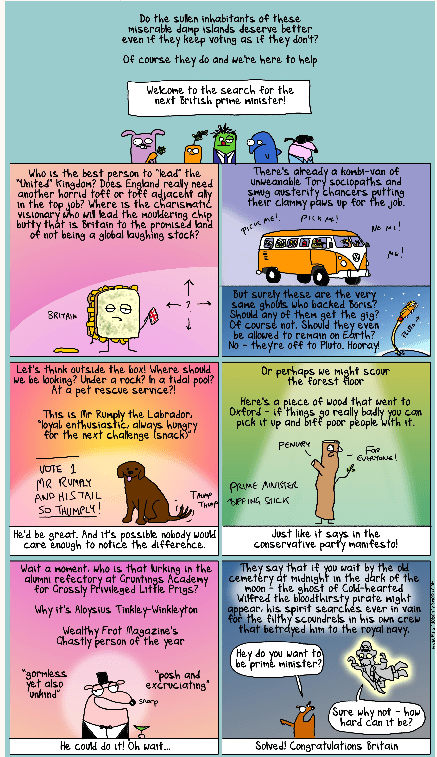
Who should be the next PM? It’s time to think outside the box

Should it be Aloysius Twinkley Winkleyton, Wealthy Frot Magazine’s Person of the Year, or this stick that went to Oxford? You decide!

First Dog on the Moon www.theguardian.com 

The Conservatives have one chance for recovery

The only chance the Conservatives have of early recovery is if they consciously abandon the discredited Johnsonian era, reject anyone associated with him, and opt instead for someone from a new, untainted generation.

The final choice lies in the hands of the small band of “True Blue” party members, so this looks unlikely. – Owl

Opinion by Peter Mandelson inews.co.uk

The Tories have only themselves to blame for the damage they have inflicted both on themselves and the country

Whoever succeeds Boris Johnson as prime minister, it is impossible to imagine that they will be as bad, a narcissist who sees every issue through the lens of his own personality, whose only abiding question is how it makes him look, a politician who lives for the next story to tell rather than detailed policy to formulate. Britain has never been as ill-served by its chief minister as we have been by Johnson.

In 2019, as the race to succeed Theresa May got underway, I was at a function and fell into conversation with the chair of the Conservatives’ 1922 Committee who said there were no circumstances in which Tory MPs would have Johnson as their leader because “they all know what he’s like”.

A month later he was duly elected despite his party knowing what he was like. The Conservatives have only themselves to blame for the damage they have inflicted both on themselves and the country.

Brexit was never going to bring the benefits for Britain its advocates claimed, but the narrow, confrontational, ideological, short-termist way in which it has been implemented by Johnson and his cohorts is going to do acute, lasting harm to our economy and future living standards.

I say nobody could be a worse prime minister because our quality of government and the whole of our politics have reached their nadir under Johnson. Ask any civil servant how professionally degraded they feel through proximity to him. The absence of any deep, objective thinking about the challenges facing Britain and of consistent, rational policy making and commitment have meant we have lurched from one makeshift, hand to mouth spasm of prime ministerial interest, to the next.

Although the crisis was not of his making, Johnson was lucky the Ukraine invasion came along: it enabled him to distract attention from all his other failures and to seek phone calls and meetings with President Volodymyr Zelensky every time he felt the need to burnish his leadership credentials.

Yes, it may be difficult to imagine that Suella (“I owe it to the country to run”) Braverman and Steve (“People are imploring me to stand”) Baker would be an improvement on the last three years, but they would not dare show the same wholesale indifference to rules and standards in public life that Johnson has demonstrated.

Surely Liz Truss and her myopic approach to trade and foreign policy, as she takes a wrecking ball to Britain’s economic relations with both of the vast markets of both Europe and China, could not fail to be some improvement, however limited.

But none of these are the answer to the Tories’ needs. The only chance the Conservatives have of early recovery is if they consciously abandon the discredited Johnsonian era, reject anyone associated with him, and opt instead for someone from a new, untainted generation. Tom Tugendhat or Tobias Ellwood come to mind but there are probably other men and women whose faces and names are not familiar to me or the general public who could engineer the necessary separation of the Tory party from its immediate past.

A new, fresh face and mind would then have to construct a programme for government which equips the nation’s priority objectives with practical, lasting plans to achieve them, for example in decarbonisation, economic and productivity growth and transformation of public services. These policies should not pander to ideological extremes but instead aim to generate the widest possible consensus so as to enable policies to survive a change of government.

Good policies depend on durability and lasting impact. A general election will take place in the not too distant future and key elements of policy should be built on rather than scrapped. We cannot afford tabula rasa policymaking, a wiping clean of the policy canvass as one administration takes over from another in Whitehall. The UK’s economy and businesses, as well as public services, need continuity for growth and improvement, not constantly shifting ground and decision-making.

There is little doubt what the public wants to see at the heart of a new programme of government. Manifest integrity and honesty in how Britain’s government and institutions are run. Fairness in the distribution of both tax burdens and spending benefits as well as the prevailing rules of immigration and welfare. Realisation of the economic opportunities offered by Britain’s world class science and technology base in which so many decades of investment has taken place.

Keir Starmer is rightly arguing that it is the Conservative Party not its leader which is incapable of bringing the change Britain needs. Starmer will continue to build the case for change with Labour as he has already started to do. The way Labour is viewed by the public is light years away from how it was judged in 2019. The party is electorally competitive again.

But if the Conservatives want to restore their own electability they will have to start with a very different leader from the one we are saying goodbye to now.

Simon Jupp’s choice for PM revealed

The one who claimed he had no working class friends! 

Perhaps a surprising choice for someone who worked as a SPAD for the right winger Dominic Rabb – Owl

[Current list of candidates with their declared supporters can be found on this link. We don’t know who Dominic is backing].

sidmouth.nub.news 

East Devon MP Simon Jupp, whose constituency includes Sidmouth, is backing former chancellor Rishi Sunak in the Conservative leadership race to become the next prime minister.

Mr Sunak was chancellor of the exchequer in Boris Johnson’s cabinet until he resigned on 5 July.

Boris Johnson then resigned on 7 July as Conservative leader amid mounting pressure. He will step down as PM when a new leader replaces him.

Simon Jupp MP, who also called for Johnson to resign on 6 July, said: “Rishi is the right person to lead the nation.

“He’s serious about the South West and understands the opportunities ahead.

“I trust him to deliver a credible Conservative vision for the future which restores trust and rebuilds our economy.”

Eleven candidates have now put their names forward [at the time this article was written].

They are:

  1. Rishi Sunak
  2. Grant Shapps
  3. Liz Truss
  4. Tom Tugendhat
  5. Nadhim Zahawi
  6. Rehman Chishti
  7. Jeremy Hunt
  8. Sajid Javid
  9. Penny Mordaunt
  10. Kemi Badenoch
  11. Suella Braverman

The Conservatives’ 1922 Committee is meeting today (Monday 11 July) to decide how the leadership race will go ahead.

Can Owls have nightmares during the day?

Jacob Rees-Mogg mulls Tory leadership bid

Jacob Rees-Mogg is mulling a shock entry in the Conservative leadership race as a “continuity Boris” candidate, The Telegraph can disclose. www.telegraph.co.uk

Planning applications validated by EDDC for week beginning 27 June

It’s a Fight for the Right and Net Zero could be a victim

From  the London Playbook www.politico.eu

FIGHT FOR THE RIGHT: MPs head back to Westminster this morning with the race to be the next prime minister about to hit full throttle. Foreign Secretary Liz Truss has finally announced her bid for Downing Street, Tom Tugendhat and Kemi Badenoch have clinched major endorsements and onlookers are asking themselves: Who the hell is Rehman Chishti? The temperature gauge will edge up another notch tonight when Conservative bosses announce the rules of engagement — but don’t expect bitter briefing against rivals, accusations and recriminations to be outlawed. The Tories wouldn’t be able to handle a contest without gnawing lumps out of each other.

All in a spin: The number of MPs still to decide which candidate to support is fast diminishing, which means most of the people Playbook spoke to last night were spinning like mad. Others who are still to back a horse used words like “ridiculous” and “mental” to describe the ballooning circus of hopefuls, and were finding the smorgasbord of right-wing crazies overwhelming. No one had the faintest idea who might win the thing, or if the last Conservative standing would be up to the job. “You need people with experience and humility in the final two,” one minister quipped. “But those aren’t characteristics that are common in people who think they could be prime minister.”

On that note … Chair of the committee on standards in public life Lord Jonathan Evans told the Week in Westminster last night that after the Boris Johnson era, a new PM must show that “public standards are going to be very high on their agenda.” On the Andrew Neil Show on Channel 4, former Chancellor George Osborne said the Tories must “drain the poison” of Johnson’s period in office.

One thing is for certain: The U.K. is showing little sign of shifting to the center ground anytime soon, as my POLITICO colleague Annabelle Dickson writes in her take on the pledges made so far. She brands it “a heady mix of tax-cutting, woke-bashing and Brexit-backing policies.” It’s no surprise Conservatives Zac Goldsmith and Chris Skidmore are terrified the fight for net zero will be a victim in the leadership race.