Son of Tory donor who hosted Boris Johnson’s wedding party handed lucrative government contract

The son of a Tory donor who hosted the Prime Minister’s wedding party was given an £11.2 million grant by the UK government, it has been revealed.

April Curtin www.thelondoneconomic.com 

Jo Bamford, CEO of Wrightbus, was given the cash to build hydrogen buses for his company Wrightbus in March 2021.

His father, billionaire businessman Lord Bamford, hosted Johnson and Carries’ wedding do at his Cotswolds estate in late July.

Lord Bamford, who is chairman of construction equipment manufacturer JCB, has donated millions to the Conservative party, and is understood to have paid for some of the costs towards the PM’s wedding celebration.

Wrightbus provided the world’s first ‘zero-emission’, double-decker buses powered by hydrogen, and has won publicly-funded contracts – worth millions – to supply these vehicles across the UK.

Jo Bamford’s other company, Ryze Hydrogen, is facilitating a £45million hydrogen and infrastructure distribution hub for Lanarkshire, and has signed a deal to import tankers of hydrogen from Australia.

Speaking to the Daily Record, SNP Cabinet Office spokesman Brendan O’Hara MP said “Tory cronyism”  has been “endemic” under Johnson’s leadership, and that the public deserve transparency regarding the £11.2million payout.

“He may be going, but the legacy that will follow Boris Johnson is one of Tory sleaze,” O’Hara said.

Economy spokesman for the Lib Dems, Willie Rennie, agreed that transparency about how such contracts are “dished out” is needed, and described the relationship between Tory donors and Tory Ministers responsible for awarding multi-million-pound contracts as “unhealthy”.

A UK Government spokesperson told the publication: “All contracts are awarded in line with procurement regulations and transparency guidelines and there are robust rules and processes in place to prevent conflicts of interest.”

Ofwat chief defends water companies over lack of new reservoirs

The head of the water regulator for England and Wales has defended water companies against criticism over not building new reservoirs despite high levels of executive bonuses and shareholder dividends.

Helena Horton www.theguardian.com 

David Black, the chief executive of Ofwat, also said old pipes were not to blame for leaks and that most companies were meeting their leakage targets.

Water companies have come under criticism as England faces water shortages. Some homes have run out of water, rivers have turned dry and farmers are facing crop failures. Many are outraged at the companies for failing to invest in reservoirs, fix leaks and stop sewage pollution from their pipes.

The bosses of England’s water companies have been criticised for banking £58m in pay and benefits over the last five years. Since privatisation, shareholders have been paid £72bn in dividends. The cash has come from big debts, with companies having borrowed £56bn, and big bills, with prices having risen 40%.

However, Black said critics were not giving companies enough credit for actions being taken to reduce leaks and improve water supply, and suggested they did not understand the “complex” issue.

He told the BBC’s Today programme: “There isn’t sufficient account given to what’s happening in the sector; we appreciate it’s complex and difficult to understand.”

Ofwat has the power to fine companies 10% of their turnover if they do not meet targets. Despite high levels of leakage, many companies are meeting these targets, which has led campaigners to question whether they are strict enough. For instance, Thames Water has 11,000 leaks across its system but is not falling below the regulator’s standards.

Black said: “Thames Water are not in breach of their performance, by my understanding. There are risks of leaks across the networks. Some of the biggest problems we face on networks are in modern infrastructure, it’s simply not the case that this is down to old pipes.”

Many have also criticised water companies as no new major reservoir has been built since privatisation in the 1980s, but Black said they were not needed. He said: “The reason there were no reservoirs is that demand had actually fallen over that period.”

He also defended the large pay water company bosses and shareholders have been given, saying it made them more competitive in the global market.

Campaigners said they did not agree with Black’s assessment and were shocked that he suggested they did not understand the issue.

Stuart Singleton-White, head of campaigns at the Angling Trust, said: “It is painful to hear Ofwat, who are complicit in our broken water sector, acting as apologists for that system and water companies. Ofwat have prevented a lot of the investment needed and allowed companies to take huge profits and screw our rivers.”

Christine Colvin, advocacy and engagement director at the Rivers Trust, said: “This drought highlights that the targets and timelines agreed with the water sector are not enough to ensure we are climate resilient for the long haul. Why are we now talking expensive inter-basin transfers when we’re leaking a fifth of our water supply?”

Some MPs also believe that Ofwat needs to take firmer action against water companies. Philip Dunne, the Conservative MP and chair of the environmental audit committee, said the regulator needed to do more to restore public trust in water companies.

He told the Guardian: “The performance of water companies is under the spotlight now more than ever before. Sewage pollution incidents and leaks wasting 20% of our mains water supply every day is eroding public trust. It is clear that there is much to do to make our water sector fit for purpose, particularly as the effects of climate change are likely to make water scarcity worse in the coming decades.

“To lead to meaningful improvements, the boards of water companies must be encouraged to develop plans to manage water resources and treatment, and work with the regulators to ensure that these can be delivered.”

Ofwat declined to comment further.

Liz Truss accused of branding British workers lazy in leaked audio

Critics of Conservative leadership candidate Liz Truss have accused her of suggesting British workers were “lazy” in comments made in a leaked recording.

[Raises the question: is failure to improve productivity just something to do with workers, as implied by Truss, or does it require a different economic model focusing on investment and the longer term? – Owl]

www.bbc.co.uk

In the audio, published by the Guardian newspaper, Ms Truss suggested British citizens lacked the “skill and application” of foreign nationals.

Labour said her comments were “offensive” and “effectively brand British workers as lazy”.

Asked about the remarks, the foreign secretary did not deny making them.

“I don’t know what you’re quoting there,” Ms Truss said under questioning at a Tory leadership event on Tuesday evening.

“But the point that I’ve always made is what we need in this country is more productivity across the country and we need more economic growth.”

The party’s roughly 200,000-strong membership are voting for their next leader, who will succeed Boris Johnson as prime minister in September.

The Guardian report said Ms Truss made the comments in the audio when she was chief secretary to the Treasury, a role she held between 2017 and 2019.

The report did not reveal the source of the audio recording, parts of which were redacted.

In the two-minute clip, Ms Truss said British workers’ “mindset and attitude” were partly to blame for them producing less per hour than their foreign counterparts, suggesting they needed “more graft”.

Ms Truss said in the recording: “Essentially it’s partly a mindset and attitude thing I think. Yeah, its working culture basically. If you go to China it’s quite different, I can assure you…

“There’s a fundamental issue of British working culture. Essentially if we’re going to be a richer country and a more prosperous country, that needs to change.

“But I don’t think people are that keen to change that.”

Speaking on difference in productivity in the UK, she said: “If you look at productivity, it’s very, very different in London from the rest of the country.”

A Truss campaign source said the comments were “half a decade old” and lacked “context”, while acknowledging the UK does “need to boost productivity”.

“As prime minister, Liz will deliver an economy that is high wage, high growth and low tax,” the source said.

The Office for National Statistics says every country has seen slower growth in output per worker since 2009 when compared with the pre-financial crisis period.

OECD figures show that in 2019, the UK came fourth highest in the rankings of GDP per hour worked among G7 countries.

Ms Truss, who has consistently led Mr Sunak in polls, has put her tax-cutting plan for boosting economic growth at the centre of her pitch to Conservative members.

The remarks by Ms Truss echo controversial arguments made in a 2012 book she co-authored, “Britannia Unchained”, in which British workers were described as among the “worst idlers in the world”.

Asked about it at a leadership debate last month, Ms Truss distanced herself from the contentious assessment, claiming co-author and Sunak supporter Deputy Prime Minister Dominic Raab, had written it.

Mr Raab has subsequently said the authors of the book, which also included several other senior Conservative ministers, had agreed “collective responsibility” over its contents.

Labour’s shadow work and pensions secretary Jonathan Ashworth said the “Britannia Unchained fiasco” seemed to be “the blueprint” for Ms Truss’s prospective government.

“Workers across the country are working all hours to keep a roof over their heads, put food on the table and provide for their families,” he said.

“Liz Truss should be helping working people to cope with this cost of living crises, as Labour this week outlined we would do, not peddling this offensive nonsense.”

The BBC approached Mr Sunak’s team for comment on the matter but received no response.


Breaking: People warned to not swim at Exmouth beach (or Budleigh Salterton)

The Environment Agency has advised against swimming at four popular Devon beaches today. There is understood to be a risk of pollution following thunderstorms in the area this week.

Mary Stenson www.devonlive.com

Beautiful views across Exmouth beach

Beautiful views across Exmouth beach (Image: Devon Live)

Four beaches on Devon’s south coast have warnings in place, advising people not to swim. Budleigh Salterton beach, Exmouth beach, Paignton Sands and Goodrington Sands are the areas that swimmers are being told to avoid.

The major concern at all four beaches is pollution as a result of heavy rain in Devon, with a yellow thunderstorm alert having been issued by the Met Office for today. However, there are also concerns over the impact the storm could have on the tides, particularly at Paignton Sands.

Budleigh Salterton and Exmouth beaches both received ‘Excellent’ bathing water quality based on water samples taken from 2017 to 2021, with Paignton Sands and Goodrington Sands having been ranked as ‘Good’. Today’s pollution risk warnings are only believed to be in place temporarily during the storms.

The yellow thunderstorm alert will remain in place for the rest of today and tomorrow. Parts of Devon have already seen flash flooding, lightning and thunder over the last two days.

Hackneyed Choice?

Starmer defends London candidate for Exeter

Labour leader Keir Starmer has defended the decision to select a Londoner as the candidate to replace Exeter’s Ben Bradshaw at the next general election. 

Philip Churm, local democracy reporter www.radioexe.co.uk 

Speaking during a visit to community group ParkLife Heavitree on Monday, Sir Keir insisted that Steve Race was chosen as someone who is familiar with the area and understands the constituency. 

“Steve Race is an excellent candidate who knows the area really well because he worked with Ben Bradshaw for a very, very long time,” said Sir Starmer.

“So he knows these communities. He knows the issues here. He’ll be an excellent candidate. 

“He’s got big shoes to fill. Obviously big boots to fill because Ben has been the MP here since 1997.

“But Steve will fill those boots and take us forward in Exeter. I’m really, really pleased that he’s our candidate.”

Mr Race is currently a councillor in the Hackney area of London, which neighbour’s Sir Keir’s Holborn and St Pancras seat. He stood for parliament in East Devon in 2015, where he lost his deposit in a campaign won by the Conservative incumbent, Hugo Swire.

Sir Keir was visiting Exeter to meet local people concerned about fuel costs and to outline Labour’s £29 billion policy of freezing the energy price cap to prevent average household bills from rising to over £3,600. 

He also argued the initiative would reduce currently soaring inflation by four percent.  

But critics, some within his own party, have said the measures do not go far enough and called for Labour to renationalise energy companies.

Sir Keir said that suggestion was unpractical.

“The Labour Party, under my leadership, is absolutely focused on helping those that need help most,” he said. 

“That’s why we’ve focused on the households who are going to face these crippling increases this October and January of next year, because if we don’t help those households, they are going to struggle even more than they did last winter. 

“The reason I’ve put forward the package I’ve put forward today is because every single penny that we’ve got under our costed scheme goes on reducing their household bills … Those energy bills. 

“If you go down the nationalisation route, then money is then used to compensate shareholders because you can’t just nationalise for free. You’ve got to pay off the shareholders. 

“I think when you’re in the middle of a crisis like this, a national crisis, every single penny should go towards reducing those prices of energy for so many households who are going to really struggle this winter.”   

Labour argues their plan could be funded by extending the scope of the windfall tax on energy companies.

It would involved scrapping the proposed £400 payments for all households and cutting government interest payments on debt when inflation rates go down.

South Hams overnight motorhome parking trial ‘a success’

A trial allowing motorhome users to sleep overnight in some car parks in the South Hams could be expanded after more than 1,400 stays were recorded in the first year.

By Johanna Carr www.bbc.co.uk

The district council set up the scheme in five of its car parks in June 2021 after an influx of visitors following the pandemic.

Councillors wanted to encourage people to visit and spend money in the area.

The council said the trial brought in £14,010 in additional income in a year.

Councillor Keith Baldry said: “It’s been very successful. We’re not doing it to make money, we just wanted to break even… but we have made a small amount of profit over the last 12 months and we’ve had a great deal of praise from users of the service.”

Sign

Self-contained motorhomes can stay for up to 48 hours in the car parks including in the Dartmouth park and ride

The five car parks included in the trial are Longmarsh in Totnes, the Dartmouth park and ride, Cattlemarket, Kingsbridge, Poundwell Meadow, Modbury and Leonards Road in Ivybridge, with the Totnes site on the banks of the River Dart being by far the most popular.

It costs £10 to stay the night, plus additional charges for daytime parking and all vehicles must be self-contained with washing and toilet facilities.

Mr Baldry, the executive member whose responsibilities include car parks, said business owners were “very happy” with the trial and the council had “no complaints from residents at all”.

He said some users of the service had complained about having to have their own toilet facilities on board, while others were keen to see the scheme expanded to include other car parks owned by the council.

The Liberal Democrat councillor added: “We decided we wanted to encourage visitors who have properly equipped motorhomes… but it also allows us to enforce stopping people who haven’t got those facilities who frankly were being very anti-social, using the hedges and so on as lavatory facilities.”

Arens Sorensen, a motorhome owner who has used the Totnes car park several times, said: “When you stay for a day or two of course you spend more than if you’re just here for a few hours so I guess it is good for the businesses.”

He said it was also cheaper than staying at a campsite, adding: “For us it’s ideal… I think it would be a great idea if there is more car parks like this.”

Other car park users had mixed views on the scheme.

One woman said she thought it was “amazing” and a Totnes resident added he hoped it would make a beautiful area more accessible.

A couple from the town said they thought motorhomes should go in a “proper caravan park” and were worried about the car parks become too busy.

Another man said: “If they are car parks rather than proper motorhome places then there is going to be a problem with hygiene.”

At the end of the summer, South Hams councillors will decide whether to carry on with the trial, make it permanent or even extend it to other car parks in the area.

Overnight stays – June 2021 to June 2022

Motorhomes

Park and Ride, Dartmouth – 239

Cattlemarket, Kingsbridge – 129

Poundwell Meadow, Modbury – 51

Leonards Road, Ivybridge – 48

Total = 1,401 overnight stays

£14,010 in additional income for the council

A Budleigh Correspondent apologies for this Rant

Dear Owl,

I hope you have space to post this heartfelt thanks to the heroic street scene staff who have efficiently cleared the rubbish bins from Steamer Steps to the Lime Kiln carpark in Budleigh Salterton in this heat. A special mention for Neil who clears up at weekends.

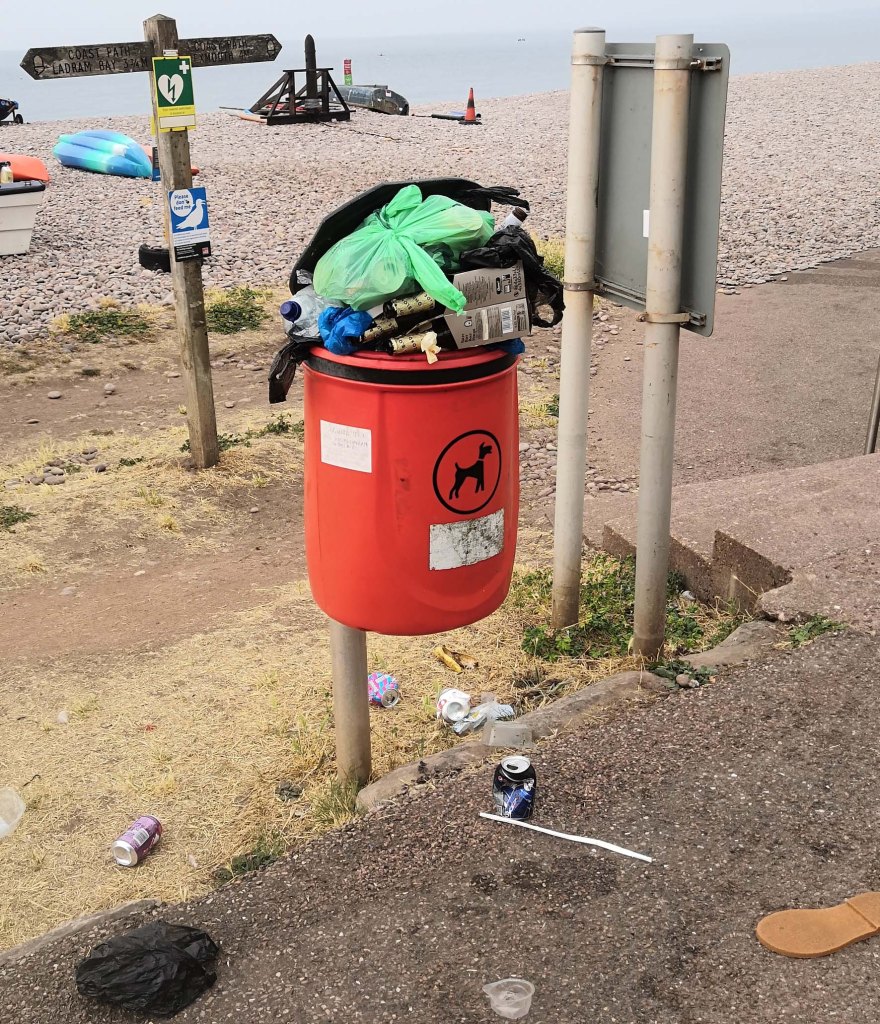
Visitors have arrived at the beach laden with their beach kit: pump-up paddle boards, wind breaks, pop-up tents, and of course the disposable BBQs, bottles galore and their food, often using a collapsible trolley. AND after a lovely time, they head home leaving all their rubbish for EDDC to clear up. Mountains of it. An example last week was a broken pop-up tent just left to blow into the sea. 

If they are able to bring it all down why can’t they take it home? Why, if they drink the beer, don’t they  take the bottles home instead of filling the dog poo bin?

Many of us living in BS could give example after example. But I am sure it is not just our beautiful town which can look like a rubbish tip after a lovely evening. I have no experience but I am sure all our seaside towns suffer from this.

 It is also the expense that I object to. It is said that a large amount of money is spent in the town. I do not believe this. People park at the Lime Kiln car park and never set foot in the town. Most of the food and bottles are bought in their own locality. BS High Street can look very quiet on a hot day.  I gather EDDC gets no government help for all the street cleaning and loo provision. If visitors respected our town perhaps I and many others would not object to this additional expense and not wish for the day when the school term time starts again.

A Budleigh Correspondent.

PS A suggestion. Could EDDC put up notices asking visitors to take their rubbish home, (a few might), as The Lake District does?

Pollution alert. Unsafe to swim at popular beach

One of North Devon’s most popular beaches, Saunton Sands, has been classified as unsafe to swim in due to pollution. A pollution warning has been issued by the Environment Agency today. [Sunday 14 August]

www.msn.com

The Environment Agency website reads: “Bathing is not advised, due to pollution from sewage. Incident started August 14 2022 10:43, affected water: Saunton Sands.”

Other no go swimming spots due to pollution include Wildersmouth at Ilfracombe and Instow.

It’s not the first time a sewage leak has impacted Devon swimmers. Earlier this year DevonLive reported on pollution warnings having been issued for two Devon beaches by an environmental charity. According to the Surfers’ Against Sewage water quality map, sewers had been emptied into the water at Salcombe North Sands and in Seaton.

Read more: Raw sewage pours into the sea at two Devon beaches

Saunton Sands, which lies on North Devon’s golden coast, has gained a reputation as Devon’s most famous beach for its popularity with residents, visitors, filmmakers and musicians. Its iconic 3 1/2 mile beach makes up a large part of North Devon’s World Surfing Reserve and is overlooked by Braunton Burrows, the core of the North Devon UNESCO Biosphere.

South West Water introduces hosepipe ban aka a “TUB”

Our update on the hosepipe ban also known as a Temporary Use Ban

[You couldn’t make this up, could you? – Owl]

From 00:01am on 23 August 2022, customers who get their water from us in Cornwall and a small part of Devon will not be allowed to use a hosepipe.

[Looks like this may still not apply to Owl’s patch]

www.southwestwater.co.uk

hosepipe-ban-update.jpg

It’s the first time in 26 years but we’ve been left with no other choice. We need to have a hosepipe ban now to protect our precious water.

We’ve done our best to avoid this ban. We’ve increased the amount of water we can store – doubling it since the last drought in 1976. We’ve opened reservoirs, installed a new borehole, and improved the way we can move water across the region to help keep everyone’s taps running. At the same time, we’ve reduced the amount of water lost through our own pipes. In the last two years we’ve doubled the amount of leak detection staff and now fix about 2,000 leaks a month. 30% of leaks happen on customer supply pipes, we’ve offered to fix these leaks for free. But all of this hasn’t been enough.

Updates will be regularly made to this page. Updated 07:00 on 15 August 2022.

Check if the ban is in your area

Use this tool to enter your postcode and check if the ban applies to your property.

Enter your postcode to see results:

You don’t live in an area with a hosepipe ban. You may use your hosepipe but please try to save water.

A hosepipe uses 1,000 litres an hour which is more than what a family of four uses in a week. Pick up a watering can and water your plants at the root. Together, let’s save water and keep the South West flowing this summer. For water-saving top tips and free water-saving goodies, click here.

wiggle2.jpg

Why is this happening?

We’ve had very little rain for the last eight months and we’ve had the driest July for nearly a century. In the South West we get most of our drinking water from surface water sources, that’s our rivers and reservoirs. Right now, those levels across the South West are much lower than usual for this time of year.

We’ve also seen demand for water rocket this summer. We plan for increases in demand over summer but in one day we treated over 70 million litres extra of water, which is the equivalent of supplying an extra three cities the size of Exeter. Although we’ve seen demand go down, it’s still much higher than normal for the time of year.

Looking ahead, the weather is forecast to remain warm throughout August and September. Combining that with high levels of demand and the risk of the increase in wildfires across the region means we must take action now.

A big thank you to everyone for taking action and saving water already. It’s a team effort and through small changes in water use we can make a big difference. Together, let’s save water and keep the South West flowing.

wiggle2.jpg

There’s no risk to drinking water supplies for customers. But having a hosepipe ban now will help save water in our rivers and reservoirs because we won’t need to take so much water from them. Protecting our water supply will also help safeguard the precious environment which relies on it. It also means our reservoirs will be able to fill up more over the winter months.

wiggle2.jpg

What can’t you do with a hosepipe….

WaterFillClean
Water a garden using a hosepipeFill or maintain an ornamental fountainClean a private vehicle using a hosepipe
Water plants on domestic or other non-commercial premises using a hosepipeFill or maintain a domestic pond using a hosepipeClean walls, or windows of domestic premises using a hosepipe
Draw water, using a hosepipe, for domestic recreational useFill or maintain a domestic swimming, paddling pool or hot tubClean paths, patios or other artificial outdoor surfaces, such as decking using a hosepipe
  Clean a private leisure boat using a hosepipe
wiggle2.jpg

This hasn’t happened for a long time. For some customers this will be the first time experiencing restrictions on water use. We know you might have questions for us so we’ve answered some key ones below.

Planning applications validated by EDDC for week beginning 1 August

Mirror, Express and local journalists vote to strike in pay dispute

Journalists at the Mirror, Express and dozens of regional newspapers have voted to go on strike in a dispute over pay.

Jim Waterson www.theguardian.com 

They will stop work for four days over the next month, severely disrupting production of the newspapers and their websites. Staff turned down bosses’ offer of a 3% pay rise, arguing it is not enough to cope with the cost of living crisis.

Local outlets that will be affected include the Manchester Evening News, Liverpool Echo, and many websites operating under the “Live” banner. All are owned by publishing group Reach, whose profits boomed in the pandemic but which recently warned of tougher trading conditions.

Its chief executive, Jim Mullen, who earned £4m last year, responded to the strike ballot by saying there would be no further increase on the existing pay offer and “industrial action will not change our position”.

In an email to staff, Mullen said he knew “pay is an important issue to our people” but could not offer more than a 3% increase without risking the company’s sustainability.

One journalist who voted to strike said pay levels were driving people out of the company: “I’m consistently in my overdraft working at Reach. I love my reporting role but if we are only going to get 3% it makes me question if I will move into comms instead.”

In addition to the strikes – which will start at the end of August – there will be a two-week period of work to rule, where staff refuse to take on additional tasks.

Many local journalists may struggle to picket their workplace as Reach has closed most of its regional newspaper offices. The shift to permanent working from home means staff face having to pick up extra heating costs this winter as prices rise.

Backing for the strike was overwhelming among members of the National Union of Journalists, with 79% voting in favour. Staff have complained that the enormous pay gap between Mullen and his journalists is the sort of “fat cat” behaviour the Mirror often campaigns against.

A strike at the Express also creates the prospect of a newspaper that has recently warned about the threat of “militant unions” itself being affected by industrial action. The Mirror is likely to be less affected, as many news journalists are members of the rival British Association of Journalists union, which has accepted the pay offer.

Three in four Tory voters back Labour’s energy plan

Three quarters of Tory voters back Sir Keir Starmer’s plan to freeze energy bills as ministers come under pressure to do more to address the “national emergency” of living costs.

Chris Smyth www.thetimes.co.uk

The Labour leader will set out a £29 billion plan today to prevent energy bills rising for six months, as polling indicates big majorities in favour of this idea and windfall taxes that Liz Truss’s team said would raise the risk of recession.

Dozens of charities also warned yesterday that children would go hungry if ministers did not double their existing support package to cover energy bills.

Greg Hands, the energy minister, said the government was “working up further options for this winter” to present to a new prime minister and acknowledged that “more is going to have to be done”. Both the Tory leadership contenders — Truss, the foreign secretary, and the former chancellor Rishi Sunak — have rejected freezing bills completely.

Hands criticised Labour’s “magical solution to just wish it all away”, saying price increases could not be “abolished” and that freezing bills would “inevitably lead to higher taxes”.

A winter freeze on bills is understood to be one of the measures being examined by officials but government sources said they would “be surprised if the Treasury recommend that” when options are given to Nadhim Zahawi, the chancellor, this week. He is understood to favour a plan to cut bills by £400 through government-backed loans replacing some extra charges to consumers.

Truss is prioritising tax cuts and has promised targeted help for the poorest, and Sunak is planning higher payments to pensioners and those on benefits as well as scrapping VAT on energy bills.

YouGov polling for The Times suggests a public appetite for more radical measures, with only one in eight people saying that they can afford rising energy bills without reducing their standard of living.

Seventy-five per cent support fixing the cap on energy bills even if it means more government borrowing, with 8 per cent opposing. This includes 75 per cent of those who voted Tory in 2019, with 12 per cent opposed. Big majorities in all parts of the country and all age groups back the plan, with little difference between Leavers and Remainers.

Starmer will promote a similar plan in media interviews today and a visit to the southwest of England designed to put pressure on Truss, Sunak and Boris Johnson. He is promising to cancel October’s price cap rise as well as one due in January, arguing it will save households £1,000 in the winter. At present bills are capped at an average of £1,971 a year but this has been forecast to exceed £4,000 over the colder months.

Starmer said people were “scared about how they’ll get through the winter” arguing that his plan was “a direct response to the national economic emergency that is leaving families fearing for the future”.

Labour says that it would pay for the plan by backdating the windfall tax imposed in May to January, closing loopholes in it and scrapping £400 payments to all households that would no longer be needed. The party also argues the freeze would save £7 billion in debt interest payments by reducing inflation driven by rising energy bills.

Critics say the proposals would mean big handouts to wealthy voters, but Labour sources argue that bills are rising so much there are now relatively few families who will not need help.

Voters are split on whether support should be means-tested, backed by 40 per cent, or applied equally to all households, favoured by 47 per cent, according to polling of 1,781 adults on Thursday and Friday.

Ranil Jayawardene, the trade minister who is backing Truss, told Times Radio: “If we don’t stop calls for windfall taxes . . . we will head for the recession that the current economic model is set out to deliver right now.”

Hands, who is backing Sunak, said that the former chancellor was “not afraid to commit big numbers”, but insisted he would not be “showering money around”.

Save the Children, Age UK and Macmillan Cancer Support are among 70 charities urging the next prime minister to increase the help available. In a letter to Truss and Sunak, they say that three quarters of those on benefits have already had to choose between heating and eating and that means-tested support “should be at least doubled” from the £1,200 pledged in May. The Institute for Fiscal Studies has estimated that rising bills mean another £12 billion will be needed to keep the promises made in the spring.

Boris Johnson spotted in Greece on second holiday in two weeks amid cost of living crisis

Boris Johnson has been spotted in Greece enjoying his second summer holiday in two weeks despite the deepening cost of living crisis.

Adam Forrest www.independent.co.uk

The prime minister has been accused of leading a “zombie” government and failing to provide reassurance to families anxious about soaring energy bills expected to hit almost £3,600 this October.

Labour accused Johnson of treating his final weeks in office as “one big party” after he was filmed shopping for groceries in a supermarket in Greece.

Greek news websites reported that Johnson and his wife Carrie were in Nea Makri, a coastal town near Athens, and only a few hours away from where his father Stanley has a villa.

The prime minister returned from a holiday in Slovenia only last week, having enjoyed a break at a mountain resort which offered “healing energies”.

A Labour spokesperson said: “On the evidence of the last few months it seems to make little difference if the prime minister is in the office or on holiday.”

The Labour official added: “It’s all just one big party for Boris Johnson while the country struggles with the Tory cost of living crisis.”

Liberal Democrat MP Munira Wilson said the PM and his “zombie government” had shown “a complete failure of leadership” in recent weeks.

“As the country is gripped with drought, our health service collapses, and the cost of living emergency turns into a cost of living catastrophe, Boris Johnson puts his out of office on for the second time in two weeks.”

Speaking on Thursday, Johnson said he could not offer any new help on energy bills now – but the public can expect the next PM to provide extra financial support in September to tackle spiralling living costs.

A large majority of Tory members still prefer the current prime minister to either Rishi Sunak or Liz Truss, according to latest poll showing “Johnson nostalgia”.

The latest Opinium survey shows Truss has a healthy lead over Sunak in the Tory leadership race, ahead 61 per cent to 39 per cent among Tory members.

But the poll shows signs of regret at the PM’s political demise over the Partygate scandal, and an apparent lack of enthusiasm for either of his would-be successors.

In a head-to-head contest between Johnson and Truss, 63 per cent of Tory members would opt for the caretaker PM, compared with 22 per cent support for the foreign secretary.

Results were even starker in a Johnson versus Sunak contest. Some 68 per cent of Tory members prefer the PM over the ex-chancellor.

Labour leader Sir Keir Starmer has also been accused of going “missing” during the cost of living crisis as he took a summer break.

Starmer, who insisted this week that his party has been “leading” on the cost of living, is setting out his party’s plans to freeze October’s energy price cap rise as part of a “comprehensive” cost of living plan on Monday.

Lib Dem leader Ed Davey – who proposed a price cap freeze a week ago – tweeted Labour: “Glad you liked my proposal to cancel the energy price rise. I also have some thoughts on electoral reform that you’re welcome to adopt.”

Devon councils urged to merge in drive for efficiency

Devon should merge its councils into a small number of unitary authorities, the county council’s opposition leader suggests. Currently, Devon’s local government consists of three top-tier authorities – Devon County, Torbay and Plymouth – and eight lower-tier (district, borough or city) councils, including Exeter.

Ollie Heptinstall www.devonlive.com

Plymouth and Torbay became unitaries in 1998, meaning those councils are responsible for all local services, including education, children’s services and adult social care, as well as those delivered at district level elsewhere in Devon, such as refuse collection. The setup is different to Devon’s neighbouring counties. Cornwall has been a single unitary authority since 2009, while Somerset becomes one next year, when its five councils merge.

Cllr Julian Brazil, leader of the opposition Liberal Democrat group at Devon County Council, claims that adopting a similar approach in Devon is likely to save money and reduce bureaucracy. “Unitary to me, in this day and age, the efficiencies you get out of it outweigh any of the disbenefits,” he said.

As an example, Mr Brazil, who represents Kingsbridge, explains how district councils currently operate their own car parks but the county is responsible for on-street parking, meaning they employ separate traffic wardens. However, Cllr Brazil admitted the county’s size may prevent it from becoming one single council: “Maybe it will be the whole of Devon, I don’t know, but I think it’s more likely that we’d probably be split into three, as other counties have been.”

The Devon unitary debate has been ongoing for years. Between 2007 and 2010, significant energy was put into attempts to reorganise the county’s two-tier structure. The two options on the table then included a ‘super council’ unitary authority for Devon, apart from Torbay and Plymouth, and promoting Exeter to unitary status like Torbay and Plymouth.

The Exeter option was given the green light by the-then Labour government only to be scrapped when the Conservative-Lib Dem coalition came to power in 2010. But the issue is still bubbling away, and Cllr Brazil doesn’t think “we should rule anything out.”

He added: “With Zoom and Teams meetings, [the county] is suddenly a lot smaller … in the sense that I can now have a face-to-face meeting with somebody who lives in Barnstaple and I’m down in Kingsbridge and they’re there in the room. It’s not ideal and it’s not perfect, but it makes it easier.” However, the county council’s long-serving leader, John Hart (Conservative, Bickleigh and Wembury), opposes reorganisation and questions whether savings would be made.

“I could see advantages for a dictatorship,” he said. “But [not] once you’ve got politics involved.”

“Some things that we do as a county are right for Devon. A lot of things that the districts do are right for smaller areas. If you’re going to create a county and then split it up into the areas, you’re not really going to save very much anyway.

“I don’t see massive savings. There could be some savings, I’ll be honest, but the government would not let us be big enough to produce the savings in my view.”

“I’ve always been against on the grounds that if you go for unitary, it would have to be a united front or we would have blood on the table. [If you] go for unitary with the districts opposing you, you finish up with district members all running the council. The first thing they will do is fall out amongst themselves, because north and south won’t agree on what is required, so I would hesitate completely.”

Cllr Hart believes any attempt to split Devon into two will result in one poor and one rich area. He also suggests that were Devon “ordered to go down the unitary route, I’m sure Plymouth and Torbay would be thrown in the mix whether they like it or not, which would mean three [authorities].”

Sidmouth Saturday: massive cliff fall rumbles along coast

Sidmouth has seen another cliff fall this morning. The eroding cliff was crashed onto the beach below at around 9:30am in front of sun-worshippers on the seafront.

[See devonlive for video]

Lili Stebbings www.devonlive.com 

An eyewitness said: “[I heard] a low rumble and then the fall followed by a good 10 mins of dust cloud. Fingers crossed no one was on the beach.”

It comes just days after emergency services were called to the same spot as pictures showing clouds of dust and rubble emerged from the scene as the cliffs broke away. Coastguards and Police were called to the scene as people were being told to stay away.

Rural East Devon Police tweeted at the time: “Another large cliff fall this morning. Reminder to beach users not to walk on the beach East of #Sidmouth due to unstable cliffs which could fall at any time.”

One eyewitness, Lynda, told Devon Live that there were a number of cliff falls in the area before the ‘large’ one took place on the morning of August 8. She said: “There were about five or six cliff falls leading up to the large on this morning in Sidmouth.”

Sidmouth sees another cliff fall

Sidmouth sees another cliff fall (Image: Caroline Montgomery)

It comes after it was announced that it would cost £19million to save Sidmouth’s crumbling coastline. Vital sea defences to save Sidmouth’s crumbling coastline and protect the Esplanade has now gone up by £5million increasing the estimated cost to a total of £19million.

Last October, East Devon District Council (EDDC) and the Sidmouth and East Beach Beach Management Plan Project Advisory Group approved a new and improved £14 million outline proposal.

It is now proposing to proceed to the next stage, with plans to secure the extra funding from government or by bridging the shortfall if required. The aim is to start work on the scheme in spring 2025, giving Sidmouth seafront and East Beach the coastal defences it needs.

Rivals fiddle while UK burns

It’s the driest, hottest summer in 50 years, yet the Conservative leadership candidates appear to be fiddling while Britain burns.

Rowena Mason www.theguardian.com 

Rishi Sunak and Liz Truss have barely been asked anything about their plans for tackling the climate emergency in all their debates and hustings so far – and nor have they made it a leading campaign issue themselves.

Their main wisdom on the subject of the drought is putting water companies “on notice” that they need to fix leaks, to avoid the necessity of households facing hosepipe bans.

Although both have committed to the net zero target, neither has talked about the crisis facing the climate with much passion or interest.

Sunak has frequently characterised his young daughters as the experts on climate in his household – surely embarrassing for a former chancellor to admit – and does not like the idea of more onshore wind turbines.

He was once thought by environmentally conscious Tories to be the biggest risk to the government’s climate aspirations, as they believed he was blocking ambitious plans to transform the UK’s energy needs on the grounds of cost.

However, the signs are that Truss, a former environment secretary, could be even less committed to net zero. Her answer to soaring energy costs, worsened by extreme winter weather conditions caused by climate breakdown, is to remove green levies from household and business bills.

It is not yet clear whether she would pay for these instead out of general taxation or scrap initiatives to insulate homes and subsidise renewables altogether. In a hustings, she suggested that net zero was a problem for business rather than government to solve.

She also cut funding for solar farms while environment secretary, calling them a “blight on the landscape”, and in a hustings vowed to remove their “paraphernalia” from fields. At the same time, she is backing fracking – popular in theory with Tory activists and MPs, but not if it is planned for their own area.

Surprisingly, Chris Skidmore, a Tory MP and the founder of the Tories Net Zero Support Group, has switched sides from Sunak to Truss in recent days, but cited the former chancellor’s U-turns as the reason.

Two Tory MPs – Vicky Ford and Simon Clarke – have also cited Truss’s support for Cop26 as a reason for backing her. But Nicola Sturgeon, the first minister of Scotland, recalled meeting Truss at the climate crisis summit in Glasgow and said the main thing she wanted to discuss was how she could get into Vogue.

Among Conservative MPs, those opposing net zero policies – such as Steve Baker, a Truss supporter – have scented an opportunity to win back ground. One of Truss’s high-profile supporters, Lord Frost, said last week that there was no evidence of a climate “emergency” and urged the next prime minister to move away from “medieval technology” such as wind power.

In fairness, those questioning the candidates have not given the topic much airtime. Open Democracy calculated that just two minutes out of an hour of interviews on the day of the first heatwave were dedicated to the climate.

But neither candidate has been keen to portray themselves as a keen supporter of the fight against climate breakdown. A lukewarm stance on the climate may win cheers at hustings, and even sway some Tory members, but polls tell a different story about voters across the spectrum, including many Conservatives and swing voters, with the country deeply worried that politicians are not doing enough.

Britain’s wetlands are the key to saving us from drought, wildfires and even floods

Fresh water is the lifeblood of civilisation. It makes life on land possible. But we have lost touch with how the water cycle works. As Britain runs further into serious drought, people are asking if we are prepared and if we should have planned better, by building more reservoirs or plugging leaks in the water distribution system.

Tony Juniper, chair of Natural England  www.theguardian.com 

These are hugely important subjects. What is not being discussed are the severe floods that may well arrive in a few months’ time. Climate change is leading to greater volatility in the water cycle. It’s time to stand back and examine our resilience to water extremes and start improving water quality.

One standout conclusion for me is that we need to have much more water in our environment. During the last 100 years, the UK has lost 90% of its wetlands. This has led to the drastic decline of wildlife and rendered the country more vulnerable to the effects of extreme conditions. Draining fens, desiccating peat bogs, drying floodplains and the claiming of coastal marshes has transformed how our land looks and works. Restoring some of those wetlands could deliver huge benefits.

Wetlands can help to keep rivers flowing, even when rain is scarce, thereby protecting the living, shimmering threads that bring life to the landscape. Water standing on the land also helps recharge the aquifers that underpin much of our public water supply. Holding more water in the environment through the restoration of wet ecosystems can reduce flood peaks and protect us from the misery of the flooding that periodically affects communities across the country.

During a recent visit to Norfolk, I saw a newly created beaver pond. The animals had been released by the farmer into a large wooded pen on the site of an old wartime base. A tiny stream had been impounded by the animals to create a quite substantial body of water topped up with winter rain. Since the rain stopped earlier this year, that pond has been sustaining a headwater stream of the Glaven, one of England’s precious chalk rivers. The new beaver pond has helped that wonderful watercourse remain in better shape than it would otherwise have been. When it does rain again, that stream will flow more evenly than if there were no beavers, therefore reducing the risk of floods.

Beaver ponds and wetlands in general are also excellent at catching carbon and other pollutants such as agricultural fertilisers, so they can play a role in meeting water-quality targets. That beaver pond was also a reminder of how wetlands can bring vibrant life back into otherwise degraded landscapes. Frogspawn, fish, birds and wetland plants had all found a home there.

Wetter conditions also diminish the risk and effect of major fires. For decades, many of our upland blanket bogs have been subject to drainage, rendering them more susceptible to fire. Making these bogs wetter can not only reduce that peril but also improve water quality, increase wildlife and reduce downstream flooding.

At Natural England, we are pleased to see lots of plans afoot to make more of wetlands. The new Environmental Land Management schemes that are replacing the EU’s common agricultural policy are a major opportunity. The new tool of biodiversity net gain, which will require developers to replace and increase habitat lost to housing and infrastructure, will add to the mix. So, too, will plans to create new wetlands to soak up nutrients from new housing developments. There is a national programme to improve peatlands and also a partnership with businesses, vigorously led by the Wildfowl and Wetlands Trust, to create 100,000 hectares (247,000 acres) of new wetlands.

There are also opportunities for water companies in the development of nature-based solutions, which harness habitat creation as a natural partner and complement to hard infrastructure. There could also be huge benefits in the careful design of engineering infrastructure such as reservoirs. One example is the Abberton reservoir in Essex, which is not only a major strategic water supply asset, it is an internationally important habitat for many bird and amphibian species.

A more natural water cycle should be a strategic national priority. Winston Churchill famously once said that we should “never let a good crisis go to waste”. The current drought, and the floods that are likely to arrive later in the year, should be an opportunity to find a new way of looking at water.

‘Local government treated worse than any other part of public sector’

Clive Betts, chair of the Levelling Up, Housing and Communities Committee, talks to Mike Thatcher about lack of progress on levelling up, pork-barrel politics and why local government finance cannot be reformed until social care funding is sorted.

www.room151.co.uk 

Is levelling up yesterday’s priority? With the cost-of-living crisis dominating the political agenda and the main levelling up evangelists – Boris Johnson and Michael Gove – going or gone, there’s certainly a feeling of old news about the phrase.

Johnson described levelling up as the “defining mission” of his government, while Gove, as levelling up secretary, set out in the levelling up white paper how undervalued communities could “take back control”.

But levelling up has been discussed rarely during the Conservative leadership hustings, and it has not been a differentiator between Liz Truss and Rishi Sunak. If Truss does become the next prime minister, as the polls suggest, it is hard to see levelling up being the focus of her speech outside No 10 as it was for Johnson three years ago.

So will levelling up go the way of David Cameron’s Big Society – a slogan that never really had any tangible impact and was then quietly forgotten?

Who better to ask than Clive Betts, the chair of the parliamentary Levelling Up, Housing and Communities Committee? Betts has chaired the committee in its different guises since 2010, and has conducted inquiries most recently into the Levelling Up and Regeneration Bill, long-term funding of adult social care, the regulation of social housing and the planning system.

The veteran Labour MP will be discussing levelling up at the Room151 Local Authority Treasurers Investment Forum and FDs’ Summit on 13 September. He tells Room151 that the next PM might not see levelling up as their top priority, but it would be hard for the government to abandon the philosophy altogether.

Has levelling up lost its lustre?

“The cost-of-living crisis may politically have to be top of the new PM’s in-tray. But they still have to address their red-wall seats and I don’t think they will let levelling up just go,” he says.

Betts expresses disappointment at the lack of progress on the levelling up agenda. He says that Gove succeeded in raising the profile of the concept, and helped it to be seen as a key challenge for the country. But he believes that there is no evidence to demonstrate that it has made a significant difference to the experience of those in the more deprived parts of the UK.

“There are far too many disparate pots of money that councils have to bid for and no linking up of those, no overall strategy and, essentially, no fundamental change in overall government departmental budgets towards the deprived areas.”

Both Gove and Neil O’Brien, the former levelling up minister, talked about moving away from what became known in local government as the “tyranny of competitive funding” to a more formula-based approach. O’Brien told Betts’ committee that what was needed was a “balanced diet” of funding.

Betts says now that ministers talked the talk, but there has been little sign of any change of emphasis. When asked if there is political manipulation of the funding for both the levelling up and towns funds, he says “it looks like it”.

Political manipulation

Opponents of levelling up have seen it as a move to US-style “pork-barrel politics”. It is tempting to agree, given that 40 out of 45 of the towns receiving funding from the towns fund had a Conservative MP. And, of course, Sunak openly admitted, in a campaign speech, that as chancellor he had started to change the formulas so that towns like Tunbridge Wells received funding rather than “deprived urban areas”.

Betts points out that Sunak’s leafy Richmond constituency was favoured over towns like Barnsley when it came to bids for the levelling up fund. And he admits to being depressed by the level of debate between Truss and Sunak.

“Local government has been treated worse than any other part of the public sector since 2010. It has had bigger reductions in its spending and there doesn’t seem to be any recognition that if there is spare money around at the Treasury, local government, and particularly priorities like social care, ought to be at the top of the list of spending rather than corporation tax cuts.”

Both Sunak and Truss have signed up to the four pledges put forward by the Northern Research Group of Conservative MPs. The four pledges are: a minister for the north; Voxbridge (two vocational institutions in the north of England); a right to devolution for all areas of the UK; and a levelling up formula to ensure that “forgotten areas” are no longer left behind.

Spending commitments on care

But Betts says he wants more than pledges. What is really missing are spending commitments, and particularly an appreciation of the urgent need for more social care funding.

“You are only going to get levelling up if you address the fundamental inequalities of government spending currently. Until you get core departmental budgets redirected, you won’t get levelling up.

“They have got to find a way of getting money to social care on a long-term basis with a degree of certainty. When we did our inquiry, it was said over and over to us by both Conservative leaders in local government and Labour leaders, until you sort social care funding out you can’t sort local government finance out.”

Social care is vital, he says, but the focus on care means that other local government services – libraries, parks, buses, street cleaning and environmental health – have had to face cuts of up to 50%.

“There is a real danger that many members of the public who don’t receive social care, and their families don’t, which is most of the public, are paying more and more council tax every year for less and less service. That is a real challenge to local democracy and to people’s willingness to support it.”

So what is the solution to that? “Sorting out social care funding,” he says.

Simon Jupp says he will talk about consumer energy bills in the Autumn

Under the heading: “Unlike households, businesses do not benefit from an energy price cap”

[Aren’t we householders are sooo lucky? – Owl]

Simon Jupp writes:

“I will be using future columns to talk again about consumer energy bills and more support this autumn.”

Stay calm and await announcements

Simon Jupp’s article can be found here www.devonlive.com