Electoral reform group seeks £1m to back MPs who can beat Tories

A grassroots campaign is hoping to raise £1m to bring more supporters of electoral reform to the Commons at the next general election.

Heather Stewart www.theguardian.com 

The group, called Win as One, will work with candidates from progressive parties who are well-placed to beat the Tories and are in support of proportional representation (PR).

Coordinated by campaign group Compass, the project’s aim is to urge candidates from Labour, the Liberal Democrats and the Greens in England and Wales to sign up to support PR – and to coordinate more closely.

With the Labour leadership sceptical about electoral reform, and having ruled out any agreement with the Lib Dems ahead of a general election, Win as One is described in a presentation seen by the Guardian as a “citizens’ pitch invasion, to change the government and the political system”.

“Instead of waiting for party leaders, who may be too cautious to do what’s needed, we will build a national and local movement based on the strengths we already have: our activism, our voices, our votes,” the presentation says.

Win as One hopes to channel resources and activists to support reform-minded candidates from any progressive party; and, more controversially, to help broker agreements about which party is more likely to win and where – what was previously called a “progressive alliance”.

Candidates would be asked to sign up to a pledge supporting electoral reform. The campaign would then aim to help support a caucus of pro-PR MPs in the House of Commons who could work together to press for change.

The group aims to encourage dialogue between activists of the different progressive parties at local level – a challenging task where tribal loyalties run deep.

The long-serving Labour MP for Dagenham and Rainham, Jon Cruddas, said Win as One could tap into a desire for change he compared to the early 1990s. “Every so often, there is a sense of an anti-Tory movement – I think we’re approaching one of those moments, and this is to maximise and capitalise on that,” he said. “People are so frustrated with politics that they want something different.”

Labour and the Lib Dems are extremely wary of any formal pact that would require them to stand down candidates in particular seats in favour of their rivals – or hint at a coalition if Labour failed to win outright.

Keir Starmer recently said he would not strike any agreement with the Lib Dems or the Scottish National party even after the next general election.

Labour and the Lib Dems are wary of the “coalition of chaos” argument that was widely felt to have damaged Ed Miliband’s prospects in the 2015 general election.

A Lib Dem source said the two recent byelection results in Tiverton and Honiton, and Wakefield – won by the Lib Dems and Labour respectively – showed the electorate was capable of voting tactically anyway, without the need for backroom deals.

But if Labour win without an outright majority, support for PR would be a likely condition of Lib Dem backing for Starmer’s governing platform.

Sign up to First Edition, our free daily newsletter – every weekday morning at 7am BST

Coalition negotiations between the Conservatives and the Lib Dems after the 2010 general election resulted in a referendum on the alternative vote (AV) system, which ensures seats are only won by candidates with majority support, but does not produce a proportional parliament. However, the proposal was defeated by 68% to 32%.

Starmer is coming under mounting pressure over electoral reform from within his own party. A motion supporting PR at last year’s Labour conference was backed by 80% of constituency delegates but failed to pass without trade union support.

Since then, Unison and Unite have shifted their position. After Unite’s conference voted to support PR last October, its general secretary, Sharon Graham, said: “Our political class has failed working people and our system is broken. It is time to change our democracy.”

MPs warn up to £1bn of Lotto charity cash could be siphoned off by legal battle

Oh dear, Nadine Dorries to decide – Owl

MPs urge ministers to stop up to £1BILLION of Lotto money earmarked for UK good causes being spent on Canadian teachers’ pensions amid legal battle over future of game

  • Camelot fighting Gambling Commission decision to let someone else run game 
  • European lottery operator Allwyn preferred applicant for the fourth licence
  • MPs worried about scale of possible damages that Camelot could receive  
  • Owned by Ontario Teachers’ Pension Plan, which has made £300m since 2017

www.dailymail.co.uk (Extract)

Camelot is seeking to have the decision overturned and be awarded the licence but the Gambling Commission wants to go ahead and give it to Allwyn before the court rules, arguing to do otherwise ‘poses a significant risk’ of reducing cash going to good causes.

However, the former chief executive of Camelot, Dame Dianne Thompson warned earlier this year that going ahead and then losing the case to Camelot could lead to massive compensation. 

She said drain up to £1billion otherwise destined for good causes via the National Lottery Community Fund and demanded the decision be delayed.

Now MPs are concerned that Camelot could scoop massive damages, cash that would go to its owner, the Ontario Teachers’ Pension Plan.

Tory MPs including Hastings and Rye’s Sally-Ann Hart and ex-Tory vice-chairman Ben Bradley have written to Culture Secretary Nadine Dorries asking that she take steps to make sure money earmarked for good causes is not at risk.

In a letter seen by MailOnline they say that it would be ‘an unacceptable cost to the British taxpayer’ at a time when the economy and civil society is under severe pressure.’

‘Brexit bonus’ plan to allow motorists to drive HGVs without extra tests to help solve driver shortages

Surely this is madness – Owl

Motorists are set to be allowed to drive lorries without taking a test under a “Brexit bonus” plan to help solve driver shortages.

Stephen Rigley www.lbc.co.uk

Transport Secretary Grant Shapps will launch a consultation on whether to lift the Brussels-imposed ban on motorists driving anything larger than a 3.5-ton vehicle.

It means motorists cannot drive vans and lorries up to 7.5 tons without taking further tests, or minibuses with up to 16 seats without restrictions.

Mr Shapps believes lifting the ban could increase the pool of commercial drivers, boosting job opportunities and the economy. It could also help address shortages of HGV drivers because some may graduate to drive heavy goods vehicles.

A government source told the Telegraph: “We are past the days when EU directives were handed down on tablets of stone, and we should be prepared to liberalise where we can, testing the necessity for maintaining driving restrictions that were once thought unnecessary in this country.

“Grant thinks we should have a fresh look at this, but of course this has to be done with due regard for safety.”

EU rules enshrined in UK law bar any motorist with a full driving licence gained after Jan 1, 1997, from driving any vehicle over 3.5 tons without a further specialised test.

Mr Shapps is understood to believe there is a strong case for returning to pre-1997 rules, where anyone with a full licence could drive any vehicle up to 7.5 tons.

In a letter to MPs, the Transport Secretary wrote: “It has been suggested that now the UK has left the European Union, we may wish to allow all car drivers – not just those who passed their test before Jan 1, 1997, the right to drive these larger vehicles without need for a further test.

“Changes to the licensing categories would potentially create a greater pool of drivers. I am quite happy to explore this idea and how this may work in reality – without making any commitments to legislative change at this stage.”

He said the consultation aimed to seek “evidence on the economic benefits of widening the recruitment pool for medium-sized goods vehicles and minibus drivers, which may attract more people to the industry and support economic growth by further strengthening our supply chain”.

A cross-party group of MPs called for the logistics industry to “get its house in order”, including better overnight facilities for drivers and new training routes to recruit more hauliers, as the sector faces labour shortages.

The Commons Transport Select Committee said that if the changes are not made within two years, then the most profitable parts of the sector should face a new tax.

Under the proposed Supply Chain Levy, large supermarkets, oil companies and online service giants could be forced to pay towards the cost of new facilities for heavy goods vehicle (HGV) drivers.

Comments on hosepipe bans

From a correspondent:

Will the water user be falling into line with the hosepipe ban?  Let us hope for the sake of our environment that these Hampshire residents, heard on the Today programme of 05/08/2022, reflect the majorities’ view. That people will just “raise eyebrows” and “pay the price” for the gross mismanagement and profiteering. 

“I think when hosepipe bans are announced people want to do their bit but for the environment and want to help. But there is the issue that people in our community have seen years if not decades of water leakage and the water companies not doing their bit. So at this time when bills are high and people are wondering where their money is going being asked additionally to stop using hosepipes is going to raise eyebrows on the south coast.” 

“I am disappointed as at much that its us lawn lovers who are going to pay the price for mismanaging maybe allowing the leakage to continue over years and years.”

[The relevant part of the programme starts at 1hr 36mins of the recording. Worth listening to the end to hear the Chair of British Water try to explain why additional reservoirs are only in the planning stage, not actually being built]

Who runs a caretaker government when the caretakers are on holiday?

What do you call a country with a caretaker government when the caretaker has gone on holiday in the middle of an economic crisis and a European war?

Sean O’Grady www.independent.co.uk 

Why, the United Kingdom, of course. It seems Boris Johnson might have had a point when he said that this was no time for a protracted and distracting leadership election. Of course, that was the price the country paid when his government collapsed beneath him through his own fault, and thus he cannot escape culpability. Still, so it is proving: Britain is drifting into recession and an existential struggle for survival for the most vulnerable in society. Families who, in Theresa May’s famous phrase, were just about managing in 2018 or 2019 are now faced with a squeeze on living standards unprecedented since the Second World War: higher fuel and food prices, energy bills, council tax, tax and national insurance, with rents and mortgages up.

The situation is getting dire and it demands leadership. But the caretaker prime minister is demob happy and on his second honeymoon, the caretaker chancellor, Nadhim Zahawi, is away on holiday and the caretaker deputy prime minister, Dominic Raab, is busily spinning for the former proper chancellor, Rishi Sunak. Meanwhile, the caretaker foreign secretary is touring the country making impossible promises and bad policy on the hoof. The likely future chancellor, Kwasi Kwarteng, doesn’t know the whereabouts of Boris Johnson (one can only hope that Carrie Johnson does). It’s not ideal.

A new premier won’t be in office for another month, nor many of the new ministers, and problems are piling up. Contrary to some expectations, the next prime minister will also mean a change of policy in key areas, and more radically so in the case of Liz Truss. Strong and stable government, to borrow again from the Big Theresa May Book of Doomed Slogans, is at a premium.

It is difficult to find encouraging precedents for such a collective dereliction of duty. Funnily enough, the last Tory leadership election in 2019, which yielded Johnson, was another exercise in self-indulgence because vital Brexit negotiating and preparation time was spaffed away on a meaningless contest between Johnson and Jeremy Hunt.

In economically and geopolitically sunnier times there was even some mild amusement to be had from the usual tussles for power when the PM is indisposed or away. Of course, modern communications mean that prime ministers are able to keep abreast of events even when they’re on the other side of the world, as has been the case for decades – provided, that is, they still want to take an interest in the job. Margaret Thatcher disliked not being in control; she didn’t bother with holidays much at all.

Others did “chillax”, as David Cameron put it. For example, there was never much of importance going on that Tony Blair wasn’t aware of, even if he was relaxing in Tuscany or hanging out in the Caribbean hideaways of Cliff Richard or Richard Branson, but it was fun to see John Prescott, Peter Mandelson and Gordon Brown try to show who was in charge. Prescott even went to the seaside to name a crab “Peter” as a bit of fun. But at least the civil servants had a range of powerful personalities to turn to if they needed a decision and didn’t want to trouble the PM. Not so much now, though.

Only rarely has the British government suffered from such lassitude as it does today. In the early 1950s, Churchill – approaching 80 and in his Indian summer as premier – suffered a series of strokes, unbeknown to the public. Usually his experienced designated deputy, Anthony Eden, took over seamlessly, but on one occasion Eden was also sick in hospital with a persistent gallbladder complaint and the government was run by the chancellor, RA Butler. It was a time of some international tension and the country was emerging from post-war austerity, but no harm was done during the hiatus before Churchill’s return. Now things are much more dicey, and much of the country is already suffering financial hardship.

Many voters will wonder why they have to wait another month without some help.

Tories leave Britain storm tossed and rudderless as bank raises interest, forecasting 13% inflation and recession

Both Boris Johnson and Chancellor Nadhim Zahawi are on holiday this week.

Anyone steering the ship of state?

Has Jacob Rees-Mogg posted “Sorry to have missed you” notes on their doors?

Rishi Sunak admits taking money from deprived areas

Is this why Exmouth and Axminster keep losing out? – Owl

Rishi Sunak has admitted taking money from deprived urban areas in order to give it to other parts of the country.

Rajeev Syal www.theguardian.com 

The former chancellor, who is standing to be prime minister, made the claim last month while speaking to Conservative party members in Tunbridge Wells, Kent.

In footage obtained by the New Statesman, Sunak said: “I managed to start changing the funding formulas to make sure areas like this are getting the funding they deserved.

Link to Twitter here 

“We inherited a bunch of formulas from Labour that shoved all the funding into deprived urban areas and that needed to be undone. I started the work of undoing that.”

Tunbridge Wells has a Tory majority of 14,645 and has been held by the party since the constituency was created in 1974.

An analysis by the Guardian in February found that, under Boris Johnson’s “levelling up” agenda, some of the wealthiest parts of England, including areas represented by government ministers, were allocated 10 times more money per capita than the poorest.

The analysis brought together the four main levelling up funds for the first time. The future high streets fund, the community renewal fund and the towns fund have been fully allocated, while the levelling up fund has allocated £1.4bn, with a further £1.8bn still to be announced. A total of £4.7bn has been allocated in England across the four schemes so far.

It is not clear from the video to which funding formula or levelling up fund Sunak is referring.

Labour’s Lisa Nandy, the shadow levelling up secretary, said: “This is scandalous. Rishi Sunak is openly boasting that he fixed the rules to funnel taxpayers’ money to rich Tory shires.

“This is our money. It should be spent fairly and where it’s most needed – not used as a bribe to Tory members. Talk about showing your true colours.”

Sunak’s Conservative colleagues were divided over the footage. The Foreign Office minister Zac Goldsmith said: “This is one of the weirdest – and dumbest – things I’ve ever heard from a politician.”

Jake Berry, the chair of the Northern Research Group of Tory MPs, said that in public Sunak “claims he wants to level up the north, but here, he boasts about trying to funnel vital investment away from deprived areas”.

“He says one thing and does another – from putting up taxes to trying to block funding for our armed forces and now levelling up,” Berry, a Liz Truss supporter, said.

But Sunak’s supporters rallied around him, with the Conservative Tees Valley mayor, Ben Houchen, arguing that Johnson led the party to electoral victory on a pledge to invest in areas “that have been ignored at the expense of urban cities”.

The public accounts committee, parliament’s spending watchdog, has been critical of the lack of rules over the towns fund. The levelling up fund is supposed to create economic growth but with no clarity of what that means and no measurements of success.

Responding to Sunak’s words, Meg Hillier, the chair of the cross-party PAC, told the Guardian: “This is evidence of a deliberate decision to change public spending priorities based on who you know.

“Pork barrel politics is unfair on taxpayers, and the areas that don’t get the funding cannot even begin to qualify for the cash in a game with no rules.”

Sunak is reported to be trailing Truss in the race to succeed Johnson as prime minister, as party members begin voting. But there is still a month of the campaign to go, with the result to be announced on 5 September.

Both candidates will appear at another hustings event on Friday evening, this time in Eastbourne, where they will take questions from Tory members.

Sunak’s campaign did not dispute the video, but argued that he had moved the cash from inner city areas to towns and poorer rural areas.

A source said: “Levelling up isn’t just about city centres, it’s also about towns and rural areas all over the country that need help too. That’s what he changed in the green book and he will follow though as prime minister.”

They added: “Travelling around the country, he’s seen non-metropolitan areas that need better bus services, faster broadband or high-quality schools. That’s what he’ll deliver as prime minister.”

The government was criticised last year for the terms of the £4.8bn levelling up fund, after it emerged that dozens of Conservative regions were placed in the top tier for assistance, despite their relative affluence.

Ministers responded to the backlash by saying they “did not have any of the political influence” suggested and had left the scheme in the hands of civil servants.

In 2020, Robert Jenrick, the then communities secretary, admitted that he and a junior minister approved payments to towns in each other’s constituencies from another government fund earmarked for deprived areas.

Sewage sleuths: the men who revealed the slow, dirty death of Welsh and English rivers – The Axe

The Long Read in yesterday’s Guardian concerned an investigation by amateur sleuths: retired professor Peter Hammond and retired detective superintendent Ashley Smith. Between them they have uncovered how the clean-up of our rivers has stalled in the past couple of decades, and the reasons why.

This extract describes the situation on the Axe.

Oliver Bullough www.theguardian.com (Extract)

…When EA inspectors checked farms along the River Axe in south-west England between 2016 and 2019, they found that almost every farm was non-compliant with the rules for storing slurry, silage or fuel oil, all of which are harmful if they leach into rivers. On almost half of the farms, the inspectors saw pollutants entering the waterway. Farmers told the inspectors they had been flouting the rules because they saw the risk of enforcement as being so low – a problem the regulators know all too well. “Last year, we had sufficient resources that would allow us, in theory, to visit every farm … less than once every 200 years,” Bevan, the EA chief executive, told a parliamentary committee last year. “That is not a great disincentive to a farmer to stay on the right side of the line.”

“I get bloody irritated, and so do most people in the EA,” one veteran EA inspector told me. “The problem is that we don’t have the resources or the legislative muscle to do what everyone knows we need to do. But you only have to look at some of the farms in Herefordshire – they are big businesses, they are not scared of loose legislation or penalty notices. They can ignore all that.”

A year ago, the government provided funding for 50 additional inspectors to check farms in England, which will increase the headcount to 80, but that will only repair some of the damage caused by a decade of underfunding. “Given the length of the river system in this country, having only a few hundred people to oversee them is a pretty tall ask,” said Bevan, in evidence to parliament.

Such interventions from Bevan are noteworthy for their laconic understatement, but the ex-inspectors and current insiders who were prepared to talk to me spoke more in the language of crisis. Although little is being done to prevent sewage and manure from poisoning our rivers, at least we recognise the problem and are seeking to understand it. With regard to other threats, such as those from antibiotic-resistant micro-organisms, microplastics or “forever chemicals” such as polyfluoroalkyl substances – which are used in dozens of consumer products and have been linked to multiple serious diseases – the collapse in funding has reduced research, meaning we are always looking at pollution in the rear view mirror. “We don’t know what’s getting into the rivers. Nobody’s looking,” said another former EA inspector who took early retirement thanks to the funding cuts. “That’s a complete failure.”

So, what’s the answer? Some local groups – such as the Friends of the Upper Wye and the Wye Salmon Association, near where I live – have started testing the rivers for themselves, trying to discover the extent and the origin of the pollution. But gathering the volume of data that Hammond had access to requires resources far beyond even the largest NGOs. Truly understanding what is happening to our waterways could only come from the regulators doing the kind of monitoring and analysis they used to do before their budgets were gutted….

Who paid for “Fizz with Liz”?

Liz Truss is embroiled in fresh controversy after a leaked email left her facing questions over why she did not declare thousands of pounds spent on schmoozing Tory MPs in the run up to her bid to succeed Boris Johnson.

Simon Walters www.independent.co.uk

Around a dozen Conservative MPs attended a so-called “Fizz with Liz” champagne dinner hosted by the foreign secretary at Mayfair members club 5 Hertford St last year.

The event was paid for by club owner, multimillionaire aristocrat Robin Birley.

When The Independent asked why Ms Truss has not declared the function – worth an estimated £3,000 – in the Commons register, where MPs are obliged to disclose hospitality worth more than £300, her spokesperson denied she had organised it.

It had “nothing to do with her,” they said. Ms Truss was merely one of a number of Conservative MP guests invited by “organiser and host” Mr Birley, the spokesperson said.

However, this account is disputed by other MPs present who told The Independent that she was the host and not Mr Birley, who “turned up briefly to say hello”.

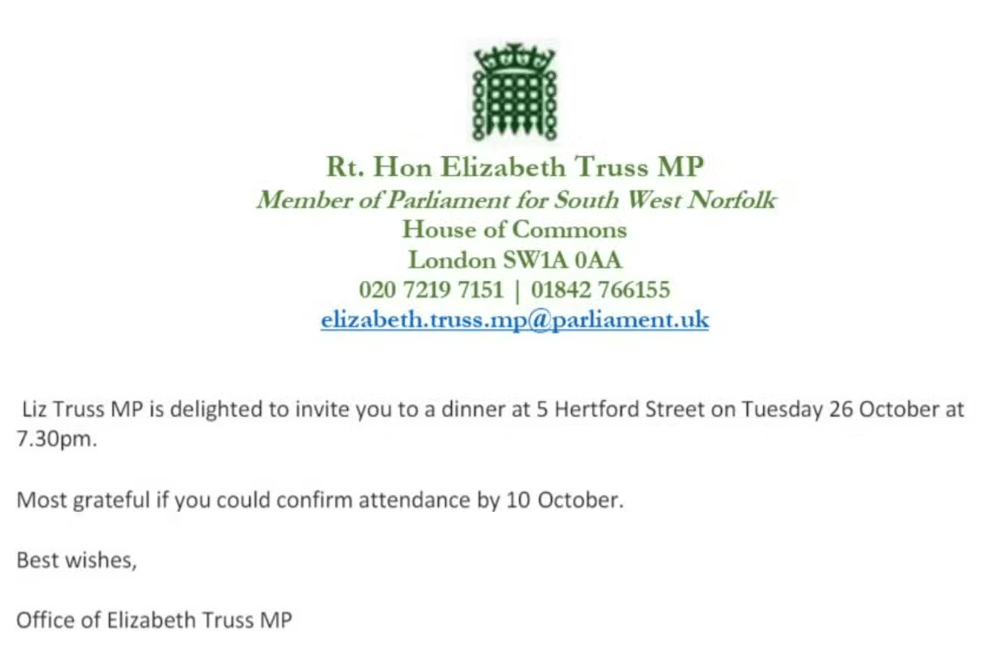
The invitation sent to MPs suggests the event was organised by Truss’s office

( Supplied)

Moreover, they said they were invited by Ms Truss. Their version of events appears to be borne out by a copy of the invitation obtained by this newspaper.

Sent from her Commons email address, it said: “Liz Truss MP is delighted to invite you to attend a dinner at 5 Hertford Street on 26 October at 7.30pm. Most grateful if you could confirm attendance by 10 October. Best wishes, Office of Liz Truss.”

A source close to Boris Johnson told The Independent that he was informed that at the time that Ms Truss had met a group of Tory MPs at 5 Hertford St in October last year and that she appeared to be “on manoeuvres”.

Former cabinet minister David Davis, who is supporting Mr Sunak, said: “We have just lost one prime minister after he broke the rules and couldn’t bring himself to tell the whole truth to the House of Commons. It would be a tragedy if a would-be prime minister did the same before they even got into Downing Street.”

Parliament’s code of conduct says MPs must declare in the Commons register of financial interests any gifts, benefits or hospitality with a value over £300.

This includes “‘any benefits which relate in any way to their membership of the House or political activities… hospitality, including receptions and meals”.

In addition, donations worth more than £1,500 must be declared to the Electoral Commission watchdog.

Declarations to the Commons register and the Electoral Commission must be made within a month.

The “Fizz With Liz” row comes hours after Ms Truss was forced to scrap plans to save up to £11bn per year from civil service pay reforms after claims that it would mean cutting the wages of nurses and teachers.

She said there had been “wilful misrepresentation” of her initiative but critics said she should “stop blaming others” for the muddle.

The 5 Hertford St club is popular with wealthy Tory donors and Brexit backers, showbusiness celebrities and royals.

It is not the first time Ms Truss’s links to the club, where membership costs £2,850 a year, have attracted attention.

She clashed with Foreign Office after insisting on hosting an official £3,000 lunch there last year for a US trade envoy. She spent hundreds of pounds on wine and gin alone, according to a Sunday Times report in January.

She reportedly described suggestions of a cheaper and less party political option as “inappropriate”, said the newspaper. The £1,400 bill was picked up by taxpayers after the Foreign Office negotiated a price cut.

This followed reports in December that 5 Hertford St had become “ground zero for anti-Boris plotters”.

The club was reportedly being used by Ms Truss for “Fizz With Liz” functions to “schmooze MPs and potential financial backers for a leadership bid”.

The Independent has spoken to a number of MPs who attended a dinner they say was hosted by Ms Truss at the club on 26 October.

“Liz was centre of attention, in great form and we discussed all sorts of things,” said one. “We had champagne, cocktails, wine and a lovely three-course meal. Mr Birley turned up briefly to say hello.”

Another MP said: “Liz said it was time to stand up for Conservative values. She didn’t talk about the leadership but we all knew why we were there. She wanted our support.”

Approached by The Independent about the event, Ms Truss’s team changed their account several times.

Initially, her spokesperson said Ms Truss paid for the event personally, which would mean there was nothing to declare.

They later said it was paid for by Mr Birley but said there was no need to declare it.

Ms Truss was merely “an attendee,” a guest of Mr Birley, said her spokesperson, and the value of her dinner was “below the £300 threshold for Commons declarations”.

The spokesperson was adamant that the event had “nothing to do with her”. “It was not organised for her, on her behalf or by her. She was invited by Robin Birley with loads of MPs. It was put on by Mr Birley to discuss low tax and deregulation.”

Asked to explain the email from her Commons office inviting MPs to the event the spokesperson said later: “I am aware of the email but it was not her event. We are sticking with the line. We have had very clear advice

“A declaration would only need to be made if there was a benefit to Liz, or it was above the threshold for individual declarations for MPs’ register of interests. Liz was one of a number of MPs in attendance.”

Mr Birley, who donated £20,000 to Boris Johnson in 2019, and who is a half brother of environment minister Zac Goldsmith, said last September that he had lost faith in the government. Mr Birley told The Times: “I do not see this government as particularly pro business. I am terribly depressed about the situation.”

Despite recent gaffes, Ms Truss remains the strong favourite to defeat Mr Sunak in the Tory leadership contest. The latest YouGov poll put her 34 points ahead among Conservative members.

Most local MP’s not on the same hymn sheet as their members

But whatever song they are singing, Tories are consumed with their own in-fighting and not concentrating on the real issues facing the country. – Owl

From today’s Western Morning News:

Rishi Sunak has won the backing of the majority of Westcountry Tory MPs.

Ed Oldfield reports

A majority of MPs in Devon and Cornwall are backing Rishi Sunak as the next Prime Minister – against the polling of party members, which puts Liz Truss way out in front.

Six of the eight Tory MPs in Devon are backing the former Chancellor to be Conservative Party leader and succeed Boris Johnson. They include Central Devon MP Mel Stride, who is running the campaign for the former chancellor.

In Cornwall, George Eustice, the Environment Secretary and MP for Camborne and Redruth, and Steve Double, the St Austell and Newquay MP, have also thrown their weight behind Mr Sunak, who was accompanied by North Cornwall MP Scott Mann – also a supporter – on a visit to Launceston this week.

Mr Sunak made a bid for the rural vote when he spoke at the Westcountry hustings event at the Great Hall at University of Exeter on Monday. He said he would make sure post-Brexit international trade deals do not penalise farmers, and said fields should be used for food production not solar panels.

Mr Stride, speaking after the meeting, said suggestions that Ms Truss was in the lead with party members was not proving to be the case, and said Mr Sunak had “everything to fight for” because there were a large number of undecided voters. He added: “He is the best person to beat Labour – the central thing is, he can beat Keir Starmer.”

The other declared supporters for Mr Sunak in Devon so far are Torridge and West Devon MP Sir Geoffrey Cox, Selaine Saxby in North Devon, Simon Jupp in East Devon, South West Devon MP Sir Gary Streeter, and Anthony Mangnall in Totnes. Torbay MP Kevin Foster outlined his support for Liz Truss in the initial stages of the contest, while Newton Abbot MP Anne Marie Morris backed Tom Tugendhat, who has since backed Ms Truss.

Mr Foster and Ms Morris attended a meeting on Monday in South Devon with Ms Truss, and the Torbay MP tweeted afterwards: “She will deliver on her pledges and unite the party behind her to do so”. Both Mr Sunak and Ms Truss pledged to win back the Tiverton and Honiton parliamentary seat, which was lost to the Liberal Democrats in a by-election in June after the resignation of Neil Parish for watching pornography on his mobile phone in the House of Commons chamber.

After Monday’s meeting, Devon County Council leader John Hart said he had come to listen and was still undecided, but added: “I was very impressed with Rishi.” How he dealt with a question about loyalty following his resignation from the Cabinet, which was one of the triggers for the departure of Boris Johnson, impressed Mr Hart.

Mr Sunak told the audience: “The Government found itself on the wrong side of yet another ethical debate that I found it hard to defend.” That related to what Mr Johnson knew about misconduct allegations against deputy chief whip Chris Pincher. Mr Hart said the response from Mr Sunak had “cleared the air”. Such opinions will be seen as an important factor as Conservative Party members make their decision about who to support in the postal ballot during August.

Who MPs support will affect their promotion prospects, when the winn­er is announced on September 5 and appoints a team of ministers.

It emerged on Tuesday that the Conservative Party has delayed sending out ballot papers for the leadership election over security concerns. The party has made changes to its process on the advice of the National Cyber Security Centre (NCSC), part of GCHQ, following warnings that hackers could change members’ votes.

Devon’s leader warns local authorities could go bust

Chickens coming home to roost for low tax, small state, austerity Conservatives – Owl

Some local authorities could go bust as income fails to keep up with cost pressures and inflation, the leader of Devon County Council has warned.

Ollie Heptinstall, local democracy reporter www.radioexe.co.uk 

Devon recently predicted a potential overspend in this financial year of up to £40 million, with its finance chief saying the council has “never before faced a combination of demand growth and price shock pressures of this scale.”

Conservative councillor John Hart, leader since 2009, says demand has gone up “far higher than we really anticipated” in children’s and adult services, while soaring inflation is “something we didn’t budget for” at the start of 2022.

It means some of the council’s bills, particularly for highways projects, are now around 20 per cent higher than it expected last year.

“We have a choice,” Cllr Hart said. “We live within in our means or we go bust.

“The more local authorities that go bust, the biggest problem the government’s got. And it’s got quite a lot of local authorities that are warning at the present moment that they have financial troubles.”

While Devon is not one of them at the moment, Cllr Hart admitted the council does have financial troubles – due to a separate overspend on caring for children with special educational needs and disabilities (SEND).

The government has told councils to put SEND overspends into separate ring-fenced accounts for three years, which ends next April, while it develops a new funding plan.

Devon’s share – effectively debt – is projected to rise to £119 million by the end of the arrangement, roughly the same amount it will have set aside in reserves based on current estimates.

But the council, along with a number of others, are still waiting to hear from the government about what will happen with the overspends.

Unlike the government, local councils have to balance their budgets by law every year and Cllr Hart predicts that a number of authorities “will go bust”

He adds: “There are a number that are getting very serious warnings at the present moment from their auditors.”

In 2018, Northamptonshire County Council effectively went bankrupt twice, leading to it and seven district councils being merged by the government into two unitary authorities.

“I think we have a problem with local government funding,” Cllr Hart said, “in as much [as] government has reduced its grant aid to local government and we have had to become much more reliant on council tax and business rates.

“Over the last few years, we’ve been responsible for the business rates and the council tax. We have been controlled, though, by government as to how much we could raise.

“So, that in itself means you aren’t giving us the money in cash. You’re not giving us the money we possibly would want in council tax because you’re telling us we have to restrict it to one-to-two per cent.

“We were able to take some extra money for social care [one per cent], and this council has always taken it because we do have an elderly population and we do have a very large social care bill, but that doesn’t actually help the general run of everything.

“75 to 77 per cent of what we spend now is on care of some sort – looking after a very small proportion of the people of Devon ….that doesn’t give you much flexibility, then, to actually help the general public.”

Last month’s financial report to Devon’s ruling cabinet said: “Immediate action [is] being taken to safeguard the financial sustainability of the authority.”

A panel of senior officers is looking at options – work labelled as top priority. It could mean services are remodelled to save money and major building projects are delayed or cancelled.

Cllr Hart added: “I would like to think that we will be in a position by Christmas [or] early new year to have reduced our pressures for this year, which makes next year’s budget a lot more saleable.”

“Oxfordshire 2050” goes the same way as GESP

Councils ditch £2.5m Oxfordshire 2050 housing plan

A £2.5m plan that Oxfordshire councils had hoped would shape how much new housing would be built for decades has been abandoned.

www.bbc.co.uk

Oxford City Council and four district councils signed up in 2018 to work together on Oxfordshire 2050.

But there is disagreement amongst them as some, including the city council, want more homes to accommodate growth and others want fewer.

The councils will now use their own plans to decide their housing numbers.

Only Labour-led Oxford City Council and Conservative-led Cherwell District Council, which are in favour of accommodating more homes, are controlled by the same political parties which led them in 2018.

Vale of White Horse and South Oxfordshire District Councils, which are led by the Liberal Democrats and a Lib Dem-Green coalition respectively, have opposed housing targets. Both were previously led by the Conservatives.

West Oxfordshire District Council was also led by the Conservatives in 2018 but are now led by a Lib Dem-Labour-Green coalition.

In a statement, the authorities said it was “with regret” they were “unable to reach agreement on the approach to planning for future housing needs”.

“The Oxfordshire Plan 2050 work programme will end and we will now transition to a process focused on Local Plans. The issues of housing needs will now be addressed through individual Local Plans for each of the city and districts,” they said.

“The councils will cooperate with each other and with other key bodies as they prepare their Local Plans.”

Planning applications validated by EDDC for week beginning 18 July

Cash-strapped council shelled out £160,000 to keep chief executive who broke Covid laws

A cash-strapped council forked out more than £160,000 to keep hold of its chief executive after she broke coronavirus laws by throwing a party, it has emerged.

Colin Drury www.independent.co.uk

Sheffield City Council is currently facing the financial abyss after its £25m emergency reserves for the year ran out last month – meaning services will now be slashed.

But the precarious financial position did not stop the authority from coughing up huge amounts of cash on a process that effectively granted disgraced chief executive Kate Josephs six months off work fully paid before welcoming her back into her role in June.

The council spent £21,682 on legal advice, £16,136 on an investigation into Ms Josephs’ behaviour – which is still being kept secret – and £31,551 on staff payments for those who had to take upgraded rolls. Ms Josephs continued to be paid her full salary during her time off – estimated to have come to around £95,000.

It all came after the 44-year-old hosted leaving drinks for more than 20 people to toast the end of her previous job leading the government’s Covid taskforce. At the time – December 2020 – people across England were barred from socialising and there were limits on numbers attending funerals.

When asked if she had attended a No 10 party, she repeatedly said she had not. She did not mention her own boozy bash, which took place in the building next door. She was fined by police for the event, and granted discretionary, full paid leave from her job running the council while her position was considered.

Now, the revelation that so much has been spent by Sheffield City Council on a process that remains shrouded in mystery – the Labour-run authority has refused to publish its internal report into the matter – has sparked further ire in the city.

Lord Paul Scriven, a Lib Dem peer who led the council between 2008 and 2011, said: “Here we have a council now sticking its fingers up twice to its taxpayers. The first time by allowing this chief executive to break the law and the return to her role without any consequences. The second time by the revelation that they have spent huge amounts of money on saving her at a time when services are having to be cut.

“It also raises another question. If this chief executive is so good at her job that senior councillors were desperate to save her, why is the council in such financial dire straits? Why has she not got a grip on this?”

The fallout of the scandal may continue for some time yet.

Sheffield City Council is so far refusing to publish the report into the matter even when requested under the Freedom of Information Act, a position that experts suggest may be untenable if challenged.

The authority has been approached for comment.

Government steps in to stop council sale of Bournemouth beach huts after 1,000 strong petition

The controversial sale of beach huts in Bournemouth, Christchurch and Poole has been stopped by central government.

The Levelling Up Secretary, Greg Clarke, has now written to all local authorities telling them not to use “loopholes to do dodgy deals”.

Sir Christopher Chope MP, Christchurch, Con.“They [Conservative Council] were warned and persisted and that’s why there is quite a lot of egg on the face over this weekend.”

www.itv.com 

BCP Council had hoped to raise more than £50 million from the move to help fund the amalgamation of the three former local authorities.

However the plan sparked huge opposition from beach hut owners who signed a petition reaching more than 1,000 signatures.

Daniel Parkin, Save Our Beach Huts Campaign, said: “I just feel that selling or transferring these assets to a separate company, you might lose the protection that the council currently provides for the owners and visitors to the beach huts.”

The Levelling Up Secretary, Greg Clarke, has now written to all local authorities telling them not to use “loopholes to do dodgy deals”.

The beach huts generate around £5 million every year. 

Councillor Vikki Slade, BCP Council Opposition Leader, Lib Dem, said: “Being honest about having spent the money and now needing to do transformation differently, this is about allowing all councillors to get involved with this and letting the residents know that this is the state the council is in.

“We need to get to basics, we need to run a council for local people for future generations.”

The conduct of the conservative-led council has also been criticised by one local Conservative MP.

Sir Christopher Chope MP, Christchurch, Con, said: “The council was using a special purpose vehicle to try and sort out its budget problems instead of reducing its expenditure, living within its means and behaving like a proper Conservative council should.

“They were warned and persisted and that’s why there is quite a lot of egg on the face over this weekend.”

Cllr Drew Mellor, Leader, BCP Council, Con, said: “We are absolutely committed to providing low council tax and keeping our assets for future generations.

“We made a point to government at the time that we should not have to go through complicated means to get there, the government should allow more flexibility.

“I had a conversation with Greg Clarke over the weekend and he says he’s looking forward to working with us to deliver some of that flexibility so we don’t need to use complicated measures such as our beach huts.”

BCP Council has applied for a loan from the government to cover the shortfall in its budget that was to be plugged by the sale of the beach huts.

The 3,600 beach huts in the area generate £5 million of income every year.

UK government to only publish seven of the 24 environmental indicators for England this year

Environmental campaigners have accused the UK government of ‘cowardice’, over its decision to publish less than a third of the metrics it uses to track the health of nature in England this year.

Fiona Jackson www.dailymail.co.uk 

Keeping a close eye on indicators of biodiversity is an essential part of monitoring and managing threats, like climate change.

The Department for Environment, Food and Rural Affairs (Defra) had previously said it would pause reporting on all biodiversity indicators in 2022, so that it could bring them in line with the UN’s targets.

However, following pressure from environmentalists, it has now announced it will publish seven of the 24 indicators for England for 2022 – excluding those on water quality, habitats and bird populations.

Defra added that this year’s full assessment will be published in 2023, and it does not anticipate that the delay will result in any loss of data. 

However, campaigners claim that the announcement, ahead of the UN Biodiversity Summit in December, is a shameless attempt to ‘bury the evidence’ that it is failing to tackle wildlife loss.

‘It is inappropriate and irresponsible to try and cover up the scale of the challenge we face,’ Elliot Chapman Jones, head of public affairs for The Wildlife Trusts, told MailOnline.

Only seven of the 24 indicators for England will be published for 2022, excluding those on water quality, habitats and bird populations. Pictured, a redshank — one of the United Kingdom’s threatened bird species

The quiet announcement of the reduced list of biodiversity data comes after the government said it would temporarily pause publishing any of the 2022 metrics. 

The Department for Environment, Food and Rural Affairs (Defra) announced decision to publish the data in a footnote on last year’s biodiversity strategy and indicators assessment.

Last year, New Scientist revealed that the government would temporarily stop publishing any of its biodiversity data for 2022.

Defra now appears to have backtracked, and decided to instead publish a reduced set of indicators this year.

These include Global biodiversity impacts, Air pollution, Protected areas, Status of priority species (relative abundance), Butterflies, Pollinating insects and Biodiversity Expenditure.

These ‘have been chosen based on data availability, user needs and timeliness’, according to Defra.

However they exclude Status of threatened habitats of European importance, Woodland species, Pollution (air and marine) and greenhouse gas removal by forests, along with 13 others.

Richard Benwell at the Wildlife and Countryside Link coalition told the ENDS Report: ‘This year’s limited set of indicators can’t cover up the story behind the numbers.

‘Instead of rapid progress toward the recovery of species and habitats, we find that sites and species continue to decline.’

The Wildlife Trust’s Mr Chapman Jones added: ‘Our natural world is in dire straits with 15 per cent of species at risk of disappearing forever. 

‘The UK Government must present the full picture about how species are faring, rather than choosing numbers that help to tell the best PR story. 

‘Our future on earth depends on the health of our natural world.’

Beccy Speight, chief executive of the RSPB told MailOnline: ‘It is an odd and deeply concerning decision, in the midst of a climate and nature emergency, not to publish progress on the majority of the nature indicator targets this year for England. 

‘These targets really matter because they show how the Government is actually doing on the ground in making progress towards the welcome ambitions it has set for restoring our natural world within a generation. 

‘In just a few months, the UK is looking to play a leading role in the global COP 15 on nature. 

‘How can we lead others to action if we are not being transparent and measuring our own progress on the wildlife and wild spaces people love so much at home?’ 

Naturalist and broadcaster Chris Packham told New Scientist:  ‘Cherry-picking which ones is just cowardice. 

‘Claiming that they need a pause at a time of absolute crisis, that’s like saying we’ll stand down the fire brigade in the middle of the Blitz so we can pull ourselves together and think about what we’re doing. 

‘It’s ludicrous. I think principally it’s because the news that will emerge is bad news.’

Conservationist Mark Avery, co-founder of campaigning non-profit Wild Justice, told New Scientist: ‘Defra is failing to tackle wildlife loss and so it has decided to bury the evidence. 

‘This is a department with no shame.’

In a statement, Defra said that the decision to delay the publication of its biodiversity indicators will not lead to any missing data.

‘Data which would have been published this year will be available in 2023,’ it said.

The Joint Nature Conservation Committee (JNCC) state that the review of the indicators is ‘to take account of the new global biodiversity framework to 2030 being negotiated under the Convention on Biological Diversity’ 

The next UN Biodiversity Summit – where the Parties of the Convention meet to – will be held in Montreal, Canada in December.

This is to discuss the Global Biodiversity Framework and set out a series of targets for halting the reduction in biodiversity worldwide by 2030. 

The first part of the landmark meetings occurred virtually from Kunming, China last October and has been delayed due to the pandemic.

It is intended to be a successor to the strategic plan for biodiversity from 2011 to 2020, which set out the 20 Aichi Biodiversity Targets.

The UN Global Biodiversity Outlook 5 report, published in 2020, revealed the world has failed to fully meet any of the conservation targets.

Tory leadership ballot papers delayed due to security fears

Haven’t received your ballot paper yet?

Tory members can no longer “vote early, vote often” and Simon Jupp has a few extra days to shore up support for Sunak – Owl

Sophie Morris news.sky.com (Extract)

Conservative members are facing delays in receiving their postal ballots to vote for who they want to be the party’s next leader due to security fears.

In a letter sent to Tory members seen by Sky News, the Conservative Party’s head of membership confirmed postal ballots will arrive “a little later than we originally said” as “we have taken some time to add some additional security” to the process.

Members were previously due to receive their postal votes this week.

However, the email sent to members says they should receive their ballot by Thursday 11 August.

The correspondence adds that voting more than once in the ongoing leadership contest will be treated as “an offence” and warns that any member who is found to have voted multiple times will “have their party membership withdrawn”.

It adds that Tory members can either vote by post or online.

But the Conservative Party has confirmed that the security fears have forced it to abandon plans to allow members to change their vote for the next leader later in the contest.

Allies of leadership hopeful Liz Truss were believed to have been concerned the original rule allowing Tory members to change their vote in the contest would work to her rival Rishi Sunak’s advantage.

The rules of the leadership contest, set by the 1922 Committee of backbench MPs and the Conservative Party board, state members should only vote once but if a “duplicate” vote is recorded, the second one will be counted.

CCHQ described it as a slight delay and were unable to give any further guidance.

A Tory Party spokesperson said: “We have consulted with the NCSC throughout this process and have decided to enhance security around the ballot process. Eligible members will start receiving ballot packs this week.”

This Lady is for turning. “Level Down Lizzie’s” Exeter policy launch to “save” £11bn handbagged in 12 hours.

So much for all the “pussy bow” posturing. Truss is no Thatcher. The housekeeping never added up in this policy.

The U-turn leaves a £11bn hole in Liz Truss’s tax give away promises.

Where are she and her crackpot advisers coming from? – Owl

Conservative leadership contender Liz Truss has dumped plans to cut the pay of public sector workers outside London and the south east after a massive backlash against the policy from Tory MPs.

Kate Devlin www.independent.co.uk

Critics within her own party accused the foreign secretary of planning to make millions of nurses, police officers and teachers poorer.

Conservative Tees Valley mayor Ben Houchen, who is backing Ms Truss’s opponent Rishi Sunak, said he was “actually speechless” at her pitch to party members choosing the next prime minister.

The proposal was a “ticking time bomb” that risked costing the party the next general election, he said.

Matt Hancock, the former health secretary, also referred to Theresa May’s general election campaign when the former prime minister infamously u-turned on her proposals for social care – dubbed the “dementia tax”.

“What if this sort of basic error was made during an election campaign? 2017 all over again,” he said. “Poor judgement, lack of detail & a gift to Labour. I hope we see a full u-tun and this policy abandoned”.

The U-turn, barely 12 hours after she announced the plans, is a blow to Ms Truss, widely seen as the frontrunner to replace Boris Johnson.

The policy, for regional pay boards to set wages in line with the local cost of living, had been announced as part of plans for a “war on Whitehall waste” that would save the exchequer billions of pounds.

But within hours Ms Truss was facing a furious reaction from Tory MPs from across different parts of England.

Richard Holden, a member of the 2019 intake of Tory MPs and another Sunak backer, said Ms Truss must immediately scrap the plans that he claimed would “kill” the government’s levelling up agenda.

Steve Double – a Tory MP and Sunak supporter – added: “This is a terrible idea and would be hugely damaging to public services in Cornwall. This is levelling down not up.”

As they announced the U-turn, Ms Truss’s campaign claimed there had been “a wilful misrepresentation” of the proposals.

A spokeswoman said. “Current levels of public sector pay will absolutely be maintained. Anything to suggest otherwise is simply wrong. Our hard-working frontline staff are the bedrock of society.”

But they added: “There will be no proposal taken forward on regional pay boards for civil servants or public sector workers.”

The move has also provoked an angry reaction from unions. The general secretary of Prospect, Mike Clancy, accused Ms Truss of planning “more of the same economically illiterate and insulting ideological nonsense this government has been churning out in recent years”.

Dave Penman, the general secretary of the FDA union, which represents senior civil servants, said: “As the government faces the huge challenges posed by a new war on mainland Europe and recovering from Covid backlogs, what we need from a prime minister is solutions for the 21st century, not recycled failed policies and tired rhetoric from the 1980s.”

Labour also said the idea would sound the death-knell for the government’s ‘levelling up’ agenda, instead widening the regional income gap and creating a race to the bottom on public sector pay.

Andy Burnham, the Labour mayor of Greater Manchester, also warned: “If this is a serious policy, we will fight it tooth and nail”.

Jacob Rees-Mogg, a Truss supporter, told on Sky News the discussion around the policy was centred on civil servants and it was “not the plan at the moment” to cut pay for the rest of the public sector.

However, the announcement sent out by Ms Truss’s campaign made clear that the proposed savings would be achieved if the policy was applied to all public sector pay.