John Humphreys investigation continues

More on the timeline of who knew what about John Humphreys.

The point that Owl made in Monday’s post was that information has emerged piecemeal, only when someone has had the courage not just to ask questions, but to press them home.

What prompted this latest revelation was Cllr Jess Bailey formally asking, in June, when concerns were first raised with Devon County Council about John Humphreys and what action had been taken to keep children safe.

In a written response, to her, Cllr Leadbetter (Cabinet member for Children’s Services and Schools) said: “I can confirm that the Local Authority Designated Officer (LADO) received a referral via the NSPCC in 2014. As part of the LADO process, our officers discussed the case with the police. The police were already aware of the individual and the allegations that had been made, and advised us that there was not enough evidence to investigate further, and it was agreed that no further action would be taken.

We also need to bear in mind that what the Conservative Party “knew” might be less than what its individual members knew. Until we have a better understanding of the timeline of events it is difficult to see what needs to be done to reduce the chance of this happening again.

Devon County Council is now conducting its own investigation but the Devon and Cornwall Police Force is not. Tomorrow, EDDC is to consider two options.

It is over a year since John Humphreys was jailed for 21 years

Georgia Cornish. www.exmouthjournal.co.uk

The Conservative Party claims it was not informed about a paedophile councillor among its ranks, despite Devon County Council and East Devon District Council officers being aware of allegations for many years.

John Humphreys was an East Devon councillor for around 20 years, and at one point also mayor of Exmouth. In 2021 he was charged with 10 accounts of serious sexual offences against two teenagers in the 1990s and 2000s, and is now serving 21 years in prison.

A motion to be put this week to East Devon District Council (EDDC), which was run during that time by the Conservatives, but is now under the control of the East Devon Alliance party, asks the council to commission an investigation into how Humphreys was able to continue as a councillor and a school governor, despite his arrest in 2016.

On Wednesday 7 September, EDDC received a reply from the Conservative Party following a request to East Devon MP Simon Jupp to investigate. Mr Jupp says he is not involved in selecting prospective councillors and passed the letter to the chair of the local party for a response.

In that letter, Cllr Bruce De Saram writes: “Devon County Council has admitted that they were notified of concerns by the NSPCC dating back as far as 2014 and of [John Humphreys’] arrest in 2016 and failed to follow the correct process…..EDDC were informed of the case by Devon County Council in March 2016 through the LADO process.”

LADO (Local Authority Designated Officer) is a role in the children’s services department of the county council role which coordinates a response to concerns about risks to children. They convened meetings to discuss Cllr Humphreys case in 2016.

Mr De Saram’s letter to EDDC continues: “The Conservative Party was not invited to join these LADO meetings. The Conservative Party was not informed by the LADO of the case.

“The LADO process provides a vital opportunity for information to be shared in a confidential environment between all relevant organisations in circumstances such as this.

“It is concerning that the Conservative Party was not informed or invited to attend as we clearly had a role in this, which the current council is undertaking to hold us accountable for.

“Had we been involved in this process and made aware of the details we would have been able to take the appropriate steps. This involvement would have ultimately prevented from him becoming a Conservative candidate and undertaking activities on behalf of the Conservative Party as detailed in your letter.”

In May, East Devon’s chief executive Mark Williams confirmed in a memo to councillors that one of its officers attended two LADO meetings called by Devon County Council in 2016, the year Cllr Humphreys was arrested on suspicion of assaulting one boy. However, he was not charged or the information about his arrest made public. He had also been questioned for similar offences in 2005 but no charges were brought.

In Mr Williams’ email in May this year, prompted by an enquiry by the Local Democracy Reporting Service, he told councillors of a further LADO meeting planned for November 2016 “prior to any decision by the police to charge Mr Humphreys. While a further LADO meeting was organised for January 2017, this was postponed a number of times, and then cancelled.”

Mr Williams describes how the East Devon council officer then had no further communication with the county council or the police after November 2016. “The officer was unaware that Mr Humphreys had been charged [at a much later date] or that he was later to face trial,” Mr Williams wrote.

“He only became aware of the fact that Mr Humphreys had been charged and stood trial after the conviction in 2021.

“It is important to know that LADO meetings are held in the strictest confidence. Furthermore, the police also give clear instruction on what can or can’t be said so as to avoid potentially jeopardising any information.”

East Devon District Council is holding an extraordinary consultative meeting on Wednesday [28 September], at which the report concerning Mr Humphreys will be reviewed. The council will be asked to decide whether they believe an independent investigation is necessary.

Councillor Jessica Bailey has put forward a proposal for an independent investigation which is estimated to take eight to 12 weeks if commissioned.


Labour surges in polls as ‘clown show’ economics turns off voters

Labour has surged to its largest poll lead over the Conservatives in more than two decades, with voters turning against Kwasi Kwarteng’s tax-cutting budget. A YouGov poll for The Times today puts Labour 17 points clear of the Tories — a level of support not seen since Tony Blair won his landslide victory in 2001.

Oliver Wright, Steven Swinford, Chris Smyth www.thetimes.co.uk

The survey revealed widespread public opposition, including among Tory supporters, to the tax-cutting measures announced by the chancellor last week.

Kwarteng’s decision to scrap the 45 per cent rate of tax for those earning more than £150,000 was opposed by 72 per cent of voters including 69 per cent of those who backed the Conservatives in 2019.

The move to lift restrictions on bankers’ bonuses was rejected by 71 per cent of the electorate, including 67 per cent of Tory voters.

Just 9 per cent of voters thought that the measures outlined in the budget would make them better off, while only 15 per cent believed they would achieve the government’s aim of kickstarting economic growth.

Overall, 60 per cent said Kwarteng’s £45 billion tax giveaway was unaffordable for the country and 25 per cent thought that the government had a clear plan to manage the economy.

The poll findings will alarm Tory MPs coming on top of today’s market reaction to the government’s plans to increase borrowing in the short term to boost growth.

Just 19 per cent of voters thought Kwarteng’s budget was “fair” — the worst polling figure since YouGov began to ask the question in 2010.

One Conservative source said: “If your plan is unpopular with the markets but popular with voters, then that’s an OK place to be. But if you’ve spent all this money and it’s unpopular with everyone, then that is very dangerous.”

YouGov’s survey, which was conducted over the weekend, showed that Tory support had fallen by four points to 28 per cent in the aftermath of the budget while Labour’s had risen five points to 45 per cent and the Lib Dems were unchanged on 8 per cent.

It is the biggest Labour lead that YouGov has recorded since it began polling in 2001. In the election that year, Labour won 43 per cent of the vote and took 412 seats. The Tories won 30 per cent of the vote and 166 seats.

The decline in support for the party appears to be linked directly to the reaction of the public to last Friday’s “mini-budget”. Just 10 per cent of voters thought that Kwarteng was doing a “good job” while 68 per cent said that the government was managing the economy badly.

Despite announcing tax cuts and scrapping Rishi Sunak’s national insurance rise, only 9 per cent of voters said they felt they would be better off next year. The same proportion believed that Kwarteng’s growth strategy would make the country as a whole better off over the next 12 months.

Ministers will point to some of the specific measures in Kwarteng’s package that voters supported in the poll.

Jon Ashworth: Working people think Liz Truss has lost the plot

Some 60 per cent backed the move to cut the basic rate of income tax from 20 to 19 per cent while 59 per cent supported reversing the national insurance rise. About half backed the planned changes to stamp duty.

However, just 31 per cent supported the decision to freeze corporation tax while 11 per cent agreed with scrapping the 45 per cent tax rate for the highest earners.

They were also unconvinced by Kwarteng’s plan for new investment zones free from some planning restrictions and regulations, with only 34 per cent saying they were a good idea.

Labour reacted jubilantly to the market turmoil, with a senior frontbencher mocking the government’s “clown show” economics.

Wes Streeting, the shadow health secretary, called Friday’s statement a “kami-Kwasi budget”. He suggested that Liz Truss was still “a deep-state Liberal Democrat, deliberately crashing the Conservative Party — there is no other plausible explanation for the clown show we’ve seen last week”. The prime minister was president of Oxford’s Lib Dem society as a student.

Lord Mandelson suggested that the next election could be comparable to the 1997 victory by Tony Blair for Labour. He claimed that the mini-budget saw the Tories forfeit their reputation for competence on the economy and described the government as “exhausted and run out of steam”.

Huw Merriman, a senior Tory MP, said Labour’s largest poll lead over the Tories in more than 20 years suggested that Truss was losing voters “with policies we warned against”.

He tweeted: “Those of us who backed Rishi Sunak lost the contest but this poll suggests that the victor is losing our voters with policies we warned against.

“For the good of our country, and the livelihoods of everyone in our country, I still hope to be proven wrong.”

Tim Farron offers help to PM and Chancellor…… and other headlines

“The last time the pound sunk as low as it is today, I was 15 and doing economics O’level. If I have a good search in the garage, I might find my text books in which case I’ll be happy to lend them to the PM and the Chancellor. Their need is apparently greater now…”

The pound Kwatanks – the Metro

Out of Control – Mirror

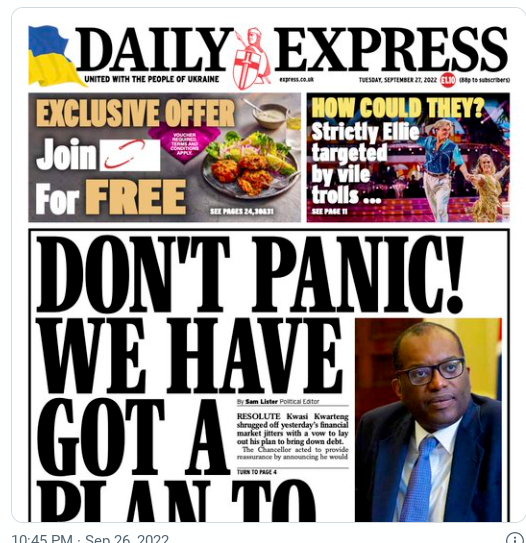
Don’t panic we have got a plan – Daily Express

Pound’s plummet underlines schoolboy error by Kwasi Kwarteng

The savage sell-off in the pound in east Asia overnight [Monday] was further evidence – should any be needed – that confidence in the new Liz Truss government is rapidly draining away.

Larry Elliott www.theguardian.com 

Sterling fell to its lowest level against the dollar, and despite an attempt at a rally in early London trading, the likelihood is that parity against the dollar will be tested before long. September tends to be the month for a sterling crisis – and so it has proved again.

Part of the story of the pound’s weakness is a function of dollar strength but that does not explain why sterling has fallen so rapidly since the end of last week. There are three UK-related factors behind the fall.

First, once a currency hits the skids it is hard to stop it. Momentum trading took over in the aftermath of Kwasi Kwarteng’s mini-budget and it has proved hard to halt.

Second, Kwarteng committed a schoolboy error by pledging further tax cuts in a full budget planned for later this year. If the markets are worried about the state of the government’s finances and the increase in borrowing needed to fund your plans, it is not the wisest course of action to add to those concerns. Kwarteng’s inexperience has been exposed.

Third, the financial markets don’t really know how the Bank of England will respond to the events of the past three days. Threadneedle Street raised interest rates by half a point last Thursday but there has been speculation of an emergency meeting of the Bank’s monetary policy committee as early as Monday.

Paul Dales, the chief UK economist at Capital Economics, says a rate rise of one – or even one and a half – percentage points would give the markets some reassurance that the Bank was committed to returning inflation to its 2% target.

While that would look like the Bank passing judgment on Kwarteng’s tax cuts, the alternative would be for the governor, Andrew Bailey, to give a strong statement that the MPC will raise rates again at its next meeting in November.

However, as Dales points out, November looks a long way away in the context of what has become a disorderly rout for the pound. Kwarteng would also need to show the Bank and the Treasury were of one voice by making clear he was committed to financial discipline, which would be seen as a U-turn by the chancellor after his weekend comments.

East Devon press ahead with local plan settlements despite protests

East Devon is pressing ahead with its local plan 2020-2040 with recommendations to endorse the sites suggested for development, despite protests from several strategic planning committee members.

seaton.nub.news

On Tuesday [6 September] the committee discussed a report outlining a number of preferred and “second best” sites for what they call tier one and two settlements around the district that may be suitable for development.

The tier system references a hierarchy of settlements being discussed, with tier one indicating places in Exmouth, tier two being Honiton and Sidmouth, three covering Axminster, Seaton, Ottery St Mary, Budleigh Salterton and Cranbrook and finally, tier four which includes Clyst St Mary, Uplyme, Colyton, Beer, Broadclyst, Lympstone, Woodbury and Dunkeswell.

Concerns raised in the report included the current plan failing to reach the desired number of new homes, and is currently expected to be 1,899 properties short.

Allocating additional “second best” sites could alleviate the shortfall in tiers one and two, with additional housing planned for tiers three and four once assessments have begun at that level. 

Housing density, currently being modelled at “reasonably typical standard density levels,” could be increased too. Other adjustments could limit the shortfall, as could expanding Cranbrook.

Whilst some objections were raised about the locations of the proposed developments, more concern was expressed about the lack of infrastructure to support these new settlements.

Councillor Jess Bailey [Independent, West Hill and Aylesbeare] said the target for housing was “incredibly burdensome,” and that she feared the manner in which the proposed sites have been assessed is “too anecdotal”.

She is calling for more refined assessments, ones that outline what would happen should infrastructure such as schools and healthcare provision be lacking.

The lack of infrastructure across Devon has been highlighted recently in a BBC survey finding that no dental practices in the county are accepting adult NHS patients.

The waiting list is reported to have reached 78,000 patients last summer, with an increasing number of dentists dropping patients from their NHS lists.

The recommendations, backed by the majority of committee members, will be applied to future plans and revisited at future meeting.