Nine reasons Jacob Rees-Mogg is totally unsuitable for his new job

Nanny has a lot to answer for – Owl

A new prime minister begets a new cabinet, and everyone’s least favourite toff Jacob Rees-Mogg has been appointed to the role of secretary of state for business, energy and industrial strategy by Liz Truss.

Kate Plummer www.indy100.com

He was previously the minister for Brexit opportunities, which appeared to be a cosmetic role in which he trotted around broadcast studios to defend the indefensible and gaslight the country about queues in Dover and other issues.

So now he’s got a Proper Job and is charged with overseeing the country’s energy and climate strategy, and leading the government’s relationship with business, a role previously undertaken by Kwasi Kwarteng who has now been promoted to chancellor.

He will make decisions about onshore wind and potentially fracking, alongside meeting ambitious targets for offshore wind, solar, nuclear and oil and gas.

It’s not up to us – we didn’t even get to vote for the new PM – but had we the opportunity to fill the new cabinet, we would have thought twice, or even thrice, before giving Rees-Mogg the keys to BEIS.

Why? Let us count the ways…

1. “Climate alarmism”.

Rees-Mogg has claimed that “climate alarmism” is responsible for high energy prices and that it is unrealistic for scientists to project future changes to the climate because meteorologists struggle to correctly predict the weather.

[Actual quote: “common sense dictates that if the Meteorological Office cannot forecast the next season’s weather with any success it is ambitious to predict what will happen decades ahead;” demonstrates a lack of any grasp of how statistical analysis can be used to discern trends. Sadly, his Eton and Oxford education seems to have left him literate but not numerate. – Owl]

2. Fossil fuels

In April 2022, he said he wanted “every last drop” of oil and gas to be extracted from the North Sea as he dismissed warnings that a renewed push for fossil fuels would ruin the UK’s chances of achieving net zero by 2050.

3. Fracking

He has also described the idea of reopening shale gas sites as “quite an interesting opportunity”, comparing the fracking threat to “a rock fall in a disused coalmine”.

4. Somerset Capital

In 2014, he was referred to the parliamentary standards watchdog for failing to disclose interests in a company with millions of pounds invested in fossil fuel, mining, and tobacco firms when speaking in relevant debates, the Independent reported.

5. “Green doomsayers”

In an article in The Telegraph, written in 2013, Rees-Mogg dismissed fears about rising emissions and said it was wrong to make policy based on these fears, even going as far as to compare climate change scientists with those who wrongly predict the weather.

He wrote: “Clearly expectations of a final disaster are part of man’s psychology and the doomsayers of the quasi religious green movement fit the bill. Perhaps one day the world will end, giving the last group to predict it the satisfaction of being right – but as many have been wrong so far it does not seem wise to make public policy on the back of these fears.

“It is widely accepted that carbon dioxide emissions have risen but the effect on the climate remains much debated while the computer modelling that has been done to date has not proved especially accurate … common sense dictates that if the Meteorological Office cannot forecast the next season’s weather with any success it is ambitious to predict what will happen decades ahead.”

6. “Mankind is adaptable”

In 2014 to Chat Politics, Rees-Mogg suggested people were adaptable and that we need to be “realistic” about how much we can change.

He said: “I would like my constituents to have cheap energy rather more than I would like them to have windmills.

“I think we have to be realistic about what we can change, the timescale over which we can change it, and actually I think mankind is highly adaptable, and we need to look at more adaptability rather than changes in behaviour.”

7. “Net zero is going to be a huge regulatory cost”

This year at the Centre for Policy Studies, Rees-Mogg moaned about the price of protecting the climate. He said: “Net zero is going to be a huge regulatory cost and that is an issue for the country to face and to face up to … If we were to have a ‘one in, one out’ or ‘one in, two out’ rule [where a piece of regulation is scrapped for every new one instituted], you would end up excluding net zero, as we previously excluded EU regulation, and then you’re tinkering at the edges because you’re ignoring the biggest piece of regulation.”

8. Voting record

Rees-Mogg has voted against some measures to help the climate. He voted against requiring the setting of a target range for the amount of carbon dioxide (or other greenhouse gases) produced per unit of electricity generated, against setting a decarbonisation target for the UK within six months of June 2016, and not to reduce the permitted carbon dioxide emission rate of new homes.

9. What other people think

Many remain concerned about Rees-Mogg’s green credentials. Sir Ed Davey, Leader of the Liberal Democrats told the FT: “For years Jacob Rees-Mogg has been on the wrong side of the argument. The last thing we need is another climate dinosaur like Rees-Mogg.”

“No government that’s remotely serious about tackling the twin climate and nature emergencies would even contemplate putting Jacob Rees-Mogg in charge of that portfolio,” said Caroline Lucas, the Green MP for Brighton Pavilion. “He’s the worst possible candidate at the worst possible moment.”

Ed Miliband, shadow secretary of state for climate change and net zero for Labour, said: “We need an energy secretary for the 2020s not the 1820s. But everything that Jacob Rees-Mogg has said on energy is stuck in the past.”

“If ministers had acted on Rees-Mogg’s views then Britain would be even more exposed to skyrocketing energy bills this winter, more dependent on expensive fossil fuels and even less prepared to tackle the climate crisis.”

“This will either be a massive own goal for Truss’s efforts to tackle the cost of living crisis or Rees-Mogg will have to do the steepest learning curve in history as he gets to grips with the issues facing our country,” said Rebecca Newsom, head of politics for Greenpeace UK.

North Devon Holiday Lets deemed “major problem”

New document reveals impact

The rise in short-term holiday lets in North Devon is a “major problem,” with over a quarter of properties in some parts of the district not being used for permanent residence, according to a council report.

local democracy reporter, Ollie Heptinstall www.radioexe.co.uk 

The finding is part of North Devon Council’s response to the government’s call for evidence on short-term holiday homes. It was set up following concern from local authorities and MPs that their increasing numbers are impacting the housing market.

Agreed at a meeting on Monday [5 September], the council’s submission says the rise over the past three years has led to at least 435 homes in the district being changed from permanent residential use to holiday lets, a figure likely to be higher as it is claimed many properties are not registered for business rates.

The council acknowledges that holiday letting websites have “enabled some homeowners to create a new income stream” while expanding the tourism market.

But it says there is a “misconception that this is a quaint cottage industry where homeowners let out a room or two to supplement their income.”  it is “particularly concerned about community cohesion” in areas with a high density of holiday lets.

In addition, it claims “anecdotal evidence” shows tenants have been evicted from permanent lets so the properties to be used as holiday lets, as well as 142 no fault evictions in the last two financial years – of which 103 were last year.

The council says data from property websites shows the number of properties available for permanent letting in North Devon shrank two-thirds (67 per cent) in the two years to August 2021.

According to the council, second homes and holiday lets now make up more than a quarter of all homes in Instow, West Down, Countisbury, Trentishoe and Martinhoe, while in Mortenhoe (47 per cent) and Georgeham (45 per cent) the proportion is almost half.

The impact is so great in Georgeham that on one particular road in the village it is believed only one property is occupied in the winter.

“Communities cannot be sustained with that level of holiday use,” the council says.

It adds the reduction in permanent housing has had an impact on house prices. In August 2019 the average was £246,147 which increased to £321,346 in July 2022.

This covered the covid period, when house prices in many rural and coastal areas rose considerably.

The lack of available housing is having a further impact on major employers and public services who now find it difficult to recruit. According to the council: “Whilst the recruitment market is more difficult at present, especially for certain professions, many employers are citing the lack of housing as a reason.”

“By way of example, the principal of the local [further education] college had appointed a deputy principal who then came to North Devon to look for a property to relocate to but found the market so restricted and expensive that they then withdrew from the offer. There have been five unsuccessful attempts at recruitment since.

“The same college has an executive officer who has had to take a flat in Cullompton when they work in Barnstaple because there was nothing suitable and affordable closer. That is a distance of 40 miles.”

The report adds: “An employee of a local care home who was living in a rented property has had to give up her job as care worker as her landlord has evicted her to allow the use as a holiday let.”

North Devon says it wants to develop a licencing scheme with physical checks of premises, citing other impacts from some holiday lets including anti-social behaviour.

But it says that should be supported by other measures, “such as the requirement to apply for planning consent for change of use where residential premises are converted to holiday lets.

“This would allow control over the number of holiday lets and allow councils to prevent areas becoming saturated.

“Other measures that might be outside the scope of this call for evidence include addressing the tax advantages for owners of holiday let premises and also introducing the same environmental requirements as are imposed on private landlords.”

Members of the council’s strategy and resources committee agreed to submit the response to the government.

The call for evidence ends on Wednesday 21 September.

Autumn Windfalls: Barratt scores £1 billion profit as house prices set new records

Barratt Developments has reported annual profit of over £1 billion for the first time in results published on the day average house prices reached fresh records in London and the UK.

Michael Hunter www.standard.co.uk 

The landmark profits came at a time when the industry is bracing for the impact of sustained increases in interest rates and the higher mortgage costs that come with them, as the Bank of England seeks to tame runaway inflation. But there is little sign of a slowdown, even with  the cost-of-living crisis biting and official forecasts pointing to inflation of over 13% before the end of the year.

Closely-watched average house price data from one of the UK’s biggest mortgage lenders, also out today, showed a rise to fresh records in London and the wider UK in August, indicating that a fall in July may have just been a blip.

According to the Halifax, annual house price inflation in the capital was the highest in six years, at 8.8%. A typical London property now costs a record £554, 718, up by almost £45,000 over the last 12 months. The average national price was up 0.4% month-on-month to £294,260, also a record and an annual rise of almost 12%.

Barratt’s chief executive, David Thomas, told the Standard that current trading was “more challenging” into the market’s key trading period from late summer into December. While levels of customer interest and inquiry levels remain high, “uncertainty in terms of the economic and political environment” means “there’s some concern about making a commitment as big as a house purchase.”

Barratt sold nearly 18,000 and returned its business to pre-pandemic levels. Its average selling price for the year on private homes was just over £340,000, up almost 5%. For affordable homes, the average price was just over £159,000, up almost 9% due to more sales in outer London.

“We are trading very much in line or slightly ahead of the market,” Thomas added. “It’s about seeing how we trade through the key periods of September, October, November.”

There were also signs that rising costs in the industry was easing off, with Barratt leaving its guidance for inflation at between 9% and 10%. Thomas noted “very, very significant reductions in timber prices over the last three months,” while overall costs were holding steady, staying in a “similar position” for six to eight weeks.

Barratt reported annual adjusted profit of just over £1 billion was up by nearly 15%.  The FTSE 100 company plans to return £200 million to investors via a share buyback. Its stock slipped 1.3% to 416p on Wednesday.

It also reported a charge of over £408 million relating to the cost of cladding repairs to buildings over 11 metres high, after safety measures brought in by the government after the Grenfell Tower disaster which the industry has agreed to fund.

New environment minister Ranil Jayawardena ‘consistently’ voted against climate measures

The replacement for “Useless”  doesn’t inspire confidence. 

It now seems highly likely that the Truss government will wreak havoc on the environment, especially with the appointment of Jacob Rees-Mogg to Energy Secretary. – Owl

Harry Cockburn www.independent.co.uk 

His appointment by Liz Truss has already caused alarm due to Mr Jayawardena’s voting record, which shows he has “consistently voted against measures to prevent climate change“, and also against government support for renewable energy projects, according to the website, They Work For You.

Despite this stance he has previously said he recognises the importance of the UK taking climate action, and has campaigned for improved recycling and supported government moves to ban plastic straws in 2020.

An MP since 2015 and formerly a junior minister at the trade department, Mr Jayawardena replaces George Eustice, who was appointed to the role by Boris Johnson in February 2020.

Mr Jayawardena’s voting record suggests he favours a light touch when it comes to environment regulations that could impact business.

The records on They Work For You show Mr Jayawardena voted “not to require a ‘climate and nature emergency impact statement’ as part of any proposal for financial assistance under a United Kingdom Internal Market Act”, in September 2020.

He also voted “not to require ministers to have due regard to the target of net zero greenhouse gas emissions by 2050 when taking actions including setting up agricultural subsidy schemes”, in October 2020.

As incoming environment secretary, Mr Jayawardena will be responsible for ensuring the UK’s food security and supporting UK farming, while also being the government’s lead figure on protecting the environment, inheriting issues such as sewage-filled water courses and seas, the agricultural impact of the current drought, the spread of bird-flu around the British coast, rewilding programmes, and grappling with the longer-term effects of the worsening climate crisis.

His voting record shows he was among the Conservative MPs who voted last year against Defra’s own environmental principles, designed, the department said, “to guide ministers and policymakers towards opportunities to prevent environmental damage and enhance the environment, where relevant and appropriate”.

These principles, put forward by the government, include the “polluter pays principle”, which means that, “where possible, the costs of pollution should be borne by those causing it, rather than the person who suffers the effects of the resulting environmental damage, or the wider community”.

The Conservatives voted against the adoption of the principles which would have required public authorities to take a greater level of environmental action.

Mr Jayawarda also voted along with his Conservative colleagues against laws to slash transport emissions by 2030, and also against a proposal to bring forward “a green industrial revolution to decarbonise the economy and boost economic growth”. Both proposals were defeated in the Commons.

Nonetheless in a blog-post on his website earlier this year, he wrote that “protecting the future environment and standard of living for our local area and beyond is one of great importance”

He said: “This is supported by the volume of correspondence to me from local people. Economic growth and respect for our planet are by no means two opposites.”

Following his appointment, Mr Jayawardena said: “It is a privilege to be appointed the Secretary of State for Defra.

“From food security and backing British farmers, to water security and growing our rural economy, I know that there is much to do.

“It is so important to recognise where our food comes from.”

In a linked Tweet, Mr Jayawardena added: “This year in North East Hampshire alone, we will consume: 11 million eggs, 550 tons of beef, 17 million pints of milk.

“I recently met local farmers with the NFU, to discuss the government’s support for British farming and the export growth ahead.”

The animal products Mr Jayawardena mentions are among the most environmentally damaging products produced on the planet, with 80 per cent of all farmland being used for livestock grazing or for growing feed for livestock.

Clearing land to support livestock has not only devastated natural ecosystems across Europe, home to some of the world’s most “nature depleted” states, such as the UK, but is also continuing to drive deforestation in vital environments such as the Amazon rainforest, where soya is grown and used to feed livestock around the world, according to the WWF.

Campaigners have called on Mr Jayawardena to now strengthen rules to protect the environment and address the sewage scandal.

Rebecca Newsom, head of politics at Greenpeace UK, said: “A summer of outcry at our sewage-strewn beaches should give the new secretary of state pause for thought when considering his priorities. The public wants to see our natural world enhanced, not degraded further through cuts to vital protections.

“This new government should seek to strengthen rules meant to stop sewage polluting our rivers and coast, keep plastic from our seas and prevent destructive fishing in our marine protected areas. These aren’t just red tape to be slashed. And far from being a boon, the new secretary of state may find the main thing unleashed by cutting these protections is a wave of public anger as our natural world is further spoiled.”

Gas drive will not solve energy crisis, climate advisers tell Liz Truss

The government’s independent climate and infrastructure advisers have delivered an unprecedented rebuke to Liz Truss for focusing on attempts to increase the UK’s gas production to bring down energy prices instead of policies to reduce demand.

Fiona Harvey www.theguardian.com 

From her first hours in the job, the prime minister has prioritised a series of measures on energy policy to head off the cost of living crisis.

She will unveil a cap on energy price rises – though without extending the windfall tax on producers – freezing the average household energy bill at £2,500 a year.

She has also signalled a push to extract more gas and oil from the North Sea, accelerate the new licensing of North Sea oil and gas fields, and lift the moratorium on fracking, to try to increase gas production.

On Wednesday, the former Conservative environment secretary Lord Deben and Sir John Armitt, who chair the Committee on Climate Change and the National Infrastructure Commission respectively, wrote to Truss warning that ramping up gas production would not solve the problem.

They wrote: “The UK cannot address this crisis solely by increasing its production of natural gas. Greater domestic production of fossil fuels may improve energy security, particularly this winter.

“But our gas reserves – offshore or from shale – are too small to impact meaningfully the prices faced by UK consumers.”

The letter marks the first time the chairs of the independent advisory bodies have written jointly to a prime minister.

They advised Truss, along with the incoming chancellor and business secretary, to focus instead on bringing down energy demand from consumers and businesses.

“Energy security and reducing the UK’s exposure to volatile fossil fuel prices requires strong policies that reduce energy waste across the economy and boost domestic production of cheap and secure low-carbon energy,” they wrote in the letter, seen by the Guardian.

This would necessitate policies such as home insulation, requiring public agencies to improve the energy efficiency of their buildings, setting up an energy advice service for consumers, and increasing renewable energy generation, particularly onshore wind and solar power.

“Renewables are the cheapest form of electricity generation. Onshore wind and solar have the potential to be deployed fastest and thus reduce our reliance on natural gas sooner,” they wrote.

Truss has said little so far on how she would improve home insulation, as the scrapping of the green homes grant last year has left the UK without a nationwide insulation scheme for those on average incomes. She has vowed to remove green levies, potentially including those that pay for insulation for poor and vulnerable households.

During her campaign for the Tory leadership, she also firmly rejected lifting the barriers in the planning system to onshore wind and solar farms.

At least 15 million homes require energy efficiency improvements, but the most recent year in which a large number of homes were insulated was 2012. Since then, the “stop-start nature of energy-efficiency policy is hampering development of the supply chain,” the letter said.

The Committee on Climate Change warned earlier this year that increasing the production of gas from the North Sea was unlikely to bring down gas prices and could endanger the UK’s target of reaching net zero emissions by 2050.

Deben and Armitt wrote that up to three-quarters of UK households are threatened by fuel poverty.

“The OBR expects natural gas to remain expensive, at three to four times the average pre-invasion [of Ukraine] price, until 2027. Ninety per cent of the recent increase in the energy price cap is driven by changes in the price of gas. Addressing our dependency on fossil energy offers us the best way out of these crises,” they wrote.

“The best policies for the consumer are those that support lasting energy security and a low-carbon, low-cost energy system. The independent analysis of our respective organisations is that this will deliver a long-term return on investment and set the UK on a path to prosperity.”

Thérèse Coffey considers paying care homes in England to free hospital beds

“HOWEVER, whether the scheme becomes a reality depends on the Treasury agreeing to cover the costs, which DHSC sources put at “several hundred million pounds”. Neither the DHSC nor NHS England have enough money in reserve to do so, it is understood.”

Denis Campbell www.theguardian.com 

Thérèse Coffey is considering handing hundreds of millions of pounds to care homes to help free up hospital beds as part of her emergency plan to tackle the growing crisis in the NHS.

The new health secretary is examining proposals to pay care homes in England to look after patients who are medically fit to leave hospital but cannot be discharged because of a lack of social care.

Officials at the Department of Health and Social Care (DHSC) believe the scheme could tackle two major NHS problems at once, by freeing up some of the 13,000 hospital beds currently occupied by “delayed discharge” patients and improving handovers by ambulance crews to A&E staff.

If approved, the plan would become a key element of the strategy that ministers are expected to set out next week to address the multiple problems affecting the NHS, including long delays for A&E, GP and cancer care and hospital beds. In her inaugural speech as prime minister outside 10 Downing Street on Tuesday, Liz Truss identified the NHS as one of her “three early priorities”.

“I will make sure that people can get doctors’ appointments and the NHS services they need. We will put our health service on a firm footing,” Truss pledged, though she gave no details.

However, whether the scheme becomes a reality depends on the Treasury agreeing to cover the costs, which DHSC sources put at “several hundred million pounds”. Neither the DHSC nor NHS England have enough money in reserve to do so, it is understood.

It would in effect see the government starting to once again pay for the NHS to operate a “discharge to assess” scheme, funding for which was ended in March despite NHS organisations warning that it would make it harder for hospitals to free up beds. The DHSC began examining the pros and cons involved in reviving that initiative under Coffey’s predecessor, Steve Barclay.

Coffey and NHS leaders are keen to do everything they can to reduce the pressure on the NHS, especially acute hospitals, before what they fear could be a winter in which the service falls over.

She is also studying plans for the NHS 111 telephone advice service to increase the proportion of patients with minor ailments it refers to a pharmacist, to reduce the strain on GP surgeries. NHS England would foot the estimated £100m bill for that initiative, which would see an expansion of the community pharmacy consultation service set up in 2019.

Coffey, who Truss has also made deputy prime minister, is expected to set out plans to stop senior doctors being hit with huge pension tax bills, which have prompted some doctors to reduce their working hours or retire early. Truss has pledged to solve the problem so that doctors can work longer hours to help tackle the 6.7 million-strong NHS care backlog.

“NHS leaders were disappointed when the previous discharge to assess funding ended, despite their pleas,” said Rory Deighton, the acute lead at the NHS Confederation. “During the first wave of coronavirus it freed up 30,000 hospital beds, led to a 28% drop in patients staying in hospital for more than three weeks, freed up more than 6,000 staff, and led to £451m of efficiency savings.”

If the approach was revived then funding would have to be long-term rather than a one-off, he said, “in order to help the NHS run smoothly and allow patients to recover in the most suitable places for them”.

Planning applications validated by EDDC for week beginning 22 August

Plymouth vote for fewer local elections

Voters in Plymouth could be asked whether they want fewer local elections.

Right now a third of councillors are elected every year, followed by one year in which no voting takes place.

local democracy reporter, Philip Churm www.radioexe.co.uk 

But on Monday the council’s audit and governance committee on Monday (5 September) said the public should be consulted on whether to have “whole council” elections every four years instead. 

In an extra general meeting of the committee, members recommended to the full council that a public consultation takes place between June and August next year on whether to change the election cycle. 

Committee members would oversee how the consultation would take place. 

A report highlighted several advantages of all-out elections every four years including;

People can vote on four-year manifestos and long-term commitments

Clearer opportunity for people to change the political composition of the council

Significant cost savings

Voters more likely to understand the election cycle

Same electoral cycle as the police and crime commissioner and combined authority Mayoral elections which take place every four years

Fewer elections may mean less election fatigue and voter apathy.

But some members of the committee criticised details in a report presented to them, including leader of the Labour group and councillor for Ham, Tudor Evans.  

Cllr Evans said: “This is an 11-year period where it is said here we will save £1.1 million over 11 years, which is £100,000 a year. 

“What is the total spending of the council over that 11 year period? And what proportion of that is represented by the cost of elections?”

There were also concerns about how many people would take part in a consultation process.

Labour councillor for Honicknowle Mark Lowry suggested a low number of participants would invalidate the process.

“How is the committee going to feel when you’ve got 500 comments back and it’s only 0.2, 0.3 or 0.8 per cent of the population, which statistically is a nonsense, really? 

“How are you going to feel when you’ve got less than half a per cent of Plymouth population come back to you? And bear in mind that that vote could be 60:40. 

“You know, you could be relying on 300 or 400 people with a view and opinion.”

Chair of the committee and Tory councillor for Southway Andy Lugger reminded members the committee’s only role was to decide whether the public should be consulted and to inform full council of the decision. 

“The matter has been deferred to this committee for resolution today on consultation only. I think the simplest way is we just simply vote whether we go with the proposition and move it forward that way.”

Cllr Evans accepted they would not be making any final decisions on the consultation process but asked for some information in the report to be corrected before a final decision was made. 

“I don’t want to hear in a month’s time or whenever we next meet that this is the basis upon which we’re consulting, because the basis upon which we are consulting is based on a table that’s wrong, with opinions that aren’t proven. 

“And I want to just make sure that we don’t get any backsliding on that; that we start with a clean slate in terms of how we’re going to progress in this subcommittee.”

Assistant chief executive of Plymouth City Council Giles Perritt agreed a new report may be needed before the whole council was able to make a decision on any consultation.

The committee unanimously agreed to recommend the consultation to the full council. 

“Cabinet of Cronies”

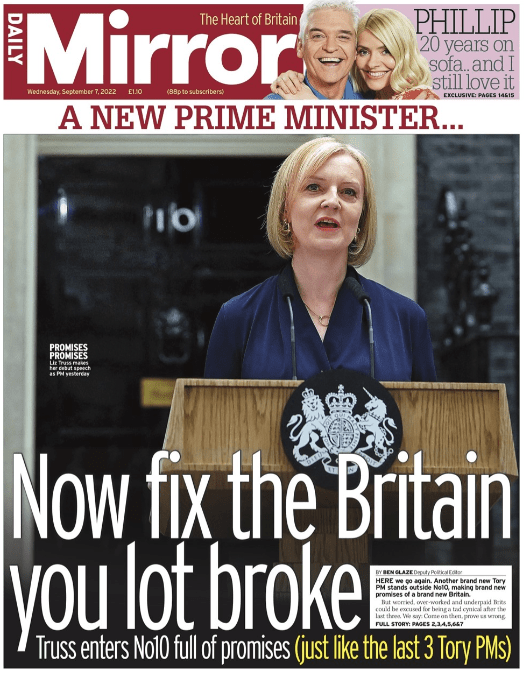
Liz Truss conducts clear-out of Sunak supporters as she builds ‘cabinet of cronies’

Liz Truss’s hopes of uniting her party after a fractious leadership contest were tonight at risk after she conducted a brutal cabinet clearout of supporters of rival Rishi Sunak in her first hours as prime minister.

Andrew Woodcock www.independent.co.uk

The new PM constructed a top team of close allies, including Kwasi Kwarteng as chancellor and James Cleverly as foreign secretary, with hardline right-winger Suella Braverman – a supporter of withdrawal from the European Court of Human Rights – becoming home secretary and Therese Coffey appointed the UK’s first female deputy prime minister as well as taking the health brief.

Jacob Rees-Mogg was made business secretary after taking part in talks with energy companies on a package of measures to tackle the cost of living crisis, due to be unveiled on Thursday and expected to include a £2,500 price freeze for households costing £90bn, as well as additional help for businesses.

One former minister told The Independent of fears that Ms Truss was creating a “cabinet of cronies”, putting personal loyalty to her over the competence needed at a time of virtually unprecedented crisis.

And former veterans minister Johnny Mercer accused her of favouring friends as he was sacked, alongside prominent cabinet Sunak backers Dominic Raab, Grant Shapps, Steve Barclay and George Eustice.

The appointments meant that for the first time in UK history, none of the four great offices of state is held by a white man, in a move welcomed by Tories as a blow for “meritocracy”.

But the former minister said he was “worried that she is creating a cabinet of cronies, which will cause her the same problems that Boris Johnson had – in the end, people felt they didn’t need to support him”.

The minister added: “A lot of people were hoping she would be more inclusive. There are competent people who should be in the cabinet who won’t be, and we need the most competent people we can get at a time of such massive challenges.”

Shadow cabinet minister Peter Kyle said the decision to consign big hitters from earlier Tory administrations to the backbenches was an indication of deep rifts in Ms Truss’s party.

“The Tory party is now ungovernable and incapable of governing,” he said.

Ms Truss moved to put her stamp on the government within minutes of arriving at No 10 after being appointed the UK’s third female PM by the Queen at Balmoral.

Speaking on the steps of her new residence in a brief break between thunderous downpours, she acknowledged that the country faces tough times ahead, but said: ”We shouldn’t be daunted by the challenges we face.

“As strong as the storm may be, I know the British people are stronger. Together we can ride out the storm, we can rebuild our economy.”

Borrowing a phrase coined by David Cameron in 2012, she said she would use tax cuts and reforms to create an “aspiration nation”, naming the economy, the energy crisis and the NHS as her top three priorities.

She spoke with Ukrainian president Volodymyr Zelensky to restate the UK’s “steadfast support”.

And she received a call from US president Joe Biden, who reminded the new PM – who has tabled legislation to tear up the Northern Ireland protocol on post-Brexit border arrangements – of the need to protect the Good Friday Agreement.

While a disappointed Mr Mercer confined himself to remarking that Ms Truss was “entitled to reward her supporters”, his wife Felicity revealed he had confronted the PM in her Commons office over her decision to drop him.

In a tweet illustrated by a Muppet under a “Liz for Leader” banner, Ms Cornelius-Mercer said her husband got no response when he asked the new PM: “Who is going to be better at this role than me, which of your mates gets the job? You promised a meritocracy.”

“This system stinks and treats people appallingly,” said the Plymouth MP’s wife. “Best person I know sacked by an imbecile.”

Meanwhile, green groups voiced alarm that Mr Rees-Mogg was being given direct responsibility for energy and climate change.

Friends of the Earth branded the appointment “deeply worrying”, pointing to Mr Rees-Mogg’s recent suggestion that “every last drop” of oil and gas should be extracted from the North Sea.

And Labour climate change spokesperson Ed Miliband accused him of seeking to undermine the science on climate change and making the wrong calls on issues like fracking.

Liberal Democrat cabinet spokesperson Christine Jardine said: “Fewer than 100,000 people voted for Liz Truss to lead our country, yet instead of seeking consensus she’s gone for a cabinet that will please only the right wing. Jacob Rees-Mogg, a climate change denier, being entrusted with protecting the planet during a climate emergency is unfathomable.“

Other appointments included former leadership contenders Penny Mordaunt as leader of the Commons and Kemi Badenoch as international trade secretary.

Ms Truss’s confirmation as the UK’s 56th prime minister and third female holder of the post followed a truculent early-morning farewell speech from Mr Johnson, who wrongly claimed that the rules had been changed to remove him from office.

The outgoing PM promised his “fervent” support for his successor but undermined his own claim to be departing permanently from frontline politics by comparing himself to Roman general Cincinnatus, who was called from his farm to take on dictatorial rule at a time of crisis.

Sacked minister’s wife calls Liz Truss an ‘imbecile’ in Twitter outburst

The wife of former minister Johnny Mercer has called Liz Truss an “imbecile” in an outburst on Twitter after her husband’s sacking.

www.theguardian.com 

Felicity Cornelius-Mercer said the cabinet system “stinks” and “treats people appallingly” after her husband was removed as veterans affairs minister by the new prime minister.

Mercer, the MP for Plymouth Moor View, had appeared angry about Truss’s move, saying he was “disappointed” but accepted that the PM is “entitled to reward her supporters”.

He also suggested he could quit the Commons, saying: “I have to accept that I will never possess the qualities required for enduring success in politics as it stands, and to be fair to my wonderful family I must consider my future.”

His wife went further, tweeting a picture mocking Truss as the character Beaker from The Muppets television show and giving an account of her husband’s exit discussions.

Cornelius-Mercer tweeted: “He asked her ‘why would you do this, who is going to be better at this role than me, which of your mates gets the job, you promised a meritocracy?’

“PM – I can’t answer that Johnny.

“This system stinks & treats people appallingly. Best person I know sacked by an imbecile @trussliz.”

Mercer had tweeted a lengthy resignation statement accompanied by the words: “I will be spending time with my family and doing no media requests.”

“Useless” defends the indefensible, then gets the chop 

George Eustice was sacked soon after defending raw sewage dumping. But this does not signal a “Green” government, far from it. Owl fears for the environment.

Eustice defends ‘utter failure’ of efforts to cut raw sewage discharges in England

What planet does “Useless” inhabit? – Owl

Richard Foord, Liberal Democrat MP for Tiverton and Honiton, said: “This summer, people visiting East Devon had their health put at risk by greedy water companies.”

Sandra Laville www.theguardian.com 

The environment secretary, George Eustice, insisted the government was tackling the millions of hours of raw sewage discharges into rivers and seas in England as MPs demanded answers to a summer of water companies dumping effluent into holiday swimming spots.

Caroline Lucas, the Green party MP for Brighton Pavilion, said: “Literal shit is being pumped into our rivers and seas. The state of our water network is a national scandal and the government has utterly failed to take action.”

She said the government’s plan, published last week, meant sewage discharges would be permitted up to 2050. “Why is the government going backwards?

“And during a cost of living scandal, floundering water bosses are still taking home obscene pay packets – pouring salt in the wounds of millions struggling to make ends meet.”

Eustice said the Conservative government was the only one to tackle the problem. He said that in 2016 just 800 storm overflows were monitored but the government had increased this to 12,000 out of a total of 15,000 overflows.

Using information from the monitoring had led to record prosecutions against water companies, he told MPs, with 54 prosecutions since 2015 and fines totalling £140m.

Defending the plan outlined last week to reduce raw sewage discharges via overflows, which was criticised as a “cruel joke”, Eustice said: “Our discharge reduction plan prioritises bathing waters. We are requiring water companies to make available all the data on storm overflows and to publish it in real time for the public.

“Water companies are investing £3.1bn to deliver 800 storm overflow improvements by 2025. We have increased monitoring of storm overflows to almost 90%, and by next year that will be 100%.”

He said £56bn of investment was to be pumped into the networks to tackle the storm overflow discharges. But the government has rejected a more widespread and systematic investment to end the use of storm overflows completely.

“The cost of completely removing storm overflows is around £600bn; to reduce use of them so they are not used in an average year would be £200bn,” he said. “What we have chosen to do is spend £56bn to target the most harmful sewer discharges and this will lead to significant change in years ahead … we have committed to this investment.”

The investment of £56bn almost matches the £57bn in dividends the English water companies have paid out to shareholders since privatisation.

As MPs debated the discharges, beaches across England were under pollution alerts once more after the dumping of raw sewage by water companies, after a night of storms and heavy rainfall.

Richard Foord, Liberal Democrat MP for Tiverton and Honiton, said: “This summer, people visiting East Devon had their health put at risk by greedy water companies.”

Eustice said the government was addressing the issue in the Environment Act and had given powers to the water regulator Ofwat to link dividend payments to environmental performance. Water companies should consider themselves on notice, he said.

Jeremy Corbyn, the Labour MP for Islington North, said: “Isn’t it very obvious we should do what every other country in western Europe does and bring our water industry as a whole into public ownership under public control, so that we don’t damage our water infrastructure in order to pay profits to distant billionaires?”

Eustice said the original vision of water privatisation was that there would be publicly listed companies on the London Stock Exchange and that water bill payers would also be shareholders. But he said: “In the early 2000s, most of these water companies fell into the hands of private equity operators and that was a change.”

Also in the early 2000s, the then government took a decision to issue licences in perpetuity rather than for fixed periods. “So there have been some changes since privatisation but [Corbyn’s] central charge that actually nationalisation would be the way to get investment is, I am afraid, wrong,” Eustice said.

Is this parody or is it Truss verbatim?

“I know that we will deliver, we will deliver and we will deliver.”

Yesterday’s acceptance speech

“Well, thank you, Sir Graham. It’s an honour to be elected as leader of the Conservative and Unionist Party.

“I’d like to thank the 1922 Committee, the party chairman, and the Conservative Party for organising one of the longest job interviews in history.

“Thank you very much. I’d also like to thank my family, my friends, my political colleagues, and all of those who helped on this campaign. I’m incredibly grateful for all of your support.

“I’d like to pay tribute to my fellow candidates, particularly Rishi Sunak. It’s been a hard-fought campaign. I think we have shown the depth and breadth of talent in our Conservative Party.

“And I also want to thank our outgoing leader, my friend, Boris Johnson. Boris, you got Brexit done. You crushed Jeremy Corbyn. You rolled out the vaccine, and you stood up to Vladimir Putin. You are admired from Kyiv to Carlisle.

“Friends and colleagues, thank you for putting your faith in me to lead our great Conservative Party, the greatest political party on earth.

“I know that our beliefs resonate with the British people – our beliefs in freedom, in the ability to control your own life, in low taxes, in personal responsibility, and I know that’s why people voted for us in such numbers in 2019. And as your party leader, I intend to deliver what we promised those voters right across our great country.

“During this leadership campaign, I campaigned as a conservative and I will govern as a conservative.

“My friends, we need to show that we will deliver over the next two years. I will deliver a bold plan to cut taxes and grow our economy. I will deliver on the energy crisis, dealing with people’s energy bills, but also dealing with the long-term.

“And I will deliver on the National Health Service, we will deliver for all for our country, and I will make sure that we use all the fantastic talents of the Conservative Party, our brilliant Members of Parliament, and peers, our fantastic councillors, our MSs, our MSPs, all of our councillors and activists and members right across our country, because, my friends, I know that we will deliver, we will deliver and we will deliver.

“And we will deliver a great victory for the Conservative Party in 2024, thank you.”


Tory MP known for blocking laws tipped to join Partygate inquiry committee

The Conservative MP Christopher Chope has been tipped to join the committee investigating claims Boris Johnson misled parliament about his knowledge of Covid law-breaking parties, sources have told the Guardian.

[The Times reports that the nomination was made by Boris Johnson as a parting shot of his premiership.]

Aubrey Allegretti www.theguardian.com 

Chope would replace Laura Farris, who announced over the summer that she was stepping down from the body that scrutinises complaints about MPs’ behaviour.

The nomination would need to be passed by the Commons in order for him to be appointed to the privileges committee.

Normally, the vote is done as a “nod or nothing” – meaning that if there was one dissenting voice, it would fall.

Chope’s appointment is likely to prove controversial given his history of blocking laws, including attempts to outlaw “upskirting”.

A source said he was well versed in parliamentary procedure. Chope also sat for two years on the privileges committee from October 2017 until November 2019.

The government did not respond to a request for comment.

Jess Phillips, the shadow minister for domestic violence and safeguarding, told the Guardian: “Chris Chope is not a man I would rely on to be on the standards committee. He tried to derail legislation that would criminalise taking pictures up women’s skirts. Why would anyone think he was appropriate?

“Frankly the Conservatives’ attempt to force him on to the committee shows that no matter who their leader is they will always rely on their mates to get them out of upholding the standards that the country would expect. Same old Tories.”

Chope’s nomination would be one of the final acts of Johnson’s administration, which has rallied against the investigation into his repeated denials that any rules were broken during lockdown.

Several of Johnson’s allies have called the inquiry a “witch-hunt”. The prime minister also recently used taxpayers’ money to commission legal advice costing £130,000 that disparaged the privileges committee.

The Partygate inquiry will not investigate the extent of rule-breaking, which has already been examined by the Metropolitan police, who issued more than 100 fines, including to Johnson himself, and by the senior civil servant Sue Gray.

The seven-member committee, which has a Tory majority but is chaired by Labour’s Harriet Harman, is instead expected to investigate whether Johnson misled parliament by denying any Covid laws were broken.

The investigation was set up after MPs passed a motion in April.

The committee can recommend a punishment for those it finds to have broken Commons rules, including ordering a written apology, suspension or expulsion. However, in order for the sanction to be imposed, MPs must vote for it.

The committee has vowed to continue investigating Johnson after he leaves Downing Street on Tuesday.

Evidence requested by the committee so far includes WhatsApp messages, photos and diary entries.

More crony contracts: Minister’s husband under fire over multi-million defence spending

Nothing has changed – Owl

A minister’s husband is facing scrutiny after £24 million of government contracts were awarded to a company where he is a non-exec director, according to Sun reports.

Jack Peat www.thelondoneconomic.com 

Gillian Keegan’s partner, Michael, 60, is a Cabinet Office mandarin responsible for government relationships with suppliers — but also holds a board role with Centerprise International.

Between October 2019 and May 2020 the Ministry of Defence gave the IT company 17 contracts.

The revelation comes hot on the heels of news that Tory MP Dr Liam Fox received a £20,000 donation earlier this year from a Covid-19 testing company that he reportedly contacted the former health secretary over.

According to an email seen by the BBC and the legal campaign group the Good Law Project, Dr Fox recommended SureScreen Diagnostics to then-health secretary Matt Hancock in 2020.

SureScreen Diagnostics would later be awarded a £500 million testing contract by the Department of Health and Social Care.

Labour called the deals “an example of vested Tory interests at the centre of Government”.

The Cabinet Office said Mr Keegan “plays no role in awarding contracts to suppliers”.

Centerprise could not be reached for comment last night.

John Healey, Shadow Defence Secretary, said: “This smacks of dodgy crony contracts at the heart of defence procurement.

“Protecting British armed servicemen and women is the most important duty of any Defence Secretary.

“Our British troops and taxpayers deserve better.”

You can also SUBSCRIBE TO OUR NEWSLETTER .

United we stand, divided we fall. Onwards! – Simon Jupp

Exhortation also applies to the opposition groups and parties in East Devon – Owl

New PM? Devon’s MPs and councillors react

Not everyone trusts Truss

Georgia Cornish, local democracy reporter www.radioexe.co.uk

Devon’s politicians have been reacting to the announcement that Liz Truss is to be the next prime minister.

She took 57 per cent of the votes of Conservative Party members, beating  former chancellor Rishi Sunak.

Ms Truss will see the queen at Balmoral on Tuesday where she will be invited to form a government after Boris Johnson has tended his resignation to Her Majesty first.

Nine out of Devon’s 12 MPs are Conservatives, including East Devon’s Simon Jupp, who backed Rishi Sunak. Mr Jupp offered his congratulations to the new Tory leader on Twitter, and sent his commiserations to Mr Sunak.

He continued: “The Conservative Party must now unite to support our new prime minister against Putin’s invasion and the huge impact it’s having on the cost of living in East Devon. United we stand, divided we fall. Onwards!”

Selaine Saxby, the MP for North Devon, also backed the Ready4Rishi campaign but tweeted with a similar sentiment to her colleague. She wrote: “There is a lot of work to do, and I look forward to working with the new prime minister to continue to level up across rural Britain and especially N. Devon”

Richard Foord MP, recently elected to the Tiverton & Honiton seat representing the Liberal Democrats, said in a statement: “Liz Truss and the Conservatives have spent months failing to act on soaring energy bills, leaving local residents in despair and small businesses going to the wall.

“They have shown they are completely out of touch with people in the westcountry who are struggling to get by.

“It is time that Conservative MPs across Devon finally listened to Liberal Democrat calls to freeze energy bills to save families and pensioners from an economic catastrophe this winter. We have tabled legislation to freeze energy bills, which could be brought in on day one to offer the help that local families and businesses need.

“Liz Truss’ premiership represents more of the same failed Conservative party policies as Boris Johnson, which have led to a cost of living crisis, leaving families and pensioners at breaking point. It’s clear that the country is in dire need of a change.”

Teignbridge District Council leader Alan Connett (LibDem, Teignbridge District Council) congratulated Ms Truss, but warned:“It will be a huge task to reunite the country after the scorching divisions on the past few years.

“That’s alongside the urgent support needed for families, businesses and communities across the country struggling with the cost of living crisis, the energy crisis, the housing crisis, the crisis in the NHS, the crisis in adults and children’s social care, and now soaring inflation.

“The new prime minister’s ‘to do’ list will be very long, I’m sure. However, at the top of that list are very real issues that threaten every household and many, many businesses.

“Like so many people, I have not been impressed by the ‘ping-pong’ politics of the Conservatives in recent years, nor this latest leadership election.”

Luke Pollard MP (Labour, Plymouth Sutton & Devonport), tweeted: “After four prime ministers in 12 years, Britain deserves a fresh start with a general election.

Liz Truss must now immediately address the rising cost of living crisis by freezing energy bills as Labour has set out.

I will be writing to the new PM to urge her to give the south west our fair share but after her comments about wanting to cut pay for public sector workers in the South West, I’m afraid I’m not holding my breath.

Bring on a general election and a Labour government”

Unlike his Plymouth colleague, Exeter MP Ben Bradshaw, who is to stand down at the next general election, hasn’t appealed for one.

Instead he said: “Truss has been chosen to be prime minister by a tiny number of Conservative members and with the lowest level of support from those members or her own MPs of any leader in modern times.

“It also seems clear she is about to renege on all the promises she made during the leadership campaign, including adopting Labour’s policy of freezing energy bills.

“This would be welcome, but the nature of her election, her lack of a mandate and the rancour that the contest generated does not auger well for competent and stable government at a time when Britain has never needed it more.”

Today’s acceptance speech leaked: “I stand before you now as your Prime Minister.” 

(You don’t have to wait until tea-time)

“With a bold vision for the country and a bold vision for our economy, which consists entirely of me saying the words ‘bold’ and ‘vision’ repeatedly.”

Otto English has got his hands on Boris Johnson’s successor’s inaugural speech as PM…

The reign of Terror is Ended – the Age of Truss is About to Begin

Byline Times bylinetimes.com

I stand before you now as your Prime Minister. 

With a bold vision for the country and a bold vision for our economy, which consists entirely of me saying the words ‘bold’ and ‘vision’ repeatedly.

I stand before you with adjectives and the sort of business-speak terms you hear Lord Sugar say on the Apprentice, and I will keep repeating them until you realise that I am a serious person who sounds impressive.

I believe in this country. I believe the children are our future. I believe in Santa Claus and I believe I can fly.

I believe too that while our history is something to be immensely proud of, there are better days ahead for me personally, if not for everyone else.

I think my track record speaks for itself. 

Whether posing for photos on the official Government Instagram account, or saying the words ‘pork markets’ suggestively, or negotiating trade deals with New Zealand that benefit Kiwi farmers – while bankrupting our own – I have already made the Brexit I never believed in work for me. 

My trade deal with Japan means that the £100,000 worth of cheese that we sell in that country will be tariff-free by 2033. And while the Japanese are selling billions of pounds worth of their cars into our market on the same terms, our cheese farmers will be rejoicing. As they say in Japan, ‘sushi!’ 

On the campaign trail people have often asked me ‘what do you really stand for Liz?’ – to which my answer is: ‘tell me what you believe in and then I will tell you the same thing back again in slightly different words.’ I am a woman of principles. Other people’s principles. And if you don’t like them, just tell me and I’ll change them to what you think instead. 

On one issue I remain resolute. I will stand firm against those who threaten our peace and security – and no I’m not talking about Putin but ‘wokery’. Too many people in this country don’t fly flags over their homes or stand for the national anthem when it plays on GB News. Worst of all, they talk about nasty things like slavery. I will not allow the truth of our history to spoil the one we all believe in! And I stand before you now determined to get positive headlines in the Sun and Daily Mail

Be reassured too that, if the time ever came to order a nuclear strike, then I would not hesitate to do it – even if it meant a few weeks of mild discomfort in my official nuclear bunker in an undisclosed location until it was safe to come out. Some things are worth sacrificing for our freedom and believe me when I say I am quite happy to sacrifice you.

But it’s now time for the serious bit. [Big pause. Solemn face].

We have huge challenges ahead as a country. Many of you will be concerned about your winter fuel bills, your healthcare, jobs, security, your children’s educations, and your own livelihoods. I know that many of you will be worried – desperately worried – about the coming months. But be reassured that by me saying ‘I love my country’ and ‘I want the best for us all’ then everything will magically be resolved. 

When Margaret Thatcher came to power in 1979, she quoted the words of the prayer of St Francis of Assisi saying, ‘where there is discord, may we bring harmony. Where there is error, may we bring truth. Where there is doubt, may we bring faith’. I would like to end with a quote of my own, by Keith Harris, which I think is very apt right now:

Nothing that you can say

Will change how I feel today:

I know that we’ll never part;

Now hear what I’m saying, Orville?

Who is your very best friend?

You are

I’m gonna help you

mend your broken heart.

God Save the Queen!

Truss will pay under £2,000 for Downing Street winter energy bills, Labour says

Liz Truss will pay no more than £2,000 in total for all her energy bills in Downing Street this winter because of state subsidies, Labour has calculated.

Peter Walker www.theguardian.com 

If Truss, as widely expected, is elected as Conservative leader and prime minister on Monday, she is expected to move into the four-bedroom flat above 11 Downing Street, the larger of the two official residences.

While the energy price cap will mean the average annual bill is expected to rise well over £4,000 during the winter, Truss will be insulated from price rises beyond a certain point because of the way her energy costs are paid for.

As set out in the Treasury’s annual accounts, the electricity and heating bills for the No 11 flat, and the smaller residence above No 10, which would be used by her chancellor, expected to be Kwasi Kwarteng, are paid for by the state.

These are then treated as a benefit in kind, meaning the costs are added to the person’s income and subject to tax. The amount of tax can vary, but even if Truss paid the higher rate of income tax on it, this would be 45% of the total.

In another perk, the Treasury rules set out that this benefit in kind is capped at 10% of the prime minister or chancellor’s salary.

Truss’s salary as PM would be £75,440, meaning that for the rest of this financial year, taking her to the end of March, the total amount on which she could be liable for extra tax for heating, electricity or other expenses, would be £4,000, or 10% of the seven months of pay. She also receives an MP’s salary but the benefit in kind would only apply to her duties as PM.

In turn, Truss would not have to cover this entire cost, just pay the tax on it. At the 45p higher rate, this would mean her energy costs are capped at £1,980 this winter. However much the energy cap might rise in the 2023-24 tax year, Truss would then pay no more than £3,400 in total from her full annual salary.

Abena Oppong-Asare, Labour’s shadow exchequer secretary, said: “While Truss may be able to rest easy knowing her energy bills won’t be soaring, the least she could do is offer the millions of families reassurance and clarity on what her plans are.

“Instead she has left people deeply anxious, worrying about making ends meet as the energy crisis escalates and only offering vague promises and lukewarm words.

“Families deserve a government ready to act and meet the scale of this national emergency. With Labour’s plan to freeze energy prices, households won’t pay a penny more this winter and we’ll be able to get a grip on this crisis.”

Downing Street and Truss’s campaign were contacted for comment.