Find ‘something better’ than energy price freeze set to cost £150bn, Liz Truss told

The energy price freeze must be replaced by “something better next winter” because it will cost up to £150bn, a leading economist has warned Liz Truss.

Rob Merrick www.independent.co.uk

Paul Johnson, the head of the Institute for Fiscal Studies, urged the prime minister to ditch plans to hold down everyone’s bills until 2024 and find a smarter solution to the crisis.

The plea comes after fierce criticism of the government for failing to reveal the expected cost of a two-year freeze ahead of an expected ‘mini-budget’ next week.

Mr Johnson called that decision “extraordinary”, saying: “This could actually turn out to be the biggest single fiscal announcement in my lifetime, because this could cost £150bn.”

He agreed the freeze “might be necessary” for this winter, but warned: “It’s incredibly expensive. It’s totally untargeted.

“It gives large amounts of money to people who don’t need it, and it means that we’re not facing the price signal that there is less gas out there. And yet, we’re being massively subsidised to use gas.”

Mr Johnson told Times Radio: “One of the things that I really hope is that they’ve got teams of people working next year on thinking of something better for next winter.”

Ms Truss carried out a spectacular U-turn, just two days into her premiership, by announcing average annual household bills will be frozen at £2,500 until 2024.

They were set to rise to £3,549 from next month and to more than £5,000 next year – threatening millions of people with bills they would be unable to pay.

Full details of how the “energy price guarantee” will work are yet to emerge, as the announcement was immediately drowned out by the death of the Queen.

The government will meet the cost – through a leap in borrowing – of capping the amount energy companies can charge customers for one unit of gas.

A £400 rebate on all bills announced earlier this year has been retained, cutting £66 every month from October until April, and green levies suspended, saving the average household about £150 a year.

The Resolution Foundation think tank has put the price tag at £120bn – the bill just to bail out households, with separate tens of billion needed to rescue businesses.

Although it is called a “guarantee”, people in large or draughty homes will inevitably pay significantly more.

Ms Truss downgraded her planned emergency budget to a “fiscal event” – to avoid scrutiny by the Office for Budget Responsibility – which was pencilled in for next week.

She is expected to fly to New York for the UN leader’s meeting as early as Monday evening, within hours of the Queen’s funeral, returning to the UK late on Wednesday or early Thursday.

That would allow the mini-budget to be held on Thursday next week, before parliament breaks up again for the Labour and Conservative party conferences.

Housebuilders ‘lobbied against plan for electric car chargers in new homes in England’

Ah yes – the rules announced in the infamous Peppa Pig speech. That’s the one in which he imitated the sound of an accelerating car with grunts that the official Downing Street release transcribed as “arum arum aaaaaaaaag”; and compared himself to Moses over his plan to help business invest in tackling climate change.

“I said to my officials the new 10 commandments were that ‘Thou shalt develop industries like offshore wind, hydrogen, nuclear power and carbon capture.’” (Pity “Fracking” Liz Truss wasn’t listening – Owl)

Jasper Jolly www.theguardian.com 

Britain’s biggest housebuilders privately lobbied for the government to ditch rules requiring electric car chargers to be installed in every new home in England, documents have revealed.

The FTSE 100 construction firms Barratt Developments, Berkeley Group and Taylor Wimpey were among the companies who argued against the policy in responses to an official consultation seen by the Guardian. The “blatant lobbying efforts” were criticised by Transport & Environment, a campaign group.

Swapping cars powered by fossil fuels for zero-emission models is viewed by scientists, environmental campaigners and the government as key to reaching net-zero carbon emissions – alongside increased public and active transport. However, the lack of chargers is seen as a barrier to uptake.

The rules requiring all new homes to have a charger were announced by Boris Johnson in November 2021 as the flagship policy of a speech to business leaders. While the details were overshadowed at the time, as the former prime minister meandered through his speech with a riff on the children’s cartoon character Peppa Pig, the government hopes 145,000 charging points will be installed thanks to the rules.

However, the housebuilders who responded stated their opposition to the policy, citing cost concerns. They also warned that mandating installation could lock homeowners into obsolete technology, that there could be a risk of electric shocks with some car chargers, and even that the plan could prevent owners from choosing between cars with different plug types used in Asia and Europe.

Taylor Wimpey warned that the installation of chargers could result in fewer homes being built. “We see practical and financial challenges associated with the proposed approach,” it wrote, citing “significant uncertainty over the financial costs”.

Berkeley Group said it did not believe chargers would be required at every parking space because people would charge at work or while “going to the gym”.

However, automotive industry leaders say charging at home is more attractive for users because it removes the need to search for available power outlets during the day and because smart tariffs allow people to charge overnight, when energy is cheapest.

The housebuilders argued that their responsibilities should end with the laying of “cable routes” into homes, which could then be used for charging points, saying this would avoid the installation of infrastructure that went unused. In most cases, these would be simple – and cheap – pipes or gutters that could later carry cables to parking spaces.

Matt Finch, T&E’s UK policy manager, said: “It’s absurd that housebuilders attempted to hold back progress and slow down the drive to net zero. In the future, all cars will be electric, and futureproofing new homes with charging infrastructure is an obvious step to take.

“The government should be applauded for resisting these blatant lobbying efforts.”

Cost concerns were a common theme in the housebuilders’ warnings. Barratt said mandatory chargers could cost it as much as £63m. Vistry Group, which recently changed its name from Bovis Homes, argued that the requirement would cost the FTSE 250 company up to £14m.

The details of the lobbying efforts came in freedom of information disclosures obtained by the Guardian, as part of the building industry’s response to ministers consulting on the new charging point rules in late 2019 – before the government introduced the measure.

Spokespeople for Berkeley Group and Taylor Wimpey said they supported moves to encourage electric vehicle adoption. The companies are now installing charging points in line with the law.

The Taylor Wimpey spokesperson said it had provided “constructive feedback” ahead of the rules being introduced, while arguing that a “wire-only approach” would have reduced the “need for retrofitting in the event of incompatible technology should electric vehicle charging technology advance”.

A Barratt spokesperson said its view in 2019 was that there was not “sufficient supply chain capacity to support full electric vehicle charging point rollout nationwide”. Since then it has worked with the government on regulations that give customers choice while “being practical for the industry to deliver at scale”.

Vistry did not respond to a request for comment.

New ‘lifeline’ banking hub to open in Axminster

A banking hub is set to open in Devon along with 12 other branches around the UK. It comes after many areas have seen the last of their banking branches close.

Does a bus service come with the hub? – Owl

Mary Stenson www.devonlive.com 

Axminster will see the opening of a brand new ‘Bank Hub’ which will serve customers of all banks. The hubs being opened in a number of locations are the Post Office’s answer to the widespread closure of banks across the country and will allow customers to access their accounts, deposit cash and checks and withdraw money.

John Howells, chief executive of Link – which is the biggest interbank network in the UK – said on BBC Radio 4’s Today programme: “”Cash is disappearing at a frightening rate, and so are ATMs and branches and it is not acceptable to leave communities without access to cash

“There is real investment and effort going in by the banks now…But now that pace needs to be picked up”.

Representatives from each of the major banks will visit the Bank Hubs once a week to deal with more complex customer enquiries.

The Anxminster branch will be joined by locations in Brechin in Angus, Forres in Moray, Carluke in Lanarkshire, Kirkcudbright in Dumfries and Galloway, Axminster in Devon, Barton-upon-Humber in Lincolnshire, Lutterworth in Leicestershire, Royal Wootton Bassett in Wiltshire, Cheadle in Staffordshire, Belper in Derbyshire, Maryport in Cumbria, Hornsea in Yorkshire and in Kilkeel in Northern Ireland.

After visiting a prototype shared banking hub in Rochford, Essex, the BBC was told the initiative had been “a lifeline” after the town’s last branch closed.

Natalie Ceeney, who chairs the Cash Action Group which is overseeing the project, said: “Cash still matters hugely to millions of people across the UK and with the cost-of-living crisis biting, more and more people are turning to cash as a way of budgeting effectively. Banking Hubs are an important part of the solution.”

However, it has been noted that there could be a delay in the branch’s opening. Link – the organisation which currently oversees the UK’s ATM network – assesses the need for a Bank Hub each time a core banking service closes. This assessment looks at the community’s cash needs, the ease of travel to the nearest alternative service and the demographics of local residents.

Despite this work, premises for the hubs need to be found, at which changes often need to be made to ensure accessibility and security. There has been criticism as services have not yet started in previously-announced locations other than Rochford and Cambuslang, in Scotland.

Ron Delnevo, a business consultant with extensive experience in the ATM industry, said: “the promised hubs don’t even scratch the surface in terms of satisfying the banking needs of the UK”.

Mark Aldred, from banking technology company Auriga, said: “As we go into a cost of living crisis that’s hitting households and businesses alike, these shared hubs are good on paper but could go further and faster.”

A spokesperson for the Financial Conduct Authority said: “Firms need to pick up the pace and deliver more banking hubs. We expect this to be done as a priority.

“Banks and building societies must treat their customers fairly and provide alternatives to branches where needed. Banking hubs are one of a range of tools they can use to ensure communities have easy access to bank services and cash.”

Other location will see the installation of withdrawal and deposit machines in libraries and community centres. This is to include Ilfracombe in North Devon, alongside Swanley and Faversham, both in Kent, Holywood in County Down, Shanklin on the Isle of Wight, Atherstone in Warwickshire, Billericay and Dunmow, both in Essex, Bourne in Lincolnshire, Holyhead on Anglesey, Swanage in Dorset, and Wallingford in Oxfordshire.

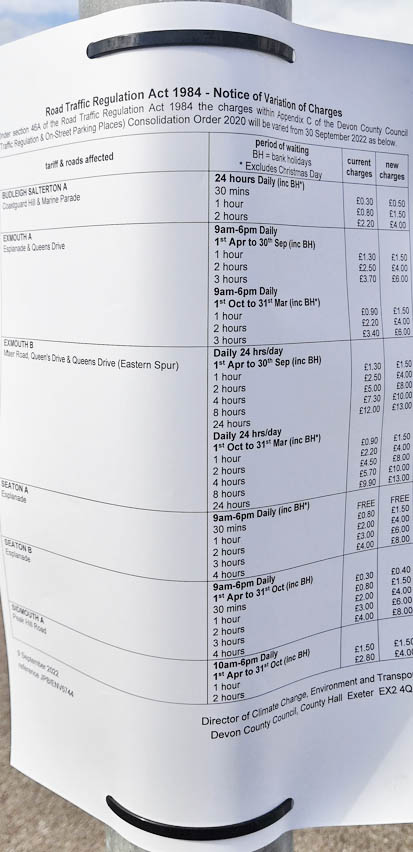
Local Tory Hypocrisy – DCC hikes parking charges but no outcry from Jupp

Back in March the East Devon Conservatives circulated a leaflet entitled “In Touch”.

This heavily criticised the independent EDDC for putting up car parking charges, without consultation, thereby risking the recovery of High Street businesses, hospitality venues and the tourism industry. It said:

 “We (the Tories) believe East Devon deserves better. We won’t prioritise council budgets over the communities we’re elected to serve. Your local Conservatives continue to work hard at every level of local government alongside our members of Parliament to make East Devon an even better place to work, visit and visit.”

Now notices have been posted of price hikes by (Conservative) Devon County Council for roadside parking in the East Devon Seaside towns of Budleigh, Exmouth, Seaton and Sidmouth but where is the Hue and Cry this time?

One down one to go!

Government to launch campaign to encourage public to cut use of power

Ministers are drawing up plans for a public information campaign to encourage people to reduce energy use this winter amid fears that a price freeze will deter them from doing so.

Under Boris Johnson, Downing Street repeatedly refused to give advice on energy use, saying that it was a matter for individuals.

Quite so, and even if it was a rule, enforced by law, he wouldn’t have followed it himself. Though economics will give many no options.

One rule for them, another for us! – Owl

Business Matters bmmagazine.co.uk

There is concern within government that the intervention set to be announced by Liz Truss to tackle the sharp rise in energy costs could increase the risk of blackouts if it means that households and businesses do not reduce consumption.

‘Really difficult winter’ could see supermarket shelves bare of certain food and drink items

The Times are reporting that ministers are wanting to work with energy companies on a public information campaign over the winter to encourage people to turn down their thermostats and turn off electrical appliances instead of leaving them on standby.

The move would represent a significant shift in government policy. Under Boris Johnson, Downing Street repeatedly refused to give advice on energy use, saying that it was a matter for individuals.

Ministers are concerned, though, that an energy price freeze will remove the incentive for people to keep their bills down. Russia has cut off supplies to Europe from the Nord Stream 1 pipeline, creating the prospect of energy rationing over the winter.

Other countries in Europe have already introduced public information campaigns. Switzerland launched an initiative with 40 partners from the public and private sector, using the slogan: “Energy is scarce, let’s not waste it.” It advised people to turn down their thermostats, take showers instead of baths, turn off electrical appliances and use a lid when boiling water.

Paul Johnson, director of the Institute for Fiscal Studies, said: “There is a logic to people reducing energy use when there’s a shortage and prices are high. A top priority of the government ought to be encouraging people to use less energy.

“If the price doesn’t go up to reflect the market price, in the end people won’t respond. This is going to be particularly true of higher-income households which use more energy.”

NHS is ‘over the precipice’, warns nurses’ leader as strike vote looms

Nurses will vote to go on a national strike for the first time in their history because the NHS has “gone over the precipice” and may not survive, the leader of the UK’s largest nursing union has told the Observer.

James Tapper www.theguardian.com 

Pat Cullen, general secretary of the Royal College of Nursing (RCN), said there is anger among nurses, who feel that ministers do not believe they are important.

In an exclusive interview with the Observer before the ballot on industrial action, Cullen recalled a conversation with frontline staff at a major hospital: “They said to me, ‘We’re not important to the government. We were seen as important during the pandemic, but we’re not important now. We don’t think the government will do anything for us’.

“When I talked to them about being a demoralised workforce, they said: ‘we’re not just a demoralised workforce. We have given up. No one seems to care any longer.’ There is an anger that they have been pushed to this position.

“We need to step up and look after these nurses. If we don’t, it’s scary to think about what will happen. The health service is not just staring over the precipice. It has gone over. And the very people who are trying to bring it back up are being paid the lowest wage we can possibly pay them. If we deplete it any further, there will not be a health service there.”

Cullen has toured the country, speaking to hundreds of nurses in the past few weeks about whether the RCN, which represents nearly 500,000 nurses, midwives and support workers, should go on strike.

An NHS nurse’s starting salary is £20,270, and the average salary is £33,384. The RCN decided to ballot after the government unilaterally gave NHS nurses a £1,400 pay rise, leaving them £1,000 a year worse off in real terms, according to the union. It wants a rise of 5% above inflation to avoid a flood of nurses leaving the profession.

The ballot was due to open on Thursday but was postponed after the death of the Queen, who was the RCN’s royal patron.

“It is probably the most difficult it has ever been for every single nurse – even more challenging and difficult now than it was through the pandemic,” Cullen said, speaking before the Queen’s death was announced. “And I think it’s quite a frightening place for our nursing staff because of the absolutely depleted workforces.”

Nurses are caring for patients with highly complex needs, she said, particularly older patients who have been waiting for surgery for years. At the same time, many nurses find themselves having to use food banks, and can’t afford to cook hot meals or buy school uniforms for their children.

Last week, NHS England said 6.8 million people were now waiting for treatment, a record high, with 377,689 waiting for more than a year. Ambulance waiting times have shot up, with only 58% of patients seen within four hours, far below the 95% target. A man died in an ambulance outside Norfolk and Norwich University Hospital on 22 August while waiting to be admitted, because there were no beds available.

Some patients who are medically fit to leave hospital have waited nine months because there is no social care available for them. Thérèse Coffey, the new health secretary, has said her “ABCD” priorities are ambulances; backlogs; care; and doctors and dentists, while prime minister Liz Truss put “delivering on the NHS” as one of her top three priorities.

Cullen became general secretary in July last year, having been director of RCN Northern Ireland. She has been a nurse for 42 years: for much of that time she worked as a nurse psychotherapist in Northern Ireland’s prisons, and principally with victims of the Troubles.

She is confident she can lead a successful strike. The union has a £50m hardship fund for striking staff whose pay is docked – members of the public have already offered donations as well – and she speaks strongly of nurses’ resolve. She also has some practice in industrial disputes, having successfully led a strike in Northern Ireland in 2019.

Nurses there were paid less than in the rest of the UK, but a row between Sinn Fein and the DUP over the Cash for Ash scandal meant there was no Stormont administration to negotiate with. In December 2019, the RCN went on strike. By mid-January, Sinn Fein and the DUP were in talks, and by the end of the month, nurses had been given a £109m pay deal.

“Very quickly we had an assembly re-established and a new executive formed,” Cullen said. “It’s well documented that was a consequence of those nurses saying ‘enough is enough, you need to get back to your work’.”

On the larger stage, Cullen is anticipating a tougher fight, with Britain facing a wave of industrial action as unions try to ensure their members do not lose out as inflation rises above 10%. Rail workers, train drivers, postal workers, bus drivers, council workers, exam board staff, academics, barristers, court staff, teachers, journalists, firefighters and doctors have all taken action or are set to ballot.

Cullen said she talks regularly to other union leaders, although the RCN is not affiliated to the TUC. Although she is unlikely to get the media treatment meted out to RMT leader Mick Lynch, Cullen said she was prepared. “[Newspapers] can dig away at me but I’m a very boring person,” she said. “I’ve been a nurse for 42 years. I’ve been married for 32 years. I spend most of my weekends still nursing. And when I’m not doing that I have the pleasure of looking after my mother-in-law, who needs a lot of care after a stroke.”

Keir Starmer has told Labour MPs not to join picket lines, and Cullen is not expecting particular support from the party for the strike.

“It’s entirely up to them. What I would suggest is that no politician should turn their back on any nurse. If they turn their back on nurses during what will be a very, very challenging time for nurses – if we move to strike – those 500,000 nurses will not forget that, and I think patients will have something to say.”

And if the government believes it can out-wait the RCN, or take them on, Cullen has a warning.

“If the government thinks of trying to set the public against nursing, I’d tell them not to bother,” she said. “The public are smarter than that.”

Environment Agency told to protect wetlands in landmark court case

The high court has ordered the Environment Agency to reduce water abstraction and protect England’s rare wetland habitats, in a landmark case that confirms that European nature conservation laws remain enforceable despite Britain having left the EU.

Patrick Barkham www.theguardian.com 

The victory for Tim and Geli Harris means the Environment Agency will be forced to tackle the damage caused by the removal of water from the internationally important wetlands of the Norfolk Broads, home to rare species including the Norfolk hawker dragonfly and the swallowtail butterfly.

The abstraction of water from England’s largest protected wetland – situated in one of the driest regions of the country – is done mostly so that farmers can irrigate crops.

The couple, who are farmers themselves, have spent £1m on legal challenges over more than a decade, winning a key battle six years ago when a public inquiry found that abstraction licences were damaging critically endangered plants such as the fen orchid at Catfield Fen, a site of special scientific interest (SSSI) that they in part own.

But they took the Environment Agency to court again because it was failing to stop abstraction reducing the flow of groundwater at other internationally important wetland sites across the Broads.

Tim Harris said: “My wife and I are pleased that the high court has ruled that there must now be urgent work done by the Environment Agency to prevent damage from water abstraction to the whole Broads special area of conservation and its unique ecosystems.”

Farmers argue that reducing abstraction would harm their ability to grow food such as potatoes, a high-value crop farmed on dry land close to the Broads and irrigated using water from it.

But Harris said reducing abstraction would simply lower some yields – and land values – but encourage farmers to grow less water-hungry crops. He said: “It’s not about food security, it’s about crop choice. They should be growing wheat, and they can still grow potatoes, it’s just that irrigation adds about 15% to yields and land values.

“Should we destroy the whole of the Broads for the sake of that extra value in agricultural land when the largest by far revenues come from tourism?”

In deciding the case, the court applied a little-known legal provision in Brexit legislation that says that even though the UK has left the EU, rules in European directives – in this case, the habitats directive – remain enforceable against UK public authorities if those rules have been recognised by a court as being enforceable prior to Brexit.

The court also ruled that a lack of funding for the Environment Agency was not a valid reason for it failing to meet its legal duties.

Penny Simpson, a partner in environmental law at Freeths, who brought the case for the Harrises, said: “This is a very important court judgment for both East Anglia and the UK. For East Anglia there must now be significant and urgent work by the Environment Agency to prevent damage from water abstraction to the large Broads conservation area.

“For England and Wales, we now know that public authorities must take appropriate steps to prevent harm to sites protected under the habitats directive where those public authorities are charged with the legal powers to do so.”

The Environment Agency said it had already informed 20 abstraction licence holders in the Ant Valley that their licences must be reduced, constrained or revoked. A spokesperson said: “We are working to restore, protect and enhance the environment but like every public organisation we have limited resources, so focus our efforts on the greatest threats to the environment.

“Originally the scope of this investigation was to evaluate the impacts of abstraction in the Ant Valley to protect the Ants broad and marshes SSSI. As a result of the judgment in this case we will now look at how we can expand our work to cover further protected sites whilst recognising the resource constraints.

“We remain committed to working with landowners, abstractors and Defra bodies to ensure that we continue to address unsustainable abstraction.”

A spokesperson for the National Farmers’ Union said that the agricultural sector in the region was working with Water Resources East on a long-term strategic plan for water resources, and that farmers were already also taking steps to maximise water efficiency. “It’s important that any solutions to the water resource challenges we face find the right balance between food production and environmental protection.”

Harris said: “You may ask why private individuals not public bodies or conservation charities have brought this judicial review, which represents a landmark ruling on the continuing role of European conservation laws in post-Brexit Britain.

“The public bodies such as the Broads Authority say they are working in a joint effort with all the stakeholders. What all sailors know is that convoys move at the speed of the slowest ship, and not much at all if the slowest ship doesn’t pull up its anchor. Unfortunately, nature can’t wait for the boat to come in.”

Fall in real wages one of highest in the OECD

“We got the big calls right” – Owl

Britain has suffered one of biggest drops in the real value of wages among members of the Organisation for Economic Co-operation and Development.

Arthi Nachiappan www.thetimes.co.uk

Real pay, which is the value of incomes after adjusting for the impact of inflation, is on course to fall by 2.9 per cent from 2021 to 2022, compared with an average of 2.3 per cent across the bloc of 38 countries.

The figures from the OECD showed that during the pandemic the UK suffered one of the biggest declines in the rate of employment among the members of the population with the least education qualifications. The rise in economic inactivity, when a worker is neither working nor looking for a job, among those with lower educational qualifications was one of the highest recorded.

The UK was one of a “handful” of countries in which employment among workers aged 55 or over was still below pre-crisis levels at the start of the year, the organisation said. Hundreds of thousands of older workers left the labour market in Britain during the pandemic.

The gap in employment rates between white people and people of ethnic minority backgrounds has widened by 0.5 percentage points since the start of 2019. The trend was recorded in several countries. In the six largest European countries, the impact of rises in food and energy prices was 50 per cent higher for the poorest fifth of people than for the richest.

Inflation, which hit a 40-year high of 10.1 per cent in July, is at more than 15 per cent for the poorest people, three times the level among the richest, according to analysis by the International Monetary Fund. This is the second most unequal rise in the cost of living of any European country.

Economists at Goldman Sachs said inflation could exceed 20 per cent in January before the announcement of the new energy bills support package on Thursday, which could shave several percentage points off the headline rate.

Mathias Cormann, the OECD secretary-general, said: “Despite widespread labour shortages, real wages growth is not keeping pace with the current high rates of inflation. Governments should implement targeted and means-tested measures to temporarily support the poorest households.”


Liz Truss received £425,000 in personal donations during her Tory leadership bid

Follow the money – Owl

A register of MPs’ financial interests revealed Truss’ rival Rishi Sunak received around £450,000 and Boris Johnson received a £23,000 donation to pay for his wedding

Liam Geraghty www.bigissue.com 

Liz Truss was handed £425,000 in personal donations to boost her Conservative leadership bid, official documents have revealed.

Published just minutes before the new prime minister laid out her new plan to freeze energy bills to support British households facing the cost of living crisis, the MP’s register of interests showed Truss had been backed by 22 personal donations to the tune of £424,349.

Among the most notable backers was billionaire property developer Tony Gallagher – 140th on the Sunday Times Rich List and worth an estimated £1.25bn – who pledged £5,500.

Peer Lord Michael Spencer, who sits three places above Gallagher on the Times’ list at £1.262bn, offered up £25,000. Fitriani Hay – the wife of Scottish millionaire businessman Jim Hay – offered £100,000 to Truss’s bid.

One £10,000 donor was listed as Smoked Salmon and is believed to be former Brexit Party MEP Lance Forman.

Truss’ opponent Rishi Sunak received £458,570 in donations, including two £50,000 donations from rock star Chris Rea.

The register of interests also revealed former prime minister Boris Johnson received £23,853 in donations from Tory donors Anthony and Lady Carole Bamford to cover the hire of a marquee and portaloos as well as paying for flowers, waiting staff, an ice cream van and a smoke and braii food truck.

‘Improvement notice’ for Devon’s special education

Devon’s underperforming services for children with special educational needs (SEND) are to be closely monitored by the government following a damning report earlier this year.

Ollie Heptinstall, local democracy reporter www.radioexe.co.uk 

Four areas of “significant concern” were identified by an inspector in December 2018 following a joint visit by Ofsted and the Care Quality Commission, but a revisit this May found “progress has not been made” in fixing any of them.

Communication remains poor and staff do not sufficiently understand strategy, the report said. As well as that, improvements need to be made in supporting children with autism as well as to education, health and care plans (EHCPs) – legal documents that outline a young person’s special educational needs.

Devon County Council and NHS Devon, which works in partnership to run SEND services in the county, both apologised, while the council chief responsible admitted it had “let down the children of Devon over the past four years.”

Following a subsequent meeting with representatives from the Department for Education (DfE) and NHS England in July, the council has now agreed to an improvement notice suggested by the minister for school standards, Will Quince.

In his letter, Mr Quince says the issues raised in the revisit report are “serious” and that “the pace of change in Devon over the past three years has been too slow and is significantly affecting the lives of children and young people and their families.”

Mr Quince added: “In taking the swift and decisive action required to address the areas for improvement identified by Ofsted and CQC, it will be vital that the local area accepts collective responsibility and accountability for delivering the agreed actions.

“This will require a relentless focus on improvement across all service providers so that children, young people and families are able to access the support that they need.”

As part of the notice an improvement plan will be overseen by an improvement board, which will meet monthly to monitor progress and report in writing to the DfE and NHS England every two months.

In an update provided to the council’s children’s scrutiny committee this week, Jackie Ross, interim deputy and SEND strategic director, said there have so far been two informal meetings to discuss the development of the plan to improve the service.

This includes reducing bureaucracy and simplifying paperwork, increasing recruitment, more training for staff and schools, and to develop clear performance monitoring and targets.

Ms Ross’ report concluded: “Whilst no council wants to be subject to intervention, this is an opportunity for the council to support the leadership team in every way possible to ensure that all children, young people, and families in Devon receive the best possible service from a council that cares and truly wants very child to reach their full potential and live fulfilled lives.”

Last month the county council’s leader John Hart (Conservative, Bickleigh and Wembury) admitted the government will “run out of patience” with the authority if improvements aren’t made over the next year.

A separate report, published in July, also revealed progress remains ‘slow’ in improving the council’s children’s services department, which was rated ‘inadequate’ by Ofsted in January 2020.

“I’m very sorry for the children that have been failed by the Devon system,” Cllr Hart said. “I do think we are reshaping, reorganising, redoing things, and we’ve got to improve the service.”

Opposition leader Councillor Julian Brazil (Lib Dem, Kingsbridge) said in July that possible government intervention was a “sad reflection on Devon County Council.”

He acknowledged that the new leadership team, appointed last year, should be given time, but said the problem was “nothing new.”

“It’s been going on for over 10 years. We failed to address the problems, we’ve allowed drift and I think that’s a terrible state of affairs.”

Speaking to BBC Radio Devon on Wednesday [7 September], cabinet member for children’s services, Cllr Andrew Leadbetter (Conservative, Wearside and Topsham) said: “We are doing everything in our power to sort this issue out and I’m confident that we will.”

Revealed: Truss adviser worked at energy lobbying firm

Liz Truss’s new director of strategy helped run a firm that lobbied for one of the UK’s biggest energy suppliers, openDemocracy can reveal.

Martin Williams www.opendemocracy.net 

Iain Carter took unpaid leave as a partner at Hanbury Strategy to join her leadership campaign over the summer and has now been installed at the heart of Number 10.

But during his time at Hanbury Strategy, the public relations agency was paid to lobby senior political figures on behalf of the now-infamous Bulb Energy.

With 1.5 million customers, Bulb was considered too big to fail – until it collapsed amid spiralling energy prices and went into administration in November 2021. It was bailed out by the government in a move that could cost taxpayers £4bn by next spring.

Downing Street refused to provide a statement on Carter’s appointment, but a spokesperson today claimed the Number 10 chief had not personally lobbied for Bulb Energy during his time as a partner at Hanbury.

In his biography on Hanbury’s official website, however, Carter states that he is “involved in the wider leadership of the agency” and “oversee[s] the work we do for a significant portfolio of clients”.

Official documents show the firm began work to sign up Bulb Energy as a client in 2017, promising to boost its public profile and provide “strategic communications advice”. This involved engaging with ministers or senior government officials at various points between 2018 and summer 2021.

Carter joined the lobbying firm in April last year as a director, at a time when the Bulb lobbying was ongoing. Following his promotion to partner in November, he was praised for having “help[ed] investors navigate an increasingly tricky political backdrop”.

Links to government

Carter’s move from Hanbury Strategy to Number 10 is the latest chapter in the company’s cosy relationship with the Conservative Party. Before joining the lobbying agency, Carter himself had previously worked as the Tories’ director of research.

Hanbury was founded in 2016 by Ameet Gill, who spent years in Downing Street as David Cameron’s director of strategy. When Cameron quit, following the Brexit referendum, he awarded Gill with an OBE.

But Gill received a slap on the wrist for setting up Hanbury Strategy just months after leaving Number 10 without the permission of the government’s sleaze watchdog. The Advisory Committee on Business Appointments said there was “concern” that private clients had already been announced before the watchdog “had the opportunity to offer its advice”.

Another director at Hanbury, Paul Stephenson, served as director of communications for the Vote Leave campaign and also worked as an adviser to Conservative ministers.

The lobbying firm is the subject of ongoing legal action by the Good Law Project, after it was awarded £580,000 worth of COVID contracts without a competitive tender.

In total, records now show that Hanbury has won at least £1.2m of government contracts for work, including opinion polling surrounding the pandemic.

It has previously defended the work, which was agreed upon at “extremely short notice”, saying it “contributed to what was a hugely successful public health communications campaign which undoubtedly prevented many deaths”.

The firm also has close ties to the Labour Party, with several staffers who have worked for both. They include Chris Ward, who served as Keir Starmer’s former deputy chief of staff and is now a director at Hanbury. Meanwhile, Labour’s deputy leader, Angela Rayner, recently hired one of Hanbury’s associate directors.

After Bulb Energy was bailed out by taxpayers, the government agreed to pay millions of pounds in bonuses to staff at the energy supplier.

Before Carter joined Hanbury, Bulb had already come under fire for breaching consumer rules. In 2020, it agreed to pay out £1.76m (some of it classed as ‘goodwill’ payments) after regulators found it had overcharged some customers.

The “wrong type of shale”.  Why fracking in UK will not fix fuel bills 

“UK fracking will only be a ‘cottage industry’ and North Sea ‘even more doubtful’ “ Citigroup.

“Fracking in the UK is a very high commercial risk, as the geology is wrong, and almost all of the oil or gas has leaked away millions of years ago. Analyses of the shales recovered while drilling for fracking in Lancashire showed the wrong type of shale and no oil or gas present.”

Fiona Harvey www.theguardian.com 

Fracking will not ease the UK’s energy crisis or bring down heating bills, but will imperil climate targets, scientists and economists have said, after the prime minister, Liz Truss, made lifting the ban on fracking one of the central planks of her energy strategy.

The technology used for hydraulic fracturing of shale rocks, and the difficulty of extracting gas from the UK’s shale deposits, have not changed markedly in the decade since fracking was first tried in the UK, according to scientists.

While the soaring price of gas might make fracking seem a more attractive proposition, in fact the difficulty of tearing up the UK’s countryside in pursuit of relatively small and hard-to-reach deposits means it remains very doubtful it could ever be profitable.

Jim Watson, professor of energy policy at University College London, said: “There is huge uncertainty about the economic viability of fracking, and it may take a long time to produce relatively small amounts of gas.”

Stuart Haszeldine, professor of carbon capture and storage at the University of Edinburgh, said: “Fracking in the UK is a very high commercial risk, as the geology is wrong, and almost all of the oil or gas has leaked away millions of years ago. Analyses of the shales recovered while drilling for fracking in Lancashire showed the wrong type of shale and no oil or gas present.”

Even if shale gas could be produced here at the scale needed, it would not make a dent in fuel bills. That is because the gas price is set by international markets, so any gas produced would be sold to the highest bidder and vast amounts would be needed to make any change to the gas price.

Kwasi Kwarteng, now chancellor of the exchequer, acknowledged this in the early stages of the Ukraine crisis, when he was business secretary. He tweeted in late February: “Additional UK production won’t materially affect the wholesale market price. This includes fracking – UK producers won’t sell shale gas to UK consumers below the market price. They’re not charities.”

One company, Ineos, the chemical business founded by the billionaire Jim Ratcliffe, who recently expressed an interest in bidding for Manchester United football club, responded eagerly to Truss’s announcement, however. Tom Crotty, director of Ineos, said: “We are renewing our offer to the government to drill a shale gas test well in the UK. We believe we can prove we can do it safely and without harm to the environment.”

He said: “Shale has helped transform the energy landscape and local communities in the US. The US is well protected against the energy crisis as it is making the most of its natural resources. It can do the same here in the UK. We have promised to invest the first 6% of the value of the gas back into local communities.”

The complex engineering needed to drill horizontal wells through which a mixture of water, sand and chemicals can be blasted against dense shale rock to release microscopic bubbles of methane, which can then be captured in pipes, was perfected in the US about two decades ago. Since then, fracking has brought about a revolution in US oil and gas production, used across vast tracts of land from Texas to Pennsylvania.

But US geology has been more favourable to fracking than the deposits likely to be found in the UK, and it is a less densely populated country with far fewer, or poorly enforced, environmental protections in some states.

Early estimates suggested there could be sizable shale deposits in the UK, but most are likely to be inaccessible and reaching the shale requires constantly expanding drilling infrastructure. Richard Davies, petroleum geologist at Newcastle University, said: “Wells drilled in the US produce modest volumes of gas. Therefore you need hundreds drilled each year to make a dent on our reliance on imported gas.”

Expectations of a shale gas boom in the UK flared up briefly in the early 2010s, when the startup Cuadrilla began operations at a site in Lancashire, but they had largely subsided even before the government announced a moratorium on drilling in 2019, after a series of seismic shocks and health and safety concerns. All the problems that stymied shale gas fracking in the early 2010s are still there.

Michael Grubb, professor of energy and climate change at UCL, said: “There was huge hype about fracking a decade ago, but over the subsequent decade it delivered almost nothing across Europe. It’s one thing to lift a ban on fracking, and quite another to get industry to invest at scale, particularly in a resource which is likely to be slow, contentious and limited.”

Mourning period will not delay energy bill freeze, says No 10

What a mess we are in as a result of the Conservatives effectively suspending government for six crucial weeks. This is  during an economic and energy crisis made worse by the £20 a week cut in universal credit last October, and because benefits have risen only 3% while inflation is pushing up bills by more than 10%. (Gordon Brown).

Conservatives need to start putting the National Interest before their own parochial ones.

As 1st October approaches, Owl hopes you find these words comforting: 

“We’re working urgently now on the wider aspects of the policy to ensure it can be delivered.”

Rowena Mason www.theguardian.com 

Liz Truss’s plans to legislate for a £100bn package of help with energy bills will not be affected by 10 days of national mourning for the Queen, despite parliament being cancelled for the next week, Downing Street has said.

The government is postponing most business until after the Queen’s funeral, but Truss’s team needs to implement the package before the energy price rise that is due to come into force on 1 October.

Parliament is unlikely to return until after the Queen’s funeral, with the earliest possible dates being 19 or 20 September. However, it is due to break up again on 22 September for its party conference recess, and Truss is supposed to be in New York for the UN general assembly for part of that week.

On Friday, Downing Street said plans would be put in place to ensure the support package was made available in time, and suggested that legislation would not be needed for the £2,500 cap on average bills to be put in place.

“The public should be reassured that the energy price guarantee will be in place for households from 1 October, as planned,” Truss’s official spokesperson said.

“We’re implementing that guarantee initially through private contracts with suppliers rather than through legislation, so this mourning period doesn’t impact that introduction.

“We’re working urgently now on the wider aspects of the policy to ensure it can be delivered. As it stands, we do not believe the mourning period would impact on delivery of the policy, neither do we think it requires any sort of legislative moments during the mourning period.

“We will be working with the Speaker to introduce any legislation that is required for as soon as possible after the mourning period concludes.”

With ministers holding back from outlining further details during the mourning period, energy suppliers are expected to contact customers before 1 October to explain how the announcement affects them.

Truss also announced an immediate lifting of the fracking ban in England this week, despite the Conservative manifesto promising not to do so unless it was scientifically proven to be safe amid concerns over earthquakes.

However, a British Geological Survey review into the safety of extracting shale gas was postponed from its scheduled publication on Thursday. Downing Street said this would now not be published until after the mourning period. A No 10 spokesperson said it would come “as soon as that period has concluded”.

The party conference season has already been affected by the national mourning, as the Trades Union Congress conference due to take place in Brighton next week has been postponed.

The Liberal Democrats conference is also hanging in the balance as that is scheduled for the week afterwards, potentially clashing with the Queen’s funeral, which is likely to be on Sunday 18 or Monday 19 September. Party sources suggested it was unlikely to be delayed until another time but could be curtailed or cancelled.

The Labour conference, which is due to start on Sunday 25 September in Liverpool, is thought to be very likely to go ahead.

One Tory source put the chances of the Conservative party conference going ahead in Birmingham from Sunday 2 October at 85-90%, with a decision “in the next few days”.

Conversations between the whips of the parties have taken place on the possibility of cancellation of the entire season, with one source saying the Tories seemed keenest on the idea of postponement, but that there had been no agreement and ultimately the main two parties were expected to proceed.

East Devon District Council delays John Humphreys decision

East Devon District Council (EDDC) have further postponed making a decision about the need for an independent investigation into the circumstances that led to them to award an honour to a former Conservative councillor who was later sent to prison.

“I am sure this type of thing will happen again. Maybe a district council, maybe a parish council, or maybe a town council,”….“So that’s where you should be focusing your attention, in my opinion. ….that’s why I don’t think it would be a proportionate use of public money merely to sort of focus in on Humphreys.” The CEO now advises against a separate independent investigation.

Not just an open case but a festering sore in the local Conservative party. It’s in no one’s long term interests to sweep this under the carpet. – Owl

Exmouth Journal Staff www.exmouthjournal.co.uk 

He was a prominent councillor at a time when the Conservatives controlled East Devon.

Whilst the court case ended over a year ago, this is still an open case in the council. In April EDDC councillors accepted a proposal for chief executive Mark Williams to provide a report to the council about whether it should commission an independent investigation into how, despite his 2016 arrest, Humphreys continued to serve as a councillor until May 2019. He also retained his position as lead member for Exmouth and was even bestowed the honour of alderman in December 2019.

His arrest was not made public until he appeared at Exeter Magistrates Court in October 2020.

In the cabinet meeting on Wednesday (7 September), members heard from the chief executive, who changed his recommendations within an hour of the start of the meeting.

The report outlined the reasons Mr Williams advised against a separate independent investigation but in the meeting, he requested an extraordinary general meeting (EGM) and that “the CEO bring to that meeting an updated report incorporating the recently received correspondence from the Conservative Party, the proposed motion from Cllr Bailey and others and any other relevant update.”

This correspondence from the Conservatives was said to be the first meaningful exchange of communication from the party since Humphreys was sentenced in August 2021, and arrived just after 5 p.m. on Wednesday, a fact that the leader of the council, Paul Arnott (Democratic Alliance Group, Coly Valley), described as “morally completely unacceptable”.

Mr Williams said: “I am sure this type of thing will happen again. Maybe a district council, maybe a parish council, or maybe a town council,”

“So that’s where you should be focusing your attention, in my opinion. But you’re the council, you can decide otherwise. But that’s why I don’t think it would be a proportionate use of public money merely to sort of focus in on Humphreys.” He concluded.

Councillor Jess Bailey (independent, West Hill and Aylesbeare) has previously said she believes an investigation is necessary told the meeting that Mr Williams was being dismissive of an important issue.

“We spend an awful lot of money on an awful lot of things that are actually considerably less important than this,” she said.

“And I would actually disagree [with Mr Williams]. How many councillors, how many councils in the country have had a councillor convicted and sentenced for sexual abuse and sent to prison for 21 years? I would think there’s very few. It’s exceptionally serious.”

In December 2021 the leader of the council alleged East Devon’s Conservative knew Humphreys was under investigation by the police for sex crimes at the time he was given an honorary title.

Cllr Eileen Wragg, a Liberal Democrat, has previously told the council she “certainly knew” of the allegations.

In other meetings councillors have expressed concerns that, as a governor of a school in Exmouth, Mr Humphreys would probably have gone through enhanced criminal record checks and yet was still appointed to senior positions.

The headteacher of the primary school gave evidence on Mr Humphreys’ behalf at his trial and told the jury he had never had concerns about his behaviour.

East Devon’s cabinet backed Mr Williams’ recommendation for an extraordinary general meeting. It is expected to take place on the week of 19  September.

[Need to keep looking at the EDDC meetings calendar which is in a state of hiatus at the moment, but could be the meeting scheduled for 28 September]

Condolences and Farewell

Owl sends heartfelt condolences to the Royal Family for their loss of a Mother, Grandmother and great Grandmother.

At 25 Queen Elizabeth II dedicated her life to the service of the nation which she has done assiduously and selflessly for 70 years, setting an example for all in public life. For this she is much loved.

In the space of just a few days, and in a state of economic crisis, we have to face a change in Prime Minister and now in our Head of State.

With great poignancy, Owl attended the concert performed by Harry Christophers “Sixteen” in Exeter Cathedral last night. It was based around a performance of Hubert Parry’s “Songs of Farewell” composed in the aftermath of the first world war. 

The concert started with a prayer and period of silence.

It ended, and people left, in utter silence.

Farewell.

Breaking: Liz Truss campaign’s biggest donation came from wife of former BP executive

The donation may raise eyebrows given Ms Truss’s refusal to further tax oil and gas firms to help people with the soaring bills, fuelled by Russia’s war in Ukraine.

Today’s Steve Bell cartoon

The single biggest donation to Liz Truss’s successful campaign for the Tory leadership came from the wife of a former BP executive.

Matt Mathers www.independent.co.uk

Fitriani Hay, the wife of James Hay, donated £100,000 to Ms Truss. It came as the new prime minister set out her plan to help families struggling with their energy bills.

Ms Truss said she would freeze bills at £2,500, which will be paid for by additional government borrowing. She declined to extend the windfall tax on the large profits of oil and gas giants.

James Hay joined BP as an engineer in the 1970s and spent nearly three decades working for the multinational firm, where he later became a senior executive.

He is now the chairman of Dubai-based JMH Group, a private family business operating in the luxury goods markets.

Mr Hay married his wife Fitriani in 1996 and they have two daughters. According to The Sunday Times Rich List he is worth £325 million.

The donation may raise eyebrows given Ms Truss’s refusal to further tax oil and gas firms to help people with the soaring bills, fuelled by Russia’s war in Ukraine.

Rishi Sunak, who Ms Truss defeated in the race to replace Boris Johnson, introduced the initial levy and said he was open to extending it if he became prime minister.

Opposition parties also called for an additional windfall tax, a policy which is widely popular among voters and has been introduced in several countries across Europe.

Ms Truss has said that extending the levy would deter investment – something Mr Sunak said before later going ahead with the policy.

In the House of Commons on Thursday, Ms Truss confirmed energy bills for the average household will be frozen at no more than £2,500.

She also confirmed that businesses will be spared crippling increases.

Her two-year plan, paid for by tens of billions of pounds of borrowing will save the typical household around £1,000 from October and protect billpayers from further expected rises over the coming months.

For businesses and other non-domestic users such as schools and hospitals, which have not been covered by the existing price cap, a six-month scheme will offer equivalent support.

Ms Truss told MPs: “This is the moment to be bold. We are facing a global energy crisis and there are no cost-free options.”

Downing Street has refused to put a cost on the programme, previously estimated to cost up to £150 billion. The PM’s official spokesman would only say the price will be “tens of billions”.

This isn’t a Conservative government, more a protection racket

 Already, there are lots of hostile quotes flying around from MPs who have been overlooked for government jobs. “She won with a third of MPs and she intends to govern with a third of MPs. Let’s see how that turns out,” one former Cabinet minister tells the FT’s Seb Payne. On his LBC show, Andrew Marr quoted an MP who said: “This isn’t a Conservative government, frankly it feels more like a protection racket.” 

From Politico’s newsletter

Nine reasons Jacob Rees-Mogg is totally unsuitable for his new job

Nanny has a lot to answer for – Owl

A new prime minister begets a new cabinet, and everyone’s least favourite toff Jacob Rees-Mogg has been appointed to the role of secretary of state for business, energy and industrial strategy by Liz Truss.

Kate Plummer www.indy100.com

He was previously the minister for Brexit opportunities, which appeared to be a cosmetic role in which he trotted around broadcast studios to defend the indefensible and gaslight the country about queues in Dover and other issues.

So now he’s got a Proper Job and is charged with overseeing the country’s energy and climate strategy, and leading the government’s relationship with business, a role previously undertaken by Kwasi Kwarteng who has now been promoted to chancellor.

He will make decisions about onshore wind and potentially fracking, alongside meeting ambitious targets for offshore wind, solar, nuclear and oil and gas.

It’s not up to us – we didn’t even get to vote for the new PM – but had we the opportunity to fill the new cabinet, we would have thought twice, or even thrice, before giving Rees-Mogg the keys to BEIS.

Why? Let us count the ways…

1. “Climate alarmism”.

Rees-Mogg has claimed that “climate alarmism” is responsible for high energy prices and that it is unrealistic for scientists to project future changes to the climate because meteorologists struggle to correctly predict the weather.

[Actual quote: “common sense dictates that if the Meteorological Office cannot forecast the next season’s weather with any success it is ambitious to predict what will happen decades ahead;” demonstrates a lack of any grasp of how statistical analysis can be used to discern trends. Sadly, his Eton and Oxford education seems to have left him literate but not numerate. – Owl]

2. Fossil fuels

In April 2022, he said he wanted “every last drop” of oil and gas to be extracted from the North Sea as he dismissed warnings that a renewed push for fossil fuels would ruin the UK’s chances of achieving net zero by 2050.

3. Fracking

He has also described the idea of reopening shale gas sites as “quite an interesting opportunity”, comparing the fracking threat to “a rock fall in a disused coalmine”.

4. Somerset Capital

In 2014, he was referred to the parliamentary standards watchdog for failing to disclose interests in a company with millions of pounds invested in fossil fuel, mining, and tobacco firms when speaking in relevant debates, the Independent reported.

5. “Green doomsayers”

In an article in The Telegraph, written in 2013, Rees-Mogg dismissed fears about rising emissions and said it was wrong to make policy based on these fears, even going as far as to compare climate change scientists with those who wrongly predict the weather.

He wrote: “Clearly expectations of a final disaster are part of man’s psychology and the doomsayers of the quasi religious green movement fit the bill. Perhaps one day the world will end, giving the last group to predict it the satisfaction of being right – but as many have been wrong so far it does not seem wise to make public policy on the back of these fears.

“It is widely accepted that carbon dioxide emissions have risen but the effect on the climate remains much debated while the computer modelling that has been done to date has not proved especially accurate … common sense dictates that if the Meteorological Office cannot forecast the next season’s weather with any success it is ambitious to predict what will happen decades ahead.”

6. “Mankind is adaptable”

In 2014 to Chat Politics, Rees-Mogg suggested people were adaptable and that we need to be “realistic” about how much we can change.

He said: “I would like my constituents to have cheap energy rather more than I would like them to have windmills.

“I think we have to be realistic about what we can change, the timescale over which we can change it, and actually I think mankind is highly adaptable, and we need to look at more adaptability rather than changes in behaviour.”

7. “Net zero is going to be a huge regulatory cost”

This year at the Centre for Policy Studies, Rees-Mogg moaned about the price of protecting the climate. He said: “Net zero is going to be a huge regulatory cost and that is an issue for the country to face and to face up to … If we were to have a ‘one in, one out’ or ‘one in, two out’ rule [where a piece of regulation is scrapped for every new one instituted], you would end up excluding net zero, as we previously excluded EU regulation, and then you’re tinkering at the edges because you’re ignoring the biggest piece of regulation.”

8. Voting record

Rees-Mogg has voted against some measures to help the climate. He voted against requiring the setting of a target range for the amount of carbon dioxide (or other greenhouse gases) produced per unit of electricity generated, against setting a decarbonisation target for the UK within six months of June 2016, and not to reduce the permitted carbon dioxide emission rate of new homes.

9. What other people think

Many remain concerned about Rees-Mogg’s green credentials. Sir Ed Davey, Leader of the Liberal Democrats told the FT: “For years Jacob Rees-Mogg has been on the wrong side of the argument. The last thing we need is another climate dinosaur like Rees-Mogg.”

“No government that’s remotely serious about tackling the twin climate and nature emergencies would even contemplate putting Jacob Rees-Mogg in charge of that portfolio,” said Caroline Lucas, the Green MP for Brighton Pavilion. “He’s the worst possible candidate at the worst possible moment.”

Ed Miliband, shadow secretary of state for climate change and net zero for Labour, said: “We need an energy secretary for the 2020s not the 1820s. But everything that Jacob Rees-Mogg has said on energy is stuck in the past.”

“If ministers had acted on Rees-Mogg’s views then Britain would be even more exposed to skyrocketing energy bills this winter, more dependent on expensive fossil fuels and even less prepared to tackle the climate crisis.”

“This will either be a massive own goal for Truss’s efforts to tackle the cost of living crisis or Rees-Mogg will have to do the steepest learning curve in history as he gets to grips with the issues facing our country,” said Rebecca Newsom, head of politics for Greenpeace UK.

North Devon Holiday Lets deemed “major problem”

New document reveals impact

The rise in short-term holiday lets in North Devon is a “major problem,” with over a quarter of properties in some parts of the district not being used for permanent residence, according to a council report.

local democracy reporter, Ollie Heptinstall www.radioexe.co.uk 

The finding is part of North Devon Council’s response to the government’s call for evidence on short-term holiday homes. It was set up following concern from local authorities and MPs that their increasing numbers are impacting the housing market.

Agreed at a meeting on Monday [5 September], the council’s submission says the rise over the past three years has led to at least 435 homes in the district being changed from permanent residential use to holiday lets, a figure likely to be higher as it is claimed many properties are not registered for business rates.

The council acknowledges that holiday letting websites have “enabled some homeowners to create a new income stream” while expanding the tourism market.

But it says there is a “misconception that this is a quaint cottage industry where homeowners let out a room or two to supplement their income.”  it is “particularly concerned about community cohesion” in areas with a high density of holiday lets.

In addition, it claims “anecdotal evidence” shows tenants have been evicted from permanent lets so the properties to be used as holiday lets, as well as 142 no fault evictions in the last two financial years – of which 103 were last year.

The council says data from property websites shows the number of properties available for permanent letting in North Devon shrank two-thirds (67 per cent) in the two years to August 2021.

According to the council, second homes and holiday lets now make up more than a quarter of all homes in Instow, West Down, Countisbury, Trentishoe and Martinhoe, while in Mortenhoe (47 per cent) and Georgeham (45 per cent) the proportion is almost half.

The impact is so great in Georgeham that on one particular road in the village it is believed only one property is occupied in the winter.

“Communities cannot be sustained with that level of holiday use,” the council says.

It adds the reduction in permanent housing has had an impact on house prices. In August 2019 the average was £246,147 which increased to £321,346 in July 2022.

This covered the covid period, when house prices in many rural and coastal areas rose considerably.

The lack of available housing is having a further impact on major employers and public services who now find it difficult to recruit. According to the council: “Whilst the recruitment market is more difficult at present, especially for certain professions, many employers are citing the lack of housing as a reason.”

“By way of example, the principal of the local [further education] college had appointed a deputy principal who then came to North Devon to look for a property to relocate to but found the market so restricted and expensive that they then withdrew from the offer. There have been five unsuccessful attempts at recruitment since.

“The same college has an executive officer who has had to take a flat in Cullompton when they work in Barnstaple because there was nothing suitable and affordable closer. That is a distance of 40 miles.”

The report adds: “An employee of a local care home who was living in a rented property has had to give up her job as care worker as her landlord has evicted her to allow the use as a holiday let.”

North Devon says it wants to develop a licencing scheme with physical checks of premises, citing other impacts from some holiday lets including anti-social behaviour.

But it says that should be supported by other measures, “such as the requirement to apply for planning consent for change of use where residential premises are converted to holiday lets.

“This would allow control over the number of holiday lets and allow councils to prevent areas becoming saturated.

“Other measures that might be outside the scope of this call for evidence include addressing the tax advantages for owners of holiday let premises and also introducing the same environmental requirements as are imposed on private landlords.”

Members of the council’s strategy and resources committee agreed to submit the response to the government.

The call for evidence ends on Wednesday 21 September.

Autumn Windfalls: Barratt scores £1 billion profit as house prices set new records

Barratt Developments has reported annual profit of over £1 billion for the first time in results published on the day average house prices reached fresh records in London and the UK.

Michael Hunter www.standard.co.uk 

The landmark profits came at a time when the industry is bracing for the impact of sustained increases in interest rates and the higher mortgage costs that come with them, as the Bank of England seeks to tame runaway inflation. But there is little sign of a slowdown, even with  the cost-of-living crisis biting and official forecasts pointing to inflation of over 13% before the end of the year.

Closely-watched average house price data from one of the UK’s biggest mortgage lenders, also out today, showed a rise to fresh records in London and the wider UK in August, indicating that a fall in July may have just been a blip.

According to the Halifax, annual house price inflation in the capital was the highest in six years, at 8.8%. A typical London property now costs a record £554, 718, up by almost £45,000 over the last 12 months. The average national price was up 0.4% month-on-month to £294,260, also a record and an annual rise of almost 12%.

Barratt’s chief executive, David Thomas, told the Standard that current trading was “more challenging” into the market’s key trading period from late summer into December. While levels of customer interest and inquiry levels remain high, “uncertainty in terms of the economic and political environment” means “there’s some concern about making a commitment as big as a house purchase.”

Barratt sold nearly 18,000 and returned its business to pre-pandemic levels. Its average selling price for the year on private homes was just over £340,000, up almost 5%. For affordable homes, the average price was just over £159,000, up almost 9% due to more sales in outer London.

“We are trading very much in line or slightly ahead of the market,” Thomas added. “It’s about seeing how we trade through the key periods of September, October, November.”

There were also signs that rising costs in the industry was easing off, with Barratt leaving its guidance for inflation at between 9% and 10%. Thomas noted “very, very significant reductions in timber prices over the last three months,” while overall costs were holding steady, staying in a “similar position” for six to eight weeks.

Barratt reported annual adjusted profit of just over £1 billion was up by nearly 15%.  The FTSE 100 company plans to return £200 million to investors via a share buyback. Its stock slipped 1.3% to 416p on Wednesday.

It also reported a charge of over £408 million relating to the cost of cladding repairs to buildings over 11 metres high, after safety measures brought in by the government after the Grenfell Tower disaster which the industry has agreed to fund.