Breaking: Liz Truss refuses to say she has confidence in Kwasi Kwarteng

Liz Truss gave broadcast interviews today as she visited a construction site in Birmingham with her chancellor Kwasi Kwarteng.

Ben Quinn www.theguardian.com 

Asked if she had confidence in her chancellor, the prime minister twice refused to say so. Here she is being interviewed by Sky News:

Watch on twitter here

Truss has no electoral legitimacy for her climate-wrecking policies

The decision by the Truss government to put Jacob Rees-Mogg, a notorious climate sceptic and advocate of squeezing every last drop out of our North Sea oil stocks, in charge of UK climate policy, when we are co-presidents of the UN’s Cop climate conference, is a heinous crime inflicted on future generations.

Donnachadh McCarthy www.independent.co.uk 

It sends a message to the world that the UK believes that all nations should likewise squeeze every last drop from their reserves, a message if acted upon, would ensure global temperatures would soar above a civilisation-ending 6C rise.

As Rees-Mogg announced the lifting of the fracking moratorium and a huge new round of fossil fuel licences for the North Sea, my first thought was the complete lack of democratic legitimacy for these extremist actions.

The announced policies are the antithesis of the 2019 Conservative election manifesto, which promised that they would not borrow to fund day-to-day spending, and would fund farmers to protect the natural environment, ban fracking unless categorically safe, lead global fight on climate change, and invest £9.2bn in energy efficiency.

But what the Truss government is doing is borrowing over £60bn to subsidise day-to-day fossil fuel consumption by homes and businesses, having failed to invest in insulation and enough renewables over the last 12 years. It is deregulating environmental protections for endangered species habitats, and “reviewing” the promised environmental payments for farmers to replace the EU’s CAP, with a view to reverting to payments per acre to increase “productivity”, which would benefit the richest landowners, at the expense of protecting soils and nature.

It has abandoned the fracking moratorium, despite the British Geological Survey reporting that associated earthquake risks were still unquantifiable.

The chancellor’s statement did include a tiny rise of £0.3bn per year for home insulation, a sum that will reduce energy bills for a paltry few hundred thousand homes, when 2.4 million homes a year were being insulated in 2012, prior to the Cameron government’s cuts.

A second source of illegitimacy is that Truss’s parliamentary majority is not based on a majority of votes cast in the 2019 election. They won only 43.5 per cent of the vote, but due to the UK’s unfair electoral system, this gave them a majority of 80 seats.

If the Liberal Democrats got an MP for every 38,300 votes that it took to elect a Tory MP, then they would have 96 MPs and held the balance of power. But as it took over 334,000 votes to elect each Lib Dem MP, they got only 11 MPs. If we had a legitimately fair electoral system, Truss would not be able to pursue this new extremist climate and nature destructive agenda.

Finally, there is the illegitimacy that these policies are the opposite of what the general public has supported in endless opinion polls over the last 12 years. Nearly two thirds of the public support redirecting the billions allocated to North Sea oil & gas expansion to renewable energy technologies and insulation/energy efficiency.

The government’s Public Attitudes Tracker shows that, by a majority of two to one, the public oppose fracking for natural gas. In a YouGov poll, 49 per cent backed renewables as their top priority for government investment, with just 7 per cent backing nuclear power. In an ECIU survey on the energy price crisis, 51 per cent saw renewables and insulation as the best way to reduce reliance on gas. Only 9 per cent backed expansion of North Sea oil and gas exploration, and a tiny minority of 8 per cent backed fracking, as the best long-term solution.

In the midst of Truss’s destructive extremism, there were two positives. Her deregulatory extremism did miraculously include ending the insane seven-year Tory ban on onshore wind farms in England. And the second piece of good news, is that Labour were putting the creation of a carbon-free electricity grid by 2030, at the centre of their economic plans for growth and better paying jobs for British workers.

We now need to shout from the rooftops that our new empress Truss is devoid of any legitimate electoral clothing for her announced climate and ecological destruction. A general election must be held immediately, so that whatever existential climate choices are being made, they have the legitimacy of an electoral mandate.

Martin Lewis brands government’s stamp duty savings claim ‘irresponsible nonsense’

Martin Lewis has branded a government claim over stamp duty savings as “irresponsible nonsense”.

Dodgy sums from Kwarteng’s Treasury – Owl

Maryam Zakir-Hussain www.independent.co.uk

The consumer champion said messaging from the Treasury could give some people “false hope” about buying properties during the cost-of-living crisis.

A Treasury post on Twitter said: “Thanks to the Growth Plan, a typical first-time buyer in London moving into a representative terraced house will save £11,250 on stamp duty & £1,050 on the household’s energy bills – and if they earn £30,000 almost an additional £400 on tax. This is around £12,700 in total.”

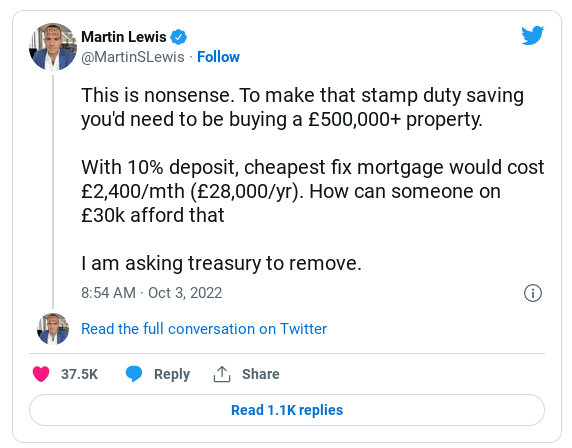
The Money Saving Expert (MSE) founder retweeted the post, writing: “This is nonsense. To make that stamp duty saving you’d need to be buying a £500,000+ property. With 10% deposit, cheapest fix mortgage would cost £2,400/mth (£28,000/yr). How can someone on £30k afford that. I am asking treasury to remove. “

Mr Lewis then questioned Treasury Chris Philp over the claim on ITV’s Good Morning Britain on Monday

“Your example is for somebody who earns £30,000 a year”, Mr Lewis said. “Clearly, they would not get that mortgage. And clearly on £30,000 a year before tax you cannot pay a mortgage of £28,000 a year.

“This seems fundamentally irresponsible for the Treasury to be putting out this kind of statement in the middle of a cost-of-living crisis.”

Mr Philip admitted he had not seen the message.

“But I imagine, I’m just sort of speculating, when they used the £30,000 to work out the tax saving, they were doing that to illustrate the income tax saving of someone on approximately medium earnings,” he added.

“You are right to point out that someone on that particular level of earnings would be unlikely to be able to get a mortgage to fund a £500,000 house, unless, of course, they were doing so with a partner, but I suspect that’s why they did it.”

Mr Lewis replied: “It doesn’t mention the partner’s income and the headline includes all the savings added in one…”

He later asked Mr Philp: “Can I ask you to look at those messages? These are big, bold messages… to have them taken offline in the middle of a cost-of-living crisis, where they give people false hope?”

He added: “Can I ask you to personally take a look at that? It seems irresponsible at the moment.”

Mr Philp said: “You’re right to point out the anomaly between the salary and the house value and I’d be happy to take a look at it.”

The choice of mortgage products on the market fell sharply following the mini-budget, as many lenders pulled deals off the shelves and re-priced their products upwards.

For some home-buyers, higher mortgage rates could outweigh any stamp duty savings they may stand to make.

According to Moneyfacts.co.uk, there were 2,262 residential mortgage products available on Monday October 3, down from 3,961 on the day of the mini-budget.

‘Pro-growth’ government has only made a UK recession more likely 

The squeeze on public spending is one reason why Truss can kiss goodbye to hopes that her mix of tax cuts and supply-side reforms will boost growth in the months ahead. A more important factor will be higher interest rates.

Despite yesterday’s U-turn, the damage is done to UK’s credit standing – Owl

Larry Elliott www.theguardian.com (extract)

The day before Kwarteng’s mini-budget, the Bank raised interest rates by half a percentage point to 2.25% – deciding against a bigger increase because it thought the UK was in recession. As it happens, an upward revision to growth in the second quarter means the economy is not actually in recession, but the respite is certain to be brief.

Huw Pill, the Bank’s chief economist, has warned that “significant” increases in interest rates can be expected at the next meeting of the monetary policy committee at its next meeting, and the financial markets currently expect official borrowing costs to keep on rising to 6%.

Make no mistake, if the Bank does push rates anywhere close to 6%, it had better be prepared for a colossal recession. Already last week there were signs of trouble ahead from the mortgage market, where more than a thousand home loan products were pulled by lenders watching what was happening to bond yields and the expected path of official Bank of England rates.

Many home buyers have taken out mortgages at high multiples of their incomes in the belief that permanently low interest rates will make them affordable. That assumption now lies in tatters, and floating rate mortgage holders and those whose fixed-rate terms are coming to an end face huge increases in their monthly payments. The supply of new buyers will quickly dry up. House prices will fall.

The irony is that the first budget of a supposedly pro-growth government has made recession more, not less, likely. The government can introduce supply-side reforms in the months ahead, but if interest rates stay high to placate jittery investors, the trend growth rate will be lower, not higher. Britain’s economic history is scattered with budgets that have quickly unravelled: Kwarteng’s is in a class of its own.

Investment zones could be allowed in England’s national parks

Investment zones with “liberalised” planning laws to accelerate development could be designated within national parks and in the most environmentally protected areas of the UK, government documents reveal.

The Tories are desperate. – Owl

Sandra Laville www.theguardian.com 

Details of the government’s new zones to increase housebuilding and commercial development reveal councils can apply for zones in national parks, areas of outstanding natural beauty, (AONBs) sites of special scientific interest, (SSSIs) and green belt land.

The deadline for councils to apply to host an investment zone is 14 October. The government says the zones “will benefit from tax incentives, planning liberalisation and wider support for the local economy” and will be granted after a “rapid” selection process.

Councils applying for the zones are asked: “For each proposed investment zone please provide details about whether the proposed development would be on land which is in:

  • A national park.
  • An area of outstanding natural beauty.
  • A site of special scientific interest, or equivalent designation.
  • The buffer zone of a world heritage site.
  • Designated green belt.

The document states: “Key planning policies to ensure developments are well designed, maintain national policy on the green belt, protect our heritage and address flood risk, highway and other public safety matters along with building regulations will continue to apply.”

Councils will also have to answer one question, with a yes or no, on whether they agree to mitigate environmental impacts of the investment zone and have to agree to accepting “a streamlined overarching planning system” within the zones.

There is no mention of environmental constraints on building in protected habitats under the habitat regulations, which provide protections for some of the most vulnerable habitats and wildlife in a network across England. The regulations also aim to prevent water pollution from excessive nitrates and phosphates, for example from sewage discharges and ensure that new developments do not lead to over abstraction of water from rivers.

Richard Benwell, the chief executive of Wildlife and Countryside Link, said the documents showed environmental protections being removed and downgraded. They also went against the government’s proposals to make every new development provide a “net gain” for nature, he said.

“There are countless examples of where mitigation is simply inappropriate or ineffective. You can’t mitigate for the loss of an ancient woodland or wetland. In many cases, supposed mitigation simply fails. Sometimes, where precious nature is at risk, you simply have to say no. The false philosophy that everything can be traded or replaced would be seriously damaging for nature,” he said.

“If large swathes of the country were made investment zones where environmental planning rules were weakened, all the government’s hopes of reversing the decline of nature could be dashed.”

The documents say the investment zones, which are being organised by the Department for Levelling Up, Housing and Communities, will benefit from “planning liberalisation”, remove “planning matters impeding delivery” and will be “streamlining the planning system”.

The government says the zones will focus on bringing growth, housing and commercial development to “undeveloped and underdeveloped areas”.

Joan Edwards, the director of policy for the Wildlife Trusts, said: “Pursuing unsustainable development on some of our most important sites for nature is a disgrace. We cannot have a thriving economy without a thriving natural world. This government has committed to protecting 30% of land and sea by 2030 – the minimum required to give nature a chance to recover. How can we achieve that if developers are given the green light to build all over our last strongholds for wildlife?”

The RSPB said the guidance published by the government further confirmed the charity’s fears that ministers were embarking upon an attack on nature. A spokesperson said: “There is no requirement to avoid impacts on nature, abandoning the mitigation hierarchy which places priority on avoiding – rather than mitigating or compensating for – losses. Furthermore, the government could have specified that investment zones should avoid protected sites for wildlife, national parks and AONBs.”

The zones are currently only applicable in England but the document says the government will work with devolved administrations and local partners to introduce investment zones across the UK.