North Devon Link Road junction “unaffordable”

And likely to get more unaffordable every time Kwasi Karteng opens his mouth – Owl

Phase two of the Tiverton junction has been paused

Ollie Heptinstall, local democracy reporter www.radioexe.co.uk

The junction under construction at Tiverton (courtesy: Devon County Council)

Plans to complete a new junction on the A361 North Devon Link Road at Tiverton are currently ‘unaffordable,’ councillors have heard.

On Tuesday [4 October], members of Mid Devon District Council’s ruling cabinet reluctantly agreed to pause phase two of the junction, which involves adding a bridge across the link road along with northern slip roads and landscaping.

Southern side slip roads were completed four years ago as part of the Tiverton Eastern Urban Extension of hundreds of new homes. A new road is currently being built to link the junction with Blundell’s Road.

Without phase two, a further area for new housing – ‘area B’ – cannot be built, although this is a longer-term aspiration and will not impact the current housing projects.

The council was already short of the previous £10.1 million estimated cost, having only secured £8.2 million of funding from Homes England, but a previous cabinet meeting in July heard how an updated estimate would now “significantly exceed” the earlier one.

The increased amount, which was not revealed, is blamed on significant rises in construction costs, volatile prices of materials and the need for a greater contingency.

After temporarily pausing the project in the summer, the council asked officers to find either additional funding or revise the scheme to make it affordable whilst still achieving its ‘core objectives.’

But in an update to members this week, Councillor Richard Chesterton (Conservative, Lower Culm), cabinet member for planning and economic regeneration, said this has proved unsuccessful.

Asking cabinet to support an indefinite pause, he said: “Clearly, this is not a recommendation which is made lightly, but it is felt to now be the most sensible course of action available to the council.

“Members will be well aware of the trying financial times in which we find ourselves currently and we’re not alone as a council in considering difficult decisions around pausing infrastructure schemes in the face of escalating costs.

“A decision to pause the scheme at this time does not mean that the scheme will not or cannot be delivered, but just that delivery will have to be reconsidered at a point in the future.”

The council is currently unwilling to borrow money to cover the shortfall.

It would add “significant further financial pressures … at a time of increasing economic and financial uncertainty and pressures and this approach is therefore not one which is considered prudent,” a report says.

As well as agreeing to pausing the scheme, cabinet also backed a second recommendation for officers to liaise with Homes England about “identifying alternative options to utilise” its funding to support other aspects of the eastern urban extension.

If these alternative options are found, it also asks officers to develop them into a “viable proposition” that can be considered by cabinet.

South West Water boss trebles pay with huge bonus as beaches are shut due to raw sewage in sea

Trickle down economics in action.

As Susan Davy gets more so do we.

But it’s not just trickling it’s gushing forth and spewing onto our beaches.

A palpable success for Trussonomics. – Owl

David Parsley inews.co.uk 

South West Water boss Susan Davy has more than trebled her annual salary with an award of more than £1m in bonus and benefits despite overseeing the closure of beaches after raw sewage was pumped into the sea around Devon and Cornwall.

Ms Davy, who is chief executive of South West Water’s parent company Pennon, is paid a base salary of £456,000, but with her bonus, incentives and benefits the company’s latest set of accounts show her total pay was bumped up to £1.6m.

The boost to her bank account comes as more than a dozen beaches across Devon and Cornwall have been shut due to pollution.

In the last week, Exmouth beach in East Devon has been unsafe to swim in since Tuesday’s heavy rain, either through continuous sewage dumping, or at least two separate dumping incidents.

A live interactive map created by Surfers Against Sewage displays a red cross on the beaches that have had sewage overflow discharges in the past 48 hours.

Exmouth had a red cross on Tuesday evening, indicating a recent spill, and still had a red cross on Thursday evening, indicating a second, or constant, spill.

Eleven beaches across the Cornish coast were also unsafe for 48 hours after overflow sewage was pumped into popular surf spots by South West Water.

Ms Davy’s bonus was paid despite South West Water having the worst environmental record of any water company in the UK.

The company has a one star Environment Agency rating, and is considered “below target” or “significantly below target” across the board for its environmental performance.

The company, which claims to be committed to the environment in its annual report, is also currently under investigation by watchdog Ofwat over the management of its sewage plants.

In June, David Black, chief executive of Ofwat, said: “Our concerns have grown further about South West Water’s operation of its wastewater assets and environmental performance. As a result, we have opened an additional enforcement case into South West Water.

“We have now opened enforcement cases against the majority of wastewater companies in England and Wales. From what we have seen so far, the scale of the issue here is shocking. Companies must resolve any problems at wastewater treatment works and do so quickly. Where they have breached their obligations, we will not hesitate to act.”

Last autumn, the Government voted to continue to allow the pumping of raw sewage into the sea around popular tourist beaches. If they had outlawed the practice, private water companies would have been forced to invest in improving their treatment of sewage.

Richard Foord, the recently elected Liberal Democrat MP for Tiverton and Honiton, said: “Our children should be encouraged to enjoy the natural world around them, especially during the summer holidays. But this week our rivers and local beauty spots have been channels for human sewage, making them a serious health risk.

“Still, South West Water executives have the audacity to take bonuses that are almost double their outrageously high salaries. With a one star rating from the Environment Agency, how can they justify this?”

A spokesman for South West Water  said: “The investments and changes we are already making across our network are delivering real results, including a one-third reduction in pollution incidents last year to the lowest number in 10 years.

“We are committed to bringing this down further year on year by strengthening our round-the-clock response, increasing resourcing levels by 25 per cent, and investing £330 million over the next three years in our wastewater network.”

Breaking: Liz Truss refuses to say she has confidence in Kwasi Kwarteng

Liz Truss gave broadcast interviews today as she visited a construction site in Birmingham with her chancellor Kwasi Kwarteng.

Ben Quinn www.theguardian.com 

Asked if she had confidence in her chancellor, the prime minister twice refused to say so. Here she is being interviewed by Sky News:

Watch on twitter here

Truss has no electoral legitimacy for her climate-wrecking policies

The decision by the Truss government to put Jacob Rees-Mogg, a notorious climate sceptic and advocate of squeezing every last drop out of our North Sea oil stocks, in charge of UK climate policy, when we are co-presidents of the UN’s Cop climate conference, is a heinous crime inflicted on future generations.

Donnachadh McCarthy www.independent.co.uk 

It sends a message to the world that the UK believes that all nations should likewise squeeze every last drop from their reserves, a message if acted upon, would ensure global temperatures would soar above a civilisation-ending 6C rise.

As Rees-Mogg announced the lifting of the fracking moratorium and a huge new round of fossil fuel licences for the North Sea, my first thought was the complete lack of democratic legitimacy for these extremist actions.

The announced policies are the antithesis of the 2019 Conservative election manifesto, which promised that they would not borrow to fund day-to-day spending, and would fund farmers to protect the natural environment, ban fracking unless categorically safe, lead global fight on climate change, and invest £9.2bn in energy efficiency.

But what the Truss government is doing is borrowing over £60bn to subsidise day-to-day fossil fuel consumption by homes and businesses, having failed to invest in insulation and enough renewables over the last 12 years. It is deregulating environmental protections for endangered species habitats, and “reviewing” the promised environmental payments for farmers to replace the EU’s CAP, with a view to reverting to payments per acre to increase “productivity”, which would benefit the richest landowners, at the expense of protecting soils and nature.

It has abandoned the fracking moratorium, despite the British Geological Survey reporting that associated earthquake risks were still unquantifiable.

The chancellor’s statement did include a tiny rise of £0.3bn per year for home insulation, a sum that will reduce energy bills for a paltry few hundred thousand homes, when 2.4 million homes a year were being insulated in 2012, prior to the Cameron government’s cuts.

A second source of illegitimacy is that Truss’s parliamentary majority is not based on a majority of votes cast in the 2019 election. They won only 43.5 per cent of the vote, but due to the UK’s unfair electoral system, this gave them a majority of 80 seats.

If the Liberal Democrats got an MP for every 38,300 votes that it took to elect a Tory MP, then they would have 96 MPs and held the balance of power. But as it took over 334,000 votes to elect each Lib Dem MP, they got only 11 MPs. If we had a legitimately fair electoral system, Truss would not be able to pursue this new extremist climate and nature destructive agenda.

Finally, there is the illegitimacy that these policies are the opposite of what the general public has supported in endless opinion polls over the last 12 years. Nearly two thirds of the public support redirecting the billions allocated to North Sea oil & gas expansion to renewable energy technologies and insulation/energy efficiency.

The government’s Public Attitudes Tracker shows that, by a majority of two to one, the public oppose fracking for natural gas. In a YouGov poll, 49 per cent backed renewables as their top priority for government investment, with just 7 per cent backing nuclear power. In an ECIU survey on the energy price crisis, 51 per cent saw renewables and insulation as the best way to reduce reliance on gas. Only 9 per cent backed expansion of North Sea oil and gas exploration, and a tiny minority of 8 per cent backed fracking, as the best long-term solution.

In the midst of Truss’s destructive extremism, there were two positives. Her deregulatory extremism did miraculously include ending the insane seven-year Tory ban on onshore wind farms in England. And the second piece of good news, is that Labour were putting the creation of a carbon-free electricity grid by 2030, at the centre of their economic plans for growth and better paying jobs for British workers.

We now need to shout from the rooftops that our new empress Truss is devoid of any legitimate electoral clothing for her announced climate and ecological destruction. A general election must be held immediately, so that whatever existential climate choices are being made, they have the legitimacy of an electoral mandate.

Martin Lewis brands government’s stamp duty savings claim ‘irresponsible nonsense’

Martin Lewis has branded a government claim over stamp duty savings as “irresponsible nonsense”.

Dodgy sums from Kwarteng’s Treasury – Owl

Maryam Zakir-Hussain www.independent.co.uk

The consumer champion said messaging from the Treasury could give some people “false hope” about buying properties during the cost-of-living crisis.

A Treasury post on Twitter said: “Thanks to the Growth Plan, a typical first-time buyer in London moving into a representative terraced house will save £11,250 on stamp duty & £1,050 on the household’s energy bills – and if they earn £30,000 almost an additional £400 on tax. This is around £12,700 in total.”

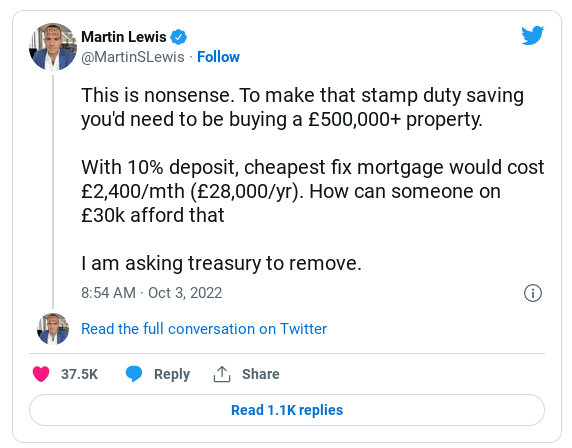
The Money Saving Expert (MSE) founder retweeted the post, writing: “This is nonsense. To make that stamp duty saving you’d need to be buying a £500,000+ property. With 10% deposit, cheapest fix mortgage would cost £2,400/mth (£28,000/yr). How can someone on £30k afford that. I am asking treasury to remove. “

Mr Lewis then questioned Treasury Chris Philp over the claim on ITV’s Good Morning Britain on Monday

“Your example is for somebody who earns £30,000 a year”, Mr Lewis said. “Clearly, they would not get that mortgage. And clearly on £30,000 a year before tax you cannot pay a mortgage of £28,000 a year.

“This seems fundamentally irresponsible for the Treasury to be putting out this kind of statement in the middle of a cost-of-living crisis.”

Mr Philip admitted he had not seen the message.

“But I imagine, I’m just sort of speculating, when they used the £30,000 to work out the tax saving, they were doing that to illustrate the income tax saving of someone on approximately medium earnings,” he added.

“You are right to point out that someone on that particular level of earnings would be unlikely to be able to get a mortgage to fund a £500,000 house, unless, of course, they were doing so with a partner, but I suspect that’s why they did it.”

Mr Lewis replied: “It doesn’t mention the partner’s income and the headline includes all the savings added in one…”

He later asked Mr Philp: “Can I ask you to look at those messages? These are big, bold messages… to have them taken offline in the middle of a cost-of-living crisis, where they give people false hope?”

He added: “Can I ask you to personally take a look at that? It seems irresponsible at the moment.”

Mr Philp said: “You’re right to point out the anomaly between the salary and the house value and I’d be happy to take a look at it.”

The choice of mortgage products on the market fell sharply following the mini-budget, as many lenders pulled deals off the shelves and re-priced their products upwards.

For some home-buyers, higher mortgage rates could outweigh any stamp duty savings they may stand to make.

According to Moneyfacts.co.uk, there were 2,262 residential mortgage products available on Monday October 3, down from 3,961 on the day of the mini-budget.

‘Pro-growth’ government has only made a UK recession more likely 

The squeeze on public spending is one reason why Truss can kiss goodbye to hopes that her mix of tax cuts and supply-side reforms will boost growth in the months ahead. A more important factor will be higher interest rates.

Despite yesterday’s U-turn, the damage is done to UK’s credit standing – Owl

Larry Elliott www.theguardian.com (extract)

The day before Kwarteng’s mini-budget, the Bank raised interest rates by half a percentage point to 2.25% – deciding against a bigger increase because it thought the UK was in recession. As it happens, an upward revision to growth in the second quarter means the economy is not actually in recession, but the respite is certain to be brief.

Huw Pill, the Bank’s chief economist, has warned that “significant” increases in interest rates can be expected at the next meeting of the monetary policy committee at its next meeting, and the financial markets currently expect official borrowing costs to keep on rising to 6%.

Make no mistake, if the Bank does push rates anywhere close to 6%, it had better be prepared for a colossal recession. Already last week there were signs of trouble ahead from the mortgage market, where more than a thousand home loan products were pulled by lenders watching what was happening to bond yields and the expected path of official Bank of England rates.

Many home buyers have taken out mortgages at high multiples of their incomes in the belief that permanently low interest rates will make them affordable. That assumption now lies in tatters, and floating rate mortgage holders and those whose fixed-rate terms are coming to an end face huge increases in their monthly payments. The supply of new buyers will quickly dry up. House prices will fall.

The irony is that the first budget of a supposedly pro-growth government has made recession more, not less, likely. The government can introduce supply-side reforms in the months ahead, but if interest rates stay high to placate jittery investors, the trend growth rate will be lower, not higher. Britain’s economic history is scattered with budgets that have quickly unravelled: Kwarteng’s is in a class of its own.

Investment zones could be allowed in England’s national parks

Investment zones with “liberalised” planning laws to accelerate development could be designated within national parks and in the most environmentally protected areas of the UK, government documents reveal.

The Tories are desperate. – Owl

Sandra Laville www.theguardian.com 

Details of the government’s new zones to increase housebuilding and commercial development reveal councils can apply for zones in national parks, areas of outstanding natural beauty, (AONBs) sites of special scientific interest, (SSSIs) and green belt land.

The deadline for councils to apply to host an investment zone is 14 October. The government says the zones “will benefit from tax incentives, planning liberalisation and wider support for the local economy” and will be granted after a “rapid” selection process.

Councils applying for the zones are asked: “For each proposed investment zone please provide details about whether the proposed development would be on land which is in:

  • A national park.
  • An area of outstanding natural beauty.
  • A site of special scientific interest, or equivalent designation.
  • The buffer zone of a world heritage site.
  • Designated green belt.

The document states: “Key planning policies to ensure developments are well designed, maintain national policy on the green belt, protect our heritage and address flood risk, highway and other public safety matters along with building regulations will continue to apply.”

Councils will also have to answer one question, with a yes or no, on whether they agree to mitigate environmental impacts of the investment zone and have to agree to accepting “a streamlined overarching planning system” within the zones.

There is no mention of environmental constraints on building in protected habitats under the habitat regulations, which provide protections for some of the most vulnerable habitats and wildlife in a network across England. The regulations also aim to prevent water pollution from excessive nitrates and phosphates, for example from sewage discharges and ensure that new developments do not lead to over abstraction of water from rivers.

Richard Benwell, the chief executive of Wildlife and Countryside Link, said the documents showed environmental protections being removed and downgraded. They also went against the government’s proposals to make every new development provide a “net gain” for nature, he said.

“There are countless examples of where mitigation is simply inappropriate or ineffective. You can’t mitigate for the loss of an ancient woodland or wetland. In many cases, supposed mitigation simply fails. Sometimes, where precious nature is at risk, you simply have to say no. The false philosophy that everything can be traded or replaced would be seriously damaging for nature,” he said.

“If large swathes of the country were made investment zones where environmental planning rules were weakened, all the government’s hopes of reversing the decline of nature could be dashed.”

The documents say the investment zones, which are being organised by the Department for Levelling Up, Housing and Communities, will benefit from “planning liberalisation”, remove “planning matters impeding delivery” and will be “streamlining the planning system”.

The government says the zones will focus on bringing growth, housing and commercial development to “undeveloped and underdeveloped areas”.

Joan Edwards, the director of policy for the Wildlife Trusts, said: “Pursuing unsustainable development on some of our most important sites for nature is a disgrace. We cannot have a thriving economy without a thriving natural world. This government has committed to protecting 30% of land and sea by 2030 – the minimum required to give nature a chance to recover. How can we achieve that if developers are given the green light to build all over our last strongholds for wildlife?”

The RSPB said the guidance published by the government further confirmed the charity’s fears that ministers were embarking upon an attack on nature. A spokesperson said: “There is no requirement to avoid impacts on nature, abandoning the mitigation hierarchy which places priority on avoiding – rather than mitigating or compensating for – losses. Furthermore, the government could have specified that investment zones should avoid protected sites for wildlife, national parks and AONBs.”

The zones are currently only applicable in England but the document says the government will work with devolved administrations and local partners to introduce investment zones across the UK.

Water companies forced to cut £150m from customers’ bills

Surely Truss and Kwarteng can’t allow even this weak regulator to go on unchecked?

Far too much state interference.

It damages profits and growth. 

Obvious target for cuts to pay for tax reductions. Growth before the environment! – Owl

[Includes South West Water]

Jasper Jolly www.theguardian.com 

Thames Water, Southern Water and other companies will be forced to cut tens of millions of pounds from consumers’ bills after the regulator said they had missed pollution targets.

Eleven water companies will have to return about £150m to customers in the form of lower bills in the 2023-24 financial year, the water regulator for England and Wales, Ofwat, announced on Monday.

The government and water companies have faced increasing criticism in recent years for allowing the dumping of raw sewage into rivers and the sea. The practice is meant to be limited to periods of high rainfall but some companies are under investigation by the Environment Agency for “significant and widespread breaches”.

Water companies in the UK have been privately owned and able to pay billions of pounds in dividends since 1989 despite enjoying a natural monopoly. As customers cannot switch water company if it underperforms, Ofwat instead runs the “outcome delivery incentives” system of automatic payments or penalties according to pre-agreed targets.

Thames and Southern will have to return £51m and £28m respectively after missed targets on water treatment works compliance, pollution incidents and internal sewer flooding across 2021-22, Ofwat said. Other recipients of large penalties included Northumbrian Water and Yorkshire Water, which will cut bills by £20m and £15m.

However, some companies will also be allowed to charge more because they have met targets. The biggest beneficiary will be Severn Trent Water, which can recoup an extra £63m from customer bills, while United Utilities will be able to charge an extra £24m.

The net result is that water companies will overall have to cut bills by £53m for failures during 2021-22.

David Black, the Ofwat chief executive, said: “When it comes to delivering for their customers, too many water companies are falling short, and we are requiring them to return around £150m to their customers.

“We expect companies to improve their performance every year; where they fail to do so, we will hold them to account. The poorest performers, Southern Water and Thames Water, will have to return almost £80m to their customers.

“All water companies need to earn back the trust of customers and the public and we will continue to challenge the sector to improve.”

Penalties to be paid by water companies

Affinity Water £0.8m; Anglian Water £8.5m; Dŵr Cymru £8m; Hafren Dyfrdwy £0.4m; Northumbrian Water £20.3m; SES Water £0.3m; South East Water £3.2m; South West Water £13.3m; Southern Water £28.3m Thames Water £51.0m; Yorkshire Water £15.2m

Bill increases allowed for companies that met targets

Bristol Water £0.6m; Portsmouth Water £0.8m; Severn Trent Water £62.9m; South Staffs Water £3.0m; United Utilities £24.1m; Wessex Water £4.4m

Tory conference: Labour favourites to win power at next election, says John Curtice

The Labour Party are “very clearly the favourites” to form the next government, pollster Sir John Curtice has told Tory activists in Birmingham.

By Brian Wheeler Political reporter, in Birmingham www.bbc.co.uk

New PM Liz Truss was now as unpopular with voters as Boris Johnson was when he was ousted, said Sir John.

And even if Labour’s current double digit poll lead reduced before the next election in 2024, Labour were still likely to gain power, he suggested.

His analysis was greeted with dismay and cries of “wow” from activists.

The veteran pollster, who masterminds general election exit polls, said Labour already had a nine point lead in the polls when Ms Truss won last month’s Tory leadership election and she had not enjoyed a honeymoon period.

Chancellor Kwasi Kwarteng’s tax-cutting mini-budget just over a week ago – and the market reaction to it – had produced a 7% swing to Labour, he said.

“The truth is, whatever the merits of Liz Truss’s package, it has resulted in very serious electoral damage to the Conservatives as an institution and to this new leader,” he told the Demos fringe meeting.

The swing to Labour was similar in size to that seen on Black Wednesday in 1992, the first time the policies of a Conservative government had produced turmoil on the money markets.

If voters remembered the events of the past week when they go to the polls in two years’ time, Labour could be on course for a three figure majority, said Sir John, even if Ms Truss’s policies work as intended and produce economic growth.

In the event of a hung Parliament, opposition parties would be unlikely to prop up a minority Tory administration, he suggested, which made Labour clear favourites to gain power.

Tory activists received a similarly sobering message at an earlier fringe meeting, from pollster with links to the party.

Veteran US pollster Frank Luntz told them: “If you want to win, stop bitching, stop griping, stop complaining and get [it] together.”

He said the party’s MPs had to start communicating with voters in a language they understood, and talking about things which mattered to them.

He also took aim at defeated Tory leadership contender and former chancellor Rishi Sunak, who has opted to stay away from this week’s conference.

“Where is Rishi Sunak? Why is he not here?” he asked the audience of Tory members.

If Mr Sunak was here he could “start to unify the party, you guys can go forward together,” added Mr Luntz.

“When people don’t even show up, what are the voters supposed to think?”

In a scathing assessment of Liz Truss’s first weeks in power, Rachel Wolf, who co-wrote the Conservatives’ 2019 election manifesto, said the new prime minister had no mandate from voters or her own MPs for the “ambitious” Thatcherite agenda she was pursuing.

She accused Ms Truss of “appearing not to care” about the impact her policies will have on voters worried about the cost of living,

“People are feeling poorer,” she added, and they don’t think the solutions Liz Truss has come up with “make any sense”.

Ms Wolf, co-founder of polling company Public First, and a former adviser to Michael Gove, picked apart Ms Truss’s claim to be a strong leader in the mould of Margaret Thatcher, and not afraid of unpopular policies.

The crucial difference between the two, she argued, was that Lady Thatcher had an electoral and Parliamentary mandate for her policies and was capable of articulating them in way that resonated with ordinary voters.

“Thatcher was always a strong leader,” she told the meeting, “but she was of the people, she spoke in their language”.

Pursuing an “ambitious Thatcherite agenda” without a mandate was a recipe for disaster at the polls, she suggested, and she hoped Conservative MPs could at least start to demonstrate some unity and competence.

She also had a message for Sir Keir Starmer.

“People are voting against the government but they are not voting for Labour, That might quite possibly be enough but it is the thing I would be most worried about if I were him.

“The thing that always comes up with Starmer, and still does, is that he has no views, no ideas of his own.”

Asked about the qualities needed in a modern leader, she said: “It’s very hard to support a leader who is uninterested in, or despises, you.

“It’s not whether they are strong, whether they have a view of their own, if they fundamentally don’t seem to like their electorate very much, or don’t think they are worth considering it’s very hard to vote for them.”

Liz Truss abandons plan to scrap 45p top rate of income tax amid Tory revolt

Liz Truss’s government has abandoned its plan to abolish the 45% top rate of income tax, following a turbulent reaction from international markets, and a mounting Conservative revolt over the policy.

But the policy of borrowing to fund tax cuts remains; what about bankers’ bonuses and why did Kwarteng deliberately avoid OBR scrutiny? – Owl

Peter Walker www.theguardian.com 

The decision came on the second day of the Tory conference in Birmingham, which had been dominated by dissent from Conservative MPs about both a tax cut for the wealthiest, and the wider idea of increased borrowing to finance tax reductions.

The abolition of the top tax rate, a marginal tax applying to incomes of £150,000 and above, was announced 10 days ago by Kwarteng as part of a mini-budget, which also included promised reductions to corporation tax, national insurance and the basic rate of income tax.

It triggered turmoil in the City, and was criticised by the International Monetary Fund. After a steep rise in the cost of government debt, the Bank of England made a a £65bn emergency intervention to restore order.

At the conference, the former cabinet ministers Michael Gove and Grant Shapps had taken aim at the plan to cut the top income tax rate, with speculation the wider programme of tax cuts could be financed in part by cutting benefits.

Gove toured fringe events at the party conference in Birmingham to give his verdict on the plan, which he called “not Conservative”, hinting that he could vote against the measure in the Commons.

Shapps, the former transport secretary, used a column in the Times to say “this is not the time to be making big giveaways to those who need them least” because “when pain is around, pain must be shared”.

“This bolt-from-the-blue abolition of the higher rate, compounded by the lack in communication that the PM acknowledges, is an unforced error that is harming the government’s economic credibility,” he said.

Damian Green, a former deputy prime minister, warned the Tories would lose the next election if “we end up painting ourselves as the party of the rich”.

The Tory ex-chancellor George Osborne said it was “touch and go whether the chancellor can survive” the fallout, telling the Andrew Neil Show it would be “curtains” for Kwarteng if his speech on Monday went badly.

The former minister Maria Caulfield said: “I can’t support the 45p tax removal when nurses are struggling to pay their bills.”

Truss has failed to rule out cuts in public spending to help balance the books, and the possibility of benefits facing a real-terms cut as earners on more than £150,000 have their taxes slashed.

Unanswered questions on the jailed peadophile Humphreys case.

Owl is upgrading this recent comment from Tim to a full post.

“Am I alone in thinking that the buck would usually stop, as far as the councils and police elements of this disgraceful period are concerned, with the bosses, the CEO and the Chief Constable?

Am I also alone in having concerns about the conduct of the EDDC officer who attended the meeting to be told of Humphreys arrest, and whether he (or she) did or should have reported it to those who had a need to know – like his/her boss?

It must have been foreseen that both officers stood/stand a chance, however large or small, of being found wanting in the way they carried out their duties. Surely neither should have had anything to do with any element of any enquiry into the matter. They should have recused themselves. Is it not unprofessional to have failed to recognise this from the start ?

In his report, Mark Williams quotes a number of sources and it appears he suggests that they back his officer’s decision to keep the matter, Humphreys’ arrest, confidential. That is his Williams interpretation, others may differ. I see those sources as firstly making it clear that victims, past, present, and potential, must be the primary concern and steps must be taken to have them kept safe. The quoted sources then also talk of the need for confidentiality for an accused, and rightly, of the principle of innocent until proved guilty. However, they then say there will be times others should know – but on a strictly ‘need to know’ basis. I feel ill at ease with a CEO who it appears thinks it not necessary that he knows about a prolific and horrendous sex offender amongst those be has some responsibility for. I know that I would want to know if it were an employee of mine.

While we are at it, let’s get this nonsense about the Cliff Richard case out of the way. That action was against South Yorks police giving confidential information about Richards to the BBC who then spectacularly made it public. Of course they were wrong. In the Humphreys case however there is no suggestion that the information was going in to the public realm. It was to be an exchange of confidential information between senior staff of two statutory bodies, both of whom had responsibilities in regard to the protection of vulnerable people. The case does not support the argument that the EDDC officer acted correctly in maintaining confidentiality. It was not unusual to exchange such information, it is not unusual, it happens all over the country all of the time. I would go so far as to say that without such ‘need to know’ exchanges happening daily between appropriate parties, the judicial system, a part of which I worked in and daily exchanged confidential information, would fall to pieces.

There are many elements of this matter that remain unclear. I have many questions remaining unanswered or unclarified, in between all the gossip. If I get clarification, or answers, I hope to add them in due course. Meantime I share the concerns already expressed.”

[Owl is aware of how much effort Tim and also Mark Hawkins put into checking that the comments they make on this case can be substantiated] 

Jacob Rees-Mogg’s business partner given senior minister role

This government is unelected, unaccountable and out of control = Owl

The City business partner of Jacob Rees-Mogg has been handed a peerage and job as a senior minister by Liz Truss’s government in a move likely to trigger accusations of cronyism.

Rowena Mason www.theguardian.com 

Dominic Johnson, a financier who co-founded Somerset Capital Management with Rees-Mogg, was appointed as a minister in the Cabinet Office and the Department for International Trade.

The announcement was slipped out on the government’s website, which said he had been appointed as of Sunday.

“Dominic Johnson CBE was appointed a minister of state jointly in the Department for International Trade and the Cabinet Office on 2 October 2022,” the statement said.

The appointment is likely to be controversial at a time when Truss, her chancellor, Kwasi Kwarteng, and Rees-Mogg face questions about being too close to the City, after the mini-budget handed substantial tax cuts to financiers and the wealthy.

Johnson is a substantial party donor who has given more than £250,000 and was vice-chairman of the Conservative party between 2016 and 2019. He replaces Gerry Grimstone, the former chairman of Barclays and Standard Life, in his role as trade minister, encouraging inward investment.

Somerset Capital Management is reported to be up for sale, with two of its founding partners now in senior government roles. Johnson recently said he was stepping down as chief executive of Somerset Capital Management.

Rees-Mogg still holds a substantial stake in the investment firm, despite the potential conflict of interest with his role as business secretary.

Petition: Call an immediate general election to end the chaos of the current government

[Already heading towards half a million – Owl]

Call an immediate general election so that the people can decide who should lead us through the unprecedented crises threatening the UK.

More details

Sign this petition

Parliament will consider this for a debate

Parliament considers all petitions that get more than 100,000 signatures for a debate

Waiting for 4 days for a debate date

Government responded

This response was given on 20 September 2022

The UK is a Parliamentary democracy and the Conservative Party remains the majority party. The Prime Minister has pledged to ensure opportunity and prosperity for all people and future generations.

Read the response in full

The United Kingdom is a Parliamentary democracy, not a Presidential one. Following the general election of December 2019, Members of Parliament of the governing party (the Conservative Party) were elected, such that there is a majority in the House of Commons. This remains the case. A change in the leader of the governing party does not trigger a general election – this has been the case under governments of successive political colours.

The Dissolution and Calling of Parliament Act 2022 provides that Parliament is automatically dissolved five years after it first meets (unless it is dissolved sooner), otherwise the timing is a matter of discretion for the incumbent Prime Minister (subject to re-established constitutional conventions).

In her speech of 6 September 2022, the new Prime Minister set out three early priorities: to grow Britain’s economy, deal with the energy crisis caused by Putin’s war, and putting the national health service on a firm footing. The Prime Minister is determined to address the challenges the country faces and ensure opportunity and prosperity for all people and future generations.

Cabinet Office

Sign this petition

Just reopen the beds in Community Hospitals

From a Correspondent:

Just reopen the beds in the Community Hospitals for stepdown care. This would make more beds available in acute Hospitals like the RD&E. Although there is a shortage of nurses, many of whom have left due to unbearable work pressure, it is possible that many would like to work in the more intimate environment or our community hospitals. This is what most people want, and would be a useful step towards care needs. For example, Ottery St. Mary hospital used to have a designated “domestic” room where patients recovering from acute procedures could regain their strength and confidence before returning to independence at home.

Climb down or stand firm – what does Truss do next?

“I don’t think there is a way out.”

It’s breathtaking to hear that judgement on Liz Truss’ problems from a seasoned former Conservative when the prime minister has not been in charge for a month.

By Laura Kuenssberg www.bbc.co.uk

But instead of a honeymoon Liz Truss’s first weeks in office have resembled a horror film.

A crash in the pound, since recovered, a crash in the polls and the Bank of England having to pump billions into the markets to stop pensions being wiped out.

Tory MPs tell me about phone calls from constituents who are in tears – fearful of losing their homes or businesses as borrowing costs soar.

And those higher costs – and inflation – will hit the government hard, bringing the prospect of dramatic spending cuts.

So instead of anticipating their new leader taking the stage in triumph at the Conservative Party conference this week, the question many MPs and members of the public are asking is how can Liz Truss – who is on our show this week – get out of this mess?

Does she ditch her plans? Stick firmly to the script? Or muddle through?

First, remember what happened to prompt the last wild week.

The government announced a hugely expensive package to freeze energy prices before following that up with a promise of chunky tax cuts that gave back more money to the wealthiest people in the country.

But what they crucially did not do was show how they planned to pay for it – by refusing to publish an assessment from the Office for Budget Responsibility – which examines the government’s tax and spending plans. And on our programme last week, Chancellor Kwasi Kwarteng suggested there would be more tax cuts to come.

Of course, there’s a healthy political debate about the rights and wrongs of those policies on their own. But what financial markets detest is the notion of spending and borrowing at huge levels without spelling out how and when the bills will be paid.

As one weary sounding Tory MP put it: “The problem wasn’t the numbers, it was that there weren’t any.”

It’s perfectly normal for governments to borrow billions of pounds from the markets but the reaction last week suggested the City had precious little faith that the government’s plans added up.

That’s toxic, because without that confidence, it makes it more expensive for the government to borrow the cash it needs. That makes the cost of loans and mortgages go up for everyone and could mean less money for public services too.

One party insider says that the hit to the Tories’ reputation for running the economy could have “all the hallmarks of a generation-defining setback”.

But all the signs are that the prime minister has zero intention of shifting an inch on this. Here’s what her supporters have told me:

  • One cabinet minister: “They have to stick to it now – the idea there can be a volte-face, forget it”
  • A minister: “She’s trying to change the direction of the country – the issues are the day to day handling of the politics”
  • A Truss backer: “‘What’s happening is a political loss of nerve – it’s entirely within our gift to recover it”

Yet No 10 faces a double nightmare of trying to recover economic and political credibility at the same time. Can they really do nothing?

The head of a large foreign investor said the UK was now “uninvestable”. Trying to keep calm (ish) and carry on just may not be possible.

The pound has recovered much of its losses but it seems a tall order for confidence to bounce back in the same way.

The last week suggests there are serious doubts about the chancellor’s strategy. As one senior investor told me: “I don’t know a single person in the City who thinks he knows what he is doing.”

Politicians I’ve spoken to – fans of the new government or not – suggest moving Mr Kwarteng would be “cowardly” or “wouldn’t make a difference”.

Liz Truss is politically close to her chancellor and a major move like that could cause even more instability. But there is no doubt that No 11’s authority is part of the problem.

A source close to Mr Kwarteng says “we make no apology for reversing an unsustainable high tax path”. But a cabinet minister told me while there’s no chance of an exit now “history shows that chancellors who have moments like this don’t necessarily survive in the medium to long-term”.

While it’s clear neither No 10 nor No 11 will consider a change of approach right now their own party may force them to make some changes so they can muddle through.

First off, there is a rising hunger for ministers to bring forward their full plans for the economy, including spelling out the costs and consequences of their spending.

As things stand No 10 is adamant this won’t be until 23 November. But plenty of backbenchers want it brought forward. One minister suggested the government will have to budge before November, saying: “Give the markets what they want with some more detailed forecasts and some attempt to show that this will work.”

There’s a thirst too to bring forward announcements of the other changes the government wants to make to get the economy going. One senior MP said the chancellor has a chance this week to talk about his “big productivity plans” to show “it’s a wider package, not just tax cuts”.

But the government may yet have to ditch some of its ideas. “They’ll have to walk back some of the things that have caused the most offence,” says an MP.

This could be scrapping the 45% top tax rate which I’m told the whole cabinet was not consulted on and which raised the most eyebrows in the mini-budget.

And it’s clear many Conservative MPs would be reluctant to back it, with one telling me: “If there is a vote on 45p or bankers’ bonuses I won’t vote for them, and neither will colleagues.”

There is growing unease too about the costs and implications of the decisions that have already been made for public spending, and specifically about the possibility of going back on Boris Johnson’s promise that benefits would rise in line with inflation.

One former minister told me the idea was “stupidity squared” because cutting tax for the best-off while giving those on benefits a real-terms cut is a total political non-starter.

Another senior figure predicts a classic climbdown where the government will stick to cutting the basic rate of tax with the classic promise to “consult” on the more controversial elements.

But what if Ms Truss can’t or won’t budge’?

Several MPs say one approach to get the government’s attention would be a kind of strike. They could make it plain the government doesn’t have backbench support by not turning up in the Commons.

But others are already contemplating even more. Extraordinary as it is to say this so soon into a new leader’s tenure, there are already conversations in the party about taking the ultimate action. In other words, if the PM won’t change her plans, her party might have to change her job.

One MP told me baldly in the last week: “They have lost the privilege of governing – I’m going to try and get rid of her.”

A former minister said there was a lot of “bluster and chest-beating” going and talk of removing the PM was “hysteria”, but added: ‘Four weeks of polls like this and we might move.”

Crazy? Perhaps. Wild talk in Westminster is often subdued by inertia. Things change quickly. There are many Conservatives who believe Liz Truss’ plans are an important and badly needed reset.

But if the Tories carry on being battered in the polls, and the market turmoil continues for weeks, all bets could be off.

And if it becomes a question of personal survival, arguably Liz Truss may not have helped her case by giving all the plum jobs to MPs who backed her in the leadership contest.

Remember she wasn’t the favourite choice of MPs to start with. As one senior figure reflects: “There is already a cohort of people who are saying ‘this is nothing to do with us’.”

Liz Truss has a huge chance in Birmingham this week to calm her party, the country and the financial markets, as well as explaining more clearly what she is trying to achieve.

And while there is no remote sense she will backtrack on her ambitions, these first steps in power have created serious doubts in her party, and among the public, about whether she has the right ideas and the backing to make radical changes to the country. Downing Street could very, very quickly become a lonely place.


UK ‘blind’ to new immune-evasive Covid variants creating ‘perfect storm’ for devastating wave

“The downscaling of Covid testing laboratories since the unveiling of the government’s Living with Covid plan means the UK is “blind” to the behaviour of new potential variants of concern. Major NHS “Lighthouse” labs closed earlier this year in line with the government’s policy on the infection.”

Thomas Kingsley www.independent.co.uk

The UK is heading into a “devastating” Covid wave this autumn exacerbated by a drop in testing and inadequate surveillance of new immune-evasive subvariants, experts have warned.

Covid-19 infections in the UK have risen 14 per cent, according to the latest figures.

Some 1.1 million people in private households tested positive for coronavirus in the latest survey, which covers the seven days to 17 September in England and the week to 20 September in the other three nations, according to the Office for National Statistics (ONS).

It is the first time the UK-wide total has been above one million since late August, though it is still some way below the 3.8 million weekly infections in early July at the peak of the wave caused by the Omicron BA.4 and BA.5 subvariants of the virus.

Professor Tim Spector, co-founder of the Covid ZOE app, told The Independent the UK was already at the start of the next wave of coronavirus.

“It looks like we’re in the start of the next wave and this time it’s affected older people slightly earlier than the last wave,” Prof Spector said.

He added: “Many people are still using the government guidelines about symptoms which are wrong. At the moment, Covid starts in two-thirds of people with a soar throat. Fever and loss of smell are really rare now – so many old people may not think they’ve got Covid.

“They’d say it’s a cold and not be tested.”

Prof Spector said early data showed new subvariants of Omicron were becoming immune-evasive and could cause the UK “real problems” as winter approaches with the NHS “already on its knees”.

University of Warwick virologist, Professor Lawrence Young, said two Omicron subvariants – BA.2.75.2 derived from BA.2, and BQ1.1 derived from BA.5 – were causing concern in early data and showing signs of being able to escape the immune system.

“What’s interesting about these variants is that although they’re slightly different in how they’ve come about they’ve come up with the same changes to get around the body’s immune system,” Prof Young told The Independent.

“What we’re finding is the virus is evolving around the immunity that’s been built up through vaccines and countless infections people have had.”

He added: “The biggest concern we’re seeing is that in early data these variants are starting to cause a slight increase in infections. In a way, this was to be expected but it does demonstrate that we’re not out of the woods yet at all with this virus, sadly.”

Prof Young also warned that the downscaling of Covid testing laboratories since the unveiling of the government’s Living with Covid plan means the UK is “blind” to the behaviour of new potential variants of concern. Major NHS “Lighthouse” labs closed earlier this year in line with the government’s policy on the infection.

“We’ve really taken our eye off the ball with Covid tests,” he said. “We can only detect variants or know what’s coming by doing sequencing from PCR testing, and that’s not going on anywhere near the extent it was a year ago.

“People are going to get various infections over the winter but won’t know what they are because free tests aren’t available – it’s going to be a problem. Another angle is the economic pressure. If people do feel poorly they’re not likely to take time off work. You have a perfect storm here, really, of inadequate surveillance, people not coming forward for vaccination and the economic situation.”

Both professors called for stronger and more proactive messaging from the government ahead of the colder winter weather, while Prof Young called for the return of mask wearing in poorly ventilated and crowded indoor spaces.

Additionally, public health experts have called for booster jab uptake to increase, with Prof Young noting that new bivalent Covid vaccine boosters, which tackle more than one variant, were key to preventing a devastating wave. But he conceded that there were still question marks around how effective the immunisation would be in keeping vulnerable people from becoming very sick.

Immunologist Professor Denis Kinane, who founded Covid testing firm Cignpost Diagnostic, also raised concerns about the lack of free testing and surveillance of new variants.

“While cases are currently on their way up, we do not yet know the full extent of what is coming in autumn and winter. However, with mass-participation events like the football World Cup taking place in November, international travel growing rapidly, differing vaccination levels across the world, and with most countries having relaxed entry requirements, a rise in cases and emergence of newer variants cannot be ruled out,” Prof Kinane told The Independent.

Sarah Crofts, ONS deputy director for the Covid-19 infection survey, said it was “too early to identify whether this is the start of a new wave”.

Dr Mary Ramsay, director of public health programmes at the UK Health Security Agency (UKHSA), said it was “clear now that we are seeing an increase” in levels of Covid-19.

“Cases have started to climb and hospitalisations are increasing in the oldest age groups. In the coming weeks, we expect a double threat of low immunity and widely circulating flu and Covid-19, creating an unpredictable winter and additional pressure on health services,” she added.

The number of people in hospital with coronavirus throughout 2022 has remained well below levels seen in 2020 and early 2021, before the rollout of vaccines.

Kwasi Kwarteng reportedly spoke of austerity cuts at champagne party on mini-budget day

Kwasi Kwarteng reportedly attended a private champagne reception with hedge fund managers at the home of a Conservative donor on the same day he delivered his mini-budget.

Nadeem Badshah www.theguardian.com 

The chancellor is alleged to have given guests information about forthcoming government spending cuts during the event at the west London home of Andrew Law, a financier, on the evening of Friday 23 September.

Kwarteng’s mini-budget earlier in the day, which introduced a £45bn package of tax cuts that will mostly benefit the richest fifth of households, triggered economic turmoil – with sterling collapsing to its lowest level since 1985 and the Bank of England acting to save pension funds.

The Labour leader, Keir Starmer, has called for the recall of parliament to address the financial crisis.

The chancellor is said to have told attenders at the reception of austerity-style budget cuts to come while guests drank wine, champagne and cocktails as they congratulated him on the measures announced in the House of Commons, according to the Sunday Times.

A source told the newspaper: “He wanted to give an unadulterated message of ‘growth, growth, growth’ and that’s why he didn’t talk about savings, because otherwise the [news] agenda would have been all about savings – ‘where will you cut? What will you cut? Blah blah blah’ – they’re fully aware they have to make savings.”

Two sources said Kwarteng described that day as a “great day for freedom”.

Another said guests told Kwarteng to “double down” – an approach from which some stood to make profits.

Tory officials told the Sunday Times that Kwarteng attended the gathering at Law’s home, which was arranged by the Conservative party’s campaign headquarters, for an hour to talk through his mini-budget plans and gave a five-minute speech.

The Liberal Democrat Treasury spokeswoman, Sarah Olney, said: “While struggling homeowners saw their mortgage bills spiral, it seems the chancellor was sipping champagne with hedge fund managers profiting from the falling pound.

“How out of touch can you get? We need an official inquiry into this now.”

A source close to the chancellor said: “Any suggestion attendees had access to privileged information is total nonsense.

“The growth plan [published earlier that day] included a commitment to review our tax code to make it simpler, better for families and more pro-growth. The government’s ambitions on lowering the tax burden are hardly a state secret.”

Kwarteng has said he will set out further details of his economic strategy when he publishes his medium-term fiscal plan on 23 November.

But the Treasury select committee, made up of MPs from all parties, has demanded that the chancellor release a full economic forecast from the Office for Budget Responsibility by the end of October.

The Treasury has been approached for comment.