Nadhim Zahawi fights for his political life after admitting tax ‘error’

“Labour didn’t deal with tax avoidance for 13 years in government! We have introduced new avoidance laws just this month” Nadhim Zahawi April 2015.

This government will have integrity, professionalism and accountability at every level. – Rishi Sunak

Michael Savage www.theguardian.com 

Nadhim Zahawi was battling to save his political career on Saturday night after he finally admitted reaching a tax settlement with HM Revenue and Customs (HMRC) following an “error” over a controversial multimillion-pound shareholding in the polling company YouGov.

In a carefully worded statement, Zahawi appeared to confirm that HMRC had carried out an investigation into his financial affairs while he was serving as chancellor last summer. Zahawi, now the Tory party chairman, said that the tax authority had concluded that he had made a “careless but not deliberate” error.

“So that I could focus on my life as a public servant, I chose to settle the matter and pay what they said was due, which was the right thing to do,” he stated. Tax experts said the statement was a tacit acknowledgment that Zahawi had paid a penalty.

The admission raises questions for Rishi Sunak over what he knew about the settlement and when. It comes with the prime minister already under pressure after being fined for not wearing a seatbelt, with MPs also unhappy over his rejection of tax cuts and the government’s allocation of levelling up funds. In an attempt to protect Sunak, Zahawi added: “When I was appointed by the prime minister, all my tax affairs were up to date.”

Zahawi’s tax affairs were thrown into the spotlight last summer when he was appointed chancellor by Boris Johnson, the day before Johnson was forced to resign. The Observer reported that civil servants in the Cabinet Office’s propriety and ethics team had alerted Johnson to an HMRC “flag” over Zahawi before his appointment, but it had been ignored.

Zahawi faced scrutiny on a tranche of shares in YouGov, the polling company he co-founded, which were held by a Gibraltar company, Balshore Investments, and sold for about £27m between 2006 and 2018. It was estimated by the thinktank Tax Policy Associates he may have avoided £3.7m capital gains tax on the sale of these shares.

Saturday’s statement immediately set off new demands for Britain’s most senior civil servant and parliament’s standards commissioner to launch separate investigations into the affair, after questions over whether Zahawi has made the correct declarations to officials and parliament concerning his financial interests.

Zahawi has still not disclosed the size of the HMRC settlement or confirmed he paid a penalty. It follows a Guardian report that he paid about £5m in relation to the sale of shares in YouGov.

Unlike his YouGov co-founder, Stephan Shakespeare, Zahawi took no shares in YouGov. However, a 42.5% shareholding was held by Balshore Investments, an offshore trust controlled by Zahawi’s parents. As YouGov grew in value, Balshore sold all the shares by 2018.

Zahawi said his father took shares “in exchange for some capital and his invaluable guidance”. He added that while HMRC agreed that his father was entitled to shares, it “disagreed about the exact allocation. They concluded that this was a ‘careless and not deliberate’ error.”

Zahawi said HMRC had agreed he had never set up an offshore structure, including Balshore Investments, and that “I am not the beneficiary of Balshore Investments”. When asked on Saturday night, his team would not comment on whether he had ever benefited from Balshore Investments in the past.

Dan Neidle, a tax lawyer and founder of Tax Policy Associates, said: “When I first reported this, he denied it, threatened to sue me and said throughout his tax affairs were in order. It is a disgrace.”

[Dan Neidle writes an extensive investigative article in Today’s Sunday Times and postulates a most likely scenario and the key considerations it raises. Including: Ministers shouldn’t dodge questions about their tax affairs — and they certainly shouldn’t set lawyers on the people raising the questions.]

Opposition parties are now demanding the publication of all of Zahawi’s correspondence with HMRC. They are also calling for independent investigations into whether Zahawi made the necessary declarations to officials and parliament.

Simon Case, the cabinet secretary, is facing calls to oversee an investigation into whether Zahawi should have declared any links relating to YouGov or Balshore under the ministerial code. The Liberal Democrats’ deputy leader, Daisy Cooper, has written to Case, calling for his intervention.

Cooper said: “Zahawi and his Conservative cabinet colleagues are arrogantly trying to brush this under the carpet. There are facts that still need to be established so there must be an independent investigation to get to the bottom of this. The British public has lost all faith in Conservative ministers to tell the truth after years of scandal.”

Meanwhile, Labour has also written to Daniel Greenberg, the new parliamentary commissioner for standards, asking whether Zahawi should have declared Balshore Investments in the public register of members’ interests.

Anneliese Dodds, the Labour chair, said Zahawi’s new remarks raised more questions. “This carefully worded statement blows a hole in Nadhim Zahawi’s previous accounts of this murky affair,” she said. “He must now publish all correspondence with HMRC so we can get the full picture. In the middle of the biggest cost of living crisis in a generation, the public will rightly be astonished that anyone could claim that failing to pay millions of pounds worth of tax is a simple matter of ‘carelessness’.”

She added: “Nadhim Zahawi still needs to explain when he became aware of the investigation, and if he was chancellor and in charge of our tax system at the time.”

Several senior ministers have defended Zahawi, including the prime minister. At prime minister’s questions on Wednesday, Sunak said Zahawi had “already addressed this matter in full and there’s nothing more that I can add”.

Labour urges inquiry into claim BBC chairman ‘helped Boris Johnson secure loan guarantee’

Labour is calling for an investigation after claims that the BBC chair helped Boris Johnson arrange a guarantee on a loan of up to £800,000 weeks before he was recommended for the job by the then prime minister.

www.theguardian.com 

The party has written to the parliamentary commissioner for standards, Daniel Greenberg, after a report in the Sunday Times that Tory donor Richard Sharp was involved in talks about financing Johnson when he found himself in financial difficulty in late 2020.

Sharp introduced multimillionaire Canadian businessman Sam Blyth, who had proposed to act as the then PM’s guarantor for a credit facility, to the cabinet secretary, according to the newspaper.

The Sunday Times said Johnson, Sharp and Blyth then had dinner at Chequers before the loan was completed, though they denied the PM’s finances were discussed.

Sharp, a former Goldman Sachs banker, was announced as the government’s choice for the BBC role in January 2021.

A spokesperson for Johnson dismissed the report as “rubbish” and insisted his financial arrangements “have been properly declared”.

“Richard Sharp has never given any financial advice to Boris Johnson, nor has Mr Johnson sought any financial advice from him,” the spokesperson said.

Of Johnson’s private dinner with Sharp, an old friend, and Blyth, who is a distant relative, the spokesperson said: “So what? Big deal.”

Sharp told the Sunday Times: “There is not a conflict when I simply connected, at his request, Mr Blyth with the cabinet secretary and had no further involvement whatsoever.”

A BBC spokesperson said: “The BBC plays no role in the recruitment of the chair and any questions are a matter for the government.”

In the letter to Greenberg, the Labour party chair, Anneliese Dodds, called for an “urgent investigation” as she cited the MPs’ code of conduct that “holders of public office should not place themselves under any financial or other obligation to outside individuals or organisations that might influence them in the performance of their official duties”.

She told the standards commissioner she was concerned that Johnson “may have breached this section by asking for an individual to facilitate a guarantee on a loan whom he would later appoint to a senior public role”.

“The lack of transparency around it, like that of the issue raised around Mr Blyth, may give the impression that this was a quid pro quo arrangement,” she added.

It comes after Labour demanded an inquiry earlier this week into reports that Mr Johnson used Blyth, reportedly worth $50m (£40m), to act as a guarantor for an £800,000 credit facility.

Dodds raised concerns that neither alleged arrangement was properly declared.

She said: “The financial affairs of this disgraced former prime minister just keep getting murkier, dragging the Conservative party deeper into yet another quagmire of sleaze.

“Serious questions need to be asked of Johnson: why has this money never been declared, and what exactly did he promise these very generous friends in return for such lavish loans?”

West Hill housing developer responds to local concerns

The developer who wants to build 23 homes on the outskirts of West Hill is hoping to allay the concerns of the parish council and other local residents. 

Convinced? – Owl

Philippa Davies www.sidmouthherald.co.uk

Morrish Homes has applied for outline planning permission for a site off Oak Road – but the parish council is strongly opposing the scheme, and 96 objections have been submitted to East Devon District Council’s website. 

The concerns include the safety aspects of extra traffic using Higher Broad Oak Road, a narrow country lane, to reach West Hill, and Oak Road, also a narrow, tree-lined lane. Residents are also concerned about the potential loss of mature trees, and said the village school, doctor and dentist would be unable to cope with the extra demand. Many objectors feel that the site is too far from the village amenities, with some questioning the distances stated in the planning application.  

In response Morrish Homes has said: “There is a pressing need for more homes in East Devon and housing delivery in the district is falling short. The land at Oak Road is a suitable site for a well-screened, relatively low-density and beautifully designed development. Current planning policy indicates that the site is sufficiently close to services and amenities along a route that is already regularly walked and cycled. As we have demonstrated in our submitted surveys and reports to East Devon District Council alongside our planning application, traffic can be safely accommodated on the local road network.” 

The company said the walking distances to local amenities include 1.3km to a convenience store, 1.4km to the post office, 1.7km to West Hill Primary School and 2km to St Michael’s Church. It has offered to make ‘appropriate financial contributions’ to the local authority to ensure that public services such as education will be able to accommodate the new residents.  

On environmental issues, Morrish Homes said: “Independent ecologists have confirmed that any potential impacts on protected wildlife species can be successfully mitigated. The retention of native trees and hedges, extra planting and open space provision will support biodiversity and screen the development, maintaining the character of West Hill as a ‘woodland village’. We want to stress that no trees will be felled.” 

The company said access to the site will feature a new banked hedge sweeping into the development, and there will be additional planting to screen the new homes from view, which will also benefit local wildlife. 

MI5 refused to investigate ‘Russian spy’s’ links to Tories, says whistleblower

MI5 repeatedly refused to investigate evidence that an alleged Russian spy was attempting to cultivate influence with senior Conservative politicians and channel illegal Russian funds into the party, a Tory member has alleged in a new complaint lodged with the investigatory powers tribunal (IPT).

See also: Landmark Ruling in Strasbourg as MPs Challenge UK Government over Failure to Investigate Russian Interference in Brexit

Carole Cadwalladr www.theguardian.com 

Sergei Cristo, a Conservative party activist and a former journalist with the BBC World Service, has lodged a complaint with the investigatory powers tribunal, filing the case after corresponding with the chair of parliament’s intelligence and security committee, Conservative MP Julian Lewis, who recommended he take the information to the authorities.

The committee’s Russia report claimed in 2020 that the security services had turned a blind eye to “credible evidence” of Russian interference and Cristo’s allegations offer potentially explosive new evidence that confirms its findings. Labour MP Ben Bradshaw said “allegations that the security services ignored evidence from a Conservative whistleblower exposing Russian infiltration at the highest levels of the party are truly shocking” and claimed the “Conservative party’s Russia problem” was an ongoing threat to Britain’s national security.

Cristo says that it was reading the Russia report that made him “suddenly aware that maybe the story I had was more significant than I thought” and, at Lewis’s suggestion, he wrote to Cressida Dick, then commissioner of the Met police.

He received a response from the counter-terrorism command (SO15) who said it was not a matter for the Met and advised him to take it to the IPT – which oversees the security services – which he has now done.

The allegations centre around the formation of a group called Conservative Friends of Russia in 2012, and its relationship with a Russian diplomat, Sergey Nalobin.

In August of that year, the Russian ambassador, Alexander Yakovenko, hosted a lavish launch party for the group in the gardens of his residence in Kensington with guests who included the former minister of culture, media and sport, John Whittingdale, and Boris Johnson’s now wife, Carrie Symonds. The Russian government also funded an all-expenses-paid trip to Moscow for a handpicked group of members including the future CEO of Vote Leave, Matthew Elliott.

Cristo says his suspicions about Nalobin, who was the political first secretary at the embassy, had been aroused two years earlier when he was approached by the diplomat and they met at the Carlton Club. When Nalobin learned that Cristo was a volunteer with the treasurers’ department of the Conservative campaign headquarters (CCHQ), he said he could “make introductions to Russian companies who would donate money to the Conservative party”.

Russian diplomat Sergey Nalobin with Boris Johnson

Russian diplomat Sergey Nalobin at a function with Boris Johnson. Photograph: Twitter

“I knew straight away that what he was suggesting was illegal under UK law,” Cristo wrote in a letter to Lewis last year.

Alarmed by Nalobin’s efforts and the embassy’s sponsorship of the group, Cristo contacted Luke Harding at the Guardian and revealed Nalobin’s background and his disturbing relationship with the group. Harding and journalists at Russia’s The Insider found Nalobin had family connections to the FSB spy agency: his father, Nikolai, was a KGB general whose responsibilities included supervising Alexander Litvinenko, while his brother Viktor also worked for the FSB.

The resulting articles led to the resignation of the honorary president of Conservative Friends of Russia, Sir Malcolm Rifkind, and the renaming of the group.

What Cristo has never previously revealed is his abortive attempts to get the security services to act. He says that he whistleblew to the Guardian only after his attempts to get the authorities to act failed. In 2011, he tried repeatedly to raise the alarm with MI5. After an initial meeting with a junior agent went nowhere, he wrote to the director general of MI5, which resulted in a further meeting with two agents in a government building in Whitehall.

Cristo offered to meet Nalobin again and question him while wearing a hidden camera about how the Russian government intended to make the donations. That offer was also declined and he was advised to cease contact with Nalobin.

He also took his concerns to senior members of the party after a discussion with Britain’s most famous Russian defector, Oleg Gordievsky, a former KGB colonel. Gordievsky studied Nalobin’s biography and told Cristo that he believed he was a spy.

Conservative Friends of Russia was reinvented as the Westminster Russia Forum and only finally shut down altogether last year after Russia’s invasion of Ukraine. Meanwhile Nalobin continued to cultivate close relationships with MPs and Conservative party activists for a further three years until the Foreign Office declined to renew his visa.

In 2017, the Observer published an article that referred to Nalobin’s interest in the rivalry between David Cameron and Boris Johnson and his forced departure from the UK. It resulted in a series of furious emails from the Russian ambassador who sought to “correct” the article. The Observer declined to do so. Last year, Nalobin surfaced in Estonia when news broke that he had been expelled for espionage and had been “directly and actively engaged in undermining Estonia’s security”.

Russian president Vladimir Putin has been accused of deploying more intelligence agents in London than at the height of the Cold War.

“I think this is important because none of this ought to have happened,” Cristo said last week. “If MI5 had taken action, Conservative Friends of Russia would never have launched and Nalobin would not have been allowed to get close to so many key Conservative politicians and party members.”

Minister Confronted With Damning Graph On NHS Funding During BBC Question Time

BBC Question Time presenter Fiona Bruce has said a Conservative claim of record spending on the NHS “doesn’t look so good” after a minister was confronted with a damning graph.

Graeme Demianyk www.huffingtonpost.co.uk 

A special edition of the corporation’s flagship political programme from Hoddeson, Hertfordshire, was devoted to health as the sector faces multiple crises, most notably a stand-off with nurses and other staff over pay.

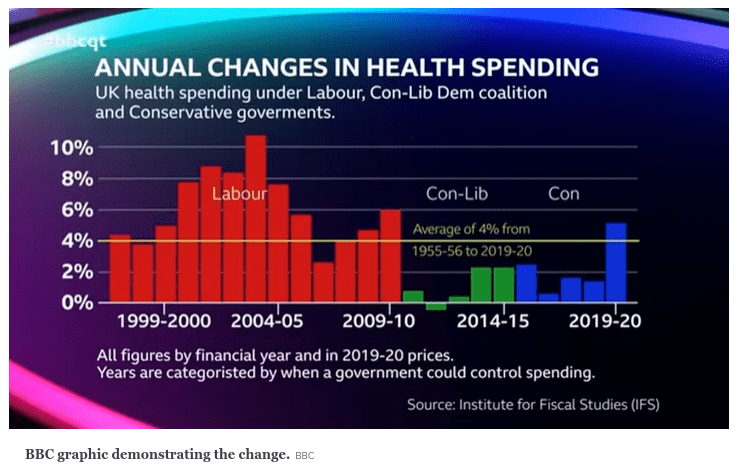
Bruce presented health minister Will Quince with a graphic using Institute of Fiscal Studies data suggesting NHS spending between 1955-56 and 2019-20 increased by an average of 4% – but the annual rise has been below that for all but one year since 2010.

Bruce said: “Let’s just look at a graph looking at funding of the NHS. This will be familiar to you, in terms of where funding was for the NHS before the Conservative government came into power and where it is now.

“As you can see, if you look at the average there, it’s pretty dramatic in terms of the drop in funding. So when you talk about record investment, that doesn’t look so good.”

Quince replied by not addressing the point of the graph – that health spending went up by a greater percentage in the Labour years – but by saying “we’re spending more on health and social care now than ever in our country’s history”.

Bruce followed up by saying “the average increase has been something like 3% but when you look at that, it’s more like 1.6%”.

But Quince persisted: “If you take, for example, 2010, it was around £100bn that we spent on the NHS. By 2025, it will be £166bn.

“And, if you look at when times were tough, for example, when we came out of the economic crisis in 2008-2009, the coalition government, despite having to make reductions in spending elsewhere, prioritised the NHS.”

It’s unclear precisely which research by the respected think-tank the graph refers to. But one study that does not include the latest annual figure states spending increased by 6% annually during the Blair-Brown years, dropped to 1% under the coalition, and was up to 1.6% under the Conservative government up to 2018-19.

In any case, many watching seized on the figures.

The IFS report said: “UK health spending increased in real terms by an annual average of 3.6% per year between 1949-50 and 2018-19.

“Spending increased sharply during the late 1990s and 2000s, growing by an average of 6% per year during the Blair and Brown governments as part of a wider growth in public service spending.

“Since 2009-10, health spending growth has slowed sharply. Between 2009-10 and 2018-19, real spending grew by an annual average of 1.3%. Average increases of 1% per year under the coalition government (2009-10 to 2014-15) were the smallest five-year average seen under any government.

“However, it is important to note that these increases took place over a period during which most areas of public spending experienced large reductions. Indeed, spending on areas such as education, defence, and public order and safety has fallen, while spending on health has continued to rise – albeit at a slower rate than has tended to be the case historically.” [Osborne austerity – Owl]

Dartmoor wild camping protesters ‘defiant’ as they march in their thousands and summon “Old Crockern”

More than 3,000 protesters gathered in Cornwood, near Ivybridge, before marching on Dartmoor to show their anger at a new High Court rule banning wild camping on Dartmoor. Campaigners congregated at the War Memorial in Fore Street.

[Crockern Tor is said to be the home of the mythical Old Crockern, variously described as a spectral figure on horseback, galloping across the moor on a skeleton horse with his phantom hounds which were stabled at nearby Wistman’s Wood; or as a local god of the moor in pre-Christian times]

Amber Edwards www.plymouthherald.co.uk 

A campaign group called The Stars are for Everyone said: “3,000 people have come to become part of this historic movement. Here we stand. Defiant, hopeful, and powerful.”

Since the High Court’s decision, landowners have agreed to allow wild camping on most of Dartmoor without permission, they are said to be paid an ‘unknown sum’ by the park. However, Right to Roam campaigners have called it a “stitched up deal”.

The group is unhappy that the “already cash-strapped national park” have to pay the landowners for “granting such permissions”.

The protest event is taking place this afternoon [Saturday] between 1.30pm and 5pm. The village situated on the edge of Dartmoor will be filled by the sounds of drumming during part of the ceremony and musicians are also said to be attending.

The group posted on their Twitter page: “We’ll see you tomorrow for the first of many acts of resistance against this new enclosure. We summon Old Crockern to our side: the ancient spirit of Dartmoor. He has risen before to put the avarice of an arrogant landowner in check – may he do so again!”

An open invitation has been extended to all for the protest today (Saturday, January 21). People are being told that they are welcome to bring something small or large that they can make a drumming sound with.

On its event page, Right to Roam said: “Old Crockern represents the values that sit within our campaign and those that embody Dartmoor: inclusivity, freedom, growth, relationship and humanity.”

They added: “Our right to be in nature should not be the plaything of the landowning elite. It is not something to be stripped away by legal theatrics, nor negotiated for a doff of the cap. It is our collective inheritance; a birthright which brokers our connection to the land and the stars.”

Right to Roam is aiming to extend the Countryside & Rights of Way Act in England so that millions more people can have easy access to open space.