Pub famed for its carvery confirms closure – Sidmouth’s Bowd Inn goes dark

A Devon pub which is renowned for its farmhouse carvery has announced its sudden closure. The Bowd Inn in Sidmouth has closed its doors with immediate effect.

Anita Merritt www.devonlive.com

It has not been confirmed how long the pub will be shut or if the current owners will reopen it again. Customers who have emailed the pub this week have been shocked to receive automatic replies stating that the business is no longer trading.

The response from The Bowd Inn states: “Unfortunately, the Bowd Inn is now closed. We would like to thank all of our guests for your custom and support.

“Emails will be reviewed periodically and responded to where appropriate.” The owners of the pub have been contacted by DevonLive but have declined to give further insight into the reasons behind its closure.

A spokesperson for the Bowd Inn said: “The business is now closed until further notice and we have no additional comment to add at this time.”

The pub’s website has been updated today to give news of its closure. It simply states: “Sorry, but we are closed until further notice. Thanks for your support.”

Its website reveals that the Webb family took over The Bowd Inn just under nine years ago. Tom Webb said: “We, the Webb family, had our eye on the Bowd Inn for some time and saw its potential and beauty, and hoped that one day it would become available.

“Fortunately for us, our chance arose in late 2013, and after many months of negotiation, a deal was struck and we received the keys in April 2014. After weeks of not always straightforward renovations we opened on May 10, 2014, with our team ready to do what they do best, look after you, our customers.”

On TripAdvisor, many customers have left five-star reviews. Just two weeks ago a customer said: “A fabulous Sunday roast and a carvery that looked beautifully presented. Well worth a visit.

“Thank you to the chap behind the carvery (possibly the owner) for really making a fuss over our party and for making our foreign visitor feel so welcome. Would highly recommend!”

.

NHS “Missing in Action” – what happened to ministerial accountability?

What Thatcher attempted in the 1980/90’s was to restrict ministerial responsibility to “policy decisions”, leaving responsibility for delivery or “operations” to semi-autonomous agencies.

Under this policy ministers are no longer responsible when things go wrong with delivery of essential services.

The present state we are in shows that this is an unsustainable fig-leaf.

Time for ministers to stop hiding. – Owl

[Currently, a total of 410 agencies and other public bodies form part of the UK government’s sprawling structure. These agencies and public bodies are service delivery units that support ministerial departments, but do so whilst operating at arm’s length from ministerial control. In effect, this means that those whom we elect to power look as though they are in charge, but in practice have scant direct power (and accordingly, accountability) over governmental operations. The democratic core of government has been hollowed out by radical structural reform began under the Thatcher government. blogs.lse.ac.uk]

BMA condemns ‘political choice’ not to tackle ‘intolerable’ pressure on NHS

www.theguardian.com 

The pressure on the NHS is “intolerable and unsustainable”, medics have said, amid warnings that the deaths of up to 500 people each week could be caused by delays in emergency care.

It comes after more than a dozen NHS trusts and ambulance services declared critical incidents over the festive period, with officials citing rising flu cases and the impact of the Covid-19 pandemic among the reasons for the pressure on the health service.

Prof Phil Banfield, chair of the British Medical Association (BMA) council, hit out at both the prime minister and the health secretary. Highlighting the scale of the crisis facing healthcare workers, he called the government’s decision not to negotiate with medics a “political choice” that is leading to patients “dying unnecessarily”.

“The current situation in the NHS is intolerable and unsustainable, both for our patients and the hardworking staff desperately trying to keep up with incredibly high levels of demand,” he said.

“The BMA has repeatedly invited the government to sit down and talk about the pressures on our health service, but their silence is deafening.

“It is disingenuous for the prime minister to talk about ‘backing the NHS’ in his new year message, when his own health secretary is failing to discuss how this crisis can be fixed.” He called on the government to “step up and take immediate action” to solve the crisis.

The Royal College of Emergency Medicine also doubled down on its claim that somewhere between 300 and 500 people are dying each week as a result of delays and problems with urgent and emergency care, as it warned against any attempt to “discredit” the figure.

Ian Higginson, vice-president of the Royal College of Emergency Medicine, told BBC Radio 4’s Today programme: “What we’ve been hearing over the last few days is that the current problems are all due to Covid or they’re all due to flu, or that this is complex, you mustn’t jump to conclusions – all that sort of stuff.

“If you’re at the frontline, you know that this is a longstanding problem. This isn’t a short-term thing. The sort of things we’re seeing happen every winter, and it still seems to come as a surprise to the NHS.”

Last week, one in five ambulance patients in England waited more than an hour to be handed over to A&E teams. NHS trusts have a target of 95% of ambulance handovers to be completed within 30 minutes, and 100% within 60 minutes.

In November, 37,837 patients waited more than 12 hours in A&E for a decision to be admitted to a hospital department, according to figures from NHS England. This is an increase of almost 355% compared with the previous November, when the figure was 10,646.

Higginson added that the Royal College of Emergency Medicine figures on deaths caused by delays were more than a “guesstimate”. “These are real figures, and I worry that we’re going to hear attempts to spin and manipulate this data and discredit it. I think if we hear that, we’ve got to say, ‘No, that is spin.’”

The figure was questioned by some health chiefs, with NHS England’s chief strategy officer, Chris Hopson, claiming not to “recognise” that estimate.

“We need to be very careful about jumping to conclusions about excess mortality numbers and their cause without a full and detailed look at the evidence, which is now under way,” he told BBC Radio 4’s World at One programme.

On Monday morning, the education minister, Robert Halfon, said Rishi Sunak was treating the issue as a “top priority”, but admitted that more needed to be done.

“The government is putting [in] a lot of funding and doing everything possible. We know, of course, that many of these problems have been caused by the pandemic and the pressures on the NHS that we’ve seen over the past few years.”

But Banfield warned that patients would die due to the current state of the health service. “The government should deliver on its obligations to the public. It is just not true that the cost of resolving this mess cannot be afforded by this country. This is a political choice and patients are dying unnecessarily because of that choice.”

The Liberal Democrats called on the government to recall parliament over the crisis. The party’s health spokesperson, Daisy Cooper, said: “This is a life-or-death situation for huge numbers of patients. The NHS is collapsing in front of our eyes whilst the prime minister and health secretary are nowhere to be seen.

“This is a national crisis and the country will never forgive the government if they refuse to recall parliament whilst hundreds of people die in parked ambulances or hospital corridors. Nobody should lose a loved one because the government was asleep on the job.”

Tim Cooksley, president of the Society for Acute Medicine, said the current situation in emergency departments was “unbearable” and would remain that way without significant changes.

“Unless we engender a belief for both NHS staff and for our patients that things will improve, and unless we are able to retain and then attract colleagues back and recruit new colleagues, then our situation will remain unbearable for a long time.”

Plan to power thousands of new homes in Exeter’s extension

There is currently insufficient electricity capacity in the area to support the full planned development of 2,500 houses around Matford.

Devon County Council and National Grid have now put forward a detailed joint planning application that would see the substation operational in 2026. 

An example of development plans running ahead of infrastructure. – Owl

Paul Greaves www.devonlive.com

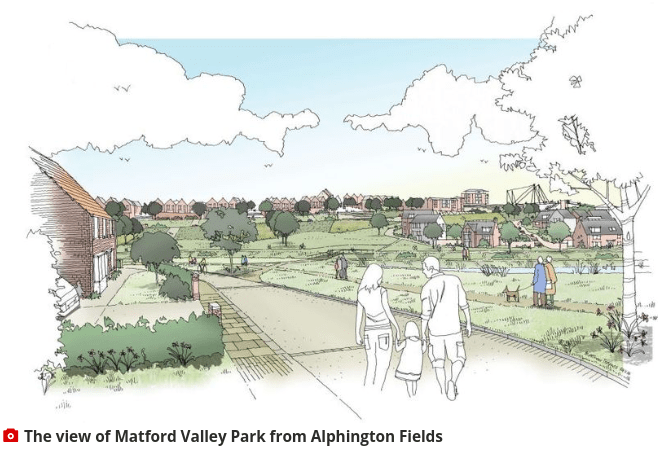
Plans have been submitted for a new electricity substation to power thousands of new houses on the outskirts of Exeter. Devon County Council says the bulk supply point at Matford Home Farm is essential to support the large housing extension to the city between Alphington and Exminster.

Housing development in the area has been taking shape off the A379 for several years. Hundreds of houses have already been built and many more are in the pipeline. But there is currently insufficient electricity capacity in the area to support the full planned development of 2,500 houses around Matford.

Devon County Council and National Grid have now put forward a detailed joint planning application that would see the substation operational in 2026. The proposed scheme is for the construction of a 132kV-33kV -11kV bulk supply point electricity substation, operational electricity plant, substation access road and surface water drainage. A planning application document sets out the principles of the plan which can be viewed online.

It says: “The proposed scheme would be located in Teignbridge district and Exeter City and forms part of the SWE urban extension which would provide 2,500 homes across Exeter (500) and Teignbridge (2,000) and well as five hectares of employment land.

“The scheme would provide key infrastructure which would enable the building of homes and employment space in the urban extension area and would help enable the delivery of the objectives set out in the Teignbridge Local Plan and Exeter Local Plan.

“The substation is required as it is understood that there is insufficient electricity capacity in the area to support the full development of SWE. This would also impact future development proposals, such as Exeter City Council’s ‘Liveable Exeter’ project. Therefore, this development is essential in providing the infrastructure to enable the development of SWE and delivering the policies and aims of the Teignbridge Local Plan and Exeter Local Plan.”

The proposed site near Old Matford Lane extends to nearly three hectares over an extensive yard area currently occupied by with a range of agricultural buildings and a farm shop. Much of the farmland surrounding the plot is currently being transformed by different housing developers as part of the wider SWE scheme. Existing power supply equipment is reaching the limits of its capability and will not cope with the expansion, says the National Grid.

The council says: “Future demand for electricity is expected to increase from 2025, when it is expected that new homes will no longer be able to have gas boilers, with the alternative likely to be heat pumps powered by electricity.

“Similarly, from 2030 new petrol and diesel cars will not be sold resulting in additional electricity required for charging. A new bulk supply point is expected to provide sufficient capacity to meet future demands. The scale of the proposed substation accords with other locations in Devon, where similar upgrades are required to meet future need.

“The proposed electricity substation aims to be operational by 2026, to serve the SWE development and future growth. In summary, the capacity of existing electricity infrastructure has been fully utilised and this, in combination with the expected future electricity need, requires significant scale upgrades to the electricity network.”

A public consultation has already taken place on the plans, which have been submitted to Devon County Council for determination. Concerns have been raised by residents living in established homes nearby about noise and light pollution. One resident said he was ‘astonished’ the site is considered suitable considering its history of flooding.

He added: “This planned substation is quite simply in the wrong location. It may be the cheapest option for Devon County Council, but it’s clearly not the best option for the hundreds of residents living in the area.”

Sidmouth no closer to getting protection for crumbling cliffs

Sidmouth remains in limbo as to when it the town will eventually get new and improved vital coastal defences – but not for another two years at least. Protection is needed for the East Devon seaside town to stop the crumbling cliffs from falling into the sea.

Will the cliffs fall victim to austerity 2.0? – Owl

Daniel Clark www.devonlive.com

Over the last several years, cliff falls have been a regular occurrence. Time and time again, landslides have taken place, seeing large red dust clouds engulf part of the cliffs and the beach – including in August, when four cliff falls happened in the space of a day.

It was hoped that by the end of 2022, the funding case for approval for the latest iteration of the scheme would have been granted by the Environment Agency. This however is yet to have happened – putting the latest anticipated timeline in doubt. No details as to how long, or the reasons for the delay, are known at this stage.

Already the costs of the vital sea defences to save Sidmouth’s crumbling coastline and protect the Esplanade have gone up by £5million in the past year, taking the estimated costs to a total of £19million. The Sidmouth and East Beach Beach Management Plan Project Advisory Group have previously approved ‘bigger and better’ Sidmouth sea defences.

In 2018, plans for a coastal defence scheme which would involve beach replenishment, periodic beach recycling, a new rock groyne on East Beach and modifications to the River Sid training wall were agreed. They would also include raising the height of the splash wall along the seafront slightly, and then topping it up with temporary storm barriers or strong glass panels when needed.

But in 2021, extra funding for the scheme is available, alternative schemes that had been ruled out due to the cost could be made on the table. This meant that options, such as additional offshore breakwater, which had previously been discussed and would have presented a more robust solution technically, were ruled out on financial grounds.

It meant that the council was able to start work on plans for a new ‘hybrid option’ to replace the former 2018 ‘preferred option’. This option includes at least one additional rock island, which may reduce the need to raise the splash wall along The Esplanade and could lower the long-term costs of recharging the beach with new material, which will be needed in the future. The hybrid option still includes a 120m rock-groyne at East Beach and requires a beach recharge on both East Beach and the town beach.

An outline business case was prepared for the Sidmouth Beach Management Scheme (BMS) in the summer for readying it for submission to the Environment Agency (EA) for funding. That however has yet to happen – putting the timeline of the scheme in doubt.

To allow the scheme to progress, then authority will submit a report to EDDC’s cabinet and full council, seeking approval for the additional funds from the capital budget as a temporary loan until further money can be secured from elsewhere.

The previously anticipated timeline:

  • Late summer 2022 – Submit the funding case for approval to EA, which if successful, secures the funding in principle. Approval should be granted by autumn 2022.
  • Late autumn 2022 – Work on the scope of the detailed design stage with a sub group made from members of the Sidmouth and East Beach BMP Project Advisory Group. They will help represent Sidmouth residents, providing guidance on what the town needs from the scheme, what it looks like, how it will work and how it will be designed and built. This will include discussions on the number and position of additional rock breakwaters.
  • Early 2023 – Finalise the scope for the detailed design.
  • Followed by – Appointing an engineering consultant to manage the detailed design process and prepare for construction.
  • Summer 2023 – autumn 2024 – Public consultation on the detailed design and propose a planning application.
  • Autumn 2024 – Early 2025 – Appoint a contractor to build the scheme.
  • Spring 2025 – Start construction.

How “Independent” are public sector pay review bodies?

NHS unions say plans for 2% pay rise next year could mean more strikes

Denis Campbell www.theguardian.com 

NHS strikes could continue for many months amid anger at UK government plans to raise staff salaries by only 2% next year, which health unions have condemned as more “real-terms pay cut misery”.

Ministers have asked the NHS pay review body to cap the increase in frontline health workers’ pay to 2% in 2023-24 to help the government achieve its ambition to curb soaring inflation.

But the attempt by the health secretary, Steve Barclay, to cap the annual salary rise at such a low level could lead to the NHS facing prolonged industrial action, health service bosses are warning. The 2% is barely a third of the estimate by the Office for Budget Responsibility (OBR) that inflation as measured by the CPI index will average 5.5% during 2023-24.

The 2% plan comes against a background of widespread strikes across the NHS in protest at the government’s decision to give the bulk of personnel a rise of £1,400 – or about 4% – for 2022-23. In England, ambulance staff will walk out again on 11 and 23 January, while nurses are due to refuse to work on 18 and 19 January, disrupting a wide range of services including planned surgery and outpatient appointments.

On 16 November, Barclay wrote to the NHS pay review body, which advises ministers what size of uplift staff apart from doctors and dentists should receive, giving them their remit for the 2023-24 settlement. While it did not specify the 2% figure, the NHS Confederation hospitals body, the Health Foundation thinktank and several health unions all say that the fact that NHS England’s budget for 2023-24 has already been set means that is the sum Barclay is keen to see awarded, with a 1% contingency potentially making it a 3% rise. Either sum is likely to provoke further unrest among NHS staff.

Pat Cullen, the general secretary of the Royal College of Nursing (RCN), said: “Our dispute is about the NHS pay award for 2022-23, and we are deciding how to engage in discussions about the 2023-24 award. Ministers need to resolve our dispute with them over this year’s award before they move on to next year’s.”

But in a direct response to the mooted 2% rise, she added: “Inflicting a decade of real-terms pay cut misery on nursing should be more than enough without considering going down that road again next year.”

Matthew Taylor, the NHS Confederation’s chief executive, urged Barclay not to try to impose such a small, below-inflation increase for a second year running.

“The trade unions are calling for a pay rise for NHS staff that is above current levels of inflation, which 2% to 3% would not deliver. If the government wants to avoid the prospect of prolonged industrial action this year, it must be prepared to negotiate on pay and both sides must be willing to compromise,” Taylor said.

Anita Charlesworth, the director of research at the Health Foundation, said: “The NHS’s budget for next year was set by the government on the basis that health service staff would receive a 2% uplift in the coming pay round. This would be less than half forecast inflation and below the [OBR’s] official forecast for earnings growth across the economy, which is 3.5%.”

A 2% award would risk exacerbating the NHS’s deepening staffing crisis, she added. “The result would be that NHS workers would face a further cut in real earnings. At a time of rising vacancies, it would mean NHS wages falling further behind other sectors, with risks to recruitment and retention.”

In his letter to Philippa Hird, the chair of the NHS pay review body, Barclay reminded her that “the NHS budget has already been set until 2024 to 2025”.

He said: “Pay awards must strike a careful balance – recognising the vital importance of public-sector workers while delivering value for the taxpayer, considering private-sector pay levels, not increasing the country’s debt further, and being careful not to drive prices even higher in the future.”

And in advice that underpins the likely 2% offer, the health secretary added: “In the current economic context, it is particularly important that you also have regard to the government’s inflation target when forming recommendations.”

NHS England cannot easily increase the 2%. It is under pressure to use its budget to tackle the 7.2 million-strong backlog of people awaiting hospital care, and the intense strain the entire service is under. That, allied to the fact that “NHS spending is planned to increase by a historically low level next year”, means that it has “little or no headroom to fund additional pay costs [beyond the 2%], with the government holding a potential contingency for a further 1% increase”, Charlesworth said.

An official at the GMB union said: “The Department [of Health and Social Care] has already sent its remit to the pay review body for next year and budgeted for a 2.1% pay increase. This is about a third of forecast inflation in 2023. The fundamental issue in the dispute is that NHS pay settlements have continuously been too low.”

However, Rishi Sunak and Jeremy Hunt, the chancellor, have ruled out increasing this year’s £1,400 offer because they are keen to demonstrate restraint over public-sector pay to help the Conservatives regain a reputation for economic competence.

Hunt has ruled out a one-off extra payment to nurses to try to end the government’s increasingly bitter standoff with the RCN, even though such a move is popular with voters.

The Department of Health and Social Care said it had not yet decided what pay rise for NHS staff for 2023-24 it could afford. “The government hugely values and appreciates NHS staff and we have committed to give NHS workers a pay rise, asking the independent pay review bodies for recommendations on pay for staff in scope,” a DHSC spokesperson said.

“This follows the acceptance of last year’s recommendations in full, which saw the lowest earners in the NHS receive a 9.3% pay rise.

“We will consider the independent pay review bodies reports carefully when we receive them. The government has not yet set out the position on affordability for 2023/24.”

And a prosperous New Year to…..

Britain’s bosses who will earn more in four days than average worker takes home in an entire YEAR

The widening gulf means the typical chief executive at a FTSE 100 company is paid more than 100 times the average worker’s salary – with many pocketing far more.

Last year it took until 9am on the fourth working day of the year for a FTSE 100 boss to earn more on an hourly basis than a UK worker’s annual salary, based on median remuneration figures for both groups. 

This year the dubious milestone will be passed much earlier – at about lunchtime on the third working day of the year, January 5…

..It also deals a blow to attempts by former PM Theresa May to tame ‘fat cat’ pay by forcing companies to disclose more information about their pay ratios.

In 2017, she described the behaviour of some company bosses as ‘the unacceptable face of capitalism’ in an article for The Mail on Sunday. 

She launched a public register – commonly now referred to as a ‘blacklist’ of egregious executive excess – when a significant number of shareholders complain boardroom pay is too high.

Details of the widening pay gap are contained in a report to be published this week by the High Pay Centre, a think-tank that campaigns for a fairer deal for staff – and more moderation from bosses. It found that after a brief pause during the pandemic, the gap between chief executive and average worker pay is on the rise again…

www.dailymail.co.uk (Extract)

A Correspondent’s 2023 New Year Message

From a Correspondent:

The word ‘democracy’ is derived from the Greek word ‘demokratia’, meaning ‘rule by the people.’ It’s made up of the two roots ‘demos’, meaning ‘the people,’ andkratos’, meaning ‘power’ – but in the 2020s do the people have significant, appreciable power and (although the people’s voices are definitely heardare their views actually listened to by both national and local politicians?

Recently, the Clyst St Mary Facebook page has included insistent reminders to the local people to share their views on a second East Devon new town planned nearby and to broadly get involved and make their voices heard to East Devon District Council (EDDC), who are requesting the people’s perspectives on planning development for the new Draft East Devon Local Development Plan, now being prepared by EDDC Planners.

. . . . But why is it necessary to chivvy and badger the local community to make their representations . . . . are many people apathetic and indifferent? (Yes – there is definitely ‘a couldn’t-care-less-attitude from some!). . . Do some really find the whole planning process so incomprehensible that they don’t wish to look moronic in public, when their views are published online? (Again, yes – the planning process is similar to ‘wading through treacle’, being difficult to comprehend and negotiate)!

However, perhaps there is another reason why the local public do not wish to participate in this round of public consultations on the East Devon Local Development Plan? Perhaps the masses in this particular village community feel that, having previously contributed to the current Local Development Plan 2013-2031, by meticulously detailing their wishes for the future of their neighbourhood (Clyst St Mary), agreeing Built-Up Area Boundaries, preparing and detailing design statements for what and where they would prefer development to occur – they now find themselves at the beginning of a New Year in 2023 with

(1) non-enforcement by EDDC of planning/environmental conditions imposed on the Oil Mill Lane Enfield Anaerobic Biodigester for the protection of the community, together with two further planning applications now pending to substantially increase the input and output threefold, with the increased odour, noise, pollution and traffic issues (which will certainly follow if planning approvals are granted, even if there are ‘conditions’ imposed!), when this community have had to tolerate these detrimental issues for over 8 years (and when a Planning Inspector has already dismissed an Appeal for the identical increases in tonnages at Enfield AD!);

(2) approval of plans for 38 homes on a valued green space (protected against development and specifically removed from the current EDDC Local Plan to 2031), but then endorsed by EDDC planners (for economic reasons) with no safe pedestrian links provided to date, (neither pavements nor lighting) to the nearby village amenities of the school, nursery, post office, shop, village hall, children’s play-park, and pub;

(3) approval of 40 sky-high, towering, four-storey flats overlooking existing homes and gardens (again with unsafe pedestrian access to village services);

(4) significant tree/hedgerow loss/extensive pruning of a treasured TPO protected mature woodland to accommodate 40 flats (with a recommendation by the Green Party planning representative that residents can purchase and plant trees themselves to compensate for the already significant loss of screening (when the Developers felled trees in the nesting season in March/April 2022) – but, oddly, there are inadequate planning conditions imposed on the Developers themselves to provide sufficient, increased tree planting (to mitigate the lack of screening caused by their previous felling) and also insufficient new tree replacement for sizeable tree loss in future from the development;

(5) a Reserved Matters planning application approved (by 6 votes to 5!) for 40 four-storey flats but with obvious, inadequate in-depth knowledge of the specifics contained in the original, outline approval, together with a lack of realisation and awareness that, as decision-makers, they could have opted to reduce the height and number of the 40 flats because the outline planning approval had not accepted either – although decision-makers should ideally remember the previous advice from their Development Manager at the time of the outline approval!

It appears that both East Devon’s professional planners and the elected representative decision-makers have ‘turned a deaf ear’ to those who live in this village, with a disregard for their views under the Localism Act, with multiple faux pas detrimentally affecting these people – who were consulted and had vigorously made their views known – but now find themselves being ‘gagged’ by local authority protocol, whereby professional planners and some politicians (who appear to display egoistic tendencies of ‘we know better than you – so your views don’t count

!’) have consistently ignored local people’s perspectives and communications to such an extent that documenting it fully in this arena is unfeasible!

So Happy New Year 2023 from an East Devon community who has been there, done that and got the T-shirt regarding planning development throughout the past eight years – our New Year message is to advise other communities to prepare for the worst but hope for the best – you are wished all the luck in the world (you will need it)!

PS – We are guessing that East Devon landowners and developers will be toasting their developmental successes this New Year and there is, no doubt, that their supernumerary views and perspectives on development will be arriving in droves to be added to this new East Devon Development Plan consultation process!

Whether the limited, public representation numbers expected will be deemed proportionately adequate to secure a legitimate planning consultation is, perhaps, questionable? Does a public consultation fail without a reasonable percentage of representations from the public if it only contains predominantly exponentially growing numbers from land owners and developers? . . . DOUBTFUL – it’s far more likely that our representatives will continue to do whatever they wish, with the public having no voice or recourse!

Hardly democratic – but hopefully not a shift towards totalitarianism – because for most of us – that would be a step too far in 2023!

MP proposes bill to force government to comply with ministerial code

A new law aiming to force government ministers to comply with their official code of ethics is to be debated in parliament.

What chance? – Owl

Lizzie Dearden www.independent.co.uk

Labour MP Debbie Abrahams is calling for a bill that would put the ministerial code, which governs standards of behaviour, honesty and accountability, on a statutory footing.

Her ten-minute rule bill, which allows backbench MPs to make their case for a new law in a short speech, is due to be debated on 10 January.

Ms Abrahams will call for codes of conduct for ministers, MPs, peers and councillors to be written into law in the same way as happens in Northern Ireland.

She told the PA news agency that putting the code onto a statutory footing would “take it out of a political arena”.

“I feel particularly strongly that politics is in a bad place, and that politics and politicians aren’t trusted,” Ms Abrahams added. “I think that’s dangerous for our democracy.

“I don’t think it’s just our fault, but I think we need to do things that are going to improve that position, not make it worse.”

The ministerial code currently has no legal basis and has proven difficult to enforce, with the government operating without an ethics adviser able to investigate breaches for six months.

Rishi Sunak recently appointed veteran banker and Historic England chairman Sir Laurie Magnus as his new independent adviser on ministers’ interests, but faced criticism for ignoring calls to enable him to start investigations without his permission.

Critics argue that the approach effectively undermines efforts to properly enforce the code, by leaving too much power in the prime minister’s hands.

There has been no investigation into Suella Braverman’s apparent breach of the ministerial code in October, when the home secretary sent a draft statement from her personal email to a backbench MP and Tory staffer.

Ms Braverman resigned from her post in Liz Truss’s government but was reinstated days later after Mr Sunak became prime minister.

Former ethics adviser Sir Alex Allan resigned in November 2020 after Boris Johnson kept then-home secretary Priti Patel in post despite his conclusion that she had broken the ministerial code by bullying civil servants.

His successor, Lord Christopher Geidt, quit in June after telling a parliamentary committee that Mr Johnson may have broken the ministerial code during the Partygate scandal.

He told MPs that he did not have the power to initiate an investigation into the former prime minister, because the “authority for the independent adviser flows from the prime minister in assisting the prime minister in the business of managing his own ministers”.

Mr Johnson cleared himself of breaking the ministerial code in a letter claiming that a Covid fine did not count as a criminal conviction, and he had corrected false statements to parliament on parties that violated restrictions.

The Independent has previously revealed numerous occasions where government ministers have failed to correct the record after making false statements in parliament – even though the code states that those who knowingly mislead parliament “will be expected to offer their resignation”.

As the New Year dawns do you know the difference between a UXB and an XBB?

UXB – This is simple it refers to an unexploded bomb

XBB – This could be a ticking bomb as it refers to the latest Omicron subvariant of “concern”.

Here is all you need to know (www.independent.co.uk – extract):

XBB is a subvariant of the Omicron BA.2 variant, and XBB.1.5 is a subvariant of XBB.

It emerged as a “recombinant lineage between the second generation Omicron variants”, Professor Kei Sato wrote in a study by University of Tokyo, Hokkaido University and Kyoto University, posted to preprint server bioRxiv.

The Japanese researchers studied XBB’s characteristics in hamsters including transmissibility and immune resistance.

Their results suggested that the subvariant is highly transmissible and has developed resistance to immunity.

In October 2022, the World Health Organisation (WHO) also said there was early evidence to suggest that XBB has a higher reinfection risk, compared to other circulating Omicron subvariants.

However, in a fact-checking article conducted by Reuters in November, its team concluded that there was no evidence that XBB “is more deadly or causes more severe COVID-19 than the Delta variant”.

Where have cases of XBB been reported?

The Omicron subvariants have taken the US by storm as together they accounted for 44.1per cent of the total cases in the country for the week ending December 31.

The subvariants were previously reported as just XBB before this week.

Though the subvariants are currently dominant in the Northeast, they account for fewer than 10 per cent of infections in many other parts of the country, according to the U.S. Centers for Disease Control and Prevention on Friday (CDC).

XBB.1.5 has been detected in at least 74 countries and 43 US states, according to outbreak.info which uses data from the Global Initiative on Sharing Avian Influenza Data (GISAID).

These countries include the UK, China, India, Pakistan, Indonesia and Australia.

End of year report: Simon Jupp

Simon continues to make a lot of noise in his support for the hospitality sector, his chosen specialist subject. But he continues to disappoint in his choice of drinking partners. He would benefit by widening his circle of friends.

Simon with “three homes” Robert Jenrick and “tractor porn” Neil Parish

UK retailers, restaurants and clubs brace for tough run-up to Christmas

(There are reports of a £1.5bn loss to the sector in December alone)

Sarah Butler www.theguardian.com 

UK retailers, restaurants and nightclubs are braced for a tough run-up to Christmas as poor weather and strikes hinder shopping and socialising.

The number of visitors to UK high streets was down by a fifth on pre-pandemic levels last week, and almost 1% down on last year when the Omicron variant and some government restrictions led to a very quiet end of the year, according to the latest data from the shopper tracking agency Springboard.

Despite the men’s football World Cup final, pubs, restaurants and bars experienced a 50% fall in takings this weekend, according to the Night Time Industries Association (NTIA), on what should have been one of the busiest weekends of the year.

Michael Kill, the chief executive of the NTIA, said the industry had lost out on an estimated £2bn of revenue as a result of rail strikes creating a situation that was “untenable for businesses”.

He called on the government to provide further support or risk “a huge swathe of businesses going into insolvency in January”.

Towns and London office locations fared the worst last week, as a cold snap and strikes combined to keep people at home. Central London and regional cities bounced back from last year – with visitor numbers up almost 9% – but were still about a fifth down on pre-pandemic levels, according to Springboard.

Diane Wehrle, the insights director at Springboard, said: “Last week – the week prior to Christmas – should have been a peak trading week for retail destinations and stores, with footfall expected to rise from the week before as Christmas shopping moves towards its zenith. Instead, footfall across UK retail destinations took a tumble last week.

“While the cold weather prevailed, which would undoubtedly have had some impact, the contrast with the results for the week before clearly demonstrate that it was the rail strikes that were the key impact on footfall.”

UK retailers have already reported lower sales than expected in the lead-up to Christmas. On Friday, figures from the Office for National Statistics showed that the amount spent on retail in Great Britain dropped by 0.4% in November, against a forecast by industry analysts of a 0.3% rise.

The boss of one big national retailer said, with heavy irony, that the “potentially lethal” combination of snow and strikes had “perfect timing”. “Around about now is the point that customers switch from e-commerce to stores, and the next [few] days are usually much more about the store experience,” he said.

The prospects for an acceleration in sales during December to make up for lost ground are being hindered by the cold snap and a series of rail strikes. There are further strikes planned, including one by Network Rail staff starting on Christmas Eve, when passenger trains will finish by 3pm.

Some online retailers are also likely to be affected by strikes, with 115,000 Royal Mail workers due to start a two-day strike over pay, jobs and conditions on Friday, running over to Christmas Eve.

Samuel Tombs, the chief UK economist at Pantheon Macroeconomics, a consultancy, said the November sales decline came as “consumers tightened their belts in the face of surging prices”.

“We expect further weakness ahead due to the snow and a further hit to real incomes,” he added, with higher energy costs an important factor in reducing households’ disposable incomes.

Amarveer Singh and Maria Nurgaziyeva, analysts at CreditSights, a debt rating agency, wrote: “December should see more support from Christmas shopping for both food and non-food retailing, although cold weather and ongoing rail strikes are expected to put a dent into it.”

Inflation has meant that consumers are getting less for their money. Singh and Nurgaziyeva said November sales by value in pounds were up by 14% compared with February 2020 – before the first UK pandemic lockdowns – but the volume of goods sold was 0.7% lower.

End of year report: Alison Hernandez

Alison once again has devoted much of her time to engineering photo opportunities and she excels in the “selfie”. Unfortunately about a third of the new “Bozzer” recruits she boasted about in 2019 (and we are paying for) are voting with their feet and leaving. She should concentrate on the day job.

(Devon & Cornwall sixth worst force for which data are available – see table at the bottom) – Owl

Police recruits who signed up under Boris Johnson’s ‘20,000 officers’ scheme quit in droves

Steve Robson inews.co.uk

Thousands of police officers recruited under Boris Johnson’s flagship manifesto pledge to boost numbers have already resigned, i can reveal.

The former prime minister promised to add 20,000 officers to forces in England and Wales under the Police Uplift Programme (PUP) by March 2023 in a bid to reverse a decade of austerity cuts made by his Conservative predecessors.

The policy has cost £3.6bn since 2019, according to the National Audit Office, and is projected to cost £18.5bn over the next ten years.

With three months to go until the deadline, the Government says more than 15,000 officers have been recruited, around 77 per cent of the target.

But figures obtained by i via Freedom of Information requests reveal that at least 1,837 of those officers who joined under the scheme have already voluntarily resigned.

The true figure is likely to be much higher, as 19 of the 43 forces in England and Wales failed to provide data, including the largest force, the Metropolitan Police.

The data obtained by i suggests that more than one in 10 police recruits who joined under the Conservative-led recruitment drive have already quit.

The forces with the highest number of recruits who had resigned include Greater Manchester Police with 206, West Midlands Police with 173, Thames Valley Police with 160, Surrey Police with 129 and Hampshire Police with 124.

Publicly available figures show the Metropolitan Police lost at least 2,123 officers to voluntary resignation between 2019-2022, although this includes all officers, not just those recruited under the PUP programme.

Mr Johnson and his former home secretary, Priti Patel, repeatedly claimed that replacing the 20,000 officers lost as a result of austerity cuts would tackle violent crime, which has escalated in recent years.

Back in August, Mr Johnson said: “We are cracking down on vile gangs and putting dangerous offenders behind bars for longer – and at the heart of these efforts are the 20,000 new officers who will be out on the streets providing the firepower for years to come in the fight against crime.”

However, during a speech to the Police Federation in May, Ms Patel acknowledged that officer “attrition”, the human resources term used to describe people leaving an employer voluntarily, is becoming an issue.

Rishi Sunak also championed the policy during his first Prime Minister’s Questions in October.

Senior policing leaders are now working with academics to understand why so many officers are voluntarily resigning early in their careers.

Some chief constables have suggested that too many people have joined police forces in recent years with unrealistic expectations of the job, including the requirement to work anti-social hours and deal with confrontation.

There has also been criticism of the decision to make recruits complete either an apprenticeship, degree or diploma on top of regular police officer training.

Dr Sarah Charman, professor of criminology at the University of Portsmouth, is currently leading a research project to understand the high number of police leavers.

She argues the data shows policing is no longer a “job for life” where people regularly serve for more than 30 years before retiring.

The number of voluntary resignations, regardless of length of service, has increased by almost 200 per cent in the past decade, from 1,158 in 2012 to 3,433 in 2022.

But the figures obtained by i will fuel concerns that the newest generation of officers are among the most likely to leave.

Dr Sarah Charman has interviewed 62 people who have resigned since 2021, of which eleven were officers with two years’ service or less. One lasted only six months in the job.

Several new recruits highlighted struggling to juggle academic learning on top of police training, she said. “They were talking about the pressure of uni work alongside training and a full time job,” Dr Charman told i.

“Some found it rushed, some mentioned the attitude of tutors. The ones that came out quite quickly talked about it not being the job that they thought it was going to be. They found it too challenging trying to study and do the job at the same time.

“For a few of them, they were doing training to be a police officer during the dark days of the lockdown and a lot of it moved online which was difficult.”

The Police Federation has also expressed concern that there is now too much emphasis on academic learning and not enough on-the-job training, leaving recruits ill-prepared for the reality when it hits them.

One training supervisor previously told The Times that they are encountering students who can’t pass a fitness test, get anxious talking to the public and “literally run away” from physical violence.

Ché Donald, the vice-chairman of the Police Federation, also claimed that recruits who “don’t have a scooby” were being hired in the uplift.

“You’ve got parents phoning up the chief inspector to say, it’s my son’s birthday tonight, he’s not going to work the night shift, you can put him on a day shift,” he told The Times.

Speaking to the Police Oracle last year, Nick Adderly, Chief Constable of Northants Police, revealed his force is losing around 120 people a year, of which a significant number are new recruits.

“I flagged this before and the chiefs pooh-poohed it,” Mr Adderley said.

“Now they’re recognising it as an issue themselves – young people coming into the police, not really knowing what it’s about, realising after just a few weeks and months that it’s not for them.”

However, Dr Charman believes this characterisation is unfair and says most leavers she has interviewed knew what they were signing up for.

“Whenever we raise this [police resignations], you hear these comments that they didn’t know they were going to have to work nights shifts and weekends, it can be quite patronising,” she said.

“It’s not the job to be honest – only one person I interviewed said they were leaving because of the nature of the job itself.

“Most are quite prepared to go out there and do the dark and dirty work many of us wouldn’t want to do, it’s the organisation itself. If people are quitting like this, something is wrong.”

Dr Charman uses the term “organisational injustice” to describe a sense that many police leavers felt when they were not progressing, being supported or looked after in their job.

Personal factors such as women struggling to fit childcare responsibilities around shifts were also significant. Pay and pension complaints were mentioned, but not frequently, she added.

Low morale was also cited as a major factor by those leaving.

Thames Valley Police told i it is among several forces to have become “aware” that it is losing student officers. A spokesperson said the role of a police officer “comes with challenges, particularly within the first three years when student officers are learning their craft”.

In September, the National Police Chiefs Council commissioned “deep-dive” research into the issue of police leavers and Thames Valley said it will be “implementing some of the recommendations from this project in due course”.

Surrey Police, however, denied that the number of student officers leaving was “notably higher than previous entry paths”.

And Hampshire and the Isle of Wight Constabulary said it “not surprising” that the force has one of the highest numbers of student officers leaving because it has recruited more officers under the national uplift programme than almost any other force.

The exodus of police officers comes after the service has faced sustained criticism over allegations of sexism, racism and corruption in recent years.

Dr Charman says the retention crisis is a “fairly new thing”. She said: “I think the attitude of the police service has been to concentrate on recruitment and less so on retention and they need to focus on that.

“Poor retention is as much of a problem and they really need to look at why officers are leaving… It’s a huge issue.”

It comes as Labour tries to set out its stall as the party toughest on crime. Shadow Justice Secretary, Steve Reed, told The Times the party would crack down on antisocial behaviour and give victims the power to decide how perpetrators are punished.

The shadow Home Secretary, Yvette Cooper, told i: “The country is still paying the price for this Government’s deeply damaging decision to cut 20,000 police officers. Even their promise to reverse those cuts isn’t working properly – there are still 6,000 fewer neighbourhood police, there’s a shortage of 1,000 detectives and now many new recruits are dropping out.

“The appalling consequence of twelve years of Conservative policies on policing and crime is that far fewer criminals are being arrested, far fewer crimes are being solved and far more victims are being let down.

“Labour has a fully-funded plan to put 13,000 extra neighbourhood police and PCSOs (police community support officers) back on our streets to fight crime at its source. Only Labour will give police and communities the support they need.”

The Home Office said the retention of police officers is a “priority” and it recently carried out a survey of 3,500 new recruits which showed a “positive onboarding experience overall”.

Job satisfaction was at 90 per cent for new recruits and 81 per cent intend to continue as police officers for the rest of their working lives, the Government said.

A Home Office spokesperson added: “Policing is a career like no other and now more than ever we need dedicated and talented officers to keep communities safe and cut crime.

“The overwhelming majority of new recruits recently surveyed report positive job satisfaction and want to remain officers for the rest of their working lives.

“The Police Uplift Programme is on track, with 15,343 additional officers already recruited, ensuring police have the support and training they need to bear down on crime.”

A spokesperson for the College of Policing added: “The Policing Educations Qualifications Framework (PEQF) provides standardised training for new officers who are being recruited as part of the Uplift programme. With the PEQF offering a number of different routes for entry, aspiring new recruits can join the force using the route they feel is best suited to them, with work continuing to be done to consider a fourth entry route which will maintain high standards of training fit for the 21st century but not result in the student being recognised for a degree.

“The PEQF training is largely practical with new recruits spending 75 per cent of their time on the job and recognises the shifting demands of modern policing with new modules covering criminal activity in new and emerging areas such as fraud and digital crime as well as retaining modules in the more traditional crimes such as burglary and violence.

“In a recent survey of almost 4,000 new police recruits, 75 per cent undergoing the updated training said it prepared them well for the job, compared with 60 per cent for the previous course. Similarly, 82 per cent undergoing the updated training said they were provided with the skills for the job, compared with 66 per cent for the previous training.”

The Police Federation added: “We are aware of the pressure on the new police student officers and are working with forces to make sure that they are supported through their probation period. The Police Federation of England and Wales is concerned that the overall uplift programme to replace officers does not go far enough to help police deal with the increasing amount of crime that we need to keep the public safe.”

The National Police Chiefs Council was also contacted for comment. A spokesman for Boris Johnson was approached for comment.

Number of officers recruited under the Government’s Police Uplift Programme to have voluntarily resigned since December 2019, per police force

Northumbria: 82

North Yorkshire: 49

North Wales: 19

Devon and Cornwall: 92

West Midlands: 173

Cheshire: 88

West Mercia: 75

Surrey: 129

Cumbria: 37

Lancashire: 89

Northants: 35

Derbyshire: 24

Lincolnshire: 37

Staffordshire: 61

Hampshire: 124

Greater Manchester: 206

Humberside: 90

Gloucester: 37

Warwickshire: 22

South Wales: 54

Merseyside: 85

Dorset: 46

Thames Valley: 160

Dyfed-Powys: 23

Total: 1,837

The apparent surge in second homes around East Devon (and how Jupp hopes to end it)

Simon Jupp reveals how proud he is to have helped navigate the “Levelling Up and Regeneration Bil” through Parliament when he worked as a PPS in the department. (That is between 14 October when he sold his soul to Fizzy Lizzy and 20  October when she resigned. Rishi Sunak became PM on 25 October and sacked the Levelling Up minister.) – A week really is a long time in politics.

He claims this bill will help to damp down the market for second homes, let’s hope EDDC takes advantage of it and it does.

What he doesn’t discuss are the various mortgage guarantee schemes and tax benefits introduced by the government in recent times that have only served to pump up an already buoyant housing market, including by Chancellor Sunak. – Owl

Simon Jupp www.midweekherald.co.uk

When I walk around the villages and towns of East Devon, the number of holiday lets and second homes is becoming ever more apparent.

Figures reveal a surge in second home ownership since the pandemic hit. There are 13,363 second homes in Devon, 11 per cent more than a year ago. It is undoubtedly warping the local long-term rent and buy market as a wander past any estate agent window will amply demonstrate.

As I’ve said many times before, homes for long-term rent and buy are increasingly out of reach for people who grew up in East Devon – including key workers who need to work in the NHS or in local schools. It’s right to take proportionate action.

Last month, I voted for the Levelling Up and Regeneration Bill. It’s a bill I was proud to help navigate through Parliament when I worked in the Department for Levelling Up, Housing & Communities. It’s a wide-ranging bill, including eye-catching powers for councils to double council tax on second homes and double council tax on homes empty for more than a year.

East Devon District Council is discussing how to bring these powers into place locally. I hope they use the new powers offered by the Conservative government once brought into law.

After a hard-fought campaign by Conservative MPs in the South West, the government has also closed a loophole that lets second homes avoid paying council tax by registering as a holiday rental, signing up for business rates, and then receiving business rates relief. To be business rated, properties will need to be available to let commercially for 140 days a year and actually let commercially for 70 days a year.

I understand these changes won’t be welcomed by everyone. I do believe people have the right to spend their money purchasing properties available to them. However, I believe higher council tax on second homes and making sure genuine short-term lets can carry on as businesses is fair and proportionate action to take.

As your MP, I want to make sure local people can get on the housing ladder, too.