Cash for Boris: MPs attack BBC boss in scathing report

The BBC chair is set to face fresh pressure to resign over a “scathing” report by MPs which is expected to lambast his role in an £800,000 loan to Boris Johnson.

All chums together – Owl

Kate Devlin www.independent.co.uk

The Independent has learnt that the powerful Commons Digital, Culture, Media and Sport select committee will strongly criticise Richard Sharp for his conduct.

It is understood MPs will accuse him of failing to come clean over his part in the arrangement of the loan.

The investigation was launched after it emerged that Mr Sharp, who Mr Johnson backed for the BBC job, was involved.

The report is also set to castigate Mr Sharp for his apparent lack of remorse during a bruising encounter with MPs earlier this week.

Although the committee will not call on him to resign, their findings are thought to be so scathing it will prompt questions about his continued position at the BBC.

Last week Mr Sharp conceded he had acted as a sort of “introduction agency” to help arrange the loan.

In a hearing in front of the committee on Tuesday, he admitted that he had introduced his friend Sam Blyth, a relative of Mr Johnson’s, to the cabinet secretary Simon Case after Mr Blyth suggested he could help with the prime minister’s money issues.

Mr Sharp, a prominent Conservative donor who has given the party more than £400,000, denied he had facilitated the loan for Mr Johnson.

But he did admit he went to see the prime minister to discuss the BBC job before he applied, although he insisted that their relationship had been “broadly professional”.

He said he was trying to ensure that the correct due process was followed when he introduced Mr Blyth to the Cabinet Office and denied that he had offered any personal financial advice to Mr Johnson.

Mr Sharp, a former Goldman Sachs banker, told MPs: “I’ve had a lot of time over the past few weeks to consider whether all the rules were followed and I wish we weren’t where we are now. I acted in good faith and have no regrets in that sense but I clearly could have said to Blyth, ‘Find your own way to Mr Case.’”

He later added that he also regretted causing “embarrassment for the BBC”.

But he insisted that during the process by which he was awarded his current role he had been “subject to a very rigorous interview process” and was hired “on merit”.

But he was accused by Labour MP Kevin Brennan, a member of the committee, of a “monumental failure of judgement” in not telling them about the loan arrangement at a pre-appointment hearing last January.

That session had been before Mr Sharp took over as BBC chairman. But he was hauled in front of the committee again after details of his involvement in Mr Johnson’s loan were reported by the Sunday Times.

Before Tuesday’s hearing the committee’s chairman Damian Green said that MPs wanted to “establish whether … anything we should have known was kept from us”.

Official guidance released by the Department for Culture Media and Sport (DCMS) on conflicts of interest in public appointments warns against even the “perception” of a clash, and says it is therefore essential all potential conflicts are declared.

It reads: “Even the perception of a conflict of interest in relation to a board member can be extremely damaging to the body’s reputation and it is therefore essential that these are declared and explored, in the same way as an actual conflict would be. The fact that a member acted impartially may not avoid accusations of bias.”

The document goes on to warn that it is “necessary for the standing of the individual and the board that members of the public have confidence in their independence and impartiality.”

Public appointments commissioner William Shawcross had been due to investigate Mr Sharp’s appointment as BBC chairman.

However, he has recused himself, saying he had met Mr Sharp “on previous occasions”.

Lawyer Adam Heppinstall KC has now been appointed to lead the investigation.

The BBC is also conducting a probe after Mr Sharp announced that he had referred himself to the nominations committee of the broadcaster’s board.

Tory vote collapse in West Lancashire by-election confirms Labour poll lead is no mirage

The West Lancashire by-election is the latest confirmation that Labour’s commanding lead in the nationwide opinion polls is no mirage.

Hugo Gye inews.co.uk 

There was no realistic prospect of the Conservatives winning this seat, which stayed Labour even in the 2019 general election when so much of the “Red Wall” fell to a Tory takeover.

But the huge majority for new MP Ashley Dalton will nonetheless worry Tory strategists. She took 62 per cent of the vote with her Conservative challenger on 25 per cent: the swing of a little of 10 per cent compared to the 2019 result roughly mirrors the national polling picture, and if replicated at the next general election would lead to a landslide victory for Sir Keir Starmer.

The result in the seat is even better for Labour than it was in the 1997 election, when Tony Blair’s party swept to the largest win of any postwar vote. Even allowing for the usual trend of governing parties doing badly in by-elections, that is an ominous sign, and a turnaround from the heady days of 2021 when the Tories under Boris Johnson repeatedly challenged Labour in its own heartlands.

There is one small consolation for Rishi Sunak: Reform UK, the latest incarnation of Nigel Farage’s Brexit Party, made no real impact in West Lancashire, taking less than 5 per cent of the vote. Fears that the Prime Minister might find his right flank seriously exposed have not yet materialised.

Mr Sunak has steadied the Tory ship this week, delighting many MPs with the relative success of his reshuffle and his meeting with Volodymyr Zelensky. But this by-election is a reminder that Sir Keir remains firmly in the driving seat.

Tory losses could be greater than any we’ve seen before

Inevitably, a poll that suggests the Conservatives could win fewer seats at the next election than the SNP grabs attention. As it should.

John Curtice www.independent.co.uk

According to a large 28,000-person poll conducted at the turn of the month by FindOutNow and statistically modelled by Electoral Calculus for The Telegraph, the Conservatives would win just 45 seats in an immediate general election, while the SNP would have 50.

However you look at them, these kinds of poll numbers will produce heavy seat losses for the Tories – if these poll numbers transpired at an election, the losses are bound to be greater than the conventional approach to estimating seat outcomes would suggest.

What is uncertain is how much greater the losses would be… not least because we have never had a party’s support drop by as much as 22 points at an election. However, we should not discount the possibility that they could be quite a bit more, even if not necessarily on the scale suggested by Electoral Calculus.

How could this be so? There is, after all, only a small difference between the estimate of national party support in this poll and the average of other polls conducted at the same time. The Conservatives are credited with 23 per cent of the vote, only a couple of points below other polls. At 48 per cent, the estimate for Labour is exactly in line with that for other polls.

Turning estimates of national support into anticipated outcomes in seats is far from straightforward. Under our first-past-the-post system, how many seats a party wins depends not just on its level support, but also on how that support is distributed across the country.

The conventional approach is to assume the geographical distribution of each party’s support will remain the same as at the last election – that is, each party’s support will go up or down in every constituency in line with the change nationally.

If we analyse the Electoral Calculus/FindOutNow poll in that way, the Conservatives, down 22 points on their 2019 tally, would be credited with 142 seats (still an all-time record low). Meanwhile, Labour, up 15 points on 2019, would have 406 seats, just a little below the record tally of 418 seats Tony Blair won in 1997, and well short of the 509 projected by Electoral Calculus.

However, at present there is a problem with this approach. There are 90 seats in which the Conservatives won less than 22 per cent of the vote in 2019 and thus where it is arithmetically impossible for the party’s support to fall by 22 points. Consequently, the party’s support must be down by more than 22 points in some places where it performed better last time. That is likely to include constituencies the party is trying to defend, resulting in a greater loss of seats than the conventional calculation would anticipate.

But where and by how much would Conservative support fall by more than 22 points? According to Electoral Calculus’s modelling, the answer is clear – the higher the Conservative vote last time, the more the party’s support would fall. In true blue Castle Point, the party’s support is projected to have fallen from 77 per cent to 42 per cent, a fall of 35 points – in sharp contrast to the picture in Liverpool Riverside, where it is estimated to have slipped from 7 per cent to 4 per cent.

On average, Electoral Calculus estimate the party’s vote in its 120 strongest seats is now as much as 30 points down on 2019 – and by 27 points in the 120 next strongest. It is those figures that explain why the poll’s estimated outcome of the Tory tally of seats is nearly 100 less than in the conventional calculation.

But is this expectation of a much sharper fall in Conservative support in the party’s strongest seats correct? After all, when the party last crashed to a serious defeat in 1997, its share of the vote was only down two points more in its safest seats than across the country as a whole.

However, at 11 points, the national drop in support for the party on the previous election in 1992 was half the fall in the Electoral Calculus poll – so there were far fewer seats in which it was mathematically impossible to match the fall across the country as a whole.

Closer to the Tories’ current position is the predicament of the Liberal Democrats in 2015, when their support fell across the country by 15 points. That translated into as much as a 20 point drop in their strongest seats. However, as compared with the position of the Conservatives now, there were nearly twice as many seats in which it was arithmetically impossible for the drop in Liberal Democrat national support to be replicated locally.

In truth, we are in unchartered waters. Given the unprecedented scale of the fall in Tory support, nobody can be sure what the outcome in seats would be if the current polls were reflected in the ballot boxes.

Maybe the party would lose rather less support in its strongest seats than Electoral Calculus anticipate. But, equally, perhaps voters would vote tactically for whichever of Labour or the Liberal Democrats could best defeat the Conservatives locally, something mid-term polls rarely pick up but which, as in 1997, could cost the Conservatives dear.

One thing though is certain. Unless the Conservatives can haul themselves out of the electoral doldrums, the party will be a much diminished parliamentary force after the next election.

John Curtice is a professor of politics at Strathclyde University, and senior research fellow for NatCen Social Research and ‘The UK in a Changing Europe’

Exmouth residents face ‘minimal’ town tax rise as council is ‘conscious’ of the cost-of-living ‘difficulties’

Residents in Exmouth will be charged less than a takeaway coffee in extra council tax to help fund the town’s CCTV, grass cutting and bus service.

Becca Gliddon eastdevonnews.co.uk

Exmouth Town Council recently announced Band D households will be charged £58.37 towards the authority’s costs during 2023/2024, compared with £57.14 last year.

The town council said it had recognised the impact of the cost-of-living crisis on residents when increasing its charge.

The total charge of £761,125 to the town council was agreed last month – an increase of £28,100 compared to last year.

Councillor Steve Gazzard, Exmouth mayor, said: “The town council’s budget demonstrates a continuing commitment to the residents of Exmouth that the town council will use its precepting powers appropriately.”

Councillor Alex Sadiq, the deputy chairman of the council, said: “Being conscious of the difficulties for many residents at this time, the council has thoroughly reviewed its expenditure to keep the precept increase to a minimum.

“We are confident the people of Exmouth continue to get good value from the town council.”

The council voted to approve the £1.23 increase at the start of January – funding services such as the town’s CCTV, grounds maintenance, grass cutting and the authority’s buildings and officers’ wages.

A contribution from the charge goes towards the running costs of the 99E bus service, which stops in areas of Littleham, Withycombe Raleigh, Brixington, and Exmouth town centre.

The town’s Tourist Information Service, Exmouth Festival, beach wheelchairs, Jubilee Clock Tower and Gorfin Hall also fall under the authority’s care.

The fee is added to the overall council tax bill, which includes charges set by the district and county authority, the Police and Crime Commissioner for Devon and Cornwall Police, and the Devon and Somerset Fire and Rescue Authority.

Success on the economic front!

The NIESR has projected the U.K. will likely avoid a technical recession in 2023 — but see “anaemic” growth, a rise in “destitution,” and a quarter of households with energy and food bills that exceed their disposable income in 2023-24, up from one in five.

Who crashed the economy? – Owl

Exeter ending free evening parking

Change could generate £10 million

Free evening parking in many Exeter car parks is to end.

Ollie Heptinstall, local democracy reporter www.radioexe.co.uk 

Currently some car parks only charge between 8 a.m. and 6 p.m., but councillors agreed this week to extend evening charges until 10 p.m. in several of them.

At an executive meeting on Tuesday [7 February], councillors also voted to create a new ‘central’ parking zone, which will include all current ‘premium’ car parks and the majority of those currently in zone one.

While standard parking charges won’t increase for 2023, the price of seasonal parking permits will go up significantly, but more city centre car parks will accept permits.

The city council will also start charging 44 pence per kwh at electric vehicle charge points in its car parks. Until now, drivers have been able to charge for free.

Bampfylde Street, King William, Leighton Terrace, Magdalen Road, Magdalen Street, Princesshay 2, Princesshay 3, Smythen Street, Howell Road and the Triangle car will all extend charging hours to 10 p.m.

Car parks at the Guildhall, John Lewis, Mary Arches, Bampfylde Street, King William, Leighton Terrace, Magdalen Road, Magdalen Street, Princesshay 2, Princesshay 3 and Smythen Street will all now be in the most expensive ‘central’ category.

Minor changes will also be made in Topsham, where all council-owned car parks will extend charging for an extra hour in the morning and another each evening, changing from 9 a.m. to 5 p.m to 8 a.m. to 6 p.m.

Free parking after 6 p.m. on Thursdays will remain at Guildhall, John Lewis and Mary Arches.

“Many of the proposals are to provide some consistency across the city council’s car park estate,” a report to the executive said.

The council estimates the new system will generate a net income of £10 million in the next financial year, which it uses to help fund a number of discretionary services such as the RAMM, parks and green spaces and leisure.

Members of the executive approved the plan unanimously.

SNP would win more seats than Tories in parliament, poll finds

The Conservatives would fall behind the SNP and be only the third largest party in parliament, if new polling was replicated at a general election.

Adam Forrest www.independent.co.uk

The latest modelling from a voting intention survey puts the Tories only 45 seats – plummeting from the 365 seats won in 2019 – while the SNP would have 50.

Pollsters Find Out Now and Electoral Calculus also found Labour would triumph with 509 seats at Westminster, giving Sir Keir Starmer a majority of more than 180.

The dire results for Rishi Sunak’s party would leave new SNP Westminster leader Stephen Flynn as the leader of the opposition to a Labour government.

The survey of 28,000 people and multi-level regression and post-stratification (MRP) modelling, carried out for the Daily Telegraph, found the Liberal Democrats would only increase their number of MPs from 11 to 23.

Chris Holbrook, chief executive of Find Out Now, said it was “shocking reading for Conservatives” and said Mr Sunak had to stamp out sleaze. “Mending perceptions of corruption may be their best hope.”

Some 15 cabinet ministers would lose their seats, according to the findings – including Mr Sunak, home secretary Suella Braverman and foreign secretary James Cleverly.

Boris Johnson and Liz Truss – having both being booted out of No 10 by their own party last year – would also be rejected by voters in their constituency on the basis of the polling.

Martin Baxter, chief executive of Electoral Calculus, said there was little sign of improvement in Tory polling fortunes since the start of the year, with Labour still more than 20 points ahead in most surveys.

“They have lost support across the country, particularly in traditionally strong Conservative areas,” he said. “That election could be a near-wipeout and worse than 1997, with the Conservatives not even being the main opposition party.”

No 10 strategist Isaac Levido set out the situation at a cabinet “awayday” last week, saying enthusiasm for Labour is weak and the Tories still have “narrow path” to victory at the next election if they prove competency.

Urging patience on a potential poll recovery, Tory peer Lord Hayward has said any recovery will come in “small steps rather than large leaps”.

The new Conservative chairman Greg Hands appeared to hint at the date for the UK’s next general election in a message to party supporters this week.

In an email to Tory supporters, Mr Hands said “the next 18 months will see us win or lose the next general election” – a hint that Mr Sunak could go to the country in September 2024.

Thérèse Coffey singles out water company for sewage spills

Aren’t the Government and South West Water “tarred by the same brush” so to speak ? – Owl

Remember:

i-would-never-vote-to-pollute-our-water-despite-some-claims-suggesting-otherwise-simon-jupp-mp

Adam Vaughan, Environment Editor www.thetimes.co.uk

Thérèse Coffey has singled out South West Water for her anger over sewage being spilled in rivers and the sea.

It is rare for ministers to attack individual companies for their record on water pollution, but Coffey, the environment secretary, told MPs that she was annoyed about the firm’s record on dumping sewage, calling it unacceptable.

South West Water, which provides sewage services to Devon, Cornwall and a small part of Dorset and Somerset, is being investigated by Ofwat. The water regulator has said the number of storm overflows spilling sewage is “shocking”.

Speaking to the environmental audit committee of MPs, Coffey said: “I’m particularly vexated by one of the water companies where they have 10 per cent of their storm discharge overflows spilling out more than 100 times a year. That’s not acceptable. I know the Environment Agency is working with that water company in particular to try and assess that.”

She did not mention South West Water by name. However, the most recent official data on storm overflows discharges, for 2021, shows it is the only wastewater company to have more than 10 per cent of its overflows spilling more than 100 times a year. The figure for South West Water is 10.4 per cent. United Utilities, which covers the north west of England, is the only other company that comes close, at 9.5 per cent.

Coffey also took a swipe at football pundit Gary Lineker, branding him irresponsible for sharing a Liberal Democrat tweet about water pollution. The tweet, which came after MPs voted on putting water quality targets into law last month, said Tory MPs “had voted to allow sewage dumping by water companies in our rivers and coasts for at least 15 more years”. Lineker had retweeted the post and said: “Why on earth would you do this?”

Coffey told the select committee: “I’m conscious Gary Lineker has a lot of fans for his football commentary and love of crisps. But . . . just retweeting a . . . false social media message put out by the Liberal Democrats was not particularly responsible. That’s his choice. But it just doesn’t help, people peddling nonsense.”

Conservative MPs have privately rounded on Coffey over the claim they had voted for sewage dumping. The Spectator reported that one Tory MP told her “we have walked into another social media drive-by on sewage because nobody thought to look for the obvious bear traps in advance”.

Coffey has come in for criticism from some quarters on her record on water pollution since taking up her role in October last year. Lord Hollick, chairman of the House of Lords regulators committee and a Labour supporter, put it to her last month that her department had “left consumers up shit creek” on the issue.

She has subsequently insisted that she does “give a shit” about water pollution, and has promised a “plan for water” later this year. “Like many campaigners, I want to see cleaner rivers, I want to see cleaner oceans,” she told MPs today.

South West Water and the Liberal Democrats were contacted for comment.

Otterton Mill wins two Golds in regional awards

Owners say beavers have made enormous difference to the risk of flooding to the site.

Philippa Davies www.exmouthjournal.co.uk

Otterton Mill has been rewarded with two Golds in the latest Taste of the West Awards.

Its café-restaurant achieved Gold for the eighth year running, and its farm shop also won Gold for the second time, having entered for the first time last year.

The regional awards are assessed using secret shoppers and diners. The independent judges commented on Otterton Mill’s commitment to local sourcing, high quality produce and knowledgeable friendly staff.

Owners Chris and Carol Wright, who have been running the Mill since 2015, said they are ‘delighted’ with its continued success, and the way the awards recognise all their hard-working staff.

But there is another busy group whose work behind the scenes is contributing to Otterton Mill’s strength as a business. According to Chris, the River Otter beavers have made an enormous difference by reducing the flood risk to the site.

Before Chris and Carol took over, Otterton Mill was plagued by flooding, with a particularly bad incident in 2012 which led to it being closed for two months. Flooding was still a regular occurrence when the Wrights arrived in 2015, but Chris said he had noticed a definite change in the following years as the River Otter’s beaver population expanded.

He said: “When you get a lot of rain the problem is when you get it hitting the river too quickly. Those beavers are slowing down how quickly it hits the main watercourse because it’s held up in all these ditches and things they’ve created their dams in. I used to be here all the time dealing with floods, but now I’m very rarely here due to flooding, The beavers have definitely, definitely made a difference, it just doesn’t hit us so quickly.”

Of course, the Lower Otter Restoration Project is also alleviating flooding in the area, but Chris said the beavers got there first.

He said: “We’ve noticed a difference 2017-18-19 onwards, before the scheme. I think the LORP will just improve the situation even more.

“The beavers didn’t necessarily help us win a Gold, though! It’s a very good team here at the Mill and it’s great to be recognised for doing a good job, and this is what the awards do for everyone involved in our business here.”

Voter ID in elections ‘a challenge to local democracy’ – Paul Arnott

Paul Arnott, leader, East Devon District Council www.midweekherald.co.uk

Here in East Devon, many of us are fortunate to live in or near happy valleys. The Axe, Otter, Sid, Exe et al have dominated our topography since the Ice Age. Last Sunday, the BBC’s own Yorkshire-set Happy Valley series came to a universally acclaimed end.

For those still to catch up, I will steer well away from any spoilers and will only make two comments about side issues which interested me. Sarah Lancashire was of course brilliant, but it was James Norton whose career was revived. Three years back he was a shoo-in as the next Bond. Then he was directed to deliver a plank of wood performance in McMafia and serious doubts arose. Happy Valley proved beyond doubt that he can act, and that he has that glint of savagery 007 always needs.

My second comment is about the Knežević brothers, a brilliantly played family of criminals who weaved in and out of the plot. Because series 3 revealed that having become wealthy in drugs and money laundering they were now planning to have a go as local councillors.

At last, I thought, to the groans of my wife and one daughter back for a few days, a drama with local councillors at the centre of it. Author Sally Wainwright clearly shared their perspective, though, because she took this plotline no further. As someone who works on and off in television, I see the problem. Imagine pitching a new drama series. “Ok, so it’s about two people having an illicit affair.” One can imagine a drama commissioner’s ears pricking up as you start the pitch. “And they’re both local councillors!” I suspect the meeting would be over within five minutes.

However, as you’d expect, I believe that local councillors play a key role in the pyramid of democracy, but sadly I have to report a challenge put in democracy’s way deliberately by the government. On the basis of no evidence at all, condemned across the board, they are insisting on introducing Voter Identification at the District and Town/Parish elections in May.

It’s more populist nonsense from the people who brought you three prime ministers in about five months, the first two now blaming everyone but themselves for their downfalls. Liz Truss named ‘the financial markets’ only this weekend, as if their existence came as a surprise to her, with Boris Johnson giving his latest iffy spin to the adoring Nadine Dorries on the fourth-rate TV station, GB News.

Therefore, on 4th May in East Devon we have the first local council elections ever held demanding that voters bring with them a form of photographic identity such as a passport or a driving licence. Needless to say, many millions possess neither.

This right-wing brainwave claims to wish to make elections safer, yet every expert organisation, such as the Electoral Reform Society, has confirmed that the phenomenon of someone impersonating someone else to cast a vote in person is more or less non-existent.

In reality, fraud through the postal vote system has always been much more of a threat. That’s where resources are needed, not making the lovely people who work at polling stations from 7am till 10pm on election days have to perform the role of amateur passport controllers. The government doesn’t care, because those who have neither a driving licence or a passport are much more likely not to vote Tory.

If you are one such person who does not have photo ID, and there will be hundreds, perhaps thousands in East Devon, you can either apply for a postal vote or, to vote in person, register for a Voter Authority Certificate through East Devon District Council. We have created a special link on our website which is http://www.eastdevon.gov.uk/voter-id. Please spread the word. Thank you.

Simon Jupp’s big day cancelled

Simon Jupp was scheduled to have been leading a Westminster Hall debate on the performance of South West Water yesterday at 0930. But he got cancelled, a victim of force majeure as President Zelenskyy paid a surprise visit to the Houses of Parliament.

PS. We need Simon PPS to get this debate rescheduled urgently.

Background

commonslibrary.parliament.uk /research-briefings/cdp-2023-0029/

Performance of South West Water – House of Commons Library

Regulatory and policy framework

There are three main regulatory bodies that monitor the performance of water companies in England:

  • Ofwat, the economic regulator;
  • The Environment Agency, the environmental regulator; and
  • The Drinking Water Inspectorate, the drinking water quality regulator.

As part of its role as economic regulator Ofwat limits the prices that water companies can charge customers. Prices are reviewed every five years and, during the review process, water companies commit to delivering certain service levels. Performance commitments cover various areas, including customer service and environmental protection.

The Government provides policy direction to Ofwat through strategic policy statements, which set long-term priorities for the water industry. Ofwat must act in accordance with the statements when carrying out its duties, including when agreeing performance commitments with water companies.

Water companies must also comply with a range of environmental legislation and targets. For example, the Storm Overflows Discharge Reduction Plan requires water companies to eliminate the adverse environmental impact of sewage discharges by 2050.

Assessments of South West Water’s performance

Ofwat and the Environment Agency publish annual reports measuring water companies’ performance against their performance level commitments and environmental obligations.

In their most recent reports, covering performance in 2021, both regulators gave South West Water (SWW) their lowest performance rating. They highlighted the number of pollution incidents as a particular area of concern. SWW was also criticised for a lack of capital investment.

As a result of Ofwat’s assessment the company will be required to pay a fine of £13.3 million in the form of lower bills for consumers.

This pack contains information on Government policy on water companies’ performance, performance measures and ratings, special performance measures, and water bills, as well as recent Parliamentary material and news items. 


Documents to download

Musical deckchairs on the Titanic: we await sixth housing minister in 12 months 

Lucy Frazer, moving to “Culture”  becomes the 14th housing minister to leave the post since the Conservatives came back to power in 2010, and the fifth in the past 12 months. Good job there’s no housing crisis. Sports and TV are much more fun, to be fair.

Her replacement has yet to be named.

(From Politico)

Ministers quietly scrap limits on Whitehall spending on consultants

“Ministers already waste billions each year hiring consultants to tell them how to do their jobs, so who knows what that bill will look like when these controls are removed. To make this change at any time would be inexplicable, but during the worst cost of living crisis for decades, it is downright indefensible.” The shadow chief secretary to the Treasury, Pat McFadden.

Evidence of an out of touch government that has lost its way and run out of ideas – Owl

Jessica Elgot www.theguardian.com 

Ministers have quietly dropped restrictions on spending controls, allowing Whitehall departments to potentially spend millions more on external consultants.

The limits were introduced under David Cameron in 2011, requiring central authorisation if contracts with firms such as Deloitte or KPMG lasted more than nine months or exceeded £20,000. The value of the contracts has been rising – with the limit earlier this year set at £600,000.

But now those spending limits have been cancelled altogether, paving the way for department to spend millions more of taxpayers’ money on external advice.

Labour said the change was “simply staggering” and it was indefensible it had been made during a cost of living crisis when government purse strings were being tightened in other areas of public spending.

The Cabinet Office minister Jeremy Quin and the chief secretary to the Treasury, John Glen, wrote to departments this month ending restrictions on consultancy “effective 31 January 2023 in line with the agreed lifting of burdens [and] realignment of focus and impact of Cabinet Office spend controls”.

The update concluded that “following workshops during January on an operational level, the removal of the controls is welcomed”.

The move was not announced, but changed on the guidance page of the Cabinet Office website, which said the spending controls on “consultancy and professional services” had ceased as a requirement. All government contracts worth more than £20m still require authorisation centrally.

The Cabinet Office says management consultant advice will be “time limited” and likely to be “related to business change or transformation”, and that the individuals employed on a consultancy basis “will operate outside of the client organisation’s structure and staffing establishment”.

Spending on outside consultants has soared in recent years, although some additional spending was connected to Covid. The UK public sector awarded £2.8bn of consulting contracts in 2022, according to data from the contract analysts Tussell Ltd in the FT last week. That figure was up 75% on 2019.

Deloitte was awarded contracts worth £278m in 2022, more than any other consultancy, though spending was down on levels during the UK height of the pandemic.

Others in the “big four” accountancy firms were also awarded millions in contracts, including £152m for PwC and £101m for EY. KPMG had withdrawn from bidding for work because of a series of scandals reported last year, but was still awarded contracts worth £12m.

The shadow chief secretary to the Treasury, Pat McFadden, said: “It is simply staggering that a government which has crashed the economy, crippled the finances of millions of households, and brought our NHS to breaking point, has decided now is the time to loosen the Whitehall purse strings when it comes to hiring outside consultants.

“Ministers already waste billions each year hiring consultants to tell them how to do their jobs, so who knows what that bill will look like when these controls are removed. To make this change at any time would be inexplicable, but during the worst cost of living crisis for decades, it is downright indefensible.”

The Financial Times reported last month that the government’s in-house consultancy hub was being scrapped by the end of January because government departments continued to prefer hiring support from major outside consultancy firms.

A Cabinet Office spokesperson said: “We are committed to improving efficiency and reducing consultancy spend across government.

“The recent changes removed a number of administrative processes and the Cabinet Office will continue to assess data on departments’ consultancy spend.”

Exeter Science Park searching for tenants to fill empty units

So obviously pressing on with a business park in Sidford is exactly what we need! – Owl

Daniel Clark www.devonlive.com 

Exeter Science Park has appointed global property consultancy JLL as marketing agents to try and find tenants for its empty units. They will also be asked to see if there are any companies who would move in, if a purpose built unit was provided.

The Science Park is one of the South West’s leading centres for businesses involved in science, technology, engineering, maths and medicine (STEMM). All current occupiers are involved in research, affiliated with higher education, or are tech related companies.

But there are several units that are current empty. As a result, JLL have been asked to help to try and let the available floor space and also identify occupiers who require build-to-suit options on its development land

Tim Western, Lead Director in the Exeter office of JLL said: ‘We are delighted to have been formally appointed by Exeter Science Park to help deliver further growth. The Park is a vital part of the region’s infrastructure and already consists of high quality, modern space in a well-connected and highly secure environment.’

As well as offices, laboratory space and amenity facilities, the Science Park offers innovation support and access to a network of like-minded individuals and leading institutions. If you are a growing STEMM business and interested in leasing space in the innovative Exeter Science Park, you can contact Tim Western tim.western@jll.com or Katie Fowler katie.fowler@jll.com at JLL or visit property.jll.co.uk.

Tory Cornwall Council paid £1 million to space launch firm Virgin Orbit

Looks like speculating with council tax payers money to Owl

Richard Whitehouse www.cornwalllive.com

Cornwall Council has explained why it paid Virgin Orbit more than £1 million last month after the company used Spaceport Cornwall for its first European launch. While Cosmic Girl successfully took off from Newquay last month the mission ended in failure due to an anomaly in the LauncherOne rocket system which was carrying nine satellites to send into orbit.

Since the event there has been speculation about how it was paid for and how much public money was spent on the launch from Cornwall Airport Newquay. At a meeting of full council last week, Independent councillor Julian German asked Conservative Cabinet member Louis Gardner if Virgin Orbit had been paid by Cornwall Council for the launch.

Cllr Gardner, Cabinet member for the economy, was unequivocal in his response stating: “Virgin Orbit were not paid by this council to do the first launch.” The launch event saw hundreds gather to watch the modified 747 take off with the Launcher One rocket under its wing, which did launch from the plane over the Atlantic but failed to reach orbit.

However, on the council’s contract register there is a contract with Sir Richard Branson’s Virgin Orbit worth £1,163,102. This contract, originally awarded in May 2021, actually started on January 18 – eight days after the launch – and finishes on March 31.

The contract listing explains this “relates to Virgin Orbit UK Limited, a named core team party within the UK Space Agency Grant Funding Agreement identified to provide specialist services related to horizontal launch system handling and operations. Virgin Orbit have specialist engineering and technical knowledge related to the design, implementation and operation of the spaceport, expertise that is critical to the successful delivery of the spaceport programme”.

Speaking after the meeting Cllr Gardner said: “Cllr German asked me if we paid Virgin for the launch. That answer was no and it remains no. We didn’t pay for the launch.

“We do have a commercial agreement with Virgin and we pay for some things and Virgin pays for things in return. What we have paid Virgin for is assistance in establishing the licence for the Spaceport. They helped us with the licencing and helped with some of the ground operations. Those things remain in place for perpetuity.”

Cllr Gardner admitted that it was a “complex” arrangement but was adamant that the council had not paid Sir Richard’s firm for the launch itself. He also added that while the contract is with Cornwall Council and paid for by the council “the vast majority of funding” came from the UK Space Agency and other Government departments.

He added: “Cornwall Council has focused its investment in the Spaceport around the operations linked with the airport and the new operations facilities which have been provided as a result.”

Three bankrupt councils given permission to raise council tax above 5% referendum limit

The government will allow three local authorities, which all have financial difficulties, to raise council tax above the referendum limit, by up to 15%. 

How close to the brink is DCC? – Owl

Kwame Boakye www.lgcplus.com

The final local government financial settlement 2023-24 was published this afternoon and it confirmed that Thurrock Council and Slough BC had been successful in their requests to raise council tax by an additional 5%. [i.e. 10%]

Croydon LBC will be able to raise council tax by an additional 10% with the government revealing that due to “exceptional circumstance” and “unprecedented scale of financial deficits in each council” ministers had agreed to their requests. [i.e 15%]

Today the government said: “Given the exceptional circumstance in these council and unprecedented scale of financial deficits in each council, government has agreed to the requests.”

Thurrock issued a section 114 notice last year and has a funding gap of £469m. Essex CC has been appointed as commissioner to oversee its finances.

Croydon also issued a Section 114 notice in November 2022, effectively declaring bankruptcy, due to a £130m black hole in the following year’s budget. This was the third time in which the council declared bankruptcy in the last two years.

Meanwhile, budget papers published last year showed that Slough BC needs almost £0.5bn support from the government to achieve financial sustainability following years of “recklessness” in the management of its affairs.

Sunak-linked hedge fund sees pandemic profits soar to £109m

Good Law Project goodlawproject.org

A hedge fund where the Prime Minister, Rishi Sunak, was a founding partner, has seen its profits more than double in a year. Annual reports published on Companies House reveal that Theleme Partners made £109m in the year up to 31 March 2022 – a £65m increase from the previous year.

Theleme is heavily invested in Covid vaccine manufacturers Moderna – which last month signed a 10-year partnership with the UK Government for an undisclosed sum. 

The Prime Minister left the company in 2013 in order to pursue his political career. However, he has refused to deny that he will profit from a surge in the share price of vaccine manufacturer Moderna and subsequent profits from Theleme.

The mystery is further compounded by the failure of the PM to publish his tax returns, despite promising to do so. 

In 2020, Sunak hired John Sheridan, a partner at Theleme to advise the Treasury on Covid policies. The fund has invested 34% of its pot in Moderna – its single biggest investment – reported to be valued at $710m.

Theleme Partners LLP’s parent company is based offshore in the Cayman Islands and lists the notorious Ugland House as its address. The small office is the registered home to approximately 40,000 entities. In the past, former U.S. President Barack Obama was highly critical of this arrangement and labelled the building as “the biggest tax scam in the world”

In a recent press release, Theleme said: “Rishi Sunak worked at Theleme from 2010 to 2013. Once he left, he ceased to have any ongoing financial interest in the funds managed by Theleme. Neither Mr Sunak, nor any of his family members, have held a financial interest in any fund managed by Theleme, or in any Theleme management company entity, since 2013.”

When asked, Theleme denied that Mr Sunak has any interest “either indirect or direct” in its funds. However, when asked how it could possibly know whether Mr Sunak was a beneficiary under a trust that held Theleme funds it failed to respond.

According to the latest list of Ministerial Interests Mr Sunak’s wealth is managed by a blind trust.

Theleme also asked us to make clear that Jolyon Maugham KC, Director of Good Law Project, had represented its founder, and Mr Sunak’s then boss, Patrick Degorce in court. It’s a matter of public record that Mr Degorce embarked upon a tax avoidance scheme and that Mr Maugham acted for him in the tax tribunal.

The Cabinet Office were approached for comment, but they haven’t responded. 

Good Law Project only exists thanks to donations from people across the UK. If you’re in a position to support our work, you can do so here

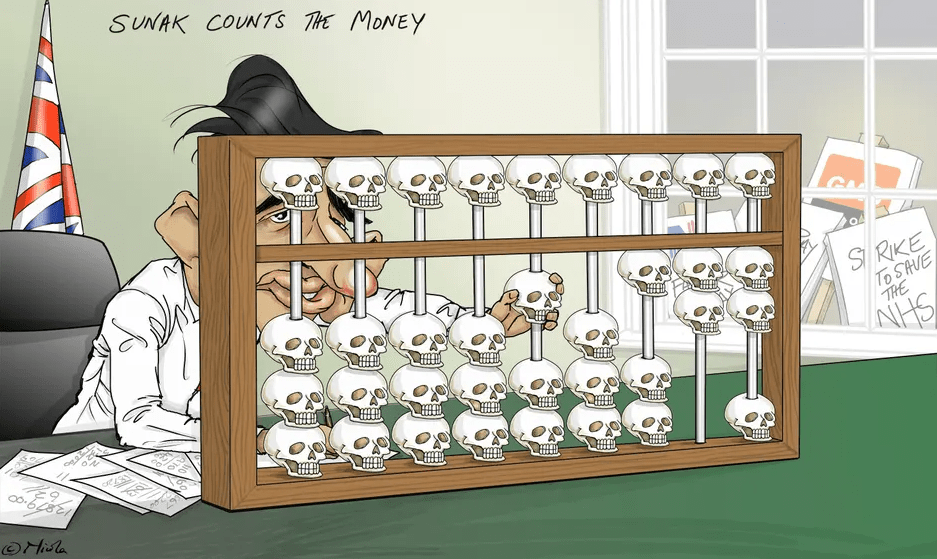
100 days and the Bean Counter continues his count

Nicola Jennings on Rishi Sunak’s economic approach.

There is money for tax breaks for the rich, there is money for building freeports, there is money for vanity projects but Sunak tells us that there is no money. To attract (fossil fuel) investment we need to keep wages low and remove protection and workers’ rights.