Under threat cliffs ‘saved’ as huge new plan agreed

Plans to protect Sidmouth’s cliffs and coast from collapse have been agreed. Protection is needed for the East Devon seaside town to stop the crumbling cliffs from falling into the sea.

Daniel Clark www.devonlive.com

An East Devon District Council advisory group has agreed to a plan which will lead to 113 residential and 70 commercial properties being better protected from increased flood and erosion risk. The scheme includes constructing a breakwater, improving the slipway and a beach ramp to be built.

At a meeting on Wednesday, the Advisory Group for the Sidmouth and East Beach Management Plan agreed to a changed scheme. The plans aim to reduce the impact and frequency of the cliff falls which have been a regular occurrence, with homes on Cliff Road slowly losing their gardens to the elements.

The scheme includes:

· On the Main Beach the construction of an offshore breakwaters/island similar to the 2 existing breakwaters, plus a “beach recharge”. Existing beach levels will be increased using similar material dredged from offshore.

· On the Esplanade and the Ham area, at the eastern end there will be a replacement splash-wall on the landward side of the existing road near the lifeboat station. West of that the existing splash way will be replaced with better foundations, and the wall rebuilt to approximately the existing height (but this will be reviewed in the detailed design).

· The far eastern end of the Ham and river training wall will have remedial works carried out and an improved larger slipway, specifically to provide speedier lifeboat launching.

· On East Beach there will be the construction of a 120m long “super groyne” and substantial beach recharge, again using beach material dredged from offshore.

· It was also agreed that a proposal for a beach ramp at Chit Rocks will be incorporated into the Beach Management Scheme. This ramp will provide easy access for families with young children and wheelchair access to the beach.

The key improvements on the previous design will be:

· A further rock island parallel to the existing beach which will provide in time additional extra sandy beach area at low tide similar to the changes now experienced between the existing islands and the pebble beach.

· The extra island will eliminate the need to heighten the splash wall along the seafront behind the island for the short to medium term and therefore maintain the existing sea views from existing viewpoints.

· Reduce the requirement to recharge and recycle the beach with extra material in the future, which will reduce future maintenance costs and reduce our carbon footprint.

In the 2017 public consultation it was found that an extra set of islands similar to the 2 islands already built in 1994 were the most popular of the options. That was because the existing islands provided good protection from westerly storms and also created a large pebble amenity beach at Clifton, which also protects the west of the town.

Unfortunately, the previous funding then available excluded the island scheme progressing and therefore the option of increasing the height of the splash wall was agreed, although most unpopular.

Now four years on, with extra funding obtained and further engineering studies, it has shown that a new “Option 6” scheme is achievable. This proposes a single rock island with a new super rock groyne on East Beach placed a short distance from the cliff face and projecting out to sea. Extra beach material is proposed to be brought in and only minimal changes to the splash wall are proposed.

The engineered island and super groyne and increased beach material will provide the required protection to the town and reduce the effect of sea erosion to East Cliffs.

EDDC Councillor Geoff Jung, chair of the Sidmouth Beach Management Advisory Group, said: “I am really pleased that the group has supported the recommendation to move onto the next stage for this important and critical project. For the last 4 years I have been the Councillor overseeing this project and was told at the very beginning it was a challenge!

“It certainly has been a challenge with the funding complexities, Covid lockdowns, escalating material costs and now the dramatic fuel costs rise, we are now finally providing Sidmouth and East Beach the protection they vitally need.

“Climate change”, and “Global Warming” was hardly a consideration when the earlier schemes were being considered in the 1990s. However, we now understand that the effects of the sea and weather will have serious detrimental consequences on the town of Sidmouth, but this plan is designed to protect properties and residents, to retain its character and unique charm for the next 100 years.

“I would like to personally thank the officers, consultants, and group members for their diligence and hours of hard work to finally move on to the detailed design stage, at which time the number and orientation of the new breakwaters will be optimised for effectiveness and visual impact.”

These changes to the scheme have been made possible by changes in the UK Government funding calculator, plus extra contributions from the town, District, County Councils, and other Government Agencies. However, there remains an estimated funding gap of £1.75m which is being underwritten by East Devon District Council (EDDC) to enable the project to progress these important works without delay.

Future Timeline

· 2023 March – Submit OBC to Environment Agency for Assurance

· 2023 June – Tender Consultant for Detailed design phase

· 2023 September – Appoint Consultant

· 2023 October/2024 August – Commence Detailed Design Stage

· 2024 August – Tender Contractor

· 2024 August/2024 November – Planning Process

· 2024 October – Award Contractor

· 2025 May – Construction Commence

· 2026 October – Construction Complete

· 2026 October – Ready for service
Labour vows biggest bus overhaul in 40 years with new powers over operators

Labour will seek to overhaul failing bus services in the biggest change in the sector in 40 years, giving local areas in England devolved powers to reinstate cancelled routes and set affordable fares.

Jessica Elgot www.theguardian.com

The changes are expected to come within months of a Labour government taking power, as part of a “take back control bill” that would give authorities powers to start their own publicly owned bus services.

The shadow transport secretary, Louise Haigh, said the reforms would be the most consequential in a generation for public transport relied on by millions, saying Labour would change a system that was “fundamentally broken”.

“It is a total quiet crisis that’s happening in every community,” she said as she met frustrated passengers in Newcastle. “And it has really serious effects on people’s lives, but it also has really serious effects on the economy, and it’s just not getting the attention it deserves.”

The changes would be a key plank of the party’s local election strategy for the May polls, which will focus on the cost of living and the decline of public services in an effort to win back control of some councils in the north of England.

Haigh said that although the national conversation often focused on trains, which Labour has promised to nationalise, poor performance of bus services often blighted more lives.

Twice as many people use buses as those who catch trains, with 2.91bn bus passenger journeys in 2022. Many do not have other options – 80% of people nationally who rely on buses have no other choice.

Local people and councillors speaking to Haigh in Kingston Park, despite living just a few miles from Newcastle city centre, told of job changes because of intolerable commutes, social isolation, missed medical appointments because of vanishing buses, and children left to wait at bus stops in the dark.

One previously reliable service had undergone three changes in recent years, and other alterations included a service that now included a long walk up a steep hill to the nearest stop, making it impossible to reach for many older people.

A commuter route, the only public transport from a new estate, had been changed to take at least 25 minutes longer to reach the city centre. One person said a journey of five miles now routinely took more than an hour and a half because buses did not appear. “The message is, get a car,” he said.

Different bus companies on routes in Newcastle use different apps, without joined-up timetables and will not accept each others’ day passes. The local MP Catherine McKinnell said the unreliability of services was terrible for local schoolchildren, who were not profitable commuters so were often left on routes with long delays, waiting in the dark.

Haigh said she often encountered disbelief from angry passengers that there was almost nothing politicians or councils could do to maintain or improve services from private bus companies, short of public admonishment.

“We’re the only country in the developed world which hands operators power over routes, fares and services with no say for communities,” she said.

Labour would offer all local areas the chance to franchise bus services, in a similar way to Transport for London, which would give them the power to set routes and fares and remove poor providers, Haigh said.

“This is a radical reform of the way transport is going to work in this country, because it hands power and control back to those communities in a direct attempt to put to reverse that feeling of decline,” she added. “This is the total failure of privatisation. The big idea behind deregulation was that it would lead to huge competition and innovation. And it’s had the opposite effect. We’ve seen bus passenger numbers steadily decline since deregulation.”

Greater Manchester, under its mayor, Andy Burnham, is the only other authority in England to have recently been given powers over bus franchising – but the introduction has been fraught with legal challenges and bureaucratic hurdles.

Labour’s plans are expected to increase costs, including on central government, but Haigh says it would be “a much more efficient and less wasteful” system.

She said many local authorities wanted powers to run their own operations, similar to legacy public bus companies in cities such as Nottingham and Edinburgh. Labour would lift a ban on municipal bus ownership.

“It means that profit isn’t being sucked out of the system to private operators. It’s being reinvested into less profitable routes. So if that’s what’s right for local communities, then of course we want to see it,” Haigh said.

Haigh, a former Unite shop steward who comes from a family of trade union officials, is one of the shadow cabinet’s last remaining champions of public ownership – and argued the case forcefully for the full nationalisation of rail that was announced at party conference.

For the time being, there is likely to be no further movement on nationalisation of other key industries, including mail, water or energy, which the shadow chancellor, Rachel Reeves, underlined in a speech earlier this week.

Haigh suggests she would go further than the party is currently committed to “if money were no object” but says she agrees there had to be priorities.

“You could make that argument out of any of our essential utilities,” she said. “But I think the private train companies have really done my job for me in this regard.”

Stagecoach change bus timetables in East Devon from April

Stagecoch will be introducing timetable changes to bus services in East Devon from April.

Adam Manning www.sidmouthherald.co.uk

From Sunday April 2, changes are coming across their network to improve ‘punctuality.’

Stagecoach are asking travellers to please check the new timetables carefully as some departure times may have changed.

Service 9/9A (Exeter – Honiton/Seaton)

The Monday to Friday 4.pm departure from Exeter, currently terminating at Sidbury, is extended to Seaton. On Sunday and public holidays some additional journeys are introduced during the early evening.

NEW Service X30 (Exeter and Seaton)

Following a successful tender award by Devon County Council, a new Service X30 will be introduced. The service will operate between Exeter and Seaton via Exeter College Technology Centre, Exeter Science Park and Honiton Monday to Friday, with three journeys in each direction. 

Service 56E (Exmouth Local Service)

All journeys on Service 56E will be re-numbered Service 96.

Service 57 (Exeter – Brixington via Topsham and Exmouth)

The number of buses between Exeter and Exmouth are doubled with the Monday to Saturday daytime frequency increased from every 30 minutes up to every 15 minutes, plus a number of additional journeys are introduced during the early morning and evening.

The small number of journeys that terminate in Brixington part way round the route will now complete the full loop to maximise journey opportunities.

Service 58 (Exeter – Exmouth)

 The current 11.23am journey from Exmouth to Exeter is re-timed to depart at 11.30am and will no longer serve Brixington. The current 5.35pm journey from Exeter to Exmouth is re-timed to depart at 5.50pm.

Service 95 (Exmouth – Sandy Bay)

For the Summer, this service will run every 30 minutes and the route operated with open top double decker buses. Buses will also resume operation on Saturday, Sunday and Public Holidays.

For passengers wishing to travel to and from Sandy Bay during the evening, Service 99E will be amended slightly to serve World of Country Life, which is a very short walk from Sandy Bay.

Service 96 (Exmouth – Lympstone)

An additional journey will operate Monday to Saturday at 6.10pm from Lympstone to Exmouth.

Journeys that currently operate as Service 56E will be re-numbered Service 96 and therefore the Service 96 timetable will include evening and Sunday / Public Holiday journeys between the town centre and Bryon Way.

Service 99E (Brixington – Littleham via Exmouth)

All evening journeys will additionally serve World of Country Life, to provide an opportunity to travel to and from Sandy Bay, during hours that Service 95 is not operating.

There are no changes to Sunday and Public Holiday daytime journeys.

East Devon: Green light for £1.2million ‘missing link’ between Seaton and Colyford

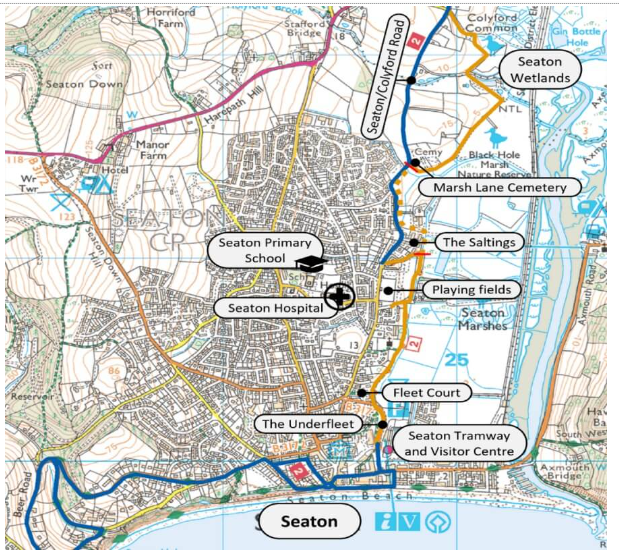
A £1.2million off-road multi-use trail – described as the ‘missing link’ between Seaton and Colyford – is on the way.

Local Democracy Reporter eastdevonnews.co.uk 

The scheme, approved by Devon County Council’s (DCC) cabinet on Wednesday, March 8, will improve part of the existing National Cycle Network Route 2 in East Devon.

It currently diverts onto a section of road that is unsuitable for families and less-confident cyclists, writes Local Democracy Reporter Ollie Heptinstall.

The off-road section will run from the rear of properties at The Saltings to Marsh Lane Cemetery, linking to Seaton Wetlands.

It will ‘encourage and enable more people to use sustainable travel and help reduce carbon emissions’, according to DCC.

Route two of the network also includes the Exe Estuary Trail and connects Exmouth, Budleigh Salterton, Sidmouth, Seaton and Axminster through to the Dorset border and onwards towards Portsmouth.

Councillor Stuart Hughes, DCC cabinet member for highways, said: “By completing the missing off-road section of this route, it will unlock the full potential of the trail for people of all abilities.

“Establishing a high-quality sustainable travel connection will encourage people to be active while supporting our net-zero carbon targets and the green recovery of our economy.”

The approved Seaton to Colyford cycle trail; the off-road section is highlighted with the dotted line. Image: DCC

Councillor Marcus Hartnell, who represents Seaton and Colyton, added: “I welcome completion of this final section of the multi-use path.

“It’s a milestone that the communities of both Seaton and Colyford will welcome.

“The benefits are widespread, encouraging safe and sustainable travel, improving accessibility for all, and boosting the local tourism economy.”

Cllr Hartnell did, however, request safety improvements in Colyford where the path exits onto Seaton Road; an issue also raised by a number of local residents according to Cllr Hughes.

East Devon District Council also support the new scheme, a report presented to cabinet revealed. It believes the multi-use path ‘will provide a stimulus for further tourism growth’.

County council opposition leader Julian Brazil welcomed the plan but said he was ‘wary’ of what are described as ‘low traffic lanes’ along the route to Axminster.

“In some cases these can be the most dangerous for cyclists,” he said.

“If it’s anything like the lanes near me, that is high hedge lanes with lots of blind corners, and the idea that cyclists have a safe passage is far from true.”

Cllr Brazil acknowledged the council ‘can’t solve that overnight’, but said it was something that should be looked at ‘in the future’.

In response, Cllr Hughes said the part of the route towards Axminster had been used for a number of years already.

DCC’s cabinet approved the section of trail. It is set to be constructed this summer.

Tory Councillor quits party over ‘shocking state’ of Devon roads

The ‘shocking’ state of North Devon’s roads has led to a Conservative councillor quitting his party saying there is a ‘non-committal’ response from the government when asking for help. 

Lewis Clarke www.devonlive.com 

Councillor Paul Henderson who was a Conservative district councillors in the South Molton ward and Devon County member for the Culmleigh & Landkey division for the past two years, will now sit as an independent. He is also a member of South Molton Town Council.

He said: “The decision for me to resign from the Conservative Party in the middle of February was one which I did not take lightly. I must stress at this point that my decision is not a reflection on my councillor colleagues for whom I only have great respect – regardless of any political allegiances.”

As well as the state of North Devon’s road, he says the governance of the North Devon Conservative group also forced him to make the decision to quit.

On the highways, Cllr Henderson said: “Devon County Council is responsible for the maintenance of our roads. However, for well over a decade funding from central government has been reduced and with increasing pressures on both adult health and social care as well as children’s services, the highways budget has declined drastically. That’s simply a point of fact. If the money isn’t there, then the necessary repairs cannot be carried out.

“Both our ‘A’ and ‘B’ roads are in a shocking state but many unclassified rural roads are now to my mind dangerous to drive on. I spend as much time on two wheels as I do driving my car, but I cannot ride my motorcycle any longer in the wet or at night because to put it bluntly, I simply don’t trust the road surface under my wheels. At my age I’m not going to mend terribly quickly (or worse) when – not if, I hit a broken road surface or pothole on the bike.

“I and a number of my parishes have asked our MP to lobby Westminster for additional funding to stop the deterioration of our road network – particularly here in North Devon. The response received was non-committal, instead quoting overall funding for the country instead of detailed information relating directly to Devon. There was also veiled criticism of Conservative run Devon County Council as to how the money they do receive is spent. Please bear in mind that I was, at the time, in the same party as the MP.

“Unless significant investment is made into Devon Highways – and we’re talking £100’s of millions of pounds over the coming few years, then I fear the damage many of us are experiencing to our vehicles will deteriorate into personal injury or death because of the condition of our highways.”

On North Devon Conservative governance, he added: “In May we’ll all have the chance to vote for candidates to become parish, town and district councillors. These elections are carried out under the strictest of rules and once elected, all councillors must follow a code of conduct.

“In essence, that means that if you attend a council meeting you must declare an interest on any agenda item to which you have either a personal or potentially prejudicial interest. That’s there to protect democracy. Unfortunately, the same rules do not appear to apply to the Conservative Party when going through their selection process to decide who should stand to contest a particular seat/ward.

“I’m sure all the political parties have a similar selection process but to me the one run by the Conservative Party is unacceptable and this was my primary reason for deciding to leave the party.

“Conservative Party candidates are selected by either their very local members or in many cases, candidates are interviewed by the executive of their relevant Conservative Party Association.

“Prior to a recent selection meeting, I queried the attendance of one voting member of the executive as they were, in effect, a paid employee of the candidate that was to sit before the panel. The response I received from the chair of the local Association having checked with Conservative Central Office was that this member of the executive did have the right to take part in the selection process and vote.

“To me, that is wrong on every single level. It is nothing to do with the personalities involved. As a councillor, the Code of Conduct is there to protect democracy, but the Conservative Party system to select candidates is by its very nature deeply flawed. I’m not suggesting any wrongdoing by the North Devon Conservative Association, but that system is open to manipulation and/or abuse and for me, I cannot be part of something that fundamentally goes against basic rules of democracy.”

In response, Selaine Saxby MP for North Devon said: “I am fully aware that we have the longest road network in the United Kingdom by 2,000 miles and that the council is working flat out to try to repair the proliferation of potholes that we have seen this winter. Not only has the weather contributed but we need to recognise that in rural Britain we have enormous farm vehicles on tiny lanes and we therefore create even more potholes, yet our council is not assigned long-term funding solutions to tackle them.

“The short-term approach to funding, with inadequate rural weighting, makes the cost of repairing each pothole far higher. At this time, Devon is moving teams off scheduled roadworks as we cannot take on full-time highways teams due to the uncertainty around long-term funding. I hope that the Minister will be able to take that away and see what more can be done to address the entirely unacceptable state of our roads. If there were an Ofsted inspection of roads, I suspect we would go into special measures, yet the current funding mechanism contributes to that. The damage that potholes do to vehicles is also hugely expensive to motorists and the council, which is no doubt reimbursing a growing number of inconvenienced motorists with damaged tyres. And it deters people from switching to active travel solutions because of the potential risk of falling due to a pothole.”