Hunt the Snowflakes….

BBC will not broadcast Attenborough episode over fear of ‘rightwing backlash’

The BBC has decided not to broadcast an episode of Sir David Attenborough’s flagship new series on British wildlife because of fears its themes of the destruction of nature would risk a backlash from Tory politicians and the rightwing press, the Guardian has been told.

Helena Horton www.theguardian.com

The decision has angered the programme-makers and some insiders at the BBC, who fear the corporation has bowed to pressure from lobbying groups with “dinosaurian ways”.

The BBC strongly denied this was the case and insisted the episode in question was never intended for broadcast.

Attenborough’s highly anticipated new series, Wild Isles, looks at the beauty of nature in the British Isles.

Narrated by David Attenborough, it is expected to be a hit, with five episodes scheduled to go out in primetime slots on BBC One.

A sixth episode has also been filmed, which is understood to be a stark look at the losses of nature in the UK and what has caused the declines. It is also understood to include some examples of rewilding, a concept that has been controversial in some rightwing circles.

The documentary series was part-funded by nature charities the WWF and RSPB, but the final episode will not be broadcast along with the others and will instead be available only on the BBC’s iPlayer service. All six episodes were narrated by Attenborough, and made by the production company Silverback Films, responsible for previous series including Our Planet, in collaboration with the BBC Natural History Unit.

Senior sources at the BBC told the Guardian that the decision not to show the sixth episode was made to fend off potential critique from the political right. This week the Telegraph newspaper attacked the BBC for creating the series and for taking funding from “two charities previously criticised for their political lobbying” – the WWF and RSPB.

One source at the broadcaster, who asked not to be named, said “lobbying groups that are desperately hanging on to their dinosaurian ways” such as the farming and game industry would “kick off” if the show had too political a message.

They added: “Frankly, this idea that you sort of put it in a separate programme to almost parcel it to one side is disingenuous. Why don’t they integrate those stories into all of them at the time?”

In a statement provided after the story was first published, the BBC said: “This is totally inaccurate, there is no ‘sixth episode’. Wild Isles is – and always was – a five part series and does not shy away from environmental content. We have acquired a separate film for iPlayer from the RSPB and WWF and Silverback Films about people working to preserve and restore the biodiversity of the British Isles.”

Alastair Fothergill, the director of Silverback Films and the executive producer of Wild Isles, added: “The BBC commissioned a five-part Wild Isles series from us at Silverback Films back in 2017. The RSPB and WWF joined us as co-production partners in 2018.

It was not until the end of 2021 that the two charities commissioned Silverback Films to make a film for them that celebrates the extraordinary work of people fighting to restore nature in Britain and Ireland. The BBC acquired this film for iPlayer at the start of this year.”

Laura Howard, who produced the programme and used to work at the BBC’s Natural History Unit, said she did not believe its messages to be political.

She told the Guardian: “I think the facts speak for themselves. You know, we’ve worked really closely with the RSPB in particular who are able to factcheck all of our scripts and provide us with detailed scientific data and information about the loss of wildlife in this country. And it is undeniable, we are incredibly nature-depleted. And I don’t think that that is political, I think it’s just facts.”

The producer said the film would touch on how farming practices had harmed wildlife, but would also profile farmers who had done the right thing.

“Those farmers are there to make the point that every farm in the country ought to be able to do a little bit at least of what they do, and that it is possible to farm alongside nature, to make a profit, to produce healthy food and to still run a business,” Howard said.

She added that she hoped a young audience would be able to find the film, as they are used to streaming on iPlayer rather than watching a broadcast.

Caroline Lucas, the Green party MP for Brighton Pavilion, said: “For the BBC to censor of one of the nation’s most informed and trusted voices on the nature and climate emergencies is nothing short of an unforgivable dereliction of its duty to public service broadcasting. This government has taken a wrecking ball to our environment – putting over 1,700 pieces of environmental legislation at risk, setting an air pollution target which is a decade too late, and neglecting the scandal of our sewage-filled waterways – which cannot go unexamined and unchallenged by the public.

“BBC bosses must not be cowed by antagonistic, culture war-stoking government ministers, putting populist and petty political games above delivering serious action to protect and restore our natural world. This episode simply must be televised.”

Chris Packham, who presents Springwatch on the BBC, also criticised the decision. He told the Guardian: “At this time, in our fight to save the world’s biodiversity, it is irresponsible not to put that at the forefront of wildlife broadcasting.”

Stephen Moss, a natural historian and TV producer who has worked for the BBC on nature programmes, said focusing on a conservation angle could win political support for the cause. He said: “Often, if you lead on environmental issues, people genuinely turn off. But if you drip feed it within the programmes and then hit people with a message at the end when you convince them how brilliant wildlife is, it tends to work.

“With Blue Planet, you got Theresa May standing up and Philip Hammond, the chancellor at the time, saying: ‘this is the BBC as its very best’, doing what Conservatives never do, basically praising the BBC and saying: this is fantastic. So maybe that will happen with this. I wouldn’t be at all surprised if Tory politicians jump on the bandwagon and go on and on about how brilliant it is.”

The charities involved in the programme are already using it to launch a campaign – unaffiliated with the BBC – called Save Our Wild Isles. They have gained the support of the National Trust, the Guardian understands.

Maybe this is the short list to avoid…

…unless Muddy Stilettos are your lifestyle.

Personally Owl prefers bloody talons.

Devon locations in race to be voted ‘best place to live’

Ten desirable Devon locations have been named among the UK’s top 250 places to live. Now you have the chance to vote for your local area to see it crowned Devon’s best place to live – and the UK’s hottest postcode outside London.

Caroline Abbott www.devonlive.com

Lifestyle website Muddy Stilettos has curated the top places to live in each county in 2023. When readers have voted for Devon’s best place to live, the winner will go through to the national finals.

Muddy Stilettos says Devon has “over 200 miles of South West coast path, national parks of Dartmoor and Exmoor and more beaches than you can shake an ice-lolly stick at. Plus two vibrant hubs: the cathedral and university city of Exeter and the Ocean City of Plymouth.”

Here are the 10 places in the running to be named Devon’s – and the country’s – best place to live in 2023. Let us know which you will be voting for and why in the comments – or tell us if there’s a place you think should have been on the shortlist but has missed out. You can vote for the place you think deserves to win here and you’ll be in with a chance to win £500 to spend at John Lewis.

Sidmouth

Muddy Stilettos loves Sidmouth’s “seaside location, its unspoilt open spaces and buzzing town centre, plus a very desirable range of period housing.”

It describes Sidmouth as “a Mecca for tourists and the well-heeled retired” but says it’s “far from sleepy.” It “isn’t short” of coffee shops and there’s a still-thriving independent department store, Fields. The town also has “every kind of dance, drama and sporting activity for children.”

Exmouth

Muddy Stilettos says Exmouth is famous for its golden sands and proximity to Exeter while celebrity chef Michael Caines is “really putting it on the map” with Lympstone Manor and Mickey’s Beach Bar.

The town has “much for outdoorsy types” especially watersports, and “increasingly swanky hospitality” as well as good chippy Krispies and Mitch Tonks’ Rockfish which has “fabulous sea views.” The website recommends boutiques Caramel and Shop Dead Gorgeous.

Okehampton

Muddy Stilettos says Okehampton is a town “very much on the up” and it “may be rural but it just got a whole lot better connected thanks to the return of The Dartmoor Line.” The website says it has “everything you could want in terms of rural idyll making it a thoroughly wholesome place to raise a family.”

It has a “vibrant” town centre and Muddy Stilettos loves Image Coffee Lounge where “the atmos is buzzing and the baking hard to beat.” Its main claim to fame is the ruinous English Heritage castle.

Ashburton

Muddy Stilettos says Ashburton is “perfect for anyone who needs all the perks of living in a town but wants to be able to make a fast getaway.” It has two cities just half an hour away and has “brilliant shops, community and a buzzing community.”

The community are “rightly proud of their town’s creative independent spirit” and the foodie scene is “bustling and getting ever more so.” Creamo’s is unmissable for ice cream in unique flavours. In terms of shops, you’re “spoilt for indie choice.”

Tiverton

Tiverton is described as the place for you if you’re a townie at heart as it has “oodles of indie shops but you’re just five minutes from bucolic rolling fields, half an hour from the sandy beach at Exmouth and 45 minutes from the stunning North Devon coast.”

Muddy Stilettos says there’s “loads to like” in Tivvy including a “romantic castle” and “good transport links and one of Devon’s best independent schools.” Sarah’s Kitchen is recommended for cakes and “the best” smoked cheese and bacon scones, while Duck’s Ditty Bar on the canal is a good place for a drink in the sunshine.

Totnes

Muddy Stilettos describes Totnes as “VERY on-trend” as it was “into sustainable living and eco-chic well before the rest of the UK.” It’s your place “if you want the countryside idyll but more than just cows and antiques shops.”

The website says: “It’s seven-day-a-week hustle and bustle with vegan coffee shops, cool indie retailers and talented local producers – vibrant, ethical and alive. Everything a historic market town should be and more.” It’s “foodie heaven” and the weekly market’s street food is “worth a trip alone.” When it comes to shops, there’s “ soooo much to choose from and lots of ethical choice.”

Muddy Stilettos recommends you do not miss Totnes Cinema which is “small and adorably vintage.” It says Totnes “punches above its weight for bringing cool culture to town.”

Topsham

Muddy Stilettos describes Topsham as “an oh-so pretty, bijou town” on the Exe estuary, less than five miles from Exeter. It’s ideal if you “want a waterside location but without the tourists and schlep to the shops.” Fore Street is “what every town wishes it had, replete with indie stores, boutiques, galleries, florists and groceries.”

It’s “buzzy by day and has plenty of nightlife (but not the noisy nightclub kind).” Denleys Essence of India is worth checking out as it has been crowned Asian Restaurant of The Year in the West Country two years on the run.

Tavistock

Muddy Stilettos says Tavistock “may not have a train station but it has everything else you could want in a town.” It has “plentiful amenities” including a swimming pool, cinema and supermarkets. It’s “old-fashioned but in a good way.” Its high street and pannier market are “vibrant and busy” and it “rocks a good cafe culture.” The most Instagrammed spot in town is Odds & Buds Florist.

Kingsbridge

Muddy Stilettos says: “If you crave a laid-back boaty lifestyle, you can’t beat this vibrant town” which is “less shishi (and less pricey) than nearby Salcombe.”

Kingsbridge is “known for a pretty impressive entrepreneurial crowd” and it has a “buzzing high street with an indie vibe.” Notable places to eat include The Old Warehouse while a spot on the upstairs deck of The Crabshell Inn is the place to go for waterside views.

St Leonard’s, Exeter

Muddy Stilettos says: “Leafy St Leonard’s is perfect for the city gal, just a 15-minute trot from Exeter centre with historic architecture, good shops and all the temptations of the cathedral city close by. But city perks come with city prices.”

It’s a “very upmarket” place where “coffee culture is strong” and the shopping parade is “going from strength to strength.”

Under threat cliffs ‘saved’ as huge new plan agreed

Plans to protect Sidmouth’s cliffs and coast from collapse have been agreed. Protection is needed for the East Devon seaside town to stop the crumbling cliffs from falling into the sea.

Daniel Clark www.devonlive.com

An East Devon District Council advisory group has agreed to a plan which will lead to 113 residential and 70 commercial properties being better protected from increased flood and erosion risk. The scheme includes constructing a breakwater, improving the slipway and a beach ramp to be built.

At a meeting on Wednesday, the Advisory Group for the Sidmouth and East Beach Management Plan agreed to a changed scheme. The plans aim to reduce the impact and frequency of the cliff falls which have been a regular occurrence, with homes on Cliff Road slowly losing their gardens to the elements.

The scheme includes:

· On the Main Beach the construction of an offshore breakwaters/island similar to the 2 existing breakwaters, plus a “beach recharge”. Existing beach levels will be increased using similar material dredged from offshore.

· On the Esplanade and the Ham area, at the eastern end there will be a replacement splash-wall on the landward side of the existing road near the lifeboat station. West of that the existing splash way will be replaced with better foundations, and the wall rebuilt to approximately the existing height (but this will be reviewed in the detailed design).

· The far eastern end of the Ham and river training wall will have remedial works carried out and an improved larger slipway, specifically to provide speedier lifeboat launching.

· On East Beach there will be the construction of a 120m long “super groyne” and substantial beach recharge, again using beach material dredged from offshore.

· It was also agreed that a proposal for a beach ramp at Chit Rocks will be incorporated into the Beach Management Scheme. This ramp will provide easy access for families with young children and wheelchair access to the beach.

The key improvements on the previous design will be:

· A further rock island parallel to the existing beach which will provide in time additional extra sandy beach area at low tide similar to the changes now experienced between the existing islands and the pebble beach.

· The extra island will eliminate the need to heighten the splash wall along the seafront behind the island for the short to medium term and therefore maintain the existing sea views from existing viewpoints.

· Reduce the requirement to recharge and recycle the beach with extra material in the future, which will reduce future maintenance costs and reduce our carbon footprint.

In the 2017 public consultation it was found that an extra set of islands similar to the 2 islands already built in 1994 were the most popular of the options. That was because the existing islands provided good protection from westerly storms and also created a large pebble amenity beach at Clifton, which also protects the west of the town.

Unfortunately, the previous funding then available excluded the island scheme progressing and therefore the option of increasing the height of the splash wall was agreed, although most unpopular.

Now four years on, with extra funding obtained and further engineering studies, it has shown that a new “Option 6” scheme is achievable. This proposes a single rock island with a new super rock groyne on East Beach placed a short distance from the cliff face and projecting out to sea. Extra beach material is proposed to be brought in and only minimal changes to the splash wall are proposed.

The engineered island and super groyne and increased beach material will provide the required protection to the town and reduce the effect of sea erosion to East Cliffs.

EDDC Councillor Geoff Jung, chair of the Sidmouth Beach Management Advisory Group, said: “I am really pleased that the group has supported the recommendation to move onto the next stage for this important and critical project. For the last 4 years I have been the Councillor overseeing this project and was told at the very beginning it was a challenge!

“It certainly has been a challenge with the funding complexities, Covid lockdowns, escalating material costs and now the dramatic fuel costs rise, we are now finally providing Sidmouth and East Beach the protection they vitally need.

“Climate change”, and “Global Warming” was hardly a consideration when the earlier schemes were being considered in the 1990s. However, we now understand that the effects of the sea and weather will have serious detrimental consequences on the town of Sidmouth, but this plan is designed to protect properties and residents, to retain its character and unique charm for the next 100 years.

“I would like to personally thank the officers, consultants, and group members for their diligence and hours of hard work to finally move on to the detailed design stage, at which time the number and orientation of the new breakwaters will be optimised for effectiveness and visual impact.”

These changes to the scheme have been made possible by changes in the UK Government funding calculator, plus extra contributions from the town, District, County Councils, and other Government Agencies. However, there remains an estimated funding gap of £1.75m which is being underwritten by East Devon District Council (EDDC) to enable the project to progress these important works without delay.

Future Timeline

· 2023 March – Submit OBC to Environment Agency for Assurance

· 2023 June – Tender Consultant for Detailed design phase

· 2023 September – Appoint Consultant

· 2023 October/2024 August – Commence Detailed Design Stage

· 2024 August – Tender Contractor

· 2024 August/2024 November – Planning Process

· 2024 October – Award Contractor

· 2025 May – Construction Commence

· 2026 October – Construction Complete

· 2026 October – Ready for service

Labour vows biggest bus overhaul in 40 years with new powers over operators

Labour will seek to overhaul failing bus services in the biggest change in the sector in 40 years, giving local areas in England devolved powers to reinstate cancelled routes and set affordable fares.

Jessica Elgot www.theguardian.com

The changes are expected to come within months of a Labour government taking power, as part of a “take back control bill” that would give authorities powers to start their own publicly owned bus services.

The shadow transport secretary, Louise Haigh, said the reforms would be the most consequential in a generation for public transport relied on by millions, saying Labour would change a system that was “fundamentally broken”.

“It is a total quiet crisis that’s happening in every community,” she said as she met frustrated passengers in Newcastle. “And it has really serious effects on people’s lives, but it also has really serious effects on the economy, and it’s just not getting the attention it deserves.”

The changes would be a key plank of the party’s local election strategy for the May polls, which will focus on the cost of living and the decline of public services in an effort to win back control of some councils in the north of England.

Haigh said that although the national conversation often focused on trains, which Labour has promised to nationalise, poor performance of bus services often blighted more lives.

Twice as many people use buses as those who catch trains, with 2.91bn bus passenger journeys in 2022. Many do not have other options – 80% of people nationally who rely on buses have no other choice.

Local people and councillors speaking to Haigh in Kingston Park, despite living just a few miles from Newcastle city centre, told of job changes because of intolerable commutes, social isolation, missed medical appointments because of vanishing buses, and children left to wait at bus stops in the dark.

One previously reliable service had undergone three changes in recent years, and other alterations included a service that now included a long walk up a steep hill to the nearest stop, making it impossible to reach for many older people.

A commuter route, the only public transport from a new estate, had been changed to take at least 25 minutes longer to reach the city centre. One person said a journey of five miles now routinely took more than an hour and a half because buses did not appear. “The message is, get a car,” he said.

Different bus companies on routes in Newcastle use different apps, without joined-up timetables and will not accept each others’ day passes. The local MP Catherine McKinnell said the unreliability of services was terrible for local schoolchildren, who were not profitable commuters so were often left on routes with long delays, waiting in the dark.

Haigh said she often encountered disbelief from angry passengers that there was almost nothing politicians or councils could do to maintain or improve services from private bus companies, short of public admonishment.

“We’re the only country in the developed world which hands operators power over routes, fares and services with no say for communities,” she said.

Labour would offer all local areas the chance to franchise bus services, in a similar way to Transport for London, which would give them the power to set routes and fares and remove poor providers, Haigh said.

“This is a radical reform of the way transport is going to work in this country, because it hands power and control back to those communities in a direct attempt to put to reverse that feeling of decline,” she added. “This is the total failure of privatisation. The big idea behind deregulation was that it would lead to huge competition and innovation. And it’s had the opposite effect. We’ve seen bus passenger numbers steadily decline since deregulation.”

Greater Manchester, under its mayor, Andy Burnham, is the only other authority in England to have recently been given powers over bus franchising – but the introduction has been fraught with legal challenges and bureaucratic hurdles.

Labour’s plans are expected to increase costs, including on central government, but Haigh says it would be “a much more efficient and less wasteful” system.

She said many local authorities wanted powers to run their own operations, similar to legacy public bus companies in cities such as Nottingham and Edinburgh. Labour would lift a ban on municipal bus ownership.

“It means that profit isn’t being sucked out of the system to private operators. It’s being reinvested into less profitable routes. So if that’s what’s right for local communities, then of course we want to see it,” Haigh said.

Haigh, a former Unite shop steward who comes from a family of trade union officials, is one of the shadow cabinet’s last remaining champions of public ownership – and argued the case forcefully for the full nationalisation of rail that was announced at party conference.

For the time being, there is likely to be no further movement on nationalisation of other key industries, including mail, water or energy, which the shadow chancellor, Rachel Reeves, underlined in a speech earlier this week.

Haigh suggests she would go further than the party is currently committed to “if money were no object” but says she agrees there had to be priorities.

“You could make that argument out of any of our essential utilities,” she said. “But I think the private train companies have really done my job for me in this regard.”

Stagecoach change bus timetables in East Devon from April

Stagecoch will be introducing timetable changes to bus services in East Devon from April.

Adam Manning www.sidmouthherald.co.uk

From Sunday April 2, changes are coming across their network to improve ‘punctuality.’

Stagecoach are asking travellers to please check the new timetables carefully as some departure times may have changed.

Service 9/9A (Exeter – Honiton/Seaton)

The Monday to Friday 4.pm departure from Exeter, currently terminating at Sidbury, is extended to Seaton. On Sunday and public holidays some additional journeys are introduced during the early evening.

NEW Service X30 (Exeter and Seaton)

Following a successful tender award by Devon County Council, a new Service X30 will be introduced. The service will operate between Exeter and Seaton via Exeter College Technology Centre, Exeter Science Park and Honiton Monday to Friday, with three journeys in each direction. 

Service 56E (Exmouth Local Service)

All journeys on Service 56E will be re-numbered Service 96.

Service 57 (Exeter – Brixington via Topsham and Exmouth)

The number of buses between Exeter and Exmouth are doubled with the Monday to Saturday daytime frequency increased from every 30 minutes up to every 15 minutes, plus a number of additional journeys are introduced during the early morning and evening.

The small number of journeys that terminate in Brixington part way round the route will now complete the full loop to maximise journey opportunities.

Service 58 (Exeter – Exmouth)

 The current 11.23am journey from Exmouth to Exeter is re-timed to depart at 11.30am and will no longer serve Brixington. The current 5.35pm journey from Exeter to Exmouth is re-timed to depart at 5.50pm.

Service 95 (Exmouth – Sandy Bay)

For the Summer, this service will run every 30 minutes and the route operated with open top double decker buses. Buses will also resume operation on Saturday, Sunday and Public Holidays.

For passengers wishing to travel to and from Sandy Bay during the evening, Service 99E will be amended slightly to serve World of Country Life, which is a very short walk from Sandy Bay.

Service 96 (Exmouth – Lympstone)

An additional journey will operate Monday to Saturday at 6.10pm from Lympstone to Exmouth.

Journeys that currently operate as Service 56E will be re-numbered Service 96 and therefore the Service 96 timetable will include evening and Sunday / Public Holiday journeys between the town centre and Bryon Way.

Service 99E (Brixington – Littleham via Exmouth)

All evening journeys will additionally serve World of Country Life, to provide an opportunity to travel to and from Sandy Bay, during hours that Service 95 is not operating.

There are no changes to Sunday and Public Holiday daytime journeys.

East Devon: Green light for £1.2million ‘missing link’ between Seaton and Colyford

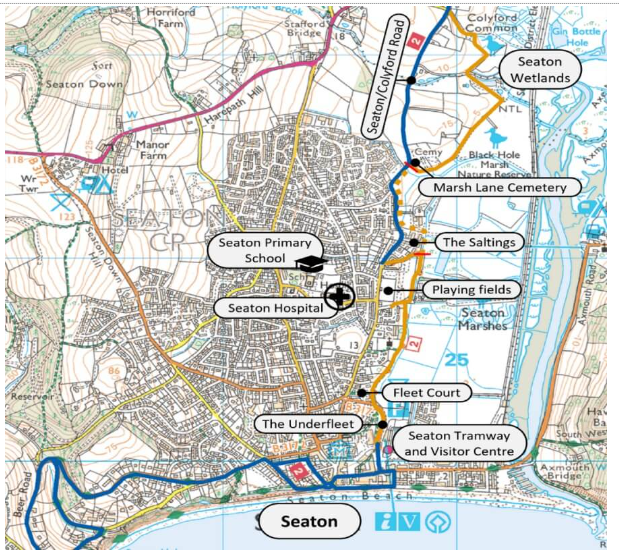
A £1.2million off-road multi-use trail – described as the ‘missing link’ between Seaton and Colyford – is on the way.

Local Democracy Reporter eastdevonnews.co.uk 

The scheme, approved by Devon County Council’s (DCC) cabinet on Wednesday, March 8, will improve part of the existing National Cycle Network Route 2 in East Devon.

It currently diverts onto a section of road that is unsuitable for families and less-confident cyclists, writes Local Democracy Reporter Ollie Heptinstall.

The off-road section will run from the rear of properties at The Saltings to Marsh Lane Cemetery, linking to Seaton Wetlands.

It will ‘encourage and enable more people to use sustainable travel and help reduce carbon emissions’, according to DCC.

Route two of the network also includes the Exe Estuary Trail and connects Exmouth, Budleigh Salterton, Sidmouth, Seaton and Axminster through to the Dorset border and onwards towards Portsmouth.

Councillor Stuart Hughes, DCC cabinet member for highways, said: “By completing the missing off-road section of this route, it will unlock the full potential of the trail for people of all abilities.

“Establishing a high-quality sustainable travel connection will encourage people to be active while supporting our net-zero carbon targets and the green recovery of our economy.”

The approved Seaton to Colyford cycle trail; the off-road section is highlighted with the dotted line. Image: DCC

Councillor Marcus Hartnell, who represents Seaton and Colyton, added: “I welcome completion of this final section of the multi-use path.

“It’s a milestone that the communities of both Seaton and Colyford will welcome.

“The benefits are widespread, encouraging safe and sustainable travel, improving accessibility for all, and boosting the local tourism economy.”

Cllr Hartnell did, however, request safety improvements in Colyford where the path exits onto Seaton Road; an issue also raised by a number of local residents according to Cllr Hughes.

East Devon District Council also support the new scheme, a report presented to cabinet revealed. It believes the multi-use path ‘will provide a stimulus for further tourism growth’.

County council opposition leader Julian Brazil welcomed the plan but said he was ‘wary’ of what are described as ‘low traffic lanes’ along the route to Axminster.

“In some cases these can be the most dangerous for cyclists,” he said.

“If it’s anything like the lanes near me, that is high hedge lanes with lots of blind corners, and the idea that cyclists have a safe passage is far from true.”

Cllr Brazil acknowledged the council ‘can’t solve that overnight’, but said it was something that should be looked at ‘in the future’.

In response, Cllr Hughes said the part of the route towards Axminster had been used for a number of years already.

DCC’s cabinet approved the section of trail. It is set to be constructed this summer.

Tory Councillor quits party over ‘shocking state’ of Devon roads

The ‘shocking’ state of North Devon’s roads has led to a Conservative councillor quitting his party saying there is a ‘non-committal’ response from the government when asking for help. 

Lewis Clarke www.devonlive.com 

Councillor Paul Henderson who was a Conservative district councillors in the South Molton ward and Devon County member for the Culmleigh & Landkey division for the past two years, will now sit as an independent. He is also a member of South Molton Town Council.

He said: “The decision for me to resign from the Conservative Party in the middle of February was one which I did not take lightly. I must stress at this point that my decision is not a reflection on my councillor colleagues for whom I only have great respect – regardless of any political allegiances.”

As well as the state of North Devon’s road, he says the governance of the North Devon Conservative group also forced him to make the decision to quit.

On the highways, Cllr Henderson said: “Devon County Council is responsible for the maintenance of our roads. However, for well over a decade funding from central government has been reduced and with increasing pressures on both adult health and social care as well as children’s services, the highways budget has declined drastically. That’s simply a point of fact. If the money isn’t there, then the necessary repairs cannot be carried out.

“Both our ‘A’ and ‘B’ roads are in a shocking state but many unclassified rural roads are now to my mind dangerous to drive on. I spend as much time on two wheels as I do driving my car, but I cannot ride my motorcycle any longer in the wet or at night because to put it bluntly, I simply don’t trust the road surface under my wheels. At my age I’m not going to mend terribly quickly (or worse) when – not if, I hit a broken road surface or pothole on the bike.

“I and a number of my parishes have asked our MP to lobby Westminster for additional funding to stop the deterioration of our road network – particularly here in North Devon. The response received was non-committal, instead quoting overall funding for the country instead of detailed information relating directly to Devon. There was also veiled criticism of Conservative run Devon County Council as to how the money they do receive is spent. Please bear in mind that I was, at the time, in the same party as the MP.

“Unless significant investment is made into Devon Highways – and we’re talking £100’s of millions of pounds over the coming few years, then I fear the damage many of us are experiencing to our vehicles will deteriorate into personal injury or death because of the condition of our highways.”

On North Devon Conservative governance, he added: “In May we’ll all have the chance to vote for candidates to become parish, town and district councillors. These elections are carried out under the strictest of rules and once elected, all councillors must follow a code of conduct.

“In essence, that means that if you attend a council meeting you must declare an interest on any agenda item to which you have either a personal or potentially prejudicial interest. That’s there to protect democracy. Unfortunately, the same rules do not appear to apply to the Conservative Party when going through their selection process to decide who should stand to contest a particular seat/ward.

“I’m sure all the political parties have a similar selection process but to me the one run by the Conservative Party is unacceptable and this was my primary reason for deciding to leave the party.

“Conservative Party candidates are selected by either their very local members or in many cases, candidates are interviewed by the executive of their relevant Conservative Party Association.

“Prior to a recent selection meeting, I queried the attendance of one voting member of the executive as they were, in effect, a paid employee of the candidate that was to sit before the panel. The response I received from the chair of the local Association having checked with Conservative Central Office was that this member of the executive did have the right to take part in the selection process and vote.

“To me, that is wrong on every single level. It is nothing to do with the personalities involved. As a councillor, the Code of Conduct is there to protect democracy, but the Conservative Party system to select candidates is by its very nature deeply flawed. I’m not suggesting any wrongdoing by the North Devon Conservative Association, but that system is open to manipulation and/or abuse and for me, I cannot be part of something that fundamentally goes against basic rules of democracy.”

In response, Selaine Saxby MP for North Devon said: “I am fully aware that we have the longest road network in the United Kingdom by 2,000 miles and that the council is working flat out to try to repair the proliferation of potholes that we have seen this winter. Not only has the weather contributed but we need to recognise that in rural Britain we have enormous farm vehicles on tiny lanes and we therefore create even more potholes, yet our council is not assigned long-term funding solutions to tackle them.

“The short-term approach to funding, with inadequate rural weighting, makes the cost of repairing each pothole far higher. At this time, Devon is moving teams off scheduled roadworks as we cannot take on full-time highways teams due to the uncertainty around long-term funding. I hope that the Minister will be able to take that away and see what more can be done to address the entirely unacceptable state of our roads. If there were an Ofsted inspection of roads, I suspect we would go into special measures, yet the current funding mechanism contributes to that. The damage that potholes do to vehicles is also hugely expensive to motorists and the council, which is no doubt reimbursing a growing number of inconvenienced motorists with damaged tyres. And it deters people from switching to active travel solutions because of the potential risk of falling due to a pothole.”

Tory loudmouth Lee Anderson slammed MP second jobs. then got one himself on TV

Aka “30p Lee”, ignores his own stricture – Owl

John Stevens www.mirror.co.uk (Extract)

Conservative Party deputy chairman Lee Anderson has got a show on GB News despite previously suggesting MPs wanting to earn big money should give up their day jobs in Parliament.

Council leader pledges to not sell farms

There were rumours the money could go into children’s services

Devon’s county farms will not be sold, the county council’s leader has pledged.

More examples of the state we are in – Owl

Ollie Heptinstall, local democracy reporter www.radioexe.co.uk

John Hart (Conservative) made the commitment after opposite number Julian Brazil (Lib Dem) claimed he had “heard rumours” they could be sold to pay off a growing overspend in supporting children with special educational needs and disabilities (SEND).

Devon’s total running overspend on the service is projected to be £127 million at the end of this month, rising to £153 million by March 2024.

Councils across the country have been instructed by the government to keep these overspends in ring-fenced accounts separate from its main budget while it develops a new funding model – an arrangement recently extended to 2026.

Negotiations between Devon and the government are ongoing about what will happen to the total – effectively debt – and who will be responsible for paying it off.

Speaking at a cabinet meeting on Wednesday [8 March], Cllr Brazil said: “I think at some stage we’ve got to have a clearer understanding of what that [overspend] is going to entail within the council.

“I’ve heard rumours that we’re going to flog off all our farms in order to pay that off.  That’s the kind of rumour that I’m hearing.”

In response, Cllr Hart said: “I will categorically say to you now, Cllr Brazil, that we are not selling the farms estate … the farms estate is not on the market. They never have been, and I said when I took over the leadership of this council that it was one of the jewels in our crown that I’m most proud of.”

Leader of the Labour group, Cllr Carol Whitton, said she “welcomed” the comments, adding: “It is indeed a real asset that is held by the county council and brings in a useful income.”

She continued: “It is a beacon in our rural agricultural county for best practice and for helping people into that particular industry.”

Devon’s county farms estate contains 3,873 hectares (9,570 acres) of agricultural land and comprises 65 fully equipped residential dairy and mixed livestock farms.

According to the county council, the estates “aims to provide people with their first opportunity to farm but with a view that within a reasonable time frame, they secure an independent livelihood from agriculture.”

Liberal Democrat councillor Alistair Dewhirst said Cllr Hart’s pledge was “really important … because there are many people out there who are really concerned about the situation at Devon County Council with this massive, huge overspend going on that somehow is hidden from public view but we all know is there.”

Updating colleagues, Cllr Andrew Leadbetter (Conservative), cabinet member for children’s services said the council is trying to reach a resolution on the SEND overspend, adding: “I am confident we will sort this out.”

Major Housing Developers Missing Crucial Government Safety Contract To Avoid Ban

Includes Persimmon.

“ Developers: Time is running out” – Michael Gove

A major housing developer at the heart of a government campaign to fix unsafe buildings has said it has still not received the final version of a crucial contract that they need to sign in the next five days or risk being “banned” from operating in the market, PoliticsHome has learned.

www.politicshome.com

In January, house-building companies were given six weeks to sign a legally binding agreement that will commit them to funding repairs to unsafe buildings in England that they have developed or refurbished over the last 30 years.

Earlier this week housing secretary Michael Gove put pressure on companies to return the crucial contract in order to avoid the ban. “One week to sign the building safety contract to fix unsafe buildings you are responsible for or you will be banned from operating in the housing market,” he tweeted.

The legal commitment solidifies a pledge made last year by 49 developers to remediate critical safety works.

When Department for Levelling Up, Housing and Communities DLUHC launched the contract on January 30, they said that legislation planned for this Spring will create a Responsible Actors Scheme, which will allow ministers to block developers who have not signed the contract or do not comply with it, and prevent them from operating as usual in the housing market. 

However, Persimmon featured on the government’s press release to publicly back the legally-binding contract when it was launched on 30 January, and said they were the “first” to signal their intention to sign, say they have still not received the final paperwork from government. 

“We still intend to sign as we signalled in January. We will do so as soon as we receive the final contract to sign,” a spokesperson for Persimmon told PoliticsHome.

“The department has not sent that to us yet.”

When the contract was launched at the end of January, Dean Finch, the group chief executive at Persimmon said in the government’s press release that the “terms of the contract are entirely consistent with our existent commitment to protect leaseholders” and “we are pleased to confirm our intention to sign the final document.” 

Another major housing developer, Lovell, who signed last year’s pledge, said that they have told the department they will sign the contract, but are also still waiting for a final version to be issued. 

“The final-form legal contract was issued in January 2023 and Lovell Partnerships Limited has confirmed in writing to DLUHC its intention to sign and execute the contract on or before the stipulated date of 13 March 2023,” a spokesperson for Lovell Partnerships said.

“We await a final version of the contract from the Department of Levelling Up Housing and Communities to enable signing.”

While some firms are believed to have received the final paperwork, PoliticsHome understands that work is still ongoing within DLUHC to add a number of annexes to contracts relating to specific buildings from particular firms, and officials hope this will be sorted in the coming days before the final deadline. 

When the contract was first announced, Gove said “there will be nowhere to hide for those who fail to step up to their responsibilities – I will not hesitate to act and they will face significant consequences”. 

A spokesperson at the Department for Levelling Up, Housing and Communities said: “Developers who signed the pledge last year committed to remediate buildings they developed. The contract binds them to that commitment.

“All developers received the final text of the contract on 30 January and several have since confirmed they will sign.

“We expect all developers to do so without delay. Those that fail to do the right thing will be banned from the housing market.”

Councillors’ concerns about planned cuts to Devon homeless prevention

Planned cuts to homeless prevention services in Devon have been criticised by senior opposition councillors.

Ollie Heptinstall.www.midweekherald.co.uk 

Devon County Council is consulting on proposals to stop funding adult homelessness services across the county, saving around £1.5 million per year.

It says it can no longer afford to pay for the services, with the money instead going towards increasing spending in other areas that support vulnerable children, young people and adults.

But local charities have urged it to think again.

YMCA Exeter, which receives £150,000 in support from the council, said “the consequences for vulnerable young adults will be huge,” while St Petrock’s warned it could lead to a “homelessness crisis” in the city.

The proposals come as new figures reveal the estimated number of rough sleepers in Devon increased by 28 per cent last year to 113.

Opposition leader of the council, Julian Brazil (Lib Dem, Kingsbridge), said: “It’s extremely worrying, but we all knew it was the case.

“Despite all the positive messages around the budget, we knew it was absolutely appalling and we’re struggling to find these cuts somewhere.”

But he added he had “some sympathy” with the council and expressed his frustration at the county’s Conservative MPs, who he claims have failed to secure more money for Devon.

“The truth is, if we don’t get the proper funding from central government, we’re never going to be able to provide these services.

“And they put as much spin as they like on it, but in the end these are cuts to the most vulnerable people in Devon and it breaks my heart to think we’re having to do that.”

Speaking to Devoncast from Radio Exe, Independent councillor Jess Bailey (Otter Valley) said she was “very concerned” about the proposals.

“I think it’s the worst possible time and, as a member of the [county council’s] health and adult care scrutiny committee, I will be looking very closely at these proposals. I’m strongly opposed to them and I think it’s removing funding from our most vulnerable residents.

“I’m very disappointed that the county council cannot apparently find the money for our most vulnerable residents and I think, in terms of health inequality, we need to find a way of supporting these people and continuing with that funding.”

Outlining the potential impacts of its loss in funding last week, YMCA Exeter warned that over 100 young adults a year could continue to face homelessness and “no longer have access to tailored wellbeing support, unable to move beyond their circumstances and thrive again.”

“Without the essential prevention measures YMCA Exeter provides,” it said, “Devon County Council could find themselves covering an average bill of over £924,000 a year in adult social care costs, rather than the current £157,000 they give to YMCA Exeter.”

The council estimates the cuts could save around £1.5 million per year. (Image: Terry Ife)

Meanwhile, Peter Stephenson, St Petrock’s director said the proposals are “disastrous for people at risk of homelessness in Exeter and across Devon, who are some of the most vulnerable people in our community.

“Long-standing and desperately needed support is set to disappear, removing a life-line people desperately need to avoid becoming homeless.”

A spokesperson for Devon County Council said: “We’ve budgeted this year to significantly increase spending in services that support vulnerable children, young people and adults, to meet rapidly growing demand for those services.

“To prioritise spending on our statutory responsibilities, we have to make savings in the region of £45 million from elsewhere and get the best possible outcomes from every single penny we spend.

“While we’ve been able to help fund this support service in the past, even though it falls outside our statutory adult social care responsibilities, sadly, we can no longer afford to do so.

“Reluctantly, we are therefore proposing to stop our contributions to this contract and instead target our scarce resources to support growing numbers of vulnerable adults who are eligible for social care support.”

The spokesperson added: “We will not make a decision regarding this proposal until we’ve considered the consultation responses, and we encourage people in the meantime to let us know what they think.”

The public consultation is open until Wednesday, April 19.

Teignbridge to build 741 homes a year

Residents in Teignbridge have less than a week to give their views on plans for development across the district over the next 17 years. 

Will they then follow EDDC and pause to await the revisions to the PPF? – Owl

Phillip Churm, local democracy reporter www.radioexe.co.uk

The draft local plan identifies how land should be used for homes and jobs as well as setting out the infrastructure needed to support developments such as roads, schools and healthcare.

It also aims to protect the environment by tackling climate change and promoting low carbon energy.  

People can give their thoughts on the plan until noon on Monday 13 March  when the fifth and final public consultation closes.

The draft local plan, described by the council as “ambitious and forward looking,” has been approved by councillors and features land allocations for 4,560 homes, with about a quarter of them affordable, more homes for people with mobility issues and it will ensure all developments are net zero by 2028.

Liberal Democrat councillor for Dawlish South West and executive member for planning, Gary Taylor said: “The final draft proposals have been shaped by the more than 7,000 people who have contributed their views at the different consultation stages.

“Residents, businesses and other organisations have just a few days left to take advantage of this final consultation and submit their views.  Please take the time to do so by completing the feedback form on our website by noon on Monday.”

The approximate distribution of new homes across the district will be:

Newton Abbot and Kingsteignton Garden Community – 37 per cent

Edge of Exeter – 46 per cent

Coastal and rural towns – 5 per cent

Villages – 12 per cent

In addition, about 65 hectares of land is allocated for employment use while two sites are identified for gypsies and travellers.

Three major expansions to existing settlements are proposed. Firstly, at Bradmore, west of Houghton Barton on the outskirts of Newton Abbot, for approximately 1,050 homes. These are in addition to the 1,800 homes in the area allocated in the existing local plan.

On the edge of Exeter, approximately 900 homes are planned for Markham Village, which will be created as a small new village between Ide and Shillingford Abbot, while a mixed use development of approximately 750 homes at Peamore is also proposed.

The plan will increase the rate of new housebuilding in Teignbridge to an average of 741 homes per year and all new-build open market homes on allocated sites will be occupied as a primary residence – secured through a legal process.

It adds how brownfield sites will be prioritised to help regenerate town centres, while most new homes would be located close to jobs, services and sustainable transport. Some small development sites are also identified in larger villages to help sustain essential local services.  

After the consultation ends on Monday, the draft plan and all comments received will be submitted to the planning inspectorate for review and public examination. 

If approved, the plan will come into force in early 2024.

Devon elections 2023: Jess Bailey criticises voter ID scheme

Devon County and East Devon District Cllr Jess Bailey (Independent, Otter Valley) is concerned about the rule’s impact on democracy and that it favours the Conservatives.

Rob Kershaw www.exmouthjournal.co.uk 

A government scheme requiring voters to show identification at polling stations has been criticised.

The new rule means that people will need to bring a certain form of ID – which include passports and drivers’ licenses – or they won’t be able to vote. It will come into effect at local elections in less than two months.

Among accepted IDs are older people’s bus passes, but not those for young people or students.

Devon County and East Devon District Cllr Jess Bailey (Independent, Otter Valley) is concerned about the rule’s impact on democracy and that it favours the Conservatives.

Speaking on Devoncast, a new weekly podcast, she said: “My view is that it’s an absolutely terrible scheme.

“Not only is it a terrible scheme that discriminates against younger people, but it also has been introduced far too late before the local elections.

“There’s an established principle that you don’t start messing around with rules relating to elections within the six months prior to those elections.

“Well, this government’s completely ignored that by introducing these rules at the last minute and I don’t think people are aware of them.

“And I’m really, really concerned that instead of making our system more robust, I think it’s actually going to disenfranchise thousands of people across the country.”

Cllr Bailey claims the rule is “designed to take votes away from non-Tory voters,” and warns of the risk of people being turned away from polling stations in May.

Former Conservative MP Neil Parish, who resigned last year, accepted that the deployment of the new scheme could have been better, but feels that it is needed to prevent voter fraud.

“I think it is actually necessary for people to identify themselves,” he told Devoncast.

“I think we are actually slow in rolling it out and we are slow in getting the necessary information to people.

“I think it’s necessary, I think we’ve got to make sure that the district councils get the information out and I would accept what Jess says – it’s getting close to the election now.

“But I think it’s really necessary because I think, in the end, we need to make sure everyone who votes are who they say they are.

“I think most people don’t actually pretend to be somebody they are not, but in some parts of the country it has happened, and I think it’s right to get it.

“Jess is right, there will be first problems in the first instance, but at some stage we do need to bring this in to make sure who is voting are exactly who they say they are.”

Mid Devon needs to find around £20 million for relief road

Mid Devon will keep trying to secure the money needed to build a new relief road for Cullompton.

Simon Jupp (Exmouth’s temporary MP) claimed a couple of weeks ago in the commons:

Devon, Cornwall, Dorset and Somerset secured £152 million from the levelling-up fund last month. The four counties make up the region’s new powerhouse, the great south west, of which I chair the all-party parliamentary group. Will my right hon. Friend [Michael Gove] meet me to discuss the fantastic opportunities that lie ahead for the great south west? 

Michael Gove replied: I absolutely will, and I will make sure that the Under-Secretary of State for Levelling Up, my hon. Friend Dehenna Davison, is with me as well. There is nothing that the two of us enjoy more than hearing good news from fantastic constituency MPs such as my hon. Friend Simon Jupp.

So there you are Levelling Up in action – Owl

Council’s relief road efforts continue

Ollie Heptinstall, local democracy reporter www.radioexe.co.uk 

The planned road to the east of the town is seen as essential for Cullompton, improving capacity at the town’s M5 junction, reducing traffic through the town centre and unlocking the development of 2,000 homes nearby.

It would also provide improved pedestrian and cycle access to the planned new Cullompton railway station, which could be in use by 2025.

But Mid Devon District Council is short of around £19 million of the road’s projected £30 million cost after being rejected again by the government’s flagship levelling-up scheme in January, despite backing from local Lib Dem MP Richard Foord and Conservative-controlled Devon County Council.

Originally set to cost £15 million, the road has ballooned in price; blamed on increased construction costs, replacing sporting facilities and the potential amount needed to buy land.

At a cabinet meeting on Tuesday [7 March], councillors agreed to submit a third bid to the levelling-up fund, if and when it is announced by Westminster, and to “continue to explore additional funding opportunities” to plug the shortfall.

Mid Devon’s new cabinet member for planning and economic regeneration, Councillor Graeme Barnell (Independent, Newbrooke) said he was “extremely disappointed” at the rejection and that it was “very important that officers do have a plan B and are working on that.”

Liberal Democrat councillor James Buczkowski (Cullompton South) stressed the importance of the road, saying it is “not only vital to the prosperity and wellbeing of Cullompton residents but vital, I believe, to the prosperity of the wider district too.

“The relief road is vital in terms of addressing the horrendous air quality in the town centre, addressing the outright dangerous transiting of heavy goods vehicles through our historical town centre, and addressing the daily congestion that has a severe detrimental impact on the lives of Cullompton residents.”

He added: “Please be assured that Cullompton residents have had enough of the daily plight and broken promises from Mid Devon District Council.”

Cllr Buczkowski urged councillors to explore other models of funding apart from the levelling-up fund, which a council officer said they are doing. Mr Buczkowski also suggested borrowing the money needed and paying it back in the long-term through developer housing contributions.

In response, Mid Devon’s director of place, Richard Marsh, claimed the council had been “working flat out” to try to make the road a reality.

He said it “wouldn’t be usual” for a district authority to borrow for a strategic highways project, while finance officer Andrew Jarrett added it was “not something we are looking to do or could do in the short to medium term” due to it putting a “very significant funding requirement” on the rest of the council.

Mr Marsh said it is planning policy that the relief road is in place before many new developments are built.

Cllr Barnell recommended a closer working with Devon County Council, which is responsible for highways and has pledged £1.5 towards the project.

The majority of cabinet members agreed to keep looking for more ways to fund the road, and to prepare another levelling-up bid.

New special school will be built in Cranbrook

A new specialist school will be built in the Cranbrook area after it was selected by the government. The school, one of 33 that will be built across the country, will cater for children aged nine to 16 and provide up to 70 additional places for children with special educational needs and disabilities (SEND).

Ollie Heptinstall www.devonlive.com 

Devon County Council is looking to increase the amount of SEND places it can provide directly, with places at independent schools costing it significantly more money. It also needs to improve its provision. Devon was last year hit with a government improvement notice for its services for SEND children, which it runs in partnership with NHS Devon.

The Conservative-run council and NHS Devon both apologised after a revisit by Ofsted and the Care Quality Commission last May found that progress had not been made in fixing four areas of significant concern identified in December 2018. A protest by SEND parents was also held at county hall last month, over what they said was a poor provision by the council in supporting children with additional needs.

Welcoming the new school, cabinet member for children’s services, Cllr Andrew Leadbetter said: “We’re trying to change the system to obviously offer a much better service to our parents, and this is part of our strategy to have more schools.” He added: “We are really pleased we’ve got this money from the government, because it’s something we want to do.”

It is not yet known exactly where or when the new school in the Cranbrook area will be built. Another catering for children with SEND, the Promise School in Okehampton, opened its doors to pupils in September, while another is planned for Ivybridge.

Cllr Leadbetter also said long-running negotiations were still ongoing with the Department for Education about the county council’s large ongoing overspend on supporting children. Since 2020, councils across the country have been told by the government to put their SEND overspends into separate ring-fenced accounts while it develops a new funding model – an arrangement recently extended to 2026.

It means Devon’s total running overspend on the service – effectively debt – is projected to be £127 million at the end of this month, rising to £153 million by March 2024.

Neil Parish may stand as Independent candidate at General Election

Will he – won’t he?

How many times has old “Tractor Porn” Parish floated the idea of standing as an “independent”!

Not that he was obviously independent minded when he was an MP.

Neil, Owl’s advice is put your money where your mouth is and stand – split the Tory vote! It will be fun to watch.

Philip Churm www.devonlive.com

The former Devon Tory MP who quit after admitting watching pornography in the House of Commons has said he may stand as an independent in the next general election. Neil Parish, who served Tiverton and Honiton for 12 years, and before that was a member of the European Parliament, resigned after he was spotted viewing sexually explicit material on a mobile device while waiting to vote.

Because of forthcoming boundary changes, the Tiverton and Honiton constituency will cease to exist. Simon Jupp, the current Conservative MP for East Devon, has said he will stand in the newly created Honiton and Sidmouth seat.

Ian Liddell-Grainger, the current Conservative MP for Bridgwater and West Somerset, has been named as their candidate in the newly-created Tiverton and Minehead seat. And Mr Parish says that if he decides to run again, it is this seat he would stand in.

But in an interview for Devoncast, a podcast hosted by the Local Democracy Reporting Service in Devon, Mr Parish said politics is in his blood and he wants voters to decide whether he should return as an MP.

In a frank interview, the former MP, who had a majority of more than 24,000 at the last general election, said the circumstances surrounding his resignation last year had met with mixed reactions.

“It was a terrible year for me,” he explained. “And it’s interesting now to see where I take myself going forward, because I still have very much a public interest in mind with politics in the blood, food, farming environment. I just want to try and keep those things running, if I can, and hopefully do some good.”

However, the 66 year-old, who opposed Brexit and previously served as an MEP, said he was no longer a member of the Conservative Party and had no plans to rejoin.

“I don’t particularly like the direction of some of the policies. So, I am just making up my mind now whether to stand for parliament as an independent,” he said.

Asked which policies he will prioritise if he is re-elected he said: “It would be the cottage hospitals, the health side of it. It would be the food and farming side of it.

“Naturally, the big issue for Tiverton itself is the new school for Tiverton High School. That’s making progress now, but that needs to be delivered.”

He will also focus on rural issues. Mr Parish admits he will face challenges without the backing of a major party but suggests his prior knowledge will stand him in good stead.

“As an independent, it’s difficult to deliver in parliament, but I have had a lot of experience in parliament,” he added. “But what it does enable you to do is look at policies across the [board] because I wouldn’t stand to be anti-Tory, anti-Labour, anti-Liberal, anti-Green.

“I would like to try to put forward a positive message and to see whether people actually wanted that.”

Mr Parish said the next general election may prove interesting as he feels many people are “looking for something different.”

Responding to critics who have said he should not see re-election after last year’s revelations, he believes the decision should be in the hands of the electorate.

“By resigning and then if you stand again, then people can make up their own mind, can’t they? And that’s what democracy’s about,” he said.

Neil Parish’s resignation triggered a by-election in June last year which was won by Liberal Democrat, Richard Foord with a 6,000 majority.

Torbay leader wants to be MP

The Lib Dem leader of Torbay Council is to challenge the area’s Conservative MP at the next general election.

Paul Nero www.radioexe.co.uk

Cllr Steve Darling currently heads the Liberal Democrat/Independent coalition that runs the council. He’s been a councillor in Torquay for 28 years and worked for former Lib Dem MP Adrian Sanders as a caseworker for 18 years.

Despite three decades in politics, the Lib Dem chairperson in the area claims he is not a career politician.

Mr Darling wants to oust former immigration minister Kevin Foster, who was a member of Boris Johnson and Liz Truss’s governments.

Mr Foster took the seat from the Lib Dems in 2015. But with most polls suggesting that the Tories are facing electoral wipeout, the Lib Dems are likely to think they would have a good chance of taking back Torbay.

It will be a challenge. Mr Foster has grown his majority considerably since being elected. In 2015, he took the seat with a 40 per cent majority, increased that in the 2017 general election, which was generally a bad one for the Tories under Theresa May, and then put on more votes in 2019 under Boris Johnson’s leadership.

With the announcement that Steve Darling is to stand, it makes the fourth candidate for the party in four elections.

Announcing his candidacy, Mr Darling said: “We must demand better for Torbay from the government. The lack of support in this cost-of-living crisis has shown that Conservative MPs are taking us for granted. Torbay needs a strong voice in parliament and I will be that voice.”

“When speaking to residents across the Bay they tell me they are tired of the lies, scandals and dishonesty associated with the Conservative Party. The Liberal Democrats will tax fairly those who have gained the most while others have struggled, and will invest in our coastal communities, create sustainable jobs, protect pensions, our NHS and social care, and take climate change seriously.”   

Chair of Torbay Liberal Democrats Pam Bagnall said: “Steve is not a career politician, he knows and understands our area and wants to work for the people of the Bay. As we have learnt in the past, if we want a strong caring voice in Parliament we have to unite behind the Liberal Democrats in Torbay because votes for Labour, Greens and others only split the vote and let the Tories win.”

Before the general election, which must be held before January 2025, Torbay will have local election this May.

Work to reinforce cliffs with concrete to enable development suspended

Whipsiderry development stalls as Duchy of Cornwall suspends licence

Work to reinforce cliffs [with concrete] to enable a luxury housing development to be built has been put on hold after intervention by the Duchy of Cornwall.

By Johnny O’Shea www.bbc.co.uk

Work at the site has been put on hold after the Duchy of Cornwall suspended a licence allowing access to the beach

Protesters have been demonstrating against work at Whipsiderry beach, near Newquay, due to concerns over damage to the environment and wildlife habitat.

Now the Duchy has suspended a licence allowing access to part of the beach it owns.

Developer Living Quarter Properties has been approached for comment.

It has permission to build seven luxury homes on cliffs above the beach, but work necessary to backfill caves with concrete cannot legally take place while the licence is suspended.

Planning consent for the development had previously been granted by Cornwall Council.

The Marine Management Organisation (MMO) granted a licence for cliff reinforcement work, while the duchy – a private estate that funds both the charitable and private activities of the Duke of Cornwall, Prince William – granted access to the beach.

Seabirds called fulmars nest at the cliffs each year, and under the terms of the MMO licence, reinforcement works had to be completed by the end of March, due to nesting season.

A demonstration was held on 18 February, and protesters have retained a presence on the beach since, disrupting progress.

A second demonstration last week attracted about 200 protesters, organisers said.

Hundreds of people gathered on Thursday to protest against works to shore up the cliffs ahead of development

Developers used a crane to get a digger on to the beach, and security guards were hired to keep people away from areas being worked on.

On Sunday, organisers wrote to the Duchy, asking it to use its “power and position of authority to stop the destruction at Whipsiderry Beach”.

A Duchy spokesperson said: “The Duchy granted access on the basis that these works be carried out in a safe manner, and that all necessary consents were in place, including observing bird-nesting restrictions.

“The Duchy has therefore suspended the licence in order for discussions between the developer and the relevant statutory authorities to take place and for those authorities to determine if and how the consented work can take place in a safe and compliant manner.”

Devon council boss doesn’t want to take his full pay rise

He thinks it would be unfair on others.

Could this public spirited public servant leading from the front, be our very own Chief Weazel?

Errrrr – not this time. – Owl

Philip Churm www.devonlive.com 

The boss of a Devon council won’t take his full salary increase because he thinks it is unfair on other staff. Nonetheless, the chief executive of South Hams District Council and West Devon Borough Council Andy Bates, could still get a £7,500 rise – or six per cent – of his £125,000 salary.

As the most senior official on the two councils, he says he doesn’t want to take a bigger percentage pay rise than the lowest paid worker. Mr Bates was speaking at a South Hams executive meeting on Thursday [2 March] to discuss pay and employee retention.

An independent report by the Local Government Association to senior councillors recommended all council staff should receive pay increases of not less than six per cent. But Mr Bates insisted: “Actually for those staff in the lower bands, typically they will be receiving a pay increase of between nine and 12 per cent.”

He explained how the recommendations in the report would “result in a seven per cent increase for directors and, indeed, myself.”

But Mr Bates, whose salary is currently £125,150 insisted he did not wish to receive a higher percentage increase than workers in lower bands.

“In the event that the executive chooses to agree this – and indeed councillors choose to agree this – it’s my intention that I should cap an increase to six per cent. I think it’s appropriate you shouldn’t be paying your senior team more than you’re paying your staff.”

Lib Dem councillor for Stokenham, Julian Brazil welcomed the comments by Mr Bates but said he hoped the decision wouldn’t lead to much bigger pay rises in future.

“I do not believe that senior management, however wonderful they are, should be paid disproportionately more than people out there at the coalface delivering the services that our people want us to do.”

The chief executive’s salary can only be decided by full council on the recommendation of the leader after taking appropriate advice. The Local Government Chronicle’s (LGC) salary tracker, published earlier this month, showed between February 2020 and January 2022, the average salary for a new chief executive was £154,764.