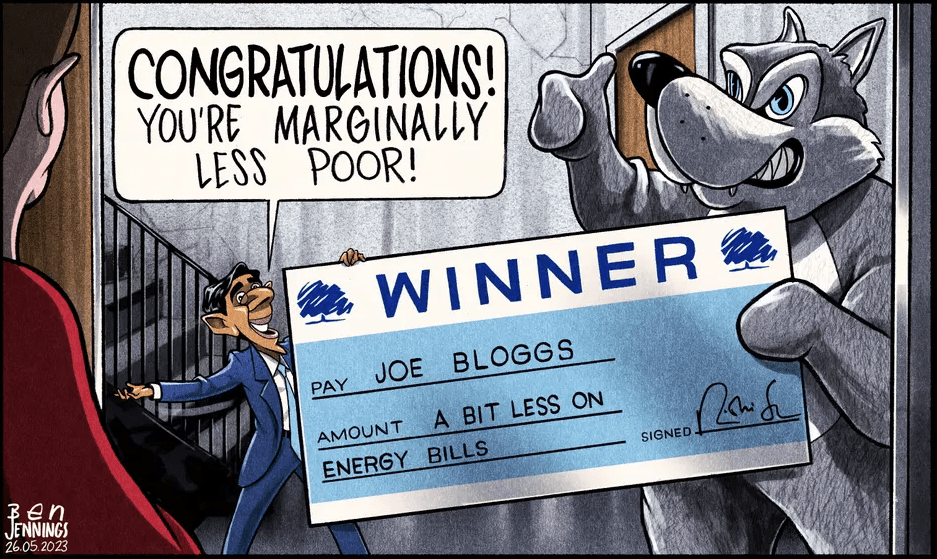
Your cartoons cleverly evoke the broken,stricken nation we’ve become, for all but the rich. www.theguardian.com
…. The tories have created a country where 4 people have the same wealth as 70% of the rest of us…
…where state education and the NHS, once exemplary and heralded as world-beating, have been starved to the point of destruction…
…where we can’t trade with the countries closest to us…
…where our rivers and beaches, which were becoming cleaner under EU regulations and which the leave campaign promised would become yet cleaner following Brexit, are now amongst the filthiest in Europe…
…where 5 million children live in poverty…
…where young people have done what we asked of them and earned top honours degrees only to find they are saddled with enormous debts and can’t afford a home…
…Where the Tories brown-tongued the Russian oligarchs enabling them to buy up extraordinary amounts of British property, launder their ill-gotten gains and accumulate yet more vast wealth which is still funding Putin’s evil war…
…where addictions are rife and where up to two suicides a day are caused by gambling…
…Where the person who threw £30 billion of the nation’s money down the drain is invited to the King’s coronation…
…where, since 2019, 8 Tory MPs have been found guilty of serious sexual misconduct and where many others have been accused or are facing investigation…
…where the most incompetent Home Secretary the country’s ever seen, previously sacked for breaking the Ministerial Code, but who is reappointed by a Prime Minister who then allows her to say asylum seekers are ‘invaders’. He then indulges her yet further to hold separatist meetings where it’s her criticising him, following which she appears to have broken the ministerial code again – but he lets her off Scot free, to inflict more pain, yet again.
We live, in short, in a country where the tories want us to believe that black is white and wrong is right.
We need to reverse it all and prevent them from coming anywhere near the corridors of power for decades, but Blairite devotees aren’t going to do that – not alone…
…With Caroline Lucas, Carla Denya, Adrian Ramsay, Humza Yousaf and Ed Davey keeping Keir focused, however, it’ll be the strongest coalition of the left this country has ever seen…
…And the Tories will be consigned to the sewer where they so belong to be.
Dorset ‘super reserve’ recreates ancient savannah habitat to boost biodiversity
It comes three years after the UK’s first “super national nature reserve” was created in Dorset, knitting together 3,400 hectares (8,400 acres) of priority habitat.
The mighty aurochs have gone, as have the tarpan horses and the wild boars, but modern-day substitutes have been drafted in to recreate a large open “savannah” on heathland in Dorset.
Instead of aurochs, considered the wild ancestor of domestic cattle, 200 red Devon cattle are to be found roaming the Purbeck Heaths, while Exmoor ponies are stand-ins for the tarpan horses and curly coated Mangalitsa pigs are doing the sort of rooting around that boars used to excel at here.
The idea of the project is to create more of the sort of habitat where precious species such as the sand lizard, southern damselfly and heath tiger beetle can thrive.
It comes three years after the UK’s first “super national nature reserve” was created in Dorset, knitting together 3,400 hectares (8,400 acres) of priority habitat. Within the super reserve, 1,370 hectares of open “savannah” for free-ranging, grazing animals as it would have been thousands of years ago is being developed with the cattle, ponies and pigs roaming freely to graze alongside deer to help shape a more diverse landscape with richer habitats.
David Brown, the National Trust’s lead ecologist for Purbeck, said: “Over large swathes of open grassland and heath, these domestic grazers are now mimicking their wild ancestors, who would have shaped habitats in the past.
“We can’t bring back aurochs but we can use our 200 red Devon cattle to graze and behave in equivalent ways. Similarly, Exmoor ponies mimic the actions of extinct tarpan horses, and the quirky, curly coated Mangalitsa pigs are rooting around like wild boars.
“We’re also discovering that by letting them get on with their own thing as much as possible, our grazing animals explore new habitats and discover different types of vegetation to eat – all of which help create a more dynamic and complex ecosystem.”
Large herbivores can play a crucial role in helping plants and less mobile insect species move around the landscape, carrying seeds and larvae on their fur and hooves, or in their dung.
By giving cattle, ponies and pigs this landscape to wander around, they are helping rare and threatened species such as Purbeck mason wasps, and heath bee-flies disperse and build stronger populations.
Brown said: “Grazing in their own individual ways, these animals are slowly forming diverse, wildlife friendly habitats. Cattle are untidy eaters, leaving messy tussocks perfect for insects; pigs turn over the soil and help sand lizards burrow; and ponies nibble tightly down to the ground creating grassland lawns full of specialist flowers such as stork’s-bill and waxcap fungi.
“These grasslands can be really important for pollinating insects, too, including rare mining bees. It’s the perfect mix of habitats in which biodiversity can thrive, and a great landscape for people to also roam freely.”
There have been some unexpected consequences. Peter Robertson, the RSPB senior site manager, said: “What has come as a surprise is how they have created new ponds by wallowing in water-logged areas and have opened up areas of salt marsh by foraging for shellfish.”
The Purbeck Heaths super reserve, which is to be the base for BBC Two’s Springwatch from Monday, is a mosaic of lowland wet and dry heath, valley mires, acid grassland and woodland, along with coastal sand dunes, lakes and salt marsh.
Already one of the most biodiverse places in the UK, it is home to thousands of species of wildlife, including all six native reptiles – the adder, grass snake, slow worm, sand lizard, smooth snake and viviparous lizard.
Liberal Democrat councillor Luke Taylor, who represents Bradninch, was elected at the authority’s annual meeting on Wednesday [24 May].
His party romped to victory at this month’s local elections to take control of Mid Devon, gaining 22 new seats to replace the Conservatives as the largest party.
Speaking after his election, Cllr Taylor said: “I promise the residents of Mid Devon that we will bring stability to [the] council. We will give the council a new start. We have an ambitious manifesto that we will now get on with delivering.
The new administration’s priorities include building more social housing, protecting leisure services, increasing recycling and meeting the council’s 2030 net zero target.
“We will also take steps to ensure the council is more open and transparent in its decision making,” Cllr Taylor said. “For too long discussions and decisions which could have taken place in public have taken place behind closed doors. We will look at ways of opening up the discussion at meetings to the public.”
He added: “As a working father of young children, I know how much time being a councillor takes, so we will be looking at how to involve a more diverse range of people.
“It is not acceptable that to participate in local democracy you need to be retired, wealthy or self-employed.”
Cllrs Simon Clist (Lib Dem, Upper Culm) and Jane Lock (Lib Dem, Canonsleigh) will serve as the new leader’s deputies.
Meanwhile, Lib Dem county and district councillor Frank Letch (Crediton Lawrence) was elected to be the council’s new chairman and promised to use his year in the role to encourage more people to vote.
“I found the turnout of voters at the recent council elections very disappointing,” he said. “This council is spending local people’s money and we have to convince them that participating in elections is in their interest.”
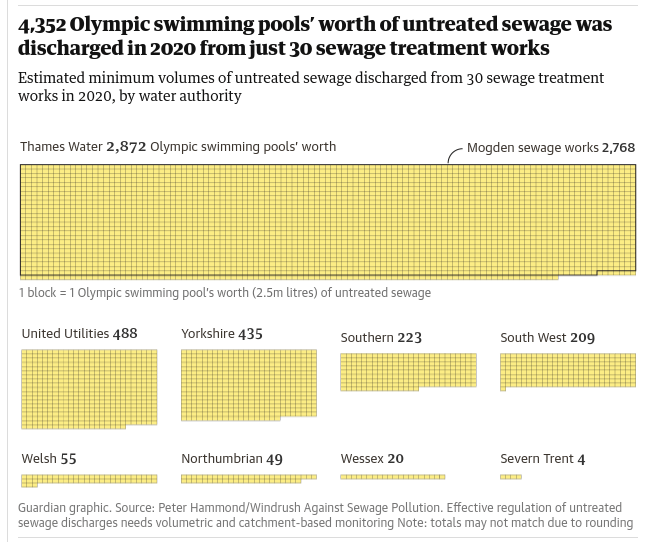
That’s 4,352 Olympic sized swimming pools of raw sewage from just 30 water treatment works out of a total of more than 7,000.
What a lot of whoopsies! – Owl
“It is extraordinary to see estimates of the volume being discharged. I am very disappointed that the government did not follow the recommendations of the environmental audit committee and make water companies fit volume monitors.” [David Clayden of the Harrogate Flyfishers’ Club and a member of the Nidd Action Group,
“I would never vote to pollute our water…….I voted for a crackdown on sewage spills.” [Simon Jupp MP]
Here are some more of Simon’s comforting words:
“….In recent years, a spotlight has been shone on storm overflows and CSOs. Water tourism is booming across our region, including windsurfing in places such as Exmouth and Sidmouth in my constituency. However, there is another reason why people have finally started talking about the issue: the Conservative Government have put in place a plan to improve our water, giving us all an opportunity to hold water companies to account.”
And:
“……Of course, in a perfect world, we would stop sewage spills completely and immediately. Sadly, that is virtually impossible in the short term; because of the pressure on our water infrastructure, we would risk the collapse of the entire water network, and the eye-watering costs involved mean we would need not just a magic money tree, but a whole forest.” [Simon Jupp MP leading his Westminster Hall debate on South West Water]
30 water treatment works released 11bn litres of raw sewage in a year, study suggests
Eleven billion litres of raw sewage were discharged from a sample of 30 water company treatment works in one year, new research suggests.
The study aimed to reveal the volume of discharged effluent released from storm overflows by water firms. Companies are not forced to reveal the volume of raw sewage released during discharges. They are only required by regulators to provide data on the number of discharges and the length of time they lasted.
Recommendations by MPs on the environmental audit committee that volume monitors be installed by water companies have so far been rejected by ministers.
In a study of 30 treatment works in 2020 run by nine of the 10 water and sewerage companies in England and Wales, the volume of raw sewage discharged was estimated at 11bn litres – or the equivalent volume to 4,352 Olympic pools.
Hammond said it was vital to establish the volume of sewage discharges by water companies. He said his research suggested the government’s target to reduce raw sewage releases to 20 per year by 2025 was not robust because there was no requirement to reveal the volume of raw sewage discharged for each release.
“There is still no data readily available showing the volume of untreated sewage discharges,” he said. “Water companies have some idea, but the regulators [Ofwat and the environment agencies in England and Wales] and the government [the Department for Environment, Food and Rural Affairs] probably have no idea. Sewage detritus in rivers, on beaches and in seas offers clues but may not reflect the volume of discharges.
“So what is the potential discharge volume for 20 spills per overflow per year?”
Of the 30 treatment works analysed, only one – Mogden sewage treatment works in west London – has volume monitors fitted. In 2020, Mogden, which serves more than 2 million people, released a volume of raw sewage equivalent to 2,768 Olympic pools.
The average volume of sewage discharged per spill from the other 29 treatment plants in 2020 was 1.3 Olympic pools. The government target of 20 spills per year by 2025 would therefore still involve huge volumes of untreated sewage, according to the analysis.
“Even if the government’s storm overflow discharges reduction plan target of 20 spills per overflow per year were to be achieved, some treatment works could still discharge a volume equivalent to 26 Olympic pools of untreated sewage annually,” Hammond said.
Measuring the volume of discharges was vital to establish the environmental impact of them upon rivers, he said. “Individual rivers receive direct, simultaneous discharges of untreated sewage from multiple storm overflows on their journey from source to sea,” Hammond said. “So, during longer spills, the lower reaches of a river may already be polluted from upstream discharges when yet more overflows downstream discharge untreated sewage.”
The River Nidd in North Yorkshire, one of the river catchments studied by Hammond, receives untreated sewage discharges from at least seven treatment works. Calculations were possible on estimated volumes for four treatment works: Pateley Bridge, Harrogate North, Darley and Kirk Hammerton. Hammond estimated the river received an equivalent of 317 Olympic pools of raw sewage from those works in 2020.
David Clayden of the Harrogate Flyfishers’ Club and a member of the Nidd Action Group, said he saw no reason water companies could not reveal the volume of raw sewage being discharged into rivers. The group is carrying out testing on the river helped by the University of Leeds. They are working on an application for bathing water status for a section of the Nidd known as the Knaresborough Lido, to drive a clean-up.
“There is a real buzz about this issue here as there is nationally,” he said. “It is extraordinary to see estimates of the volume being discharged. I am very disappointed that the government did not follow the recommendations of the environmental audit committee and make water companies fit volume monitors.”
Data from treatment works run by Welsh Water that feed into the Conwy, a sea trout river in north Wales, was also studied. Hammond estimated the volume of discharges from both inlets and storm tank overflows was an equivalent to 34 Olympic swimming pools.
Volumes at the 29 treatment works that did not have monitoring were estimated in one group by calculating the difference between flow meters at the inlet where raw sewage arrives and outlet where treated effluent is discharged. During spills of raw sewage, Hammond estimated the volume of raw sewage being released rather than treated, as the difference between the two meters.
At another group of treatment works Hammond had to estimate the volume by analysing data from overflow weirs, start and stop times on event duration monitors and flow to treatment meters – something he accepts was the least reliable approach.
A Yorkshire Water spokesperson said: “In the short time we’ve had to review this report we’ve identified several industry-wide claims we don’t recognise … The report focuses on potential impact of storm overflows at Pateley Bridge, Harrogate North, Darley and Kirk Hammerton. We are aware of an instrument issue that was identified in the 2020 Pateley Bridge return, which overinflated discharges from the 6x overflow and paints a false picture of the overflows.
“This monitoring is being replaced and was discounted in the 2021 and 2022 returns. Storm overflows are not identified by the Environment Agency as reasons for these sections of the Nidd not achieving good ecological status. The assessments suggests that where Yorkshire Water can make a difference is in reducing phosphorus from final effluent of wastewater. That is why we are investing £790m by 2025 in phosphorus removal.”

 East Devon Watch