What does a “Progressive” council look like?

Well even Labour, with only three councillors, managed to get a Vice – Chair post!

Owl has already published the principal office holders and cabinet:

Chair, Cllr. Eleanor Rylance (Democratic Alliance – LibDem)

Vice Chair Cllr Sam Hawkins (Independent Group – Cranbrook Independent)

Leader Cllr Paul Arnott (Democratic Alliance – LibDem)

Cllr Paul Hayward (Democratic Alliance – Independent)

See here for the cabinet.

Below are the Chairs and Vice-Chairs of some of the important committees. 

Remember that the committee members are chosen to achieve “political balance” amongst the political groupings, a complicated operation when it comes to rounding up or down.

The full list of Committees, Boards, Panels and Forums and links to lists of members can be found here

Scrutiny Committee

Overview Committee

Planning Committee 

Given the potential interest and impact of this committee on communities, Owl has included the full list of members, including which ward they represent. 

Whilst political balance might be achieved, it is not obvious that geographic representation will be achieved. This has always been the case.

In this case it looks as if the communities in Honiton and Seaton will have to do with near neighbours.

Strategic Planning Committee

Audit and Governance Committee

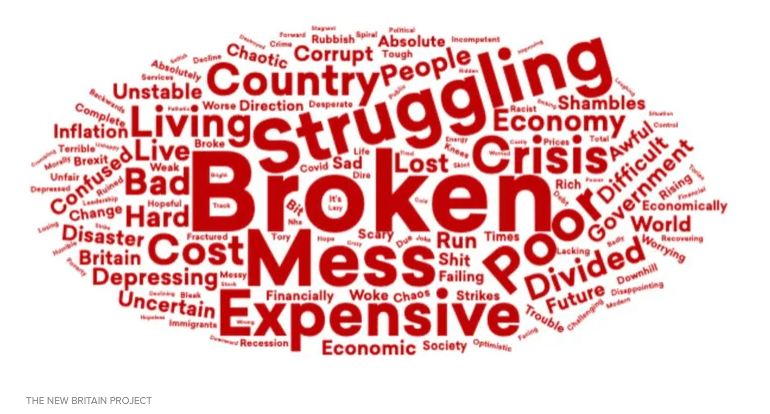
‘Broken’, ‘Struggling’, ‘Expensive’ And A ‘Mess’: What Britain Thinks About Life

People across the UK view the country as “broken”, a “mess”, “expensive”, “struggling” and in “crisis”, according to a new poll.

Ned Simons www.huffingtonpost.co.uk

A survey conducted for the The New Britain Project think-tank by More in Common and shared with HuffPost UK has captured the mood of the nation.

The poll asked 2,017 adults between 12 and 15 May to describe Britain in their own words. And the results were not positive.

Of the words picked, “broken” was the top choice, used by 162 people. In second place was “mess” with 118.

The first term rated as positive rather than negative was “rich”, in 56th place with eleven people having chosen it.

Other popular choices included “divided”, “depressing”, “confused”, “bad” and “shit”.

The results prove uncomfortable reading for Rishi Sunak who has just over a year before he has to call a general election.

Sunak’s seven months in office have been against the backdrop of soaring inflation and rolling strike action.

Labour has held a consistent poll lead for months and the results of the local elections earlier in May suggest Keir Starmer is on course to become prime minister.

The most recent YouGov poll showed Labour on 43%, ahead of the Conservatives on 25% and the Lib Dems on 12%.

In a sign that many in the Conservative Party have accepted the election is lost, almost 40 Tory MPs have already announced they will quit parliament rather than stand for re-election.

The mass exodus of Conservatives includes former deputy prime minister Dominic Raab, former culture secretary Nadine Dorries and former chancellor Sajid Javid.

Labour plans to allow local authorities to buy land cheaply for development

Labour is planning to give local officials sweeping new powers to buy land cheaply and develop on it, as part of the party’s new “pro-building” agenda.

Might be prudent for EDDC to start identifying land on the back of its local plan review. “Doing today what is right for tomorrow” is the aspiration of Clinton Devon Estates’ long term strategy. – Owl

Kiran Stacey www.theguardian.com 

Party sources say that if elected next year, they will pass a law to allow local development authorities in England the power to buy up land at a fraction of its potential cost if they want to build on it.

The new law will allow officials to buy land under compulsory purchase orders without having to factor in the “hope value” – a massive price premium granted to any land on which developers hope to secure planning permission.

Keir Starmer, the Labour leader, is already under fire for his promise to make it easier to build on the green belt. But the details of the party’s latest pro-development policy show he is willing to risk the wrath of existing land and property owners in his attempt to jump-start new building across the country.

One party source said: “We want to rebalance the power between landowners and local communities. We want local areas to capture a lot more of the value that is created when you build on land nearby. The principal is to tilt the balance of power, which right now is tilted towards landowners and not communities.”

Homeownership in England has been falling for years, as prices have risen and banks have asked for increasingly large deposits. In 2003, 71% of all homes were owned by the people who live there, but by 2021-22, that had fallen to 64%.

The Conservatives have attempted to tackle this by offering financial help for new buyers, but the impact of those schemes have been limited by falling supply.

Michael Gove, the housing secretary, has promised a series of planning reforms, but has been hampered by a set of powerful Conservative backbenchers who believe their seats are under threat because of building schemes in their constituencies.

Last year Gove bowed to pressure from those Tory MPs to drop a mandatory target to build 300,000 new homes every year, making it voluntary instead.

Since then, several local authorities have delayed or scaled back their building plans, causing analysts to slash their projections of new housebuilding over the coming years. A study earlier this year by the Home Builders Federation suggested housebuilding in England was set to fall to 120,000 a year – the lowest level since the second world war.

Labour is promising to be “the builders, not the blockers”, launching a series of pro-building policies, including a return to the mandatory 300,000 target.

As part of that, sources say the party would pass a law soon after entering government to allow local development authorities to buy up land under compulsory purchase orders without factoring in the hope value.

Hope value is the price premium attached to land on which planning permission has either been granted or on which developers hope it will be granted. An analysis by the Centre for Progressive Policy in 2018 found that planning permission inflated the price of agricultural land by 275 times, pushing it up from £22,520 per hectare to £6.2m per hectare.

Politicians from the two main parties have argued for years that hope value should be stripped out of compulsory purchase valuations. In 2018 the Tory MP Neil O’Brien called the practice of paying it “highly questionable”, in a report for the centre-right think tank Onward.

O’Brien, who is now a health minister, said: “This has made it prohibitively expensive and complex for the old ‘new towns’ model to be viable. And even where government spends taxpayers’ money on major infrastructure projects, the value of this investment is often not discounted when government buys the land for the infrastructure. The system has become unbalanced.”

Gove has taken up a version of O’Brien’s reforms, but intends to leave it up to the housing secretary at the time to decide whether to eliminate hope value from CPOs on a case-by-case basis. The reforms are part of the levelling up and regeneration bill, currently passing through the House of Lords.

A spokesperson for Gove’s department said: “It will ultimately be for the secretary of state to decide whether a compulsory purchase order can be approved and if the removal of hope value is appropriate.”

Labour argues, however, that this would leave local planning officials relatively powerless to buy up the land they believe is needed for local development schemes, and would also leave the secretary of state vulnerable to sustained lobbying from landowners.

Labour officials are still deciding on the scope of the reforms, and whether they should be passed in the “take back control” bill, which Starmer has promised will be part of his first king’s speech, or whether they should be part of a separate planning bill. They are also deciding on how best the value added by planning permission should be dispersed to local communities themselves.