Covid inquiry: Ministers avoid questions on care home deaths until after election

“The public and bereaved families have already been left waiting far too long for answers over why the Government got it so wrong and failed to protect care home residents during the pandemic.

“It’s deeply disappointing that because the Conservative ministers took so long in setting up the Covid inquiry, they now won’t be held to account over these failures until after the election.” – Daisy Cooper, the Liberal Democrats’ health spokesman.

By Daniel Martin, Deputy Political Editor www.telegraph.co.uk

Ministers will avoid questions about the deaths of thousands of care home residents during the pandemic until after the general election, the official Covid inquiry has announced.

Baroness Hallett, chairman of the inquiry, set out the timetable for public hearings on Tuesday, with the final ones not taking place until the summer of 2026.

She revealed that hearings to investigate how the care sector coped during the pandemic will not start until spring 2025.

Hearings on government procurement, expected to include the large amount of wasteful spending on unusable PPE, will begin in early 2025.

The issue of how children’s education and mental health was impacted by lockdown will not be investigated until mid 2025 at the earliest.

Rishi Sunak, the Prime Minister, has to call the next election by the end of 2024.

Lady Hallett also revealed that the public hearings on vaccines, where the Government is widely judged to have performed well, would take place from summer 2024.

It means the sessions on vaccines, which will not be as embarrassing for the Government, could well happen just before the election.

She said: “Last year, I promised I would work hard to ensure the whole of the UK can learn useful lessons from the pandemic as quickly as possible.

“Today I am providing greater clarity on our investigations and the likely end point for the inquiry’s hearings.”

Daisy Cooper, the Liberal Democrats’ health spokesman, said: “The public and bereaved families have already been left waiting far too long for answers over why the Government got it so wrong and failed to protect care home residents during the pandemic.

“It’s deeply disappointing that because the Conservative ministers took so long in setting up the Covid inquiry, they now won’t be held to account over these failures until after the election.”

Caroline Abrahams, charity director at Age UK, said: “Many families and friends of the 40,000-plus older people who died in care homes during the first wave of the pandemic are likely to be deeply disappointed by this delay.

“Care home residents were among those most grievously harmed by official decisions that were or were not made during the health emergency and it’s really important that the right lessons are learned so we can protect older people more effectively in the future.

“The worry is that as the weeks and months go by, recollections dim and it becomes harder to establish exactly what happened, and why.”

The Covid inquiry is split into six different investigations, the first three of which are pandemic preparedness, decision-making and the impact of the pandemic on health systems.

On Tuesday, Lady Hallett announced three more investigations – vaccines, therapeutics and anti-viral treatment; government procurement across the UK; and the care sector across the UK.

Details of further investigations will not be unveiled until early 2024, the inquiry said, but they would not start until mid 2025.

Future investigations will cover issues such as NHS test and trace, the effect of lockdowns on education, and the effect on children and young people.

The inquiry will also consider financial support for business, additional funding of public services, and benefits and support for vulnerable people.

The inquiry’s final modules will specifically investigate the impact of pandemic policies on inequalities in the context of public services, including key workers.

The inquiry is aiming to complete public hearings by summer 2026.
The damaging legacy of right to buy

Originally published last year this analysis is still relevant and an excellent summary of the problems facing the new council. – Owl

Tom Pollard neweconomics.org (extract)

Right to buy embedded the notion of a ​‘property owning democracy’ into the British political psyche and brought Thatcher into power in 1979 through a mass of working-class votes. At the moment, it allows council tenants to purchase their homes at a large discount: up to £116,200 cheaper in London and £87,200 elsewhere. Much of the money from this purchase is sent to the Treasury, with the council allowed to retain a portion, as long as they spend the portion on additional affordable homes in a manner approved by central government. Johnson wants to extend this policy to housing associations, who today hold the majority of affordable housing stock. Since its inception, approximately 2m sales of social housing have taken place under right to buy. To Johnson, this is a victory of greater homeownership, but this ignores the grave costs of the policy.

First, the sales of council homes have not been accompanied by investment to replace the social homes lost to right to buy. Rather, investment in new social housing has been consistently slashed since the 1980s, with government investment instead going to paying the housing benefit bill. In addition, right to buy actually disincentivises the building of new social homes. Why would councils pay to build homes, only to sell them at a discount, lose income from future rental payments and not receive the full sale receipt?

When homes are sold at a discount under right to buy, this represents a loss to public finances – an estimated £75bn over the lifetime of the policy since 1980. Extending the policy to housing associations will only extend this disincentive to more providers of social housing, slowing social housebuilding when it needs to be sped up. It is estimated that the government may have to compensate housing associations by £14.6bn in a decade if the policy is extended.

With right to buy sales far outweighing supply, there been an average annual net loss of 24,000 social homes since 1991. The government has sought to have a one-to-one replacement policy in recent years. Yet, how can a policy of one-to-one be effectively applied when right to buy discounts result in financial loss? The replacement policy has had little success. Furthermore, lost social homes don’t need to be replaced with new social homes – any home will do, according to the government. Genuinely affordable social homes may be replaced by unaffordable shared ownership properties that are easier to make viable on development schemes.

Second, the policy hasn’t straightforwardly led to higher levels of homeownership or owner-occupancy of former social homes. Research from Inside Housing showed over 40% of right to buy homes are now rented privately. Affordable social housing has turned to unaffordable private rented housing. It is no wonder that during the existence of right to buy we’ve seen ​‘generation rent’ emerge in 2011/​12, when the proportion of households in the private rented sector outstripped those in the social sector. While some social housing has been allowed to fall into disrepair, private rented properties lack even the regulation of social housing, meaning that residents live in worse quality housing with insecure tenancies, while paying higher rents.

Worse still, many of the tenants of these ​‘right-to-buy-to-let’ properties rely on housing benefit. 25% of private renters received housing benefit in 2020/​21. Right to buy has reduced the supply of social homes, meaning more people rely on housing benefit because they cannot be housed in a council house. This means a larger housing benefit bill which ends up in the bank accounts of private landlords, not councils and housing associations who would recycle it into public investment.

Third, right to buy has added to the declining perception of social housing, furthering stigma. Inherent in the policy is the idea that homeownership is a superior tenure, and that social housing should act as a stepping stone to the aspirational homeownership. With social housing in such short supply, it has become a tenure for the very poorest, as only the wealthiest social tenants can make use of right to buy. With this promotion of homeownership, the government has a vested interest in ensuring rising house prices to support their voting base, at the expense of providing housing for those in need. All of this results in prejudice against social housing and makes gathering political support for social housing difficult.

Admittedly, the government have tried to use extending right to buy as a ​‘vote winner’ before and not followed though: David Cameron piloted a similar policy back in 2018. Nevertheless, Johnson’s announcement indicates the current government’s dangerous attitude towards social housing, at a time when need for itis at its greatest. The focus remains on winning elections, instead of building a housing system that makes sure all of us can live in good quality, affordable homes.

The prevailing attitude towards social housing won’t change without pressure. At NEF, we are launching Homes for Us, a campaign for affordable and desirable social homes for the 21st century. You can help us prepare by contributing to our Social Housing Listening Campaign, which is gathering perceptions and perspectives on social housing.

River Wye health status downgraded by Natural England after wildlife review

River pollution is getting worse, but don’t worry Thérèse Coffey has a plan! – Owl

The River Wye’s health status has been downgraded by Natural England, as wildlife charities accuse the government of failing to stop farming pollution harming the waterway.

Helena Horton www.theguardian.com 

The government nature watchdog has updated the status of the river from “unfavourable-improving” to “unfavourable-declining”, meaning its condition is poor – and worsening.

The assessment shows the river, which flows for 155 miles from mid-Wales to the Severn estuary in England, has experienced declines in key species such as the Atlantic salmon and white-clawed crayfish.

Previous studies have linked its decline – the river has been pictured over the years going from clear and full of wildlife to the colour of pea soup – to intensive chicken farming on the catchment. This is because the poultry reared in the area produce large amounts of manure, which contains nutrients including phosphorus. Much of this is spread on the land, which can result in the phosphorus it contains entering the river.

The Wildlife Trusts, which manages nature reserves across the Wye catchment, has expressed concern at the downgrading of its status and urged the government to take action.

It is calling for ministers in England and Wales to place an immediate policy moratorium on any new or extended intensive livestock production units (poultry, cattle and pig) in the Wye catchment. It is also asking for farmers and supermarkets to work with nature charities to put an end to the pollution, and for farmers in the area to be rewarded for providing public goods and enabled to diversify into regenerative and sustainable methods of production which cause less pollution.

Joan Edwards, the director of public affairs at the Wildlife Trusts, said: “That the Wye is in even worse condition now will come as no surprise to the people that love and live near it. But this new admission represents a shocking failure by the agencies and authorities in Wales and England that are supposed to protect this once beautiful river.

“Wider research shows that farm pollution is the main cause of its decline – that’s why the authorities must enforce the law wherever the causes of pollution are clear. It’s time to prevent more chicken sheds from being built and ensure that all farmers are rewarded for nature-friendly, cleaner food production methods.”

Thérèse Coffey, the environment secretary, said: “The River Wye is clearly struggling and it is vital that we turn the tide on its decline. As I set out in our plan for water, we need local plans catchment by catchment, community by community to tackle issues that are affecting water quality. Bringing people together from the local communities, it is clear we have a common goal. We do all need to work together at a greater pace and with purpose to actively support our farmers and food producers to produce food sustainably and reduce pollution.”

Anyone know the whereabouts of the “unambiguously irrelevant”, relevant diaries?

The BoJo diaries seem to have mysteriously gone missing, at the last moment!

“I think the prime minister looks really slippery today. He says he wants the government to co-operate with the inquiry but the government has been withholding information the inquiry has asked for.

“One minute the government says the messages they have are immaterial; the next minute they’re saying they don’t exist. Which is it?” Wes Streeting

Failure to hand over everything requested would “make a mockery of this whole process and would be yet another insult to the millions of bereaved still waiting for justice”. Lib Dem health spokesperson, Daisy Cooper.

 “Some cover-up going on here to save embarrassment of ministers”, Bob Kerslake, a former head of the civil service.“This government will have integrity, professionalism and accountability at every level.” Rishi Sunak.

Nearly two-thirds of millennials think Tories deserve to lose election, poll says

The Conservatives’ failure to win over young voters poses an “existential” challenge to the party, Rishi Sunak has been warned, as new polling found nearly two-thirds of millennials said it deserves to lose the next election.

Aubrey Allegretti www.theguardian.com 

Research from the centre-right thinktank Onward found that millennials – which it defined as those aged 25 to 40 – think the Tories are dishonest, incompetent and out of touch. Yet despite this, it said there was hope younger voters could be attracted back to the party.

Millennials are predominantly “shy capitalists” who support lower taxes over redistributing wealth, Onward’s report said.

The report has been endorsed by former Tory vice-chair Bim Afolami. “The millennial generation is not becoming more likely to vote Conservative as its members age, this situation is worsening, and we need to better understand it,” he said in his foreword.

“This issue is existential for the Conservative party, and not just for votes at the next or subsequent elections.”

In what will make sobering reading for party bosses before the expected general election next year, a survey commissioned by Onward of 8,000 millennials found only 21% would vote Conservative should polling day be held tomorrow.

Such is their antipathy that nearly two-thirds – 62% – said the Tories “deserve to lose the next election”, with 45% saying they planned to vote Labour.

While the Conservatives have historically been less popular with younger voters, the party’s problem is getting worse.

“Millennials are the first demographic cohort not to become more rightwing as they age,” said Afolami. “They are failing to acquire many of the attributes that have traditionally moved voters rightwards: home ownership, secure and stable employment, starting families.”

About 26% of the adult population are millennials, and they are said to be the largest cohort of any generation in about half – 324 – of Britain’s 650 constituencies. However, turnout at elections is often higher among older age groups.

Areas with high numbers of younger voters tend to be clustered in cities – but also stretch to the periphery of them, to places such as Thurrock and Slough.

Onward’s report warned that there is a danger the Tories “will eventually run out of road” and that if the party did not start to win over younger voters, “it risks an electoral timebomb”.

Home-owning millennials are more likely to cite a distrust of the Conservatives to manage the economy, Onward found. It said this “suggests that the market shock caused by the 2022 mini-budget has undermined one of the traditional strengths of the Conservative brand”.

A “silver lining” for the party is that Sunak himself is far less unpopular than his party among those born in the 1980s and 90s, the thinktank’s survey found. It said that his popularity was 20 percentage points higher than the party’s.

Those “pro-Sunak, not Tory” voters, as Onward described them, are less likely to be white, probably live in urban areas, have high-level jobs and own a home. The cost of living, the NHS and the environment are top issues they share with all voters. But uniquely, they place housing and taxation much higher up the list.

“Government has not delivered on millennials’ core priorities,” found the report, titled Missing Millennials. It cited issues with housing, and a lack of family-friendly policies and jobs, and said millennials had “no time for the culture war” which senior Tories are often accused of trying to wage.

“The Tories’ opportunity for improving their stand with millennials is clear. They will need to be bold to win younger generations back,” it concluded.

Paul Arnott on the new council

With June busting out all over, as the song once sang, your district councillors have finally put an exhausting couple of months behind them.

Paul Arnott www.exmouthjournal.co.uk 

In early May every four years, East Devon electors choose 60 individuals to represent them, and after the deed is done these members spend the rest of the month organising themselves into the appropriate committees. Then, on the last Wednesday, in May we hold “Annual Council”.

This year’s happened at the Ocean in Exmouth, where I turned up with a kidney infection and a heavy cold and couldn’t wait for the evening to be over, to be frank. This saddened me because there was much to celebrate.

The first business transacted was to elect a Chair of Council. This is a critical non-partisan role, the conscience of the council, and members selected Eleanor Rylance from Broadclyst without opposition. I had then intended to say something substantial in support of proposing Sam Hawkins from Cranbrook as Eleanor’s vice chair, but felt so groggy I kept it pretty brief. Sorry Sam.

Eleanor is a Broadclyst working mother of four children from graduate to school age. She is a passionate local representative in a part of the district saturated with planning applications, often contentious. She has an Oxbridge law degree, is a bilingual translator, and is altogether a class act. And I have no doubt that if she finds me wanting as Leader I will be as remorselessly grilled as much as any backbencher!

Sam from Cranbrook is in his thirties, a qualified accountant and auditor by profession, and has had to deal with the many teething troubles of the new town. He has a forensic mind, is courteous at all times, and as his time chairing our Audit & Governance committee has shown will not hesitate from asking the most difficult of questions.

Forgive me for labouring this point but I’d emphasise again how important the appointment of a woman councillor with professional and family breadth, and a younger male councillor with auditing skills, is for East Devon. Vive la difference.

This week, then, it’s back to business full tilt. I was very grateful to be elected Leader for a fourth year, and feel confident that my Democratic Alliance group with nearly half of all members will work brilliantly with other groups for the public good.

In between coughs in my short acceptance speech at the Ocean, I simply stated where the emphasis will remain for the coming year. Homes. Environment. Economy.

These are the areas of public life we know a district council can influence (unlike pot-holes, education or adult social care which are county responsibilities). Two days after being made Leader again, I attended a meeting of the new Devon Housing Commission, where various local representatives could meet with members of the new board, chaired by excellent crossbench peer, Lord Richard Best.

Hosted brilliantly by the Cranbrook Education Centre, Lord Best was able to hear about the challenges, failures and successes of how the new town was conceived and developed. It was an excellent, non-political exchange of views.

At East Devon we are in no doubt that this must be an absolute priority. Local people of all ages are facing a crisis if trying to rent or purchase, and there is a lot of evidence of younger people moving back home.

The Kwarteng/Truss bombshell budget of last year and its immediate effect on spiking interest rates has not helped.

Our Strategic Planning Committee will push hard on all this, as will our excellent Homes and Communities Cabinet Member Dan Ledger, a genuine local in his early 30s working professionally in local government. We’ve got the A team in place – now let’s get some results.

Female representation on Devon County Council slammed

Male, pale, stale and bust! – Owl

The lack of female Devon county councillors in senior roles is coming under fire.

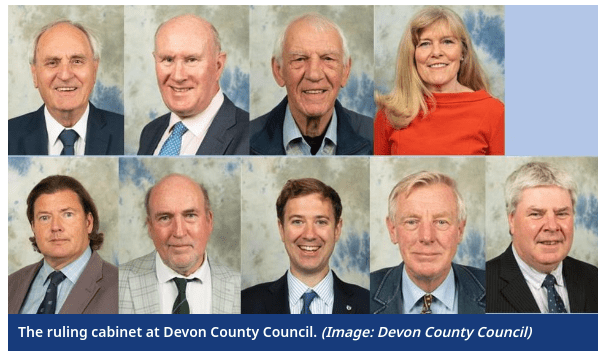
Just one of the nine members of Devon’s ruling cabinet are women, while men also occupy most of the chair and vice chair positions on various committees.

Ollie Heptinstall, Local Democracy Reporting Service www.exmouthjournal.co.uk

The council says that despite trying to promote ‘greater diversity,’ around 70 per cent of councillors are men, and parties “put forward who they feel is most appropriate” to various roles.

The issue was raised by independent councillor Frank Biederman (Fremington Rural), who voted against the appointment of chairs and vice chairs at the authority’s annual meeting on Thursday, May 25.

“A great deal has been made of this county council’s move to more [inclusivity], equality and diversity,” Cllr Biederman said.

“And it’s also our mission statement on our website. We’re rightly very proud of our diverse workforce and we’re working to help them.”

The issue was raised by independent councillor Frank Biederman (Fremington Rural).

But he added: “I don’t believe that we do that in our election of chairs and vice chairs, and that’s why I’d like to be recorded as voting against it.

“And just to remind you, we’ve just appointed 25 male vice chairs, chairs and members of cabinet, and only six of those will be female. That’s why I can’t support this.”

In response, a council spokesperson said: “All political groups at the council are asked to put forward chairs and vice chairs for our committees, proportionally to the number of seats held by each group.

“Despite Devon County Council trying to promote greater diversity in all its forms, including the proportion of women to men, the split between male to female councillors is currently around 70 per cent male, to 30 per cent female.

“Ultimately, the political groups will put forward who they feel is most appropriate to the role.”

Meanwhile, Cllr Percy Prowse (Conservative, Duryard & Pennsylvania) has been elected as the new chair of the council.

He will perform the ceremonial role for the next 12 months, which involves hosting full council meetings and representing the authority at civic functions.

Cllr Colin Slade (Conservative, Tiverton East) is his deputy.