Mystery pothole vigilante hunted by council breaks silence: ‘They should thank me’

A mystery motorist hunted by highways chiefs after filling in a huge pothole in Cornwall has said the local council should be thanking him.

Emily Atkinson www.independent.co.uk

The unnamed vigilante repairman allegedly spent £1,000 of his own money to fill the 10ft hole with concrete. The crater lies in the middle of a road in Lostwithiel, which has been closed for more than a month to the despair of residents.

The man has since broken his silence, telling MailOnline he is, in fact, an experienced road worker who only had acted in support of his neighbours.

Speaking on condition of anonymity, he said: “ I thought it was a good thing to do personally. I think I did everybody a favour.

“If anything the council should be thanking me, not hunting me down. I spent the seven hours and £1,000 hiring the equipment and buying materials.”

Days after the hole was filled, the council deployed its own road maintenance team to reinstall the barriers to close off the road once again, saying the work had been done “by persons unknown, without consent”.

Council chiefs then urged residents to turn in the man, but he remains confident he won’t face retribution.

“Why kick up such a fuss? It was open for three days before they put the concrete blocks back. I think the council are just trying to save face now because they’re embarrassed,” he said.

The unnamed man’s actions were subject to widespread acclaim, with former Cabinet minister Jacob Rees-Mogg among those heaping praise on the guerilla repair operation.

“The bureaucratic state hates being humiliated so resorts to bullying the good citizen,” he wrote on Twitter.

One nearby resident told MailOnline: “The person who filled it is a hero.”

Another compared the mystery man to Sir Rod Stewart, who last year helped fill potholes near his home in Harlow, Essex.

Cornwall Council’s roads repair company Cormac has said the road would now remain closed until 9 June, adding it did not intend to mend it again until it has caught up with a backlog of pothole repairs.

Ahead of this month’s local elections, prime minister Rishi Sunak promised a clampdown on potholes.

On a visit to Darlington, he said new powers would help ensure firms repair roads properly after carrying out works, through more fines and inspections.

Local councillor Colin Martin stands in front of pothole which has closed the road in Lostwithiel

The government also said it was investing more than £5.5bn between 2020 and 2025 in highways maintenance, with an extra £200m to help fix potholes announced in March’s budget.

A Cornwall Council spokesperson said: “There is an ongoing issue with drainage at this site which has led to the deterioration of the road surface. These drainage issues have meant that any surface repairs during the winter have been temporary.

“As we are now moving into warmer and drier weather, Cormac [the maintenance company] can programme in the permanent drainage and surfacing repairs needed at this site.”

Feargal Sharkey: The water industry apology doesn’t stand up to scrutiny

I don’t think it is an apology at all. I think it was somebody trying to strategise: “We are going to treat our customers with even more contempt than we’ve ever done before.”

Feargal Sharkey www.thetimes.co.uk 

We’ve paid and provided all the funding needed for the water companies to meet their legal obligations, to build, operate, maintain sewage systems for 30 years. They’ve had all the funding.

They’re now turning around and, even more contemptuously, suggesting that they now want to put up customers’ bills by £10 billion to cover up and pay for their failure. It’s their greed and their bloody profiteering and their own incompetence that’s created the situation.

For me, it seems like this investment clearly hasn’t been approved by [the regulator] Ofwat. So it’s money that doesn’t even exist until it’s approved. It’s £10 billion over seven years. That’s £1.42 billion a year divided between nine main sewage companies. That’s £158.7 million a year.

Let me remind you that between April and September last year, Thames Water declared they had made £493.5 million in profit. The sector still managed to find a way to pay themselves £1.4 billion in dividends last year. So tell me again: is this an apology?

I’ve heard no apology for the billions they’ve made off with [in dividends and profits], the £60 billion worth of debt they’re in. I’ve heard no apology for the absolutely desperate state these rivers are now in because of their actions over the past 30 years. And I see absolutely nothing that actually looks like a plan.

Five of them have now given up their bonuses. Having spent three years dumping 7.5 million hours’ worth of sewage into our rivers, I don’t think you’re entitled to a bonus anyway.

The government, Ofwat and the companies now need to publish the strategy over the next five, ten, 15 years about exactly who’s going to be doing what, who’s going to be held accountable for it, who’s going to deliver it, who’s going to end up paying for it. How much pain the water companies are going to feel? How much are their shareholders going to put up? Who’s going to do something to rein in all of these limited bonuses?

This doesn’t stop until it’s fixed. And it’s a long, long way from being fixed.

Tractor joins Devon and Cornwall Police

It’ll be shown at events throughout the summer.

(Is this one of Alison Hernandez’ ideas? Owl hopes Neil Parish will behave himself!)

Devon and Cornwall Police have revealed the latest addition to their fleet in a bid to spread awareness of rural crime.

Radio Exe News www.radioexe.co.uk

 The tractor is being leant to the force (courtesy: Devon and Cornwall Police)

A tractor has been leant to them by local agricultural and turf dealership Mason Kings and will be at across the region at agricultural shows and other events throughout the summer.

The force says the rural affairs team will use the new vehicle to raise awareness of the support it can give to those who are concerned and effected about issues such as agricultural plant, GPS and livestock theft.

Police constable Clarke Orchard said: “A huge part of our job is to connect to and be visible in our rural and agricultural communities.

“We work with local police neighbourhood teams to tackle rural crime and anti-social behaviour anywhere in our counties.

“Whilst this vehicle won’t be used operationally, it will be seen at various shows across the region, sparking conversations with farmers, highlighting crime prevention strategies, and engaging with those who might not interact with police teams normally.”

The tractor is making its debut at the Devon County Show.

End of the road for Devon’s mobile library service

Tory run Devon County is still cutting services to rural communities (and don’t mention the potholes). – Owl

Devon’s mobile library service is to be scrapped because the county council says it can no longer afford to run it.

Philippa Davies www.midweekherald.co.uk

The council currently has four library vehicles, adapted for people with mobility or hearing problems, that visit 374 locations across Devon every month. In East Devon these include Sidford, Salcombe Regis, Beer, East Budleigh, Lympstone, West Hill, Cranbrook, Whimple, Feniton, Offwell and many other communities outside the district’s main towns.

But the vehicles – three of which are 15 years old – have become unreliable and expensive to maintain, and the county council says it cannot afford to replace them.

A consultation on the termination of the service is open until Friday, May 26, but it seems that the decision has already been made and the council is inviting suggestions on how people could access library services without the mobile vehicles.

Devon County Council says there has been a steep fall in the number of people using its mobile libraries – a decrease of 44 per cent in the last 10 years. Its figures show there were more than 161,000 loans from mobile libraries in 2012, with 5,546 active members, compared to around 51,000 loans in 2022 with 3,080 active members.

But Paul Sandy, a regular user of the mobile library service, says these figures are misleading. He has discovered that in 2012 there were eight library vehicles, presumably providing a much fuller service. The reduction to four vans in 2013-14 would have cut the number of users.

He also highlights the county council’s own statement that collectively, its library vehicles were off the road for 670 hours last year, largely because of ‘vehicle issues and maintenance’, making it impossible to provide a reliable service. This would also have reduced user numbers.

Mr Sandy said: “Worryingly, the proposal seems to take no account of the social impact of ending the mobile service, where people in small and often isolated rural communities have a reason to get out of the house to meet once a month. In addition, it is well known that many of those who visit the library borrow books for mobility-impaired or housebound friends, neighbours and relations to read. Thus the ‘active user’ count is certain to be significantly less than the number that benefit from the service.”

He is also concerned that the council does not seem to have looked into other options, such as leasing library vans instead of buying new ones or seeking grants and sponsorship to fund the service.

The county council’s rationale for ending the service, and the consultation document, can be found here:

https://www.devon.gov.uk/haveyoursay/document/mobile-libraries/

Food security is key says NFU South West at Devon County Show

Simon Jupp’s recent charm offensive  doesn’t seem to be winning hearts and minds in the farming community. – Owl 

As Devon County Show opens, the county’s farming leaders are asking the Government to do more to support their family farms.

Lisa Young www.southwestfarmer.co.uk 

A recent survey by the NFU showed that confidence levels in the industry are at their lowest level for three years.

The Farmer Confidence Survey found that the main concern for farmers in the region was steep increases in costs of production, with 88 per cent saying they are being negatively affected by price rises of ‘inputs’ like energy, fuel and fertiliser.

Eighty-two per cent said the phasing out of current farming support payments – which were worth £120 million to Devon in 2020 – is negatively impacting their business confidence and 72 per cent highlighted the impact of increased regulation and legislation.

Farmers are hoping to find out more about what the government’s intentions are at the Devon County Show, which begins today at Westpoint near Exeter.

Devon NFU chair Paul Glanvill, a dairy farmer from Woodbury near Exeter said: “Our family farms are a key part of the county’s economy, with food and farming contributing more than £1.7 billion annually.

“As a family we have invested heavily in facilities at our farm, and if we are to encourage the next generation into the agricultural industry then more farmers need to have the confidence to do the same.

“There are many challenges facing us at the moment and we will be asking politicians at the show what they intend to do to help secure the future of such a crucial industry.

“In particular we are still awaiting many details of the Environmental Land Management Scheme (ELMS) that is supposed to replace the Basic Payment Scheme, so it is high time we heard more about that.”

The annual survey also found three key factors that would make farmers in the region more willing to invest in the next three years.

They want to see the introduction of a government strategy to avoid them being undercut by food imports from countries with lower production standards, where the carbon footprint caused by food production is much higher than our own.

Farrmers also say they need to see an increase in output prices and a reduction in levels of input price inflation.

Mr Glanvill added that this week’s Farm to Fork food security summit, which saw the NFU and other bodies calling on the government to make sure food security is higher up the policy agenda was a positive step in the right direction, but farmers needed the government to deliver action, not just words.

“We want to see a commitment to maintaining Britain’s food self-sufficiency at 60 per cent whilst avoiding imports that may be causing environmental harm elsewhere in the world, and for supply chains to be made fairer.

“We also need to see Defra and Natural England recognise the role of farmers as custodians of the landscape, and work with us as we seek to enhance the natural environment that it is in all our interests to preserve.”

The NFU marquee will be in its usual position above the main livestock rings at the Devon County Show and NFU president Minette Batters will be there today.

How many times do we have to pay to have a resilient water supply and stop pollution?

Yesterday’s mea culpa came from Water UK, an umbrella organisation funded by the water companies to represent the water industry as a whole. It was obviously intended as a “pitch rolling” exercise, softening us up to pay a second time for something we have already paid for.

Feargal Sharkey:

“What I am actually hearing is no apology for the fact we have paid them for a service we haven’t got, they are now suggesting we pay them a second time for a service we haven’t had,” he told BBC Radio 4’s Today programme.

“We should have an apology for the suggestion they are going to put bills up by £10bn for their incompetence and their greed. This is nothing to celebrate.”

The detailed industry proposals include:

Resilient Water Supplies. The aim is to reduce the amount of water taken from rivers by reducing leakage from pipes and helping customers to reduce their own storage. New supplies of water will be sourced locally and regionally.

Bill increases £25 for the average bill

Tap quality drinking water. Taking a source to tap investment approach to ensure customers continue to receive high quality water that looks tastes and smells great

Bill increases £15 for the average bill

Controlled and managed drainage Invest in sewer and wastewater network treatment processes. Protect bathing beaches and environmentally important sites as a priority

Bill increases £95 for the average bill

Environmental leaders Improve coastal and river water quality. Increase biodiversity through natural capital solutions, planting trees and restoring peatland. Invest in renewable energy and reduce carbon emissions to reach net zero by 2030

Bill increases £13 for the average bill

Customers and communities to have a great experience every time they interact. By improving performance and being transparent and open. To increase the level of trust.

Bill increases £10 for average bill

The expected cost to the consumer

The current average household combined bill is at present £476

£476 (+£25 +£15 +£95 +£13 +£10) £158 a 33% increase on top of inflation to £634

We await the verdict from:

OFWAT – the regulator; the Government; and at the general election us, the voters.

Here is what Simon Jupp said in March:

……Of course, in a perfect world, we would stop sewage spills completely and immediately. Sadly, that is virtually impossible in the short term; because of the pressure on our water infrastructure, we would risk the collapse of the entire water network, and the eye-watering costs involved mean we would need not just a magic money tree, but a whole forest.

Pledges and apologies will not be enough to clear UK waters of raw sewage

Sandra Laville www.theguardian.com 

Across the country this weekend campaigners will paddle out on their local rivers or beaches to warn water companies they will not put up with another summer of sewage pollution.

No doubt they will be buoyed up by the high-profile mea culpa trumpeted by privatised water companies on Thursday, along with a promise to treble their existing investment in pipes, water treatment works and water storage to £10bn over the next 10 years.

But if Ruth Kelly, the head of the industry body Water UK and one of the architects of this belated change in direction, thinks it will see off any more of these mass protests, she is likely to be disappointed.

Kelly, who is new to the job, reverted to dubious claims about the Victorians as she promised the new investment. “These are 150-year-old pipes, and sewage systems that need to be upgraded,” she said. The Victorian myth has been used for years by water companies as an excuse not to act because the task was just too great.

In fact pipes, sewage and treatment plants mostly date back to the 1970s and 80s. In the more than three decades since water was privatised, there have been many opportunities to invest the necessary money to keep modernising, but as some water bosses now admit, they have instead overseen decades of underinvestment, while taking huge salaries – in one case £3.9m – and paying dividends to shareholders which last year reached £1.4bn.

Within the puff of the announcement carefully placed in friendly media on Thursday by an industry forced into a change of tack, the crux is stark. It is the customer who will be paying for this trebled investment, which water companies should have been carrying out for years to fulfil their legal duties. And it has always been the customer who pays, as the once publicly owned utility has morphed over the decades into a highly complex, opaque financial instrument set up to maximise returns for investors.

Now the customer will be asked to pay even more if the companies are true to their word and triple their investment. This is despite Ofwat having made clear last year that water companies had all the funding needed to carry out all their legal responsibilities, which are to treat sewage and provide clean water, and did not need to raise bills.

Kelly said on Thursday that by and large the water companies had indeed been carrying out their legal duties; a spin which may be one too far for many of those waxing surfboards and blowing up paddleboards before the mass protest on Saturday.

So far have some water companies been from carrying out their legal duties :that six of them are at the centre of a major investigation into suspected illegal activity by Ofwat.

And it was only two years ago that Southern Water was fined a record £90m for illegally dumping billions of litres of raw sewage into protected waters amid a reprimand from the judge for its repeated criminality.

The water activist and former Undertones frontman Feargal Sharkey did not have his tongue in his cheek when he suggested on Thursday the water companies should be paying the customers the £10bn in compensation for failing to do their legal duty. And the idea is not so far-fetched, given compensating customers and the environment is built into the regulatory system when companies fail to fulfil their responsibilities.

Behind the grovelling apologies and promises of more money – promises which seem to come once a month as the election looms – there is still a lack of recognition that the public have for years been paying for a service which they did not get. It has taken surfers, swimmers, paddlers and dedicated data detectives such as Prof Peter Hammond to reveal the scale of the water companies’ failures; and with the print still drying on their apology, those guardians of the waters will continue to be watching and holding those responsible to account.

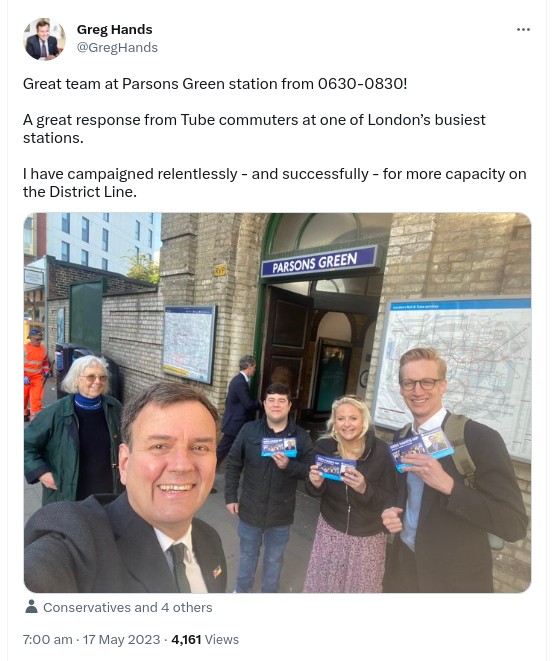
Sidmouth’s new councillor spotted campaigning in London with Greg Hands.

Owl sees that newly elected Cllr. Sophie Richards was campaigning hard in Greg Hands’ constituency in London on Wednesday for more capacity on the District Line.

Doesn’t seem to have much relevance to the lives of the good people of Sidmouth.

On the other hand it could make a lot of sense to a wannabe Tory parliamentary candidate.

Campaigning with the Chairman of the Party must have certain attractions over campaigning with Simon Jupp.

As Owl has already remarked, Sophie has a  track record of campaigning hither and thither. 

Owl doesn’t expect to see her in Simouth very often.

Twitter link can be found here

Join us and help us kick these out of touch Conservatives out – Richard Foord MP

Last week people across our part of Devon saw their livelihoods swept away as thunderstorms and heavy rainfall resulted in a series of flash floods that turned our roads into waterways. The flooding was particularly heavy along the banks the River Otter, especially in and around Newton Poppleford – a small village which is in the East Devon Area of Outstanding Natural Beauty (AONB).

Richard Foord www.devonlive.com 

The damage of flooding takes a long time to clean up. Indeed, several days after the waters receded, we still saw pictures of people’s living rooms and business places still under water. It’s clear that the work to rebuild has only just began. The work of both emergency service workers, who initially responded to the floods, and the local people, who have rallied together to support each other, has been hugely inspiring. Their swift and resilience has really shown us at our best.

Now the focus turns to the clean-up operation and arduous task of repairing the damage caused by water, mud, and silt. I have spoken to several community leaders, including the local District Councillor, about what help they need to properly rebuild their lives.

We must ensure that this work is properly supported by Devon County Council and the Government in Westminster, both in the immediate aftermath – but also in the long-term too. There is real concern that while help is often forthcoming in the days after the flooding takes place, this tends to peter out as the weeks go by.

Flooding is not something we can avoid, but it is something that we can prepare for. We know that cases like this are only going to get worse as we see the effects of climate change continue to shape our world. It is now incumbent on the Government to set out exactly how they plan to help those affected.

Local Councils have seen their budgets repeatedly hollowed out by the current Conservative Government, forcing many to make cutbacks to vital frontline services. This means they are unable to properly respond to events like this in the scale that is needed.

That’s why we need clarity on what package of support is being given to Devon authorities to help kickstart repair work. I recently wrote to the Flooding Minister Rebecca Pow to ask this very question, but also to try and understand what the formal process was for triggering extra help for areas affected by flooding.

We need to have confidence that these decisions are being made fairly and quickly, not on an ad-hoc basis at the whim of Ministers. This is the only way we can ensure that our communities get the support they need to properly rebuild and repair the damage done by environmental events like these.

Last week’s Council elections showed that things are changing. People are fed up with being taken for granted by the Conservatives and are will not allow the neglect of rural areas like ours to continue. Now we wait to see whether the Government has finally got the message and is going to listen.

Liberal Democrats are the main challengers across Devon and are fighting to get a fair deal for our county. If that’s what you want to see too, then join us and help us kick these out of touch Conservatives out.

East Devon MP backs Devon farmers at Westminster meeting

This meeting is the one that has been dubbed a “PR Stunt”

Our Simon knows a lot about PR so he should have been in his element.

He backs farmers, but since he is a PPS he is obliged to back the government.

Only a few days ago, NFU President Minette Batters, was highly critical of the government’s trade deals with Australia and New Zealand which come into force on May 31.

These post-Brexit trade deals have done no favours to British farmers and threaten to undermine welfare standards. – Owl

honiton.nub.news 

Simon Jupp, the MP for East Devon, has been in Westminster today ahead of this week’s Devon County Show and the UK’s Farm to Fork Summit.

Mr Jupp welcomed new investments, announced today, which the government say will help support British farmers. It is hoped the measures will strengthen food security and grow the economy. 

The MP, who lives in Sidmouth, also provided feedback from the most recent farmers roundtable in Sidford to the Prime Minister about the need to keep focused on food security, reducing red tape, and improving access to advice and support.

Both the Farm to Fork Summit and the Devon County Show will take place this week at Westpoint, with Mr Jupp attending both events and speaking to farmers, visitors and producers. 

The pledges announced today include putting farmer’s interests at the heart of trade policy through a new framework for trade negotiations, committing to protect the UK’s high food an welfare standards and prioritising new export opportunities. 

New measures announced by the government today include: 

  • Farmers’ interests will be put at the heart of trade policy through a new framework for trade negotiations, committing to protect the UK’s high food and welfare standards and prioritise new export opportunities. The Prime Minister has written an open letter to farmers today setting out how these new principles will help the industry benefit from the trade opportunities available to us outside the EU.
  • Investing £2m to boost our programme of global trade shows and missions, as well as providing £1.6m for the GREAT food and drink campaign.
  • Extending funding to promote seafood exports around the world with an extra £1 million between 2025 and 2028 and create a new bespoke £1m programme to help dairy businesses, particularly SMEs, to seize export opportunities, particularly in the Asia pacific region.
  • Confirming the government will improve future support for horticulture by replacing the retained EU Fruit and Vegetable Producer Organisation Scheme when it closes in 2026 with an expanded offer as part of new farming payment schemes.
  • New reviews into fairness in the horticulture and egg supply chains, in light of the impact of global challenges on these sectors in particular.
  • Recognising the unique role and needs of the sector, and listening to the calls from the NFU, FDF and others, the Grocery Code Adjudicator will not be merged with the Competition and Markets Authority, in recognition of its importance in ensuring our food supply chains function.
  • Plans to cut the red tape currently holding farmers back from delivering projects on their land to diversify their incomes, such as repurposing farm buildings to use as shops, with a call for evidence later this year.
  • Increasing water security by accelerating work on water supply infrastructure, so that farmers can count on steady access to water, including in periods of intense dry weather.

You can read the full list here

Simon Jupp, MP for East Devon, said: “The new investment and support for farmers announced today is great news for the agricultural sector. 

“East Devon’s farmers work hard around the clock to keep great quality food on our plates, so it’s good to see the Prime Minister hosting this important summit today. 

“Our farmers are at the heart of our rural economy, bringing jobs and opportunity to East Devon. I regularly hold farming roundtables across East Devon with local farmers and I always share the feedback with government. 

“East Devon produces some of the best food and drink in the country, and I will continue to work with producers and ministers to support a productive and thriving agricultural sector, which I look forward to seeing in all its glory at the Devon County Show later this week.”

Rishi Sunak MP, Prime Minister, said: “I will always back British farmers, and I pay tribute to their hard work and dedication all year round which keeps shelves stocked and food on our tables. 

“Supporting our farmers and food producers must, and always will be, at the heart of our plans to grow the economy and build a more prosperous country. That’s why I’m proud to host this summit, and working together, I’m determined to build resilience, strengthen our food security and champion the best of British at home and overseas.” 

Don’t make cheese sandwiches if you can’t afford them, Ann Widdecombe tells struggling families

Ann Widdecombe has told people to not make cheese sandwiches if they cannot afford to buy the ingredients as a way to deal with the ongoing cost of living crisis.

Tara Cobham www.independent.co.uk 

The politician, who is a member of the Reform UK party, was asked what she would advise people faced with the spiralling costs of basic food items on a panel discussing BBC research that showed the price of a homemade cheese sandwich has shot up by a third in the past year to 40p.

On the Politics Live programme, the former Brexit Party MEP said: “You don’t do the cheese sandwich.”

She added there was no “given right” to low food prices and spoke of how farmers would “constantly” complain to her about supermarket pricing when she was Conservative MP for Maidstone.

“The only way this is going to be tackled is if inflation is going to come down,” Ms Widdecombe said. “You will not get inflation coming down if you continue to have inflationary wage rises.

“We just have to be as grown-up about this as we can and stop thinking it’s solely a UK problem, because it isn’t.”

New Statesman journalist Rachel Cunliffe said the situation is so dire for some families that they “cannot afford to feed their children” as a result of the increasing price of basic items. But Ms Widdecombe shot back: “None of it’s new. We’ve been through this before.

“The problem is we’ve been decades now without inflation, we’ve come to regard it as some kind of given right…”

Separately, Ms Widdecombe has suggested those claiming unemployment benefits should be made to fill labour shortages by picking fruit.

Speaking on Jeremy Vine on 5, she said: “I ask why it is that we’ve got 1.2 million people on the dole, and I do mean on the dole, on unemployment benefit. Some of them obviously wouldn’t be fit enough to work at fruit picking. But 1.2 million?

“And the word that is always used is that our people aren’t ‘willing’ to pick. Now ‘willing’ doesn’t matter if you’re drawing public money – I think you should be made to pick.”

UK water companies offer apology and £10bn investment for sewage spills

Shareholders in water companies will initially fund the investments. However, the costs will be recouped from customers through unspecified increases in their bills determined by regulators, in a move which threatens to add further pressure to household costs.

Shareholders have been creaming profits for nearly a quarter of a century, time for a haircut! – Owl

Alex Lawson www.theguardian.com 

Water companies have apologised for repeated sewage spills and pledged to invest £10bn this decade in an attempt to quell public anger over pollution in seas and rivers.

The companies will triple their existing investment plans to plough funds into the biggest modernisation of sewers “since the Victorian era” to reduce spills of overflowing sewage into England’s waterways.

Industry body Water UK said the plans will cut the number of overflow incidents by up to 140,000 each year by 2030, compared with 2020.

Environment Agency figures earlier this year showed there were a total of 301,091 sewage spills in 2022, an average of 824 a day.

The spending on more than 350,000 miles of sewer comes on top of the current £3.1bn being spent between 2020 and 2025.

Shareholders in water companies will initially fund the investments. However, the costs will be recouped from customers through unspecified increases in their bills determined by regulators, in a move which threatens to add further pressure to household costs.

The investment will see new facilities built to hold surges in rainwater, increased capacity for sewage treatment works, measures to reduce rainfall entering sewers and fixing misconnected pipes from properties.

An online hub will launch next year, giving the public almost live information on overflows and the state of rivers and coastal waters. The companies also pledged to support up to 100 communities in creating new protected water for swimming.

The move comes after intense criticism of water companies from politicians and campaigners.

Water UK, which represents 25 companies across the UK, issued an apology and said the public was “right to be upset about the current quality of our rivers and beaches”.

There have been calls for greater fines for breaching environmental laws and The Environment Agency has even suggested that water company bosses should be jailed for serious pollution.

Ruth Kelly, the chair of Water UK, said: “The message from the water and sewage industry today is clear: we are sorry. More should have been done to address the issue of spillages sooner and the public is right to be upset about the current quality of our rivers and beaches.

“We have listened and have an unprecedented plan to start to put it right. This problem cannot be fixed overnight, but we are determined to do everything we can to transform our rivers and seas in the way we all want to see.”

Britain’s privatised water and sewage companies paid £1.4bn in dividends in 2022, up from £540m the previous year. Annual bonuses paid to water company executives rose by 20% in 2021, as water bosses paid themselves £24.8m, including £14.7m in bonuses, benefits and incentives, in 2021-2022.

Last week the chief executives of Yorkshire Water and Thames Water and owner of South West Water declined their bonuses in an acknowledgment of the public anger over companies’ dumping of sewage in Britain’s rivers.

Liberal Democrat leader Ed Davey said: “This apology and plan just don’t go far enough. For years water companies have arrogantly dismissed the public’s fears of rivers, lakes and coastlines being damaged by sewage discharges.

“This announcement does nothing to match the billions water firms have paid out in dividends to overseas investors, or stop their CEOs being handed multimillion pound bonuses.”

Davey also called on the environment secretary, Thérèse Coffey, to apologise.

In a letter apologising to its customers, Yorkshire Water said it is investing £180m in reducing discharges from storm overflows over the next two years.

Its chief executive, Nicola Shaw, said: “Tackling overflows, which were designed into the system as a relief valve, is a priority for us, but it is also a significant task … further investment from our shareholders is helping us tackle this issue.”

Last month, Coffey said the government would introduce legislation to put plans to reduce storm overflows on a “new legal footing”.

Stuart Singleton-White, head of campaigns at the Angling Trust, said, “This must be only the beginning. The problems our rivers face will not be solved by sorting out overflow spills, chucking in some money for swimming, and putting nature-based solutions on the end of pipes.”

A spokesperson for Ofwat, the water regulator, said: “We welcome the apology from water companies and this now needs to be turned into action.

“We have been pushing water companies to do more, faster, for their customers and for our waterways and beaches. We look forward to seeing the plans and how companies will step up performance.”

Devon’s 14 best beaches given famous Blue Flag status for 2023

[Even when it’s raining and the flood gates are opened, because you can get a warning to stay away! – Owl]

Devon is known for it’s stunning coastlines and beautiful beaches. Many of those beaches are now proud owners of the prestigious Blue Flag, an internationally recognised award for beaches and marinas.

www.devonlive.com (Extract)

The Blue Flag is only presented to well-managed beaches with high standards of cleanliness, safety and environmental management. Oddicombe in Torbay has scooped the award every year for 36 years, making it one of the best beaches in the world.

Elsewhere Seaton has retained the Blue Flag it won for the first time last year. Exmouth has now won the accolade for the fifth year in a row, while this is the fourth year for Sidmouth.

Beer features in the list this year, having not made the cut in 2022.

[Budleigh only gets the “seaside award” – see below]

 Blue Flag Water Quality criteria

  • The beach must fully comply with the water quality sampling and frequency requirements
  • The beach must fully comply with the standards and requirements for water quality analysis
  • No industrial, waste-water or sewage-related discharges should affect the beach area
  • The beach must achieve ‘excellent’ water quality as set out in the Bathing Water Directive.  

Seaside Award Water Quality criteria

  • The beach must fully comply with the water quality sampling and frequency requirements 
  • The beach must fully comply with the standards and requirements for water quality analysis  
  • No industrial, waste-water or sewage-related discharges should affect the beach area 
  • At designated bathing waters from 2016 the water quality should be graded as ‘sufficient’ as set out in the Bathing Water Directive. (In 2015, bathing beaches should of mandatory standard.) 

So the difference lies in water quality: “excellent” versus “sufficient”.

Plymouth shootings: Frustration grows at delayed response

Kicking it into the long grass, where is the selfie commissioner? – Owl

Campaigners for changes to gun laws in response to the 2021 Plymouth shootings are frustrated at delays in responses to recommendations from the coroner.

BBC News www.bbc.co.uk

The government had been due to respond to an extended deadline on Tuesday.

But the Home Office said it was still considering the findings and wanted a “short extension”.

Jake Davison, 22, used a legally-held shotgun to kill his mother Maxine Davison, 51, and four others before shooting himself.

Three-year-old Sophie Martyn, her father, Lee, 43, Stephen Washington, 59, and Kate Shepherd, 66, were all killed.

Gill Marshall-Andrews, chair of the Gun Control Network, told the BBC: “I think the delay is indicative of a reluctance to grasp the issues.

“What we worry about is that the whole thing is going to be put out to some sort of consultation and will be kicked into the long grass until everybody’s forgotten about it.”

Analysis: Ben Woolvin, BBC Spotlight Home Affairs Correspondent

The Home Office has at this stage been unable to give us any information about the reason for the delay.

In a very short statement a spokesperson says the government is “still giving careful consideration to the recommendations made by the coroner”.

Luke Pollard, Labour MP for Plymouth Sutton and Devonport, said he had not been told the reason for the delay.

He said it was possible there was an administrative issue which would delay things only by a few days, but he also said he was concerned this could be an indication that the government was no longer as committed to gun law reform as it previously said it was.

After the inquest in February, senior coroner for Plymouth, Torbay and South Devon, Ian Arrow, wrote a series of prevention of future deaths reports, saying current gun laws were “at odds with public safety”.

He wrote to Home Secretary Suella Braverman, Policing Minister Chris Philp, the Lord Chief Justice of England and Wales Sir Ian Burnett, the National Police Chiefs’ Council (NPCC), every chief constable in England and Wales and the College of Policing, identifying areas of concern.

The recipients were legally required to respond within 56 days.

A Home Office spokesperson said: “We are still giving careful consideration to the recommendations made by the coroner in the Keyham inquest, and are currently seeking a short extension from him.”

No 10 food summit ‘no more than a PR stunt’ and failed to tackle key issues

Another day, another PR stunt! – Owl

Rishi Sunak’s Downing Street food summit has been described as “empty” by food and farming industry representatives, who rounded on the prime minister for failing to discuss soaring inflation or set out measures to safeguard British food production.

Joanna Partridge www.theguardian.com 

The Farm to Fork summit, the first meeting of its kind, brought together farmers, food producers and some of Britain’s largest supermarkets.

One representative of a trade body that attended the summit described it as an “empty meeting” with no action on price or inflation discussed. “It was there for the Tories to show they are supporting farmers,” they said.

Another attender said the summit elicited a “low-key response” from those present because it “did not touch the fundamental problems of food price inflation”.

“If you are not doing something about the cost of living, cost of production, access to labour and affordability of food then you are never going to fix the overall problem,” the attender said.

The summit had been expected to tackle topics such as food price inflation, fairness within the supply chain and helping farmers to invest in domestic production, but there was no subsequent announcement on those issues. Ministers offered no commitments in response to a call by the National Farmers’ Union (NFU) to stop Britain’s self-sufficiency in food slipping below its current level of 60%.

The summit took place against a backdrop of stubbornly high inflation, partly driven by food and drink prices, which rose 19.1% in the year to March, according to official figures.

In advance, consumer groups had called on ministers to ask grocery bosses to commit to holding down prices to help squeezed consumers, after an agreement by supermarkets in France to cap prices on key food items and a move by the French government to support food producers.

Hours before the meeting, Sunak published an open letter to farmers, promising to put UK farming at the heart of future trade deals and vowing that chlorinated chicken and hormone-fed beef would not be allowed on to the UK market.

Sunak’s pledges were welcomed by the NFU, which had repeatedly asked the prime minister to hold a food summit.

The union’s president has previously criticised the government for making farmers “a pawn in trade deals”, including those struck with Australia and New Zealand by Sunak’s predecessor, Liz Truss, during her time as international trade secretary.

Tom Bradshaw, the NFU’s deputy president, said the union believed the government had “put food security on a par with energy security” at the summit, which he called “a big step forwards”.

He added that farmers had battled to get ministers to “deliver resilience to the food supply chain”, which he hoped would help reverse recent falls in domestic production, as farmers have quit the industry amid soaring costs.

However, the government did not immediately answer the NFU’s calls to make the summit an annual event.

The meeting, which according to one person present was attended by between 60 and 70 people and lasted all morning, began with a welcome from the prime minister, before participants took part into four separate discussion groups.

Richard Griffiths, the chief executive of the British Poultry Council, who attended the summit, believed the meeting represented only “a little step forward” for the food industry.

He welcomed the government’s promises regarding future trade deals, but said “there needs to be more attention on how we and the government promote British food”.

He said promising to support producers in international trade deals without making plan on how to tackle food inflation “was like taking one corner of a big problem and trying to fix it without reference to the rest”.

Lee Stiles, the secretary of the Lea Valley Growers’ Association, a trade body for glasshouse growers, described the food summit as “no more than a PR stunt” with “nothing of substance” to help growers.

Stiles, who was not at the meeting, called on the government to take action to help with labour shortages.

He described the current seasonal agricultural workers scheme as “not fit for purpose” because it only enables holders to work for six months, although workers are needed for almost twice that period, meaning that multiple groups had to be trained each year to keep production flowing.

Stiles added: “The idea you can fill these roles with local workers is ridiculous and has been since the 1950s.”

Fresh election for Sidmouth Town Council seats after no candidates stand

A fresh election will be held for four seats on Sidmouth Town Council after no candidates stood for them in the local elections.

sidmouth.nub.news 

All of the local authority’s current councillors were automatically elected as too few people competed for the positions.

It is likely that if anyone stands for election this time, they will also be immediately appointed.

Nomination papers must be submitted by 25 May, and if any election is contested the poll will take place on 22 June.

One councillor is to be elected for the Sidmouth East ward, two for Sidmouth Sidford Village, and one for Sidmouth West.

What is: “the one overarching threat to British conservatism” ?

(Greater even than the climate emergency!)

The answer according to Miriam Cates MP, one of the rising stars of Tory MPs when she gave the warmup speech at the, mostly male, National Conservatism gathering on Monday, is the UK’s low birthrate.

She also said: “Spending so much time and money on education also makes it much more difficult, particularly for women, to decide when is a good time to pause and have children.”

And concluded by saying “Conservatism is always common sense.”

Owl wonders what Simon Jupp and his local conservatives make of all this.

Will they embrace the problem with enthusiasm?

Time is running out before the general election to make much headway on tackling this threat to conservatism.

The other snag is that the younger generations are less likely to vote Tory, so we are talking long term. – Owl

Three in four pothole claims rejected by councils

Motorists are being denied millions of pounds in compensation for damage and injuries caused by potholes.

(Cyclists are at the greatest risk of serious injury from potholes, with 425 killed or injured because of poor or defective road surfaces since 2016, according to government figures.)

Ben Clatworthy www.thetimes.co.uk

Local authorities are rejecting on average 75 per cent of claims, although one in five councils reject at least 90 per cent.

It was found that Dundee city council rejected 96 per cent of claims over a three-year period. Each year at least 45 of 50 highway authorities rejected more claims than they paid out on.

Councils have been accused of trying to “wriggle out of responsibility” for defective road surfaces which shred tyres, damage car suspension and injure cyclists.

Rod Dennis, of the RAC, told the Daily Mail: “Drivers may not be aware that their chances of claiming any pothole damage costs back from a local authority is virtually zero if the council can say it wasn’t aware of a problem with the road in the first place.”

The newspaper analysed claims data from a sample of 50 highway authorities obtained via freedom of information requests, looking at the three financial years from April 2019 to March last year.

Overall about £3 million was paid out in compensation by the same group each year.

However, with about 75 per cent of claims being rejected each year, it could mean up to £9 million was denied by these 50 councils alone.

Gloucestershire county council settled only 93 of the 1,667 claims it received. Transport for London closed 93 per cent of claims without compensation and has so far paid out on only 24 of the total 776.

Lincolnshire had one of the best payout rates of the group, approving 48 per cent of claims.

Cyclists are at the greatest risk of serious injury from potholes, with 425 killed or injured because of poor or defective road surfaces since 2016, according to government figures.

Keir Gallagher, Cycling UK’s campaigns manager, said: “One pothole can cause an experienced cyclist to suffer a life-changing collision.”

A Local Government Association spokesman said councils “prefer to use their budgets to keep our roads in good condition” rather than paying out for compensation claims, while a spokesman for Gloucestershire county council said “almost 5,000” potholes were filled in April alone.

A Dundee city council spokesman said: “Each claim is dealt with on its individual merits.”

The UK has a PR plan masquerading as an industrial strategy

It’s “just industrial-strength bullshit”, like all the ” economic growth plans” announced locally , which seem to have had no impact.

These have included: Heart of the South West LEP; the “Golden Triangle” LEP (Exeter, Plymouth, Torquay) and the latest unelected, unaccountable and non-transparent quango – The Great South West (GSW), the LEP for LEPs

Who is the power behind the GSW economic strategy? None other than Pennon, the South West’s biggest employer and parent company of South West Water! – Owl

UK Needs an industrial strategy to compete in manufacturing

Larry Elliott www.theguardian.com

Who is the power behind the GSW economic strategy? None other than Pennon, the South West’s biggest employer and parent company of South West Water! – Owl

Countries that are serious about manufacturing have industrial strategies. The US and China have one. So do Germany and France.

Britain does not have an industrial strategy. Rishi Sunak talks about turning the UK into a “science and technology superpower” but that’s all it is: talk. It is a PR strategy masquerading as an industrial strategy.

Faced with the challenge presented by Joe Biden’s inflation reduction act (IRA), the government says it has no need to respond to the package of green subsidies being provided by Washington because Britain has already established a thriving renewables sector and the Americans are playing catch-up. The complacency is staggering.

Andy Haldane, once chief economist of the Bank of England and now chief executive of the Royal Society of Arts, had this to say last week. “The world is facing right now an arms race in re-industrialisation. And I think we’re at risk of falling behind in that arms race unless we give it the giddy-up.”

China, Haldane added, has been focusing on green technology for many, many years and had forged ahead in tech such as solar and batteries. “The west has belatedly woken up. The IRA is throwing cash to the wall on that. The cost of that [is] almost certainly north of half a trillion dollars. Possibly north of a trillion. The EU is now playing catch-up, [and] the UK currently is not really in the race at any kind of scale.”

A quick glance at the latest trade figures shows that Britain has some way to go before it can be considered a manufacturing “superpower”. That was true once, but no longer. Manufacturing’s share of the economy shrunk from more than 30% to less than 10% of national output during Queen Elizabeth II’s reign. The goods deficit, which has not been in surplus since the early 1980s, stood at £55bn in the first three months of 2023, with imports more than 50% higher than exports. A £40bn quarterly surplus in services was not enough to close the trade gap.

Those who supported Brexit say the UK now has the freedom to export more to those parts of the world economy that are growing faster. Those who opposed Brexit say exporting to the EU has become more burdensome. Both are right, but both are missing the point. Before Britain can take advantage of export opportunities, it has to have stuff to export. The fact is the UK is no longer a first-rank manufacturing economy and hasn’t been for decades.

The recent announcement by Dyson that it will build a new battery factory in Singapore is a perfect illustration of the challenge facing the UK. There was never the remotest possibility that the plant would be in the UK, owing to what its founder James Dyson, a prominent supporter of Brexit, called in a letter to the Times the “scandalous neglect” of science and technology businesses.

Only part of the company’s reluctance to manufacture in the UK is due to the recent jump in corporation tax, although the increase in the budget wipes out any benefit from tax breaks for research and development. It is also the planning system, the lack of enough trained engineers, the disdain shown for science and technology, and government interference in the way businesses are run.

Dyson is unhappy about plans to make it possible for new recruits to request to work from home from day one of their employment, something which is incompatible with the hands-on, learning-on-the-job approach required by a high-end manufacturing business.

The company says the UK will remain a key centre for R&D, and will invest £100m in a new tech centre in Bristol for software and AI research. But the idea that Britain can do all the clever, high-value-added, brainpower stuff while other countries do the production is an illusion. Increasingly, Dyson’s R&D is happening in Singapore – where it has its global HQ – and in the Philippines.

Dyson is by no means alone. A report by the lobby group Make UK found that six in 10 manufacturers thought government had never had a long-term vision for manufacturing, while eight in 10 considered the absence of a strategy put their company at a competitive disadvantage compared with other manufacturing countries.

Stephen Phipson, Make UK’s CEO, said last week the US was spending 1.5% of national output on the IRA. The equivalent sum in the UK would be £33bn. It is not just the money, though.

“A lack of a proper, planned, industrial strategy is the UK’s achilles heel,” Phipson added. “Every other major economy, from Germany, to China, to the US, has a long-term national manufacturing plan, underlying the importance of an industrial base to the success of its wider economy. The UK is the only country to not have one. If we are to not only tackle our regional inequality, but also compete on a global stage, we need a national industrial strategy as a matter of urgency.”

One option is to treat manufacturing as a niche sector and concentrate instead on sectors where it does have global clout: financial and business services, for example. In that case, the pretence has to stop that levelling up will be delivered by spanking new factories turning out world-beating products. The government can either make Britain an attractive place for manufacturing companies to invest or it can decide not to compete. Judged by its actions rather than by its rhetoric, it seems to have chosen the latter option.

Haldane, Dyson and Phipson are right. There is no plan and there is no strategy. There is just industrial-strength bullshit.

‘Progressives’ continue as Exeter’s official opposition

And now they’re nine-strong

Exeter’s Green Party and Liberal Democrats are to continue their opposition partnership on the city council.

Ollie Heptinstall, local democracy reporter www.radioexe.co.uk

The parties, together with an independent who is no longer a councillor, formed the ‘Progressive Group’ in 2019 in solidarity against the ruling Labour group.

Last year it overtook the Conservatives as the council’s main opposition and added a further two councillors – one each for the Greens and Lib Dems – at this month’s local elections.

The group is now nine strong, with six members from the Greens and three Liberal Democrats – after Andy Ketchin won the Green Party’s first ever seat in Newtown and St Leonard’s and Adrian Fullam took a seat for the Lib Dems in St Thomas.

Cllr Fullam returns as a councillor having previously served as city council leader between 2008-10, before Labour became Exeter’s dominant party.

The group has pledged to work “cooperatively together” and bring “balance and scrutiny” to Labour, which won and lost a seat earlier this month to remain on 25 councillors.

Co-leader, Green councillor Diana Moore, who was re-elected in St David’s, said: “The Progressive Group has demonstrated that a different type of politics is possible and that working cooperatively together is in the interests of local people and the environment.

“People repeatedly tell us they really like this cooperative approach.”

Fellow co-leader, Lib Dem councillor Michael Mitchell, who was re-elected in Duryard & St James, added: “We intend to ensure that the Labour-dominated council’s proposals and actions are subject to full public scrutiny.”

“Exeter is set to see some major changes and developments in the coming years. A strong opposition is going to be vital to challenge and suggest improvements to these plans. The Progressive Group will provide that challenge and, if needed, strong opposition.”

Mr Mitchell was previously co-leader of the group but is set to become the 2023-24 lord mayor of Exeter; a politically neutral, ceremonial role which is shared between the parties.

He said: “Four years ago I helped set up the Progressive Group on the city council. It was the first time individuals from different political parties and none had come together in Exeter in such a way. We developed a close bond, which is based on mutual respect.

“I am delighted to see that this group, which started as four councillors, is now nine-strong. I am hugely proud of every member in the group and of what we have achieved together. I know the group will go from strength to strength.”