Woman devastated as major flood rips through home in Newton Poppleford.

She has described the community’s support as “absolutely brilliant” as people in the small village have banded together to organise a huge clear and clean up effort. 

She said: “We’ve got a big field that the farmer has ploughed and beyond that we’ve got the common. Basically all the water came down off the hills. We’ve got a six foot stone wall and it’s breached the wall and it’s just completely flooded through our house.

[For more images of the local flooding see: PHOTOS and VIDEOS: Flash flooding turns roads to rivers across East Devon, leaving ‘devastated’ residents counting the cost of the clear-up – Owl]

Mary Stenson www.devonlive.com

A woman living in a Devon village that was among the worst hit by flooding yesterday (May 9), has said she is “devastated” and “emotional” after water rapidly gushed into her home, causing significant damage.

Following a yellow weather warning from the Met Office, rain battered Devon yesterday afternoon. Newton Poppleford in particular suffered flooding which some motorists described as “horrendous”, with some parts of the village becoming totally impassable.

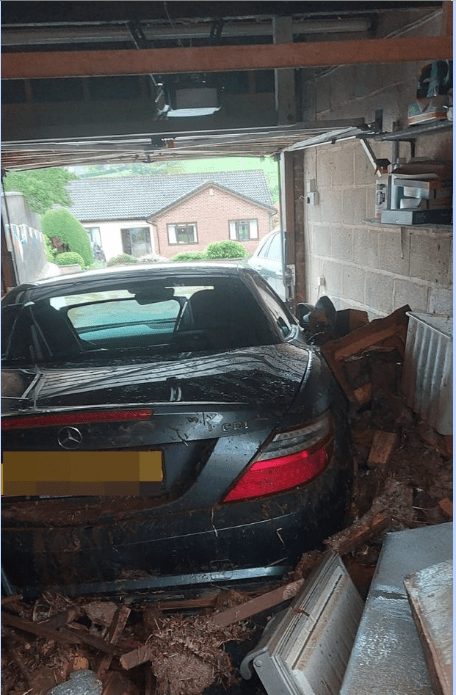
One household in the village is facing a huge clean up as their home became severely damaged by torrents of water flowing in. Hilary Pinfold and her husband have lived in the house for two years but this is the first time they have experienced flooding in their home. They said they were “shocked” by the power of the flood which knocked over walls, a fridge-freezer and even moved their car.
(Image: Hilary Pinfold)

When asked what was going through her head as water poured into her home, Hilary said: “I don’t think I can repeat it to be honest. We were just shocked because we just felt helpless because we didn’t know what to do.

“We couldn’t get our heads round the volume of water and how powerful it was. It had the power to move a car, it’s moved my husband’s car in the garage, it’s turned over a fridge-freezer, it’s knocked down two walls in the garage that have just collapsed.

“I just heard my neighbour shouting at one point ‘your outhouse is going’ and the outhouse just collapsed. We’re in a bit of a mess.

“We’ve got to have the floors replaced because we don’t know if water’s gone under the house. We’ve lost a hell of a lot of stuff as well.”

The water was able to enter the property as it ran down from a field behind the house that had recently been ploughed. In footage captured by Hilary, the water can be seen coming into the garden, leaving behind thick silt the next day.

She said: “We’ve got a big field that the farmer has ploughed and beyond that we’ve got the common. Basically all the water came down off the hills. We’ve got a six foot stone wall and it’s breached the wall and it’s just completely flooded through our house.

“The garden is a nightmare because we’ve got about eight to ten inches of silt in the garden. I don’t know what we’re going to do with it. If there’s any gardeners out there that know what to do then that would be very helpful.”

Hilary went on to explain that she has felt “very tearful” and “emotional” in the 24 hours following the flood. She says this made it difficult for her to sleep and the family dog has even felt the impact as Hilary explains it is “absolutely petrified”.

She said: “(I feel) shocked and very tearful at times and emotional and tired, really tired because I was up at about 5am and I don’t think I fell asleep until about 1am.

“The dog is absolutely petrified and doesn’t know what’s going on, the poor thing.”

Despite the devastation to their home, Hilary has described the community’s support as “absolutely brilliant” as people in the small village have banded together to organise a huge clear and clean up effort. She said: “The community spirit has been absolutely brilliant. We’ve had a team of volunteers because so many houses affected. We’ve had so many people just cleaning and digging and clearing out the garage. People from the church have just been and taken away the towels to wash and things.”
Water chiefs not taking their mini bonuses? Hurrah for small mercies 

Have the trio volunteered to give up bonuses they wouldn’t have received or, despite their environmental performance, were they in for bonuses anyway? – Owl

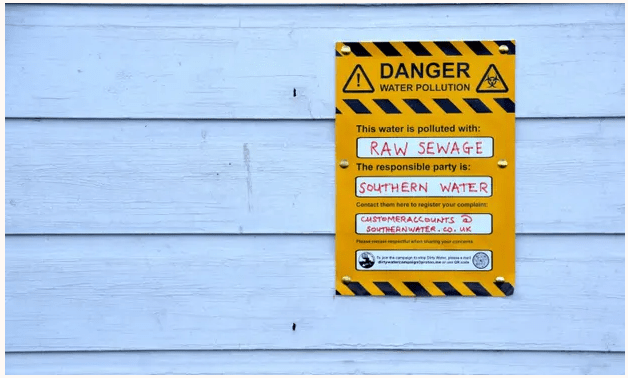
Contain your excitement at news that bosses of a few water companies won’t be taking their bonuses this year. In all three cases – South West Water, Thames Water and Yorkshire Water – acceptance of any bonus at all would rightly have provoked general outrage. These firms were at, or near to, the bottom of the league table in the Environment Agency’s last set of annual environmental performance ratings.

Nils Pratley www.theguardian.com 

At the most sludgy end, South West joined Southern in scoring the lowest possible one star out of four, which the chair of the EA – a body that itself has hardly excelled during three decades of under-regulation – translated into plain English: it meant the companies’ environmental performance “was terrible across the board”. Thames and Yorkshire were two of four companies getting two stars, which indicated a need for “significant improvement”, so still deeply in cruddy territory.

It is conceivable, of course, that the trio have upped their game and undergone a transformation since the EA published its ratings for 2021 last July. But, even if they have (don’t hold your breath until this July), the timing doesn’t work bonus-wise for the 2022-23 financial year. Improvement has to be seen to have happened – and then to be achieved regularly to remove weather-related vagaries.

Given the star ratings, many may wonder if Sarah Bentley at Thames, Susan Davy at Pennon (owner of South West) and Nicola Shaw at Yorkshire are volunteering to forego bonuses they wouldn’t have received anyway. The answer – strange as it sounds – is that, actually, they are probably surrendering a few hundred thousand pounds or so each.

In common with the set-up across the entire UK quoted-company scene, the formula for awarding bonuses tends to include so many metrics that it is hard for a chief executive to be awarded zilch. Aside from financial targets, the service-related metrics themselves contain a dashboard of dials. There’s always something to achieve.

Bentley’s incentives, for example, include reducing complaints from customers – an area where the numbers at Thames have markedly improved recently. And Davy’s bonus last year included ticks for hitting leakage targets, reducing emissions and maintaining a “great place to work” accreditation. That was despite South West’s “wastewater pollution incidents, per 10,000km sewer” running at more than three times the target level and the water quality being deemed miles away from the required standard.

The mini bonus surrender, then, can be seen as an acknowledgment that handing out prizes for financial performance or minor operational triumphs is unacceptable if you’re still failing on core environmental measures. Quite right too: the customers don’t care if South West is a nice place to work; they are overwhelmingly bothered about water quality and sewage dumping.

Bentley and Davy were first out of the blocks in recognising the bleedin’ obvious. Counterparts at the sector’s other laggards now know what’s expected – and shouldn’t hang about. But the other conclusion here is that relying on executives’ sense of embarrassment when public anger is red-hot is a terrible way to structure a performance-related remuneration scheme.

Thames has semi-grasped the point by promising to review its pay structure with the aim of giving “a greater weighting to customer service and environmental performance than financial results”. It – and others – should go further. Utilities with public service obligations aren’t like regular companies, so here’s a simpler pay principle to concentrate minds: no bonuses for financial success until the environmental scores are consistently on the right path.

Have your say on how the region adapts to climate change

People in Devon can have their say on a new consultation will help ensure  can make the changes needed to cope with the worst effects of climate change.

Adam Manning www.midweekherald.co.uk

From Tuesday May 9 until June 30 residents are being consulted on the Climate Adaptation Strategy for Devon, Cornwall, and Isles of Scilly ahead of its publication later this year.

To effectively respond to the climate crises, it is vital that strategies are put in place to deal with both the cause of rising greenhouse gases and their effect on our communities, also called Mitigation and Adaptation.

Mitigation focuses on tackling the causes of climate change to make the inevitable impacts of rising global temperatures less severe by reducing the emission of greenhouse gases to net-zero.

Whereas Adaptation is the process of adjusting to the impacts of climate change that we are already seeing and can be expected in the future.

The draft Adaptation Strategy has been delivered by the Devon, Cornwall, and Isles of Scilly Climate Impacts Group, with the assistance of RSK, an engineering and environmental consultancy.

The Group is a partnership of strategic organisations, including local authorities, that is chaired by the Environment Agency. The draft Strategy specifically looks at climate impacts which require, or which would benefit from, working in partnership.

The Strategy accepts that significant climate ‘shocks’ are inevitable, and as the world grows warmer, different places, depending on factors like geography and population, will be affected in different ways.

For instance, our region has approximately 1500km of coastline, and rising sea levels of up to 78cm by the 2080s will put the region’s low lying and coastal communities at increased risk while extreme weather events such as storms will become more severe and more frequent and could lead to increased flooding for communities near rivers and watercourses.

Public water supplies will need more than 3.4 billion extra litres of water per day by 2050 impacting our rural economy as crop failures will become more frequent in response to droughts.

And as global temperatures rise, the seas will become more acidic, putting fishing stocks at risk.

The Adaptation Strategy is divided into three, beginning with a Risk Assessment of the impact of climate change in our region including flooding, sea level rise and coastal erosion, reduced availability of water and extreme temperatures.

The second part is the Strategic Adaptation Plan which sets out the conditions to enable regional partners to act on adapting to climate change together; and finally, an Action Plan, highlighting where we should focus our efforts over the next five years.

Mark Rice, the Environment Agency’s Area Director, Devon, Cornwall and the Isles of Scilly, said: “Significant impacts from climate change are now inevitable, but we can successfully respond to the climate emergency through greater, collective focus on adaptation to the increased hazards that are already evident.

“Mitigation and adaptation are of equal importance, but while reducing emissions now will help minimise the extent of climate change and its impact on communities and wildlife, in the longer term it is adaptation and how well prepared we are for climate shocks that will save lives.

“This is why the Climate Adaptation Strategy is so vital – it looks at climate impacts, risks and actions which require regional solutions.

“By responding to the consultation, you will have the opportunity to influence the future resilience of your community.”

You can view the Adaptation Strategy, a series of ‘short-reads’ and respond to the consultation HERE.

If you’ would like to fill out the questionnaire at home, you can order a copy by emailing environmentalpolicy@devon.gov.uk or by phoning 03451551015.

Devon still on flood watch after rain battered county

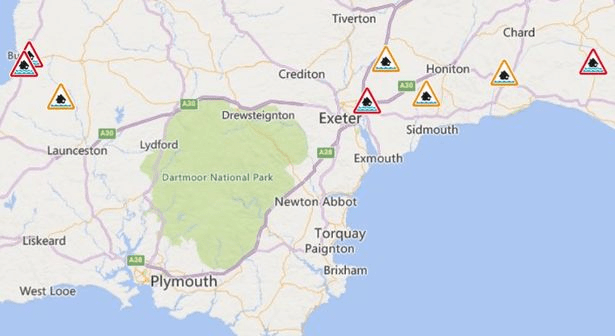
Flood warnings are still in place across Devon after yesterday’s deluge which saw flash flooding causing havoc across the county. There are a number of flood warnings in areas like Exeter, Sidmouth and Cullompton, according to the Environment Agency.

Zhara Simpson www.devonlive.com

It comes after a yellow weather warning was issued by the Exeter based forecaster yesterday (May 9) as parts of Devon were battered with thunderstorms and heavy rain.

In Exeter flash floods caused chaos in Honiton Road. Pictures showed vehicles stuck and bins floating in the water. The A3052 at Newton Poppleford was another area that experienced flooding with some parts of the road being impassable.

Guidance from the Environment Agency states that local residents should monitor water levels and weather conditions, adding to avoid low-lying footpaths or entering areas prone to flooding.

Here’s the flood warnings across Devon

Exeter River Clyst from Broadclyst to Clyst St Mary

Flood warning area: riverside locations and roads between Broadclyst and Clyst St. Mary, including Broadclyst, Ashclyst, Clyston Mill, Sowton Barton, Newcourt Barton, the A3052 at Clyst Honiton, and the B3181 at Broadclyst.

Sidmouth River Otter and Sid, and Exmouth area

Flood alert area: Lympstone, Exmouth, Budleigh Salterton, Honiton, Ottery St Mary and Sidmouth areas.

River Clyst and Culm and their tributaries

Flood alert area: Hemyock, Cullompton, Stoke Canon, Broadclyst and Clyst St Mary areas.

The Met Office flood warnings (Image: The Met Office)

River Axe area

Flood alert area: Rivers Axe, Coly, Yarty, Umborne Brook and coastal streams from Branscombe to Axmouth.

Upper River Tamar

Flood alert area: Bude, Helebridge, Bridgerule, Canworthy Water, Launceston and Yeolmbridge.

The guidance states: “Monitor local water levels and weather conditions. Avoid using low lying footpaths or entering areas prone to flooding. Start acting on your flood plan if you have one. Environment Agency Flood Warning Officers set the river or tidal levels that have triggered this message.

“During industrial action this message has been automatically issued based on rising river or tidal levels. Follow @EnvAgencySW on Twitter for information for your area.”

Today’s Met Office’s forecast for the south west is as follows:

Today: Rather cloudy to start with showery rain. Cloud breaking to allow for sunny spells, although further showers developing. Showers locally heavy and thundery, though less widespread than of late and dying out later. Breezier, but feeling pleasant in any sunshine. Maximum temperature 16 °C.

Tonight: Any remaining showers soon easing to leave some late evening sunshine, then clear spells overnight. Turning cloudier in the west later, with further showery outbreaks of rain arriving. Lighter winds. Minimum temperature 7 °C.

Thursday (May 11): A mixture of sunny spells and showers. Showers could be heavy at times and slow moving, carrying the risk of thunder. Light winds, and feeling warm in the sunshine. Maximum temperature 16 °C.

Outlook for Friday (May 12) to Sunday (May 14): Sunny spells on Friday, perhaps with the odd shower. Mostly dry on Saturday with sunny intervals. Cloud increasing on Sunday, with rain possibly arriving later. Feeling warm in the sunshine.

Tory MPs voice unease over Sunak’s flying pharmacy visit

Tory solution to beat the 8 am rush for GP appointments – take a helicopter! – Owl

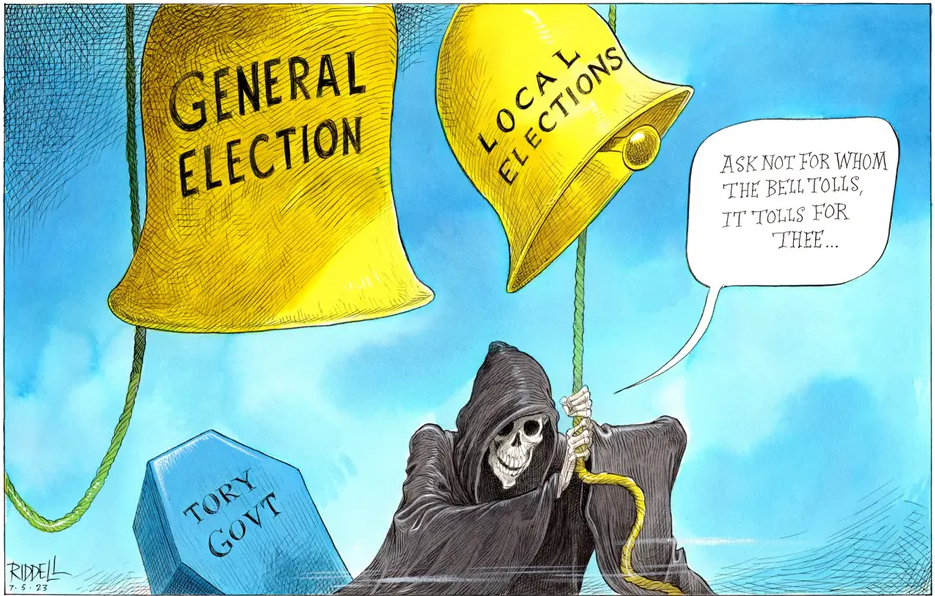
Rishi Sunak flew to the south coast and back by helicopter to announce a new government health policy on Tuesday as he tried to calm Conservative jitters after a disastrous set of local election results.

Pippa Crerar www.theguardian.com 

In the latest example of the prime minister’s fondness for short-distance air travel, the prime minister visited Southampton to set out plans for pharmacists to provide prescriptions for millions of patients in England to help ease the GP crisis.

However, instead of getting the train from Waterloo station for the 160-mile round trip, which would have taken one hour 15 minutes and cost about £30 return, he opted to travel by air, at a cost to the taxpayer in the region of £6,000.

The visit, instead of reassuring Tory MPs that he was focused on getting on with the job after the Conservatives lost more than 950 seats in last week’s local elections, unintentionally underlined the fears of some that he is seen by voters as out of touch.

“Is it unfair to say that the weekend was about a powerful unelected individual who is unfeasibly wealthy and lacks the common touch … and King Charles III?” one Tory MP even joked darkly.

“To go backwards from our results in 2019 when we lost 1,300 seats is a damning indictment of the public view of the government. To outperform our own very low expectations is appalling.”

Sunak told reporters in Southampton that the local elections results were “obviously disappointing” but insisted his priorities were right for the country and he would “keep working” to deliver them.

His official spokesperson claimed that he had travelled by helicopter in part because he had “a series of meetings” in the afternoon that he needed to attend, with No 10 insiders insisting he was determined to stick with his plan.

Yet when his MPs returned to Westminster after the coronation weekend many were despondent. One former cabinet minister told the Guardian that Sunak’s allies were in “fantasy land” if they thought his plan could bring about the Tories returning to power next year.

“I think we can still deny Labour a majority, but I can’t see a path to us actually winning the election. Rishi has clearly decided his best bet is to stick to the path that he’s on, but I don’t think that will be enough.”

There are also concerns that voters do not see Sunak’s priorities as the right ones for the country – or at least don’t believe they’re deliverable. “If his five pledges were really the people’s priorities then they would presumably have voted for them,” one MP said.

Others have criticised party’s local election campaign, with Justin Tomlinson, the North Swindon MP, saying the Conservatives had gone into the local election lacking “a coherent message” and did not even hold a proper launch event.

“The results were devastating,” he told Times Radio. “It’s frankly insane for anybody to try and spin it otherwise … This was off the scale. We lost some very good councillors, not just in Swindon but in many parts of the country. It has to be a wake up call for the party at all levels. There’s no getting away from that.”

One former minister told the Guardian that beyond the sheer scale of losses last Thursday, the way it happened pointed towards more fundamental worries for the Conservatives.

“Obviously, a lot of it was because of where we are politically, but one thing I really noticed in my area this time is that we just don’t have the ground operation any more.

“There is a real lack of volunteers, and this is a long-term problem. We’re an ageing party. We’re a shrinking party. And every time we lose 1,000 councillors the problem gets worse. It’s going to be a real issue in the general election.”

However, one backbench MP insisted that despite the opposition gains, there was still a route for Sunak to lead the biggest party after a general election.

“Yes, some of the results were pretty grim, but voters like to give the government a kicking in local elections,” they said. “It doesn’t necessarily mean they will do the same in a general election.

“Rishi has really stabilised things since Boris and Liz, and in my area people are gradually starting to notice. We’re certainly in a much better place. There was a time when Liz was PM that I worried our election loss would be so bad there was an outside chance I’d end up as opposition leader.”

Downing Street will, no doubt, take some solace from the lack of appetite from MPs for yet another Tory leadership contest – or bringing back Boris Johnson. One MP admits: “Colleagues have run out of puff, but they’re not feeling rebellious. Though I think that’s probably the worst of all worlds for the party.”

London council spending thousands on art and security patrols in opulent wards

An example of Tory council priorities! – Owl

One of Britain’s most unequal boroughs is spending hundreds of thousands of pounds in social infrastructure funds on sculptures and security patrols for wards filled with multimillion-pound homes.

Robert Booth www.theguardian.com 

The Royal Borough of Kensington and Chelsea has agreed to spend £226,000 on an artwork outside a new luxury housing development where two-bedroom flats sell for close to £2m. It is also spending £50,000 erecting a sculpture by Sir Eduardo Paolozzi on a green off Kings Road.

In 2021 and 2022, £173,000 also went on community safety wardens to patrol wards including Holland and Brompton and Hans Town where a terrace house sold recently for £33m and a flat went for £5m.

The spending has sparked accusations the borough is failing to level up and prioritising the wrong things. Close to 70% of households in the poorest wards in the north of the borough, where Grenfell Tower is located, suffer deprivation, according to the latest census, while in the richest wards in the south less than a quarter are deprived.

The funds come from planning agreements with property developers – known as S106 and neighbourhood community infrastructure levy (NCIL) – and are meant for “local infrastructure”. Government guidance suggests potential projects such as affordable housing, in the case of S106, and play areas, healthcare facilities and schools in the case of CIL.

But over the last two years, the amount of neighbourhood CIL spent in Conservative-controlled wards in the south of the borough has been 10 times higher than in the poorer wards that are represented by Labour and Liberal Democrat councillors, Guardian analysis of spending records shows.

The council has agreed to allow luxury housing developer, Berkeley Homes, to use £226,000 from its own S106 payments to erect a 3.5-metre high bronze sculpture by the artist Nick Hornby at the entrance to a new housing complex. Berkeley Group agreed to contribute the funds as part of a deal to secure planning permission for 375 apartments at Royal Warwick Square. The sculpture will “sit right at the heart of the scheme, providing a point of curiosity”, the developer has said. The council said some S106 money was collected specifically for public art.

But John Lowery, a local resident who obtained details of the deal under the Freedom of Information Act, said: “The north of borough is in receipt of a pittance whilst in the south almost a quarter of a million pounds is lavished on a Nick Hornby commission right outside the development that made the S106 contribution. How is that mitigating the impact of the development? It’s enhancing it for the very few rich people who can afford to live there.”

Hornby has produced works for Glyndebourne opera house in East Sussex and exhibited at Tate Britain. The council has also allocated £94,606 from planning payments for a second Hornby sculpture at De Vere Gardens and £54,000 for a Sir Eduardo Paolozzi sculpture of Oscar Wilde to be erected at Dovehouse Green, off Kings Road in Chelsea.

Labour’s candidate for the Conservative-held Kensington & Chelsea parliamentary seat, Joe Powell, said: “RBKC is failing to serve the whole of Kensington fairly. While neighbouring Westminster extends free school meals and Hammersmith provides adult social care, RBKC continues to fail its residents and prioritise the wrong things.”

RBKC said national planning rules limit where it can spend money from NCIL but it is able to redistribute 25% of the funds “to make this fairer”. It also said Berkeley’s S106 payments have funded a new state primary school and affordable housing. The council funds the operator of the Tabernacle arts centre in the north of the borough and part-funds the Notting Hill carnival, it added.

“The amount that developers contribute to local communities is linked to land values,” a spokesperson for RBKC said. “With some of the most expensive land in the world in parts of borough, the NCIL funding pot is bigger in some neighbourhoods.”

Neighbourhood CIL is meant to be spent on priorities identified by local communities. RBKC consulted residents in 2020 who identified air quality, policing and emergency services, parks, streetscape and community safety as needs.

The council collected close to £19m in community infrastructure levies from approved planning applications and spent £3.8m in 2021-22. Most of these funds are allocated for use on borough-wide projects. More than £3.3m has been spent in the last two years on a replacement for the Grenfell Tower nursery and the refurbishment of Oxford Gardens and Park Walk primary school, both in the north of the borough.

“In North Kensington NCIL has funded everything from community kitchen gardens and a new sports pitch near Ladbroke Grove, to extra CCTV near Barlby Road and improved estate security at Notting Barn,” an RBKC spokesperson said.

Berkeley Group declined to comment.

Three UK water bosses give up bonuses after anger over sewage

Better late than never. Is it a coincidence that all three are women? 

With yesterday’s heavy rainfall do you need to check the Surfers against Sewage online pollution alert map or can you assume that there have been sewage discharges all over the place? – Owl

Three water company bosses have given up their bonuses in an acknowledgment of the public anger over companies’ dumping of sewage in Britain’s rivers.

Alex Lawson www.theguardian.com 

The chief executives of Yorkshire Water and Thames Water as well as the owner of South West Water have declined to accept bonuses this year.

Water companies have been criticised for raking in profits and their executives receiving large pay packets while sewage has regularly been released into Britain’s rivers and seas in large quantities.

Nicola Shaw, of Yorkshire Water, said she understood the “strength of feeling” on river pollution and had decided to refuse what would have been her first bonus since joining the company in May 2022.

Annual reports show she could have received between £600,000 and £800,000 if the company met its performance targets. Last year, the company paid out £878,000 in bonuses to directors.

She said: “I understand the strength of feeling about the issues linked to river health which is why I’ve decided that this year I won’t be accepting a bonus.

“This is the right thing to do and I’m committed to improving Yorkshire Water’s performance.”

Sarah Bentley, who runs Thames Water and last year received a £496,000 payout, forwent her payout alongside the company’s chief financial officer, Alastair Cochran, who will also skip his bonus for 2022-23. He received £298,000 last year.

Bentley said it “just did not feel like the right thing to take performance-related pay this year”.

South West Water’s Susan Davy, who received £522,000 last year, will also not receive a bonus. “This is the right thing to do. We’re listening to our customers, we get it,” said Davy, whose company spilled untreated sewage 37,649 times last year. She runs Pennon Group, the listed owner of South West Water, and has turned down a pay rise for the past two years.

The exact size of the bonuses that would have been due to the three executives has not been disclosed.

An analysis of water companies’ annual reports released last month found the bonus pool for executives stood at an average of more than £600,000 at each company. In total, the 22 water bosses paid themselves £24.8m, including £14.7m in bonuses, benefits and incentives, in 2021-22.

Emma Clancy, the chief executive of the Consumer Council for Water, welcomed the decisions. She said: “Our recent research, Bridging the Gap, shows that bonuses add to people’s current frustration with the water industry and they would like much more openness and transparency on this issue. This announcement shows that people’s concerns are being listened to.”

Gary Carter, a national officer at the GMB union, said it was “grotesque for water companies to post such mammoth profits while so many are repeatedly caught dumping sewage in our nation’s glorious seas and waterways”.

He added: “GMB calls on all water bosses to waive their annual bonuses until Ofwat can confidently say the scourge of sewage dumping is under control.”

The Financial Times reported on Monday that Britain’s privatised water and sewage companies paid £1.4bn in dividends in 2022, an increase from £540m the previous year.

Last week, Macquarie, the Australian owner of Southern Water, the utility company criticised for discharging sewage into the sea, posted record profits after a boom in its commodities trading division.

Flash flooding in Tipton St John and Newton Poppleford

The flash flooding in Newton Poppleford and Tipton St John was widely reported last night.

BBC spotlight reported that parents were told not to attempt to collect their children from the Tipton Primary. The children were rescued by a combination of the fire service and a local tractor and trailer.

The Environment Agency (EA) declared in 2015 that there is a ‘risk to life’ of the children attending the hub and that it must be rebuilt outside of the flood zone.

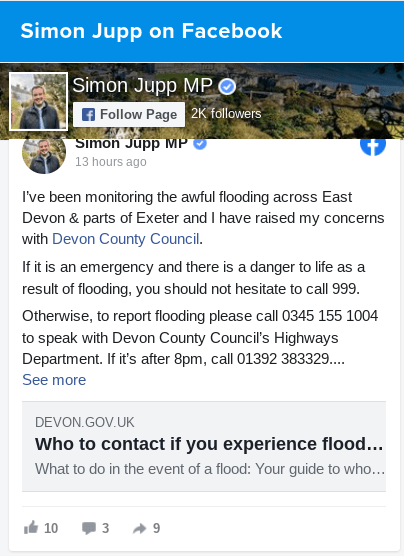
Don’t worry Simon Jupp is on the case! 

He takes aim at Devon County Council not EDDC for once.

Steve Brine breached rules when lobbying ministers in pandemic, watchdog finds

More Tory rule breaking – Owl

A leading Conservative MP and former health minister did not properly declare his second job for a health recruitment firm when lobbying Matt Hancock and Michael Gove during the pandemic, the standards watchdog has found.

Rowena Mason www.theguardian.com 

Steve Brine, the chair of the Commons health committee, was found to have breached the rules twice by failing to declare in his approaches to cabinet ministers in early 2021 that he was a paid strategic adviser to Remedium Partners, a recruitment firm offering doctors for free to the NHS.

In a new judgment, the standards commissioner found Brine should have been clearer in emails to Hancock, then the health secretary, and Gove, then a Cabinet Office minister, that he was employed by Remedium.

However, Daniel Greenberg, the commissioner, cleared Brine of paid advocacy because his efforts were not seeking “financial or material benefit” for Remedium because the doctors’ services were offered pro bono.

Greenberg said the case would be dealt with under the “rectification” process, with Brine acknowledging he broke the rules, apologising and promising not to do so again in future.

In response to the report, Brine said: “This was always about responding in the national interest in an emergency so I am pleased, and not surprised, to be cleared of paid advocacy and I accept fully the commissioners advice on declarations that, even in an emergency, I should have been clearer and follow a compliant form of words to avoid any misunderstanding.”

The complaint about Brine was made after messages from Brine to Gove, forwarded to Hancock, were published as part of a leak to the Telegraph of correspondence from the former health secretary during the Covid era.

The message said: “I have been trying for months to help the NHS through a company I am connected with – called ‘Remedium’. They have 50 anaesthetists right now who can be in the country and on the ground in the NHS if someone only said let’s us help. They just want to assist and asked me how they might.

“Despite offering this to health and to [the then chief of NHS England] Simon Stevens I’ve had nothing despite SS telling the press conference last week this is an acute problem, despite the PM telling the liaison committee this is his biggest problem etc etc.”

In his findings, Greenberg said: “It is disappointing that you have not been able to provide me with a detailed breakdown of the earlier approaches that you made to ministers and NHS officials, which you reference in your message to Mr Gove.

“Members working on behalf of an external employer are well advised to keep detailed records on such matters, not least so that they can be in a position to robustly defend their actions if challenged.”

During the course of the investigation, Brine also disclosed a further email he sent to Hancock in January 2021, saying: “Earlier at the liaison committee the PM said ‘we need more doctors’. He is obviously right. See below from friends of mine who I KNOW can help. They clearly have doctors right here and now who can help but they need your help. Can you help? Let me know.”

Brine was employed by Remedium as an ad hoc consultant being paid £800 a day from September 2019 to February 2020. From July 2020 he was paid £1,600 for eight hours’ work a month, which continued until the end of December 2021.

Under parliament’s rules, MPs are not allowed to lobby for any firm that pays them if it would confer “financial or material reward” on that company. It was a breach of this ban on paid lobbying that led to the resignation of the former Tory minister Owen Paterson in 2021.

UK water company dividends jump to £1.4bn despite criticism over sewage outflows

Britain’s privatised water and sewage companies paid £1.4bn in dividends in 2022, up from £540mn the previous year, despite rising household bills and a wave of public criticism over sewage outflows.

Gill Plimmer www.ft.com (Extract)

The figures, based on a Financial Times analysis of the 10 largest water and sewage companies’ accounts, are higher than headline dividends in the year to end March 2022. This is because several have layered corporate structures with numerous subsidiaries, only one of which — the operating company — is regulated by Ofwat.

Maintaining dividends means less money is available from customer bills for investment in critical infrastructure such as sewage treatment and water mains.

The complex arrangements enable providers to distinguish between internal dividends — payments between intermediate holding companies in the group — and external dividends to private equity, sovereign wealth and pension funds, which own the entire water and sewage business including the holding companies….

After being sold with no debt at privatisation three decades ago, the companies have racked up borrowings of £60.6bn, according to Ofwat.

At the same time total spending on waste water infrastructure by the 10 largest companies — excluding Thames Tideway — has failed to rise significantly. Average annual wastewater investment was £295mn in the 1990s, £297mn in the 2010s and £273mn in the 2020s so far.

Now costs — including interest payments — are soaring, adding to pressure on company finances just as they face demands to ramp up investment in infrastructure…..

After being sold with no debt at privatisation three decades ago, the companies have racked up borrowings of £60.6bn, according to Ofwat.

At the same time total spending on waste water infrastructure by the 10 largest companies — excluding Thames Tideway — has failed to rise significantly. Average annual wastewater investment was £295mn in the 1990s, £297mn in the 2010s and £273mn in the 2020s so far.Now costs — including interest payments — are soaring, adding to pressure on company finances just as they face demands to ramp up investment in infrastructure…….

Second homes ‘destroying’ Welsh-speaking areas, say campaigners

More than 1,000 people gathered outside Caernarfon Castle in north Wales for a rally protesting against second homes, which they say are “destroying” Welsh language strongholds.

Steven Morris www.theguardian.com 

Members of Cymdeithas yr Iaith (the Welsh Language Society) are calling for a new Property Act to protect communities in language heartlands such as Gwynedd in the north and Pembrokeshire in the south-west.

Cymdeithas yr Iaith argues that because so many of the places where Welsh is strong happen to be in some of the country’s most beautiful coastal and rural areas, they are magnets for second-homeowners whose arrival can hollow out Welsh-speaking communities. They say the problem increased during the pandemic when many people left cities and towns and relocated on the coast or in the country.

Ffred Ffransis, a prominent Cymdeithas yr Iaith activist, said: “This current system drives especially young people out of their communities as houses are snapped up – often online within hours – by people moving in from higher-income areas outside Wales.

“This process is destroying Welsh-speaking communities, but is also a wider issue throughout Wales as local people are forced out by commercially driven developments for commuters, people retiring, and unaffordable rents.

“Cymdeithas is calling for a Property Act, which would regulate the open market and treat housing as social assets to provide homes for people in their communities rather than the open-market system which views houses as commercial assets for profit.”

The choice of Caernarfon as the venue for the Nid yw Cymru ar Werth (Wales is not for Sale) rally during the coronation weekend was not insignificant. King Charles’ investiture as Prince of Wales took place at the castle in 1969 and the rally was designed to highlight the contrast between the huge wealth of a few and the desperate need of some within Welsh-speaking communities.

Mared Llywelyn Williams, 30, a Welsh writer, said when she talked to young people on the Llŷn Peninsula in north Wales as research for a play, she was surprised how many of them expressed concern about second homes.

“It was quite scary – these were 17-year-old girls who want to live in their own communities when they’re older but they can’t. That’s heartbreaking. They felt angry and deflated.”

Dylan Lewis-Rowlands, an Aberystwyth Labour councillor, said he was worried about how high rents were. “There are places in west and north Wales where landlords control almost the whole village,” he added.

He cited the case of a nurse who worked at a hospital in mid Wales but lived in Birmingham, more than an hour’s drive away. “It’s cheaper for her to rent in Birmingham and pay the petrol. I think frustration is turning to anger.”

New measures giving councils in Wales a raft of extra powers designed to tackle the second homes problem came into force last month.

But Cymdeithas yr Iaith argues the measures do not go far enough and says a new law should place a duty on local authorities to ensure suitable housing solutions for local people within a reasonable distance and time.

A Welsh government spokesperson said: “We are taking radical action using the planning, property and taxation systems to achieve this, as part of a joined-up package of solutions to a complex set of issues.

“We are also committed to publishing a white paper on the potential to establish a system of fair rents as well as new approaches to make homes affordable for those on local incomes.”

Reflections on being a caring councillor

An “Open Letter from the Heart”, written in Feb 2022 but only now revealed.

Independent former councillor and Environmentalist Denise Bickley, who lost her seat by just 26 votes in the Sidmouth Town ward, put these thoughts on paper in February 2022 but didn’t post it at the time.

The letter reveals what it’s really like to be a deeply caring councillor and a member of the 2020/23 Democratic Alliance. 

Denise has now posted it on her blog, though you need to go to the blog to read her personal introduction, under the heading:

A new focus

February 2022
An open letter to anybody interested [unsent unfortunately]

denisebickley.info 

In May 2019 I stood as a councillor, full of enthusiasm and naivety, wanting to make a difference for the environment in East Devon. This was on the back of gaining a voice through setting up Sidmouth Plastic Warriors. I found it odd that to get anything done I had to go to the council and get approval for things so I thought I’d try and cut out the middle man and get stuff done myself. 

I knew that the role involved other areas that were outside of my interest, but felt that as long as I came at it from speaking for the environment, everything else would work out. I aligned myself with other people who have become firm friends and I am full of admiration for the work and commitment they put in. They also ran as councillors not for any personal gain, but usually for a background story of some way that the previous administration or decisions had affected their own lives and got them interested in local politics. All are diligent in ensuring everything they do is above board, transparent and follow the 7 Nolan Principles of public life. All of us in the administration are ‘left of centre’, put people before profit, put the environment before developers and we have been busy working on a very green council plan, as befits a council in these times of climate emergency. 

Unfortunately, before coming a councillor I would probably have been much like the other residents of East Devon. Speak out on Facebook or Twitter, lump all the councils together as ‘The Council’, write off decisions taken that I didn’t like and question their motivation. Now, however, I will not do that as I know differently. I know how hard my colleagues in the Democratic Alliance, the current administration, work. I know the toll it has taken on many of them – their mental health, their home situations, their work. I know how hard so many of the employees of the council work – some seem tireless and I am so full of admiration.  

I know that, like my colleagues, I am never switched off. If I don’t keep up with my emails, I am inundated, so I feel the need to check them very regularly. Even then, I know some emails slip through the cracks unanswered, and the guilt weighs heavy. Couple this with working, running a community environment group and the small matter of having a family, and the workload is overwhelming some days. My problem I know – it was my decision – but being a councillor should be open to everybody, whatever their situation otherwise we end up with a very narrow demographic which is not great for democracy. 

I know how different councils are responsible for different things. As much as I’d like us to get rid of potholes, or replace the bus stops, or make our town pedestrian friendly for instance, I know that that is Devon County Council’s role. I know that there is not one ‘The Council’ to blame for everything, and I also know that a lot is beyond any of the local councils remit and is central government.  

I also know how short of money local councils are. District councils have statutory duties (organizing elections, planning and development management, building control, housing, homelessness prevention, environmental health, waste collection and recycling, street cleansing, food safety and water sampling, health safety and licensing, and council tax and rates collection). They also carry out discretionary services such as managing car parks, promoting economic development, culture and events, some recreation and leisure facilities, providing some grants, maintaining some parks and gardens, and public toilets. Discretionary of course means NOT statutory, but provided where possible. 

Over the last decade, the council has lost 60% of the funding it used to receive from central government. Remember that all council tax gets handed over, and we get a bit back. For every £1 of council tax you pay, EDDC get 7 pence, (7%), so from the Average Band D house of £151.78 per month, EDDC get £10.62, with just £2.76 going to waste and recycling for example. This is not a local decision – this is decided by central Government. 

So from this EDDC are meant to cover all the statutory duties, plus as many of the discretionary ones as possible. All this with going into the covid pandemic with a shortfall in the budget. 

The last thing we wanted to do was to go bankrupt, as some councils have done (https://www.bbc.co.uk/news/uk-57720900). Top it off with the fact that EDDC’s council tax had been kept very low for years by the previous administration, without investment (the toilets have not been improved for years, and car parking charges have not gone up for 8 years). It would be the easiest choice to drop the discretionary services of toilets and non-profitable car parks completely. 

However, our administration dug in, worked out ways of saving the toilets plus investing in them (but making sure they were in the right place and up to the right standard). We have spent months trying to work out a system where car parks income is maximised so that we are ‘sweating our assets’ but not penalising local residents, by ensuring that a monthly payment permit will prove much more reasonable to all (and only available to EDDC council tax payers). We are confident that our beautiful towns can sustain tourist visitors at a higher rate – as we see from the privately owned car parks who already charge the higher rate at Sidmouth and have a queue. We have also kept the £2 per day charge for 5 months of the year to encourage people to our towns when footfall is lower. We have worked with officers and have had cross-party support for this.  

The weird thing is though, that I am discovering now that I am so exhausted and negative about all of it that I may just quit, is that nobody wants to know why these decisions are taken. They don’t want to know about the lack of money, or the pandemic meaning that the council has lost millions of pounds through car parking, or that toilets are not up to standard and are in the wrong places. Everybody is an expert. Everybody has an opinion. But very few people care enough to actually do something about it.
My future as a councillor is in the balance. I’m honestly not looking for reassurances from friends or anybody else (or negative comments either thanks) – this is a personal decision. I think being a councillor is like being a bar tender – it is a job that everybody should do for a while to walk in the footsteps, and get a real feel for how it works. Only then can you really know what it is like to receive hideous personal comments, rudeness, apathy, frustration that what you want to achieve is unaffordable/impossible/someone else doesn’t want it to happen so obstructs it. 

But it’s probably easier for members of the public to just carry on being negative, assume they know best, and blame councillors. 

Something for the new council to ponder

Will Phil Skinner be made an Alderman?

Eligibility requirements for nomination are that the councillor should have served for at least eight years (two terms), not necessarily consecutively.

Nominees then need the approval of a two thirds vote from the full council.

The draft Verita report describes the nomination process within EDDC as relatively informal:

The CEO described the steps that were normally involved. He wrote: 

“The Council’s convention has been that Group leaders and/or other interested Members have put forward suggestions to the Democratic Services Manager (on behalf of the CEO) as to who could be nominated for conferment of the title of Honorary Alderman.”

“Once a Group Leader or councillor nominating an individual for the title has provided information to support their nomination, a report of all the nominations received with the evidence as to why the title should be conferred is collated and sent to all Group leaders for consideration. They will discuss all of the nominations and then convey their respective views about whether the title should be conferred or not at this point in order to reach collective agreement and the nominees are then contacted.” 

Where does that leave independents, especially those who dare to hold the council to account?

Phil Skinner is just one of more than a dozen long standing councillors who have stood down or failed to get re-elected. 

In December 2019 Conservative ex-councillor John Humphreys, was one of 11 ex-councillors to be awarded the honorary title of “Alderman”.

Following John Humphreys’ conviction for historic rape this honour was withdrawn from him in September 2021.

Owl thinks that it is  high time for this council to rethink the whole process, now that it has become debased to the detriment of genuinely deserving individuals. Shouldn’t it  be reserved for exceptional service to the community; rather than just long service by itself or some sort of consolation prize for political appointees who have no longer been selected as a candidate by their party?

Government to crack down on Fraudsters!

On Wednesday, Rishi Sunak announced “a new plan to stop scams at the source and help make it easier for people to protect themselves from fraudsters”.

Owl recalls that when Conservative Cllr Graham Brown was exposed in a Telegraph sting offering to get planning permission for cash, the case was referred to the Police by the EDDC monitoring Officer who then referred it to “Action Fraud”

Action Fraud eventually declared that it wasn’t a matter they dealt with. 

By the time the local Police put a “Senior Fraud Officer” on the case the trail had gone cold.

Though the story has refused to die.

This new strategy concentrates on online fraud rather than political fraud.

All a bit rich coming from the Conservatives, don’t you think? – Owl

Fraud Strategy

www.gov.uk (Extract)

This strategy sets out a plan to stop fraud at source and pursue those responsible wherever they are in the world, reducing fraud by 10% on 2019 levels by 2025.

Predatory criminals take money out of the pockets of hard working people, businesses, and organisations, callously targeting the most vulnerable, online and in their own homes. The volume and severity of fraud also undermines public confidence in the rule of law and threatens our national and economic security.

To deliver a 10% cut in fraud on 2019 levels by December 2024, the government will:

  • establish a new national fraud squad with over 400 new posts and make fraud a priority for the police
  • deploy the UK intelligence community and lead a new global partnership to relentlessly pursue fraudsters wherever they are in the world
  • put more fraudsters behind bars through better investigation and prosecution processes for fraud and digital offences
  • ban SIM farms which are used by criminals to send thousands of scam texts at once
  • stop fraudsters from being able to send mass text messages by requiring mass texting services to be registered, subject to a rapid review
  • Replace Action Fraud with a state-of-the-art system for victims to report fraud and cyber crimes to the police
  • ban cold calls on financial products so fraudsters cannot dupe people into buying fake investments
  • stop people from hiding behind fake companies and create new powers to take down fraudulent websites
  • work with industry to make sure that intelligence is shared quickly with each other and law enforcement
  • change the law so that more victims of fraud will get their money back
  • overhaul and streamline fraud communications so that people know how to protect themselves from fraud and how to report it
  • make the tech sector put in place extra protections for their customers and introduce tough penalties for those who do not
  • shine a light on which platforms are the safest, making sure that companies are properly incentivised to combat fraud

East Devon’s destiny to be decided at the Annual Meeting 24 May

The Annual Meeting is the one at which the full council elects the Chair, Vice-Chair and Leader for the coming year who will then announce Cabinet appointments.

The proposed venue is the Ocean in Exmouth which has been used for recent “in person” council meetings.

Why not use another enduring legacy, the Tory Flagship Council Office in Honiton with its narrow dysfunctional council chamber? 

Does this extract from Tim Todd’s FOI, June 2019, give us a clue?

Along with a fair number of members of the public, I attended the first council meeting under the new intake of councillors in May. Even arriving early I found that there was no room to accommodate me and a number of other members of the public, we had to use a less than satisfactory gallery with a restricted view of the participants. We also had to put up with broadcast information and missed out on all that was said when speakers forgot to use the microphones. Being quite separate from councillors and others, we were not readily able to have conversations with others on matters that may have been relevant and could have been raised by our representatives.

I gather from some in the small chamber downstairs, and from social media, that many were less than impressed and some felt the design and construction did not give due weight to public engagement in council matters in their public meetings, that the council has failed in its duty to provide adequate facilities or encourage participation.

Annual Council meeting 24 May 6.00 pm

The agenda will be displayed in the week before the meeting

Proposed venue: Ocean Suite, Ocean, Queen’s Drive, Exmouth, EX8 2AY

The First Cabinet meeting 7 June

The agenda will be displayed in the week before the meeting

Proposed venue: Council Chamber, Blackdown House, Honiton

Midas fallout: New homes to be demolished before they’re even finished

A partially-built development of up to 40 flats in Cornwall will be demolished before it’s even completed. Work ceased at what was previously known as Trennick Villas in Truro over a year ago when contractor Midas went bust.

Lee Trewhela www.cornwalllive.com

After demolition started in 2021, the retirement living scheme, known as Lowarth Morbies, on Malpas Road was due to offer 40 “independent living one and two bedroom apartments within a community setting for people over the age of 55, available for rent and shared ownership”. Housing 21, the company behind the scheme, which overlooks the river at Malpas, says damp has got into the partially built homes meaning they will now have to come down.

Work stopped a year ago when building giant Midas went into administration. Thousands of people and businesses all over Cornwall may end up out of pocket after it was revealed that construction firm Midas left a whopping £22m debt behind after going bust.

A spokesperson for Housing 21 said: “Our development, Lowarth Morbies in Truro, has been severely delayed because the contractor we were working with went into administration. Works ceased and it has taken several months to work through the contractual position. Consequently, when work stopped, the site was open to elements which may have resulted in water ingress.”

The spokesperson added: “To ensure we have a quality building that provides much-needed and affordable accommodation for older people in this fantastic location, we have made the decision with our newly appointed contractor to take down previous works and build from foundations up.”

Due to the delays, the apartments are now expected to be completed in Spring 2025. The work was originally expected to be finished this year. Housing 21 says anyone who has expressed an interest in living at Lowarth Morbies is being kept informed of progress

The development will now have to start from scratch after water got into the partially built flats (Image: CornwallLive)

Residents of neighbouring Carew Pole Close have received letters from the demolition company, Demolition South West Ltd (DSW), informing them that the work will take place between May 9 and June 9, by order of Classic Builders. Nick Southall, contracts manager, says in the letter: “We will do our best to limit the amount of noise or disruption to you throughout our works.” Residents are asked to contact DSW’s office if they have any concerns during the demolition period.”

A neighbour of the development told CornwallLive: “At least something is actually happening. I’m sick of seeing it.” Another said online: “I live at the top of the hill past this site, it’s been derelict for a very long time. I will be really pleased if they do complete the development as it’s such a superb site for housing.”

The original Trennick Villas retirement home had been vacant for several years and was boarded up to stop people breaking in and causing damage. In August 2020, a large part of the building was extensively damaged in an all-night blaze which saw eight fire engines from Truro and surrounding towns called to the scene.

In 2018, Housing 21 announced plans to refurbish the site and, after several attempts, was granted planning permission for the apartment development. However, work came to a halt in March 2022 after Midas went bust the month before.

Jacob Rees-Mogg’s ‘eye-watering’ hourly rate for GB News work revealed

Is that £84,000 salary not enough? Details made public this week have revealed just how much money Jacob Rees-Mogg has made from presenting shows on GB News – and the bank-busting figure is causing outrage online.

Tom Head www.thelondoneconomic.com

How much money does Jacob Rees-Mogg make from GB News?

According to the financial documents, the MP for North Somerset is currently raking in £32,083 PER MONTH from the fledgling broadcaster. That makes his hourly rate a rather healthy £802, and puts him on course for extra annual earnings of roughly £385,000.

Rees-Mogg is a senior stalwart of the Conservative Party, and he’s become a divisive figure in British politics. Critics have accused him of ‘being out of touch with the public’, over comments he has made about dealing with the cost of living crisis.

Who’s paying Jacob Rees-Mogg £800 an hour?

Given that most of us can’t just stroll onto the set of GB News and spout whatever we like, his methods of building-up the bank balance certainly differ from ours. The channel itself is largely funded by a Dubai-based investment firm.

Local Elections 2023: Critics revel in Tory turmoil

With Mr. Rees-Mogg currently projected to lose his seat as an MP at next year’s General Election, perhaps it is rather astute of him to already have a Plan B in place. In fact, if his local council results are anything to go by this week, a career change could occur sooner rather than later.

The constituents of North Somerset and Bath shunned the Tories, who failed to make any significant gains in a stronghold territory. They retained 13 councillors out of a possible 50, with Labour and the Greens substantially increasing their number of local representatives.

Carol Vorderman has essentially done a ‘Reverse Rees-Mogg’ over the past few years, and the TV presenter-turned-political-activist was overjoyed with these results. She says that the Conservatives have been the architects of their own downfall.

“Looks like Jacob Rees Mogg won’t be around after the next General Election. The Nasty Conservative Party vote has TANKED. This is because they try to put us down by bullying, mocking, and stealing. Think again.” | Carol Vorderman

Senior Tories ‘looking nervously over their shoulders’ after heavy local election losses

Cabinet ministers will be “looking nervously over their shoulders” after Labour and the Liberal Democrats made huge gains in the local elections, according to a Lib Dem source.

Archie Mitchell www.independent.co.uk

The Lib Dems scored a significant win in levelling-up secretary Michael Gove’s Surrey Heath constituency, taking control of the council from the Conservatives.

The party declared it a “Michael Portillo” moment, in reference to the former cabinet minister who lost his Enfield Southgate seat during the 1997 general election. Mr Portillo’s defeat was seen as a pivotal result and an indication that New Labour would win the election by a landslide.

And deputy prime minister Oliver Dowden’s Hertsmere constituency, where he has a 21,313 majority, also fell victim to Labour and the Lib Dems. The Conservatives lost control of the council for the first time since 1999, with Labour and the Lib Dems picking up 13 seats between them.

Other senior Tories who came under pressure included former prime minister Theresa May, whose constituency of Maidenhead in Berkshire is covered by Windsor and Maidenhead council, where the Conservatives suffered heavy losses.

The Liberal Democrats took control of the council for the first time in 16 years, gaining 13 seats while the Tories lost 16.

In chancellor Jeremy Hunt’s South West Surrey constituency, the Lib Dems gained five seats, Labour picked up two, and the Conservatives lost eight.

And in a further sign of trouble brewing in the so-called blue wall of solidly Tory-backing areas, the Conservatives lost eight seats in Bath and North East Somerset, where former business secretary Jacob Rees-Mogg is the local MP.

The Lib Dems claimed to be ahead on vote share in North East Somerset, with 39.5 per cent, compared with the Tories on 26.3 per cent.

Other top Tories who saw their party lose control of councils in their constituencies include former party chair Nadhim Zahawi and justice secretary Robert Buckland.

And the Lib Dems gained six seats while the Tories lost four in Elmbridge, which is in former deputy PM Dominic Raab’s constituency.

A Liberal Democrat spokesperson said: “Conservative MPs across the blue wall will be petrified at these results,” while a party source added: “Senior Conservative ministers are now looking nervously over their shoulders at the Lib Dems.”

Rishi Sunak came under pressure from senior Conservatives to deliver on his flagship pledges after his own party chair described the disastrous local election results as a “wake-up call”.

The prime minister was dealt a major blow in his first election test as the Tories lost dozens of councils to Labour and the Lib Dems, leading to comparisons with the dire days of the mid-1990s.

Labour leader Sir Keir Starmer claimed the results mean Labour is on course for a majority government at the next general election.

The Conservatives lost more than 1,000 seats in total, exceeding even the most pessimistic forecasts for the party. And Labour is now the biggest party in local government, having gained more than 500 seats.

Ministers missed chances to prepare social care for a pandemic, review finds

Cathy Gardner vindicated once again – Owl

Distress and heartbreak for millions could have been avoided if the government had not missed opportunities to prepare social care for a pandemic, according to a big investigation into how the first wave of Covid hit care homes.

Robert Booth www.theguardian.com 

A review of events in spring 2020, when almost 20,000 care home residents died with Covid in England and Wales, found it was the result of “letting one of our most important public services languish in constant crisis for years”.

A two-year study by the Nuffield Trust health thinktank and the London School of Economics found successive governments failed to respond to risks already exposed by cross-government pandemic planning exercises, didn’t have enough civil servants working on social care, and failed to appreciate the sector’s fragility when sending patients into ill-prepared care homes.

The study is the latest independent assessment to undermine the claim by the former health secretary, Matt Hancock, to have thrown “a protective ring around social care”. It comes before the Covid-19 public inquiry’s investigation into the care sector, the timing of which has yet to be announced.

One social care representative told the study about a meeting hosted by the then prime minister Boris Johnson and Hancock in February 2020 at which “[we] … could not get air time for social care’s issues” unless it was about the NHS’s requirements.

Natasha Curry, deputy director of policy at the Nuffield Trust, said: “Those early months exposed … weaknesses within social care that impacted the shape, speed and effectiveness of the response. Many of these difficult challenges could have been eased had warnings been heeded. Governments of all hues have failed to make social care and those who need it a priority.”

The Covid-19 Bereaved Families for Justice group said the report showed “our loved ones might still be with us if care homes had been properly prepared for and protected during the pandemic”.

The study found:

  • The government excluded social care from pandemic-planning exercises such as Exercise Alice and after problems were identified by Exercise Cygnus, which did include the sector, action was not taken.
  • Social care leaders felt invisible at the start of the pandemic because there had been no dedicated director general for social care in government since 2016.
  • No adult social care representatives sat on the Scientific Advisory Group for Emergencies (Sage) and people leading the UK pandemic response lacked “deep understanding” of social care.

“Had the sector had the tools it needed then some of the confusion and delays that led to so much distress and heartbreak that millions of people faced could have been avoided,” said Curry. “Despite the pain endured during the pandemic, we now have the ominous sight of reforms being yet again delayed.”

The analysis was part-funded by the UK government, through the National Institute for Health and Care Research. No officials at the Department of Health and Social Care agreed to be interviewed.

“The social care sector was underresourced for years and … my mum, who had worked her whole life, needed help but was left with a system woefully unprepared to protect her,” said Deborah Doyle, a spokesperson for the Covid bereaved families group whose mother, Sylvia Griffiths, died in a care home in April 2020. “We cannot allow horrific scenes like this to happen again, and we don’t have time to wait.”

Adelina Comas-Herrera, an academic at the LSE and a report co-author, said: “The evidence suggests that some countries were able to cope better than others. We are seeing how countries such as Ireland, Finland and Spain are using lessons from the pandemic to reform their care systems. Our research shows that social care in England needs a system-wide reform.”

The care minister, Helen Whately said: “During the pandemic we supported social care with £2.9bn in specific Covid funding, sent out more than 230m Covid tests to care homes and prioritised social care for Covid vaccinations. We are committed to learning lessons from the pandemic and are investing up to £7.5bn over the next two years to put social care on a stronger financial footing, help reduce waiting lists and alleviate workforce pressures.”