Build back beautiful – Owl


Build back beautiful – Owl
The number of UK homes sold this year is expected to fall to the lowest level in more than a decade, as the soaring cost of mortgages puts off homebuyers.
Mark Sweney www.theguardian.com
House sales reaching completion are expected to fall 21% year-on-year to about 1m in 2023, the lowest level since 2012, according to a report from the property website Zoopla.
Annual house prices fell at the fastest rate in 14 years in July, by 3.8% according to Nationwide, as higher interest rates weighed on people’s ability to buy a property with a mortgage.
The number of house sales completed securing a mortgage is forecast to fall by 28% this year, while cash sales will remain relatively resilient, falling just 1% in 2023, according to the report.
A typical two-year fixed mortgage was 6.73% on Tuesday, and the average five-year fix was 6.21%, according to Moneyfacts. Some lenders have cut rates in recent weeks, however, as competition returns.
Zoopla said: “Mortgage rates have started to fall slowly but rates need to fall below 5% before we see an increased appetite to move home in the second half of 2023.”
It also said that over the last four weeks, demand for homes had been 34% lower than the average for the same period over the last five years.
The report estimates that the cost of renting is on average 10% cheaper than making mortgage payments, despite high growth in rental rates in recent years.
Lack of affordability is affecting the housing market the most in southern England, where average house prices are highest, meaning buyers need larger mortgages, bigger deposits and higher incomes to buy.
Levels of market activity are holding up better in more affordable parts of the UK, including parts of Scotland.
“These trends will continue over the rest of 2023 and into 2024,” said Zoopla.
The report found, however, that affordability was improving relative to earnings, with wages up 7% over the last year. The report forecasts that the UK house price-to-earnings ratio will fall back into line with the 20-year average by the end of this year, at 6.3.
“Surprisingly, affordability has improved most in London where the price to earnings ratio will move to single digits for the first time in 11 years as house price growth continues to lag earnings growth,” the report said.
The average price of a property in London is £542,400, compared with £267,000 in Edinburgh, £253,900 in Cardiff and £167,900 in Belfast.
Visitor numbers in Devon and Cornwall are down by up to a fifth for the summer, figures suggest. www.bbc.co.uk
The South West Business Council said feedback from businesses along with traffic analysis suggested visitor numbers were down between 17 and 20% over summer 2023 to date.
Visit Devon also estimated visitor numbers were down 16 to 20% while Visit Cornwall estimated numbers were down by about 10%.
Some businesses have suggested tourists are also spending less.
Sally Everton, head of Visit Devon, said: “If we’d had a really cracking start weather-wise to the summer holiday we’d have done very well… but that didn’t really materialise for us.
“That said, we did have some good pick-up in the first two weeks of August… so that did give us a hand but it isn’t where we wanted to be in all honesty”.
Keith Richardson, a Torquay hotelier, said: “We’ve already got 20% less people but our food sales are less by 40%, so there’s a significant change there.
“This year has been pretty awful across the board.”
The handling of a major Tory housing policy announcement to rip up environment laws around river pollution in order to build more homes has been branded “cack-handed” and a “farce” by developers.
Ben Gartside, Daniel Capurro inews.co.uk
Industry sources fear changes to housebuilding laws in England to stop environmental legislation blocking developments could fail because a poorly handled announcement has already triggered a major backlash from green groups.
Housing industry insiders told i that the Government’s apparent failure to warn environmental groups about the new policy had only served to hand more momentum to them.
“It’s cack-handed how [the policy] has been handled,” one industry executive said. “The narrative has got out badly, and now environmental campaigners are treating it poorly. We’re expecting backlash, as we’re now being targeted for the failure of water companies.”
He also hinted that the policy had come too late. “This is not an overnight solution… Inflation, lack of demand and the cost of living crisis has meant we won’t see the same level of building we could have,” the source said.
Government plans to tear up EU-derived requirements on pollution from housebuilding have been years in the making, with fears over an environmental backlash stymieing previous proposals.
Builders have been complaining publicly about the policy since 2021, which require new housing developments not to increase the amount of nutrient pollution in protected rivers.
Developers are required to offset any new pollution, for example by contributing to the development of new wetlands which naturally filter surface run-off. Offsets can cost up to £15,000 per home.
The law, which was retained during the Brexit period, halted development in a number of counties following interventions from Natural England. The policy has been a popular target for reform, with former prime minister Liz Truss pledging to scrap the policy last year, and Levelling Up Secretary, Michael Gove, touting reform in July.
The current rules have proved controversial with claims developments have been blocked where the rules have been applied too stringently and that builders have bought up trout farms to shut them down in order to meet nutrient neutrality rules.
Despite the long-touted reforms, the housing industry and environmentalists appeared to have been blindsided by the announcement on Tuesday morning, with the executive labelling it a “farce”.
An announcement was rushed out following briefings to a number of papers, while some environmental groups and housebuilders were unaware any reforms were due.
Environmental activists accused the Government of lying over pledges not to weaken EU environmental legislation.
Housing industry sources are also concerned the issue could become a lightning rod for river campaigners, who are dissatisfied with the Government’s attempt to tackle it.
Housebuilders argue that they contribute a very small amount to river pollution, compared to water companies and farmers.
Sources have pointed the finger at Tony Juniper, the chairman of Natural England, as the driving force behind the current strict interpretation of the law.
Mr Juniper has denied claims that Natural England or nutrient neutrality was causing a blockage in housebuilding, defending the policy regularly.
In an interview with i last month, Mr Juniper called on housebuilders to stop complaining and to “see the bigger picture” of the legislation.
Housebuilders have privately questioned whether his role is still tenable, given his spirited defence of the rules. It is understood Mr Juniper has tried to blocked any attempts to loosen nutrient neutrality rules in order to aid development when asked by central Government.
Industry pressure on Mr Juniper also extends to the Housing Secretary. While Mr Gove has been recently supportive to builders over the changes, he had previously been criticised for a lack of action.
Mr Juniper’s appointment to Natural England was made by Mr Gove during his period as environment secretary in 2019.
An industry source told i that some housebuilders had refused to provide supportive quotes for the Government’s announcement, on account of a hostile relationship with Mr Gove. They remain frustrated with him over a policy requiring developers to pay for dangerous cladding.
One developer said that the relationship between the industry and minister were “non-existent” following prolonged antagonism between the parties during cladding negotiations, with Mr Gove labelling the housebuilders a “cartel”.
Mr Gove said in a statement: “We are committed to building the homes this country needs and to enhancing our environment. The way EU rules have been applied has held us back. These changes will provide a multi-billion pound boost for the UK economy and see us build more than 100,000 new homes.
“Protecting the environment is paramount which is why the measures we’re announcing today will allow us to go further to protect and restore our precious waterways whilst still building the much-needed homes this country needs.
Don’t all flush at once!

1. Repeal of the pollution law by amending the “Levelling Up and Regeneration” bill may not pass in time for the King’s speech, and therefore may not be enacted before the election. – see below
2. Even if it does, developers say repeal of pollution rules won’t solve England’ housing crisis. – see below
3. Even if it did, no material increase in house building is likely before the election kicks off!
4. Sound and fury from environmental groups will be huge.
So is this the real reason?
Money talking just before the conference season? – Owl

Repeal of water pollution rules won’t solve England’s housing crisis, say developers
Michael Gove’s plan to repeal water pollution rules in an attempt to kickstart housebuilding will not solve England’s housing crisis, developers have warned, thanks to delays in implementation and other planning burdens.
Kiran Stacey www.theguardian.com
The housing secretary announced on Tuesday he intends to remove the regulations regarding nutrient levels in rivers, prompting outrage from green groups but relief from housebuilders, whose shares promptly rose.
But while developers have campaigned for years for an end to the rules, they warned that amending the levelling up bill to do so risked months of delays given opposition to numerous parts of the expansive legislation.
A spokesperson for the Home Builders Federation said: “After four years the proposals are a welcome step towards a solution, but clearly the bill still has some way to go and we are potentially many months from unlocking sites and starting construction work.”
They added: “Whilst this ultimately may remove one major barrier to housing supply, it is no silver bullet and the government’s approach on planning remains an even greater constraint alongside mortgage availability in the current economic environment.”
Gove said on Tuesday he would use the levelling up bill, which is being debated in the House of Lords, to remove rules blocking new development if it is forecast to add to levels of nutrients such as nitrates and phosphates in rivers.
Those nutrients, which are contained in waste products, can cause algae and other plants to grow so quickly that they choke off aquatic life.
However, housebuilders say the rules have been enforced so strictly by Natural England that it has become impossible to build on large parts of the country. The regulations have meant no houses being built in the past four years in large parts of the Solent and the Lake District for example.
Under the new regime, developers will no longer have to offset the nutrient pollution caused by sewage from new homes. Instead, the government is spending an extra £140m to offset extra pollution, shifting the burden from the polluter to the taxpayer.
Gove told BBC Radio 4’s PM programme: “After all the measures we’ve announced today have been enacted there will be fewer nutrients going into British rivers.”
Richard Benwell, the chief executive of Wildlife and Countryside Link, said: “Scrapping the rules may reduce the costs for big businesses, but those costs don’t disappear. Instead, the public will pick up the bill for pollution reduction, and the environment will bear an unbearable cost of yet more pollution in our most sensitive rivers and streams.”
Some Conservatives also expressed concern. Sam Hall, the director of the Conservative Environment Network, said: “It is disappointing that the government has chosen to exempt housebuilding’s nutrient pollution from the habitats regulations, rather than seek a holistic reform with developers paying proportionally for their pollution.”
Conservative MPs, however, were broadly supportive, including those who have opposed Gove over housebuilding in the past.
Theresa Villiers, who has previously led rebellions against plans to liberalise the planning system, said on Tuesday: “For a long time the nutrient neutrality rules have been operating in a very inflexible way, and have all but stopped development in a number of places.”
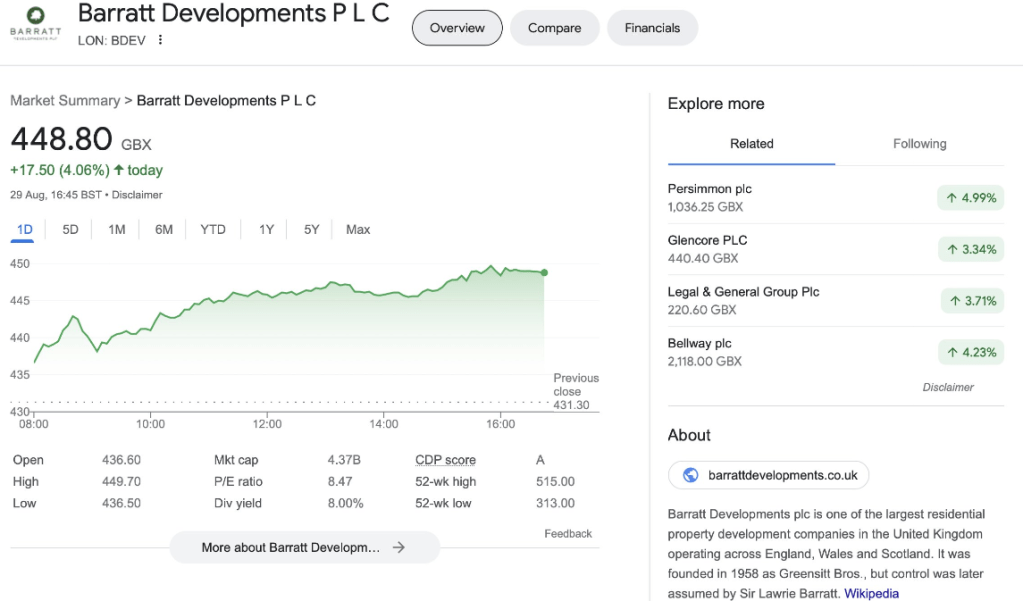
Shares in big developers rose on Tuesday, with Persimmon, Taylor Wimpey, Barratt Developments and Berkeley Group all performing well.
However, industry executives warned that Gove’s attempts to repeal the pollution regulations could still fail given the tortuous process behind passing the levelling up bill.
Lords have debated dozens of amendments already, covering everything from education policy to electric vehicle charge points. The government also wants to use the bill to push forward new measures to allow councils to opt out of low emission zones such as London’s Ulez.
“This bill has become a Christmas tree with various members using it to advance their chosen policies,” said one supporter of the move to repeal the nutrient neutrality rules. “The worry is now that it simply doesn’t pass in time.”
If the bill is not passed in time for the king’s speech in November, it will have to be reintroduced for the next session, where it will fight for legislative time with the rest of the government’s priorities for what is likely to be the final session before an election.
And even if the bill does pass, officials admit it will be months before the pollution regulations are formally removed.
The last pretence that this govt gives a hoot about the environment finally blown asunder.
Greenest govt ever? Lie. Not lower enviro standards? Lie. leave rivers in a better state? Lie. All of it Lies.
NOTE: You cannot offset a dead river. Feargal Sharkey

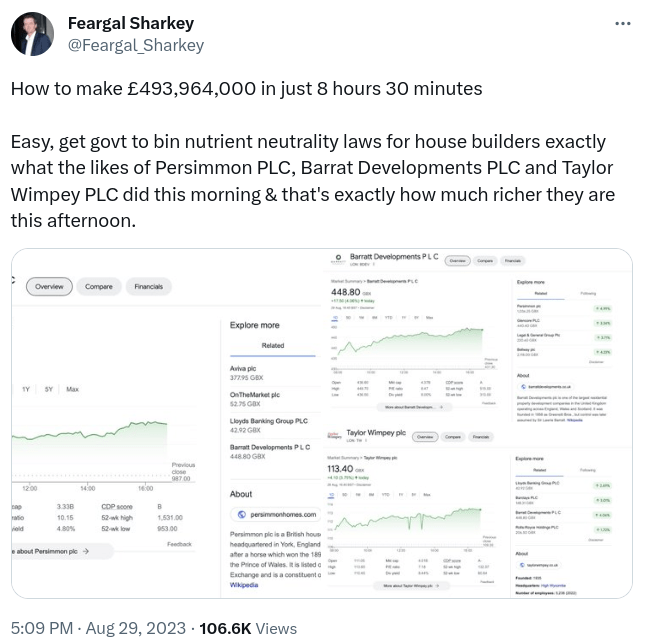
Easy, get govt to bin nutrient neutrality laws for house builders exactly what the likes of Persimmon PLC, Barrat Developments PLC and Taylor Wimpey did this morning & that’s exactly how much richer they are this afternoon. Feargal Sharkey 29 August on “X”
No longer will the polluter have to pay!
Taxpayers will pick up the bill for pollution by housebuilders, government officials have admitted, as rules on chemical releases into waterways are scrapped.
If an amendment in the House of Lords tabled on Tuesday passes, developers will no longer have to offset the nutrient pollution caused by sewage from new homes. The government has said it will double Natural England’s wetland funding to £280m in order to show it is trying to meet the requirements of its legally binding Environment Act.This extra £140m will come from the public purse, the government confirmed. When asked by the Guardian whether this meant the taxpayer was now picking up the bill for pollution caused by developers, a government official responded “yes”, adding that while “the polluter pays principle is very important”, it was having too many adverse impacts on small- and medium-sized housebuilders.
Helena Horton www.theguardian.com (Extract)
“Now instead of the polluter paying, the costs have been dumped on the environment and the taxpayer,” Craig Bennett, the chief executive of the Wildlife Trusts said. “Time and again the costs go on the environment and the taxpayer as a result of lobbying by industries and what we have seen here is another example of very effective lobbying from the construction industry.
“It is not only terrible value for money for the taxpayer but it’s breaking promises to the environment made only weeks ago by Rishi Sunak. How can we ever trust environmental promises he makes again?”……
….Richard Benwell, the chief executive of Wildlife and Countryside Link, said: “What the government is proposing here is to remove legal protections for nature, throw away requirements for polluters to pay, and instead use taxpayers’ money to try to fill the gap. But a single, short-term capital injection will do nothing to make up for the harm that our rivers and wildlife will suffer as a result.
“Scrapping the rules may reduce the costs for big businesses, but those costs don’t disappear. Instead, the public will pick up the bill for pollution reduction, and the environment will bear an unbearable cost of yet more pollution in our most sensitive rivers and streams.”
Anyone believe increasing wetland funding will actually mitigate the damage this amendment will cause? – Owl
 East Devon Watch