Report reveals £1million boost to council coffers from East Devon car parks price hikes

Car park price hikes across East Devon boosted council coffers by more than £1million a new report has shown.

Local Democracy Reporter eastdevonnews.co.uk 

Car park fee hikes have brought in an extra £1 million for East Devon District Council (EDDC) from April to October each year, according to a cabinet report, writes local democracy reporter Will Goddard.

Parking charges in the area went up for the first time in 10 years in April 2022.  Some tariffs doubled from £1 to £2 per hour in short-stay car parks.

In 2021, gross council car park revenue from its summer season between April and October was just under £2.5 million.

In 2022 and 2023, it rose to over £3.5 million each year.

Summer ticket sales have gone down year on year, but revenue has grown.

This year saw a “very small” rise of £2,600 overall compared to last year. Takings dropped in July and August , possibly because of poor weather, but the normally quieter months before and after increased.

There has also been a shift in the type of car park people use.

More motorists are reportedly paying for longer stays in EDDC long-stay car parks and staying for shorter amounts of time in short-stay car parks.

The council claims this is not a problem, as long-stay car parks are larger and so are “well suited to this type of use.”

People are buying more monthly permits too. East Devon residents can also buy £120 annual permits for parking in one town, which increases by £24 for each additional town up to a total of five locations.

A monthly payment option, introduced last year, is available for this permit type.

This helps split the upfront cost across the year or allows residents to only buy permits for the months they need.

Sales of monthly permits have more than doubled since they were brought in, which the report suggests could be down to the cost-of-living crisis, tariff rises or the introduction of residents’ parking zones in Exmouth.

East Devon District Council is to produce a parking strategy next year, which will set out how car parks “will be holistically used and managed in the coming years”, including pricing and special offers.

The report recommends Councillors keep car park charges in East Devon the same next year and make any future changes in line with this new strategy.
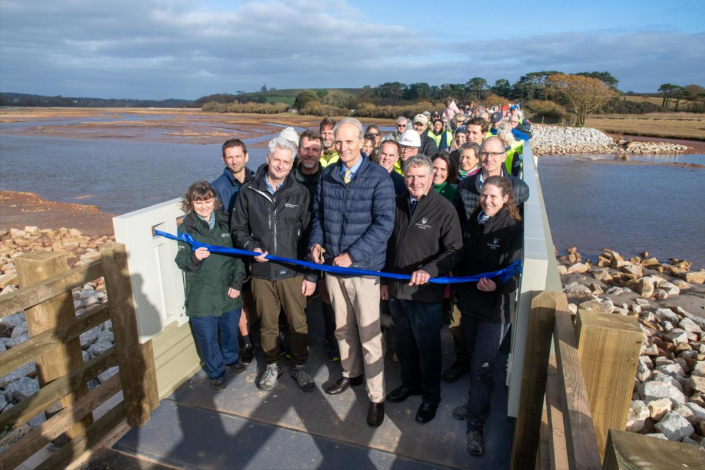
New bridge marks completion of Lower Otter Project

The Lower Otter Restoration Project is finished -15 years after the idea was first put forward.

Philippa Davies www.exmouthjournal.co.uk

The 70-metre footbridge was the final construction stage of the major environmental scheme at Budleigh Salterton.

The project is creating 55 hectares of mud flat and saltmarsh by allowing the tide to flow freely in and out of a new inter-tidal area. 

It is reversing the work done 200 years ago when an embankment was created to hold back the sea, creating more farmland. In recent years, the embankment had started to fail, putting recreational facilities, footpaths, a municipal tip and other infrastructure at risk from serious flooding.

To prevent this, Clinton Devon Estates and the Environment Agency devised an ambitious plan to re-connect the River Otter and estuary to its former floodplain, providing space for floodwater and creating habitats for invertebrates, fish, waders and wildfowl.

On Friday, November 25, the Elizabeth Bridge was officially opened, spanning the breach made in the 200-year-old embankment. The breach reconnects the sea and the river to its original floodplain.

Clinton Devon Estates said the Lower Otter Restoration Project (LORP) is central to its 2030 Strategy on land use, with two of its ambitions being adaptation to a changing climate and the restoration of the ecological health of its land holdings.

Chief executive John Varley said: “Everything we do is with tomorrow in mind. There was a danger that without the Lower Otter Restoration Project there would have been no ‘tomorrow’ for parts of the Estate or for our tenants and neighbours.”

Dr Sam Bridgewater, Clinton Devon Estates’ Director of Environment Strategy and Evidence, and the Estates’ lead on the project, said one of the biggest challenges was having to restructure the Estate landholdings to accommodate the project. For example, working with tenant farmers to adapt their business models to an uncomfortable climate change reality and finding a large, flat piece of ground to relocate the often-flood hit local cricket pitch.

He said: “LORP has been a great partnership project and with the Environment Agency we found a partner whose vision and ambition matched our own.”

The Environment Agency managed the development of the scheme, appointing engineering consultant Jacobs to lead the design of the project, contractor Kier to carry out the construction work and Hi-line to provide specialist ecological support.. 

Project managers say significant positive changes have already been recorded, both for the benefit of local people, visitors, and wildlife. South Farm Road, which in the past has been impassable due to flooding, has been moved and raised by the project. Budleigh Salterton Cricket Club has now moved to a flood-free pitch, with improved facilities enabling it to develop youth, women’s and disability cricket with a stunning new pavilion. New signage, interpretation and parking is also in place to help visitors understand and enjoy the site and identify its wildlife.

Animal and plant species already resident in the area, including beavers, bats and rare birds such as the Cetti’s warbler and little ringed plovers, continue to thrive in the valley. The evolution of habitat from agricultural land to wetland habitat has only just begun, but already rare bird species including lesser yellowlegs, white egrets, avocets, glossy ibis, spoon bills and at least two ospreys, have been seen.

Ecologist Mark Wills, an ornithologist with Hi-Line, worked on the project for more than two years. He said: “We have had two different ospreys call in on migration. Normally they just stop over for a day or two – this time they remained on site for nearly two weeks, which is amazing. We’ve got a bigger body of water, and the ospreys seem to have felt better able to feed.”

Although construction is now complete, monitoring work will continue at the Lower Otter, which it’s hoped will become an extension of the East Devon Pebblebed Heaths National Nature Reserve (NNR).

The zombie Tory government staggers on

 Chris Riddell www.theguardian.com

The real s.. hole in this country is parliament.

The way it has treated the citizens of this country is utterly disgusting.

A housing crisis that has not been dealt with in more than 40 years.

A sewage system that has not had any proper level of investment in over 40 years.

No new reservoir built in over 40 year despite a big increase in population.

The total lack of investment in public services.

The promise of lower prices and more efficiency through privatization.

We appear to have a banking system that prefers to invest in the inflation of house prices rather than invest in businesses. This in turn then means that people cant afford to get on the housing ladder. It also means that the big multi nationals (who all off shore as much of their profit as possible) have effective monopolies in the market. They are allowed to offshore huge profits while at the same time paying poverty levels of wages that need to be topped up with in work benefits.

We shovel huge sums to big business. For example we are giving the big oil companies £42 million per week with the tax relief that goes to new oil and gas drilling while these companies are making massive profits. Around 90% of the cost of new oil and gas fields is being paid for by the tax payer through these tax reliefs.

Then people wonder why it is that we have so many low waged jobs in this country. We are continually told that they are going to turn us into a high skilled high wage economy and then never deliver what they tell us. They fail time and time again to invest in education and health properly.

We are continually told they are making things more efficient and that deregulation will lead to higher levels of growth.

If we have seen all of the efficiency improvements that we have seen governments bang on and on and on about why is it that housing is now so insanely expensive when compared to 50 years ago?

If we have seen all of the efficiency improvements that we see the government bang on and on and on about why is it that public services are on their knees?

Our whole system is in a total mess and the stench emanates from those who are running the country.

We are constantly fed a diet of lies and misinformation while watching the rich get richer and the poor get poorer.

‘A disgrace’: headteachers attack Hunt’s failure to provide money for schools in autumn statement

Headteachers have called the government’s failure to invest in school staff and crumbling buildings in the autumn statement “an absolute disgrace”.

Anna Fazackerley www.theguardian.com 

Unions said this weekend that the government had now lost any vestiges of credibility among teachers after the chancellor, Jeremy Hunt, failed to announce any new investment for schools on Wednesday – despite Rishi Sunak’s pledge at last month’s Conservative party conference that education would be his “main funding priority”.

With education unions determined to make staff shortages an election issue, parents can now search the newly relaunched School Cuts website to see whether their local school may be forced to shed teaching staff next year. The unions warn that 99 per cent of state secondary schools and 91 per cent of primaries will have to make cuts to survive in 2024.

[Examples of searches on the School Cuts website]

Garry Ratcliffe, chief executive of the Golden Thread Alliance, which runs nine primary academy schools in Dartford and Gravesend in Kent, told the Observer: “Especially with support staff, when someone leaves for a better paid position in a supermarket, most schools are now asking: ‘Can we afford to replace them?’”

Ratcliffe’s schools are now focusing on helping struggling families with food and cheap presents for Christmas, despite fighting to cope with rising costs themselves. He added: “People in schools have given up hope that this government will suddenly start to invest in children’s education.”

A primary school head in a deprived area of north-west England, who asked not to be named to avoid alarming parents, said the potentially dangerous reinforced autoclaved aerated concrete (Raac) recently discovered in his school’s roof was far from the only problem. “The list is endless: asbestos, flooding, damp, cracked windows,” the head explained.

“And we need urgent safety upgrades to our school entrance and car park which have been delayed because of Raac. The fact that education spending is going to be flat is an absolute disgrace.”

The head said he had had to “really fight” to get the Department for Education to approve a temporary “crash deck” to make the school usable after it joined the growing list of schools deemed unsafe due to Raac. However, the department is refusing to provide any timetable for a decision on what to do to make the school safe permanently, or whether it will need to be demolished.

Tim Warneford, a consultant who advises academies on their buildings, said the autumn statement would lead to “further deterioration” of thousands of schools as they faced another winter with serious issues including Raac, leaking roofs, broken boilers and asbestos.

He said: “This has to be another reason for poor attendance. Why would you want to come in if your school isn’t safe or warm or dry? What message does that send to children about how much they are valued?”

A damning parliamentary inquiry into the school estate found that 700,000 pupils are learning in classrooms that need a major rebuild or refurbishment, but many schools have no hope of an overhaul because of the Raac crisis.

Paul Whiteman, general secretary of the National Association of Head Teachers, said: “Teaching assistants and support staff will probably be the first roles to go as schools try to make savings, and of course that will hit the most vulnerable children who need extra support that won’t be there.”

He added that after the autumn statement, the government has “completely lost the trust of the teaching profession”.

Geoff Barton, general secretary of the Association of Schools and College Leaders union, said: “On current funding levels, schools will only be able to afford a 1% pay award for staff next year – and this is in the midst of the worst recruitment and retention crisis in living memory.”

A Department for Education spokesperson said: “Our school rebuilding programme is transforming 500 schools over the next decade, with the first 400 projects selected ahead of schedule. The education secretary has already confirmed we will fully fund the removal of Raac from our schools – either through grant funding or through the school rebuilding programme.”