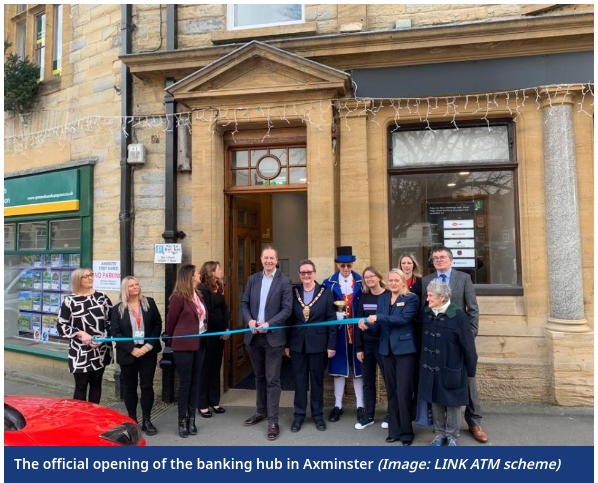
Axminster’s new banking hub is now officially open

A new banking hub has opened in Axminster, a year after the town lost its last remaining bank branch.

The hub, based in the former Lloyds Bank building, was officially opened by local MP Richard Foord on Friday, November 24.

Philippa Davies www.midweekherald.co.uk

It is a shared banking space, offering face-to-face service for customers of all major banks and building societies and access a full range of banking services.

The Community Bankers will work on rotation, with a different bank available on each day of the week. The hub will be open Monday to Friday from 9am until 5pm.

The banking hub is the second to open in Devon, and was established by Cash Access UK, an organisation set up to protect nationwide access to cash. It will be operated by the Post Office. 

Mr Foord joined local community leaders and the Mayor of Axminster to cut the ribbon and formally open the site on Friday.

He said: “This new banking hub will make a huge difference. It will enable local people to access a full range of banking services in their own community and will help resuscitate the high street.

“Rural areas have lost so many bank branches in recent years. Many towns have seen every branch close; that is what happened in Axminster.

“This new hub shows that when we apply pressure to Government and to big business, we can protect vital services like face-to-face banking, which are essential to small businesses and older residents in particular.

“I will continue to advocate for more action by the Government to speed up the delivery of banking hubs across our corner of Devon, so as to protect people’s access to cash close to where they live.

“In particular, I will be pressing for similar progress with a proposed banking hub in Sidmouth – which has been roundly endorsed by the local Chamber of Commerce there.”
Devon councils warned of merger pitfalls by Somerset MP

Tory candidate for the new Tiverton & Minehead constituency, currently member for Bridgwater and West Somerset, Ian Richard Peregrine Liddell-Grainger, sounds off again. [Use EDW search box to find past harrumphs].

Owl doesn’t think the creation of a Somerset unitary authority, by merging Districts, is entirely relevant to the hoops Devon is trying to jump through to unlock devolution cash.

Beware of who you vote for in Tiverton. – Owl

Lewis Clarke www.devonlive.com

Parliamentary candidate Ian Liddell-Grainger has warned Devon councils not to rush into a merger they might later regret. He says plans to link Devon County Council and Torbay Council and devolve some Government functions could end up saddling taxpayers with unforeseen costs.

Under Government proposals the authorities would merge to become a single, Level 2 non- mayoral council.

Spokesmen for the councils have welcomed the deal, saying it will benefit residents and businesses and give the area a stronger voice in influencing national policies.

But Mr Liddell-Grainger, who intends to stand for the Conservatives in the new seat of Tiverton and Minehead said every caution should be exercised.

“Mergers between local authorities are always talked up as opening the door to a prosperous new world but they don’t always turn out so successful,” he said.

“Take a look at what happened in Somerset where the former county council leader David Fothergill sold the idea of merging all five local authorities with the carrot of £18 million savings.

“Two years later Somerset council is on the dung heap: on the point of bankruptcy with unmanageable debts.

“Somerset’s case should serve as a terrible warning as to how taxpayers can be dragged into chaos as a result of uncontrolled enthusiasm for change.”

New homes are given the go-ahead for village farmland in East Devon

New homes for farmland on the edge of an East Devon village have been given the go-ahead amid concerns raised over the impact the development could have on drainage.

Local Democracy Reporter eastdevonnews.co.uk

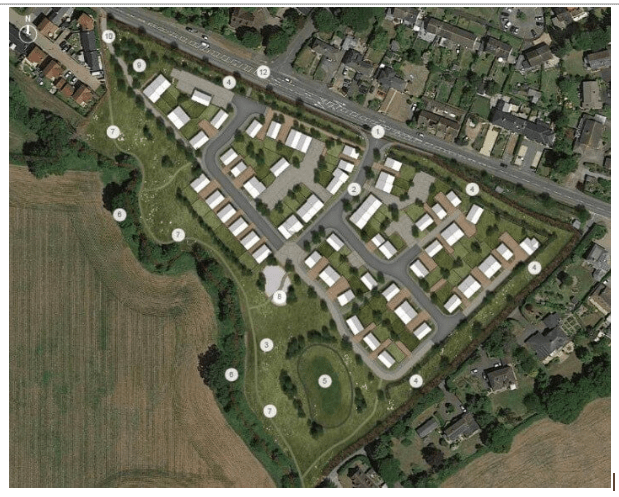
Plans to build up to 70 homes on farmland on the southern edge of Woodbury in East Devon have been approved, writes local democracy reporter Will Goddard.

Since the application was outline only, more concrete plans including exactly how many new houses there would be, and what they would look like, must be put forward later.

A computer generated image taken from the planning documents, shows the proposed layout of the new homes. Image: LHC Design.

Fears about the development’s impact on the sewage system, and therefore a potential increase in raw sewage discharges, led Councillors to put the plans on hold last month to ask the Environment Agency (EA) and South West Water (SWW) again whether they had any pollution-related objections.

Having received no reply, and with the EA saying it would not change its position that it doesn’t object, council officers suggested imposing a condition on the developer to draw up a sewage management scheme before putting forward further plans “to ensure that the network as a whole is not overloaded as a result of the development.”

East Devon District Council principal planning officer Gavin Spiller explained how this method could help the council get more information and evidence than further consultations would.

Satisfied, Councillors granted permission with this condition and several others, including having a pedestrian crossing and two bus stops.

Speaking about SWW’s failure to respond, Cllr Eileen Wragg (Lib Dem, Exmouth Town) said: “It is disappointing that this council did not have a reply from South West Water, but again, are we surprised? No, we’re not. I think it’s deplorable, frankly.”

Cllr Mike Howe (Independent, Clyst Valley) expressed his dismay at raw sewage discharges.

He said: “It is unacceptable for raw sewage in this day and age to be regularly flooding footpaths, footways and anything else in our communities. Full stop.

“We cannot allow development to happen where we are going back to the 1800s, where you just throw it out in the street.”

Members of the public and Woodbury Parish Council also objected, expressing concerns about road safety and infrastructure.

Will Sid provide the readies for more tax giveaways?

According to the latest financial analysis only if the government offers NatWest shares at a loss to the taxpayer of £28bn.

But this government might be tempted to try anything to stay in power, or is Owl being too cynical? 

NatWest sale ‘could cost taxpayers £28bn’

George Grylls, Ben Martin www.thetimes.co.uk

The government may end up losing £28 billion from selling its shares in NatWest, a financial analysis has shown.

Jeremy Hunt announced last week that the government would explore options to sell its remaining 38.6 per cent stake in the bank, potentially offering the public the opportunity to buy shares. The chancellor said it was “time to get Sid investing again”, a reference to the 1980s advertising campaign during the privatisation of state-owned assets such as British Gas.

The government bailed out the Royal Bank of Scotland, which subsequently rebranded as the NatWest Group, purchasing an 84.4 per cent stake for £45.5 billion between 2008 and 2009 during the financial crisis.

Ministers have been reducing the government’s stake in the bank since 2015, but all of these sales have been at a loss. Financial analysts have questioned the decision to examine ways to expedite the sale of the remaining stake at a time when NatWest is struggling.

The bank has lost a quarter of its value this year after the former chief executive, Dame Alison Rose, was forced to resign over the debanking scandal involving Nigel Farage, the former Ukip leader, and Coutts, the private bank owned by NatWest.

Analysis by Hargreaves Lansdown, the investment firm, has shown that selling the government’s remaining stake at the bank’s current share price of 206p would lead to a total cost of £28 billion to the taxpayer.

The government has benefited from some returns on its NatWest shares when dividend payments were resumed in 2018 after a ten-year pause. NatWest figures suggest that the government has been paid £4.4 billion since 2018 in dividends. The bank has paid out a total of 70.8p per share in ordinary and special dividends, amounting to only 14.2 per cent of the buy-in price, according to Hargreaves Lansdown.

Derren Nathan, head of equity at the investment group, said that despite those modest returns the taxpayer was still facing an “eye-watering loss”.

“It needs to be said that gain on investment wasn’t the main motivation for the initial bailout, as this was seen as essential for the nation’s financial stability,” he said. “But given where we are in the cycle the timing of a disposal may be somewhat questionable. Based on forward earnings the valuation is close to a ten-year low.

“There are of course still potential economic tripwires ahead, but so far a much-anticipated recession has been avoided and there’s still a chance the landing in the UK will be on the softer side. Meanwhile NatWest is poised to benefit from some of the structural tailwinds that should lift sector earnings over the medium term.”

The Treasury said the government planned to sell its final shares by 2025-26 “subject to market conditions and value for money”. It said: “As part of the plan to return [NatWest Group] to the private sector, the government will also explore options to launch a share sale to retail investors in the next 12 months, subject to supportive market conditions and achieving value for money.”

NatWest Group said: “Any decisions around share sales are a matter for the government. We welcome the government’s continued commitment to returning NatWest Group to private ownership and believe this is in the best interests of the bank and our shareholders.”