I swear by Almighty God…
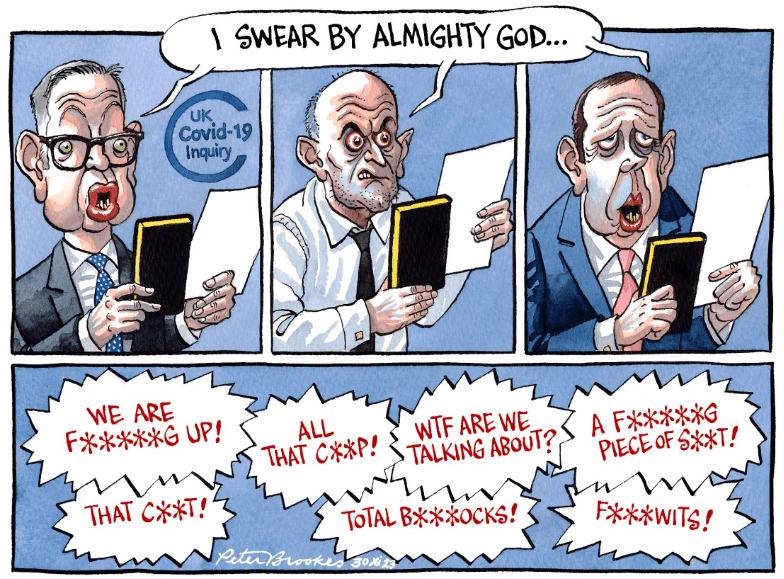

I swear by Almighty God…
Exeter City Council has voted against selling off two multimillion-pound sites for student housing.
A report for the council had recommended selling the old Clifton Hill leisure centre site and the Mary Arches multi-storey car park site with unrestricted use – going against council policy.
The report said the city council needed to make the maximum amount of money from the sales so it could pay off a debt of about £9m as a result of the failure of its housing development company, Exeter City Living.
On Tuesday, the council’s executive voted unanimously not to allow purpose-built student accommodation on either site.
Council leader Phil Bialyk, Labour and Cooperative, said: “We will continue to work to get the right homes built in the right place, for the right people.
“We will do this even when it is the option that doesn’t give the highest financial return.
“By choosing to invest in the future development of our city in this way we will ensure that our shared vision continues to be delivered.”
Mr Bialyk said figures for the valuation of the sites were confidential but he was confident the sales of both sites would “satisfy the situation of our outstanding debt”.
Diana Moore, Green Party leader on Exeter City Council, said the Labour-led council had “turned council assets into complete liabilities”.
She said: “They are now selling off important sites which should be decent homes, affordable homes for our communities.”
Exeter City Living was set up as an arms-length company by the council to provide social and affordable housing and bring in extra revenue.
Exeter City Council said the project failed due to a series of issues such as Brexit, Covid-19, the invasion of Ukraine, high inflation rates and repeated interest rate rises.
Michael Mitchell, Liberal Democrat group leader, said there was “about a £9m shortfall” that would need to be found from the sale of the two sites.
He said: “We don’t know what the market value of these two sites are, particularly with the restricted use on them.”
Mr Mitchell believed the council would still have to find more money to cover its debt.
Anne Jobson, Conservative group leader on Exeter City Council, said council debt was a growing problem.
She said: “There clearly will be a financial implication on a council who has already, I would say, by its own financial poor decision making, in approximately £163m worth of debt.”
The matter will now go to full council for a final decision.
Rishi Sunak pushed “very hard” for a lifting of all lockdown restrictions during a meeting in July 2021 where Boris Johnson referred to people as “malingering” and “workshy”, the Covid inquiry has heard.
Ben Quinn www.theguardian.com
The then chancellor and prime minister were pitted against the “more cautious” approach of Michael Gove and Sajid Javid during the meeting, which took place when Covid-19 cases and hospital admissions were rising, according to a diary entry by the then chief scientific adviser Sir Patrick Vallance.
“PM looks downbeat and talks of grim predictions,” the entry read. “[Javid] says ‘we are going to have to learn to live with it’, ‘and die with it’, PM says.”
Javid, who was the health secretary from June 2021 to July 2022, told the inquiry on Wednesday it was “possible” that Johnson had said the words attributed to him.
“The prime minister in these meetings often said things that were hard to determine what he actually thought versus a joke,” he said. “Even when you were discussing something as important as this.”
The same entry recorded: “[Sunak] pushes very hard for faster opening up and fuller opening up. Getting rid of all restrictions. Repeats his mantra ‘we either believe in the Vx [vaccine] or we don’t’. I pointed out we would be facing a lockdown now if it was not for the Vx.”
Referring to Johnson, it added: “He says he wants everyone back at work ‘we can’t have the bollocks of consulting with employees and trade unions. They need to come back to work. All the malingering workshy people.’”
Vallance concluded in the entry that the whole meeting was “political posturing” and that civil service officials were worried. He said he and the chief medical officer for England, Sir Chris Whitty, had made the risks “very clear”.
However, a claim by Javid that Johnson was not in charge of the government during the pandemic and that his chief adviser, Dominic Cummings, was “prime minister in all but name” was later contradicted when Dominic Raab gave evidence.
“I just don’t accept the characterisation that there was some sort of puppet regime,” the former foreign secretary told the inquiry.
Raab, who resigned this year after a report on alleged bullying behaviour towards civil servants, mounted a defence of Cummings, who has been accused of contributing to a toxic environment at No 10.
Cummings was there to “galvanise the direction of travel” and act as “some grit in the oyster”, Raab told the inquiry.
In tetchy exchanges, he accused the counsel for the inquiry Andrew O’Connor KC of being “dismissive” when O’Connor suggested Raab was resorting to “managing speak” as Raab told the inquiry about his theory of taking what he called a “perpetual beta” approach to decision-making in crises.
“In any crisis it’s not going to be a manicured response and there will certainly be people who feel bruised by the pressure. Sometimes that will be because someone has behaved inappropriately. I get it,” Raab said, adding that there was a broader problem of delivery in Whitehall.
Raab defended his going on a series of overseas government trips and on a family skiing holiday as the pandemic loomed and as initial cases were appearing in Britain, insisting he very rarely went on holiday in what was a “gruelling” role and that he would have been umbilically linked to chains of communication no matter what.
The former minister also told of how he was given “five minutes’ notice” in April 2020 that he was to deputise for the prime minister, who had been hospitalised with the virus. Planning before it had been “pretty sparse”, he said, but there had been an understanding when he was first appointed as deputy prime minister by Johnson, who he said had told him: “You’ve got my back.”
Raabs said one of his first acts was to “get the team together” and convene a cabinet meeting, and he insisted he was aware of how the moment was perceived.
He said: “I didn’t want anyone saying that Dom Raab’s enjoying this a bit too much, because I wasn’t, and I was there to do a job.”
Nottingham city council has issued a section 114 notice, in effect declaring itself bankrupt, as experts warn an increasing number of councils are “reaching breaking point”.
Jessica Murray www.theguardian.com
In an announcement on Wednesday, the local authority said it had a significant gap in its budget and the council’s chief financial officer had decided it was not able to produce a balanced budget for this year.
The Labour-run council attributed its financial problems to issues affecting councils across the country, including an increased demand for children and adults’ social care, rising homelessness presentations and the impact of inflation.
It also acknowledged previous issues relating to financial governance and an overspend in the past financial year had played a part but said it still had sufficient financial resources to meet all of its current obligations.
Robert Jenrick, the Conservative MP for Newark in Nottinghamshire, said the council had displayed “breathtaking waste and incompetence” and called for the secretary of state to appoint commissioners to “restore order”.
A section 114 notice means all spending, apart from on protecting vulnerable people and providing statutory services, will be suspended.
Birmingham city council issued a section 114 notice in September because of financial problems compounded by a £760m equal pay bill and failed IT implementation costing £100m.
Sir Stephen Houghton, the chair of the Special Interest Group of Municipal Authorities (Sigoma), said the government risked “seeing an epidemic of S114 notices” as Nottingham council’s crisis showed “the funding model is completely broken”.
“There are fundamental systemic issues with the local government finance system that have resulted in an increasing number of councils reaching breaking point,” he said.
“The chancellor in his recent autumn statement had the perfect opportunity to help address some of the well-publicised pressures in local government and the wider public sector but failed to do so.”
Accounts showed Nottingham city council was headed for a £23m overspend in the 2023-24 financial year, and government commissioners could be brought in to take charge.
The local authority has been beset by financial difficulties for years. The collapse of a council-run Robin Hood energy scheme in 2020 led to the loss of millions and a government-appointed board being brought in to monitor the council.
It was also revealed that more than £40m of ringfenced cash from the council’s housing revenue account was unlawfully spent as general funds, with the cost of repayment estimated to be £49m-£51m.
However, the council leader, David Mellen, has previously said the council’s financial “mistakes” were small in comparison with the year-on-year reduction of funding from central government, which was estimated to be a loss of £100m over the past decade.
Sigoma said Nottingham city council’s spending power was 28% lower in real terms compared with 2010-11, and the council was spending 31% of its budget on children’s services, up from 19% a decade ago.
Jonathan Carr-West, the chief executive of the Local Government Information Unit, said the news from Nottingham was unsurprising.
“Nottingham isn’t the first to issue a section 114 and certainly won’t be the last. More and more well-run and effective councils are saying that they could be next,” he added. “Government is quick to point the finger at ‘failing councils’ but the truth is we have a broken system.”
A spokesperson for the Department for Levelling Up, Housing and Communities said: “We used our statutory powers to intervene at Nottingham city council last year over serious governance and financial issues and have been clear that improvements must be made.
“We have expressed concern over the lack of urgency demonstrated by the council in addressing these challenges. We are assessing the situation and will consider whether further action is necessary.”
Tory commitments to the British countryside are equivocal, particularly amongst local Tories.
History of broken promises
In 2018 Michael Gove, then Secretary of State for Environment, Food and Rural Affairs, commissioned Julian Glover to undertake a review of National Parks (NPs) and Areas of Outstanding Natural Beauty (AONBs). Glover was given an extensive brief to review the areas’ statutory purposes and their alignment with the government’s 25 Year Environment Plan.
In July 2019 Glover published his interim findings, which included:
“… The message from all this work has been vigorous and clear. We should not be satisfied with what we have at the moment. It falls short of what can be achieved, what the people of our country want and what the government says it expects in the 25-year plan for the environment.
Some of this failure comes from the fact that our protected landscapes have
not been given the tools, the funding and the direction to do the job we should now expect of them.”
In November 2021 Owl reported that Natural England had been tasked by the government to assess the creation of a new National Park based on combining the East Devon and Dorset AONBs. This was in line with the “Ten Point” plan for a green revolution published a year earlier. [The proposal originally submitted to Natural England in 2013 covered the Dorset AONB and East Devon AONB]
Note East Devon “Build, build, build” Tories have consistently refused to countenance or engage with this proposal to combine the two AONBs into a National Park for fear of losing control over planning. As a result of this petty intransigence the proposal is generally described as “the Dorset National Park” and led from Dorset. For similar reasons East Devon lost the lead to Dorset on the Jurassic Coast with consequences for tourism.
In October 2023 Owl reported that the Government was blowing cold on the idea and were set to break their manifesto pledge to do so.
This was followed a few days ago by an email circulating introducing a “rebranding” of the East Devon AONB.
Owl is always deeply suspicious of the opportunity this gives to water down commitments.
“Today marks the start of a new chapter in the story of designated Areas of Outstanding Natural Beauty (AONBs) in England and Wales.”
It will now be called East Devon National Landscape.
“The new name reflects our national importance: the vital contribution we make to protect the nation from the threats of climate change, nature depletion and the wellbeing crisis, whilst also creating greater understanding and awareness for the work of the whole National Landscapes family.
This is a significant milestone for the UK and the next step in fully realising our vision to be leading examples of how thriving, diverse communities can work with and for nature in the UK: restoring ecosystems, providing food, storing carbon to mitigate the effects of climate change, safeguarding against drought and flooding, whilst also nurturing people’s health and wellbeing.”
Is this a fudge to blur the distinction between AONBs and National Parks reducing all to the lowest common denominator?
Last minute volte face?
Following the sacking of Thérèse Coffey we now hear the proposal to create more National Parks might all be on again, though the number has been reduced to just one.
There is no official shortlist of locations and the decision process could take some time. But three areas have emerged as early favourites after a government-commissioned landscape review called for three new national parks to be created, in the Chilterns, the Cotswolds and Dorset and East Devon.
Labour’s 2019 manifesto called for 10 new designations of “National Nature Parks”.
Search to begin for a new national park in England amid criticism of ‘true state’ of UK’s landscapes
Report by news.sky.com
The search for a new national park for England has been announced as part of a plan for nature set out by Rishi Sunak.
Critics have said the environmental package – which includes woodlands and food production covering 200,000 hectares of land – will be unable to hide the “true state” of the UK’s natural landscapes.
The scheme has received a lukewarm response because government funding for nationals parks has fallen by 40% in real terms in just the last decade, reported the Campaign For National Parks.
Critics also pointed to the state of the UK’s waterways, rivers and coastlines with increasing levels of sewage dumping, which the government has admitted is “unacceptable”.
Earlier this year, England’s environmental watchdog, the Office For Environmental Protection, strongly condemned the government’s record on climate and nature – finding the Tories were not “demonstrably” on track to meet a single target.
As part of the new project, an allocation of £15m will be shared by England’s 10 existing national parks and 34 National Landscapes.
Natural England will assess a list of possible national park sites, while there are plans to create two community forests in Derbyshire and the Tees Valley.
Prime Minister Rishi Sunak unveiled the efforts “to protect these much-loved spaces” ahead of Thursday’s COP28 climate summit in Dubai.
But shadow environment secretary Steve Reed said the Tories had been overseeing the “destruction” of the British countryside.
He added: “Under their watch, the UK is one of the most nature-depleted countries in the world, and waterways face the highest levels of illegal sewage discharges in our history.”
Mike Clancy, the general secretary of the Prospect trade union, which represents a range of professions including engineers and scientists, also highlighted the conditions of the UK’s waterways – and Tory funding cuts to the Department For Environment, Food And Rural Affairs.
“Bold-sounding initiatives can’t hide the true state of our rivers, shorelines and natural landscapes,” he said.
“Without adequate funding for the guardians of our natural environment, there is little chance the government’s rhetoric will be able to meet its stated ambition.”
In August, environmentalist and author Guy Shrubsole, who lives near Dartmoor National Park, told Sky News “we need a balance of areas” to allow habitats to thrive.
He said: “Our national parks are in a pretty shocking state for nature… they’ve actually found that on average, they’re in a worse condition than nature is, outside our national parks.”
 East Devon Watch