A Christmas Carol: an update by Mike Temple

A Christmas Carol: an update (31.12.21)
(from Fables for Our Times – Mike Temple)

Once in Little-Britain City
Lived a Tory known as Scrooge.
Stranger he to Truth and Pity
But his assets were quite huge;
His cash was tax-free, stashed offshore.
He didn’t care about the Poor.

He cut their benefits and “credit”,
Ignored the homeless at his door;
“Want” was “humbug” (yes, he said it).
His friends grew richer than before.
Bob Cratchit was this Tory’s stooge,
Kept on low pay by the said Scrooge.

Bob Cratchit on his low wage went
To nearby Food Banks every week.
He spent so much on heat and rent
His prospects did look very bleak,
While for his son called Tiny Tim
The future really did look grim.

At Xmas-time Scrooge went to bed
But didn’t sleep a wink at all;
He’d drunk a lot and was well fed
But saw a Ghost upon the wall
Who oped his cloak, and what Scrooge saw
Were kids called “Ignorant” and “Poor”.

This Ghost was from the Tory Past,
From just about three years ago;
The kids were mean, also low-classed
And marked with misery and woe.
They looked at Scrooge as if to say:
“Your policies turned out this way.”

Next night our Scrooge was sleeping when
The Ghost of the Time-Present came
Who showed the children once again –
It was indeed a crying shame –
The kids were hollow-eyed and thin
With little flesh, just bone and skin.

The third night’s Ghost from Future Time
Brought on the double-act once more,
Both skeletons – it was a crime
And done by those who’d made them poor.
The “Poor” kid now was Tiny Tim
And millions more were just like him.

Reform UK to challenge Tories in every seat at general election

Simon Jupp, who is self-isolating from those living in the real world, won’t know which way to turn.

Tories could face a Canadian style wipe-out.  – Owl

Harry Yorke www.thetimes.co.uk 

The leader of Reform UK has privately given his senior team “cast-iron guarantees” that general election candidates will not be told to step aside for Tory opponents in a move that could split Rishi Sunak’s vote in key seats.

Richard Tice has offered written assurances to key party figures that they will fight the Conservatives right up to polling day.Reform has already selected candidates for 440 seats and intends to stand in all constituencies bar those in Northern Ireland.

It fought the 2019 general election as the Brexit Party, led by Nigel by Farage, changing its name afterwards

It posed a significant threat to Boris Johnson’s chances of winning a majority — until Farage decided to stand down 317 candidates to help ensure Jeremy Corbyn did not secure the keys to Downing Street. While Farage said he had put country before party, it caused significant anger among many Brexit Party candidates and supporters.

Tice, who took over as leader from Farage — currently Reform’s honorary president — has vowed not to repeat the move next year. He has given “concrete” assurances in writing to members of his top team and several parliamentary candidates who have been recently recruited. They include Ann Widdecombe, the former Conservative minister who is now Reform’s spokeswoman on immigration, and Ben Habib, its co-deputy leader.

The commitment was intended to convince many of the party’s high-profile figures that it is serious about fighting a major campaign at the next election. Several, including Habib and Widdecombe, are former Brexit Party MEPs who have rejoined in recent months after the promises were made.

Tice told The Sunday Times: “In the 2024 election year we will be ready whenever it comes, spring, summer or autumn. We will be standing in seats everywhere in England, Scotland and Wales. Many, including Tory MPs and commentators, still don’t believe us, but I have news for them: you are seriously underestimating our intent to have a massive impact in this coming election.”

The disclosure of Tice’s tactics poses another major headache for Sunak, whose party trails Labour by as much as 20 points in the polls and appears increasingly to be heading towards a landslide defeat.

Reform, meanwhile, is polling at around 9 per cent, with Conservative MPs concerned the rival party threatens to erode their vote share still further.

While Reform’s current polling numbers suggest it will not take seats directly from the Tories, it could steal enough Conservative votes to hand dozens of tight marginals to Labour. This has already been demonstrated in two recent by-elections in mid-Bedfordshire and Tamworth, where the number of votes cast for Reform was greater than the Labour majority.

A recent analysis by the pollster More in Common suggests support for Reform at the ballot box could cost the Tories 35 seats. These are likely to be pro-Brexit areas in the north and Midlands. Reform’s popularity is expected to grow in the new year, amid mounting speculation that Farage is preparing to return to frontline politics after his widely publicised stint on I’m a Celebrity … Get Me Out of Here!.

Farage and Tice have been speaking regularly since the former’s return from Australia and over Christmas are expected to discuss Farage’s “future role” in Reform. Tice is to hold a press conference on January 3, setting out Reform’s plans for the coming months, with Farage this weekend remaining tight-lipped about whether he will attend.

Tice is expected to use the event to ratchet up his attacks on the Conservatives while also seeking to appeal to pro-Brexit voters in “red wall” seats, who remain reluctant to return to Labour.

“Our view is that the toxic Tories are done and they are finished, and we will attack them mercilessly,” a senior Reform figure said. “But we are also now turning our guns onto Labour and the weaknesses of Keir Starmer. People will notice a significant stepping up and a shift in the way we attack the main two parties.”

Since taking over Reform, Tice has insisted publicly there will be no repeat of the concession made to the Conservatives in 2019. However, to convince former Brexit Party figures to rejoin, a senior source said he had made written commitments to each of them individually. This includes promising that all major decisions relating to the election campaign will be subject to consultation and not made unilaterally.

“[The decision to stand down candidates in 2019] has caused a great deal of hurt and upset among many of our Brexit Party people up and down the country,” they added. “You carry the scars with you, as the leadership team. Richard recognises how important that loyalty is and he isn’t doing that again. Keir Starmer is not Jeremy Corbyn, there is no threat of a Labour-SNP coalition, there is less chance of them overturning Brexit.”

Widdecombe added: “The situation is completely different now. In 2019 if we had not stood down Labour could have won and there was a real chance that Brexit could have been overturned. This time Brexit has been done — at least legally. Yes, Starmer will do some things that we don’t like, but the Conservatives are doing that anyway.”

Similar reassurances have been made to a number of parliamentary candidates and party staff. In several instances, these commitments were given after candidates said they had been contacted by Tory MPs they are due to stand against, who urged them to consider contesting another constituency instead.

Tice has made clear internally that no concessions will be granted and that the party will contest 630 seats across the UK, excluding Northern Ireland. He wrote in the Telegraph following the Mid Bedfordshire and Tamworth by-elections in October that he was “delighted to have made the difference by stopping the Tories from winning not one but both by-elections in their ‘safe’ seats”. Labour took both.

Reform has already recruited about 440 candidates, with 220 attending a training day in Wakefield in November. Reform intends to have confirmed the remaining 190 by the end of February.

The party is also stepping up its programme of events for the coming election year. Tice is due to host a Welsh conference in Port Talbot, home to one of the biggest steelworks in the world, on February 4, with Reform holding its national spring conference in Doncaster three weeks later.

Senior party figures believe that if Farage does return to the front line, the party’s popularity will continue to grow. This, one predicted, could lead to an electoral wipeout akin to that suffered by the Progressive Conservative Party in Canada, which, in 1993, after a decade in power, lost 167 seats and was left with just two MPs.

They insisted that, unlike in 2019, the government’s alleged failings on Brexit and failure to pursue “genuine” conservative policies mean that Reform was determined to remove the Tories from power.

“My gut feeling is if Farage was properly engaged, 8.5 per cent [in the polls] would become 13 per cent overnight,” they added. “You do that to the Tories and you are looking at a Canadian wipeout. That’s exactly what we want.”

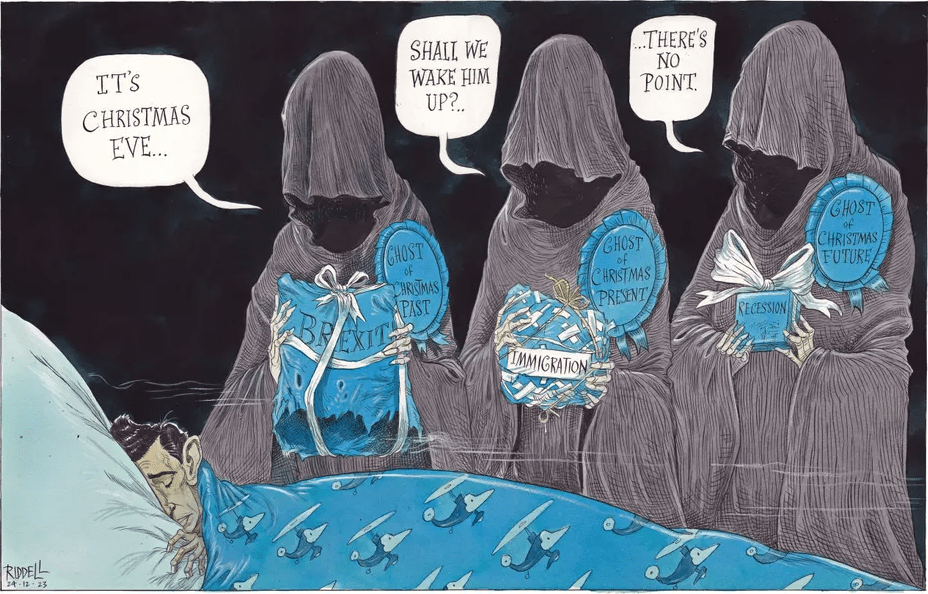
Is Rishi Sunak on the same spreadsheet as the rest of us?

“Economic optimism is increasing, consumer confidence is increasing, growth estimates are being raised.” (Six months ago)

UK economy on brink of recession after growth falls

Economic growth performed worse than expected this year, with official figures for the last two quarters showing the UK is on the brink of a recession.

Mehreen Khan www.thetimes.co.uk

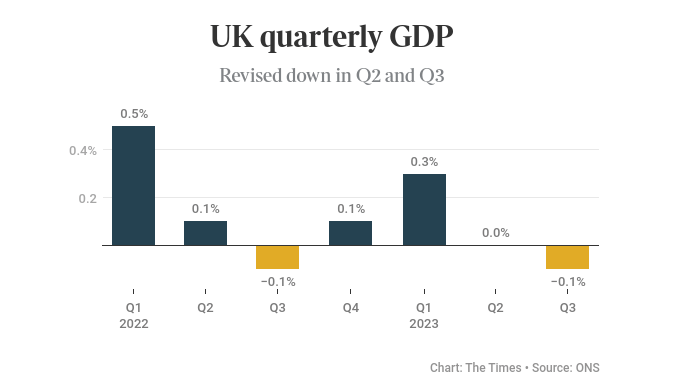
The Office for National Statistics (ONS) cut its initial growth estimates for gross domestic product (GDP) to a fall of 0.1 per cent in the third quarter, from a first calculation of 0 per cent, and said the second quarter’s 0.2 per cent expansion was revised down to 0 per cent.

The downgrades confirm the weak growth performance of 2023 when the economy was hit by the impact of steadily rising interest rates and high inflation for most of the year. The figures also show how close the UK could have come to a formal recession, which is marked by two consecutive quarters of negative growth. Another three months of falling output would confirm a recession at the end of the year.

The downgrades mean that the economy has expanded by 0.3 per cent so far this year, down from economists’ projections of 0.6 per cent, and the economy overall is 1.4 per cent larger than pre-pandemic levels.

Jeremy Hunt, the chancellor, said the country’s growth outlook was “far more optimistic than these numbers suggest”. He said: “We’ve seen inflation fall again this week, and the Office for Budget Responsibility expects the measures in the autumn statement, including the largest business tax cut in modern British history and tax cuts for 29 million working people, will deliver the largest boost to potential growth on record.”

The UK is on course to post growth of about 0.2 per cent to 0.4 per cent in the final quarter of the year, with economists expecting better consumer spending and a recovery in the growth-driving services sector to ensure a recession is dodged heading into 2024.

In the three months to September, the output in the services sector, which makes up around three quarters of the entire economy, fell by 0.2 per cent, with declines in household spending and business investment in the third quarter. There was positive news for households, whose disposable incomes rose by 0.4 per cent when stripping out the impact of inflation, continuing from the 2.3 per cent expansion recorded between April and June.

Thomas Pugh, an economist at professional services firm RSM, said there was still a “significant risk” of a formal recession at the end of the year if weak growth projections for the fourth quarter disappoint.

“The economy will continue to stagnate through most of 2024, though, only returning to sustainable growth in the second half of the year,” Pugh said.

The ONS said its revisions were driven by analysis of the latest monthly VAT data and its regular business surveys, which “show the economy performed slightly less well in the last two quarters than our initial estimates”.

Darren Morgan, director of economic statistics at the ONS, said: “The broader picture, though, remains one of an economy that has been little changed over the last years. Later returns from our business survey showed film production, engineering and design and telecommunications all performing a little worse than we initially thought.”

Samuel Tombs, chief UK economist at Pantheon Macroeconomics, said he expected growth to hold steady in the final three months of the year, “before then rising at an average quarter-on-quarter rate of 0.3 per cent during 2024”.

Water firms race to meet deadline for sewage monitors by end December

South West Water has met the deadline. So it’s going to get worse before it gets better! – Owl

The milestone of almost 100 per cent monitoring on storm overflows is likely to mean the number of spills will look worse when new figures are published next March, potentially posing a headache for ministers in the run-up to an election.

Adam Vaughan www.thetimes.co.uk

England’s era of sewage spill blindspots has drawn to a close. Water company data released to The Times shows that by the end of December, monitoring will be in place for all bar one of the 15,000 pipes that act as relief valves for England’s sewer network.

Known as storm overflows, the pipes are designed to release raw sewage into rivers and seas only during heavy rainfall to avoid it backing up into homes. Water companies face a legal deadline of December 31 to install “event duration monitoring” equipment to track when the discharges stop and start during overflows.

Environmental information regulation requests revealed that six of England’s nine main wastewater companies were still striving to install the final monitors this month. The other three, Southern Water, South West Water and Severn Trent, had all met the deadline.

By mid-December Wessex Water had five remaining and Northumbrian Water had 11. Another three companies had one monitor each to complete. These five said the final monitors would be in place by the end the month.

The not-for-profit operator Welsh Water, which maintains more than 100 storm overflows in England, could not guarantee the remaining unmonitored overflow pipe would be ready in time. This outstanding pipe is in Hereford, located by a busy A-road, and the monitor work will require temporary three-way traffic lights that are not yet in place.

A spokesman for Water UK, which represents the industry, said: “England is the first country in the world to achieve full monitoring of all 15,000 of its storm overflows. This information will allow the sector to target investment at those sites that most urgently need improvements.”

The trade association said that the installations were only a “first step” and that its members were planning to spend £11 billion by 2030, which it hoped would mean 140,000 fewer spills a year.

The milestone of almost 100 per cent monitoring on storm overflows is likely to mean the number of spills will look worse when new figures are published next March, potentially posing a headache for ministers in the run-up to an election.

Data showed there were 300,000 ­releases of raw sewage, lasting 1.7 million hours, in the previous year. The government said the figure, which was a small reduction on the year before, was only down because it had been a dry year. This year has been wetter and there are now more than 600 extra monitors than when the last statistics were published, implying an increase.

The spills are one of the most visible examples of water pollution, and have been the target of campaigners angry at rivers being spoiled. While discharges are only meant to happen during rainfall, there is growing evidence that companies are illegally spilling on dry days.

The government has set targets for water companies for the 2030s to curb the spills, with 2050 being the deadline for effectively ending spills for good. The Times’s award-winning Clean it Up campaign has called for earlier targets and faster investment to tackle the problem affecting British waterways.