Indigenous west country people are stereotyped as “Thick” in this report about advertising. – Shocking! Owl
[Probably why you don’t hear many Devonians speaking “broad”]
Channel 4 has recently commissioned a report on how Class and Social Grade are portrayed in the advertising industry entitled: Mirror on Class.
It found:
“Our audit also highlighted that accent and manner of speech are often used as stereotypical signifiers of class in ads. This is a technique commonly acknowledged by media professionals, highlighting how the class issue we have in the ad industry is infiltrating our creatives and reinforcing negative biases – something we’ll go into more later in the chapter.”
“What we do is we borrow from lazy stereotypes. When you’re writing an ad for example, there’s some lazy stereotyping around accents – always put a Scottish voice on a bank ad because [the stereotype says] they’re really tight. If you want somebody to be a little bit thick, West Country accents. If you want to signify dirty-handed working class, stick a Brummie in it.”
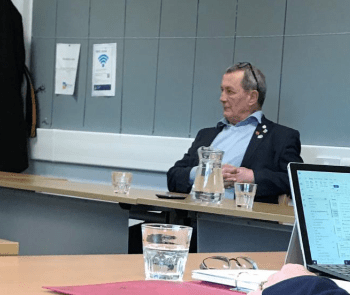
A DORSET councillor has been admonished for his behaviour towards a senior, female, officer.
Tory councillor Bill Pipe, who represents Lytchett Matravers and Upton, has been told to send a letter of apology and to undertake diversity and inclusion training.
He will also be offered a mentor to provide ongoing guidance and support.
Cllr Pipe admits mimicking the accent of the officer and said he was astonished that she had been offended and intimidated by what he saw as “merely jovial banter.”
He denied telling a homophobic joke, making a comment about a visible panty line and saying he wanted to know where the officer parked so he could ‘nick the parking space. The investigating officer agreed that these allegations could not be substantiated.
A panel of three decided that Cllr Pipe had breached the council’s Code of Conduct and protocols for dealing with officers, bringing the council into disrepute.
Chair Cllr Susan Cocking said the panel had been appalled at the lack of respect shown, which she said, amounted to harassment and bullying.
“This was offensive and not acceptable under any circumstances – no one should be subject to such treatment,” she said.
Cllr Pipe, who had his council pass withdrawn in the summer when the investigation started, and is only allowed in council buildings when accompanied, said after the hearing that he was genuinely remorseful and had not realised his actions would cause offence, having gone on for what he said was eight or nine years, without complaint.
He said he failed to understand why the officer had not raised it with him, the chief executive or her line manager, at the earliest opportunity if she was offended.
“Had I known my doing this would offend, or belittle her, I would have stopped immediately and apologised… had she come to me and said not to do it I wouldn’t have carried on,” said Cllr Pipe.
“I thought she was taking it in the spirit it was meant – a happy, jovial way. It’s pretty sad it’s got to this state.”
He revealed that he is now being treated for depression, but said after the hearing that it was unlikely the finding would alter his decision to stand for council again at the May elections.
The council has no powers to bar any councillor found to breach code of conduct rules from office, apart from for proven criminal activity.
Dorset Council said: “Cllr Pipe remains a councillor. He is entitled to attend council meetings and has access to do so.
“Standards committees have no ability to suspend or dis-bar councillors.”
The Environment Agency faces new allegations of neglect of the River Wye after a project by a conservation group found effluent and contaminated waters at free-range egg farms flowing directly into watercourses in the catchment.
Out of 47 sites visited in England and Wales in the Wye catchment, 19 had drains running from the poultry units to a nearby watercourse. Many of the farms had drains excavated within a few metres of the sheds.
Charles Watson, chair of River Action, the charity that obtained details of the advisory visits to free-range egg farms under freedom of information laws, said: “These documents show a large number of intensive egg production farms have been allowing the excrement of hundreds of thousands of chickens to run off, without any proper mitigation, straight into the river system.
“This is in clear breach of the regulations, and the bodies protecting the environment have largely been in denial while this has been going on. There has been scandalous neglect over the years.”The River Wye has been blighted by poultry pollution, with hundreds of new production units approved in the last two decades to feed the nation’s huge demand for chicken meat and eggs. The condition of the River Wye was downgraded last May after campaigners warned its ecosystem has been devastated by intensive poultry production.
The advisory visits to the farms were conducted by the Wye and Usk Foundation, which works to improve the ecology of the River Wye. The visits were conducted in partnership with free-range egg farmers, including suppliers to Noble Foods, owner of the free-range egg brand the Happy Egg Company.
In an email to Environment Agency officials sent in February last year, the Wye and Usk Foundation said that drainage water from the farms was “a pollution risk and should not be directed to watercourses”. It added that the issue was “very common and one that we have found very difficult to address”.
The charity was seeking guidance on how the run-off should be treated. The Wye and Usk Foundation is working with farmers to better protect the River Wye catchment from effluent and agricultural run-off.
Simon Evans, chief executive of the Wye and Usk Foundation, said: “The Wye and Usk Foundation works with farmers and the wider supply chain to solve the problems afflicting our rivers. Many of the challenges we are trying to resolve are the legacy of historic poor planning decisions, such as when the planners have insisted the units be located too close to watercourses. In some cases, the solutions are not obvious and require careful consideration along with guidance from regulators. Noble has been actively engaged in helping to find and fund solutions on the farms that supply them, and their support is driving the progress that is being made to resolve the issues.”
River Action is taking a judicial review against the Environment Agency over allegations it had failed to protect the River Wye from agricultural pollution. It is claimed the agency has failed to prevent the spreading of excess organic manure or properly apply the rules.
Ricardo Gama, a solicitor at Leigh Day, which is representing River Action in the judicial review due to be heard next month at the high court in Cardiff, said: “River Action’s ultimate goal is that the agency takes a strong hand and actually starts enforcing these rules.”
An Environment Agency spokesperson said: “We recognise the River Wye is under pressure, which is why we are already offering a wide range of support to farmers around the river to speed up their transition to more sustainable practices. We work closely with groups like the Wye and Usk Foundation, who provide advice to farmers.
“In the Wye catchment, we carried out 493 farm inspections and issued 285 improvement actions from 1 April to 31 December 2023. These inspections targeted high-priority catchments such as protected habitats, and those where intelligence indicated rule breaches and pollution.”
A spokesperson for Noble Foods said: “Over the last three years [we] have been working hard with our producer base in the Wye and Usk region. We are supplied by family-run farms in the region, which represent less than 5% of the total poultry flock in the area. We are encouraging our producers to embrace nature-based solutions, such as wetland pools, as part of our work with the Wye & Usk Foundation.”
Gary Ford, chief executive of British Egg Industry Council (BEIC), said: “BEIC is committed to complying with legal requirements and ensuring that egg production does not adversely impact the local environmental infrastructure.
“BEIC is funding a number of independent research projects in this subject area. The initial evidence suggests that the impact of free-range farming is likely to have a minimal, if any, direct effect on the increased phosphate levels in the Rivers Wye and Usk.”
Rhian Jardine, head of development planning at Natural Resources Wales, said: “[Welsh Water] has published data which indicates that rural land use is contributing to 72% of phosphorus loading of the upper Wye. We will use all the resources at our disposal to prevent pollution. We also recognise that we can’t reach lasting solutions alone. Everyone has a role to play.”

 East Devon Watch