Rising sea levels ‘to cost Britain £100bn by 2100’

Rising sea levels could cost the British economy more than £100 billion by the end of the century, as floods cause “catastrophic” damages to some of Europe’s coastal regions.

Adam Vaughan www.thetimes.co.uk 

Sea levels have already increased by 20cm globally since the start of the twentieth century, increasing the risk of flooding from surges during storms and high tides.

Dutch and Italian researchers have estimated the cost of future swelling seas, predicting that GDP in Britain and the European Union will be €872 billion smaller in 2100 than in a counterfactual world without rising sea levels. Overall, GDP would be down 1.3 per cent.

The researchers expect Britain be face a loss of €121 billion, or 1.1 per cent of GDP.
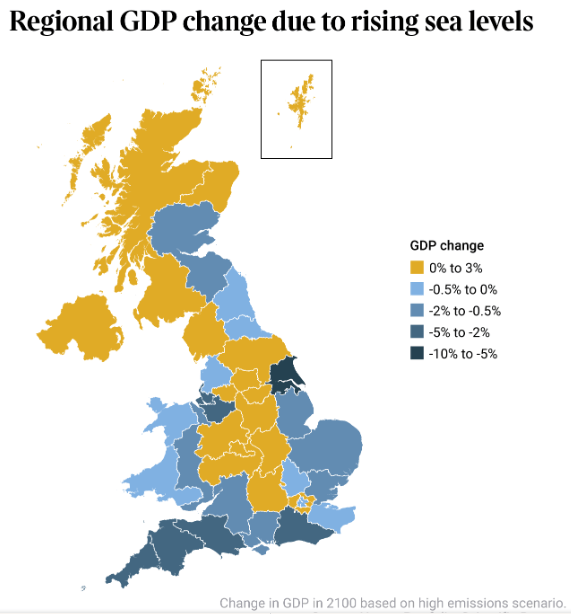
However, the impact on some coastal areas will be far higher, as much as 21 per cent in the north of Italy and north of Poland. “A 20 per cent loss of GDP is catastrophic. It is not something you recover from, really,” said Ignasi Cortés Arbués at Delft University of Technology, who led the study published on Thursday in the journal Scientific Reports.

Britain is close to the European average in terms of damages. Cortés Arbués said Lincolnshire and surrounding areas would likely suffer the biggest impact in the UK. Lincolnshire’s coastal transport infrastructure is expected to be badly affected, causing knock-on economic effects for the rest of the agriculture-rich county.

The estimated economic impact for the UK and EU’s 27 member states is something of a worst case scenario.

Cortés Arbués and colleagues assumed global carbon emissions continue on a high trajectory. That path is considered less likely than previously because of the growing number of countries pursuing net zero plans and switching to renewable energy.

The researchers also assumed no new coastal defences or other adaptation measures were taken after 2015. But planners are already exploring how defences such as the Thames Barrier will need to be upgraded later this century.

The researchers defended taking a gloomy view. “This is a stress test of what the economy can do, based on what we do have today,” said Theodoros Chatzivasileiadis, also at Delft University of Technology. The study authors also pointed out that they had not factored in “tipping points” in glaciers and ice sheets around the world, which could lead to faster collapse and greater sea level rise than expected.

The estimated damages were calculated by looking at different sectors, from transport to agriculture. While the economic impact of rising seas has been explored in the past, it has not been looked at such a granular regional level before.

“This study is useful for showing how the increasing threat from climate-induced sea level rise plays out in an economically uneven way. While the hit to national GDP may or may not be high in particular countries, their data reveals that within those overall national figures, particular coastal regions and sectors may be particularly badly hit,” said Professor Chris Hilson at the University of Reading, who was not involved in the research.

Exmouth Council holds free cost-of-living crisis workshop

Exmouth Town Council and Devon Communities Together are holding a free cost-of-living crisis workshop at Littleham Leisure Centre.

Adam Manning www.exmouthjournal.co.uk

Taking place on Tuesday, January 30 -from 6:00pm to 7:30pm and Wednesday January 31- 12:00pm-2:00pm.

Come along for a FREE workshop for advice on how to reduce your energy use and manage your bills during the cost of living crisis.

The workshop will advise residents on accessing financial support Understanding fuel poverty, the energy market and energy costs How to use energy effectively in the home, keeping warm Supplier services for vulnerable customers and smart meters.

FREE Energy Advice Workshops from Devon Communities Together.

Book a 10-minute advice session and get a FREE bag of goodies to help keep you warm this winter call 01392 248919 or email: anderson.jones@devoncommunities.org.uk

This scheme is in partnership with Devon Communities Together and Exmouth Town Council, to find out more call 01395 276167 or email zoey.cooper@exmouth.gov.uk.

Campaign, now 3 hospitals, returns to County Hall next Wednesday

seatonmatters.org /

Seaton and Teignmouth Hospital campaigners will be joined at Devon Health Scrutiny Committee on Wednesday by supporters of Okehampton Hospital, where the ICB are also trying to hand back a ward to Property Services. Please join us if you can!

A three-community protest, Save Devon’s Community Hospitals, will meet outside County Hall at 1.30. The Committee is at 2.15 and Jack Rowland and I will again be speaking, along with Teignmouth and Okehampton colleagues. We are talking to supportive members of the Committee about what it can best do.

Richard Foord MP had intended to be present, but now needs to speak in a debate on international affairs in Parliament, and is sending a letter of support to the Scrutiny Committee. He presented the Seaton Hospital petition in Parliament two days ago.

Planned discussions with the ICB and Property Services have been postponed, but we are now hoping to meet them on 1 February at the Hospital. In the meanwhile, our Steering Committee is also meeting next week to discuss progress on our own plans for using the empty space.

Campaigners are now asking: Which community hospital, paid for by a local community, will be under threat next?

  • The ICB have revealed to Seaton campaigners that they originally looked into using the Brownfield Land Fund to obtain public funding for demolishing part of the hospital and building houses. 

The Committee will be considering reports on Teignmouth and Seaton – the report on Seaton includes NHS Devon’s proposal for Okehampton. 

  • Speakers from the 3 communities will address the Committee.
  • Richard Foord MP has written to the Committee

Fujitsu boss admits his company knew right from the start about the Post Office IT problem

Fujitsu knew of defects in the Horizon IT system for nearly two decades, while witness statements used in the prosecution of subpostmasters were edited to omit references to the problems, the software manufacturer’s European chief has admitted.

“Shameful” and “appalling”.

Zoe Grunewald www.independent.co.uk

Fujitsu Europe director Paul Patterson told the official inquiry into the Post Office scandal that bugs and errors in the faulty accounting system were known about “right from the very start” by “all parties”.

And he said he had seen evidence of the editing of witness statements – an action he described as “shameful” and “appalling”.

Hundreds of subpostmasters were prosecuted for theft and false accounting because of errors generated by the Horizon software, in what Rishi Sunak has described as “one of the greatest miscarriages of justice in our nation’s history”.

Their plight was highlighted in an ITV drama, Mr Bates vs The Post Office, which triggered a public outcry earlier this month and led the prime minister to announce plans to exonerate those who had been affected by the scandal.

Fujitsu is now facing demands to contribute a “substantial” sum towards the mammoth £1bn compensation bill, after the company admitted earlier this week that it had a “moral” duty to do so.

Giving evidence to the official inquiry into the fiasco, Mr Patterson said that the earliest report of a bug he was aware of was in November 1999, and the latest in May 2018.

When asked if Fujitsu knew about the existence of errors and defects at a “corporate level”, he said that “right from the very start of the deployment of this system, there were bugs and errors and defects which were well known to all parties”.

He told the inquiry: “I’m surprised that that detail was not included in the witness statements given by Fujitsu staff to the Post Office – and I’ve seen some evidence of editing of witness statements by others.”

Pressed by the inquiry lawyer on how he would describe the editing out of bugs or “data integrity problems” in witness statements, he said: “Shameful, appalling – my understanding of how our laws work in this country [is] that all of the evidence should have been put in front of the subpostmaster, that the Post Office was relying on to prosecute them.”

Mr Patterson also told the inquiry that data provided to subpostmasters during criminal proceedings was “not sufficient” for them to understand whether Horizon was “operating correctly at the relevant branch”.

It was “certainly not a gold standard or any standard – it’s a very simple Excel file which tells you not very much”, he added.

Appearing in front of MPs on the business and trade committee on Tuesday, Mr Patterson acknowledged that Fujitsu had a “moral obligation” to contribute to the compensation awarded to subpostmasters. But he said that the “right place to determine that” was after the official inquiry had published its findings.

His appearance came as the Post Office was ordered by the government to investigate a second IT system after the i newspaper revealed that a number of subpostmasters had claimed to have been convicted of theft on the basis of errors generated by Capture software.

The government has now been asked to look into the case of Steve Marston, a 67-year-old former subpostmaster in Heap Bridge, Greater Manchester, who claims that errors in the software – a precursor of Horizon – led to his being convicted of theft and false accounting offences in 1998.

On Thursday, the Department for Business and Trade asked the Post Office to establish “if there are issues with any other systems currently or previously used by [the] Post Office”, following reports that three former subpostmasters had said that the system was prone to errors and caused shortfalls when they went to balance their books.

A Post Office spokesperson said: “We take very seriously the concerns that are being raised about cases from before the Horizon system was first rolled out in 1999, and we will of course assist in looking into such cases brought to our attention.”

Mr Marston said he had not stolen “a penny” but had pleaded guilty in order to avoid being sent to prison.

“They said pleading guilty was the only way to avoid going to jail,” he said. “I just thought it must be something I’m doing wrong; computers were in their infancy, you didn’t think they could be wrong.”

“They said, ‘Capture doesn’t make mistakes,’” he added.