
Rising sea levels could cost the British economy more than £100 billion by the end of the century, as floods cause “catastrophic” damages to some of Europe’s coastal regions.
Adam Vaughan www.thetimes.co.uk
Sea levels have already increased by 20cm globally since the start of the twentieth century, increasing the risk of flooding from surges during storms and high tides.
Dutch and Italian researchers have estimated the cost of future swelling seas, predicting that GDP in Britain and the European Union will be €872 billion smaller in 2100 than in a counterfactual world without rising sea levels. Overall, GDP would be down 1.3 per cent.
The researchers expect Britain be face a loss of €121 billion, or 1.1 per cent of GDP.
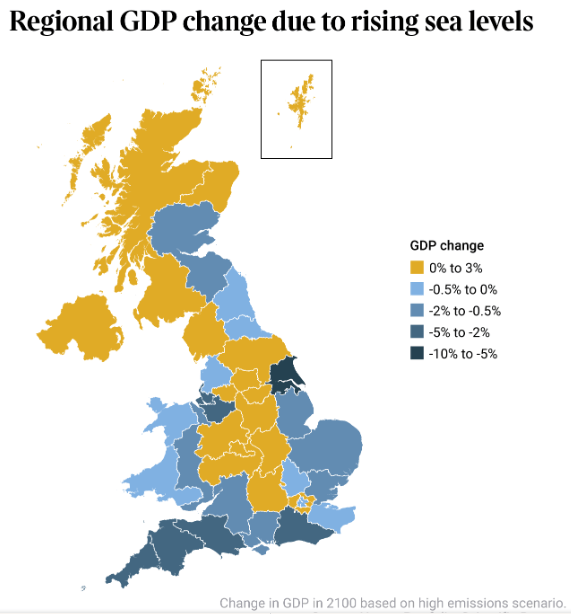
However, the impact on some coastal areas will be far higher, as much as 21 per cent in the north of Italy and north of Poland. “A 20 per cent loss of GDP is catastrophic. It is not something you recover from, really,” said Ignasi Cortés Arbués at Delft University of Technology, who led the study published on Thursday in the journal Scientific Reports.
Britain is close to the European average in terms of damages. Cortés Arbués said Lincolnshire and surrounding areas would likely suffer the biggest impact in the UK. Lincolnshire’s coastal transport infrastructure is expected to be badly affected, causing knock-on economic effects for the rest of the agriculture-rich county.
The estimated economic impact for the UK and EU’s 27 member states is something of a worst case scenario.
Cortés Arbués and colleagues assumed global carbon emissions continue on a high trajectory. That path is considered less likely than previously because of the growing number of countries pursuing net zero plans and switching to renewable energy.
The researchers also assumed no new coastal defences or other adaptation measures were taken after 2015. But planners are already exploring how defences such as the Thames Barrier will need to be upgraded later this century.
The researchers defended taking a gloomy view. “This is a stress test of what the economy can do, based on what we do have today,” said Theodoros Chatzivasileiadis, also at Delft University of Technology. The study authors also pointed out that they had not factored in “tipping points” in glaciers and ice sheets around the world, which could lead to faster collapse and greater sea level rise than expected.
The estimated damages were calculated by looking at different sectors, from transport to agriculture. While the economic impact of rising seas has been explored in the past, it has not been looked at such a granular regional level before.
“This study is useful for showing how the increasing threat from climate-induced sea level rise plays out in an economically uneven way. While the hit to national GDP may or may not be high in particular countries, their data reveals that within those overall national figures, particular coastal regions and sectors may be particularly badly hit,” said Professor Chris Hilson at the University of Reading, who was not involved in the research.
 East Devon Watch