‘Sewage pollution alert’ issued for every East Devon beach

The Surfers Against Sewage app shows a ‘sewage pollution alert’ for every beach in East Devon this morning (January 22).

Adam Manning www.exmouthjournal.co.uk

Alerts for Exmouth, Sandy Bay, Budleigh Salterton, Sidmouth, Beer and Seaton all say “there has been a sewage discharge into the sea from here. South West Water is responsible for this spill”.

The app says:

“Exmouth’s started at 10pm on Jan 21.”

“Sandy Bay’s began at 05:35 on Jan 22.

“Budleigh Salterton’s began at 22:05 on Jan 22.

“Sidmouth’s began at 23:25 on Jan 21.

“Beer’s began at 23.25 on Jan 21.

“And Seaton’s sewage discharge began at 05:50 on Jan 22.”

There are three types of alerts on the Surfers Against Sewage app, a sewage discharge alert, means there has been a sewage discharge from a combined sewer overflow within the past 48 hours.  pollution risk alert’ which means’ bathing is not advised’ and a pollution incident alert which means there has been a confirmed incident alert.

Planning applications validated by EDDC for week beginning 8 January

Labour vows to put water bosses ‘in the dock’ for illegal sewage dumping

Water bosses responsible for illegally dumping raw sewage “should be in the dock” for the damage caused to the UK’s waterways, Labour’s Shadow Environment Secretary has insisted.

Richard Vaughan, inews.co.uk

Steve Reed has warned executives of the major water companies that Labour will go after them personally with criminal sanctions if they continue to allow illegal “toxic” discharges to pollute the country’s rivers and seas.

Currently the firms themselves can be held liable for pollution but individual executives rarely are.

The Shadow Cabinet minister claimed that the Conservative Government has “turned a blind eye” to sewage dumping because of “a cosy relationship” with “the polluting water industry”.

Speaking exclusively to i as part the Save Britain’s Rivers campaign, Mr Reed accused water firms of “corruption” and vowed to legally pursue chief executives if they fail to clean up the mess being left in the country’s waterways.

“Last year, we had the highest level of illegal sewage discharges in history. And that means you’ve got toxic, raw sewage swilling through our rivers, our lakes and into our seas and lapping up onto our beaches. And the public are quite rightly furious about this,” he said.

Mr Reed highlighted the case of United Utilities, which was accused last year of downgrading pollution incidents, including dumping raw sewage into the World Heritage Site Lake Windermere. The move enabled the firm to increase its bills for customers by £5.1m, according to a BBC Panorama documentary. United Utilities denies the allegations.

Asked if water bosses should be in court over the illegal dumping of sewage, Mr Reed said: “The reason I want to begin personal criminal liability is because I think they should. I do think they should, but this government has just sat back and let them get away with it.

“And you have to ask why? What is this cosy relationship that exists between the Conservative Government and the polluting water industry?”

Labour has vowed to immediately place water companies in “special measures” if it forms a government, and will block the payment of bonuses to water executives if they are found to have overseen illegal sewage dumping. The bosses of the worst offending companies will then be held personally criminally liable and firms will be stripped of powers to self-monitor their own water outlets.

Water companies receive permits that allow them to discharge sewage into rivers, lakes and coastal areas during times of exceptional rainfall to prevent their infrastructure from becoming overwhelmed.

However, firms have faced repeated accusations of dumping sewage outside the parameters of of these permits, which is illegal.

Criminal charges can be filed for breaches of these permits, but such cases are lengthy and expensive, meaning that the Environment Agency (EA) often relies on civil penalties. The Government recently increased the maximum fine that water companies can face in civil cases from £250,000 to £250 million.

For the most severe cases, the EA does pursue criminal charges, but these have resulted in fines levied against water companies, not custodial sentences for executives.

For example, Southern Water was fined £90m as part of a criminal investigation that concluded in 2021 that found the firm was responsible for thousands of illegal raw sewage discharges that polluted rivers and coastal water around Kent.

The EA has in the past urged courts to impose jail sentences on water company executives when serious cases of pollution are proved. However, the Crown Prosecution Service would have to consider the public interest when deciding whether to charge executives with criminal offences, and weigh how likely they would be to secure a conviction.

Mr Reed told i that the threat of losing bonus payments and possibly ending up in court will “focus the minds of water bosses”.

“It will make sure they comply with the law, and that means making sure you put in place a serious plan to bring in the investment that we need to get the water infrastructure fixed,” he said.

The dumping of sewage has become a major political issue as people across Britain have become increasingly aware of how often untreated waste is being released into our waters through points known as “storm overflows”.

This awareness is partly due to increased monitoring; in December water companies hit a Government-imposed target of installing monitoring equipment at 100 per cent of these storm overflow points for sewage spills, up from just 7 per cent in 2010.

Mr Reed, the MP for Croydon North, also pledged to look at the “revolving door” between regulators Ofwat and the Environment Agency and the water companies.

An investigation last year found that at least six senior current industry staff members have been identified as moving jobs between regulators including Ofwat and the EA and water firms such as Southern, Northumbrian and South West Water.

The EA Government body has itself come under fire for its failure to properly regulate water companies who flout the conditions of their permits. Last month i revealed that the watchdog failed to visit 90 per cent of toxic water spills in England last year, including 60 per cent of the most serious incidents.

Mr Reed also raised the Conservatives’ attempts to scrap so-called nutrient neutrality regulations that protect waterways from overdevelopment in a bid to build more housing. He suggested it was an example of the Tories turning a “blind eye” to water pollution to appease big developers, many of whom are Conservative Party donors.

“Looking at the nutrient neutrality issue, who is one of the biggest sources of donations to the Conservative Party? It’s developers. And who is the government trying to lower environmental standards to benefit? It’s developers. Well, there’s a cosy relationship.”

He said the Government is “as aware as anyone” about the problem, but has failed to prevent it because the Conservatives have a “far too cosy relationship with the water companies”.

It comes as Labour has published figures that show water bosses have paid themselves a staggering £25m in bonuses since the 2019 election, despite accusations of widespread failure in the system.

“There’s £25m I’ve identified that could be spent on improving infrastructure by not paying it as bonuses and incentives to water bosses who are overseeing law breaking. I don’t think the public should be charged a penny more. While there is that amount of corruption – and I do think it’s corruption – in the system.

“If you’re knowingly breaking the law and covering it up to make more money for yourself and your company, that is corruption.”

The Conservatives have been approached for comment.

Over 40 MPs – including seven former cabinet members – urge the government to re-think local authority funding plans 

A large cohort of county MPs – including 44 Conservatives and seven former cabinet members within this group – have written to the Prime Minister urging his government to provide an emergency injection of funding for councils to prevent major reductions to local services.

Ian Burbidge www.countycouncilsnetwork.org.uk 

The government is currently consulting on its final Local Government Finance Settlement, to be published next month. This will confirm how much funding councils in England will receive in 2024/25.

It follows November’s Autumn Statement, which provided no new funding for local authorities despite the County Councils Network (CCN) highlighting its members were under extreme financial pressure and set to overspend this year by £650m, with these councils facing a total £4bn funding deficit over three years. To compound this, the announcement of the National Living Wage has left those 37 councils over £230m worse off next year.

With local authorities now setting out significant service reductions in their budgets next year, the 46 MPs who have signed the letter say they are ‘exceptionally concerned’ that residents will be faced with a ‘double whammy’ of reductions in services and higher council tax rates in order for councils to deliver a balanced budget.

Read the letter here.

The group of MPs, include former Local Government Secretary of States Robert Jenrick and Greg Clark, as well as prominent former cabinet members such as Priti Patel, Therese Coffey, Damien Green, and Brandon Lewis. They also include former local government ministers Neil O’Brien, Heather Wheeler, Kit Malthouse, and Jake Berry.

They have called for the government to provide emergency funding for councils to prevent substantial cuts to local services, or worse, some authorities facing financial insolvency and unable to deliver a balanced budget in 2024/25.

In the letter, co-ordinated by CCN and the County All-Party Parliamentary Group (APPG) they say ‘There is still an opportunity to rectify the situation and ensure MPs are able to support the vote on the Local Government Settlement within the House of Commons in early February.

‘We would therefore urge you to do all you can to use the Final Local Government Finance Settlement to provide additional funding for local government to ensure that the councils in our areas can continue to provide the services that our residents depend upon on a regular basis.’

…’As a fellow MP for a county area, we are sure that you will find the prospect of residents in county and rural areas being impacted in such a way at this time concerning.’

Read CCN’s consultation response to the provisional Local Government Finance Settlement here.

Out of the £650m projected overspend, 45% is down to pressures in children’s services, 25% is down to costs in adult social care, and 20% is attributable to rising demand in school transport services for SEN pupils. The signatories urge government to prioritise any additional funding to these three areas.

Following the letter being submitted, the CCN and the County APPG say they are having ‘constructive’ discussions with Downing Street but are urging the government to rectify the situation and announce additional funding as soon as possible.

Cllr Ben Bradley MP, Chair of the County All-Party Parliamentary Group, said:

“County and unitary councils across the country are currently setting out their budgets for next year, with many proposing substantial reductions to highly valued local services as well as tightening of eligibility for care services. With council tax set to rise again this year, residents face a double whammy. No council leader will take any pride in taking this action, but they simply have no choice after the Autumn Statement left them in a significantly worse position.

“The extent of the impact can be reduced if councils are given an emergency injection of funding, and 46 MPs have signed our letter calling on the government to intervene and protect local services. The fact that we have two former Local Government Secretaries, seven former cabinet members, and support from all three main parties shows the strength of feeling on this issue, particularly amongst my Conservative colleagues.

“I’m the privileged position of being both a council leader and MP and so I can see both sides. The Autumn Statement put more money in people’s pockets and I understand that the public finances are tight, but councils provide important local services that millions rely on each day. We have had constructive dialogue with Downing Street, but we are urging the government to rectify the situation as soon as possible so colleagues in the Parliamentary party are able to support the vote for the final Local Government Finance Settlement next month.”

Cllr Barry Lewis, Vice-Chair of the County Councils Network, added:

“We county leaders pride ourselves on being financially prudent and not afraid to make the difficult decisions but this year we find ourselves under financial pressure like never before. We desperately need government support to stave off the extent to which we will have to make unpalatable reductions to services.

“It is encouraging that an unprecedented number of county MPs, including those from all parts of the country, share our same concerns over the funding shortfall we face. We have had constructive discussions with ministers, but we now hope the government listens to our joint campaign and provides emergency resource later month.”

  • The County Councils Network (CCN) is the national voice for England’s county councils. It represents 21 county councils and 17 county unitary authorities. Collectively, they represent 25 million people, or 47% of the country’s population. For more information click here.

Today is “Max Out” Monday

Rishi Sunak facing renewed pressure over plans to ‘max out’ North Sea oil

Rishi Sunak is facing further attacks on his plans to expand oil and gas exploration in the North Sea this week. The Offshore Petroleum Licensing Bill – to be debated in the Commons on Monday – has already triggered widespread protests, including the resignation of Chris Skidmore, a former Conservative energy minister.

Robin McKie www.theguardian.com

The bill aims to boost fossil fuel extraction by establishing a new system under which licences for North Sea oil and gas projects will be awarded annually.

Green groups and analysts are lining up to criticise it. UpLift, which campaigns for green energy, pointed out that the bill, which the government says will “max out” the UK’s reserves, will actually result in only a 2% rise in North Sea gas output. “The remaining 98% of gas demand will come from existing North Sea fields,” its analysis finds.

It adds that just one 1.3 gigawatt windfarm would generate more than enough electricity to offset the gas that would be lost if no new licences were awarded under the bill.

“Sunak, like his predecessor Liz Truss, is obsessing over oil and gas, but dithering on renewables and insulation which will boost UK energy security and lower bills,” said Tessa Khan, executive director of UpLift. “And it’s making people in this country colder and poorer.”

This point was backed by Bob Ward, policy director at the Grantham Research Institute on Climate Change and the Environment. “Investments in new North Sea developments will not make a significant difference to energy bills; they will have relatively high operating costs; and they will make it more difficult for the world to halt climate change.”

By contrast, investing in clean British energy and electrifying the economy, with heat pumps and electric vehicles, would reduce dependence on insecure and expensive fossil fuels, Ward added.

A new report by a group of leading economists including Nicholas Stern, criticises the government for allowing too much investment to continue to flow into unsustainable economies such as the development of new oil and gas fields and the construction of homes and offices that are not energy efficient or climate-resilient.

“Investing in the opportunities afforded by the global transition to an efficient, resilient and inclusive economy needs to be a bigger part of restoring productivity and output growth for the UK to gain a competitive lead in the innovative markets of the 21st century,” they state.

These criticisms follow a letter from the all-party parliamentary group for climate change which says: “Just last month, as the UK’s second warmest year on record concluded, the UK joined other countries in signing the UAE consensus at Cop28 and thus pledged to transition way from fossil fuels.

“However, this bill is diametrically opposed to that agreement. Instead of honouring the promises we’ve made to our allies and partners at Cop28 this bill further weakens any claim the UK makes to be a world leader in tackling climate change.”

For his part, Skidmore said before his resignation that he could not vote for legislation that “clearly promotes the production of new oil and gas” and would show that the UK is “rowing ever further back from its climate commitments.”

High rents force older tenants to move to deprived seaside towns

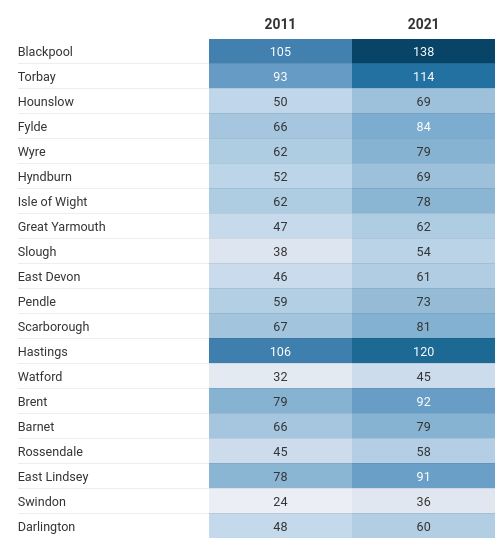
Of the 20 areas with the largest increase in older private renters during 2011 and 2021, ten are coastal areas that are among the poorest local authorities in the country.

Torbay and East Devon are in the list. – Owl

David Byers www.thetimes.co.uk

High rental prices are forcing older tenents to uproot and move to deprived communities with already overstretched public services, an analysis of census data has revealed.

Indepen/dent Age, a charity supporting pensioners in hardship, compared data from 250 English local authorities in the censuses of 2011 and 2021, and discovered widespread migration over the decade from richer to poorer areas for those aged 65 and over.

Of the 20 areas with the largest increase in older private renters during this period, ten are coastal areas that are among the poorest local authorities in the country. The area with the biggest rise is Blackpool — officially the poorest town in England — where 138 out of 1,000 older households were renting in the latest census compared to 105 in 2011.

This is followed by Torbay in Devon (114 per 1,000 compared to 93 in 2011), Hounslow in west London (69 instead of 50), and the Lancashire coastal areas of Fylde (84 up from 66) and Wyre (79 up from 62). Overall, Blackpool has the highest percentage of renting pensioners in England, with 14 per cent of all older people living in the private rented sector.

The areas with the most rapid decrease in older renters are the most expensive, dominated by London boroughs. This exodus is because of years of rising rental prices in these areas, which made them ever-more unaffordable, combined with an exodus of landlords who are facing higher taxes.

The biggest decrease of older renters was in the City of London, with 43 out of 1,000 households aged 65 and over renting in 2021 compared to 89 in 2011. This is followed by Camden, down from 92 to 69 between the two censuses, Westminster (157 to 135), Lambeth (73 to 57) and Hammersmith and Fulham (73 to 57).

Harlow in Essex was the local authority with the smallest percentage of older residents in the private rental sector in England, at 2 per cent.

Tenants have faced years of rent increases, particularly in London, as landlords sell up and property becomes unaffordable for many existing renters to buy. In the last year, as landlords’ mortgage rates went up, there have been double-digit rent rises for tenants in most regions.

Some tenants have reported being forced to compete with more than a dozen others for a room, submit personal statements for properties, queue and pay well over the odds to secure the room. However, Joanna Elson, chief executive of Independent Age, said there has been little attention given to how this phenomenon affects older people and the communities they move into.

In a report to accompany its research, Independent Age said older private renters are almost three times more likely to be in poverty than those who own their home mortgage-free.

“Older private renters living on a low income desperately need more protections. If they are forced to move out of the towns they know because of high rent, it is likely they will be cut off from friends and family and move into areas where access to services, including the NHS can be harder, which can lead them to experience worse health outcomes.

“This is not just a disaster for them, but a disaster for our society as a whole. None of us want to live our later years isolated, in poor quality housing or have our freedom to choose where we live taken away. Yet this is becoming a reality for a growing number of older people in financial hardship in the private rented sector, and it looks set to increase.”

Statisticians at Hamptons believe 11.5 per cent of all retirement-age couples will be in the private rental sector by 2033 if current trends continue compared with 5.7 per cent in 2022, a rise from 402,963 to 1,003,382, following an analysis of the English Housing Survey. As well as placing a strain on resources in some areas and driving up rental prices, Hamptons said the trend could also mean smaller amounts of inheritance being passed down the generations in future, creating more problems for already-squeezed younger people.