1.30 pm, Wednesday, before Health Scrutiny Committee at 2.15
Campaigners from TEIGNMOUTH, where the hospital has been under threat for some time, and SEATON, where NHS Devon announced 3 months ago that they were intending to hand back a wing to NHS Property Services for disposal, will be joined this time by campaigners from OKEHAMPTON, where a ward space is now also being handed back.
Richard Foord, MP for Tiverton & Honiton which includes Seaton, has written a letter to be read out at the Committee.
Campaigners are now asking: Which community hospital, paid for by a local community, will be under threat next?
The ICB have revealed to Seaton campaigners that they originally looked into using the Brownfield Land Fund to obtain public funding for demolishing part of the hospital and building houses.
The Committee will be considering reports on Teignmouth and Seaton – the report on Seaton includes NHS Devon’s proposal for Okehampton.
Speakers from the 3 communities will address the Committee.
Richard Foord MP has written to the Committee
CONTACT: Professor Martin Shaw, Secretary, Seaton Hospital Steering Committee 07072 760254
Last week at St Peter’s primary, Budleigh Salterton, the temperature in the 1960’s “sheds” dropped below 7C.
Hettie, 10, said: “When it’s so, so cold, you start shivering, so your writing goes really wobbly when you’re actually writing it because our hands are shaking so much.”
Last March, Head Teacher, Steve Hitchcock, sent a letter to the DfE, his MP Simon Jupp, and the parents at the school. He rehearsed the problems in education today and proposed solutions. He started: My community of headteachers has been meeting with our local Conservative MP for many years, and we sound like a broken record.
In 2010 Michael Gove cancelled the “Building Schools for the Future” programme introduced by Labour in 2004
Is Simon Jupp AWOL, gaining face recognition in the new Honiton and Sidmouth constituency which doesn’t include Budleigh? Tipton isn’t the only primary with long standing problems.
Schools in urgent need of repair have told Panorama they are struggling to keep children warm in buildings that are “not fit for purpose”.Watch on BBC iplayer(UK only)
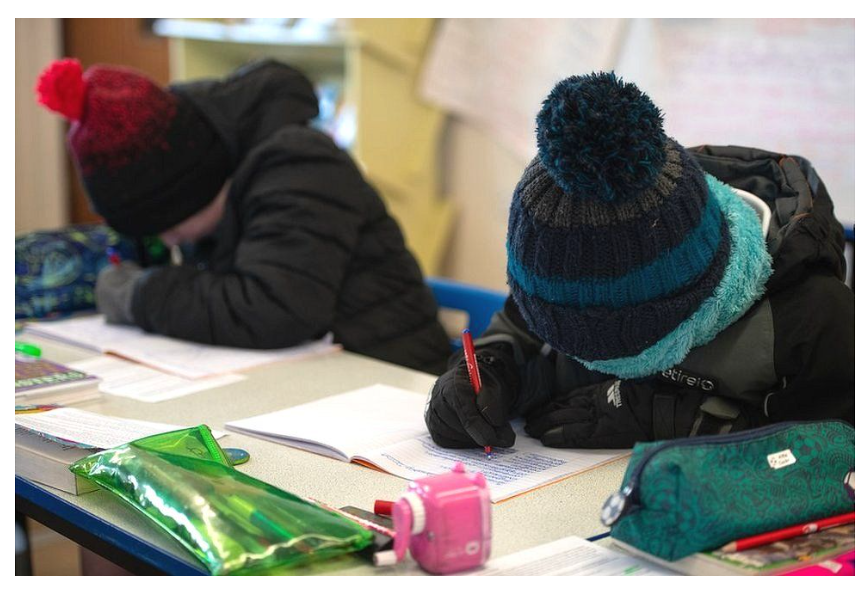
At one primary in Devon, temperatures are so low that children keep gloves and coats on during some lessons.
The head teacher says despite parts of the school being seemingly impossible to heat, he has been told it does not qualify for extra money for repairs.
The Department for Education (DfE) says pupil and staff safety is “paramount”.
According to the government’s own figures, the average primary in England needs £300,000 worth of maintenance or upgrades, while the average secondary school needs an estimated £1.5m.
BBC Panorama’s investigation reveals what some of that damage and decay means for pupils and teachers who experience it every day. We found:
A secondary school in Dumfries and Galloway where draughty windows are stuck together with sticky labels
Another in North Yorkshire that teaches some lessons in marquees in a playground, because two-thirds of its building became unusable after the discovery of potentially dangerous concrete, known as Raac
A further secondary school in Essex that has a no-go area after a Raac problem led to the discovery of asbestos
A primary school in Greater Manchester that has faced multiple evacuations because of flooding and worrying levels of potentially explosive sewage gas
At St Peter’s Church of England Primary School in Budleigh Salterton, Devon, some children work in unheated modular buildings – nicknamed “the sheds” – which were built in the 1960s and were supposed to be temporary.
St Peter’s has three classrooms that its head teacher describes as “just sheds”
Just last week, temperatures in the “sheds” dropped below 7C – even with all the heaters on. Workplace regulations say classrooms should be at least 16C.
“I’m really cold. I have to wear gloves and it’s really hard to use a pencil or a pen when you’ve got your gloves on,” said Sebastian, who is eight.
Hettie, 10, said: “When it’s so, so cold, you start shivering, so your writing goes really wobbly when you’re actually writing it because our hands are shaking so much.”
Last year, a National Audit Office (NAO) report on school conditions said about 24,000 school buildings were “beyond [their] original design life” – that’s more than a third of the entire school estate in England.
It also found about 700,000 children were having to learn in “a school that the responsible body or DfE believes needs major rebuilding or refurbishment”.
The NAO’s report also highlighted the scale of the Raac crisis across the school estate in England.
The funding of school maintenance can be complicated. Different responsibilities are shared between central government, devolved administrations, local authorities and the schools themselves.
The Welsh and Scottish governments say they don’t have figures for their backlogs of school maintenance. Northern Ireland says its bill has been growing for 15 years and is now estimated at about half a billion pounds.
The DfE says £5.3bn is needed each year to maintain schools in England, but it has only been allocated about £3bn by the Treasury.
After a survey, St Peter’s was given an A grade for the condition of its buildings
With a £2bn shortfall, the backlog of repairs is growing fast.
In 2021 the government published results of a conditions survey of almost every school in England and graded them in four categories.
St Peter’s in Budleigh Salterton was rated grade A, which means it had been assessed as in the best condition.
Steve Hitchcock is head teacher at St Peter’s, which is left putting the little funding it has into maintaining its “sheds”
“It’s farcical,” said head teacher Steve Hitchcock. “We have three classrooms that are just sheds, that are just not fit for purpose.”
A report from MPs on the Public Accounts Committee at the end of last year noted that schools in the north of England generally appeared to be in worse condition than those in the south.
At Russell Scott Primary School in Denton, Greater Manchester, head teacher Steve Marsland empties out buckets of water collected from leaks around the school whenever it rains.
In 2015, the school underwent a multi-million pound refurbishment to its 150-year-old building. But Carillion, the company contracted to carry out the repairs, left the school with a catalogue of new problems, including faulty fire doors.
Carillion has since gone bankrupt, with debts of more than £7bn, and the school has been left battling issues old and new, including flooding, roofs leaking and heating failures for nearly a decade.
“Since 2015, we’ve had to close the building six or seven times for various issues,” said Mr Marsland.
“We’ve actually abandoned the building for explosive levels of sewer gas.”
Back in 2004, the Labour government’s solution to repairing schools was billed as the biggest school-building investment programme since the Victorian era.
It was called Building Schools for the Future and aimed to rebuild or refurbish every secondary school in England over a 15-20 year period.
But this programme was cancelled in 2010, by the coalition government and then-education secretary Michael Gove. A separate programme for primary schools was also cut back, but not cancelled.
Sam Freedman was Mr Gove’s adviser at the DfE in 2010. Speaking to Panorama, he said he now felt the decision to cut the Building Schools for the Future programme had been rushed.
He also said if the programme had not been cancelled he thinks most of the issues impacting the school estate today, including Raac, would have been “picked up earlier” – because every secondary school in England would already have been structurally assessed.
In a statement, a DfE spokesperson said the government had compiled the largest and most comprehensive survey of school building conditions in Europe – the first of its kind – to “significantly” improve the condition of the school estate, targeted where it was needed most.
The spokesperson added that £15bn of capital funding had been allocated since 2015 for essential maintenance and improvements, including £470m in 2023 “to address school buildings in need of immediate support as quickly as possible”.
In addition, the School Rebuilding Programme, which began in 2021, commits the government to rebuilding 500 schools in England, both primary and secondary, over the next 10 years.
In Wales, the government says it spent £2.3bn over the past 10 years rebuilding and refurbishing schools.
Meanwhile, the Scottish government provided £1bn of funding to the Learning Estate Investment Programme (LEIP), which started in 2019.
However, in England, three years in, only four schools have been rebuilt and, according to the NAO, the government is already behind on its plans.
Emma Wilson, author of last year’s NAO report, said the DfE “has made much slower progress than initially expected with the school rebuilding programme. Both in terms of getting those schools on contract and ready for the build and also doing the construction itself, which will inevitably have impact on the rest of the schools that are following in the queue behind them.”
The DfE told Panorama that progress with the School Rebuilding Programme had been hampered by global events like the war in Ukraine.
In the meantime, St Peter’s is left putting the funding it has into maintaining its cold and leaky sheds.
And at Russell Scott Primary, Mr Marsland is still laying out plastic containers when it rains.
In 2022, he received a letter from the Secretary of State for Education, saying that the school would be rebuilt, but he has been waiting since then for news of when the work will start.
When Panorama contacted the DfE, it said the school will have “a detailed programme plan to review” by the end of January 2024 and will be more “deeply engaged” by the department from that point onwards.
“You get used to every problem and you deal with it, and deal with it, and deal with it. So it becomes second nature and just normalised, which is the issue,” Mr Marsland said.
“I should have been retired, I’m 65 now. But I can’t leave the school in this way until it’s rebuilt. Until I see a digger on the foundations being being laid for a new school… I’ll be going nowhere.”




 East Devon Watch