Labour and Tories need to be honest about economic trade-offs, says IFS

“If to govern is to choose, then to campaign should be to present clear choices and trade-offs to the electorate. If the parties don’t do that clearly and honestly over the next year, we at IFS will do what we can to plug that gap.” Paul Johnson, Director IFS.

Larry Elliott www.theguardian.com 

Britain’s next government faces some of the toughest tax and spending choices for generations as it is forced to grapple with the impact of weak growth and high debt interest payments, a leading thinktank has said.

The Institute for Fiscal Studies (IFS) warned that Jeremy Hunt’s much-predicted budget tax cuts risked being reversed or paid for by spending cuts, and urged the Conservative and Labour parties to “level” with voters before polling day.

Launching the IFS’s work programme for an expected autumn general election, the thinktank said the victorious party would have a “thorny” inheritance.

“Living standards have endured an unprecedentedly long stagnation. Taxes are at record levels for the UK (though remain low to middling by European standards). Public services are showing visible signs of strain and are, in many cases, performing less well than they were in 2010,” the report said.

Falling inflation and lower market interest rates have improved the short-term outlook for the public finances and provided Hunt with the scope for a giveaway package worth around £20bn. But the IFS said the chancellor needed to spell out what taxes would rise in the future or specify which services currently supplied by the state would be axed.

“Further tax rises and further cuts for most public services are built into current plans. But on official forecasts, this is only just enough to stabilise government debt as a fraction of national income,” the report said.

The thinktank said the challenges facing the next government were made more acute because a slow-growing economy would generate less in tax, and interest payments on the UK’s £2.7tn national debt would account for 9% of revenues on average across the next parliament.

Both the Conservatives and Labour have promised to reduce debt as a share of national income – which stands at just under 98% – but the IFS said this would be more difficult than at any time since the 1950s and would involve trade-offs. These included:

  • A large cut to public investment over the rest of the decade, which would still fall even if Labour’s planned spending on its green prosperity plan was taken into account.
  • Tough funding constraints, with concentration of spending on priority areas such as the NHS, schools and defence, implying cuts of £20bn in other unprotected departments.
  • Plans by both parties to cut net migration to the UK had implications for the social care and higher education sectors, and neither party had talked about the higher care costs or the higher tuition fees for domestic students that would result from cutting numbers.
  • Progress towards achieving net zero had involved picking most of the low-hanging fruit and the next steps – such as reducing emissions from buildings – would involve short-term costs on businesses and consumers.
  • Spending on disability benefits was rising fast and required urgent attention, but previous efforts to rein in spending had struggled to achieve the stated objectives, while any general promises to cut spending would need to be accompanied by specific details as to who would lose out.

The IFS said that unlike wars and pandemics, the challenges facing an incoming government were predictable, but could not be dealt with by a government that ignored reality and the need to choose from competing options.

The thinktank’s director, Paul Johnson, said: “Now more than ever, as a country, we face some big decisions and trade-offs over what we want the state to do and how we’re going to pay for it. Those looking to form the next government should be honest about these trade-offs.

“If they are promising tax cuts, let’s hear where the spending cuts will fall. If they are going to raise, or even protect, spending, they should tell us where taxes will rise. Or parties might think that further increases in government debt are justified, in which case they should make the argument for why debt should be rising.

“If to govern is to choose, then to campaign should be to present clear choices and trade-offs to the electorate. If the parties don’t do that clearly and honestly over the next year, we at IFS will do what we can to plug that gap.”
“Blue sky” ideas for Exmouth facelift

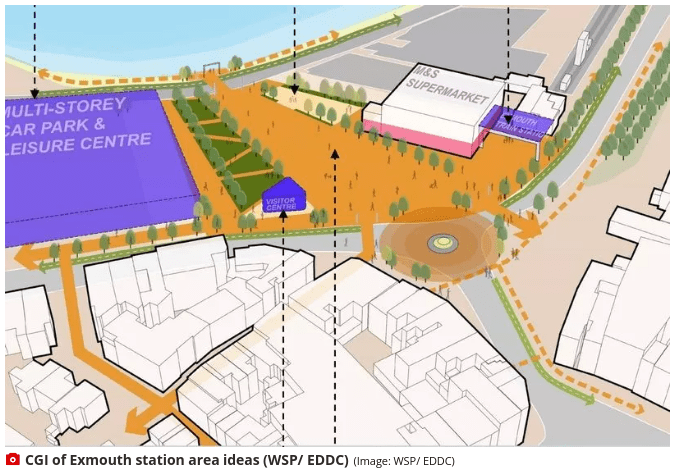
Several “blue-sky” ideas have been put forward for how Exmouth could be given a facelift. Changes to the area around the railway station, the town and the seafront were suggested by consulting firm WSP at an East Devon District Council (EDDC) meeting this week.

Will Goddard www.devonlive.com 

An extended forecourt is proposed at the station, followed by a public space which could be used for events, as well as a children’s play area and visitor centre. A new leisure centre, theatre, GWRSA facility and multi-storey car park would also be built at the current Imperial Road short-stay car park.

The ideas are separate to Devon County Council ’s plans for the station area, which include new crossings and filling in the subway.

Heading into town, WSP suggests extending the public space along Church Street and introducing more foliage, and also creating a space alongside Tower Street Methodist Church to “reposition the town centre as a pedestrian-friendly place.”

At the seafront, the firm explains how Exmouth Pavilion could be turned into a sports facility to “complement the leisure centre,” with a new public space opposite in place of the Beach Gardens car park. “Sculptural stairs” towards the Ocean leisure complex could provide access to the beach and also provide seating.

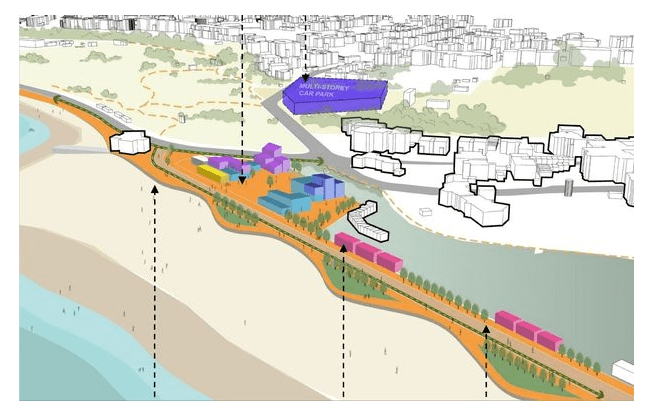
The last of its proposals included a new “arts and culture hub” at Foxholes car park, a new multi-storey car park on Maer Road, and a pedestrianised Queen’s Drive towards Orcombe Point with “pods” for a variety of uses.

No car parking places would be lost, just “consolidated” and the concepts are not set in stone.

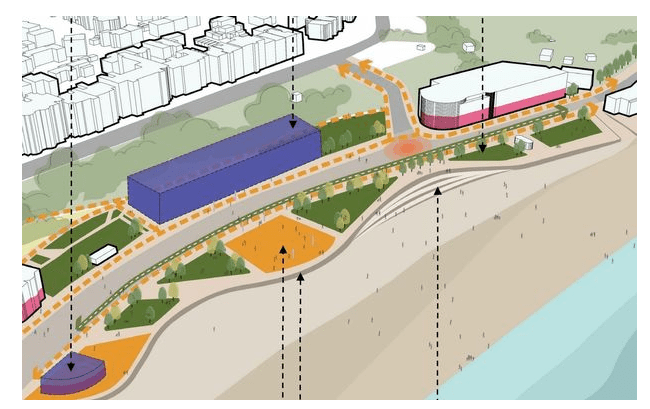
CGI of Exmouth’s Queen’s Drive ideas (WSP/ EDDC) (Image: WSP/ EDDC)

If all WSP’s ideas were to be implemented, it estimated the base cost could be just under £6 million between 2024 and 2026.

Cllr Olly Davey (Green, Exmouth Town) was impressed with the proposals, but says the public should be asked what they think.

He said: “I think it’s really important that we listen to local people as we go along.

“Unless we ensure that we take the people of Exmouth with us, we are going to get a lot of pushback.

“And it’s not always because people don’t like what we’re doing, but they resent the fact that they weren’t asked, they weren’t told, and they weren’t involved.

“So please let’s make sure that we really use meaningful consultation. We cannot run this and deliver it without the buy-in of the people of Exmouth.”

Cllr Geoff Jung (Lib Dem, Woodbury and Lympstone) said EDDC would need to think about sewage-related constraints.

CGI of Exmouth Esplanade ideas (WSP/ EDDC) (Image: WSP/ EDDC)

He said: “We need to work with the Environment Agency on the engineering and the climate resilience, and we need to work with South West Water with their infrastructure at the moment because South West Water pumping station is at Maer Road car park and there’s tanks underneath the car park, which we would have to consider when we’re putting a multi-storey car park there.

“We’ve also got sewage tanks underneath Imperial Road car park and again we’ll have to consider that. Having a car park and a sports hall above a sewage tank, there’s question marks there.

“We also need to work with [Devon County Council] highways because of their parking, the roads.

“It all forms part of a jigsaw. We’re well aware that South West Water are making big investments in Exmouth. And this project, a lot of these things will need to fit hand in hand with what they want to do.”

‘We need to give young people a voice in our decision-making’

Richard Foord, MP for Tiverton & Honiton 

I have been a staunch advocate for older people in beautiful East Devon. This has included speaking up in Parliament for the Triple Lock on pensions, through to being a stickler for older people’s access to services through traditional means, such as high street bank branches, and railway ticket offices. Today, I would like to give up my column to younger people.

Last year Devon County Council spent just under £2million on all youth services across the county; an almost trivial sum in the context of their wider £1.7billion budget. A tiny fraction of this sum would make a huge difference to local volunteer groups that are supporting young people. I visited one such last week – Headlight, that does vital work in Axminster and Ottery St Mary.

Those of us who are adults now are merely custodians of our planet. Many of us seek to pass on to our children a world that is slightly better than the one we inherited. We Liberal Democrats seek to make policy decisions that look to the long term.

It is vital we ensure the voices of young people are heard. We should give them the opportunity to help shape our decision-making. That’s why the British Youth Council was established, and why the Youth Parliament plays a key role in giving a voice to young people across the country.

I learned recently that Devon will not be participating in the British Youth Council’s youth Parliament. I do understand the huge challenges facing local government finances, but I feel this decision to withdraw from the British Youth Council is wrong.

Last year, I was lucky enough to have one of Devon’s Youth Parliament members spend a week volunteering in my office. Emiko is passionate about ensuring young voices from rural and coastal communities are heard. She has used her time as an ‘MYP’ (Member of Youth Parliament) to encourage other young people to register to vote.

It was great to get to work with her. I am just sad that, as her term nears its end, there will not be another person like her taking up the mantle if Devon is to withdraw from the scheme.

Given climate change and the nature crisis, we need young people around the table now more than ever. We should seek to help them leave a great country to another generation who we may never see.

If we want to create thriving communities that remain attractive places for people to live, work, and start a family, then we must ensure we put our young people at the heart of our planning.

Thames Water spilt more sewage into rivers than year before

Thames Water must “get a grip” on river pollution, Sadiq Khan has said, after an analysis revealed the duration of sewage spills in London increased more than fourfold last year.

Adam Vaughan www.thetimes.co.uk /

“Frankly the current state of some of our rivers is appalling and only getting worse. Thames Water urgently need to up their game, and get a grip of the situation,” said the mayor of London.

Khan has invested considerable political capital in tackling air pollution, resisting pressure last summer for a U-turn on expanding the ultra low emissions zone. But this is the first time he has turned his focus on water pollution.

Data from Thames Water, analysed by City Hall, shows there were 6,590 hours of sewage spills in the last nine months of 2023, up from 1,420 hours for the same period in 2022. The figures only started being published in April 2022, preventing a full year comparison.

Between 25 and 31 December last year, sewage was dumped 18 hours a day on average, amid heavy rainfall.

Khan has written to Chris Weston, who was appointed chief executive of Thames Water last month, calling for more action. In the letter, he expressed his dismay at slow action on sewage spills into the River Wandle. Last year the river became the last in London to be downgraded from “good” ecological status, meaning close to its natural state, to “moderate”.

“I have many fond memories of walking alongside the Wandle with my family. As one of our few treasured chalk stream rivers, it is a truly precious asset, and I am deeply disappointed on behalf of Londoners that you have inherited an approach that is not prioritising its restoration,” Khan told Weston.

Storm overflows, which act as emergency valves on the sewer network, are designed to spill sewage into waterways during times of heavy rainfall. While 2022 was dry with a months-long drought in many parts of the country, 2023 was much wetter — July was the sixth wettest on record.

Thames Water, which has built a £4.5 billion “supersewer” under London that is expected to begin trial operations at the end of this year, noted it was still the only water firm to offer a real-time map of sewage spills into rivers. A spokesman said: “Taking action to improve the health of our rivers is a key focus for us and we are leading the way with our transparent approach to data.”

Khan also accused the government, which has a plan of effectively ending spills by 2050, of not doing enough to stop discharges of raw sewage. “Ministers are standing by and letting more and more dirty sewage flow into our rivers. We need tougher legislation that forces water companies to act as a matter of urgency,” he said.

However, the chief executives of ­England’s water companies were pressured this week over their record by Steve Barclay, the new environment secretary. At a meeting yesterday, he is understood to have told bosses he was “shocked and appalled” at what appears to be routine law-breaking due to pollution incidents in the water industry.

People in the room said Barclay made it clear that bonuses should not be paid to leaders of any companies where such illegality takes place. The Labour party this week reiterated its plan to ban bonuses at polluting firms, finding water bosses had taken £26 million in bonuses since the last election.

Meanwhile, England’s post-Brexit environment watchdog said the government may have broken the law through inaction on stopping farmers from polluting rivers.

In a ruling on a complaint by green groups ClientEarth and WWF, the Office for Environmental Protection said: “We believe Defra may have failed to comply with environmental law and, if it has, we consider that failure would be serious.” The complaint hinged on whether the Department for Environment, Food and Rural Affairs was sending enough inspectors to farms to check for breaches of water pollution rules.

A river in Lyme Regis is now closely monitored after tourists complained of a bad smell

“The government must [now] revise their guidelines and we hope this will help bring river pollution under control as soon as possible,” said Kyle Lischak, head of UK at ClientEarth, an environmental law charity.

A Defra spokesperson said: “We have set highly ambitious legally binding targets to reduce water pollution from agriculture, and just last year more than 4,000 farm inspections were carried out to ensure farmers comply with legal requirements.”

Government gives in to MP Richard Foord campaign on raw sewage discharge monitoring

CULM Valley MP Richard Foord was celebrating on Wednesday (January 24) after winning his battle with the Government to stop water companies collecting and reporting on their own data on sewage discharges.

John Thorne www.wellington-today.co.uk 

Mr Foord, who represents parishes stretching from Hemyock to Holcombe Rogus, had campaigned against water companies being allowed to ‘mark their own homework’ on data showing whether or not they were illegally polluting rivers.

The responsibility for both collecting data on sewage discharges and reporting to Government on the data had been left with the private companies since 2009.

The ‘in-house’ data collection and assessment meant there was little oversight by Government or environmental regulators as to the ‘true’ scale of sewage discharges into watercourses.

Liberal Democrat Mr Foord tabled a Bill in Parliament last year which was expected to be debated next month and would make the Environment Agency legally responsible for checking data collected by water companies and offering its own assessment of the situation. [See www.midweekherald.co.uk December 2023]

Now, the Government has told the water companies the Environment Agency will be tasked with carrying out official inspections of its own.

The Government was also thought to be considering a ban on dividends being paid to water firm bosses if it was proven that illegal discharges were taking place. 

Mr Foord said: “I am delighted that Ministers have agreed to adopt my proposal, which ends the farce of water companies marking their own homework on sewage spills.

“Now, we need to see the Government go further and beef-up our regulators with the power to properly crack down on this negligence.

“These negligent firms have been allowed by the Government to get away with this for so long and it must be addressed.

“I will not stop fighting to ensure that Conservatives hear the anger from people across the Westcountry.”

Council bosses say more money is needed despite £600m funding boost

Just papering over the cracks before the pre-election tax giveaway, beggaring the next government. – Owl

A £600m boost for local authorities will not fix the long-term funding issues faced by town halls up and down the country, a council group has said.

It warned that more funding will be required to meet the demand-led pressures councils are facing.

David Parsley inews.co.uk

Communities Secretary Michael Gove said he will raise the percentage by which councils’ core spending power increases each year, from 3 per cent to 4 per cent.

This boost to the Government’s funding guarantee amounts to a combined package of £600m and will increase councils’ core spending power up to £4.5bn in 2024-25.

The support package will primarily see an additional £500m added to the Social Care Grant to bolster budgets – a key concern raised by councils.

“We have listened to councils across England about the pressures they’re facing and have always stood ready to help those in need,” said Mr Gove.

“This additional £600m support package illustrates our commitment to local government. We are in their corner, and we support the incredible and often unsung work they do day-to-day to support people across the country.”

While council chiefs said the new emergency funding will help dozens of local authorities avoid falling into effective bankruptcy in the short-term, there remains concern over the longer-term financial issues that have resulted in budget cuts to many essential services.

“This increase in funding is welcome and will help councils in the short-term,” said Councillor Sir Stephen Houghton, chairman of the Special Interest Group of Municipal Authorities, which represents 47 urban councils.

“However, it won’t address the long-term funding gap or the need for reform of the broken local government finance model.”

Sir Stephen added: “This unprecedented increase before the final settlement shows that there is a growing understanding within the Government about the crisis in local government finances. These pressures have been well-documented for some time, so it is disappointing that the funding has only been announced at this late hour.

“More funding will be required to match the current level of demand-led pressures and stabilise the sector.”

The Local Government Association, which estimates councils in England face a £1.6bn funding gap in 2024-25, also believes the bailout will not be enough.

Its chair, Councillor Shaun Davies, said: “All councils will be using any positive additional money to reduce frontline service cuts but it will not be enough to cancel out these cuts completely or the council tax rises.”

The new funding deal follows calls from more than 40 Conservative MPs – including seven former cabinet members – for the Government to bail councils out ahead of this year’s expected general election.

Earlier this week, a group of more than 50 councils warned the Government they fear bankruptcy without emergency funding as many are spending almost half their budgets on emergency accommodation for homeless people.

There are also concerns that the additional funding will not be enough to solve the social care crisis.

Cathie Williams, joint chief executive of the Association of Directors of Adult Social Services, said the extra money was “much needed” and would be welcomed by people who receive and provide support.

But she added the scale of the pressures on budgets means more needs to be done to enable independence at home, support unpaid carers and address workforce shortages.

“We need to move from treating the symptoms to addressing the cause of the challenges we see in adult social care, like long waiting times and people missing out on care altogether,” said Ms Williams.

The local government finance settlement for next year includes a £64bn funding package.

The Department of Levelling Up, Housing and Communities said this was an average real terms increase of 6.5 per cent for councils.

Finance bosses at seven councils have issued at least one Section 114 notice since 2020, with three doing so last year.

The notices are an acknowledgment that the local authority cannot balance its books as required by law and lead to a freeze on non-essential spending on services.

Nottingham City Council became the latest authority to issue a Section 114 notice after forecasting a £23.4m budget deficit.

The county followed Birmingham City Council’s collapse in September.

As a result of the funding issues facing council across the country, households are expected to face large increases in council tax bills.

Local government sources have suggested that almost every council is likely to raise local taxes by 4.99 per cent, the largest increase permitted without seeking permission from the government for additional rises.

Earlier this month, Somerset Council warned that it will be forced to issue a Section 114 notice unless the Government permits it to increase council tax bills by 9.99 per cent.

Scrutiny blocks Teignmouth referral – as government ends committee’s power to refer – urges agreement on Seaton

seatonmatters.org /

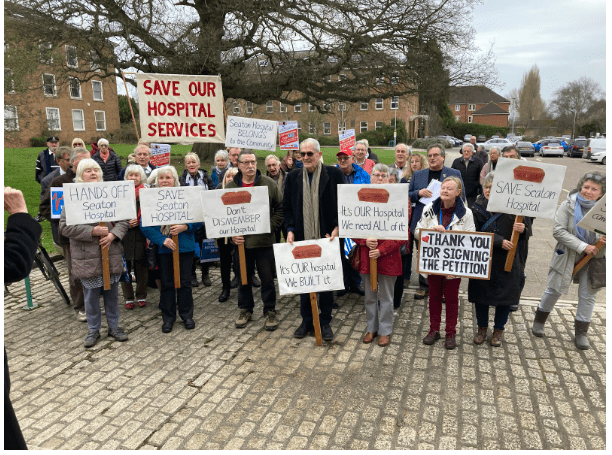
Community hospital supporters with long memories will recall that in 2017, Devon Health Scrutiny Committee refused to refer the closure of beds in Seaton, Honiton, Ottery and Oakhampton to the Secretary of State. Tory councillors, mostly from East Devon, blocked the referral, the last chance to keep our hospitals as they were supposed to be when local communities paid to build them. This is the background to the new crisis in Seaton, and now also in Okehampton.

Today, the Committee refused by 8-5 to refer the closure of Teignmouth Community Hospital to the Secretary of State, with Tory councillors once again blocking the decision and Lib Dem, Labour and Independent councillors voting for. And this is the last time they will have the chance to refer any decision – the Government has abolished scrutiny committees’ powers to refer, from 31 January. No reason has been given, but it’s pretty clear that they are just removing the last vestiges of local democratic accountability. Another reason to vote them out later this year!

Health Scrutiny backs Seaton again

Devon’s Health Scrutiny Committee once again urged Devon NHS and NHS Property Services to come to an agreement with the Seaton Hospital Steering Committee today, after Jack Rowland, Marcus Hartnell and I addressed them. Seaton Hospital supporters were out in force.