Ms Bateman vs South West Water: Feargal Sharkey offers help

Exmouth Swimmer suing over sewage leaks at Devon coast

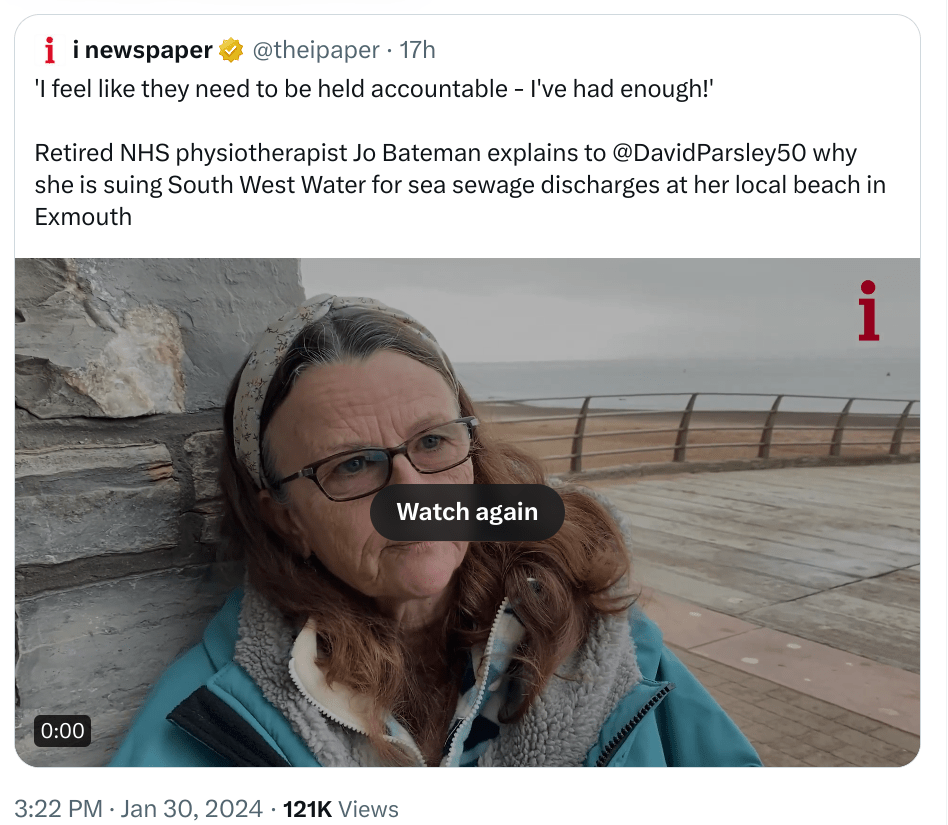
A woman is taking South West Water to court over sea sewage discharges that she claims have harmed her health and prevented her from taking daily swims.

David Parsley inews.co.uk

Retired NHS physiotherapist Jo Bateman has submitted an action to the Small Claims Court alleging that illegal sewage spills into the sea at her local beach in Exmouth, Devon, have affected both her physical and mental wellbeing.

In her claim, Ms Bateman details 54 instances when she believes South West Water illegally dumped sewage into the sea during 2023.

“I could have claimed for many more spills,” Ms Bateman, 62, told i. “But I focussed on the spills that South West Water could not claim were legal and due to storm overflows.”

Ms Bateman is claiming South West Water’s pollution of the Exmouth sea has led to what is legally known as a loss of amenity, which mean she must prove she has been injured.

She claims her daily sea swims help with her depression.

“I make no secret of the fact that I am on anti-depressants,” she said. “But since I have been swimming in the sea every day, my doctor has reduced my dose by half.

“The swimming helps me in all sorts of ways, and I believe the sea is an amenity to anyone that wants to enjoy it.

“It belongs to all of us and South West Water’s actions have meant that amenity is not available to me, and everyone else, all of the time – which it should be.”

While Ms Bateman is claiming compensation, fees and costs of only £379.50. “It’s not a lot of money,” she said. “It’s about the principle that South West Water is polluting our seas and making something that should be available to everyone too dangerous to use.

“I believe I can win this. I know South West Water will probably put up a really expensive lawyer that costs thousands more than my claim, and I’m on my own because I can’t afford a lawyer,” she added.

“If I win my case then this could set a precedent that will open up South West Water to thousands and thousands of claims all around Devon and Cornwall.

“They are deliberately doing damage to our coastline, and they need to be held to account for that.”

Earlier this month, i revealed that millions of litres of sewage had been transported to what the Environment Agency called a “failed pumping station” just 200m from Exmouth’s sandy beach.

One campaigner described it as “willful pollution” by South West Water. The company confirmed one pump at the site had failed but denied untreated sewage was being discharged into the sea.

As well as taking legal action, Ms Bateman is also withholding the sewage element of her water bill and currently owes £64 to South West Water.

“I’m not paying for a service that they do not provide,” she said. “I’m not backing down, and I’m prepared to go to prison for it if they force me.

“I’m on an NHS pension and work part-time in a local bakery, but I don’t need much and I get by. I don’t care if I end up with a County Court Judgement as I don’t need to get a loan for anything.”

South West Water, which has until 12 February to file its defence, declined to comment on Ms Bateman’s claim.

A spokesman for the company said: “We take our responsibility to the environment very seriously and are investing record amounts to reduce the use of permitted storm overflows across the region, including circa £38m earmarked for Exmouth up to 2030.”
X link here

IMF warns Jeremy Hunt against tax cuts in budget

The International Monetary Fund has issued a strong warning to Jeremy Hunt against cutting taxes in his budget in March, stressing the need to boost key areas of public spending instead.

Larry Elliott www.theguardian.com 

In updated forecasts for the UK and the rest of the global economy, the Washington-based fund doubted whether the widely anticipated tax cuts would be possible without extra borrowing or post-election spending cuts.

The IMF said the chancellor should be focusing on repairing the public finances after the damage caused by the pandemic and the war in Ukraine in order to meet growing spending pressures.

An IMF spokesperson said: “Preserving high-quality public services and undertaking critical public investments to boost growth and achieve the net zero targets, will imply higher spending needs over the medium term than are currently reflected in the government’s budget plans.

“Accommodating these needs, while assuredly stabilising the debt/GDP ratio, will already require generating additional high-quality fiscal savings, including on the tax side.”

Hunt is expected to cut income tax in the budget, but the IMF called on the chancellor to increase carbon and property taxes, take steps to eliminate loopholes in the taxation of wealth and income, and overhaul the pensions triple lock. “It is in this context that [IMF] staff advises against further tax cuts,” the IMF said.

Hunt rejected the IMF’s call. “The IMF expect growth to strengthen over the next few years, supported by our introduction of the biggest capital investment tax reliefs anywhere in the world, alongside national insurance cuts to improve work incentives,” the chancellor said.

“It is too early to know whether further reductions in tax will be affordable in the budget, but we continue to believe that smart tax reductions can make a big difference in boosting growth.”

The IMF said it was forecasting UK growth of 0.5% in 2023 and 0.6% in 2024 – both unchanged from October – and with only Germany of the leading G7 industrialised economies expanding more weakly.

With lower inflation likely to boost consumer spending power, the IMF said it was pencilling in UK growth of 1.6% in 2025 – slower than forecast three months ago. “The markdown to growth in 2025 of 0.4 percentage points reflects reduced scope for growth to catch up in light of recent upward statistical revisions to the level of output through the pandemic period,” the IMF said.

Last year, the Office for National Statistics revised up its estimates of UK growth in 2020 and 2021 by 1.8 points in total across the two years.

The IMF said the global economy was gliding towards a “soft landing” after coping with the impact of tough central bank interest-rate action to reduce inflation.

Revising up its growth estimates for 2024, the IMF said a number of big economies – including the US, China, Russia and India – had posted stronger than expected performances in 2023 and it was surprised by the resilience shown.

Pierre-Olivier Gourinchas, the IMF’s economic counsellor said: “The clouds are beginning to part. The global economy begins the final descent toward a soft landing, with inflation declining steadily and growth holding up.”

Announcing details of the interim World Economic Outlook (WEO), Gourinchas said the IMF expected global growth to be 3.1% in 2023 and 2024, upward revisions of 0.1 and 0.2 percentage points respectively. But he stressed the pace of expansion – which compares with an average of 3.8% during the 2010s – remained slow and there was a risk of turbulence ahead.

The IMF said the likelihood of a hard landing had receded and risks to its forecasts were evenly balanced. Growth could be higher than expected if tumbling inflation allowed deeper cuts in interest rates, if governments facing elections boosted public spending or if artificial intelligence increased productivity.

However, the IMF warned of downside risks including the volatile situation in the Middle East; the possibility that inflation would prove stubborn and signs that investors were excessively optimistic about the scale of interest rate cuts from central banks this year.

Gourinchas said he had been particularly surprised by the rapid improvement in the supply side of the global economy, singling out higher labour force participation rates, the easing of supply chain bottlenecks and lower commodity and energy prices.

He warned that central banks “must avoid premature easing that would undo many hard-earned credibility gains and lead to a rebound in inflation”.

However, Gourinchas added: “Signs of strain are growing in interest rate-sensitive sectors, such as construction, and loan activity has declined markedly.

“It will be equally important to pivot toward monetary normalisation in time, as several emerging markets where inflation is well on the way down have started doing already. Not doing so would jeopardise growth and risk inflation falling below target.

“My sense is that the US, where inflation appears more demand-driven, needs to focus on risks in the first category, while the euro area, where the surge in energy prices has played a disproportionate role, needs to manage more the second risk. In both cases, staying on the path toward a soft landing may not be easy.”

The IMF produces two full versions of the WEO each year, in April and October, then updates its forecasts in January and July. The latest interim WEO revised up US growth for 2023 from 2.1% to 2.5%, China from 5% to 5.2%, India from 6.3% to 6.7% and Russia from 2.2% to 3%.

The eurozone, in contrast, performed less strongly in 2023 than previously forecast and its growth has been revised down by 0.2 percentage points to 0.5%.