Breaking: Claire Wright’s fulsome endorsement of Paul Arnott

From Claire’s facebook post

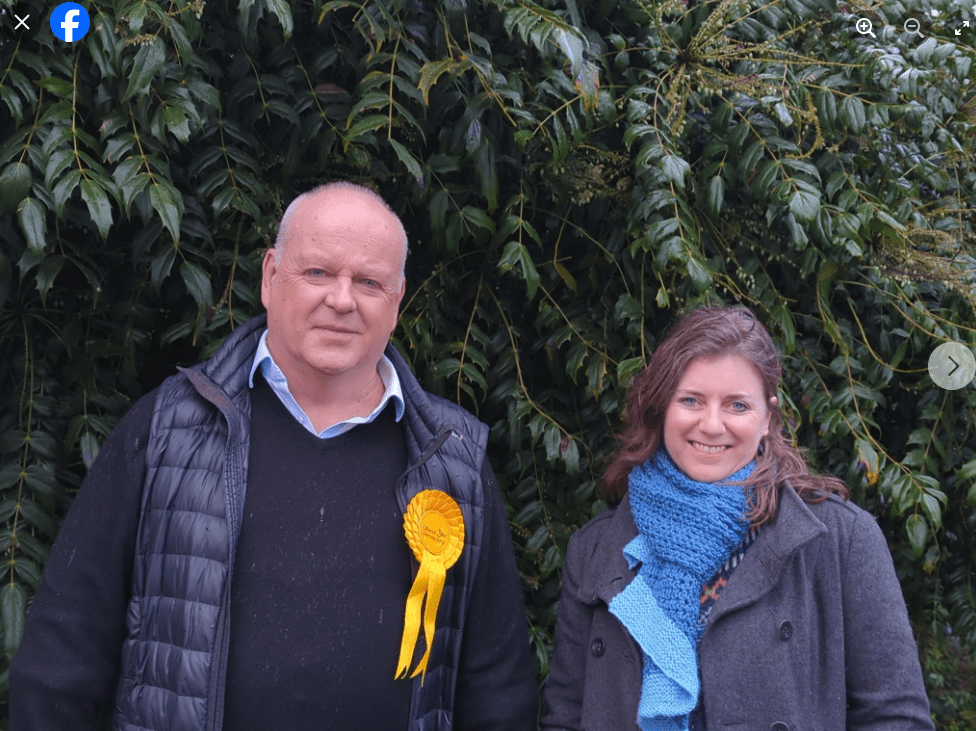
I am really happy to announce that I am backing Paul Arnott to take Exmouth and Exeter East in the general election!

For those of you not familiar with Paul, he is the Liberal Democrat leader of East Devon District Council, presiding over a rainbow coalition of LibDem, Independent and Green councillors, after taking the helm back in 2020.

I first met Paul Arnott back in 2009 in the sitting room of the dear late Broadclyst LibDem councillor, Derek Button. 

It was the first meeting of a small group of worried politically active people that included Cllr Roger Giles and Jonathan Underwood, who was a parliamentary candidate for the Liberal Democrats in 2010. 

At the time Paul was being persecuted by the then Conservative run East Devon District Council, for asking difficult questions about planning matters.

Anyone who remembers those days, will recall the absolute steamroller that it was, flattening any dissent or challenge and hauling unfortunate opponents before standards hearings for minor misdemeanours, while perpetrators of actual planning atrocities got off scot free.

They were dark days but myself, Paul and our group were absolutely determined to change things.  And so we did. 

The investigation of some murky planning matters led to the creation of Communities Before Developers on 2010, a campaign group I led that repeatedly challenged EDDC’s proposals to throw out much of the countryside protections in its new draft local plan

Having a shared cause, Paul and I remained friends. After I was elected to EDDC as an Independent in 2011, Communities Before Developers fizzled out as I had a vote and a more powerful platform. But we had sown the seeds of something much bigger…

The following few years were probably the most febrile time in EDDC’s history and the council was shaken to its core in 2013 when its conservative deputy leader, Graham Brown, was outed in a Daily Telegraph sting operation, which was splashed across its front page.  His long political tenure was finally over and the event marked the beginning of the end for the East Devon Conservatives’ lengthy and stultifying reign of power.

In 2015, with Paul firmly at its centre, the East Devon Alliance was birthed and immediately set about fielding a raft of Independent candidates from across the constituency to the EDDC elections of that year, which overthrew many Conservative councillors.

Some were so outraged at losing their seats that they wrote furious letters to the local papers about this terrible injustice!

It was an exciting ground-breaking time and I loved being a slightly detached part of the team (I had my own battles).

In 2019, the East Devon Tory steamroller squashed its last dissenter, as the East Devon Alliance with its rainbow coalition took control of the council and the Conservatives were reduced to a rump of 16.  

The old rotten regime had finally been replaced by something inspiring, decent and wholesome, run by people who wanted to do something positive.  People who I indentified with and loved spending time with. I was excited beyond words.

So … who is Paul?  The Paul that I know is decent, hard-working, tough, but also incredibly compassionate. He has a laser-like focus and will leave no stone unturned when justice is at stake.

He is a great dad to four adult children and has a lovely wife, Lydia.

And today, fifteen years after I first met Paul and instantly knew I had found one of my tribe, the hilariously witty, determined, fiercely intelligent, light-seeking missile that he is, has been selected as the Liberal Democrat candidate for the new constituency of Exmouth and Exeter East.

He would make a strong and wonderful MP but he needs your support to win!

So if you live in the soon-to-be-formed constituency of Exmouth and Exeter East (includes Exmouth, Budleigh Salterton, Cranbrook, Pinhoe and a chunk of Eastern Exeter) and would like to help with Paul’s campaign, either by leafleting, finance or in some other way, please email Todd Olive at libdemtodd@gmail.com

Thank you so much!
Local news in the UK is in deep trouble. But this band of radicals could change everything 

Imagine there’s no local news. You hardly have to try. Hundreds of local newspaper titles have disappeared over the past 10 years, BBC local radio is in freefall and local television has sunk from view. More than 4 million people in the UK live in “news deserts” without adequate local journalism, and millions more reside in “news drylands”, where local news is close to collapse.

Jonathan Heawood  www.theguardian.com

But this isn’t the whole story. While legacy publishers and broadcasters grapple with economic headwinds and blame social media platforms for their woes, a new generation of independent news providers is emerging. Unsung, unfunded and mostly underpaid, these indies are reimagining local news in communities from Shetland to the Isle of Wight and from Caerphilly to Newry.

In Manchester, the Mill has attracted thousands of paying subscribers to in-depth local journalism via its Substack newsletter. The Bristol Cable produces investigative journalism on a co-operative basis, with local people setting the agenda. In Glasgow, two nonprofit outlets – Greater Govanhill and the Ferret – have come together to open the UK’s first community newsroom, where local people are invited in to talk about their concerns and take part in editorial meetings.

Not all of these indie publishers are confined to a single location. The Bylines Network has 10 outlets, from Sussex to Scotland. Social Spider runs five papers in a number of north London boroughs. And the Mill has launched spin-offs in Birmingham, Liverpool and Sheffield, with more to follow.

In some ways, these initiatives are part of the long tradition of local journalism in the UK. In other ways, they are subtly radical. They don’t just treat the public as sources or consumers of journalism, they co-create the news with them. They don’t provide journalism in order to make money, they make money in order to provide journalism.

You might think that the government would want to support these news entrepreneurs, who are levelling up information provision in communities across the UK. But no. In fact, successive governments have channelled a range of subsidies to the corporate publishers who own the surviving legacy local papers, while the indies have received next to nothing.

Rather than benefiting from subsidies, indie publishers are instead footing the bill for the information needs of their communities, providing public interest journalism at a fraction of the cost it takes to produce, simply because they care. This is unsustainable. Already, we are seeing indie news providers burning out – full of passion for their work but frustrated that they don’t get the recognition they deserve. When we asked indie publishers about their greatest challenge, many simply said, “surviving”.

This sector isn’t perfect. There are concerns that the focus on digital news will exclude people who aren’t online, and that small independent publishers simply can’t keep up with everything that’s happening in their local communities. Indie publishers are aware of these limitations, and desperately want to do more to serve their communities with up-to-date news in multiple formats. But there’s only so much they can do on a median turnover of only £35,000.

We can turn this situation around. The government could rewrite the rules around public notices, to allow local councils to advertise with those outlets that reach the most engaged local audiences, whether they’re in print or online. Central government could also place a chunk of its multimillion-pound advertising budget with indie publications. Big tech companies could reimburse indie publishers for the traffic and engagement they generate on their platforms. Philanthropists could recognise the huge social value of independent local news, and donate money to local news funds to stimulate grassroots media around the UK.

Initiatives to revitalise local news are under way in other parts of the world. Philanthropists in the US have pledged $500m to rebuild local news, with the target of raising $1bn over the next decade. Governments in Denmark, the Netherlands and New Zealand provide subsidies for local news through arm’s-length mechanisms to protect journalistic independence. The City of New York puts more than 80% of its advertising budget in the hands of community media. In Canada, there are tax breaks for journalism.

The UK is an outlier in its lack of support for independent local news. Despite the recommendations of the Cairncross review in 2019 and at least four other inquiries since then, the government has allowed our local news industry to become ever more concentrated, and ever more fragile.

We are locked in a downward spiral when we could be in a cycle of renewal. The government keeps throwing money at the newspaper publishers who have done the least to solve the problem, rather than unlocking the potential of the indies.

This isn’t an either-or situation. We don’t have to abandon the legacy papers that have been part of the fabric of British life for hundreds of years. We could explore placing them in community ownership, as the National Trust for Local News is doing in parts of the US, or at least make their subsidies conditional on investing in journalism, as recommended by the National Union of Journalists. At the very least, we urgently need to create a level playing field, where new entrants are able to compete on equal terms.

Audiences will pay for quality local news. But it will take concerted action to build a sustainable local news economy. The indie news entrepreneurs are the key to a better future. They are giving so much to society. It’s time they got something in return.

Senior tories set to lose seats as rural Conservative vote at risk of collapses

Labour will beat the Tories in the most 100 rural constituencies in England, according to a shock new poll.

Historically the rural communities in the South West have supported the Liberals (now the Lib Dems) as an alternative to the Conservatives (and EDDC still has one). – Owl

Zoe Grunewald www.independent.co.uk

The poll found Conservative support had fallen by 25 points since the 2019 election, with just 34 per cent of voters in the 100 most rural constituencies in England saying they would vote for the party.

The Conservatives currently hold 96 of the 100 most rural seats, but now face losing more than half to Labour and the Lib Dems, including those of senior Tories Jacob Rees-Mogg, Jeremy Hunt, Thérèse Coffey, Andrea Leadsom, Mel Stride, Mark Harper and Liam Fox.

Labour support has risen over the same period, going from 20 per cent in 2019 to 37 per cent at the start of this year – giving the party a narrow lead in what has traditionally been considered Conservative territory.

But while the survey suggests Conservative support has collapsed in the party’s heartlands, many rural voters are still “politically homeless”, with almost 35 per cent of respondents still undecided about how they’ll vote.

Victoria Vyvyan, president of the Country Land and Business Association (CLA), which represents 28,000 rural businesses and landowners, said the poll makes it clear that rural voters up and down the country feel “disconnected from central government”:

“This poll makes it clear that rural voters up and down the country feel politically homeless and disconnected from central government – but their votes are still up for grabs. Whichever party produces a robust and ambitious plan for growth in the rural economy will undoubtedly secure support.

“For the good of our rural communities and the nation as a whole, now is the time for the main parties to make it clear that they will back the countryside.”

Support for the Liberal Democrats has remained largely unchanged, with 14 per cent saying they would back the party – down only two points from 2019.

But the poll, carried out by Survation on behalf of the CLA of more than 1,000 people, also shows neither of the main parties is seen as understanding or respecting rural communities.

Only 28 per cent said they thought Labour understood rural communities, while 25 per cent said the same about the Conservatives.

The CLA has put forward a series of “missions” for parties to show they understand rural voters, including investing in profitable and sustainable farming, providing affordable homes for rural communities, tackling rural crime and improving connections for rural areas.

Ms Vyvyan told the PA news agency: “Our vote is there for the taking, and they need to show us that they understand and respect our community.”

She added: “We feel invisible. I spoke to a small farming group in West Cornwall and the question that was asked was why are governments not interested in our community? Why are they interested in everyone else’s community except ours?

“We are politically homeless.”

Rural dissatisfaction has led to protests by farmers in other parts of Europe, such as France and Spain, while Welsh farmers have warned of “huge unrest” over plans by Cardiff to reform agricultural subsidies to reward “sustainable” food production.

But Ms Vyvyan played down the possibility of similar unrest in England, saying farmers were “well set” on the way to agricultural transition, adding farming minister Mark Spencer and Environment Secretary Steve Barclay had “produced very good rates” for payments.

The current government is committed to spending an average of £2.4 billion a year on the farming budget in England across this Parliament, and has spent less than that in each of the last two years. It needs to spend at least £2.7 billion this year to hit its own target.

Council to keep funding homelessness support during 2024/25

Devon County Council is planning to continue its contribution to adult homelessness prevention services for the next financial year – but says it’s still looking for a sustainable long-term funding solution.

Philippa Davies www.sidmouthherald.co.uk 

Last year the council proposed withdrawing a total of £1.5 million in funding to five hostels and a network that helps people struggling on low incomes to stay in their homes.

That proposal was scrapped after severe concerns were raised by the leader of East Devon District Council, along with local charities helping the homeless. The county council agreed to continue funding the services until the end of March 2024.

Cuts to spending on homelessness services had been on the agenda for last week’s  Cabinet meeting, but councillors then heard that the Government’s funding settlement was slightly higher than expected. They agreed to maintain the current level of spending, with a budget of £1.45 million for 2024-25.

However, the county council has no statutory responsibility for housing and the homeless, which come under the work of district councils, and has said it will continue discussions with the districts over long-term funding of the homelessness support services.

The Cabinet meeting also agreed to spend an extra £1.5 million on road maintenance work to prevent potholes. The money will be used for regular drainage works to stop potholes forming after heavy rain.

Devon’s Cabinet member for finance Phil Twiss told councillors: “The final Government settlement was announced after our draft budget was published so it is pleasing to be able to include some extra spending.

“We’ve been talking to our district council colleagues and listening to what our budget scrutiny committees at Devon County Council have told us over the past month.

“We’ve also held formal consultation meetings with representatives from business, the trade unions and the voluntary sector, taking on board their priorities.

“Councillors’ postbags regularly include complaints from motorists about potholes on our roads and it is important that – when there is some extra money available – we do our best to tackle the problem.

“We also recognise the work that district councils and organisations like the YMCA do to make life a little easier for some of the homeless and I am delighted we are able to continue to help with a full grant.”

The full council will meet on Thursday (February 15) to finalise the budget for 2024/25.

It includes above inflation increases in spending on Devon’s vulnerable children and adults with a 10.4 per cent increase in the revenue budget for children’s services, a six per cent rise in adult services and 4.7 per cent extra for climate change, environment and transport.

Reductions in other departmental spending and increased income will mean an overall rise of 6.3 per cent in the budget for next with a total spend of over £743 million.

Devon and Cornwall police allegedly protected officers accused of abusing seven women

Appalling allegations.

Devon and Cornwall Police are in special measures, they deliver poor value for money and the Chief Constable is suspended whilst under criminal investigation over serious allegations of sexual offences.

What is the Police and Crime Commissioner doing?

Indulging in photo opportunities and helping promote her Tory party’s image. What an advert! – Owl

Police officers accused of subjecting seven women to abuse including rapes, beatings, and psychological torment were allegedly protected by their force, with two appointed to roles protecting women from assault and harm.

Vikram Dodd www.theguardian.com 

The force, which stands accused of systematic failings, is Devon and Cornwall, the Guardian has learned.

One of the male officers is accused of abusing and threatening his partner, who is also a serving police officer. In this case it is alleged the male officer was promoted twice after the force received the allegations over a 14-year period, and appointed to a leadership position in the force’s effort to tackle violence against women and girls.

Nationally, police have vowed to take violence against women and girls seriously after a series of scandals, and have previously been accused of routinely protecting officers who are abusers.

One of the seven women has waived her right to anonymity. Paula Kressinger, 57, served in the Devon and Cornwall force for 30 years until 2016. She said: “It defies belief. I was completely failed by them, disrespected and insulted. I lost trust and confidence in the police as a result. It was a definite cover-up.”

It is alleged the failings in the force were so well-known that male abusers knew they would be protected from justice, with one allegedly bragging to a woman that the force had “made things go away”.

Lawyers for the seven women have written to the force saying they will sue, alleging that when abuse allegations were reported, Devon and Cornwall police failed to take potentially criminal allegations against their own officers seriously.

Among the alleged errors are failures to gather evidence; failure to take statements or sending officers to investigate; and knowing the suspect or openly showing bias.

The allegations of abuse are made against seven current and former male officers, who are understood to deny any criminal wrongdoing.

Last Monday, the Guardian and BBC News put detailed questions to Devon and Cornwall police, who declined to answer specific questions, but said it would refer the allegations to the Independent Office for Police Conduct. An IOPC spokesperson said the matters were “serious” and the police watchdog was in talks with the force about a formal referral.

In Kressinger’s case, the man she had been in a relationship with had retired as a police officer at the time of an alleged attack. He allegedly placed her in a neck hold, at the door of the home they had shared together.

A neighbour who witnessed the incident can support Kressinger’s account, she claims.

When police arrived, Kressinger claims one officer called her “pathetic” and she said police then failed to pursue her allegations properly, instead treating her as the offender.

Kressinger said: “When I was a police officer for 30 years, you go to a domestic incident, you listen to both sides and you deal with it appropriately. That is what I expected. I was completely dismissed. It was clear they knew him.”

She said she has been left with post-traumatic stress disorder as a result of her treatment by her former partner, which was “exacerbated by the lack of police action”.

After years of trying, one officer took her claims seriously, she said. “I had to fight to be heard.”

Another complainant said that one alleged attacker used his position as a firearms officer to intimidate her.

Another alleged attacker was appointed to a sexual offences and domestic violence team.

In two cases, it is alleged Devon and Cornwall police’s protection of its alleged abusive officers extended to bungling claims they had attacked children.

Emma (not her real name), still a serving officer, at first could not tell anyone what she said happened to her, and colleagues tried to help her. Allegations were first reported to Devon and Cornwall police in 2004, then again in November 2017, and no action resulted.

She said: “On one occasion, he lost his temper, when I had my baby … in my arms. My other child was screaming as he rained punches on any area of my body he could get at. He cornered me in a room and repeatedly kicked me as he stood over me. I was terrified and was begging him to stop.”

More allegations of violence Emma suffered were received by the force in December 2017, as well as the name of a potential witness.

Further allegations were made to Devon and Cornwall police in 2018 including coercive and controlling behaviour, and mistreatment of the couple’s teenage child.

No action followed for criminal matters or discipline, and the alleged attacker was promoted twice after the allegations were first received by Devon and Cornwall.

In another case, a former officer is under criminal investigation by another force, after Devon and Cornwall were accused of errors investigating allegations made against him by a woman.

Jim Pearce, an assistant chief constable with the force, said the allegations needed “careful consideration and appropriate review”.

He added: “As a result of the information received, the force has made a mandatory referral to the Independent Office for Police Conduct. The IOPC has asked for further work to be progressed by the force before they can accept and assess a referral, but we remain in consultation with them in providing the required information.

“It would be both inappropriate and premature to comment further at this stage.”

A recent report from His Majesty’s Inspectorate of Constabulary into Devon and Cornwall police said of an audit the force carried out into its culture in 2021: “Without exception, every female respondent interviewed in the cultural audit reported experiencing some form of sexual harassment or discrimination in the workplace.”

Solicitor Debaleena Dasgupta, from the Centre for Women’s Justice, which is representing the seven women, said this was the first time a force was being sued for the systematic failing of women attacked by its own officers.

She said: “These shortcomings demonstrate a failing system, and are so egregious, they breach the women’s human rights. It takes immense bravery to report a police officer to their own police force. For the victims to then be so badly failed is deplorable.

“Why do D&C [Devon and Cornwall] appear to accept what their male officers tell them, over what their female officers tell them?

Dasgupta added: “As part of their claim, the women have offered to help D&C improve its practices and procedures.”

Devon and Cornwall police have been placed in special measures by the official inspectorate.

A government-ordered report into police failings that left the former Met officer Wayne Couzens free to commit a string of sexual offences, culminating in the kidnap, rape and murder of Sarah Everard, is expected to be published within weeks.

Paul Arnott on Seaton Hospital, baseless smears in EDDC and, yes, a certain candidacy 

[He also reveals he has the support of Claire Wright. More on this in due course. – Owl]

Paul Arnott 

I had intended to write this week’s column about some really good news for Seaton Hospital.

Readers may recall that it has been under something of a cloud recently with elements of the standalone NHS Property Services wanting to consider its partial demolition.

Several huge meetings took place in Seaton and Colyford, and a campaign committee was formed, on which the local MP and I sit, alongside local medical representatives, the League of Friends and experienced serving and ex-councillors from Seaton.

It’s a long road ahead, but the one thing I knew I could help deliver was to ensure East Devon District Council gave a good hearing to a suggested application from the League of Friends to have the hospital listed as an “Asset of Community Value (AOCV)”. There was an attempt to do this when the Conservatives ran the council some years ago but it fell on stony ground.

This time, our officers did an extensive and professional analysis and made the decision that the hospital does indeed qualify to be entered into our Register of AOCV. I am really pleased to have been able to secure this for the local people, and congratulate the League of Friends for their excellent application and follow-up work.

Then I realised I also needed to write about a significant finding regarding baseless smears of “bullying” at EDDC. This was a myth created by a disgruntled former senior officer for their own ends, but of course the Conservatives have tried to keep this dishonest flame flickering for years.

Last week, the most senior entity in the land for councils, the Local Government Association, came in to East Devon for what is called a “Peer Review”. This means that a cross-party team of 5 spend three days and many more preparatory days looking under the bonnet to see what the council is doing well and what it could do better. It is a non-cynical but also highly rigorous peer challenge.

During the process, 150 officers and members of the council were fully consulted (along with many external bodies). The spokesperson for the final report, which will be published in the next month, took pains to say that because of these repeated smears in the media of bullying, they felt they had to look into that as part of their work.

They confirmed in the report that they found no evidence of bullying whatsoever, but rather clear evidence of staff and officers feeling that they were working for a progressive council, worried only that this politicised parroting of false accusations was damaging their council’s reputation unfairly.

However, having mentioned Seaton Hospital and the official refutation of false bullying allegations, I realised I should use the last 100 words today for a small announcement.

Last week I accepted the offer to be the prospective LibDem Parliamentary candidate for the new constituency of Exmouth and Exeter East. As EDDC leader I already do a vast amount of work in the constituency so know it well, and look forward to a courteous contest.

I’ve never been one to fight my way up the greasy pole of national politics, but I am very much on for this, and suspect it’s a two-way contest between the LibDems and the Conservatives. I am also thrilled to have the personal support of the renowned independent Claire Wright, who took 25,000 votes last time.

I even have an agent! If you’d like to hear more, please do contact Todd Olive at libdemtodd@gmail.com.