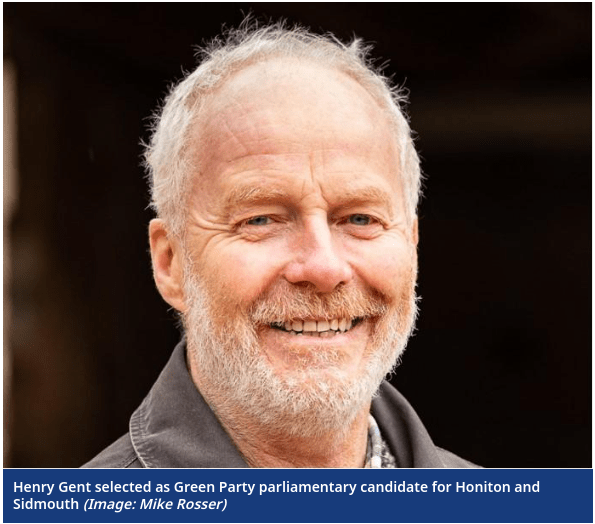
Green Party candidate Henry Gent for Honiton and Sidmouth

The Green Party has selected Henry Gent as its prospective parliamentary candidate for the new constituency of Honiton and Sidmouth.

Adam Manning www.sidmouthherald.co.uk 

The constituency also includes Ottery St Mary, Cullompton and Axminster.

Other candidates for this new constituency are sitting MPs Simon Jupp (Conservatives, East Devon) and Richard Foord (Liberal Democrats, Tiverton and Honiton).

Mr Gent has enjoyed being a member of Devon County Council since 2021, enabling him to campaign for local active travel routes and safer conditions for pedestrians across his division.

He has also been a member of Broadclyst Parish Council since 2010. Henry has run his family farm in East Devon for 40 years and is now handing on to the next generation.

Speaking on his appointment, Henry told the Herald: ”I have agreed to stand for parliament because people want the Green Party on the ballot paper, for a society fit for the transition to a low carbon sustainable future.”

Nearly one in 10 English councils expect to go bust in next year, survey finds

Welcome to the broken shires, the legacy of 14 years of Tory austerity and cheese pairing. –  Owl

Nearly one in 10 councils in England have warned they will go bust in the next 12 months as authorities plan widespread cuts, above-inflation council tax rises and across-the-board increases to resident charges, a survey has revealed.

Patrick Butler www.theguardian.com 

The Local Government Information Unit (LGIU) annual poll of local authority leaders and top managers reveals a near-total collapse in confidence in the financial viability of councils as they grapple with “desperate” pressures and shrinking budgets.

It warns that council insolvencies – once extremely rare and triggered by unusual special factors such as the failure of commercial investments – should now be regarded as “normal occurrences” likely to hit even well run authorities.

The LGIU chief executive, Jonathan Carr-West, said: “This report, for the first time, demonstrates how widespread councils’ desperate funding situation is. That there is a structural funding issue is now impossible to deny.”

Eight English councils have declared themselves in effect bankrupt since 2018, including four in the past 15 months, including Woking, Nottingham, Birmingham and Thurrock. Several others have planned major cuts in an explicit attempt to stave off insolvency.

Earlier this month, a cross-party group of MPs said an emergency £4bn cash injection was needed to address an “out of control” financial crisis. In January, the government announced £600m in one-off emergency funding – widely regarded as an inadequate “sticking plaster” response by councils.

The survey lays bare what it calls a “dysfunctional” relationship between councils and Whitehall, with the vast majority (94%) of local authority leaders believing ministers have little understanding of the scale of the financial crisis facing councils.

Only 4% of council leaders felt confident about the sustainability of local government finance – down from 14% last year and 20% in 2020. One respondent described running the council as “a permanent state of crisis management”.

Another respondent said: “It feels the worst I’ve ever known it (even than when I started in the early 90s) with no prospect of change. Chief finance officer conferences feel more like group therapy nowadays.”

Survey findings include:

  • Nine per cent of councils (14 authorities) surveyed reported they were “likely” to declare effective bankruptcy in the next 12 months, with more than half saying they would go bust in the next five years without extra funding.
  • Rising need and costs in children’s services were the biggest drivers of financial instability in top-tier councils, with soaring homelessness bills the biggest risk factor for district councils.
  • Nine out of 10 councils plan to raise council tax, with the same proportion proposing to introduce or raise charges for services like garden waste disposal and parking. Nearly two-thirds plan service reductions, “meaning that services are getting more expensive just as they are being cut”.

The survey is based on 160 responses from 128 councils in England (out of a total of 317) reflecting a broad cross-section of councils and geographical spread, and a mixture of political control.

A spokesperson for the Department for Levelling Up, Housing and Communities said: “We recognise councils are facing challenges and that is why we announced an additional £600m support package for councils across England, increasing their overall funding for the upcoming financial year to £64.7bn – a 7.5% increase in cash terms.

“This includes £500m of new funding for councils with responsibility for adult and children’s social care, distributed through the social care grant. Councils are responsible for their own finances and setting council tax levels, but we have been clear they should be mindful of cost-of living pressures while controlling any unnecessary or wasteful expenditures.”

Thames Water lobbying government to let it increase bills by 40%

To quote an impeccable/infamous Tory source from the last century: “No!….. No!……No!” – Owl

Thames Water has been lobbying the government and regulators to let it increase bills by 40%, pay lower fines for breaches and keep paying out dividends as part of efforts to avert a taxpayer bailout, according to a report.

Jack Simpson www.theguardian.com 

The UK’s largest water company was trying to strike a deal with the watchdog Ofwat that would give it permission to charge customers more to avoid having to be taken over by court-appointed special administrators, the Financial Times reported.

That plan would give Thames Water permission to increase bills by 40% by 2030, while also offering more leniency around regulator fines and rules around the dividends it can pay to shareholders.

It comes as the company, which serves more than 15m households, attempts to deal with a debt pile of £14bn and widespread criticism over sewage dumping.

If the government or Ofwat felt that Thames Water was unable to pay its debts it could apply to the high court to invoke the special administration process, in which administrators would be brought in to help manage the company.

Last week, the Department for Environment, Food and Rural Affairs (Defra) updated 30-year-old legislation on the special administration regime, which would allow existing shareholders to retain a stake in the company and make it less likely that failing water companies could be fully renationalised.

According to the FT, officials at Defra have in place contingency plans for Thames Water if it collapses, under the name Project Timber. As part of this, it hopes Ofwat would allow “regulatory easements” on the issuing of hefty fines, which would put further pressure on the company.

In December, the parent company of Thames Water, Kemble Water Holdings, was told by auditors that it could run out of cash by April if shareholders did not inject more funds into the company.

The company has raised £500m and says shareholders would inject more than £3bn more – but this would be dependent on Thames Water getting what it wants from the regulator.

A crucial part of this is getting permission to issue dividends to services its debt. However, new rules introduced by the government last year can take enforcement action against water companies issuing dividends if they are performing badly against financial and environmental targets.

Thames Water has said investors will not take any money out of the business until the turnaround is completed but the rules do not distinguish between internal and external dividends.

Thames Water revealed this month that it expected more leaks than initially thought, after its ageing pipes were overwhelmed by heavy rain this winter.

An Ofwat spokesperson said: “Ofwat does not comment on speculation. Thames Water needs to continue to deliver on its turnaround plan to improve its operational and environmental performance. It is for the company to secure shareholder backing to improve its financial resilience. We will continue to closely monitor the company’s progress as they do so to protect customers’ interests.”

A government spokesperson said: “Water companies are commercial entities and we do not comment on the financial situation of specific companies as it would not be appropriate.

“We prepare for a range of scenarios across our regulated industries – including water – as any responsible government would.”

Thames Water declined to comment.

Are you bathing in sewage without realising due to outdated warning system?

The technical article below explains why researchers from Reading believe the Environment Agency (EA) forecasting system that tells people whether it is safe to swim in bathing waters in England is not fit for purpose.

Before getting to the summary of the research, Owl, and Owl’s correspondents, have  long had additional concerns.

There is the dubious method, described below, of how the EA justifies discarding highly polluted readings when awarding coveted star ratings to beaches.

Another concern, put to Owl by correspondents in the past but  not discussed in this article, is whether the EA sampling is conducted where bathers actually swim.

Observation suggests not.

Jo Bateman, when interviewed on “This Morning” earlier this month, said that she first started swimming in the Exe estuary “Duck Pond” until she learned the significance of the “oily slick” that often appeared on the surface of the water.

Next door in Budleigh there are two brook outlets discharging onto the beach and the river Otter carrying whatever flows into it from Honiton and Ottery St Mary across the bay. How can the whole beach be given a single rating? Like Exmouth, there must be some sections more likely to suffer pollution than others. These problems are common to all our beaches.

Now to this opaque, but important “small print”, in the Environment Agency explanation of how bathing water quality is assessed:

 “At the bathing waters where PRF [Pollution Risk Forecasting] is possible, there is an agreement with local authorities for them to display warning signs at a bathing water when a pollution risk warning is issued. If one of these warnings is seen to be in place by our samplers when taking a sample and meets relevant criteria, then the sample may be disregarded from the set which is used to make the annual classification. This is done under the ‘Short Term Pollution’ provisions of the Regulations. This provision means that the classification reflects the water quality when advice against bathing wasn’t issued, and when people are likely to be using the water.

Owl thinks this means: bathing water quality may be “excellent 3-star” except when it isn’t!

And remember the PRF warnings only operate during the summer, yet people swim all year round. Perhaps beaches should have a summer and winter quality rating.

Sea swimmers bathing in sewage without realising due to outdated warning system

Lucie Heath inews.co.uk

Swimmers are bathing in sewage in locations that they have been wrongly told are safe because of the Goverment’s “outdated” pollution warning system, i has been told.

Researchers from the University of Reading found that the system that tells people whether it is safe to swim in bathing waters in England relies on old weather forecasting technology and insufficient sample data.

Local councils are therefore only able to provide daily pollution warnings for around 40 per cent of the country’s 424 official bathing sites in the sea and rivers, the researchers said.

Even at these sites, swimmers are not always being warned when the water quality in beaches or rivers is unsafe. as the Government’s “outdated” system is not always able to predict high bacteria levels in the sea, the study found.

The Environment Agency (EA) operates a forecasting system designed to predict when England’s bathing waters are too polluted to swim in. Separate forecasting systems are in place in Scotland, Wales and Northern Ireland.

The system combines weather forecast data with historical water quality sample data to predict the level of E.coli in the water on a given day.

When the level of bacteria is above a certain threshold, the EA issues an alert to local beach managers, who are employed by councils and put up signs to warn people against entering the water.

But the study found that warnings are not always being deployed when they should be, due to failures with the watchdog’s forecasting system.

Lead author of the report Karolina Krupska, an environmental scientist, told i one of the main problems with the system is that it does not make use of the best rainfall forecast technology available.

Water companies often release untreated sewage from pipes into bathing waters during periods of heavy rain as their infrastructure becomes overwhelmed, meaning rainfall is often a good predictor of bacteria levels in the water.

Ms Krupska said the EA could incorporate more modern rainfall prediction methods into its forecast system. She said the watchdog has already done this for its flood prediction system but the bathing water system is “behind”.

As a result, she said the bathing water system is not good at predicting sudden intense rainstorms and therefore warning of the likelihood of increased bacteria levels in the water. She added that this is a particularly problem as this type of weather is expected more often in the UK as a result of climate change.

In some instances, this can result in the system issuing warnings for the wrong locations or not at all. For example, the system failed to issue alerts for a number of popular beaches in Cornwall, following heavy storms in the areas in the summer of 2021, Ms Krupska said.

“There was a mismatch over the warnings given and what actually happened on the ground. So no warnings were given around really popular beaches in Newquay,” she said.

The study also found that the forecasting system relies on limited sample data for each bathing spot. The EA samples the water quality at bathing spots 20 times per year on random dates, meaning the samples are often not taken during a pollution event.

Ms Krupska said this means the watchdog is unable to provide warnings for all spots in England “because the model is not accurate enough to provide any kind of useful forecast”.

In 2023, the EA was only able to provide forecasts for 172 (41 per cent) of the 424 designated bathing sites in England. The forecasts are only provided during the official bathing season, which runs from May until September.

Some water companies operate their own warning systems, which are separate to the forecaster published by the EA and issue alerts when they are dumping sewage into the sea and rivers.

A final problem identified by the study is that the EA only provides pollution forecasts once per day, typically around 8am.

Ms Krupska said this means swimmers are often not made aware of pollution that occurs in the afternoon.

“Water quality changes rapidly and to keep people safe you really need to have an almost real time dynamic warning system … we don’t have that information so if something happens in the meantime the people just won’t know about the pollution until they see it or smell it,” she said.

She added: “With existing pollution warning systems, beach users don’t have good enough information to decide whether it is safe to go in the water. The science underpinning the next generation of bathing forecasting already exists, but a lack of action means these solutions have not been implemented.”

Campaigners have been calling on the EA to introduce a better system for monitoring the quality of water at bathing sites.

Among them is the University of Reading rowers who train on the River Thames, which has suffered from pollution due to sewage and chemical pollution from motorways an agriculture.

An Environment Agency spokesperson said: “We know how important our bathing waters are to local communities. That is why we monitor water quality at more than 400 beaches and inland waters across England – with more than 7,000 water samples taken and analysed during last year’s bathing water season alone.

“We already use a range of monitoring programmes and data and welcome additional research on forecasting pollution in waters, especially those used for bathing.”