
- Sycamore: shorten back on south side by approximately 2m. Reason – to leave a more balanced form. Ash: reduce height and side branches by approximately 2-3m to a suitable side branch. Reason – to relieve weight and lessen the likelihood of branch breakage. Elm: remove to as near ground level as possible. Reason – dying.
 9 Garrett Close Seaton EX12 2FERef. No: 24/0401/TRE | Validated: Fri 23 Feb 2024 | Status: Awaiting decision
 - Erection of a single storey rear extension which would extend beyond the rear wall of the original house by 4m, for which the maximum height would be 3.5m and for which the height of the eaves would be 3m 46 Arcot Park Sidmouth EX10 9HURef. No: 24/0400/GPD | Validated: Fri 23 Feb 2024 | Status: Awaiting decision
- Demolition of single storey side extension. Addition of two storey side extension. Knapp House Pound Lane Uplyme DT7 3TTRef. No: 24/0398/FUL | Validated: Fri 23 Feb 2024 | Status: Awaiting decision
- Agricultural unit extension Hogsbrook Farm Woodbury Salterton Exeter EX5 1PYRef. No: 24/0397/FUL | Validated: Fri 23 Feb 2024 | Status: Awaiting decision
- Single storey rear extension 45 Sid Park Road Sidmouth Devon EX10 9BRRef. No: 24/0402/FUL | Validated: Fri 23 Feb 2024 | Status: Awaiting decision
- Discharge of condition for 23/2102/ADV: Condition 6 (individual signage letters) The Old Sorting Office 52 – 54 High Street Budleigh Salterton EX9 6NBRef. No: 24/0396/DOC | Validated: Fri 23 Feb 2024 | Status: Awaiting decision
- Rear and side single storey extensions Barafundle Bunts Lane Seaton Devon EX12 2HYRef. No: 24/0390/FUL | Validated: Thu 22 Feb 2024 | Status: Awaiting decision
- Application for Permission in Principle for 4-9 houses Land South Of Park Lodge Talaton Road FenitonRef. No: 24/0378/PIP | Validated: Thu 22 Feb 2024 | Status: Awaiting decision
- Demolition of x2no. outbuildings to be replaced with 2 bed detached chalet bungalow [re-submission of 23/2485/FUL] 34 Raleigh Road Ottery St Mary EX11 1TGRef. No: 24/0392/FUL | Validated: Fri 23 Feb 2024 | Status: Awaiting decision
- T1, Willow: overall reduction, reducing height by approximately 4m, reducing width of canopy by approximately 2m, maximum cut diameters 100mm, cutting to viable growth points wherever possible. Crossway House The Street Musbury Devon EX13 8AURef. No: 24/0376/TCA | Validated: Wed 21 Feb 2024 | Status: Awaiting decision
- Construction of porch extension [resubmission of 18/0097/FUL] 5 Parkhayes Woodbury Salterton Devon EX5 1QSRef. No: 24/0375/FUL | Validated: Wed 21 Feb 2024 | Status: Awaiting decision
- Proposed extensions, alterations and part garage conversion 29 Cranford Avenue Exmouth EX8 2QARef. No: 24/0372/FUL | Validated: Wed 21 Feb 2024 | Status: Awaiting decision
- Discharge of condition for 23/1508/FUL: Condition 4 (Plant Noise Assessment) 86 High Street Honiton EX14 1JNRef. No: 24/0365/DOC | Validated: Tue 20 Feb 2024 | Status: Awaiting decision
- Discharge of condition for 22/2718/FUL: Condition 3 (cladding) 38 Cranford Avenue Exmouth Devon EX8 2QARef. No: 24/0370/DOC | Validated: Tue 20 Feb 2024 | Status: Unknown
- Construction of 1 no. timber frame commercial unit Millers Farm Shop Gammons Hill Kilmington Devon EX13 7RARef. No: 24/0363/FUL | Validated: Tue 20 Feb 2024 | Status: Awaiting decision
- Removal of condition no.4 (Agricultural Occupancy Condition) from planning permission 83/P1768 – Change Of Use To Agricultural Contractor’s Depot. Following approved 23/1793/CPE, The condition needs to be removed to allow the dwelling to be occupied as an unrestricted C3 dwelling Thornfield Tytherleigh Devon EX13 7BGRef. No: 24/0355/VAR | Validated: Mon 19 Feb 2024 | Status: Awaiting decision
- Proposed replacement of conservatory with single storey extension Passlands Membury Axminster EX13 7TERef. No: 24/0350/FUL | Validated: Mon 19 Feb 2024 | Status: Awaiting decision
- Discharge of condition for 23/2278/FUL: Condition 3 (Materials) 67 Bicton Street Exmouth Devon EX8 2RURef. No: 24/0359/DOC | Validated: Mon 19 Feb 2024 | Status: Awaiting decision
- A small scale (10 pitch maximum), tent only, campsite for up to 60 days per annum, including moveable toilet facilities, operated under Part 4 Class BC of the GPDO. Holly Farm Alston Axminster EX13 7LGRef. No: 24/0360/R77 | Validated: Mon 19 Feb 2024 | Status: Awaiting decision
- Demolition of existing bungalow and garage with construction of a replacement house and integral double garage. Lindridge Elsdon Lane West Hill Devon EX11 1UBRef. No: 24/0352/FUL | Validated: Thu 22 Feb 2024 | Status: Awaiting decision
- Proposed replacement porch with timber cladding 3 Hill Court Hillhead Colyton Devon EX24 6NJRef. No: 24/0346/FUL | Validated: Thu 22 Feb 2024 | Status: Awaiting decision
- Replacement garden shed, height increase and repairs to existing chimneys, re-roofing of porch and replacement window. Church Terrace Cottage Dunkeswell Honiton EX14 4QZRef. No: 24/0348/FUL | Validated: Mon 19 Feb 2024 | Status: Awaiting decision
- Replacement garden shed, height increase and repairs to existing chimneys, re-roofing of porch and replacement window Church Terrace Cottage Dunkeswell Honiton EX14 4QZRef. No: 24/0349/LBC | Validated: Mon 19 Feb 2024 | Status: Awaiting decision
- Silver birch: remove to ground level.; Ash to be reduced to wall height. Peppercorn Cottage Brampford Speke EX5 5HGRef. No: 24/0336/TCA | Validated: Tue 20 Feb 2024 | Status: Awaiting decision
- Certificate of Lawful development for rear extension 1.5m from existing wall, remove store shed and extend to the side by a maximum of 4.48m.Barafundle Bunts Lane Seaton Devon EX12 2HYRef. No: 24/0330/CPL | Validated: Tue 20 Feb 2024 | Status: Refused
- Retrospective planning application for the installation of one 7KW Air Source Heat Pump (Resubmission of 22/0974/FUL) 11 Mill Lane Branscombe EX12 3DSRef. No: 24/0321/FUL | Validated: Thu 22 Feb 2024 | Status: Awaiting decision
- Demolition of storage building and erection of a one bedroom bungalow. Southlands Gardens King Street HonitonRef. No: 24/0325/FUL | Validated: Tue 20 Feb 2024 | Status: Awaiting decision
- Variation of condition no. 2 (approved plans) of planning permission 20/0779/FUL – New industrial unit for B1, B2 and B8 use. Proposal for reduction in the size of the building Coverstructures House Exeter Road Ottery St Mary Devon EX11 1RERef. No: 24/0282/VAR | Validated: Thu 22 Feb 2024 | Status: Awaiting decision
- Construction of rear single storey extension, and new front porch 5 Dunsford Close Exmouth Devon EX8 2HWRef. No: 24/0266/FUL | Validated: Thu 22 Feb 2024 | Status: Awaiting decision
- Annexe extension 4 Swains Road Budleigh Salterton EX9 6HZRef. No: 24/0262/FUL | Validated: Tue 20 Feb 2024 | Status: Awaiting decision
- Single storey en-suite side extension14 Highcliffe Close Lympstone EX8 5HFRef. No: 24/0243/CPL | Validated: Wed 21 Feb 2024 | Status: Awaiting decision
- Site Log Cabin Brackenrigg Cathole Lane Yawl Devon DT7 3XDRef. No: 24/0216/FUL | Validated: Wed 21 Feb 2024 | Status: Awaiting decision
- Demolition of existing garage and erection of garden office building Norwood Blackhorse Broadclyst EX5 2FTRef. No: 24/0208/FUL | Validated: Wed 21 Feb 2024 | Status: Awaiting decision
- Proposal for change of use of land to site 3no. timber cabins for holiday accommodation; landscaping and construction of pond. Twistgates Farm Upottery Devon EX14 9PERef. No: 24/0195/FUL | Validated: Fri 23 Feb 2024 | Status: Awaiting decision
- Demolition of existing dwelling; construction of replacement dwelling with integral annexe; construction of carport; construction of storage building; and associated works. Timbervale Sowton Exeter EX5 2AGRef. No: 24/0097/FUL | Validated: Thu 22 Feb 2024 | Status: Awaiting decision
- Permission in principle for the erection of 9 no. dwellings Land At Ford Farm WoodburyRef. No: 24/0043/PIP | Validated: Mon 19 Feb 2024 | Status: Awaiting decision
- Proposal to create a new wildlife pond. Gilletts Farm Yarcombe Devon EX14 9AZRef. No: 23/2759/FUL | Validated: Mon 19 Feb 2024 | Status: Awaiting decision
Daily Archives: 4 Mar 2024
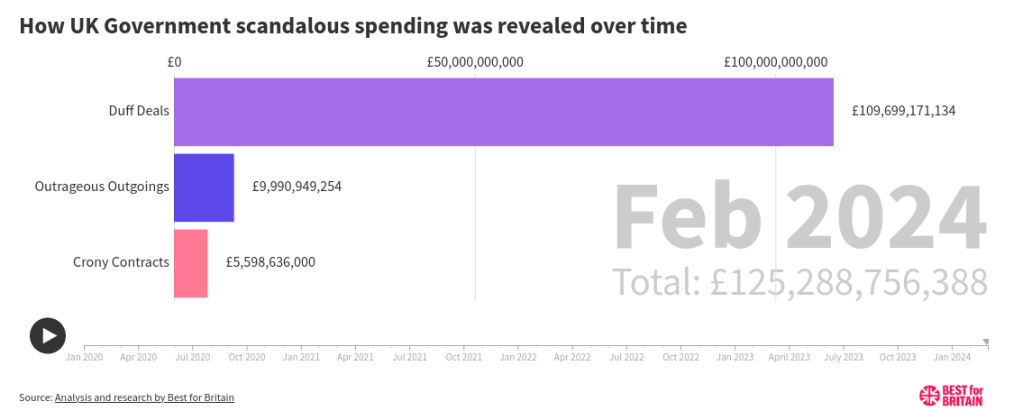
The UK Government is reported to have wastefully spent or dubiously allocated £125.5m since 2019
Scandalous spending tracker
That’s right, the UK Government has scandalously spent £125,554,393,254 since 2019.
As Chancellor and now Prime Minister, Rishi Sunak has had responsibility for government spending for almost all of this period.

Posted by Best for Britain www.bestforbritain.org
It’s easy to become numb to the scale and frequency of the Government’s fiscal ineptitude and dodginess, and all at a time when ordinary people struggle to pay bills and public services are crumbling.
The total does not include the catastrophic hit to public finances from the Government’s Brexit deal which has crippled businesses, slowed economic growth, and is estimated to be costing around £100bn per year. Similarly, the total does not include the titanic economic cost of the disastrous mini-budget which increased bills for mortgage payers across the country and which ended Liz Truss’ premiership after 6 weeks.
It does, however, include figures like the devastating £290m sunk on the Government’s cruel, unworkable and unlawful Rwanda Deal. It also includes a whopping £2.3bn spent on cancelled parts of HS2, and £50m spent on a new helicopter for top Tories.
We’ll keep it updated as new revelations come to light so check back to get the latest eye-watering figure. What’s clear is that every day this government remains in power is more money wasted. Find out what we’re doing about it at GetVoting.org.
The data
The total figure is an estimate using publicly available data. You can find the full list of scandalous spending along with sources here.
We’ve categorised each entry as either a Crony Contract (such as giving government contracts to Conservative chums), a Duff Deal (like blowing billions on stuff that doesn’t work) or an Outrageous Outgoing (including spending silly money on interior design).
Keep informed
Make sure you keep up to date, join Best for Britain’s mailing list and be the first to hear about our work and campaigns.
Dismay as UK government halts cash for world-renowned Covid programme
Does this government reinforce success? Invest in preparedness for the next pandemic? Of course not. – Owl
It changed the treatment of Covid-19 patients across the globe, saved thousands of lives by pinpointing cheap, effective drugs during the pandemic, and earned Britain widespread praise from international groups of scientists.
Robin McKie www.theguardian.com
But now government support for the UK Recovery programme is to end. In a few weeks’ time, central financing for the programme will halt. The scheme will only be able to continue thanks to funding from a group of US-based philanthropists.
The move has dismayed senior scientists who say it is another worrying example of the UK’s life sciences sector being short-changed by government. “We knew Recovery had huge potential and that was realised in a very short period during Covid. But now that dream is being unrealised,” said Prof Peter Horby, one of the co-founders of Recovery.
And it is not just the value of Recovery that has been ignored as the pandemic has ended, added Horby. “Britain did some of the world’s best clinical trials, vaccine development, and genomics work, but a lot of that has just been thrown away or starved of investment. Yet we badly need to be alert to the dangers of future pandemics.”
Recovery – the Randomised Evaluation of Covid-19 Therapy – is a drug-testing programme that, at the height of the pandemic, involved thousands of doctors and nurses working with tens of thousands of Covid-19 patients in hospitals across Britain. Trials were carried out in intensive care units and wards crammed with seriously ill patients.
“In day-to-day, regular clinical medicine, it’s absolutely critical to work out the difference between what you think might work, what actually works – and what doesn’t,” said Prof Martin Landray, Recovery’s other co-founder. “Recovery did exactly that.”
The programme managed to pinpoint four effective medicines, while conclusively showing that eight overhyped drugs were not. For example, the anti-malarial drug hydroxychloroquine – widely touted by Donald Trump as a Covid-19 treatment – was shown to provide no help for patients. By contrast, dexamethasone, a cheap treatment for inflammation and arthritis, was found to reduce deaths by a third among patients on ventilators in ICUs. No other nation came close to matching these achievements.
“Other countries, including Canada and the US, have made it clear they are extremely envious of what Britain did with Recovery and are preparing to spend considerable sums in setting up similar schemes – at a time when we seem to be losing interest collectively in the programme. And I think that is a shame,” added Landray.
Recovery in the UK will survive thanks to Flu Lab, an American philanthropic organisation dedicated to battling the future flu epidemics, with the programme being extended to investigate new treatments for flu as well as Covid under the new deal.
The decision by the UK government not to continue to support Recovery comes against a worrying background, which has seen Britain fall badly behind other countries in conducting clinical studies, where new medicines are tested on volunteers to make sure they are safe and work, and to monitor any side effects. The Swiss firm Novartis recently scrapped a large trial of a cholesterol drug in Britain, for example.
“We’ve been dropping down the league table when it comes to doing trials so that we are now below Italy, Poland, France and many other countries. The state of the NHS is part of the problem but it is nevertheless worrying,” said Horby.
“I welcome the government’s ambition for the UK to become a scientific superpower but if you look at what is happening today, we seem to be heading in the wrong direction.”
This point was backed by Landray, who warned that it was crucial the UK was prepared for the arrival of future pandemics. “You don’t get ready to fight the next war by disbanding the army just because it’s peacetime,” he told the Observer.
Is Simon Jupp ready to “step up to the plate”?
Jeremy Hunt has given over £100k to local Tory party in effort to retain seat
Jeremy Hunt has been forced to contribute more than £100,000 of his own money to his constituency Conservative party to bolster his chances of re-election, official records show, amid warnings that he is set to lose his seat.
Aletha Adu www.theguardian.com
Hunt’s Godalming and Ash constituency is a target seat for the Liberal Democrats, and a Survation poll projects that he is on course to become the first chancellor in modern times to lose at a general election.
Electoral Commission records show that he has given £105,261 to the South-west Surrey Conservative association over the last five years.
The chancellor’s personal donations to the association under the last three Conservative prime ministers stand in stark contrast to the total £4,447 he gifted under the leadership of Theresa May and David Cameron.
The most recent accounts for Hunt’s local association have warned that its “balance sheet is at a less than satisfactory level”. A note stated that members’ annual subscriptions were due to increase this year.
Donations to the chancellor’s association were down by almost 50% in 2021. South West Surrey received only £42,693 in donationsthat year, down from over £80,000 in 2020.
A Labour source said: “This tells you everything you need to know about the state of the Conservative party, with the chancellor seemingly spending more time dishing out personal cheques to prolong his political career than fixing the economy his government has wrecked.
“And on the same day the chancellor is talking about clamping down on money being wasted, he might want to look at how he is spending some of his own money.”
Hunt said on Sunday: “I hope to be chancellor after the election.” However, the poll in his constituency shows the Lib Dems on 35% of the vote, the Tories on 29% and Labour on 22%. When local voters were asked to outline the issues that would determine how they would vote, health and the NHS was top, while only 4% said tax was a key issue.
Daisy Cooper, the deputy leader of the Liberal Democrats, said: “It’s no wonder that Jeremy Hunt is on the brink of his losing his seat when people across Surrey are furious they can’t get GP appointments, that their hospitals have been left to crumble, and water firms are still allowed to pollute their rivers.
“In the chancellor’s own back yard, food bank demand is surging after his government failed to get a grip on the cost of living crisis. Liberal Democrats are fired up in Surrey to oust Conservative MPs who have taken people for granted.”
Does South West Water have a cunning plan?
Correspondence with Karen Crawford, Exmouth resident and year round swimmer, reveals how South West Water (SWW) could be “gaming” the much trumpeted tougher regulations to their, but not our, advantage.
Water companies now have to fit emergency discharge monitors (EDM) on combined sewer outfalls to report spills and their duration (not volume). This will be a metric which politicians will use to demonstrate that our rivers and bathing waters are “improving” and water companies will use to award bonuses and avoid penalties.
SSW claim that they are investing £38m in Exmouth and Sandy bay to reduce pollution.
It seems that, so far, an impressive £14m has been invested in upgrading the main Exmouth discharge pipe out to sea from Sandy Bay/Straight Point.

Do you remember seeing this strange floating structure off Straight Point in 2022?
This means that much more treated water can be discharged in normal circumstances and raw sewage in times of overload. Possibly four times as much.
However, improvements to the Maer Lane treatment works are only at an initial or “concept” stage for starting in 2028. I.e.there will be no increase in treatment capacity until at least then, realistically a lot, lot later. And we continue to build more houses.
Meanwhile, SWW is giving priority to upgrading the pumps at surrounding sewage pumping stations. These are tanks used to collect local sewage which is then pumped to the treatment works. Improving the pumps means they will be able to reduce the discharges at 5 or 6 EDM sites by increasing capacity to send more sewage directly out to sea through the trunk main. So 5 or 6 potential discharges could be reduced to a single, combined one, instead.
Remember, SWW committed to building treatment works for the new development locally at Cranbrook but changed their mind and used Countess Weir. Now, Maer Lane and Countess Weir have no spare capacity at all. Both treatment works discharge at the first sign of rain.
So investing in increasing the pipe capacity from Maer Lane into the sea and upgrading the pumps at pumping stations, is a quick win for the government and SWW but doesn’t do anything for us or the environment.
Sandy Bay has already gone from “Excellent” to “Sufficient” bathing water quality in just a few years.
It all seems a bit topsy-turvy to Owl who would have thought that the first priority would be to increase treatment capacity.
 East Devon Watch