Breaking: ‘What tax cuts can we expect in the Chancellor’s budget?’ Richard Foord has a few better ideas

Richard Foord, MP for Tiverton & Honiton

By the time you read this, it’s possible you might have heard the Chancellor of the Exchequer Jeremy Hunt present the Government’s budget for the year ahead. Writing as I am before he gets to his feet, there is talk of what tax cuts he will make.

Tax cuts anticipate a General Election like a blackbird’s song predicts daybreak. Neither lasts very long afterwards! What is lacking though is a sense of just how bad things are right now for those who continue to depend on public services.

Local health services are being pushed to the brink. Community Hospitals like the one in Seaton are threatened with being divided and even disposed of. NHS dentistry is decaying before our very eyes. To my mind, there are several things the Government could do right now to help the economy and society in Devon and beyond.

The Chancellor could permanently cut the rate of VAT for tourism and hospitality businesses. This would boost vital businesses in tourist hotspots like ours – allowing them to stay afloat and generate taxes to support other vital services.

A low VAT rate levied on a pub that continues to trade is better for the Treasury than a high VAT rate levied on a landlord who is driven out of business. The permanent VAT cut I propose contrasts with the temporary cut that has been proposed by some Tory MPs. They seem not to have spotted that the VAT rate on hospitality businesses has leapt up and down like a yo-yo at the hands of this Conservative Government.

Secondly, the Chancellor ought to cancel the planned real-terms cut to the NHS. Failing to increase the NHS budget in line with inflation would remove around £1.3bn from services that are already struggling. We need to invest in people’s health: recruit more GPs, boost the number of dental appointments, and cut the long waits for urgent cancer care. People who are well can work, contribute to society and pay taxes.

Finally, Government must stop handing out tax breaks to big banks. It must stop allowing energy firms to rake in bumper profits off the back of rising energy costs too. This would generate billions extra to invest in our communities.

People are tired of the chaos and mismanagement this Conservative Government has presided over. People tell me they are ready for a change, and here in Honiton & Sidmouth, the way to get that is to vote Liberal Democrat, so we can send this obstreperous Government off the pitch and enjoy the dawn of a new day.

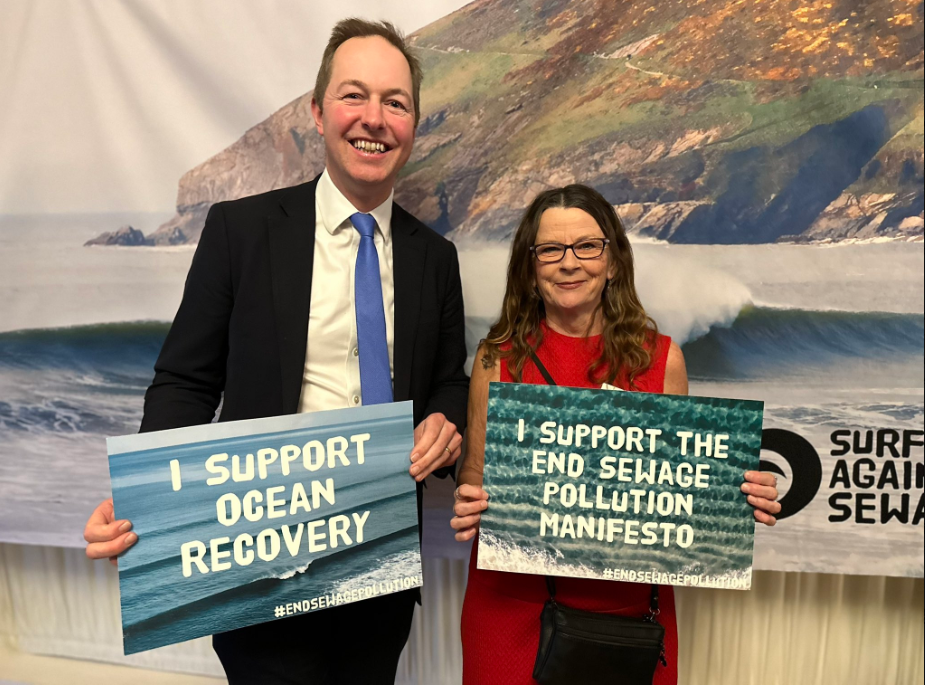
Richard Foord hosted pollution campaigners in Westminster. Minister invited but shunned the event.

Jo Bateman attended as part of the Surfers Against Sewage campaign.

4 March Richard Foord:

Tonight, I hosted @WaterWaysProtct and @sascampaigns in Parliament. No Minister was present, though he was invited.

We need the Govt to take this issue seriously – with more powers and resources, as well as duties, so the regulator can enforce the law.

What Richard Foord will have done is collect first hand information for Today’s “Westminster Hall” debate that Simon Jupp is kicking off at 4.30pm.

Do the Tories really care about pollution? – Owl

Water firms are gaming the monitoring system, says regulator

Regulators have accused water companies of “genuinely shocking” behaviour, gaming a self-monitoring system and demonstrating a “culture of complacency”.

Adam Vaughan www.thetimes.co.uk

The comments from the heads of the Environment Agency and Ofwat mark an escalation of rhetoric from the water sector’s regulators.

Philip Duffy, chief executive of the Environment Agency, singled out sewage pollution incidents by Southern Water and Severn Trent, which were recently fined £330,000 and £2 million, respectively.

He said they were “genuinely shocking, shocking cases of pollution of our rivers, that shouldn’t be happening in a well-regulated industry”.

In Southern Water’s case, more than 2,000 fish were killed after a pump failed and sewage was released into a stream that feeds into the River Hamble in Hampshire. Severn Trent, meanwhile, was responsible for a “reckless failure” in allowing 260 million litres of sewage to be spilled illegally into the River Trent, a judge concluded.

Duffy said that “time and time again” promises made by water firms to the Environment Agency and Ofwat hadn’t been kept. “Infrastructure that should have been maintained to a certain level hasn’t been maintained to that level,” he said.

Under Duffy’s leadership, the Environment Agency is preparing to increase the number of inspections of water companies from less than 1,000 in the current financial year to 4,000 next year and more than 10,000 the year after. He said the measures were needed because the system of companies monitoring themselves, introduced in 2009, “had been gamed a bit”.

“The times of day the samples were taken, the way the samples were taken, gave a misleading positive impression,” he said. Duffy also said he was “really worried” about chemical pollution in rivers, specifically the “forever chemicals” PFAS and PFOS which have been linked to serious health harms including increased risk of cancer.

David Black, the chief executive of Ofwat, said that water companies needed to restore public trust by implementing improvements and showing greater transparency.

“We need to see a change of culture,” he told a conference held by the Water Report on February 29. “I think the water sector has demonstrated a culture of complacency in the face of significant challenges, such as climate change, resource scarcity and population growth, and this has led to stagnating performance.”

However, Black said he was pleased the water industry was beginning to “respond in a meaningful way to the challenges it faces”. He cited the £96 billion water firms have proposed spending between 2025 and 2030. Ofwat has to decide this summer whether to approve the spending, despite it requiring a 31 per cent increase in household water bills over the period.

The Times’s Clean it Up campaign has been calling for stronger governance of the water sector and more resources for regulators to do their job.

In recent weeks the government has vowed to ban bonuses for bosses of water companies that commit criminal acts of pollution. Chief executives have received £26 million since 2019 and, while some voluntarily waived their bonuses last year amid public anger, five still took them.

However, it has emerged that the government has rowed back on a plan by the environment secretary, Steve Barclay, to block dividends at water firms with a poor environmental record. “The government has no plans to block water company dividends over illegal pollution events,” Gareth Davies, exchequer secretary to the Treasury, wrote in a message to industry last week. Labour is understood to have no appetite for such a dividend ban.

David Henderson, chief executive of Water UK, the industry body, said a dividend ban would have been disastrous. “If you want to break the system, and get terrible environmental performance, that’s the way to do it,” he said when asked if a ban would harm investment in the sector.

Henderson said there “still a lot to do” in improving the state of rivers but he was hopeful the sector would tackle the problem. “Performance has not been where it should have been,” he admitted. “We have failed, in some parts quite acutely, to keep up with public perceptions of what is needed.”

Will winner of “South Devon Primary” oust the Tories from historic stronghold?

Despite what many see as the inevitability of an overall Labour victory nationally when voters go to the polls, history suggests that non-Conservative votes are likely to be spread between Labour, the Liberal Democrats and the Green Party in what in the future will be the South Devon constituency.

Polls indicate that the Conservative candidate could win with as little as 34 per cent of the vote.

Totnes pulls together to oust Tory MP

Mario Ledwith www.thetimes.co.uk

For decades, the market town of Totnes in Devon has been almost entirely under the control of the Conservatives, making it one of the safest seats in the country. Without a sudden change in Britain’s voting system, polls show that things may well stay that way in the near future, despite the dismal poll ratings for Rishi Sunak’s party.

So, with no sign of reform on the horizon, campaigners in the constituency representing what they describe as the “progressive vote” have decided to take matters into their own hands. Giving themselves the sole task of unseating the Tories, the group has launched a series of events aimed at crowning a single candidate who can successfully compete at the forthcoming general election.

Those behind the so-called South Devon Primary believe that selecting a “People’s Champion” is the only way of securing victory.

Attendees showed their appetite for change on a question and answer board

Despite what many see as the inevitability of an overall Labour victory nationally when voters go to the polls, history suggests that non-Conservative votes are likely to be spread between Labour, the Liberal Democrats and the Green Party in what in the future will be the South Devon constituency.

Polls indicate that the Conservative candidate could win with as little as 34 per cent of the vote. The campaigners say that they have decided to act because Britain’s first-past-the-post voting system is “no longer fit for purpose”, having been developed when there were only two main parties.

In response, Anthony Mangnall, Totnes’s Conservative MP, has accused those hoping to anoint a unity candidate of seeking to “restrict democracy”.

Although rare on the mainland, electoral pacts have been a feature of elections in Northern Ireland. Under such agreements, unionist parties have joined together to select one candidate to prevent a republican party from winning. The Totnes concept differs in that it is an unofficial endorsement, separate to the parties’ own campaigning, with losing candidates remaining on the ballot.

The successful candidate from the South Devon Primary will be chosen through voting at seven town hall events across the constituency over the next fortnight. The first of those took place on Saturday in Totnes, a town of 9,000 residents whose independent spirit came to national prominence in 2012 when they united to block Costa Coffee from opening a branch.

As nearly 300 people packed into its Civic Hall and a further 160 gathered outside a pub where the primary was being live-streamed, hopes rippled at the prospect of upsetting the electoral status quo.

Those who had gathered were hoping to hear pitches from the Labour, Lib Dem and Green candidates, with a vote for the candidate deemed most likely to win an election being submitted at the end.

However, as the event neared, it was clear that the attempt to reshape the town’s voting framework had stumbled. Labour, which has not yet chosen a candidate, did not send anybody to speak up for the party. Those in attendance had to focus instead on the pledges of Caroline Voaden, the Lib Dems’ prospective candidate, and Robert Bagnall, the Greens’ prospective candidate.

The organiser of the South Devon Primary and the sitting Conservative MP give their views to Times Radio

The organisers — Anthea Simmons, Simon Oldridge and Ben Long — told the audience that they themselves were not members of any political party. Addressing the elephant in the Civic Hall room, Oldridge said of the lack of Labour representation: “It’s disappointing and frustrating. We would love to see their candidate here.” He added: “The vast majority of people want to get behind someone for a change.”

Simmons told the room that she was an “ex-tribal Tory” who had voted for the party in 2015 before growing disillusioned. “We need better democracy,” she said. “It’s time to see off these Tories.”

The candidates began the two-hour session by introducing themselves and stating why they were the best person to defeat Mangnall. They drew laughs, applause and some awkward glances during long-winded responses as George Monbiot, the event chairman, Guardian columnist and environmental activist, tried to steer proceedings. He hailed the event as “groundbreaking”.

Perhaps inevitably, the candidates agreed on the need for proportional representation. Other areas of consensus included tackling second-home ownership, Airbnbs, assisted dying and taking utilities, such as water companies, out of the private sector.

Voaden acknowledged that ultimately neither the Lib Dems nor the Greens would be making government policy after the election, but she insisted that MPs could stand up for local issues on the opposition benches.

The constituency will be slightly redrawn during this year’s vote and will be known as South Devon, rather than Totnes. At the 2019 general election, Mangnall won the seat with 53.2 per cent of the vote, compared with 28.8 per cent for the Lib Dem candidate and 17 per cent for Labour.

Outlining her reason for attending the event, Voaden said: “I am here because I don’t want to be represented in Westminster by a Tory MP for a minute longer and by an inept, corrupt and cruel government lost in the political wilderness.”

The South Devon Primary will announce its unity candidate when voting is completed after its seventh event. Voaden, who said she was in politics because she was passionate about proportional representation and opposing Brexit, appeared confident that she would get the nod when the votes are counted in Brixham this month. “I do not want to be standing there on election night on that platform by Anthony Mangnall’s smug face because he has won this election by a thousand votes. Visualise how that will feel.”

Less than 20% of levelling up projects completed in England, figures show

Tories promised post-Brexit freedoms would be used to reduce regional inequality in England but have failed to deliver.

“The Tories’ begging-bowl approach to levelling up forces leaders to spend time, effort and taxpayers’ money bidding for uncertain and tightly ringfenced pots of money. This sticking-plaster approach won’t give local leaders the tools they need to drive growth in their local area and live up to their best potential.” (Justin Madders, the shadow levelling up minister).

Is Exmouth’s Gateway project really the most pressing way of spending money in the town? – Owl

Kiran Stacey www.theguardian.com 

Less than a fifth of the projects approved by Michael Gove to improve towns across England have been completed, the government has admitted, in the latest sign of the problems facing his levelling up agenda.

Responses from Gove’s department to freedom of information requests show that fewer than 20% of the projects sanctioned under the £3.6bn towns fund were on track to be finished by the end of February. Fewer than half will have been completed by the next election, even if it is held in November, the figures show.

The data is the latest example of how difficult the Conservatives have found it to meet the promises the party made at the last election to use post-Brexit freedoms to reduce regional inequality in England.

The Guardian revealed last year that councils were having to scale back or freeze levelling up projects because of soaring costs and that Gove’s department was handing back nearly £2bn of housing money after struggling to find projects to spend it on.

Jack Shaw, a local government expert who uncovered the figures, said: “Given this was a flagship policy priority at the last general election, the expectations on the government to deliver new infrastructure in places that have historically been ignored were high.

“Inflation and interest rates have prevented some projects from making progress, but the government has also failed to respond to those changes and has instead asked places to reduce their ambition. Come the election, current evidence suggests the government will have failed its pledge to ‘level up’ communities.”

The towns fund was announced immediately after the last election, with Gove promising it would give “underinvested towns the much-needed funding and support to get going on their long-term plans”.

The fund was a key plank in his levelling up plan to improve infrastructure outside London and major cities. Projects include a new investment zone around Blackpool airport, an industrial centre in Grimsby and the regeneration of Bedford’s train station.

Since then, however, high inflation has eaten into large parts of Gove’s budget and made it increasingly difficult to complete building projects. The Guardian reported last year that at least £500m had been lost from levelling up projects because of rising costs, with leisure buildings, high streets, museums and public spaces all being hit.

Many councils have stalled or reduced their plans as a result of higher costs, and some say they have found it a lengthy and bureaucratic process to get Whitehall officials to approve their alterations to the original plans.

A report by Thurrock council last November showed the authority struggling under the pressures of higher inflation.

The council was due to spend £22.8m on improving Tilbury town centre, including a new community hub, a youth centre, new cycle paths and a new jetty. In November local officials warned there had been “significant cost price inflation” since the plans were submitted, forcing them to review the entire scheme to make sure the council did not overspend.

The report added: “There has been a significant delay in the confirmation of the business cases due to the need for further reassurance and assessment work on governance by [the levelling up department] and the commissioners.”

The figures unearthed by Shaw show that out of 973 towns fund projects, only 154 are due to have been completed by the end of February. By the end of November, that figure rises to 385, just 40% of the total.

More than 170 projects are due to finish in March 2026, the official deadline given by Gove for spending all the towns fund money. A few are scheduled for completion after that date, but officials indicated this could be because they were relying on other sources of funding to finish the projects.

The Department for Levelling Up, Housing and Communities said: “All of the money which was allocated from the towns fund is on track to be spent by March 2026 as planned, with more than 100 projects already completed. The rate at which projects are being completed is entirely consistent with the delivery timeframes we have set out.”

Labour said the problems were a further indication of the issues with ministers in Westminster trying to dictate how local authorities across the country spend their money.

Justin Madders, the shadow levelling up minister, said: “The Tories’ begging-bowl approach to levelling up forces leaders to spend time, effort and taxpayers’ money bidding for uncertain and tightly ringfenced pots of money. This sticking-plaster approach won’t give local leaders the tools they need to drive growth in their local area and live up to their best potential.”

“Is it safe to swim in Budleigh?”

Good question for an “excellent quality 3 star” beach.

Detailed analysis of latest Environment Agency testing data shows the water in Budleigh may not have been fit for swimming for around 30 days in the 150-day May to September sampling season. That’s about 20% of the time. Does that measure up to an “Excellent” rating?

What is the message for all year round bathers?

Well if it’s not safe during the summer during heavy rain and for 48 hours after, as this analysis concludes, probably pretty crap most of the time! [Including as we go to press]- Owl

Petercrwilliams fightingpoolution.com

One of the most frequent questions we hear is “Is it safe to swim off the beach at Budleigh?” In this post, we’ll take a look at the water quality data, and offer some guidance on how best to check before you swim – Summer and Winter. Note: we are not providing advice on whether it is safe for anyone to swim on any given day!

Firstly, it’s the role of the Environment Agency (not South West Water), to regularly test bathing water during the Summer months, and to categorise all designated bathing beaches from the results. In particular, each sample is tested for the levels of E-Coli and Enterococci present in the water. High levels of these bacteria in bathing water can – and do – cause sickness and diarrhoea to swimmers and other beach users, so there are defined thresholds, above which, bathing is ‘Not Advised’.

At the end of each bathing season, the EA look back over all the samples taken in the last 4 years and, depending on the % of samples tested which are worse than the POOR level, the beach is assigned a star rating of Excellent, Good, Sufficient or Poor. Budleigh currently has an ‘Excellent’ rating, though as can be seen in the chart below, we are very close to slipping down into the ‘Good’ category.

Budleigh Water quality trend. If the blue ‘Actual’ average moves above green line, we slip down to ‘Good’ status. Chart (c) Environment Agency 2023

It’s probably important to consider that the water rating is more a measure of how many bad water days we get, rather than the cleanliness of the water on the majority of ‘normal’ days. This may reassure some swimmers who worry that the water may always be quite polluted.

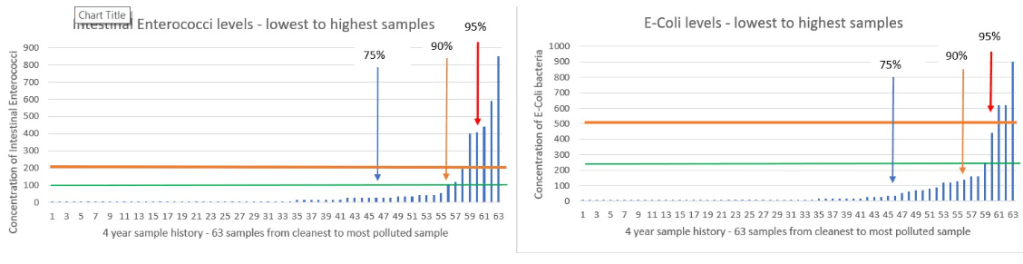
We can do that by analysing the results of the EA water samples taken, and seeing the bacteria concentration levels of each of the 63 samples taken over the last four years, from very cleanest (left hand side of chart below), through pretty toxic (right hand side).

Majority of days (80%+) have ‘Very Low’ to ‘Low’ levels of pollution.

Below Green line shows water is EXCELLENT, but above Orange line – water quality is POOR

This clearly shows that the water really is pretty clean on around 80% of days in the May-Sept period, BUT it also shows just how highly polluted the water can get (up to 3 times worse than the ‘Poor’ level) after incidents of pollution or high rainfall.

So how do the EA sample Budleigh’s bathing water?

  • Critically the EA only sample the water in the Summer ‘swimming season’, from May to September. This is a major issue for us – as many Budleigh folk swim all year round. This is a national issue, but with more and more people swimming all year round, it’s important that we campaign to see how this can be changed
  • The Environment Agency aim to sample the bathing water 20 times in the season, so about once per week. Testing water quality is not quick, so results of each test are not available for several days after sampling. This means that we cannot check the current actual water quality on the EA web site. The main purpose of this sampling appears therefore to determine the next year’s water quality rating, as well as to identify any major issues
  • To try and resolve that, the EA run a computer analysis every morning during the bathing season, to forecast the likely pollution level at the beach that day. This results in a straight ‘OK’ or ‘Bathing not Advised’ status. This status is displayed at Steamer steps, on the electronic board near the Longboat Cafe, and online via the LoveBudleigh web site. During the season, this should give the most accurate forecast on swimming conditions.
  • During the 2023 season, there were 16 days when the EA declared ‘Bathing not Advised’

The chart below shows how the 2023 daily forecasts compare with the subsequent water quality measured from the samples. For each day of the season, RED in the first column identifies any days when the EA declared a Pollution Risk forecast. BLUE in the second column shows the 20 days when a water sample was taken, and Red or Amber in the third column shows if any of those samples were subsequently found to be POOR.

What this shows is that whenever the EA sampled the water within 48 hours after an EA declared ‘Pollution Risk’ day, the subsequent sample showed E-coli or Enterococci levels close to or greater than POOR levels.

This suggests that the water may not have been fit for swimming on around 30 days in the 150-day sampling season. That’s about 20% of time. That’s appears worse than the ‘Excellent’ rating would indicate.

One possible reason why our figures look worse than the official rating, is IF the EA suspend normal sampling if a Pollution Forecast is active. Although this possibility would appear to make a mockery of the whole sampling process (as they would only then sample the water when they were pretty sure it was ‘clean’!), there does seem to be scope for them to do this within the regulations. Looking at the pattern of testing days in the chart above, there are a couple of occasions when the sampling pattern suggests that this could have happened. To find out IF the EA have ever suspended or changed the sampling dates, we’ve raised an Information Request on EA to ask that question.

What the sampling results do show is that the Pollution Forecasting system appears to be a good indicator of when not to swim – but perhaps prudent to wait 48 hours before going back in after a Warning, rather than just 24 hours.

So during the bathing season, the EA Pollution Forecast, via the LoveBudleigh web site, is probably the best indicator of whether it’s safe to swim. But what about the other 7 months of our swimming year?

The most useful tool outside of the season is probably the Surfers Against Sewage app, SSRS. This takes input from all of the local sewage overflow sensors, and it produces an alert for the beach IF any of these sewage overflows registers a prolonged discharge (the actual time threshold is specific to each sewage overflow point). It’s also of note that there appear to be significantly more sewage discharges by South West Water outside of the sampled bathing season.

What SSRS does not take into account is any agricultural pollution coming in from the River Otter, which is a significant contributor to the water quality. That’s why we want the EA to extend their pollution forecasting and water sampling to all year round. In the meantime, do download and use the ‘SSRS’ app, for all ‘out of season’ swimming. However, it’s probably also prudent to avoid times when the river has been particularly high after heavy rain – and certainly avoid the area by the river mouth and brook outfalls.

Next time, we’ll take a look at where on the beach the Environment Agency take their samples, and why this might either under- or over-estimate the cleanliness of the water – depending on where you decide to swim.

Tory support hits lowest level for more than 40 years. Lib Dems could form His Majesty’s loyal opposition 

Latest poll damning 

Support for the Conservative Party has plunged to the lowest level since 1978 with just a fifth of British voters now backing Rishi Sunak’s party, according to a new poll.

Archie Mitchell www.independent.co.uk 

The bombshell survey, showing the Conservatives as 27 points behind Sir Keir Starmer’s Labour Party, would spell electoral oblivion for Mr Sunak’s party if replicated at a general election.

The Ipsos poll, published on Monday, shows Mr Sunak could hold on to as few as 25 seats – 351 fewer than Boris Johnson won in 2019 – in what would be a historic defeat.

It also predicts Sir Keir could secure as many as 537 seats – 340 more than Jeremy Corbyn managed at the last election and equating to a landslide which would eclipse Sir Tony Blair’s 1997 win.

Calculus election predictor using Ipsos data based new constituency boundaries

The survey showed support for the Tories at just 20 per cent, the lowest since 1978 when Ipsos started tracking the poll. Ipsos is a multinational market research firm and the poll is the latest in its monthly independent Political Monitor.

It comes just weeks after a Tory bust-up over a series of secretive polls trying to discredit Mr Sunak, including one poll that warned of a Tory wipeout unless he was removed as leader.

In the latest survey, Labour’s support has dropped to 47 per cent from the 49 per cent it had in January.

Meanwhile, the Liberal Democrats were backed by 9 per cent of the electorate, while support for both the Green Party and Reform UK was at 8 per cent – double what it was in January.

Ipsos’s previous lowest score for the Conservatives was 22 per cent, recorded by John Major in December 1994 and May 1995, only a few years before Sir Tony’s election win.

The slump in Conservative support follows a series of bad headlines for Mr Sunak at the start of 2024, with confirmation that the UK had entered a recession at the end of last year, two large by-election defeats in Wellingborough and Kingswood and an Islamophobia row over comments by now-suspended Tory MP Lee Anderson.

There is also public frustration at near-record NHS waiting lists and record high net migration, with Mr Sunak failing on four of his five key pledges to voters including to “stop the boats” and grow the economy.

Ipsos head of political research Gideon Skinner said: “The historical comparisons continue to look ominous for Rishi Sunak and the Conservatives. The Ipsos Political Monitor series started in the late 70s and has never recorded a Conservative vote share this low.”

He added that individual support for the PM is also heading downwards, with Mr Sunak’s approval rating hitting -54, a record low.

“Combined with Labour taking leads on issues of economic credibility to go with their traditional strengths in public services, this means the Conservatives face big challenges across a number of fronts if they are to turn the situation around,” Mr Skinner said.

In a further worrying sign for the Conservatives, Labour is now seen as having a lead on which party would best manage the economy, compared with October when the parties were neck and neck.

The public also believe Labour’s Rachel Reeves would make the best chancellor, with just a fifth satisfied with the job Jeremy Hunt is doing.

It will pile further pressure on the government to come up with an offering in Wednesday’s Budget, with right-wing Tories clamouring for tax cuts while others want Mr Hunt to ensure better funding for public services.

The poll was based on a survey of 1,000 British adults between February 21 and 28.